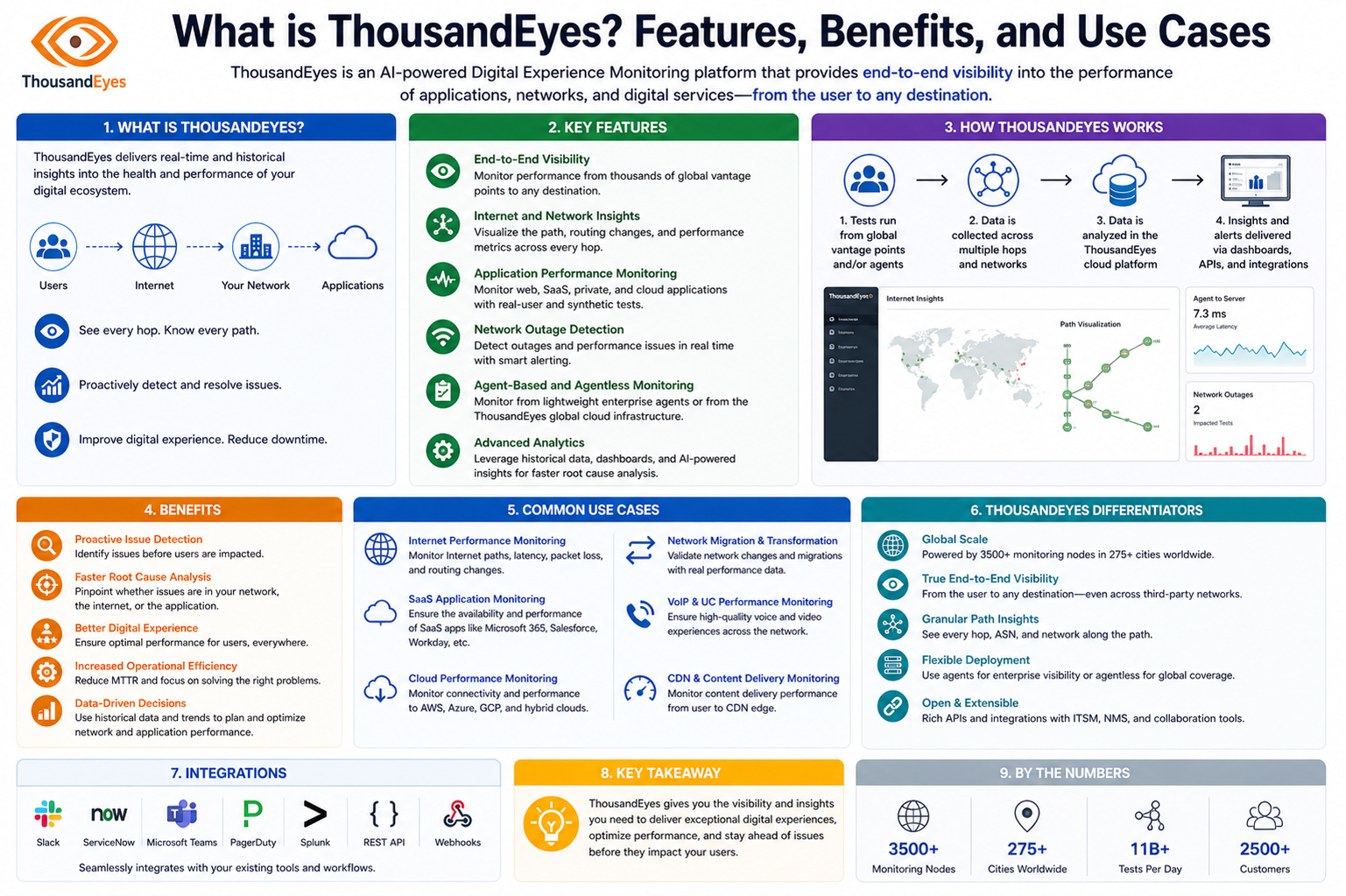
ThousandEyes is a modern digital experience monitoring platform designed to provide deep, end-to-end visibility across today’s highly distributed IT environments. As organizations increasingly rely on cloud services, SaaS applications, and global networks, maintaining performance and reliability has become far more complex than in traditional on-premise setups. This platform addresses that challenge by offering a unified view of how applications are delivered and experienced across internal systems as well as external networks that organizations do not directly control.
It was later acquired by Cisco, which expanded its capabilities and integrated it more deeply into enterprise networking ecosystems. Despite this integration, the platform remains distinct in its ability to monitor the “internet as a network,” giving organizations visibility beyond their own infrastructure. This is particularly important because many performance issues originate outside corporate networks, such as in internet service providers, DNS layers, or third-party SaaS providers.
By combining real-time monitoring with detailed analytics, the platform enables organizations to understand how data travels across the internet and where disruptions occur. This insight transforms how IT teams troubleshoot issues, shifting from guesswork and reactive responses to precise, data-driven decision-making. The result is not only faster resolution times but also a proactive approach to maintaining optimal digital experiences.
Core Capabilities
At its core, the platform is built to provide visibility across multiple layers of digital delivery, including network infrastructure, application performance, and user experience. It achieves this by deploying monitoring agents in various environments such as cloud platforms, enterprise data centers, and even end-user devices. These agents continuously collect data about performance, latency, packet loss, and routing behavior.
One of the defining capabilities is its ability to map the complete path that traffic takes from source to destination. This path visualization allows IT teams to see every hop along the route, including routers, ISPs, and exchange points. When a performance issue arises, teams can quickly identify whether the problem is within their own network, a cloud provider, or somewhere in the broader internet.
Another important capability is synthetic testing, which simulates user interactions with applications from multiple global locations. These tests can be scheduled at regular intervals, providing consistent performance benchmarks and early detection of potential issues. In parallel, real user monitoring captures actual user experiences, offering insights into how real-world conditions affect application performance.
The platform also includes advanced analytics tools that aggregate and analyze large volumes of data. These tools help identify trends, recurring issues, and anomalies, enabling organizations to move from reactive troubleshooting to proactive optimization. By correlating data across different layers, the platform provides a holistic view of performance that is difficult to achieve with traditional monitoring tools.
Advanced Monitoring Features
The platform goes beyond basic monitoring by offering a wide range of advanced features designed to address the complexities of modern IT environments. One such feature is internet intelligence, which provides insights into global network conditions. This includes information about outages, congestion, and routing changes across the internet, helping organizations understand how external factors impact their services.
Another advanced feature is deep application visibility, which allows teams to monitor the performance of specific applications and services. This includes tracking response times, error rates, and dependencies on external services. By understanding how applications interact with underlying infrastructure, teams can identify bottlenecks and optimize performance more effectively.
The platform also supports monitoring of hybrid and multi-cloud environments. As organizations increasingly distribute workloads across multiple cloud providers, maintaining visibility becomes more challenging. This solution addresses that challenge by providing a consistent monitoring framework across different environments, ensuring that teams have a unified view of performance regardless of where applications are hosted.
Additionally, the platform includes alerting and notification capabilities that enable teams to respond quickly to issues. Alerts can be customized based on specific thresholds and conditions, ensuring that teams are notified only when meaningful events occur. This reduces noise and allows teams to focus on critical issues that require immediate attention.
Benefits for Organizations
One of the most significant benefits of this platform is its ability to deliver comprehensive visibility across the entire digital delivery chain. This visibility is crucial in today’s environment, where applications depend on multiple interconnected components, many of which are outside an organization’s direct control. By providing a clear view of these dependencies, the platform helps organizations understand how different elements contribute to overall performance.
Another key benefit is faster and more accurate troubleshooting. Traditional troubleshooting methods often involve multiple teams and tools, leading to delays and inefficiencies. With this platform, teams can quickly pinpoint the root cause of an issue, whether it originates in the network, application, or an external provider. This reduces mean time to resolution and minimizes the impact on users.
The platform also supports proactive performance management. By continuously monitoring performance and identifying trends, organizations can address potential issues before they become critical. This proactive approach helps maintain high levels of availability and reliability, which are essential for delivering positive user experiences.
Improved collaboration is another important benefit. By providing a shared view of performance data, the platform enables different teams—such as network, application, and operations teams—to work together more effectively. This collaboration leads to better decision-making and more efficient problem resolution.
Use Cases Across Industries
The platform is widely adopted across various industries where digital performance is critical to operations and customer satisfaction. In the financial sector, organizations use it to ensure that online banking systems, payment gateways, and trading platforms operate with minimal latency and maximum reliability. Even small delays can have significant financial implications, making real-time monitoring essential.
In the healthcare industry, the platform helps maintain the performance of critical applications such as electronic health records and telemedicine services. Reliable connectivity and fast response times are vital for delivering timely care, and any disruption can directly impact patient outcomes. By providing visibility into network and application performance, healthcare providers can ensure consistent service delivery.
Retail and e-commerce businesses also benefit significantly from this solution. During peak shopping periods, such as seasonal sales or promotional events, maintaining application performance is crucial to preventing revenue loss. The platform enables these businesses to monitor user experience in real time and quickly address any issues that could affect transactions or customer satisfaction.
In the technology sector, companies use the platform to monitor their own services as well as third-party dependencies. This is particularly important for SaaS providers, whose applications rely on multiple external services and networks. By understanding how these dependencies impact performance, companies can ensure a seamless experience for their users.
Another important use case is supporting remote work environments. As more employees work from different locations and networks, ensuring consistent connectivity becomes a challenge. The platform provides insights into how remote users experience applications, helping organizations identify and resolve connectivity issues regardless of location.
Overall, the platform serves as a critical tool for any organization that depends on digital services, offering the visibility and insights needed to maintain high performance in an increasingly complex and interconnected world.
Deployment Models and Architecture
ThousandEyes is designed with a flexible architecture that allows it to be deployed across a wide range of environments without disrupting existing infrastructure. Its architecture is based on distributed monitoring points, often referred to as agents, which can be installed in cloud platforms, enterprise data centers, branch offices, and even on end-user devices. These agents continuously collect performance data and send it to a centralized platform for analysis and visualization.
Cloud-based agents are commonly used to simulate user traffic from different geographic regions, enabling organizations to understand how their applications perform globally. Enterprise agents, on the other hand, are deployed within corporate networks to monitor internal systems and connectivity to external services. Endpoint agents provide visibility into the actual user experience by capturing data directly from employee devices, which is particularly useful in remote work scenarios.
The platform integrates seamlessly with cloud providers and enterprise tools, making it easier for organizations to adopt without major changes to their existing workflows. Its architecture is highly scalable, allowing businesses to expand monitoring coverage as their infrastructure grows. This scalability ensures that organizations can maintain visibility even as they adopt new technologies and expand into new regions.
End-User Experience Monitoring
One of the most critical aspects of modern IT operations is understanding how users actually experience applications. The platform addresses this need by offering detailed end-user experience monitoring capabilities. Instead of relying solely on backend metrics, it captures real-world performance data from the user’s perspective, including page load times, application responsiveness, and network conditions.
This approach helps organizations identify issues that may not be visible through traditional monitoring methods. For example, an application might appear to be functioning normally from a server perspective, but users in a specific region may experience slow performance due to network congestion or routing inefficiencies. By capturing this data, the platform provides a more accurate picture of overall performance.
End-user monitoring also supports troubleshooting by correlating user experience data with network and application metrics. This correlation allows IT teams to quickly determine whether an issue is caused by the application itself, the network, or an external dependency. As a result, organizations can resolve issues more efficiently and improve overall user satisfaction.
Internet and Network Intelligence
A distinguishing feature of this platform is its ability to provide visibility into the broader internet ecosystem. Traditional monitoring tools are typically limited to internal infrastructure, but this platform extends visibility to external networks, including ISPs, cloud providers, and DNS services.
This internet intelligence capability is particularly valuable because many performance issues originate outside an organization’s control. For example, a routing change by an ISP or an outage in a cloud provider’s network can significantly impact application performance. Without visibility into these external factors, troubleshooting becomes much more difficult.
The platform continuously collects and analyzes data from its global network of monitoring points, creating a comprehensive view of internet health and performance. This data can be used to identify trends, detect anomalies, and understand how external events impact application delivery. By leveraging this intelligence, organizations can make more informed decisions and respond more effectively to performance issues.
Security and Performance Insights
In addition to performance monitoring, the platform also provides valuable insights into security-related issues. Network disruptions and anomalies can sometimes indicate security threats, such as distributed denial-of-service attacks or misconfigured routing policies. By monitoring network behavior in real time, the platform helps organizations detect and respond to these threats more quickly.
It also supports validation of security configurations by ensuring that traffic flows follow expected paths and policies. This is particularly important in environments with complex security architectures, where misconfigurations can lead to performance issues or vulnerabilities.
Furthermore, the platform helps organizations ensure compliance with service-level agreements by continuously monitoring performance metrics and identifying deviations. This capability is essential for businesses that rely on third-party providers, as it allows them to verify that agreed-upon performance standards are being met.
Operational Efficiency and IT Collaboration
Modern IT environments often involve multiple teams working together to maintain performance and reliability. The platform enhances operational efficiency by providing a single source of truth for performance data, enabling teams to collaborate more effectively.
Network engineers, application developers, and operations teams can all access the same data and insights, reducing the need for separate tools and minimizing communication gaps. This shared visibility helps teams align their efforts and resolve issues more quickly.
Automation is another important aspect of operational efficiency. The platform can integrate with existing IT service management and automation tools, allowing organizations to streamline workflows and reduce manual effort. For example, alerts generated by the platform can trigger automated responses, such as rerouting traffic or scaling resources, to mitigate performance issues.
By improving collaboration and reducing manual processes, the platform helps organizations operate more efficiently and focus on strategic initiatives rather than routine troubleshooting.
Cloud and SaaS Optimization
As organizations increasingly rely on cloud and SaaS solutions, optimizing performance in these environments has become a top priority. The platform provides detailed insights into how applications perform across different cloud providers and regions, helping organizations identify the best configurations for their needs.
It also enables comparison of performance across multiple providers, allowing businesses to make data-driven decisions about where to host their applications. This is particularly useful in multi-cloud strategies, where workloads are distributed across different platforms.
For SaaS applications, the platform provides visibility into service availability and performance, helping organizations ensure that critical tools such as collaboration platforms and customer-facing applications operate smoothly. By monitoring these services in real time, businesses can quickly detect and address issues that could impact productivity or customer satisfaction.
Digital Transformation Support
Digital transformation initiatives often involve adopting new technologies and shifting workloads to the cloud, which can introduce new complexities and challenges. The platform plays a key role in supporting these initiatives by providing the visibility needed to manage and optimize modern IT environments.
It helps organizations validate the performance of new systems and ensure that they meet business requirements before full deployment. This reduces the risk of performance issues and ensures a smoother transition to new technologies.
The platform also supports continuous improvement by providing ongoing insights into performance and user experience. This allows organizations to refine their strategies and make incremental improvements over time, ensuring that their digital transformation efforts deliver the desired outcomes.
By enabling better visibility, faster troubleshooting, and proactive optimization, the platform becomes an essential component of any digital transformation strategy, helping organizations navigate the complexities of modern IT with greater confidence and control.
Troubleshooting and Root Cause Analysis
ThousandEyes plays a crucial role in simplifying one of the most challenging aspects of IT operations: identifying and resolving performance issues quickly. In traditional environments, troubleshooting often involves multiple tools, fragmented data, and time-consuming guesswork. This platform transforms that process by providing a unified, data-driven approach to root cause analysis.
When an issue occurs, the platform correlates data from different layers, including network paths, application performance, and user experience. This correlation allows IT teams to trace problems back to their exact origin, whether it is a misconfigured router, a congested ISP, or a failing third-party service. Instead of spending hours isolating variables, teams can quickly pinpoint the root cause and take targeted action.
Another key strength is its ability to provide historical data alongside real-time insights. This helps teams understand whether an issue is a one-time event or part of a recurring pattern. By analyzing trends over time, organizations can identify underlying weaknesses in their infrastructure and implement long-term solutions rather than temporary fixes.
The visual representation of network paths further enhances troubleshooting by making complex routing information easier to understand. Teams can see how traffic flows across different networks and identify exactly where delays or disruptions occur. This level of clarity significantly reduces the time required to resolve issues and improves overall system reliability.
Proactive Monitoring and Alerting
Beyond reactive troubleshooting, the platform enables organizations to adopt a proactive approach to performance management. Continuous monitoring ensures that potential issues are detected early, often before they impact end users. This shift from reactive to proactive operations is essential for maintaining high levels of service availability in modern digital environments.
Customizable alerting mechanisms allow organizations to define thresholds based on their specific performance requirements. When these thresholds are exceeded, alerts are triggered and sent to the appropriate teams. This ensures that issues are addressed promptly without overwhelming teams with unnecessary notifications.
The platform also supports intelligent alerting by reducing false positives and focusing on meaningful events. By analyzing patterns and trends, it can distinguish between normal fluctuations and genuine performance problems. This helps teams prioritize their efforts and respond more effectively to critical issues.
Proactive monitoring not only improves reliability but also enhances planning and optimization. By identifying trends and potential bottlenecks in advance, organizations can make informed decisions about capacity planning, resource allocation, and infrastructure upgrades.
Scalability and Flexibility
Modern IT environments are constantly evolving, with organizations expanding their infrastructure, adopting new technologies, and entering new markets. The platform is designed to scale alongside these changes, providing consistent visibility regardless of the size or complexity of the environment.
Its flexible deployment options allow organizations to add new monitoring points as needed, ensuring that all critical systems and locations are covered. Whether an organization operates a small network or a global infrastructure, the platform can adapt to meet its needs.
Scalability also extends to data processing and analytics. As the volume of monitoring data increases, the platform continues to deliver fast and accurate insights without compromising performance. This ensures that organizations can maintain visibility even as their operations grow.
Flexibility is further enhanced by the platform’s ability to integrate with a wide range of tools and technologies. This allows organizations to incorporate it into their existing workflows and maximize the value of their current investments. By supporting a variety of use cases and environments, the platform remains relevant as technology landscapes evolve.
Improving Customer and Employee Experience
In today’s digital-first world, user experience is a critical factor in business success. Whether it is a customer accessing an online service or an employee using internal applications, performance issues can have a direct impact on satisfaction and productivity. The platform helps organizations deliver consistent, high-quality experiences by providing detailed insights into how users interact with applications.
For customer-facing services, even minor delays can lead to lost revenue and reduced trust. By monitoring performance in real time, organizations can quickly identify and resolve issues that might affect user experience. This ensures that customers can access services reliably and without frustration.
For employees, especially those working remotely, reliable access to applications is essential for productivity. The platform provides visibility into connectivity issues that may affect remote users, enabling organizations to address problems regardless of location. This is particularly important in hybrid work environments, where employees rely on a mix of corporate and public networks.
By focusing on both customer and employee experiences, organizations can create a more resilient and user-centric digital environment. This not only improves satisfaction but also supports long-term business growth.
Competitive Advantage and Business Impact
Organizations that leverage advanced monitoring platforms gain a significant competitive advantage in their respective industries. By ensuring consistent performance and দ্রুত issue resolution, they can deliver better services than competitors who rely on less sophisticated tools.
The ability to quickly identify and resolve issues reduces downtime, which directly impacts revenue and operational efficiency. In industries such as finance, healthcare, and e-commerce, even a few minutes of downtime can result in substantial losses. By minimizing disruptions, the platform helps protect both revenue and reputation.
Data-driven insights also support strategic decision-making. Organizations can use performance data to evaluate the effectiveness of their infrastructure, choose the best service providers, and optimize their technology investments. This leads to more efficient use of resources and better overall outcomes.
Additionally, the platform enhances transparency and accountability by providing clear, measurable performance metrics. This is particularly important when working with third-party providers, as it allows organizations to hold them accountable for meeting agreed-upon standards.
Future Outlook and Innovation
As digital ecosystems continue to grow in complexity, the need for comprehensive visibility and intelligent monitoring will only increase. Platforms like ThousandEyes are expected to evolve further, incorporating advanced technologies such as artificial intelligence and machine learning to enhance their capabilities.
These advancements will enable even more accurate predictions of performance issues, allowing organizations to take preventive action before problems occur. Automation will also play a larger role, with systems capable of responding to issues in real time without human intervention.
Integration with emerging technologies, such as edge computing and next-generation networks, will further expand the platform’s scope. As applications become more distributed, maintaining visibility across all layers of the digital experience will be essential.
The continued evolution of such platforms will help organizations navigate the challenges of modern IT environments with greater confidence. By providing deeper insights, faster responses, and more intelligent automation, they will remain a critical component of digital infrastructure strategies in the years to come.
Integration and Ecosystem Compatibility
ThousandEyes fits into modern IT ecosystems by offering strong integration capabilities with a wide range of enterprise tools and platforms. Organizations rarely operate with a single system; instead, they rely on multiple monitoring, security, and management solutions. This platform enhances its value by connecting seamlessly with these tools, allowing teams to centralize insights and streamline operations.
It integrates with IT service management systems, collaboration tools, and automation platforms, enabling faster incident response and improved workflow efficiency. For example, alerts generated from monitoring data can automatically trigger tickets or notifications in other systems, ensuring that the right teams are informed without delay. This reduces manual effort and ensures that issues are addressed in a structured and timely manner.
Another important aspect of integration is compatibility with cloud environments and enterprise networking solutions. Since it is part of the broader ecosystem of Cisco, it can work closely with networking hardware and software to provide deeper insights and enhanced visibility. This tight integration helps organizations gain more value from their existing infrastructure investments while improving overall performance monitoring.
The ability to share data across different platforms also promotes better collaboration between teams. When network, application, and security teams have access to the same information, they can work more effectively to resolve issues and optimize performance. This unified approach is essential in complex environments where problems often span multiple domains.
Reporting and Visualization Capabilities
Effective monitoring is not just about collecting data; it is also about presenting that data in a meaningful and actionable way. The platform excels in reporting and visualization by offering intuitive dashboards and detailed reports that make complex information easier to understand.
Users can create customized dashboards tailored to their specific needs, highlighting key performance indicators and critical metrics. These dashboards provide a real-time overview of system health, enabling teams to quickly assess performance and identify potential issues. Visualization tools such as network maps and path diagrams help simplify complex routing information, making it easier to pinpoint where problems occur.
Historical reporting is another valuable feature, allowing organizations to analyze trends over time. By examining past performance data, teams can identify recurring issues, evaluate the effectiveness of previous solutions, and plan for future improvements. This long-term perspective is essential for continuous optimization and strategic decision-making.
Reports can also be shared with stakeholders, providing transparency and accountability. Whether it is internal teams or external partners, having clear and accessible performance data helps ensure that everyone is aligned and informed. This improves communication and supports better decision-making across the organization.
Reliability and Business Continuity
Maintaining reliable digital services is critical for modern businesses, and the platform plays a key role in supporting business continuity. By continuously monitoring performance and detecting issues early, it helps organizations minimize disruptions and maintain consistent service availability.
In the event of an outage or performance degradation, the platform provides the insights needed to respond quickly and effectively. This reduces downtime and ensures that services can be restored as soon as possible. The ability to identify whether an issue originates internally or externally is particularly valuable, as it allows organizations to take the appropriate action without unnecessary delays.
The platform also supports redundancy and failover strategies by providing visibility into how different components of the infrastructure perform under various conditions. This helps organizations design more resilient systems and ensure that backup solutions function as intended.
By improving reliability and reducing the impact of disruptions, the platform helps protect both revenue and reputation. In industries where uptime is critical, such as finance, healthcare, and e-commerce, this level of reliability is essential for maintaining trust and competitiveness.
Cost Optimization and Resource Management
Another important advantage of using this platform is its ability to support cost optimization. By providing detailed insights into performance and usage, organizations can identify inefficiencies and make more informed decisions about resource allocation.
For example, monitoring data can reveal underutilized resources or unnecessary network paths, allowing organizations to optimize their infrastructure and reduce costs. It can also help evaluate the performance of different service providers, enabling businesses to choose the most cost-effective options without compromising quality.
In cloud environments, where costs can quickly escalate, having clear visibility into performance and usage is particularly valuable. The platform helps organizations ensure that they are getting the best value from their cloud investments by identifying areas where optimization is possible.
Additionally, by reducing downtime and improving efficiency, the platform indirectly contributes to cost savings. Faster issue resolution means less time spent on troubleshooting, while improved performance reduces the risk of revenue loss due to service disruptions. These combined benefits make it a valuable tool for both technical and financial optimization.
Adapting to Modern IT Challenges
The rapid evolution of technology has introduced new challenges for IT teams, including increased complexity, greater reliance on external services, and higher user expectations. The platform is specifically designed to address these challenges by providing the visibility and insights needed to manage modern digital environments effectively.
As organizations adopt hybrid and multi-cloud strategies, maintaining consistent performance becomes more difficult. The platform helps overcome this challenge by offering a unified view across all environments, ensuring that teams can monitor and optimize performance regardless of where applications are hosted.
The rise of remote work has also increased the importance of end-user experience monitoring. With employees accessing applications from various locations and networks, ensuring consistent connectivity is more critical than ever. The platform provides the tools needed to understand and improve these experiences, helping organizations maintain productivity and efficiency.
Security is another growing concern, and while the platform is not a dedicated security solution, its monitoring capabilities can help identify unusual patterns and potential threats. By providing visibility into network behavior, it supports broader security strategies and helps organizations respond more effectively to potential risks.
Conclusion
ThousandEyes has emerged as a powerful solution for organizations seeking to manage the complexities of modern digital environments. By providing end-to-end visibility across networks, applications, and user experiences, it enables businesses to understand how their services are delivered and where potential issues may arise.
Its comprehensive features, including advanced monitoring, real-time analytics, and detailed visualization, allow IT teams to move beyond reactive troubleshooting and adopt a more proactive approach to performance management. The platform’s ability to monitor both internal infrastructure and external dependencies sets it apart from traditional tools, making it especially valuable in today’s interconnected world.
The benefits extend beyond technical improvements, impacting overall business performance. Faster issue resolution, improved user experiences, and enhanced collaboration contribute to greater efficiency and reliability. Organizations can also make more informed decisions about their infrastructure and service providers, leading to better outcomes and optimized costs.
With strong integration capabilities and support from Cisco, the platform fits seamlessly into existing IT ecosystems while offering the scalability needed to grow alongside evolving business needs. As digital transformation continues to accelerate, having a solution that provides deep visibility and actionable insights is no longer optional but essential.
In an era where performance, reliability, and user experience define success, this platform stands out as a critical tool for ensuring tha
Future Trends and Technological Evolution
ThousandEyes is expected to continue evolving as digital ecosystems become more complex and interconnected. One of the most significant trends shaping its future is the increasing use of artificial intelligence and machine learning in monitoring and analytics. These technologies will enable more accurate predictions of performance issues by analyzing patterns across massive datasets. Instead of simply reacting to problems, organizations will be able to anticipate disruptions and take preventive action before users are affected.
Another important trend is the rise of automation in IT operations. Monitoring platforms are gradually shifting toward self-healing systems, where detected issues can trigger automated responses such as rerouting traffic, scaling resources, or adjusting configurations. This reduces the reliance on manual intervention and allows IT teams to focus on strategic initiatives rather than routine troubleshooting.
Edge computing is also influencing the evolution of monitoring solutions. As applications and services move closer to end users through edge locations, maintaining visibility across these distributed environments becomes more challenging. The platform is adapting to this shift by expanding its monitoring capabilities to cover edge infrastructure, ensuring that performance remains consistent regardless of where applications are deployed.
The continued growth of cloud-native architectures, including containers and microservices, further emphasizes the need for granular visibility. Monitoring tools must be able to track performance at a very detailed level, capturing interactions between numerous small components. This platform is evolving to meet these requirements, providing insights that help organizations manage increasingly dynamic and complex systems.
Role in Modern Networking Strategies
In modern networking strategies, visibility is no longer optional—it is a fundamental requirement. The platform plays a central role in helping organizations design, implement, and maintain efficient network architectures. By providing detailed insights into traffic flows and performance metrics, it enables network engineers to make informed decisions about routing, peering, and infrastructure design.
One of the key contributions is its ability to validate network performance in real-world conditions. Instead of relying solely on theoretical models or limited testing, organizations can use real data to understand how their networks perform under actual usage scenarios. This leads to more accurate planning and better overall performance.
The platform also supports the adoption of software-defined networking and intent-based networking approaches. These modern networking paradigms rely heavily on data and automation, and having accurate, real-time insights is essential for their success. By providing this data, the platform helps ensure that network configurations align with business objectives and deliver the desired outcomes.
Additionally, it plays a role in optimizing connectivity between different environments, such as on-premise data centers, cloud platforms, and remote users. This optimization is critical for maintaining consistent performance in hybrid and multi-cloud setups, where traffic may traverse multiple networks and providers.
Enhancing Digital Experience Management
Digital experience management has become a top priority for organizations, as user expectations continue to rise. The platform contributes significantly to this area by offering tools that measure and improve how users interact with applications and services.
By combining synthetic testing with real user monitoring, organizations can gain a comprehensive understanding of user experience. Synthetic tests provide controlled benchmarks, while real user data reflects actual conditions. Together, these insights allow teams to identify gaps between expected and actual performance and take corrective action.
The platform also helps organizations prioritize improvements based on user impact. Not all performance issues are equally critical, and understanding which problems affect the most users or have the greatest business impact is essential for effective resource allocation.
Furthermore, it supports continuous improvement by providing ongoing feedback on performance changes. As organizations implement updates or optimizations, they can immediately see how these changes affect user experience. This iterative approach ensures that digital services continue to evolve in line with user expectations.
Industry Adoption and Growing Importance
The adoption of advanced monitoring platforms is growing rapidly across industries as businesses recognize the importance of maintaining reliable digital services. From financial institutions to healthcare providers and technology companies, organizations are investing in solutions that provide deeper visibility and better control over their IT environments.
In highly competitive industries, even minor performance improvements can make a significant difference. Faster response times, fewer disruptions, and better user experiences can lead to increased customer satisfaction and loyalty. The platform helps organizations achieve these goals by providing the insights needed to optimize performance at every level.
Regulatory requirements and compliance standards are also driving adoption. Many industries require organizations to maintain high levels of availability and demonstrate accountability for service performance. By providing detailed monitoring and reporting capabilities, the platform helps organizations meet these requirements and avoid potential penalties.
The growing reliance on third-party services further underscores the need for comprehensive monitoring. As organizations depend more on external providers, having visibility into these dependencies becomes essential for maintaining control and ensuring consistent performance.
Long-Term Value for Businesses
Over the long term, the value of using a platform like ThousandEyes extends beyond immediate performance improvements. It becomes a strategic asset that supports innovation, growth, and resilience.
By providing a clear understanding of how digital services are delivered, the platform enables organizations to make more informed decisions about technology investments. This leads to better alignment between IT strategies and business objectives, ensuring that resources are used effectively.
It also supports innovation by reducing the risks associated with adopting new technologies. When organizations have confidence in their ability to monitor and manage performance, they are more likely to explore new solutions and expand their capabilities. This fosters a culture of continuous improvement and innovation.
Resilience is another key benefit. In an increasingly unpredictable digital landscape, the ability to quickly detect and respond to issues is essential for maintaining operations. The platform provides the tools needed to build resilient systems that can adapt to changing conditions and continue to deliver reliable performance.
Final Thoughts
ThousandEyes represents a significant advancement in how organizations approach monitoring and performance management. As digital environments continue to evolve, the need for comprehensive visibility and intelligent insights will only grow.
Its ability to provide end-to-end visibility across networks, applications, and user experiences makes it an essential tool for modern IT operations. By enabling proactive management, improving collaboration, and supporting strategic decision-making, it helps organizations navigate the complexities of today’s digital landscape with confidence.
Backed by the innovation and resources of Cisco, the platform is well-positioned to continue leading in this space. As new technologies and challenges emerge, it will play a critical role in helping organizations maintain performance, reliability, and user satisfaction in an increasingly connected world.