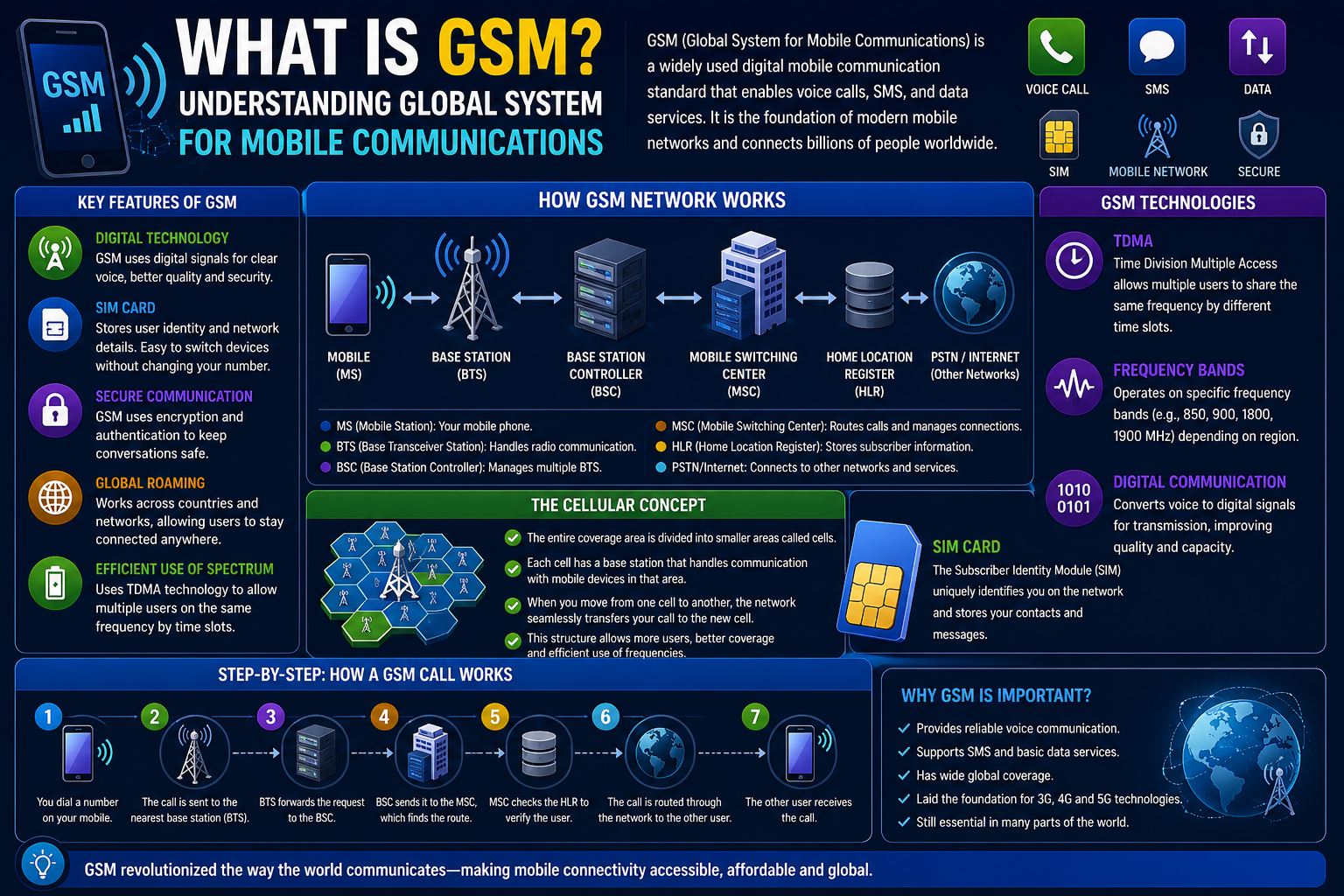
GSM, or Global System for Mobile Communications, is a digital cellular technology designed to provide consistent mobile communication across countries and networks. It was originally developed to replace fragmented analog systems that existed in different regions, which made international communication difficult and inefficient. Before GSM, mobile networks were incompatible with each other, meaning a phone used in one country often did not work in another. GSM solved this problem by introducing a unified standard that allowed mobile devices to work globally on any compatible network.
The core idea behind GSM was standardization. Engineers and telecommunication experts wanted a system that could deliver reliable voice communication, support roaming, and use radio spectrum efficiently. GSM achieved this by introducing digital transmission, which significantly improved call quality, reduced interference, and allowed more users to share the same network infrastructure. Over time, it became the foundation of modern mobile communication systems used worldwide.
The Evolution of GSM Technology
GSM development began in the early 1980s when European countries recognized the need for a unified mobile communication system. At that time, each country had its own analog cellular network, which created limitations for travelers and businesses operating internationally. The responsibility of developing a new standard was given to a European group of telecommunications experts who designed GSM as a fully digital system.
The first commercial GSM network was launched in the early 1990s. It quickly gained popularity due to its improved call quality and better security features compared to analog systems. Unlike earlier networks, GSM used digital encoding, which made it more resistant to noise and eavesdropping. As mobile usage grew, GSM expanded beyond Europe and became a global standard adopted by countries across Asia, Africa, the Middle East, and the Americas.
Over time, GSM evolved to support additional services such as SMS messaging, data transmission, and basic internet connectivity. This evolution allowed GSM to remain relevant even as newer technologies like 3G, 4G, and 5G were introduced.
How GSM Network Architecture Is Structured
The GSM network is built using a structured architecture that ensures smooth communication between users. It consists of several interconnected components that work together to manage calls, messages, and data transfer.
At the center of the system is the mobile device, which communicates with nearby cell towers. These towers are part of the radio access network, which handles wireless communication. Each tower covers a specific geographic area known as a cell. When a user moves from one cell to another, the network automatically transfers the connection to maintain uninterrupted communication.
Behind the cell towers are control systems that manage network traffic and ensure efficient operation. These systems coordinate communication between multiple towers and ensure that users receive strong and stable connections. The core network acts as the brain of the system, handling tasks such as routing calls, managing user authentication, and connecting different networks together.
This layered structure allows GSM to handle millions of users simultaneously without overwhelming the system.
Role of SIM Cards in GSM Communication
One of the most important features of GSM is the use of SIM cards. A SIM card, or Subscriber Identity Module, is a small chip inserted into a mobile device that stores user-specific information. This includes the subscriber’s identity, authentication key, and network permissions.
The SIM card allows users to switch devices easily without losing their mobile identity. When a SIM card is inserted into a phone, the network recognizes the user and grants access to services such as calling, texting, and mobile data. This portability is one of the reasons GSM became so popular worldwide.
SIM cards also enhance security by storing encrypted information that verifies the user’s identity. Without proper authentication, unauthorized access to the network is prevented. This makes GSM more secure compared to earlier mobile systems that did not use SIM-based identification.
How GSM Uses Digital Signals for Communication
GSM is a fully digital communication system, meaning it converts voice and data into digital signals before transmission. When a person speaks into a mobile phone, the sound is converted into digital data using compression techniques. This data is then transmitted through radio waves to the nearest cell tower.
The use of digital signals allows GSM to reduce interference and improve sound quality. It also enables more efficient use of radio frequency spectrum, allowing multiple users to communicate simultaneously. The system divides communication into small time intervals, ensuring that each user receives a dedicated portion of network resources.
Once the signal reaches the network, it is converted back into audio or text format for the recipient. This process happens almost instantly, allowing real-time communication between users.
Understanding GSM Frequency Bands and Channels
GSM operates on specific frequency bands that vary depending on the region. These frequency bands are divided into channels that carry voice and data signals. The system uses a technique called frequency division to separate communication channels, ensuring that multiple users can operate without interference.
In addition to frequency division, GSM also uses time division multiple access. This means that each frequency channel is divided into time slots, allowing multiple users to share the same channel at different times. This combination of frequency and time management makes GSM highly efficient in handling large numbers of users.
Different regions use different frequency ranges, which is why some mobile devices are designed to support multiple bands. This allows users to access GSM networks in different parts of the world.
Security Features in GSM Networks
Security is a major aspect of GSM technology. The system includes multiple layers of protection to ensure that communication remains private and secure. One of the key security features is authentication, where the network verifies the identity of the SIM card before granting access.
GSM also uses encryption to protect voice and data transmission. When information is sent over the network, it is encrypted so that it cannot be easily intercepted or understood by unauthorized users. This helps protect users from eavesdropping and data theft.
Another important feature is temporary identity assignment. Instead of using a permanent identifier, GSM assigns temporary numbers to users during communication sessions. This makes it more difficult for attackers to track or identify users.
Roaming and Global Connectivity in GSM
One of the most powerful features of GSM is its ability to support roaming. Roaming allows users to access mobile services even when they are outside their home network coverage area. This is possible because GSM networks around the world follow the same technical standards.
When a user travels to another country, their SIM card connects to a local GSM network through roaming agreements between operators. This enables uninterrupted communication without needing to change SIM cards or devices.
Roaming made GSM a truly global communication system, allowing people to stay connected anywhere in the world. It also helped businesses expand internationally by providing reliable mobile communication for employees traveling abroad.
GSM Services and Applications
GSM supports a wide range of services beyond voice calls. One of the earliest and most popular services is SMS, or Short Message Service, which allows users to send text messages. SMS became one of the most widely used communication methods worldwide due to its simplicity and reliability.
In addition to messaging, GSM also supports basic data services. Although early GSM data speeds were slow compared to modern standards, they enabled users to access simple internet services, email, and multimedia messaging.
GSM also supports supplementary services such as call forwarding, voicemail, caller identification, and conference calling. These features enhance user experience and provide flexibility in communication.
Limitations of GSM Technology
Despite its advantages, GSM has certain limitations. One of the main limitations is its relatively low data speed compared to modern mobile technologies. While GSM was sufficient for voice calls and text messaging, it struggled to support high-speed internet applications.
Another limitation is network congestion in heavily populated areas. Since GSM relies on shared frequency bands, too many users in one area can reduce performance. Additionally, GSM infrastructure requires significant maintenance and upgrades to remain functional alongside newer technologies.
However, despite these limitations, GSM continues to be used in many regions for basic communication services due to its reliability and wide coverage.
GSM’s Transition to Modern Mobile Technologies
As mobile communication evolved, GSM became the foundation for more advanced technologies such as 3G, 4G, and 5G. These newer systems built upon GSM principles while introducing faster speeds and improved capabilities.
Even though modern networks offer higher performance, GSM still plays an important role in global communication. Many networks continue to maintain GSM infrastructure to support basic services and ensure compatibility with older devices.
This transition shows how GSM acted as a stepping stone in the evolution of mobile communication, paving the way for today’s advanced wireless systems.
GSM Fundamentals
GSM remains one of the most influential technologies in the history of telecommunications. Its introduction standardized mobile communication, improved security, and enabled global connectivity. By using digital signals, SIM-based authentication, and efficient network architecture, GSM transformed how people communicate across the world.
Even in the era of advanced mobile networks, GSM continues to serve as a reliable backbone for basic communication services. Its legacy remains deeply embedded in modern wireless technology, making it a crucial part of the global communication infrastructure.
GSM Network Components in Detail
The GSM system is built on several key components that work together to ensure smooth communication between users. Each component has a specific role, and together they form a complete mobile communication ecosystem.
The mobile station is the user’s device, which includes the handset and the SIM card. This is the part of the system that directly interacts with the user. It converts voice into digital signals and sends them to the network. It also receives incoming signals and converts them back into sound or text.
The base transceiver station is responsible for handling radio communication with mobile devices. It sends and receives signals from mobile phones within a specific area called a cell. Each base station covers a limited geographic region, and multiple base stations are deployed to provide wide coverage.
The base station controller manages several base transceiver stations. It controls radio resources, handles handovers when a user moves from one cell to another, and ensures that network resources are efficiently used. It acts as a bridge between the radio network and the core network.
The mobile switching center is one of the most important parts of the GSM architecture. It handles call routing, connects different networks, and manages communication between users. It also interacts with databases that store user information and authentication details.
The home location register stores permanent subscriber data, such as the user’s identity, service profile, and location information. It ensures that the network can identify and authenticate users correctly. The visitor location register temporarily stores information about users who are currently roaming in a different area.
Process of Call Setup in GSM Networks
When a user makes a call in a GSM network, several steps occur in the background to establish the connection. The process begins when the mobile device sends a request to the nearest base transceiver station. This request is forwarded to the base station controller, which allocates necessary resources for the call.
The request then reaches the mobile switching center, which checks the user’s identity and verifies whether the call can be completed. If the recipient is on the same network, the call is routed internally. If the recipient is on a different network, the mobile switching center communicates with external networks to establish the connection.
Once the connection is established, voice signals are transmitted in both directions through the network. The system continuously monitors the connection to ensure call quality and stability. If the user moves during the call, the network performs a handover to another cell without dropping the connection.
Handover Mechanism in GSM
Handover is a critical feature in GSM that ensures uninterrupted communication when a user moves from one cell area to another. Since mobile users are constantly in motion, the network must transfer ongoing calls or data sessions smoothly between base stations.
There are different types of handovers depending on the situation. Intra-cell handover occurs when a user changes frequency within the same cell. Inter-cell handover occurs when the user moves from one cell to another under the same controller. Inter-controller handover takes place when the user moves between cells managed by different base station controllers.
The system continuously measures signal strength and quality to determine when a handover is needed. Once the signal weakens in one cell and becomes stronger in another, the connection is transferred automatically without user interruption.
GSM Data Transmission and GPRS Integration
Although GSM was originally designed for voice communication, it later supported data services through enhancements like GPRS. GPRS introduced packet-switched data transmission, allowing users to access the internet and send multimedia messages.
Unlike traditional circuit-switched communication, where a dedicated channel is reserved for the entire session, packet switching divides data into small packets. These packets are sent independently and reassembled at the destination. This method improves efficiency and allows multiple users to share the same network resources.
GPRS significantly improved GSM’s capabilities by enabling basic internet browsing, email access, and application-based communication. It marked an important step toward modern mobile internet services.
GSM Channel Structure and Time Division Multiplexing
GSM uses a combination of frequency and time division techniques to manage communication channels. Each frequency band is divided into multiple time slots, allowing several users to share the same frequency without interference.
Time division multiplexing assigns each user a specific time slot for transmission. This means that each user transmits data in short bursts, one after another, within a repeating cycle. This method ensures efficient use of available bandwidth and reduces signal congestion.
The structure of GSM channels includes control channels and traffic channels. Control channels manage system information, call setup, and network coordination. Traffic channels carry actual voice or data communication between users.
Authentication and Security Mechanisms in GSM
GSM networks use a multi-layered authentication system to ensure secure communication. When a device connects to the network, it must prove its identity using information stored in the SIM card. The network sends a random challenge to the device, which is processed using a secret key stored in the SIM. The response is then verified by the network.
If the response matches the expected value, the user is authenticated and allowed access. This process ensures that only legitimate users can connect to the network.
Encryption is also used to protect communication between the mobile device and the base station. Voice and data are encrypted before transmission, making it difficult for unauthorized parties to intercept or decode the information.
Temporary identifiers are assigned to users to protect their privacy. These identifiers change regularly, reducing the risk of tracking or surveillance.
GSM Frequency Planning and Spectrum Allocation
GSM networks operate within specific frequency ranges allocated by regulatory authorities. These frequency ranges are divided into uplink and downlink channels. Uplink channels are used for communication from the mobile device to the base station, while downlink channels are used for communication from the base station to the device.
Proper frequency planning is essential to avoid interference between neighboring cells. Network engineers design frequency reuse patterns that allow the same frequencies to be used in different locations without overlapping signals.
This careful planning ensures efficient use of the limited radio spectrum and maintains high-quality communication across large geographical areas.
Power Management in GSM Devices
Mobile devices operating on GSM networks use power control techniques to manage battery consumption and signal strength. The network continuously adjusts the power level of both the mobile device and the base station to maintain optimal communication.
When a device is close to a base station, it uses lower transmission power. When it moves farther away, the power is increased to maintain signal quality. This dynamic adjustment helps conserve battery life and reduces interference in the network.
GSM also includes idle mode operations where the device reduces activity when not in use. In this mode, the phone periodically checks for incoming calls or messages while minimizing energy consumption.
GSM in Rural and Urban Coverage Areas
GSM networks are designed to provide coverage in both urban and rural areas. In cities, where population density is high, base stations are placed closer together to handle large numbers of users. This ensures strong signal quality and high network capacity.
In rural areas, base stations are spread farther apart due to lower population density. Larger cells are used to cover wide geographic regions with fewer infrastructure requirements. This allows GSM to provide connectivity even in remote locations.
The flexibility of GSM network design makes it suitable for diverse environments, from densely populated cities to sparsely populated countryside regions.
Evolution of GSM Services Over Time
As technology advanced, GSM services evolved beyond basic voice and messaging. New features were introduced to improve user experience and expand functionality. Multimedia messaging allowed users to send images, audio, and video content.
Mobile internet access became more widely available through enhancements like GPRS and EDGE. These improvements increased data speeds and enabled more complex applications such as mobile browsing and early social communication platforms.
Value-added services such as mobile banking, location-based services, and roaming enhancements further expanded GSM capabilities. These developments helped bridge the gap between traditional mobile communication and modern smartphone-based systems.
GSM Compatibility with Modern Networks
Even with the introduction of advanced technologies, GSM remains compatible with newer systems through multi-mode devices. Many modern smartphones still support GSM bands to ensure connectivity in areas where newer networks are not available.
Network operators often maintain GSM infrastructure alongside newer technologies to provide fallback coverage. This ensures that users can still make calls and send messages even when high-speed networks are unavailable.
GSM’s compatibility and reliability make it an important part of the global communication ecosystem, especially in regions with developing infrastructure.
GSM Cell Structure and Frequency Reuse
GSM networks are organized into a pattern of cells, which are small geographic coverage areas served by individual base transceiver stations. Each cell operates on a set of specific frequencies, and together these cells create a continuous coverage area for mobile users. The idea behind this structure is to divide large regions into manageable sections so that communication can be efficiently handled without overwhelming the network.
One of the most important concepts in this structure is frequency reuse. Since the available radio spectrum is limited, GSM networks reuse the same frequencies in different cells that are far enough apart to avoid interference. This allows the system to support a large number of users without requiring additional spectrum. Careful planning ensures that adjacent cells do not use the same frequency, preventing signal overlap and maintaining communication quality.
Cell sizes can vary depending on population density and network demand. In urban areas, cells are smaller and more densely packed to handle heavy traffic. In rural regions, cells are larger because fewer users are spread across wider areas. This flexible design allows GSM networks to balance coverage and capacity efficiently.
Types of GSM Channels and Their Functions
GSM communication relies on different types of channels that serve specific purposes within the network. These channels are broadly divided into traffic channels and control channels, each playing a critical role in maintaining communication.
Traffic channels are responsible for carrying actual voice conversations or data transmission between users. When a call is made or a message is sent, it travels through these channels. They are designed to ensure smooth and uninterrupted delivery of information.
Control channels, on the other hand, handle signaling and network management tasks. They are used for activities such as call setup, user authentication, location updates, and system broadcasting. Without control channels, the network would not be able to coordinate communication between devices and base stations.
Within these categories, there are further specialized channels that manage paging, random access, and synchronization. Paging channels notify mobile devices of incoming calls, while random access channels allow devices to request network access. Synchronization channels help mobile devices align with the network timing structure for proper communication.
Location Tracking and Mobility Management in GSM
GSM networks continuously track the location of mobile devices to ensure that calls and messages are delivered correctly. This process is known as mobility management. As users move from one location to another, the network updates their location information in real time.
When a mobile device moves into a new area, it sends a location update request to the network. The network then records the new location in its database. This ensures that incoming calls and messages can be routed to the correct cell area.
Paging is used when the network needs to locate a specific device. The system sends signals to multiple cells in the area where the device is believed to be located. Once the device responds, communication is established.
This constant tracking system allows GSM to support seamless mobility, enabling users to move freely while staying connected.
GSM Signaling Process and Communication Control
Signaling in GSM refers to the exchange of control information between different network components. This includes call setup, handover coordination, authentication, and resource allocation. Signaling does not carry user voice or data but instead manages how communication is established and maintained.
When a call is initiated, signaling messages are exchanged between the mobile device, base station, and core network. These messages ensure that resources are available and that both parties are ready to communicate. Once the setup is complete, traffic channels are assigned for actual communication.
Signaling also plays a key role in maintaining network stability. It helps detect errors, manage congestion, and coordinate handovers between cells. Without efficient signaling, GSM networks would not be able to function smoothly under heavy usage.
GSM Security Algorithms and Encryption Methods
GSM uses specific encryption algorithms to protect user communication. These algorithms ensure that voice calls and data transmissions are secure from unauthorized access. One of the key components of this system is the use of secret keys stored in the SIM card and network database.
When a user connects to the network, a cryptographic process is initiated. The network sends a random number to the device, which is processed using the secret key. The result is then compared with the network’s calculation to verify identity.
Once authentication is successful, encryption is activated for communication. The system uses stream ciphers to scramble voice and data signals before transmission. This makes it extremely difficult for anyone to intercept or decode the information without the proper keys.
Although early GSM encryption methods had limitations, they still provided a significant improvement over earlier analog systems.
GSM Roaming Mechanism and International Connectivity
Roaming is one of the most important features of GSM, allowing users to stay connected while traveling outside their home network. This works through agreements between mobile operators in different regions or countries.
When a user enters a foreign network area, their SIM card is recognized by the local operator. The visitor location register temporarily stores the user’s information and communicates with the home network to verify identity and services.
Once authentication is complete, the user can make calls, send messages, and use available services under the roaming agreement. The process is seamless from the user’s perspective, even though multiple networks are involved in the background.
Roaming made GSM a truly global system, enabling international communication without requiring changes to mobile devices or SIM cards.
GSM Network Optimization and Performance Management
To maintain high-quality service, GSM networks require continuous optimization. Network operators monitor performance indicators such as call drop rates, signal strength, and traffic load to ensure smooth operation.
When congestion occurs in a specific area, adjustments are made to balance traffic. This may include reallocating frequencies, adjusting cell coverage, or increasing capacity by adding new base stations. Optimization helps prevent network overload and improves user experience.
Drive testing is often used to evaluate network performance in real-world conditions. Engineers travel through coverage areas while measuring signal quality and identifying weak spots. This data is used to improve network design and configuration.
GSM Data Evolution Toward EDGE Technology
As demand for faster mobile data increased, GSM was enhanced with technologies like EDGE. EDGE improved data transmission speeds by using more efficient modulation techniques. This allowed users to experience better internet performance without changing the underlying GSM infrastructure.
EDGE increased the amount of data that could be transmitted per time slot, making it significantly faster than earlier GSM data services. It supported applications such as mobile browsing, email, and early multimedia usage.
Although still slower than modern broadband networks, EDGE represented an important step in the evolution of mobile data services.
GSM Infrastructure Deployment and Maintenance
Building a GSM network requires significant infrastructure planning and deployment. Base stations must be strategically placed to ensure full coverage, and transmission links must be established between network components.
Maintenance is also a critical part of GSM operations. Equipment must be regularly checked, software updated, and faults repaired to maintain service quality. Power supply systems are often backed by generators or batteries to ensure uninterrupted operation.
Environmental factors such as terrain, buildings, and weather conditions are considered during network planning. Engineers design coverage maps to optimize signal distribution and reduce dead zones.
GSM Interconnection with Other Networks
GSM networks are designed to interconnect with other communication systems, including landline networks and internet-based services. This interconnection allows users to communicate across different platforms.
When a GSM user calls a landline, the mobile switching center routes the call through gateway systems that connect to fixed-line networks. Similarly, messages and data can be exchanged between mobile and internet-based services through specialized gateways.
This interoperability is one of the reasons GSM became widely adopted, as it integrates smoothly with existing communication infrastructure.
GSM Impact on Global Communication Systems
GSM transformed the way people communicate by making mobile connectivity widely accessible and standardized. It enabled billions of people to own mobile phones and communicate across long distances with ease.
Businesses benefited from improved communication efficiency, while individuals gained the ability to stay connected while on the move. The introduction of SMS changed communication habits globally, making text messaging one of the most popular forms of communication.
GSM also played a key role in economic development by improving access to communication in rural and developing regions. It provided a foundation for digital inclusion and helped bridge communication gaps between different parts of the world.
GSM Network Services and Supplementary Features
GSM provides a wide range of services that go beyond simple voice calling. One of the most widely used services is Short Message Service, which allows users to send and receive text messages quickly and reliably. This service became extremely popular because it is simple, cost-effective, and works even in low-signal conditions.
Another important feature is voicemail, which allows callers to leave recorded messages when the recipient is unavailable. Call forwarding enables users to redirect incoming calls to another number, ensuring they do not miss important communication. Caller identification displays the number of incoming callers, helping users manage their calls more effectively.
GSM also supports conference calling, which allows multiple users to participate in a single call. This feature is widely used in business communication and group discussions. These supplementary services enhance the flexibility and usability of GSM networks, making them more than just basic communication systems.
GSM Power Control and Energy Efficiency
Power control is an essential part of GSM operation that helps maintain network efficiency and device battery life. The system continuously adjusts the power level of mobile devices and base stations depending on their distance from each other. When a device is close to a base station, it uses less power, while greater distances require stronger signals.
This dynamic adjustment reduces interference in the network and ensures stable communication. It also helps extend the battery life of mobile devices, making them more energy efficient. GSM devices also use standby modes when not actively communicating, which further reduces power consumption.
These power management techniques allow GSM networks to operate efficiently even under heavy usage conditions.
GSM Compatibility and Integration with Modern Systems
Although newer technologies like 3G, 4G, and 5G offer faster speeds and advanced features, GSM remains an important part of global communication infrastructure. Many modern networks still support GSM to ensure backward compatibility with older devices and provide coverage in areas where advanced networks are not available.
GSM also acts as a fallback system in many regions. When newer networks are unavailable or overloaded, devices automatically switch to GSM to maintain basic communication services. This ensures uninterrupted access to voice calls and messaging.
Its integration with modern systems highlights its continued relevance and reliability in global telecommunications.
Conclusion
GSM stands as one of the most influential technologies in the history of mobile communication. It introduced a standardized digital system that made global connectivity possible, improved communication quality, and enabled services like roaming, messaging, and secure mobile access. Its structured network design, efficient use of spectrum, and reliable performance helped shape the foundation of today’s advanced wireless technologies. Even with the rise of faster mobile networks, GSM continues to play a vital role in ensuring universal access to basic communication services worldwide.
Beyond its technical achievements, GSM also had a major social and economic impact. It made mobile communication affordable and widely accessible, allowing people in both urban and rural areas to stay connected. This connectivity helped improve business operations, emergency communication, and personal relationships by making communication instant and portable. In many developing regions, GSM was the first step toward digital inclusion, giving millions of people access to modern communication tools for the first time.
Another important aspect of GSM is its reliability in diverse environments. Whether used in dense cities, remote villages, or across international borders, GSM networks are designed to maintain consistent performance. This adaptability made it one of the most trusted communication systems globally. Even today, it continues to support essential services where newer technologies may not yet be fully available or economically viable.
GSM also played a foundational role in shaping future mobile innovations. Technologies such as 3G, 4G, and 5G were built upon concepts first introduced by GSM, including digital transmission, cellular structure, and network switching methods. Many of the core principles of modern mobile communication still trace back to GSM design, proving its long-lasting influence on the industry.
In addition, GSM’s simplicity and efficiency ensured its widespread adoption across different countries and operators. Its standardized framework allowed seamless integration between networks, which made international communication easier than ever before. This global compatibility remains one of its strongest achievements.