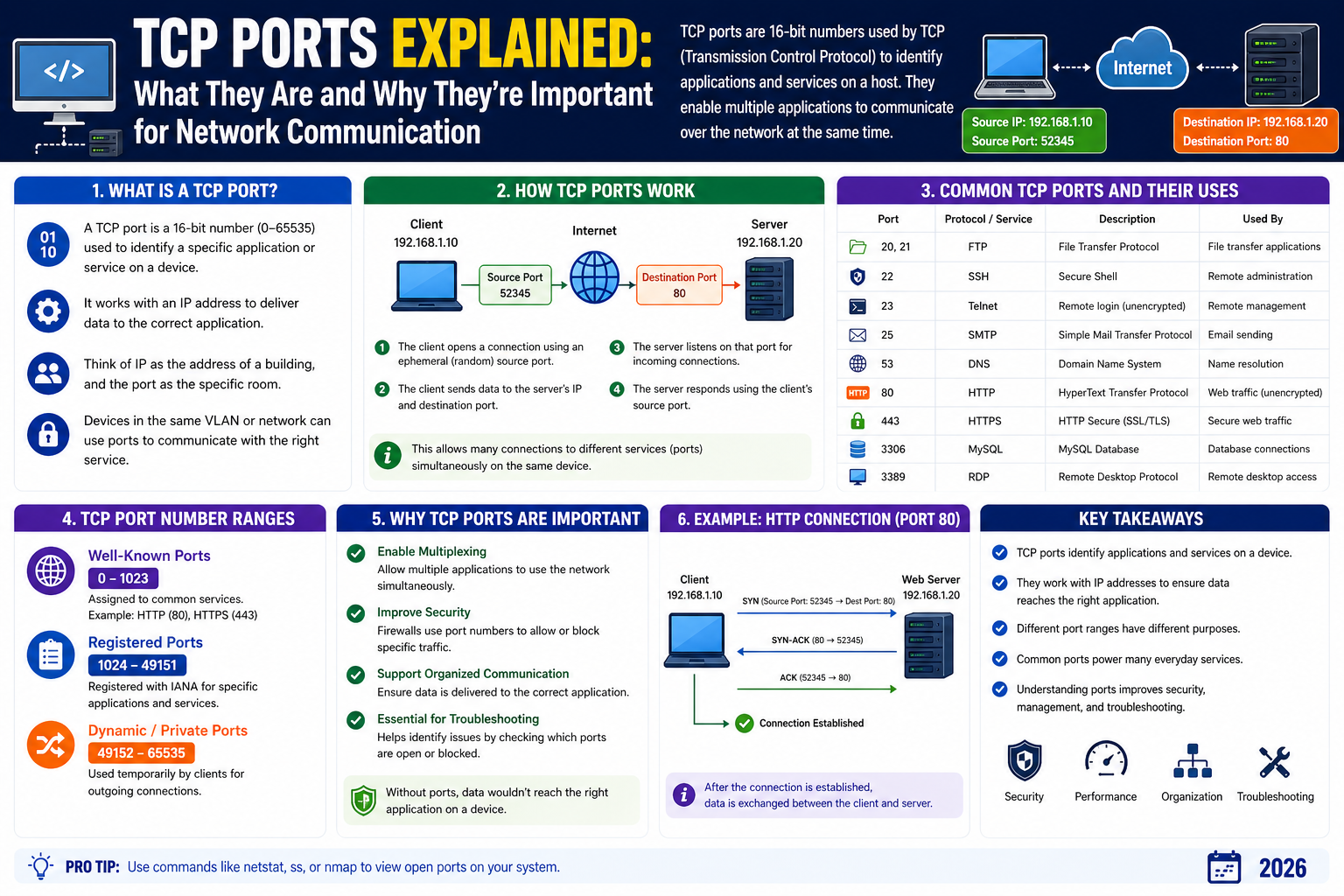
TCP ports are one of the most fundamental building blocks of how devices communicate over networks. While an IP address identifies a device on a network, a TCP port identifies the specific application or service on that device that should receive the incoming data. This dual system ensures that data does not just reach a computer, but reaches the correct program running on it. Without ports, all incoming traffic would be confused, mixed, and unusable because the system would not know where to send each piece of information.
TCP ports operate within the Transport Layer of the networking model, where reliability and structured communication are essential. They work closely with the Transmission Control Protocol to ensure that data is delivered accurately, in order, and without loss. Every time you browse a website, send an email, stream a video, or play an online game, TCP ports are actively involved in directing that traffic correctly.
The Relationship Between IP Addresses and Ports
An IP address alone is not enough to fully define a communication endpoint. It only tells the network which device should receive the data. However, modern devices run multiple applications at the same time, all needing network access. This is where ports become necessary.
A complete communication endpoint is defined by a combination of an IP address and a port number. This pairing is often referred to as a socket. The socket ensures that data is delivered not only to the correct machine but also to the correct application inside that machine. For example, a single server might host a web service, email service, and file transfer service simultaneously, each using different ports.
This system allows efficient multitasking across networks and is one of the reasons modern internet infrastructure can support millions of simultaneous connections.
How TCP Establishes Reliable Communication
TCP is designed to create a stable and reliable connection between two systems before data is exchanged. This process begins with what is commonly known as a handshake. During this phase, both devices agree to communicate and establish parameters for the connection.
Once the connection is established, data is broken into smaller packets and sent across the network. Each packet includes information about the source port and destination port. These ports ensure that the receiving device can properly reassemble the data and deliver it to the correct application.
If any packets are lost or arrive out of order, TCP is responsible for retransmitting them and restoring the correct sequence. This reliability is what makes TCP suitable for critical applications such as web browsing, file transfers, and secure communications.
The Role of Port Numbers in Communication
Port numbers range from 0 to 65535, and each number serves a specific purpose in network communication. These numbers are divided into categories based on how they are used and assigned.
Some ports are permanently assigned to well-known services. Others are registered for specific applications, while a large portion is reserved for temporary or dynamic use. This structured allocation ensures that conflicts between applications are avoided and communication remains organized.
When a client device initiates a connection, it typically uses a temporary port, while the server listens on a fixed port. This structure allows many clients to connect to a single server simultaneously without confusion.
Well-Known Ports and Their Importance
Certain port numbers are universally recognized and associated with specific services. These well-known ports are essential for standard internet functions. For example, web traffic commonly uses specific ports for secure and unsecured communication, while email and file transfer services use their own designated ports.
These standardized assignments allow devices and applications from different manufacturers and systems to communicate seamlessly. Without such standardization, interoperability across the internet would be extremely difficult.
Well-known ports act as a universal language for network services, ensuring that systems understand where to send and receive specific types of data.
Registered and Dynamic Ports
Beyond well-known ports, there are registered ports and dynamic ports. Registered ports are assigned to specific software applications or services that are not universally standardized but still require consistent communication channels.
Dynamic ports, on the other hand, are temporary ports assigned automatically by the operating system when a device initiates a connection. These ports are used for short-term communication and are released once the session ends.
This dynamic allocation is crucial for scalability. Without it, systems would run out of available ports quickly, especially in environments with many simultaneous connections.
Sockets and Their Function in Networking
A socket is the combination of an IP address and a port number, and it represents a single endpoint in a network communication session. Sockets allow applications to send and receive data over the network in a structured and identifiable way.
When two devices communicate, a pair of sockets is created—one on the client side and one on the server side. This pairing ensures that data flows correctly between the two applications involved in the communication.
Sockets are essential in modern networking because they provide a clear structure for managing multiple simultaneous connections without interference.
How Servers Use TCP Ports
Servers rely heavily on TCP ports to manage incoming requests from multiple clients. Each service running on a server listens on a specific port, waiting for incoming connections.
For example, a web server listens for browser requests on a designated port, while an email server listens on a different port for incoming mail requests. When a request arrives, the server uses the port number to determine which service should handle it.
This system allows a single server to host multiple services efficiently without conflict, making it a core part of internet infrastructure.
Client-Side Port Usage
On the client side, ports are usually assigned dynamically. When a user opens a web browser or any network application, the operating system assigns a temporary port number for that session.
This temporary port is used to track the outgoing request and match it with the incoming response from the server. Once the session ends, the port is released and can be reused for future connections.
This dynamic system ensures that millions of applications can operate simultaneously on a single device without port conflicts.
TCP Ports and Firewalls
Firewalls play a critical role in controlling access to TCP ports. They monitor incoming and outgoing traffic and decide whether to allow or block communication based on port numbers and other rules.
By controlling port access, firewalls help protect systems from unauthorized access, malicious attacks, and unwanted traffic. For example, a firewall might block unused or suspicious ports while allowing essential services to function normally.
This makes TCP ports not only a communication mechanism but also an important aspect of network security.
Port Scanning and Security Implications
Port scanning is a technique used to check which ports on a system are open or closed. While this can be used for legitimate network diagnostics, it is also commonly used by attackers to identify potential vulnerabilities.
Open ports can reveal active services on a system, and if those services are not properly secured, they may become entry points for attacks. For this reason, system administrators often monitor and restrict open ports carefully.
Understanding port behavior is essential for maintaining a secure network environment.
How NAT Interacts with TCP Ports
Network Address Translation, commonly known as NAT, is used to allow multiple devices on a private network to share a single public IP address. TCP ports play a crucial role in this process.
When multiple devices behind a NAT router communicate with external servers, the router uses different port numbers to track each connection. This ensures that incoming responses are correctly routed back to the right internal device.
Without port mapping, NAT would not be able to distinguish between multiple simultaneous connections.
Real-World Examples of TCP Port Usage
Everyday internet activities rely heavily on TCP ports. When you visit a website, your browser connects to a web server using a specific port. When you send an email, your email client communicates with a mail server using another port. Even file downloads, video streaming, and online gaming all depend on properly assigned ports.
These processes happen in the background, invisible to the user, but they are essential for ensuring smooth and reliable communication.
Troubleshooting TCP Port Issues
Network issues are often related to port misconfigurations or blocked ports. If a service is not working correctly, one of the first steps in troubleshooting is to check whether the required port is open and accessible.
Problems can occur due to firewall restrictions, incorrect configuration, or conflicts with other services using the same port. Identifying and resolving these issues requires a clear understanding of how ports function within the system.
Proper monitoring and configuration of ports help maintain stable network performance.
Importance of TCP Ports in Modern Systems
TCP ports are not just technical details; they are essential components of modern digital communication. They allow multiple applications to share a single network connection, ensure proper routing of data, and support the scalability of the internet.
From small personal devices to large enterprise servers, every connected system relies on TCP ports to function effectively. Without them, structured and reliable communication between applications would not be possible.
Their role continues to grow as networks become more complex and interconnected, making them a foundational concept in networking.
Advanced Role of TCP Ports in Network Architecture
As networks evolve, TCP ports continue to play an increasingly advanced role in shaping how communication systems are designed. In modern network architecture, ports are not just simple numerical identifiers; they are part of a structured framework that allows distributed systems, cloud platforms, and large-scale applications to function smoothly across millions of connections at once. Every service running on a modern server depends on carefully managed port allocation to ensure performance, stability, and scalability.
In large infrastructures such as cloud environments, ports are dynamically managed at a massive scale. Virtual machines, containers, and microservices all require isolated communication channels, and TCP ports help provide that separation. Without this structure, modern cloud computing systems would not be able to support the complexity of simultaneous services running across distributed environments.
TCP Ports in Cloud and Virtualized Systems
Cloud computing relies heavily on virtualization, where multiple virtual systems operate on a single physical machine. Each of these virtual systems may run different applications that require network access. TCP ports ensure that each virtual environment can communicate independently without interfering with others.
In container-based systems, such as those used in microservices architecture, each container may expose or consume different ports. These ports act as controlled gateways between services, allowing communication while maintaining isolation. This separation is critical for security, performance optimization, and system stability.
As cloud services scale globally, port management becomes a key part of infrastructure design, ensuring that applications remain accessible, efficient, and secure across distributed data centers.
Load Balancing and Port Distribution
Load balancing is another area where TCP ports play a vital role. In high-traffic systems, multiple servers are used to distribute incoming requests evenly. Each request is directed based on port configuration and routing rules.
Load balancers monitor incoming traffic and forward it to appropriate backend servers using predefined ports. This ensures that no single server becomes overwhelmed while maintaining smooth performance for users. The system continuously tracks port-based connections to distribute workload efficiently.
This mechanism is essential for large websites, streaming platforms, and online services that handle millions of users simultaneously.
Security Layers Built Around TCP Ports
TCP ports are also a foundational element in network security strategies. Security systems such as intrusion detection systems and advanced firewalls analyze port activity to detect unusual behavior. Since each service operates on specific ports, any unexpected traffic patterns can signal potential threats.
Attackers often attempt to exploit open or misconfigured ports to gain unauthorized access. For this reason, organizations implement strict port management policies, closing unnecessary ports and monitoring active ones continuously.
Encryption protocols also depend on ports to secure communication channels. Secure connections are established through specific ports designed to handle encrypted traffic, ensuring that sensitive data remains protected during transmission.
Port Forwarding in Private Networks
Port forwarding is a technique used in private networks to allow external access to internal services. When a request comes from outside a network, the router uses port forwarding rules to direct the traffic to the correct internal device and service.
This process is essential for hosting services such as gaming servers, remote desktop access, and private web servers. Without port forwarding, external systems would not be able to reach devices behind private networks.
However, improper configuration of port forwarding can expose internal systems to security risks, making careful management essential.
Ephemeral Ports and Temporary Communication
Ephemeral ports are temporary ports assigned by the operating system during outbound communication. These ports are used for short-lived connections, such as loading a webpage or sending a quick request to a server.
Once the communication ends, these ports are released back into the system pool for reuse. This dynamic allocation allows systems to handle a large number of simultaneous connections without exhausting available port numbers.
Ephemeral ports are a critical part of how operating systems manage efficiency in network communication, especially in environments with high traffic volume.
Multiplexing and Efficient Data Handling
TCP ports enable a process called multiplexing, where multiple communication streams are handled simultaneously over a single network interface. This means that different applications can send and receive data at the same time without interference.
For example, a computer might be downloading a file, streaming video, and syncing email all at once. Each of these activities uses different ports, allowing the system to manage all connections efficiently.
Without multiplexing, network communication would be far more limited and less efficient, as only one application could effectively use the network at a time.
Port Conflicts and System Behavior
Sometimes, two applications may attempt to use the same port on a device, leading to a port conflict. When this happens, one of the applications may fail to start or lose network functionality.
Operating systems prevent this by ensuring that each port can only be used by one service at a time per IP address. However, misconfigurations or poorly designed applications can still lead to conflicts.
Resolving port conflicts usually involves reconfiguring application settings or assigning alternative ports to the affected services.
Monitoring TCP Ports for Performance Optimization
Network administrators continuously monitor TCP ports to ensure optimal system performance. By analyzing traffic on specific ports, they can identify bottlenecks, unusual spikes in activity, or inefficient configurations.
Performance monitoring tools track how ports are being used over time, helping administrators adjust system resources accordingly. This is especially important in high-demand environments where even small inefficiencies can impact overall performance.
Port monitoring also plays a role in predictive maintenance, allowing potential issues to be identified before they affect users.
Role of TCP Ports in Internet of Things Systems
The Internet of Things relies heavily on TCP ports to manage communication between connected devices. Smart devices such as sensors, cameras, and appliances communicate with central systems using designated ports.
Each device may send data to a server or receive instructions through specific ports, enabling coordinated operation across large networks of devices. This structured communication system allows IoT ecosystems to function efficiently and reliably.
As IoT networks continue to expand, port management becomes even more critical for maintaining performance and security.
Scalability Challenges and Port Management
As systems grow, managing TCP ports becomes increasingly complex. Large-scale applications must ensure that port usage remains organized and efficient across thousands of services and devices.
Scalability challenges often involve ensuring that ports are not exhausted, connections are properly balanced, and services remain accessible under heavy load. Engineers design systems with dynamic port allocation strategies to handle this complexity.
Proper scalability planning ensures that network performance remains stable even as demand increases.
TCP Ports in Real-Time Applications
Real-time applications such as online gaming, video conferencing, and live streaming rely heavily on TCP ports for continuous communication. These applications require low latency and stable connections, which depend on efficient port usage.
Each session is assigned specific ports to maintain a consistent flow of data between users and servers. Any disruption in port communication can lead to lag, disconnection, or degraded performance.
This makes port stability a critical factor in the quality of real-time digital experiences.
Future Trends in TCP Port Usage
As networking technology advances, TCP ports will continue to evolve in their usage and management. Automation, artificial intelligence, and software-defined networking are already changing how ports are allocated and monitored.
Future systems are expected to use more intelligent methods for dynamic port management, reducing manual configuration and improving efficiency. Security systems will also become more adaptive, analyzing port behavior in real time to detect threats more effectively.
Despite these advancements, the fundamental role of TCP ports in organizing network communication will remain unchanged.
Advanced Understanding
TCP ports are far more than simple numbers used in networking. They are essential components of modern digital communication systems, enabling everything from basic web browsing to complex cloud computing and real-time global applications.
Their role in structuring communication, ensuring security, enabling scalability, and supporting advanced technologies makes them one of the most important elements of network architecture. As technology continues to evolve, TCP ports will remain at the center of how data moves across the digital world.
Deep Dive into TCP Port Behavior at the Operating System Level
At the operating system level, TCP ports are managed by the kernel, which is responsible for controlling all network communication. Every time an application requests network access, the operating system assigns or binds a port to that process. This binding process creates a structured link between software applications and network interfaces, allowing data to flow in and out in an organized manner.
The operating system maintains a detailed table of active connections, often called a socket table. This table tracks which IP addresses and ports are in use, which applications own them, and what state each connection is in. States may include listening, established, closing, or waiting. These states help the system manage communication efficiently and ensure that data packets are routed correctly.
Because the operating system handles port allocation automatically, users typically do not need to manage ports manually. However, system administrators and developers often interact with port configurations when setting up servers or troubleshooting network issues.
TCP Connection States and Port Lifecycle
Every TCP connection goes through a defined lifecycle, and ports play a central role in each stage. The lifecycle begins when a port is placed in a listening state on a server. This means the service is waiting for incoming connection requests on that specific port.
When a client initiates a connection, both sides go through a handshake process, after which the connection enters an established state. During this stage, both client and server ports are actively exchanging data.
Once communication is complete, the connection enters a closing state. The ports involved are then released or moved into a temporary waiting state to ensure no leftover packets interfere with future connections. Eventually, the ports become available again for reuse.
This structured lifecycle ensures stability and prevents data corruption or misrouting in network communication.
Time-Wait State and Port Reuse Behavior
One of the most important aspects of TCP port behavior is the time-wait state. After a connection closes, the port does not immediately become available. Instead, it remains in a waiting period to ensure that any delayed or duplicate packets from the previous connection do not interfere with new connections.
This mechanism protects data integrity and prevents confusion between old and new sessions that may use the same port combination. Although it slightly delays port reuse, it significantly improves reliability in network communication.
In high-performance systems, a large number of connections can lead to many ports being in time-wait state simultaneously, which is why efficient port management becomes important in server optimization.
Port Exhaustion and High Traffic Environments
In systems that handle extremely high volumes of traffic, port exhaustion can become a real challenge. Since there are a limited number of available ports, rapid creation and termination of connections can temporarily consume a large portion of them.
When ports are exhausted, new connections may fail until existing ports are released. This is especially common in systems that rely heavily on short-lived connections, such as web APIs or high-frequency data services.
To prevent this issue, systems use techniques like connection pooling, reuse of existing connections, and optimized timeout settings. These strategies reduce unnecessary port usage and improve overall system efficiency.
NAT and Port Address Translation in Depth
Network Address Translation, combined with Port Address Translation, allows multiple devices within a private network to share a single public IP address. This is achieved by mapping internal IP addresses and ports to external ports on the router.
When a device inside the network sends a request, the router modifies the source port and keeps a translation table. When the response comes back, the router uses this table to forward the data to the correct internal device and port.
This system is essential for conserving public IP addresses and enabling large private networks to connect to the internet efficiently. It also adds a layer of abstraction that enhances security by hiding internal network structures.
Ephemeral Port Range and System Allocation Strategy
Operating systems define a specific range of ports known as the ephemeral port range. This range is used exclusively for temporary connections initiated by client applications.
When a connection is made, the system selects an available port from this range and assigns it to the application. Once the connection ends, the port returns to the pool.
Different operating systems may define different ranges, but the principle remains the same. Efficient allocation of ephemeral ports is critical for handling large numbers of simultaneous connections without performance degradation.
TCP Port Multiplexing in Complex Applications
Modern applications often use multiplexing techniques to handle multiple streams of data over a single connection. TCP ports enable this by allowing different logical sessions to be distinguished even when they share the same physical network interface.
For example, a single application may maintain multiple connections to a server using different ports. Each connection can carry different types of data, such as video, audio, or control signals.
This ability to separate and manage multiple data streams efficiently is essential for modern multimedia applications and distributed systems.
Firewall Inspection and Port-Based Filtering
Firewalls use TCP ports as one of the primary criteria for filtering network traffic. Each incoming or outgoing packet is inspected, and decisions are made based on port number, protocol, and connection state.
Administrators define rules that specify which ports should be open or closed. For example, ports associated with web services may be allowed, while unused or sensitive ports are blocked.
Advanced firewalls can also perform deep packet inspection, analyzing not just the port but also the content of the data being transmitted. This provides a higher level of security and control over network traffic.
TCP Ports in Load-Balanced Distributed Systems
In distributed systems, TCP ports are essential for routing traffic across multiple servers. Load balancers distribute incoming requests based on port configuration and system load.
Each backend server may listen on specific ports, and the load balancer ensures that requests are forwarded appropriately. This distribution helps maintain system performance and prevents overload on any single server.
In advanced architectures, load balancers may also perform health checks on ports to ensure that only active and responsive services receive traffic.
Role of Ports in API Communication
Modern applications rely heavily on APIs for communication between services. These APIs often operate over specific TCP ports, which define how requests and responses are transmitted.
Each API endpoint listens on a designated port, allowing external systems to interact with it securely and efficiently. This structured approach ensures that communication remains organized, even in complex microservices environments.
Port-based API communication also allows developers to isolate services, making systems easier to scale and maintain.
Debugging and Diagnostic Use of TCP Ports
When network issues occur, TCP ports are one of the first areas examined during troubleshooting. Tools can be used to check which ports are open, which services are listening, and whether any unexpected activity is occurring.
Common diagnostic steps include checking port availability, verifying firewall rules, and testing connectivity between client and server ports. These checks help identify misconfigurations, service failures, or network restrictions.
Understanding port behavior is essential for diagnosing performance issues and ensuring system stability.
Security Risks Associated with Open Ports
Open ports are necessary for communication, but they can also introduce security risks if not properly managed. Every open port represents a potential entry point into a system.
Attackers often scan networks to identify open ports and exploit vulnerabilities in the services running on them. For this reason, minimizing the number of open ports is a common security practice.
Regular auditing and monitoring of ports help reduce exposure and strengthen overall system security.
TCP Ports in High-Frequency Trading and Critical Systems
In environments such as financial trading systems, where speed is critical, TCP ports must be optimized for minimal latency. Even small delays in port communication can have significant financial consequences.
These systems are designed to maintain persistent connections using dedicated ports to reduce overhead. This ensures that data flows continuously without the need for repeated connection setups.
Efficiency in port usage is directly tied to system performance in such high-stakes environments.
Evolution of Port Management in Modern Networking
As networking technology continues to advance, port management is becoming more automated and intelligent. Systems are increasingly using dynamic allocation strategies, predictive scaling, and machine learning to optimize port usage.
Software-defined networking allows administrators to control ports programmatically, adjusting configurations in real time based on network conditions.
This evolution is making network systems more adaptive, efficient, and secure while reducing manual intervention.
Final Understanding of TCP Port Systems
TCP ports represent a critical layer of structure in all modern digital communication. From low-level operating system processes to global cloud infrastructures, ports ensure that data reaches the correct destination reliably and efficiently.
They support scalability, enable security mechanisms, and allow millions of applications to operate simultaneously without conflict. As technology continues to expand, TCP ports will remain a foundational element of how networks function across the world.
TCP Ports in Modern Internet Architecture and Global Connectivity
TCP ports sit at the core of how the modern internet functions, especially when viewed at a global scale. Every digital interaction between devices, whether local or international, depends on structured communication channels that rely on port numbers. These ports ensure that data not only travels across vast networks but also reaches the correct service at its destination without confusion.
On a global level, billions of connections are made every second, and TCP ports help organize this enormous flow of traffic. Internet service providers, data centers, and backbone networks all depend on consistent port behavior to maintain stability. Without this system, the internet would not be able to support the complexity of modern communication.
TCP Ports in Content Delivery Networks
Content Delivery Networks rely heavily on TCP ports to deliver data efficiently across geographically distributed servers. These networks store cached versions of content closer to users to reduce latency and improve speed.
Each CDN node uses specific ports to communicate with origin servers and end users. When a user requests content, the request is routed through a nearby node using predefined port configurations. This ensures faster delivery and reduced load on central servers.
Port management in CDNs is optimized for speed, redundancy, and fault tolerance, allowing seamless content access even under heavy global traffic conditions.
Microservices Architecture and Port Isolation
In microservices-based systems, applications are broken down into smaller independent services that communicate over the network. Each microservice typically runs on its own TCP port, creating a highly modular system.
This separation allows developers to update, scale, or replace individual services without affecting the entire application. Ports act as communication boundaries between these services, ensuring that each component interacts in a controlled and predictable way.
This architecture has become a standard in modern software development due to its flexibility and scalability.
High Availability Systems and Redundant Port Usage
High availability systems are designed to remain operational even in the event of failures. TCP ports play an important role in achieving this reliability.
Multiple servers may listen on the same service port across different machines. If one server fails, another can immediately take over without interrupting service. Load balancers and failover systems monitor port activity to ensure continuous availability.
This redundancy ensures that critical systems such as banking platforms, healthcare systems, and communication networks remain operational at all times.
Latency Optimization and Port Efficiency
Latency refers to the delay between sending and receiving data, and TCP port usage can influence this performance. Efficient port handling reduces overhead and improves response times.
Persistent connections that reuse the same ports help minimize the time spent establishing new connections. This is especially important in applications that require real-time interaction, where even milliseconds matter.
Optimizing port usage contributes directly to smoother and faster network experiences for end users.
TCP Ports in Mobile and Wireless Networks
Mobile networks rely on TCP ports just as heavily as wired systems. Smartphones constantly open and close connections using dynamic ports to access apps, services, and cloud data.
In wireless environments, port efficiency becomes even more important due to fluctuating signal strength and network conditions. Mobile operating systems manage ports dynamically to maintain stable connections while conserving battery life and bandwidth.
This adaptability allows mobile devices to function seamlessly across different network environments.
Impact of IPv6 on TCP Port Usage
With the introduction of IPv6, the number of available IP addresses has increased dramatically, but TCP ports remain unchanged in structure and function. Each IPv6 address still uses the same port system for communication.
This means that while addressing has expanded, the role of ports continues to be essential for service identification and traffic management. IPv6 enhances scalability at the addressing level, while TCP ports maintain communication structure at the application level.
Together, they form a complete system for modern networking.
Automation and Intelligent Port Management
Modern network systems increasingly rely on automation to manage TCP ports. Intelligent systems can dynamically allocate, monitor, and adjust port usage based on real-time traffic conditions.
Automation reduces human error and improves efficiency by ensuring optimal port distribution across services. Machine learning models can even predict traffic patterns and adjust port assignments proactively.
This level of automation is especially useful in large-scale cloud environments where manual management would be impractical.
TCP Ports in Cybersecurity Defense Strategies
Cybersecurity systems use TCP ports as a key factor in defense strategies. Monitoring port activity helps detect unusual behavior, unauthorized access attempts, and potential intrusions.
Security tools often analyze port scanning activity to identify attackers attempting to map a network. By observing which ports are being probed, systems can respond with protective measures such as blocking IP addresses or tightening firewall rules.
Ports also help segment networks into secure zones, limiting access between different parts of a system and reducing potential damage from attacks.
Legacy Systems and Port Compatibility
Many older systems still rely on traditional TCP port configurations, and maintaining compatibility with these systems is important for continuity. Legacy applications often use fixed port assignments that must be preserved to ensure proper functionality.
Modern systems must balance innovation with backward compatibility, ensuring that newer technologies can still communicate with older infrastructure.
This coexistence highlights the long-standing importance of TCP ports in networking history.
Scalability in Cloud-Native Environments
Cloud-native systems are designed for scalability, and TCP ports are central to this design. Services can be replicated across multiple instances, each using dynamically assigned ports.
This allows systems to scale horizontally, adding more instances as demand increases. Port management ensures that each instance remains accessible and properly routed within the network.
Scalability depends heavily on efficient port allocation and routing logic to maintain performance under varying loads.
Observability and Monitoring of Port Activity
Observability tools provide deep insights into how TCP ports are being used across systems. Metrics such as connection count, latency, error rates, and throughput are all tracked at the port level.
This data helps engineers understand system behavior and identify potential issues before they impact users. Port-level monitoring is a key component of modern DevOps practices.
By analyzing port activity, teams can optimize performance and maintain system reliability.
Future of TCP Ports in Evolving Technologies
As technology continues to advance, TCP ports will remain essential, but their management will become more automated and abstracted. Future systems may hide direct port configuration from developers, instead relying on intelligent networking layers.
Despite these changes, the fundamental concept of ports as communication endpoints will remain unchanged. They will continue to serve as the backbone of application-level networking.
Emerging technologies such as edge computing, artificial intelligence, and distributed systems will only increase the importance of efficient port management.
Conclusion
TCP ports are a foundational element of all modern network communication. They work alongside IP addresses to ensure that data reaches the correct application, enabling everything from simple web browsing to complex global cloud infrastructures.
Across operating systems, cloud platforms, mobile networks, and cybersecurity systems, ports provide structure, organization, and reliability. They support scalability, enable security, and ensure efficient communication between billions of devices worldwide.
As networks continue to grow in complexity and scale, TCP ports will remain a constant and essential part of how digital communication is structured. Their role may evolve in implementation and automation, but their core function as communication endpoints will always be central to the functioning of the internet and modern computing systems.