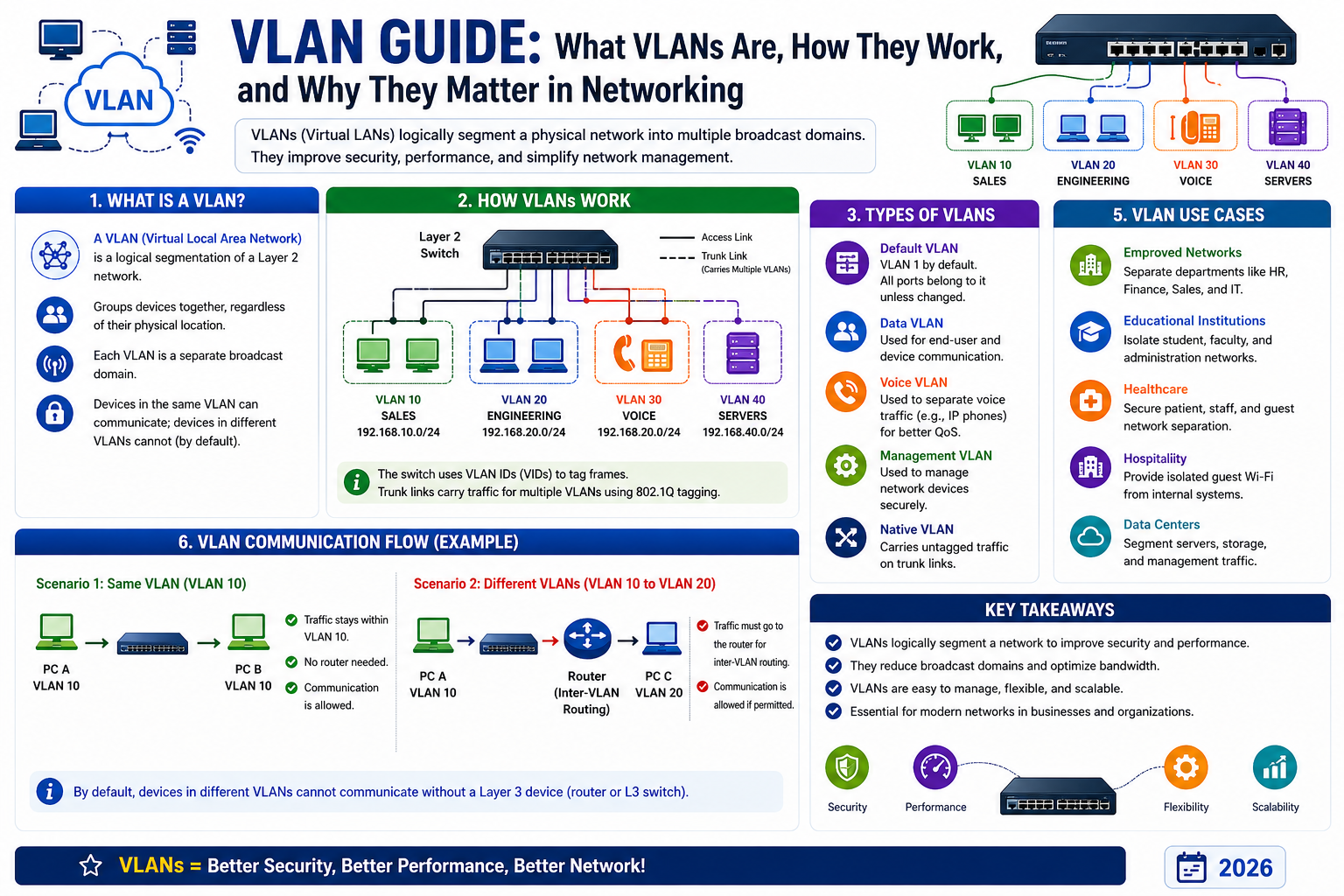
VLAN tagging is the core mechanism that allows multiple virtual networks to coexist on the same physical infrastructure. When data travels across a network, it is encapsulated into frames. In a VLAN-enabled environment, these frames are modified to include additional information that identifies the VLAN they belong to. This identification is what allows switches to correctly separate traffic even when it is passing through the same physical cables. The tagging process ensures that each frame carries its own logical identity, which prevents confusion between different VLANs sharing the same network hardware.
This tagging system is especially important when traffic moves between switches. Without tagging, a switch would not know which VLAN a frame belongs to once it leaves its original device. By embedding VLAN information inside each frame, the network maintains proper segmentation across multiple interconnected switches.
Access Ports and Their Role in VLAN Structure
Access ports are the simplest type of switch port configuration in a VLAN environment. They are assigned to a single VLAN and are responsible for connecting end devices such as computers, printers, and other user equipment. When a device sends data through an access port, the switch automatically assigns that traffic to the configured VLAN without requiring the device to be aware of VLANs.
This simplicity is important because end devices do not need any special configuration to operate within a VLAN. The switch handles all the segmentation work behind the scenes. Access ports ensure that devices remain isolated within their designated network group, which improves both organization and security.
Trunk Ports and Multi-VLAN Transport
Trunk ports are designed to carry traffic from multiple VLANs simultaneously. Unlike access ports, trunk ports are used primarily for communication between networking devices such as switches or routers. They rely on VLAN tagging to distinguish between different traffic streams passing through the same physical link.
When multiple VLANs share a trunk connection, each frame is tagged so the receiving switch can correctly identify its VLAN membership. This allows large and complex networks to scale efficiently without requiring separate physical connections for every VLAN. Trunking is essential in enterprise environments where multiple switches must work together as a unified system while maintaining VLAN separation.
Inter-VLAN Communication and Routing
Although VLANs are designed to isolate traffic, there are situations where communication between different VLANs is necessary. This is where inter-VLAN routing comes into play. Since VLANs operate as separate logical networks, a routing device is required to transfer data between them.
A router or a multilayer switch examines incoming traffic, determines its destination VLAN, and forwards it accordingly. This controlled communication ensures that while VLANs remain isolated by default, they can still interact when properly configured. This balance between isolation and controlled access is one of the key strengths of VLAN-based network design.
VLAN Segmentation and Network Efficiency
One of the major advantages of VLANs is their ability to reduce broadcast traffic. In a traditional network without VLANs, broadcast messages are sent to all devices, which can lead to unnecessary network congestion. VLANs divide the network into smaller broadcast domains, meaning that broadcast traffic is limited to devices within the same VLAN.
This segmentation significantly improves network efficiency. Devices receive only relevant traffic, reducing processing overhead and improving overall performance. In large organizations, this optimization becomes critical for maintaining smooth and responsive network operations.
Security Advantages of VLAN Implementation
VLANs also play a crucial role in improving network security. By isolating different departments or user groups, VLANs prevent unauthorized access between segments of a network. For example, sensitive financial systems can be placed in a separate VLAN from general employee workstations, reducing the risk of internal data exposure.
Even if a malicious user gains access to one VLAN, they cannot directly interact with other VLANs without proper routing permissions. This segmentation acts as a built-in security layer that limits lateral movement within a network. When combined with proper access control policies, VLANs significantly strengthen overall network protection.
Voice VLANs and Traffic Prioritization
In modern networks, different types of traffic require different levels of priority. Voice VLANs are specifically designed to handle voice communication such as internet-based phone systems. These VLANs prioritize voice data to ensure low latency and high-quality audio transmission.
By separating voice traffic from general data traffic, networks can reduce delays, jitter, and packet loss. This separation is essential in environments where communication quality is critical, such as business call centers or remote communication systems. Voice VLANs ensure that real-time communication is not affected by heavy data usage on the same network.
Management VLANs and Administrative Control
Management VLANs are used exclusively for network device administration. Switches, routers, and other infrastructure components are placed within this VLAN to allow secure monitoring and configuration. By isolating management traffic from general user traffic, network administrators reduce the risk of unauthorized access to critical systems.
This separation also improves stability because administrative traffic does not compete with user traffic for bandwidth. It ensures that network devices remain accessible even during periods of heavy network usage.
Native VLAN Behavior in Trunk Links
Native VLANs are used in trunk connections to handle untagged traffic. In some cases, network devices may send frames without VLAN tags. The native VLAN provides a default assignment for this type of traffic so it can still be processed correctly.
Proper configuration of native VLANs is important because mismatches between connected devices can lead to communication issues or security risks. Ensuring consistency in native VLAN settings helps maintain stable trunk operations across the network.
Spanning Tree Interaction with VLANs
In switched networks, loops can cause serious performance issues. The Spanning Tree Protocol is used to prevent these loops by selectively blocking redundant paths. When VLANs are introduced, spanning tree operates within each VLAN or group of VLANs depending on configuration.
This means each VLAN can have its own logical spanning tree topology. This separation allows more efficient use of network paths while still preventing loops. It also provides redundancy, ensuring that if one path fails, another can take over without disrupting network traffic.
VLAN Design Strategies in Large Networks
Designing VLANs in large environments requires careful planning. VLANs should be organized based on function, department, or security level rather than random assignment. A well-structured VLAN design improves manageability and reduces complexity.
Networks often use hierarchical designs where core, distribution, and access layers work together to manage VLAN traffic. This structure allows scalability while maintaining performance and control. Proper planning also reduces the chances of misconfiguration and network conflicts.
Common VLAN Configuration Challenges
Despite their advantages, VLANs can introduce complexity if not configured properly. Common issues include incorrect port assignments, mismatched trunk configurations, and inconsistent VLAN tagging. These problems can lead to connectivity failures or unexpected traffic behavior.
Another challenge is ensuring consistent VLAN configuration across multiple switches. Without proper coordination, devices may interpret VLAN information differently, leading to communication breakdowns. Careful documentation and standardized configuration practices help avoid these issues.
Real-World Applications of VLANs
VLANs are widely used in enterprise environments, educational institutions, data centers, and service provider networks. In businesses, VLANs separate departments such as finance, human resources, and operations. In educational environments, they are used to isolate student, faculty, and administrative networks.
In data centers, VLANs help organize virtual machines and services, ensuring efficient resource allocation. Service providers use VLANs to segment customer traffic while sharing the same physical infrastructure. This versatility makes VLANs one of the most important tools in modern networking.
Limitations of VLAN Technology
While VLANs offer many benefits, they are not without limitations. VLANs do not inherently improve bandwidth or speed; they only organize traffic. Misconfiguration can lead to security vulnerabilities or communication issues between network segments.
Additionally, VLANs require proper routing mechanisms for inter-network communication, which adds complexity. In very large environments, managing hundreds of VLANs can become challenging without proper network management tools.
VLAN Trunking in Multi-Switch Environments
In larger networks, multiple switches are often connected together to expand connectivity and coverage. In such environments, VLAN trunking becomes essential because it allows multiple VLANs to pass through a single physical link between switches. Instead of dedicating separate cables for each VLAN, trunk links carry traffic for all VLANs simultaneously by using tagging mechanisms that identify which VLAN each frame belongs to.
When a frame leaves one switch and enters another through a trunk link, it retains its VLAN identity through tagging. This ensures that the receiving switch can correctly forward the frame only to ports that belong to the same VLAN. Without trunking, scaling VLANs across multiple switches would require an impractical number of physical connections, making network design inefficient and expensive.
Trunking also plays a key role in maintaining VLAN consistency across an entire network infrastructure. It ensures that devices in the same VLAN, even if connected to different switches, can still communicate seamlessly as if they were on the same local network segment.
Dynamic VLAN Assignment and Network Intelligence
In more advanced network environments, VLAN membership does not always have to be manually configured. Dynamic VLAN assignment allows devices to be automatically placed into specific VLANs based on certain criteria such as user identity, device type, or authentication method.
This process is typically handled through centralized authentication systems that communicate with network switches. When a device connects, the network evaluates its credentials and assigns it to the appropriate VLAN automatically. This reduces administrative overhead and improves flexibility in environments where users frequently move or change roles.
Dynamic VLAN assignment also enhances security by ensuring that only authorized devices are placed into sensitive network segments. It helps enforce network policies consistently without requiring constant manual configuration changes.
Private VLANs and Micro-Segmentation
Private VLANs provide an additional layer of segmentation within a single VLAN. Instead of all devices in a VLAN being able to communicate freely with each other, private VLANs restrict communication between specific devices while still allowing them to share the same IP subnet.
This technique is often used in environments like data centers or hosting services where multiple clients share the same infrastructure but must remain isolated from each other. Private VLANs create a micro-segmentation model that enhances security without increasing the complexity of IP addressing.
By controlling communication at a more granular level, private VLANs reduce the risk of lateral movement within a network and help enforce strict isolation policies.
VLAN Hopping Attacks and Security Considerations
Although VLANs provide strong logical separation, they are not immune to security threats if misconfigured. One known vulnerability is VLAN hopping, where an attacker attempts to send traffic into unauthorized VLANs by exploiting switch misconfigurations.
This type of attack typically occurs when trunk ports are improperly configured or when default VLAN settings are left unchanged. Attackers may try to manipulate tagging behavior to gain access to restricted network segments.
To mitigate these risks, proper configuration practices are essential. Disabling unused ports, enforcing strict trunk configurations, and using secure VLAN assignment policies significantly reduce the chances of such attacks. VLAN security relies heavily on correct implementation rather than the technology itself being inherently secure.
Broadcast Control and Traffic Containment
One of the key functions of VLANs is controlling broadcast traffic within a network. In traditional flat networks, broadcast messages are sent to all connected devices, which can create unnecessary congestion and reduce performance. VLANs solve this problem by dividing the network into smaller broadcast domains.
Each VLAN acts as its own isolated broadcast environment. This means that broadcast traffic generated within one VLAN is not forwarded to other VLANs. As a result, network efficiency improves significantly because devices only process relevant traffic.
This containment also improves stability in large networks. If excessive broadcast traffic occurs in one VLAN, it does not impact other VLANs, preventing widespread performance degradation.
Scalability of VLAN-Based Networks
VLANs provide a scalable approach to network design. As organizations grow, new VLANs can be created to accommodate additional departments, services, or user groups without redesigning the physical infrastructure.
This scalability is one of the main reasons VLANs are widely used in enterprise environments. Instead of physically restructuring networks, administrators can simply adjust logical configurations. This reduces downtime, lowers costs, and improves adaptability.
However, scalability also introduces complexity. As the number of VLANs increases, proper documentation and management become critical to avoid configuration errors and maintain network stability.
Inter-VLAN Routing Methods
Since VLANs are isolated by design, communication between them requires routing. There are several methods used to achieve inter-VLAN routing depending on network architecture.
One common method is router-on-a-stick, where a single physical router interface is divided into multiple logical sub-interfaces, each assigned to a VLAN. Another approach involves using multilayer switches that can perform routing functions internally without requiring a separate router.
Both methods allow controlled communication between VLANs while maintaining segmentation. The choice between them depends on network size, performance requirements, and hardware capabilities.
Performance Optimization Through VLAN Design
Proper VLAN design can significantly improve network performance. By grouping devices based on function or communication patterns, network traffic becomes more predictable and efficient.
For example, separating high-traffic servers from general user devices prevents resource contention. Similarly, isolating backup systems or monitoring tools ensures that critical operations do not interfere with everyday network usage.
Efficient VLAN design reduces unnecessary data flow and improves response times across the network. It also allows administrators to prioritize certain types of traffic when needed.
Role of VLANs in Cloud and Virtualized Environments
Modern cloud and virtualization platforms rely heavily on VLAN-like segmentation techniques. In virtual environments, multiple virtual machines often share the same physical hardware, making logical separation essential.
VLANs help organize virtual networks in a way that mirrors physical network segmentation. This ensures that virtual machines remain isolated while still sharing underlying infrastructure.
In cloud data centers, VLAN concepts are often extended into more advanced overlays that allow even greater scalability and flexibility. However, the foundational principles remain the same: separation, control, and efficient traffic management.
Troubleshooting VLAN Issues
VLAN-related problems are often caused by misconfiguration rather than hardware failure. Common issues include incorrect VLAN assignments, trunk misconfigurations, or mismatched native VLAN settings.
When troubleshooting, network administrators typically verify port assignments, check tagging consistency, and ensure that VLANs are properly propagated across all switches. Connectivity issues between devices in the same VLAN often indicate configuration errors rather than physical faults.
Systematic troubleshooting is essential because VLAN issues can appear as random connectivity problems even though the underlying cause is configuration-related.
VLAN and Quality of Service Interaction
VLANs often work alongside Quality of Service mechanisms to prioritize certain types of traffic. While VLANs separate traffic logically, Quality of Service ensures that important data receives higher priority during transmission.
For example, voice or video traffic can be prioritized over regular data traffic to maintain performance quality. This combination ensures both organizational structure and performance optimization within the same network.
By integrating VLANs with traffic prioritization systems, networks can achieve both segmentation and efficiency simultaneously.
Future Evolution of VLAN Technology
Although VLANs have been used for many years, they continue to evolve alongside modern networking technologies. In large-scale cloud and software-defined networks, VLAN concepts are being integrated into more advanced virtual networking systems.
These systems extend VLAN principles beyond traditional hardware boundaries, enabling even more flexible and dynamic network segmentation. While the underlying idea remains the same, implementation has become more automated and intelligent.
Despite newer technologies, VLANs remain a foundational concept in networking education and real-world infrastructure due to their simplicity and effectiveness.
Enterprise VLAN Architecture and Hierarchical Design
In large enterprise networks, VLANs are not deployed randomly but are carefully structured into a hierarchical design. This structure typically follows a layered approach where access, distribution, and core layers work together to handle traffic efficiently. VLANs are usually created at the access layer where end devices connect, then carried upward through distribution and core layers using trunk links.
This hierarchical approach ensures that network traffic flows in a controlled and predictable manner. It also allows administrators to implement policies at different levels of the network. For example, security policies can be enforced at the distribution layer while high-speed forwarding is handled at the core layer. VLANs act as the foundation that supports this structured flow of data across the entire organization.
VLAN Planning and Addressing Strategy
Proper VLAN planning is critical for maintaining a stable and scalable network. Each VLAN should represent a logical grouping such as a department, function, or service type. Careful planning ensures that VLANs remain organized and do not overlap in purpose.
Although VLANs operate at Layer 2, they are often paired with structured IP addressing schemes. Each VLAN is usually assigned a specific IP subnet, which simplifies routing and troubleshooting. This alignment between VLANs and IP subnets helps administrators quickly identify where traffic originates and how it should be routed.
Without proper planning, VLAN sprawl can occur, where too many poorly organized VLANs make the network difficult to manage. A structured approach prevents confusion and ensures long-term maintainability.
VLAN Segmentation for Security Zones
One of the most powerful uses of VLANs in enterprise environments is the creation of security zones. Different levels of trust are assigned to different VLANs depending on the sensitivity of the data or systems involved.
For example, highly sensitive systems such as financial servers or database environments are placed in isolated VLANs with strict access controls. General user devices are placed in separate VLANs with limited access to critical systems. Guest networks are often placed in completely isolated VLANs with internet-only access.
This segmentation ensures that even if one part of the network is compromised, the damage is contained within that specific VLAN. It significantly reduces the attack surface and limits lateral movement across the network.
VLAN Overlays and Virtual Networking Integration
In modern virtualized environments, VLANs are often extended using overlay technologies. Instead of relying solely on physical infrastructure, virtual networking allows VLAN-like segmentation to span across multiple physical locations or cloud environments.
This approach is commonly used in data centers where virtual machines are dynamically created and moved between hosts. VLAN concepts are extended through encapsulation techniques that preserve network segmentation across physical boundaries.
Overlay networks maintain the same logical separation principles while adding flexibility and scalability. This allows organizations to build highly dynamic and distributed network infrastructures without losing control over segmentation.
Load Distribution and Traffic Engineering with VLANs
VLANs also play an important role in balancing and distributing network traffic. By separating different types of traffic into distinct VLANs, administrators can manage bandwidth usage more effectively.
For example, high-bandwidth applications such as video streaming or file transfers can be isolated in specific VLANs, preventing them from impacting critical business applications. This separation allows more predictable network performance and reduces congestion.
In combination with routing policies, VLANs enable traffic engineering strategies where data flows are optimized based on network capacity and business priorities.
Redundancy and High Availability in VLAN Networks
Enterprise networks require high availability to ensure continuous operation. VLANs are often designed with redundancy in mind, using multiple switches and trunk links to prevent single points of failure.
Spanning Tree Protocol and its modern variations ensure that redundant paths do not create loops while still remaining available as backup routes. If one link fails, traffic can automatically be rerouted through an alternate path without disrupting VLAN connectivity.
This redundancy ensures that VLAN-based networks remain stable even in the event of hardware or link failures. It also supports maintenance operations without requiring complete network downtime.
VLAN Scaling Challenges in Large Organizations
As networks grow, managing VLANs becomes increasingly complex. One of the main challenges is maintaining consistency across multiple switches and locations. Without proper coordination, VLAN mismatches can occur, leading to connectivity issues.
Another challenge is limiting the total number of VLANs. While VLANs are logically scalable, hardware and management systems have practical limits. Too many VLANs can increase administrative overhead and make troubleshooting more difficult.
To address these challenges, organizations often use standardized VLAN numbering schemes and centralized management systems. This helps maintain consistency and reduces configuration errors across large infrastructures.
VLAN and Network Monitoring Systems
Monitoring VLAN traffic is essential for maintaining network health and performance. Network monitoring tools can analyze traffic patterns within each VLAN to detect anomalies, congestion, or security threats.
By separating traffic into VLANs, monitoring becomes more efficient because each segment can be analyzed independently. This makes it easier to identify the source of network issues without inspecting the entire infrastructure.
Monitoring also helps in capacity planning, allowing administrators to understand which VLANs consume the most bandwidth and may require optimization.
VLAN Role in Internet Service Provider Networks
Internet Service Providers use VLANs extensively to manage multiple customers over shared infrastructure. Each customer or service type is assigned a separate VLAN, ensuring complete isolation between different users.
This approach allows providers to deliver services efficiently without needing separate physical networks for each customer. It also simplifies billing, management, and service provisioning.
In some cases, VLANs are combined with other technologies to deliver advanced services such as virtual private networks or dedicated internet access.
Automation and VLAN Configuration Management
Modern networks increasingly rely on automation to manage VLAN configurations. Instead of manually configuring each switch, administrators use centralized systems that automatically deploy VLAN settings across the network.
Automation reduces human error and ensures consistency across large infrastructures. It also allows rapid deployment of new VLANs when needed, improving operational efficiency.
In dynamic environments where network changes are frequent, automation becomes essential for maintaining stability and scalability.
VLAN Troubleshooting in Complex Networks
Troubleshooting VLAN issues in large networks requires a systematic approach. Problems often arise from incorrect port assignments, inconsistent trunk configurations, or mismatched VLAN identifiers.
One common issue is when devices in the same VLAN cannot communicate due to misconfigured trunk links between switches. Another issue is when VLANs are not properly propagated across the network, leading to isolated segments.
Effective troubleshooting involves verifying configurations at each layer of the network and ensuring that VLAN information is consistent across all devices.
Impact of VLANs on Network Latency and Performance
While VLANs improve organization and security, they can also influence network performance. Properly designed VLANs reduce unnecessary traffic and improve efficiency, which can lower latency.
However, poorly designed VLANs or excessive inter-VLAN routing can introduce delays. Each time traffic moves between VLANs, it may need to pass through routing devices, which adds processing time.
Balancing VLAN segmentation with efficient routing is important to maintain optimal performance in large networks.
VLAN Integration with Modern Software-Defined Networking
Software-defined networking introduces a more flexible approach to network management, where control is separated from physical infrastructure. VLANs still play a role in these environments, but they are often abstracted into higher-level policies.
Instead of manually configuring VLANs on each device, software-defined systems define network behavior centrally and apply it automatically across the infrastructure. VLAN concepts are still used underneath, but they become part of a more intelligent and automated system.
This integration allows networks to adapt quickly to changing requirements without manual reconfiguration.
VLAN Design in Campus Networks
In large campus networks such as universities, corporate offices, or multi-building environments, VLAN design becomes more complex and structured. Instead of treating each switch independently, VLANs are designed to span across multiple switches while maintaining consistent segmentation. This allows users in the same department but different buildings to remain in the same logical network.
Campus VLAN design usually follows a centralized planning model where VLANs are defined globally and then extended across access switches using trunk links. This ensures that a user’s location does not affect their network identity. A student or employee can move between buildings and still remain in the same VLAN without requiring reconfiguration.
This level of flexibility is one of the main reasons VLANs are heavily used in educational and corporate environments where mobility is common.
VLAN Propagation and Consistency Across Switches
For VLANs to function correctly in multi-switch environments, they must be consistently configured across all devices. If a VLAN exists on one switch but not on another, communication issues can occur even if trunk links are properly configured.
To maintain consistency, administrators often use standardized VLAN databases or centralized management systems. This ensures that VLAN identifiers, names, and associated policies remain identical across the entire network.
Inconsistent VLAN propagation is one of the most common causes of network connectivity problems in large infrastructures. Even a small mismatch can isolate entire sections of the network unintentionally.
Spanning Tree Behavior in VLAN Environments
Spanning Tree Protocol plays a critical role in preventing loops in switched networks. In VLAN-based networks, spanning tree operates in relation to VLAN topology. This means that each VLAN can have its own logical spanning tree instance depending on configuration.
By allowing multiple logical topologies, networks can optimize traffic flow while still preventing loops. Some links may be active for one VLAN while being blocked for another, enabling more efficient use of infrastructure.
This VLAN-aware approach to spanning tree helps balance redundancy and performance across complex network designs.
VLAN Security Hardening Techniques
Although VLANs provide logical separation, additional security measures are required to fully protect network environments. One important practice is disabling unused switch ports to prevent unauthorized access.
Another key technique is restricting trunk ports so that only required VLANs are allowed to pass through them. This reduces the risk of unintended VLAN exposure.
Administrators also avoid using default VLAN configurations because they are commonly targeted in attacks. Changing default settings and enforcing strict VLAN policies significantly improves network security.
Proper security hardening ensures that VLAN segmentation remains effective even in environments where physical access to network hardware is possible.
Voice VLAN Optimization and Quality Considerations
Voice VLANs are specifically designed to handle real-time communication such as voice calls. Unlike regular data traffic, voice traffic is highly sensitive to delay, jitter, and packet loss.
To ensure optimal performance, voice VLANs are often configured with priority rules that allow them to take precedence over other types of traffic. This ensures clear and uninterrupted communication even during periods of heavy network usage.
In addition, voice VLANs are typically separated from data VLANs to prevent congestion. This separation ensures that large file transfers or background data traffic do not interfere with voice quality.
Proper configuration of voice VLANs is essential in environments where communication systems are critical to business operations.
Multicast Traffic Handling in VLANs
Multicast traffic is used when data needs to be delivered from one source to multiple receivers simultaneously. In VLAN environments, multicast traffic is contained within the VLAN unless specifically routed.
Without proper management, multicast traffic can still cause unnecessary load within a VLAN. To handle this efficiently, networks use multicast optimization techniques that ensure only interested devices receive the data.
VLAN segmentation helps reduce the spread of multicast traffic, making it more controlled and efficient. This is especially important in applications like video conferencing or live streaming within enterprise networks.
VLAN Troubleshooting Methodology
Troubleshooting VLAN issues requires a structured and systematic approach. One of the first steps is verifying physical connectivity to ensure that devices are properly connected to switch ports.
Next, administrators check VLAN assignments to confirm that ports are assigned to the correct VLANs. Misconfigured access ports are one of the most common causes of connectivity issues.
After that, trunk configurations are verified to ensure that VLANs are being properly carried between switches. If a VLAN is missing on a trunk link, devices in that VLAN may become isolated.
Finally, inter-VLAN routing is checked to ensure that communication between VLANs is functioning correctly when required. This layered troubleshooting approach helps quickly identify the root cause of issues.
Performance Bottlenecks in VLAN Networks
Although VLANs improve organization and segmentation, they can sometimes introduce performance bottlenecks if not properly designed. One common issue occurs when excessive inter-VLAN routing is required.
Every time traffic moves between VLANs, it must pass through a routing device, which adds processing overhead. If too many applications rely on inter-VLAN communication, this can create latency.
Another potential bottleneck is trunk link saturation. Since trunk links carry traffic for multiple VLANs, heavy usage can lead to congestion if bandwidth is not sufficient.
Proper capacity planning and traffic distribution are essential to avoid these performance issues.
VLAN in Data Center Environments
In data centers, VLANs are used to isolate different types of workloads such as applications, storage systems, and management interfaces. This separation ensures that critical systems remain protected from general traffic.
Data centers often use highly optimized VLAN architectures where traffic flow is carefully controlled to maximize efficiency. Servers may belong to multiple VLANs depending on their roles and services.
Because data centers handle large volumes of traffic, VLAN design must be extremely precise to avoid performance degradation and ensure high availability.
VLAN Limitations in Modern Networking
While VLANs are highly effective, they do have limitations. One major limitation is the fixed number of VLAN identifiers available. This can restrict scalability in extremely large networks.
Another limitation is the dependency on Layer 2 infrastructure, which can become complex in large distributed environments. Managing VLANs across multiple physical locations requires careful coordination.
Additionally, VLANs do not inherently provide encryption or advanced security features. They must be combined with other technologies to achieve full network protection.
Despite these limitations, VLANs remain widely used due to their simplicity and reliability.
Comparison with Modern Overlay Technologies
Modern networking has introduced overlay technologies that extend VLAN concepts beyond traditional boundaries. These technologies allow virtual networks to span across different physical locations and cloud environments.
Unlike traditional VLANs, overlay networks are not limited by physical infrastructure constraints. They use encapsulation techniques to transport traffic across complex environments.
However, VLANs still serve as the foundational concept behind these advanced systems. Even in modern architectures, VLAN principles are often embedded within overlay designs.
VLAN Automation and Infrastructure as Code
In modern network management, automation plays a major role in VLAN configuration. Instead of manually configuring each switch, administrators define VLAN policies using automated systems.
These systems can deploy VLAN configurations across the entire network instantly and consistently. This reduces human error and ensures uniform configuration standards.
Automation also allows rapid scaling of networks, where new VLANs can be created and deployed without manual intervention. This is especially useful in dynamic environments where network requirements change frequently.
Best Practices for VLAN Deployment
Effective VLAN deployment requires careful planning and adherence to best practices. One important practice is maintaining clear documentation of VLAN structures and purposes.
Another best practice is grouping VLANs logically based on function rather than arbitrary assignment. This improves clarity and simplifies troubleshooting.
It is also important to minimize unnecessary VLAN creation. Each VLAN should serve a clear purpose to avoid complexity and administrative overhead.
Consistent naming conventions and standardized numbering systems also help maintain organization in large environments.
Real-World Importance of VLANs
VLANs are used in nearly every modern network environment, from small businesses to global enterprises. They provide the foundation for organizing traffic, securing data, and improving performance.
Without VLANs, large networks would become unmanageable due to excessive broadcast traffic and lack of logical separation. VLANs make it possible to build scalable, efficient, and secure network architectures using shared physical infrastructure.
Their importance continues even as networking technology evolves because they solve fundamental problems in network design.
Conclusion
VLANs represent one of the most important innovations in networking because they allow logical separation of devices within a shared physical environment. Through segmentation, tagging, and controlled routing, VLANs provide structure, security, and efficiency.
When properly designed, VLANs support large-scale enterprise networks, data centers, and modern cloud infrastructures. They reduce congestion, improve performance, and enhance security by isolating traffic into manageable segments.
Even with the rise of newer networking technologies, VLANs remain a foundational concept that continues to shape how modern networks are built and managed.