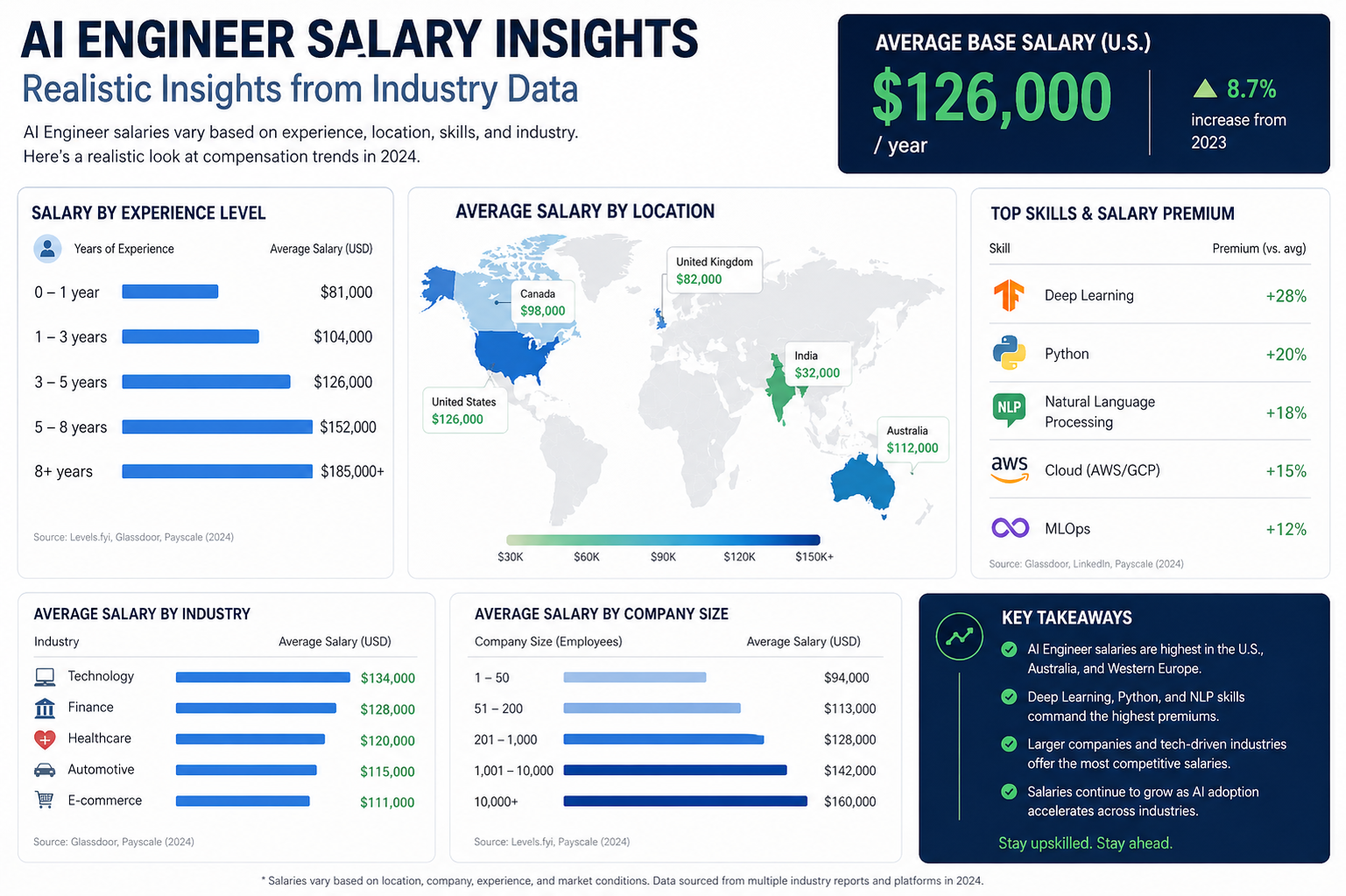
AI engineering has become one of the most financially rewarding career paths in the technology sector, but compensation is not uniform across the world. Salaries vary widely based on regional economic conditions, demand for talent, cost of living, and the maturity of the AI industry in each market. In highly developed tech ecosystems, companies compete aggressively for skilled engineers, which pushes compensation levels significantly higher. In emerging markets, salaries may be lower in absolute terms but still highly competitive within the local job landscape.
In general, global compensation trends show a clear pattern: regions with strong research ecosystems, large technology corporations, and advanced digital infrastructure tend to offer the highest salaries. However, remote work opportunities have started to blur these boundaries, allowing engineers in lower-cost regions to access international pay scales. This shift has gradually reshaped global salary expectations in AI-related roles.
United States AI Engineer Compensation Landscape
The United States remains one of the highest-paying markets for AI engineers. This is driven by the presence of leading technology companies, strong venture capital investment, and intense competition for machine learning expertise. Even entry-level professionals often receive compensation packages that are significantly above national averages for software roles.
As engineers progress in their careers, salary growth can be rapid. Mid-level professionals who can independently deploy machine learning systems and optimize models for production environments often receive substantial increases in base pay. Senior engineers, especially those working in advanced domains such as deep learning infrastructure, large-scale distributed systems, or generative AI models, can reach very high compensation levels. In many cases, total compensation is not limited to salary alone but includes bonuses and equity, which can significantly increase overall earnings.
The most experienced AI professionals working in top-tier organizations or research-focused roles often reach compensation levels that reflect both technical expertise and leadership responsibility. These positions may involve guiding AI strategy, mentoring teams, and influencing product direction, which adds to their overall value within companies.
European AI Engineering Salary Trends
In Europe, AI engineer salaries are generally strong but more varied compared to the United States. Countries with highly developed tech sectors such as Germany, the United Kingdom, and Switzerland tend to offer higher compensation levels, while other regions may offer more moderate pay. However, strong employee benefits, job stability, and work-life balance often complement salary packages in this region.
Mid-level and senior AI engineers in Europe typically experience steady salary growth, especially when working in industries such as automotive technology, finance, and industrial automation. While base salaries may sometimes be lower than those in the United States, total compensation can still be competitive when factoring in benefits and long-term career stability.
Remote work has also started influencing European salary structures, as companies increasingly hire international talent. This has created opportunities for engineers in various countries to access higher-paying roles without relocating.
Asia-Pacific AI Salary Distribution
The Asia-Pacific region presents a highly diverse salary landscape for AI engineers. Countries with advanced technology industries, such as Japan, South Korea, Singapore, and parts of China, offer competitive compensation packages. These markets are heavily investing in artificial intelligence, automation, and robotics, which has increased demand for skilled professionals.
In rapidly developing tech hubs within the region, salaries are rising steadily as companies compete for talent. However, there is still a noticeable gap between the highest-paying countries and developing economies within the region. Despite this variation, the overall trajectory is upward, with AI engineers experiencing strong career growth opportunities.
Many multinational companies operating in Asia also offer compensation packages aligned with global standards, particularly for engineers working on international products or research initiatives. This further enhances earning potential for skilled professionals in the region.
Remote Work and Global Salary Equalization
One of the most significant changes in the AI job market is the rise of remote work. Companies are increasingly hiring AI engineers from different parts of the world, allowing talent to access salaries that were previously limited to specific regions. This shift has created a more globalized compensation structure.
Engineers working remotely for international companies often earn salaries that exceed local market averages. This is particularly beneficial for professionals in regions with lower domestic pay scales. However, competition has also increased, as companies now have access to a broader talent pool.
Remote roles also introduce flexibility in lifestyle and work environment, which has become an additional factor influencing career decisions. As this trend continues, salary differences between regions may gradually narrow, although not completely disappear.
Role of Experience in Salary Progression
Experience remains one of the strongest factors influencing AI engineer salaries. Entry-level professionals typically focus on learning foundational skills such as programming, data preprocessing, and basic machine learning algorithms. Their compensation reflects their early-stage contributions and learning curve.
As engineers transition into mid-level roles, their responsibilities expand significantly. They begin to work on production systems, optimize models for real-world performance, and contribute to larger project goals. This increase in responsibility is directly reflected in salary growth.
Senior engineers not only handle complex technical challenges but also contribute to architectural decisions, research direction, and team leadership. Their compensation reflects both technical mastery and strategic impact. At this stage, salary growth is often supplemented by bonuses, stock options, and performance-based incentives.
Impact of Specialization on Earnings
Specialization plays a major role in determining salary levels within AI engineering. Professionals who focus on high-demand areas such as deep learning, natural language processing, computer vision, or reinforcement learning often command higher compensation due to the scarcity of expertise.
Emerging fields such as generative AI and large language model development have further increased demand for specialized skills. Engineers working in these areas are often compensated at premium levels due to the cutting-edge nature of their work and the direct business value they provide.
In contrast, more general machine learning roles may offer slightly lower compensation, although they still remain highly competitive compared to many other engineering disciplines.
Industry-Specific Salary Differences
AI engineers working in different industries often experience varying salary structures. Technology companies typically offer some of the highest compensation packages due to their direct involvement in AI-driven products and services. These organizations rely heavily on machine learning for innovation and scalability.
Financial services firms also offer strong compensation, particularly for roles involving algorithmic trading, risk modeling, and fraud detection. The high-value nature of financial decision-making makes AI expertise especially valuable in this sector.
Healthcare, automotive, and manufacturing industries are also investing heavily in AI, leading to increasing demand and improving salary trends. While compensation may vary between industries, the overall demand for AI talent continues to push salaries upward across all sectors.
Total Compensation Beyond Base Salary
AI engineer compensation is rarely limited to base salary alone. Many organizations offer additional financial incentives such as performance bonuses, stock options, and profit-sharing plans. These components can significantly increase total earnings, especially in high-growth companies.
Equity-based compensation is particularly common in startups and large technology firms. While its value may fluctuate based on company performance, it can become a major financial benefit over time. Bonuses tied to performance metrics or project success also contribute to overall income.
Non-monetary benefits such as flexible work arrangements, learning budgets, and research opportunities further enhance the attractiveness of AI engineering roles, even though they do not directly affect salary figures.
Long-Term Salary Growth and Career Trajectory
The long-term earning potential for AI engineers is strongly influenced by continuous learning and adaptation. The field evolves rapidly, with new models, frameworks, and techniques emerging frequently. Engineers who consistently update their skills tend to experience sustained salary growth.
Career progression often leads to roles such as senior machine learning engineer, AI architect, research scientist, or technical lead. Each of these positions comes with increased responsibility and higher compensation.
In the long run, some professionals transition into leadership or specialized research roles, where their expertise is applied at a strategic level. These positions often represent the highest earning potential in the field.
Key Factors Influencing Salary Variations
Several key factors collectively determine AI engineer salaries. Technical expertise, years of experience, industry type, geographic location, and company size all play significant roles. Additionally, the ability to work on large-scale systems and deliver measurable business impact can significantly increase earning potential.
Communication skills and cross-functional collaboration abilities are also increasingly valued, especially in senior roles. Engineers who can bridge the gap between technical implementation and business strategy often receive higher compensation due to their broader impact.
Market demand continues to be a major driver of salary trends. As artificial intelligence becomes more integrated into everyday products and services, the demand for skilled professionals continues to grow, supporting strong salary levels across the industry.
Evolving Future Salary Expectations
The future of AI engineer compensation is expected to remain strong as artificial intelligence continues to expand into new industries and applications. Advancements in automation, generative models, and intelligent systems will likely increase demand for highly skilled professionals.
As competition for talent intensifies globally, salary levels are expected to remain competitive or continue rising in many regions. Engineers who develop expertise in advanced AI domains and maintain adaptability will be best positioned to benefit from this growth.
Overall, AI engineering continues to represent one of the most dynamic and financially rewarding career paths in the modern technology landscape, with strong long-term prospects for skilled professionals across the world.
Advanced Career Stages in AI Engineering
As AI engineers progress beyond mid-level roles, their career trajectory becomes less about routine model building and more about system ownership, strategic decision-making, and innovation. At this stage, engineers are expected to design entire machine learning ecosystems rather than just individual models. This shift in responsibility is one of the key reasons compensation increases significantly at senior levels.
Senior AI engineers often work on architecture-level decisions that define how data flows through an organization, how models are trained at scale, and how systems are deployed reliably in production environments. Their work directly influences product performance, business outcomes, and long-term technical direction. Because of this impact, companies are willing to offer significantly higher compensation packages to attract and retain such talent.
Beyond senior engineering roles, AI professionals may transition into staff engineer, principal engineer, or AI architect positions. These roles focus heavily on cross-team collaboration, technical leadership, and solving complex system-wide challenges. Compensation at this level is often driven not just by technical skill, but also by leadership ability and strategic influence.
Research-Oriented AI Roles and Compensation Structure
A distinct branch within AI engineering involves research-focused roles. These positions are often found in large technology companies, specialized AI labs, and academic-industry hybrid environments. Research scientists and applied scientists typically focus on developing new algorithms, improving model efficiency, and pushing the boundaries of machine learning capabilities.
Compensation in research roles can be extremely competitive, especially when working on cutting-edge technologies such as large language models, reinforcement learning systems, or multimodal AI frameworks. In many cases, research roles offer higher total compensation compared to traditional engineering roles due to the specialized nature of the work and the scarcity of talent in this domain.
However, these roles also demand deep theoretical understanding, strong mathematical foundations, and the ability to publish or contribute to scientific advancements. The balance between research output and practical application often defines career progression and salary growth in this path.
Impact of Education and Academic Background
Educational background continues to play a role in AI engineer compensation, although its importance has gradually decreased compared to practical experience. Candidates with advanced degrees in computer science, data science, machine learning, or related fields often start with slightly higher salaries due to their strong theoretical foundation.
However, the AI industry places increasing value on demonstrable skills rather than formal qualifications alone. Engineers who can build scalable systems, deploy production-ready models, and solve real-world problems often progress faster in terms of salary growth, regardless of academic background.
That said, higher education still matters in specialized research roles, where advanced mathematical knowledge and theoretical expertise are essential. In such cases, master’s or doctoral degrees can significantly enhance earning potential and open doors to high-impact positions.
Startup vs Large Company Salary Dynamics
AI engineers working in startups and large corporations often experience very different compensation structures. Large technology companies typically offer higher base salaries, structured bonuses, and equity packages that may become highly valuable over time. These organizations provide stability, well-defined career paths, and access to large-scale AI infrastructure.
Startups, on the other hand, may offer lower base salaries but compensate with equity ownership and faster career progression opportunities. In high-growth startups, equity can become extremely valuable if the company succeeds, potentially exceeding traditional salary earnings in the long term.
The choice between startups and large companies often depends on risk tolerance, career goals, and preferred working style. Some engineers prioritize stability and structured growth, while others prefer high-risk, high-reward environments.
Skill Sets That Drive Higher Salaries
Certain technical skills have a direct impact on AI engineer compensation. Proficiency in machine learning frameworks such as TensorFlow, PyTorch, and JAX is essential for most roles. However, advanced expertise in distributed systems, GPU optimization, and scalable model deployment significantly increases earning potential.
Data engineering skills are also highly valuable, as AI systems rely heavily on clean, well-structured datasets. Engineers who can design efficient data pipelines and manage large-scale data infrastructure are often compensated at higher levels.
Another critical area is MLOps, which focuses on deploying, monitoring, and maintaining machine learning models in production. This skill bridges the gap between development and operational environments and is increasingly in demand across industries.
Additionally, expertise in specialized domains such as natural language processing, computer vision, and generative AI can lead to premium compensation due to the complexity and demand associated with these fields.
Emerging Technologies and Salary Impact
The rapid evolution of AI technologies has a direct impact on salary trends. Emerging areas such as generative AI, foundation models, and autonomous systems have created new categories of highly specialized roles. Engineers working in these fields often receive significantly higher compensation due to the novelty and business impact of their work.
Generative AI, in particular, has transformed the demand landscape. Engineers who understand transformer architectures, large-scale model training, and prompt optimization are now among the most sought-after professionals in the industry. This surge in demand has contributed to rapid salary growth in a short period of time.
Similarly, advancements in reinforcement learning and robotics are opening new opportunities for high-paying roles in industries such as automation, logistics, and autonomous transportation.
Geographic Mobility and Remote Salary Arbitrage
Geographic mobility has become an important factor in AI compensation. Engineers willing to relocate to high-demand tech hubs often experience substantial salary increases. Cities with strong AI ecosystems tend to offer higher compensation due to competition among employers.
At the same time, remote work has introduced a new phenomenon often referred to as salary arbitrage. Skilled engineers living in lower-cost regions can now access salaries traditionally reserved for high-cost countries. This has created new opportunities for financial growth while maintaining geographic flexibility.
However, companies are increasingly adjusting compensation based on location, which means remote salary advantages may vary depending on employer policies and regional benchmarks.
Performance-Based Compensation Models
Modern AI engineering compensation is increasingly tied to performance metrics. Companies evaluate engineers based on the impact of their models, improvements in system efficiency, and contributions to product performance.
Performance-based bonuses can significantly increase total compensation, especially in roles where AI systems directly influence revenue or operational efficiency. Engineers who consistently deliver high-impact solutions often see faster salary growth compared to peers.
In some organizations, compensation is also linked to research output, system scalability improvements, or cost reduction achievements. This performance-driven structure encourages innovation and continuous improvement.
Leadership Roles and Executive Transition Paths
Experienced AI engineers often transition into leadership positions such as AI team lead, engineering manager, or director of machine learning. These roles shift focus from hands-on technical work to team management, project coordination, and strategic planning.
Leadership roles typically offer higher total compensation, but they also require strong communication skills, decision-making ability, and organizational awareness. Engineers in these positions are responsible for aligning technical development with business goals.
At the highest level, some professionals transition into executive roles such as Chief AI Officer or VP of Engineering, where compensation packages can become extremely large, often combining salary, bonuses, and significant equity stakes.
Long-Term Industry Demand and Salary Stability
The long-term outlook for AI engineer salaries remains strong due to sustained industry demand. Artificial intelligence is becoming deeply integrated into nearly every sector, including healthcare, finance, education, transportation, and entertainment.
As AI adoption expands, the need for skilled professionals capable of designing, implementing, and maintaining intelligent systems continues to grow. This structural demand supports long-term salary stability and upward growth trends.
Even during economic fluctuations, AI-related roles tend to remain resilient due to their strategic importance in business operations and innovation.
Final Perspective on AI Engineer Earnings
AI engineering continues to be one of the most financially promising career paths in the global technology landscape. Compensation is shaped by a combination of technical expertise, experience, specialization, and industry demand.
While entry-level salaries are already competitive, the most significant financial growth occurs as engineers gain experience and move into specialized or leadership roles. The field rewards continuous learning, adaptability, and the ability to solve complex real-world problems.
Overall, AI engineering offers not only strong earning potential but also long-term career stability in an industry that is rapidly shaping the future of technology.
Negotiation Strategies and Salary Optimization in AI Roles
Salary growth in AI engineering is not determined only by experience or technical skill; negotiation also plays a major role in total compensation. Many professionals underestimate how significantly offer negotiation can impact earnings, especially in competitive markets where companies expect candidates to negotiate.
Strong candidates typically evaluate multiple offers before finalizing a role. This creates leverage that can be used to improve base salary, bonuses, or equity packages. Even within the same experience level, engineers who actively negotiate can often secure noticeably higher compensation than those who accept initial offers without discussion.
Understanding market benchmarks is also critical. Engineers who research current salary ranges for their experience level, specialization, and region are better positioned to negotiate effectively. Companies are generally flexible when they recognize that a candidate’s expectations align with industry standards and competitive hiring pressure.
Equity, Stock Options, and Long-Term Wealth Building
In many AI engineering roles, especially in startups and large technology firms, equity forms a significant portion of total compensation. While base salary provides immediate income stability, equity represents long-term financial potential.
Stock options or restricted stock units can become extremely valuable if the company performs well. In high-growth companies, equity gains can sometimes exceed several years of salary combined. However, equity also carries risk, as its value depends entirely on company performance and market conditions.
Understanding vesting schedules is important for engineers evaluating offers. Most equity grants vest over several years, meaning long-term commitment is often required to fully benefit from them. Engineers who stay with a company during its growth phase often see the highest returns.
AI Engineer Salary Progression Over Time
Salary progression in AI engineering tends to follow a steep upward curve compared to many other professions. Early career growth is usually rapid due to high demand and limited supply of skilled professionals. Within a few years, engineers often move from entry-level compensation to mid-level earnings that reflect significantly higher responsibility.
Mid-career stages are where salary acceleration is most noticeable. Engineers at this level often transition into ownership roles for systems, models, or entire AI pipelines. Their ability to independently deliver production-grade solutions makes them highly valuable in the job market.
At senior levels, salary growth becomes less linear and more dependent on impact. Engineers who lead high-value projects or contribute to core product innovations often see compensation increases tied to business outcomes rather than tenure alone.
Cost of Living Adjustments and Real Income Value
While nominal salary figures are important, real income value depends heavily on cost of living. An AI engineer earning a high salary in an expensive city may have less disposable income than a similarly skilled engineer in a lower-cost region working remotely.
Companies often adjust salaries based on geographic location, although this practice is evolving with the rise of remote work. Some organizations now offer standardized global pay scales, while others continue to use location-based compensation models.
Engineers evaluating job offers must consider housing costs, taxes, transportation, and lifestyle expenses when assessing real earning potential. A lower nominal salary in a low-cost region can sometimes provide greater financial comfort than a higher salary in an expensive tech hub.
Freelance and Contract AI Engineering Income
Beyond traditional employment, AI engineers also have opportunities in freelance and contract-based work. This path can offer significantly higher hourly or project-based earnings, especially for experienced professionals with specialized skills.
Freelance AI engineers often work on short-term projects such as model development, system optimization, or data pipeline design. These roles can pay premium rates due to the flexibility and expertise required.
However, freelance work also comes with income variability and lack of long-term benefits such as health insurance or equity. Engineers choosing this path must balance higher short-term income with financial stability considerations.
Industry Disruption and Salary Acceleration
The rapid expansion of artificial intelligence across industries has created continuous disruption, which directly influences salary trends. As companies race to integrate AI into their products and services, demand for skilled engineers continues to outpace supply.
This imbalance leads to aggressive hiring strategies, including higher salaries, signing bonuses, and accelerated promotion paths. Engineers who specialize in emerging AI technologies often benefit the most from these market dynamics.
Industries undergoing digital transformation, such as healthcare, logistics, and manufacturing, are particularly active in hiring AI talent. These sectors often offer increasing compensation packages as they compete with established tech companies.
AI Research Labs and Elite Compensation Levels
At the highest level of AI engineering, research labs and elite AI organizations offer some of the most competitive compensation packages in the world. These environments focus on breakthrough innovations, often involving large-scale models and advanced machine learning systems.
Compensation in these roles is not only based on engineering skill but also on research contributions, publications, and ability to solve highly complex problems. Engineers working in these environments often collaborate with top-tier researchers and contribute to globally impactful technologies.
Total compensation in elite AI labs can reach extremely high levels due to a combination of salary, bonuses, and equity. However, these roles are also highly selective and require exceptional expertise.
Skill Evolution and Continuous Learning Requirements
One of the defining characteristics of AI engineering is the need for continuous learning. The field evolves rapidly, with new architectures, tools, and methodologies emerging frequently. Engineers who fail to adapt risk stagnation in both skills and salary growth.
Successful professionals continuously expand their knowledge in areas such as deep learning optimization, large-scale training systems, and AI deployment strategies. Staying updated with industry trends ensures long-term career growth and compensation increases.
Learning new programming frameworks, understanding hardware acceleration, and mastering cloud-based AI infrastructure are all important for maintaining competitiveness in the job market.
AI Engineer Salary Compared to Other Tech Roles
AI engineering salaries are generally higher than many traditional software engineering roles due to the specialized knowledge required. However, the gap varies depending on company type and role complexity.
Compared to general backend or frontend development roles, AI engineers often earn more due to the added complexity of machine learning systems. However, senior software engineers in large-scale distributed systems can sometimes reach similar compensation levels.
The key differentiator is specialization. Engineers working on high-impact AI systems or advanced machine learning research tend to command higher salaries than those in more general development roles.
Psychological and Lifestyle Factors in High-Salary AI Roles
High-paying AI roles often come with increased responsibility, tighter deadlines, and higher cognitive demands. Engineers are expected to solve complex problems, optimize systems, and continuously deliver improvements.
This level of pressure can influence work-life balance, especially in fast-paced environments such as startups or competitive research labs. However, many organizations now emphasize flexible work arrangements and mental well-being to retain top talent.
Despite challenges, many engineers find AI work highly rewarding due to its intellectual depth and real-world impact.
Long-Term Financial Trajectory in AI Careers
Over time, AI engineers who remain in the field and continuously develop their expertise can achieve substantial financial growth. Career progression often leads to high-paying senior, leadership, or research roles with significant compensation packages.
Some engineers eventually transition into entrepreneurship, founding AI-driven startups or consulting firms. In successful cases, this path can lead to even greater financial outcomes, although it carries higher risk.
Overall, the long-term financial trajectory in AI engineering remains strong, supported by ongoing technological advancement and increasing global reliance on intelligent systems.
AI Engineer Compensation in Emerging Markets
In emerging economies, AI engineering salaries are steadily rising but still vary widely depending on local demand, company type, and access to global clients. While base pay may be lower compared to developed regions, the growth rate in compensation is often faster due to increasing digital transformation and talent shortages.
Many multinational companies now operate development centers in emerging markets, offering salaries that are significantly higher than local averages. This creates strong opportunities for skilled engineers to earn competitive incomes while living in lower-cost environments. Additionally, remote work has further expanded access to international salary standards, allowing engineers to bridge the global pay gap more effectively.
As local AI ecosystems mature, salary structures are expected to continue improving. Investment in tech education, startup growth, and government-backed digital initiatives is contributing to stronger demand for AI professionals across these regions.
Influence of Company Size on Salary Levels
Company size plays a major role in determining AI engineer compensation. Large corporations typically offer structured salary bands, comprehensive benefits, and predictable growth paths. These organizations also provide access to large datasets, advanced infrastructure, and complex systems, which contribute to skill development.
Mid-sized companies often balance stability and flexibility. They may offer slightly lower base salaries than large corporations but compensate with faster promotions and broader responsibilities. Engineers in these environments often gain exposure to multiple aspects of product development, accelerating career growth.
Small companies and startups usually offer the highest variability in compensation. While base salaries may be modest, equity stakes can become extremely valuable if the company succeeds. These environments are often fast-paced and require engineers to take on diverse responsibilities beyond traditional roles.
AI Engineer Demand Across Industries
The demand for AI engineers is not limited to the technology sector. Almost every major industry is integrating artificial intelligence into its operations, which has expanded career opportunities significantly.
In finance, AI is used for fraud detection, algorithmic trading, and risk modeling. In healthcare, it supports diagnostics, predictive analytics, and personalized treatment planning. In retail and e-commerce, AI drives recommendation systems, demand forecasting, and customer behavior analysis.
Manufacturing and logistics industries are adopting AI for automation, predictive maintenance, and supply chain optimization. Each of these sectors values AI engineers differently, but all contribute to increasing overall salary demand due to the critical nature of AI-driven efficiency improvements.
Career Stability and Job Security in AI Engineering
AI engineering offers relatively strong job security compared to many other technical fields. The increasing integration of artificial intelligence into core business functions ensures continuous demand for skilled professionals.
However, job stability is closely tied to skill relevance. Engineers who fail to keep up with evolving technologies may find their roles less competitive over time. Continuous learning and adaptation are essential for maintaining long-term employability.
In general, engineers with strong foundations in machine learning, systems design, and data infrastructure tend to experience stable career paths, even during economic downturns, due to the strategic importance of their work.
Non-Salary Benefits in AI Engineering Roles
Beyond monetary compensation, AI engineering roles often include a range of additional benefits. These can include flexible working hours, remote work options, learning budgets, conference participation, and access to advanced tools and research environments.
Some companies also offer wellness programs, relocation assistance, and extended parental leave policies. While these benefits do not directly increase salary, they contribute significantly to overall job satisfaction and long-term career sustainability.
Access to cutting-edge technology and large-scale datasets is another non-monetary advantage, particularly valuable for engineers focused on research and innovation.
Salary Growth vs Skill Plateau Risk
One of the key challenges in AI engineering careers is avoiding skill plateau. Engineers who specialize too narrowly or fail to adapt to new technologies may experience slower salary growth over time.
The field evolves quickly, and skills that are in high demand today may become less relevant in the future. For example, engineers who only focus on outdated frameworks or limited application areas may find fewer opportunities for advancement.
On the other hand, professionals who continuously expand their expertise into emerging domains such as generative AI, multimodal systems, and large-scale distributed training tend to maintain strong salary growth throughout their careers.
Future of AI Engineer Salaries
The future outlook for AI engineer salaries remains highly positive. As artificial intelligence becomes more deeply embedded in global infrastructure, demand for skilled professionals is expected to increase further.
New technological advancements such as autonomous systems, advanced robotics, and next-generation foundation models will create additional specialized roles. These roles are likely to command premium compensation due to their complexity and impact.
At the same time, competition among companies for top talent is expected to intensify. This will likely sustain high salary levels and expand compensation packages, especially in high-impact roles.
Final Conclusion
AI engineering has established itself as one of the most financially rewarding and intellectually engaging career paths in the modern technology landscape. Salaries in this field are shaped by a combination of experience, specialization, location, industry demand, and individual performance.
While entry-level positions already offer competitive compensation, the most significant financial growth occurs as engineers advance into specialized, senior, or leadership roles. Equity, bonuses, and performance-based incentives further enhance total earnings, especially in high-growth companies.
The global expansion of artificial intelligence ensures continued demand for skilled professionals, making the field both stable and lucrative in the long term. Engineers who invest in continuous learning, adapt to emerging technologies, and develop strong problem-solving capabilities are well-positioned to achieve sustained salary growth and long-term career success.