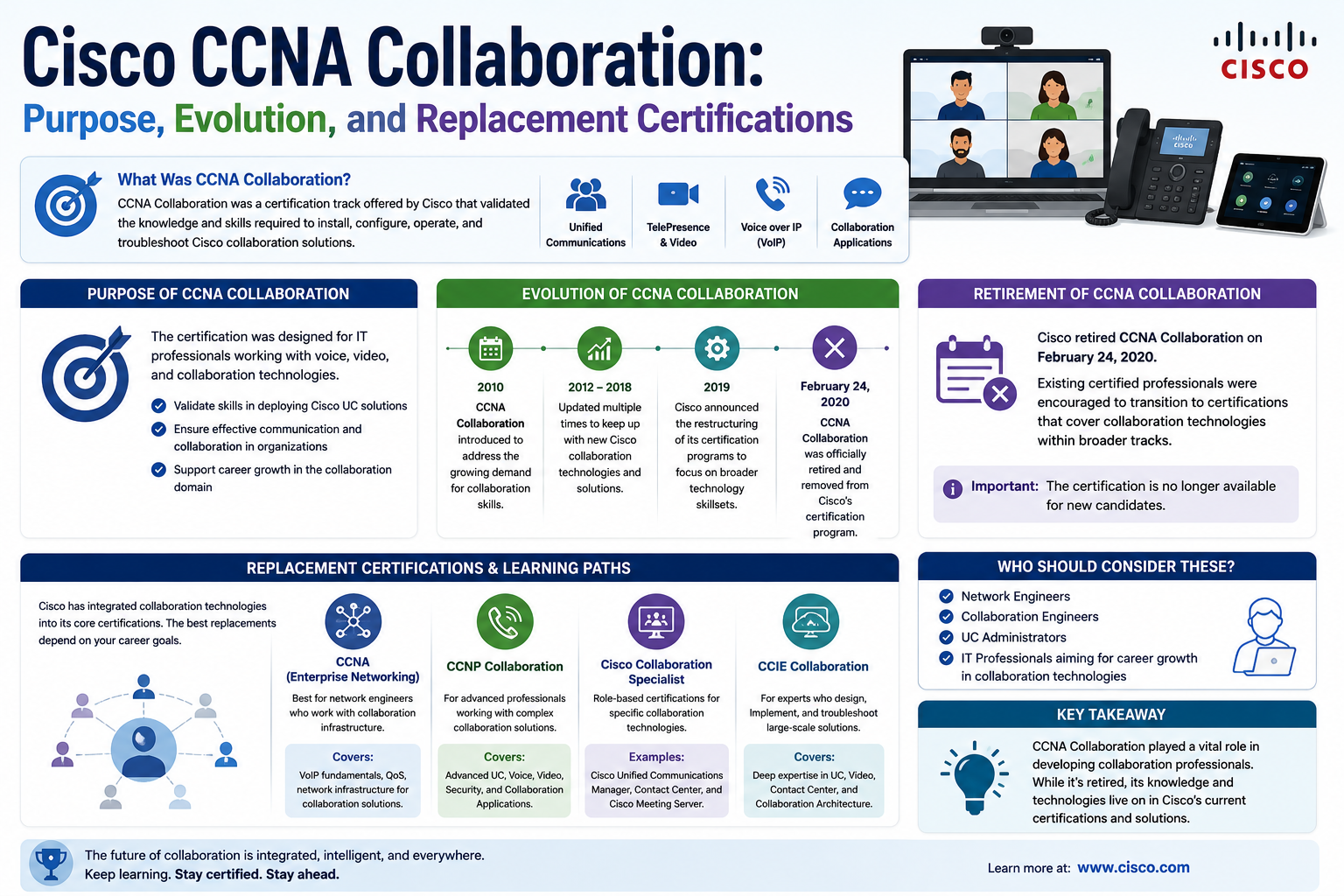
The Cisco Certified Network Associate Collaboration certification, better known as CCNA Collaboration, was once one of the most recognized certifications for IT professionals working in voice, video, and unified communications technologies. During the rapid expansion of internet-based communication systems, businesses needed professionals who could manage modern collaboration infrastructures that connected employees, offices, and customers across multiple locations. Cisco introduced the CCNA Collaboration certification to help meet this growing demand.
As communication systems evolved from traditional telephone networks into internet-based collaboration platforms, organizations required highly skilled engineers capable of supporting Voice over IP systems, video conferencing environments, messaging platforms, and unified communications applications. The CCNA Collaboration certification validated the foundational knowledge needed to deploy and manage these technologies effectively.
For many years, this certification served as the entry point into Cisco collaboration careers. It became popular among network engineers, voice specialists, systems administrators, and telecommunications professionals who wanted to specialize in enterprise communication systems. The certification also helped organizations identify professionals capable of maintaining critical collaboration environments that supported daily business operations.
Although Cisco eventually retired the CCNA Collaboration certification during a major restructuring of its certification program, the certification remains an important part of networking history. It represented a time when collaboration technologies became central to enterprise infrastructure and when specialized voice and video expertise became increasingly valuable in IT careers.
Understanding the history and purpose of the CCNA Collaboration certification helps explain how modern collaboration technologies evolved and why unified communications remain so important in today’s business world.
The Growth of Unified Communications
To fully understand the significance of CCNA Collaboration, it is important to understand how communication systems changed during the early growth of enterprise networking.
Traditional business communication relied heavily on analog telephone systems. Companies maintained separate infrastructures for voice communication, data networking, video systems, and messaging services. These separate systems were expensive to manage and difficult to scale across large organizations.
As internet technologies improved, businesses began transitioning toward unified communications platforms that combined multiple communication methods into a single integrated environment. Voice calls started moving across IP networks rather than traditional phone lines. Video conferencing became more affordable and practical. Messaging systems evolved into real-time collaboration platforms.
This transformation created enormous opportunities for businesses. Organizations could reduce operational costs, improve communication efficiency, and support employees working across multiple offices or countries. Unified communications also improved customer service by integrating voice, messaging, and conferencing systems into centralized platforms.
However, these new technologies introduced new technical challenges. Voice and video traffic behaved differently from traditional network traffic. Applications such as VoIP and video conferencing required low latency, minimal packet loss, and stable connectivity to function properly.
Businesses therefore needed IT professionals with specialized skills in collaboration technologies. Cisco recognized this growing need and responded by developing collaboration-focused certification programs.
Cisco’s Expansion into Collaboration Technologies
Cisco originally built its reputation through networking products such as routers and switches. As networking technology evolved, Cisco expanded aggressively into enterprise collaboration and unified communications solutions.
The company introduced products designed to support internet-based communication systems, including IP telephony platforms, conferencing systems, collaboration applications, and video communication infrastructure.
Cisco Unified Communications Manager became one of the company’s flagship collaboration products. It allowed businesses to manage voice calls, devices, voicemail services, conferencing systems, and communication policies through centralized infrastructure.
Cisco also developed collaboration hardware such as:
- IP phones
- Video conferencing endpoints
- Telepresence systems
- Voice gateways
- Collaboration servers
- Unified messaging systems
As businesses deployed these technologies, they needed professionals capable of configuring, troubleshooting, and maintaining increasingly complex collaboration environments.
Cisco certifications became one of the primary ways for professionals to validate these skills. The CCNA Collaboration certification was specifically designed to provide foundational collaboration knowledge for IT professionals entering the field.
What Was the CCNA Collaboration Certification?
The Cisco Certified Network Associate Collaboration certification was an associate-level credential focused on collaboration technologies, voice networking, video communications, and unified communications infrastructure.
Unlike the standard CCNA certification, which focused broadly on networking fundamentals, CCNA Collaboration specialized in communication technologies used within enterprise environments.
The certification validated foundational knowledge in areas such as:
- Voice over IP
- Cisco collaboration architecture
- Video communication systems
- Cisco Unified Communications Manager
- IP telephony
- Collaboration endpoints
- Video conferencing infrastructure
- Quality of Service
- Collaboration troubleshooting
- Voice gateway configuration
Cisco designed the certification for professionals responsible for supporting communication systems used by businesses and organizations.
The certification was especially relevant for environments where communication uptime and performance were critical. Many businesses relied on collaboration platforms for customer support, remote meetings, executive communications, and day-to-day operations. Downtime or poor call quality could significantly impact productivity and business performance.
CCNA Collaboration helped professionals develop the knowledge needed to maintain reliable communication environments.
The Purpose Behind the Certification
Cisco created CCNA Collaboration with several major goals in mind.
One important goal was to address the growing demand for collaboration specialists. Businesses increasingly needed engineers who understood how voice and video systems operated within IP-based networks.
Traditional networking certifications did not always provide sufficient coverage of voice and video technologies. Cisco therefore developed a specialized certification focused specifically on collaboration systems.
Another major goal involved preparing professionals for real-world collaboration roles. Cisco wanted learners to develop practical knowledge that aligned with enterprise deployment scenarios.
The certification focused heavily on hands-on concepts such as:
- Configuring collaboration devices
- Managing voice systems
- Deploying video endpoints
- Troubleshooting call quality issues
- Supporting communication infrastructure
- Maintaining collaboration services
Cisco also intended the certification to serve as a career entry point into collaboration engineering. Many professionals used CCNA Collaboration as the first step toward more advanced Cisco certifications and specialized communication careers.
The certification also helped organizations identify qualified candidates for collaboration-related job roles. Since collaboration systems directly affected business communication, companies wanted professionals who could demonstrate verified expertise.
The Importance of Voice over IP
Voice over IP technology played a central role in the CCNA Collaboration certification.
VoIP refers to transmitting voice communications over internet-based networks rather than traditional telephone infrastructure. This technology revolutionized enterprise communication by reducing costs and improving flexibility.
Before VoIP adoption, organizations maintained separate networks for voice and data communication. Traditional phone systems required dedicated wiring and hardware that increased infrastructure complexity and maintenance costs.
VoIP simplified communication infrastructure by allowing voice traffic to travel across existing IP networks.
This transition provided several advantages:
- Lower communication costs
- Easier scalability
- Improved mobility
- Simplified management
- Integration with collaboration applications
- Support for remote communication
However, voice traffic introduced new technical challenges for network engineers.
Unlike standard data traffic, voice communication requires real-time transmission. Delays, jitter, and packet loss can significantly reduce call quality.
CCNA Collaboration therefore taught professionals how to optimize networks for voice traffic and maintain high-quality communication services.
The Role of Video Collaboration
Video communication technologies also became increasingly important during the years when CCNA Collaboration was active.
Businesses adopted video conferencing systems to reduce travel costs and improve communication between geographically distributed teams.
Cisco developed advanced video collaboration products such as TelePresence systems that delivered high-quality video conferencing experiences.
Video collaboration technologies became especially valuable for:
- Remote meetings
- Executive communications
- Distance learning
- Healthcare consultations
- Global business operations
- Team collaboration
Supporting video systems required specialized technical knowledge because video traffic consumes significant network bandwidth and demands stable connectivity.
CCNA Collaboration included topics related to:
- Video endpoint deployment
- Video infrastructure configuration
- Multipoint conferencing
- Video quality management
- Video troubleshooting
- Video network optimization
The certification helped professionals understand how video technologies integrated into enterprise networks and how to maintain reliable video communication services.
Collaboration Engineering as a Career Path
One of the reasons CCNA Collaboration became popular was because it aligned with rapidly growing IT career opportunities.
As businesses invested heavily in collaboration platforms, demand for collaboration engineers increased significantly.
Professionals who pursued CCNA Collaboration often worked in roles such as:
- VoIP engineer
- Collaboration engineer
- Unified communications administrator
- Voice support specialist
- Telecommunications engineer
- Video systems engineer
- Network collaboration technician
- Cisco voice administrator
These professionals supported communication systems that organizations relied upon daily.
Typical responsibilities included:
- Configuring IP phones
- Managing collaboration servers
- Troubleshooting call quality problems
- Supporting conferencing systems
- Monitoring communication infrastructure
- Managing voice gateways
- Supporting remote communication platforms
The certification also served as a stepping stone toward advanced collaboration certifications and higher-level engineering roles.
Industries That Relied on Collaboration Experts
Collaboration technologies became essential across numerous industries.
Healthcare organizations used collaboration platforms to support communication between hospitals, clinics, and medical staff. Video conferencing technologies enabled remote consultations and improved patient coordination.
Financial institutions relied heavily on secure communication systems for customer interactions, internal operations, and executive collaboration.
Educational institutions adopted video conferencing and collaboration platforms to support online learning and communication between students and faculty.
Government agencies used collaboration infrastructure to improve communication between departments and regional offices.
Large multinational corporations depended on unified communications systems to connect employees working across multiple countries and time zones.
Because communication services were critical to operational efficiency, organizations valued professionals who could maintain reliable collaboration environments.
The Evolution from Earlier Cisco Certifications
CCNA Collaboration evolved from earlier Cisco certifications focused separately on voice and video technologies.
Initially, Cisco offered independent certification tracks for voice and video specialties. These certifications reflected the industry structure at the time because voice and video systems often operated independently.
However, communication technologies gradually merged into unified collaboration platforms.
Businesses no longer wanted separate systems for voice, video, conferencing, and messaging. Instead, they preferred integrated communication environments that supported multiple services within centralized infrastructure.
Cisco adapted its certification strategy accordingly.
The company retired older voice and video certifications and introduced CCNA Collaboration as a unified associate-level certification focused on modern collaboration technologies.
This transition reflected broader changes within enterprise IT environments where networking and communication systems became increasingly interconnected.
Why Collaboration Skills Became Valuable
Collaboration technologies eventually became essential to everyday business operations.
Organizations depended on communication platforms for:
- Internal communication
- Customer support
- Executive meetings
- Team collaboration
- Remote work
- Video conferencing
- Mobile communication
- Unified messaging
As businesses expanded globally, reliable communication systems became even more important.
Companies needed professionals who could maintain collaboration infrastructure capable of supporting thousands of users across multiple locations.
Because communication failures could disrupt productivity and customer service, collaboration engineers became highly valuable IT professionals.
CCNA Collaboration helped validate the skills needed to support these mission-critical environments.
The Technical Skills Covered
CCNA Collaboration covered a wide range of technical concepts related to collaboration infrastructure.
Candidates learned about Cisco collaboration architecture and how communication systems integrated within enterprise networks.
The certification also focused on practical operational skills such as:
- Configuring Cisco IP phones
- Managing collaboration endpoints
- Deploying voice gateways
- Configuring dial plans
- Supporting voicemail systems
- Managing user accounts
- Monitoring call quality
- Troubleshooting collaboration problems
Quality of Service was another major topic.
Since voice and video traffic require low latency and consistent performance, engineers learned how to prioritize collaboration traffic within enterprise networks.
Security concepts were also important because communication systems required protection against unauthorized access and service disruptions.
The certification emphasized troubleshooting as well. Candidates learned how to diagnose connectivity issues, call failures, endpoint registration problems, and performance degradation within collaboration environments.
The Growing Demand for Remote Communication
The increasing popularity of remote work further elevated the importance of collaboration technologies.
Organizations needed communication systems capable of supporting employees working outside traditional office environments.
Collaboration platforms allowed remote workers to:
- Participate in meetings
- Access messaging systems
- Join video conferences
- Use IP telephony services
- Collaborate with distributed teams
This growing reliance on remote communication increased demand for professionals skilled in collaboration infrastructure.
Even before large-scale remote work became common globally, businesses recognized the importance of flexible communication systems.
CCNA Collaboration helped prepare professionals to support these evolving workplace requirements.
Exams, Skills, Career Paths, and Industry Impact
The Cisco Certified Network Associate Collaboration certification became one of the most respected certifications for professionals interested in unified communications, voice networking, and enterprise collaboration technologies. During the period when organizations rapidly transitioned toward internet-based communication systems, collaboration expertise became an essential skill in enterprise IT environments.
Businesses no longer relied solely on traditional phone systems. Instead, they adopted integrated communication platforms capable of supporting voice calls, messaging, conferencing, video communication, and remote collaboration across global networks. Cisco developed the CCNA Collaboration certification to validate the foundational knowledge needed to deploy and support these advanced communication systems.
The certification focused heavily on practical collaboration skills used in real-world enterprise environments. Engineers pursuing the credential learned how to configure Cisco collaboration devices, manage IP telephony infrastructure, troubleshoot communication problems, and support video conferencing technologies.
CCNA Collaboration also became a popular starting point for professionals seeking long-term careers in collaboration engineering and unified communications administration. Many organizations actively searched for certified professionals capable of maintaining reliable communication systems because business operations increasingly depended on uninterrupted collaboration services.
This section explores the exams that made up the CCNA Collaboration certification, the technical skills learners developed, the importance of Quality of Service and collaboration troubleshooting, the industries that depended on collaboration specialists, and the long-term career opportunities associated with collaboration expertise.
The Structure of the CCNA Collaboration Certification
The CCNA Collaboration certification consisted of two separate exams. Candidates needed to pass both exams to earn the credential.
Cisco designed the certification structure to cover both foundational collaboration concepts and video networking technologies. This approach ensured that learners developed broad collaboration knowledge rather than focusing on only one communication discipline.
The two required exams were:
- Implementing Cisco Collaboration Devices
- Implementing Cisco Video Network Devices
Each exam addressed different aspects of enterprise collaboration environments.
The first exam focused primarily on collaboration infrastructure, communication devices, and Cisco Unified Communications technologies. The second exam concentrated more heavily on video networking systems and video collaboration technologies.
Together, these exams validated a wide range of collaboration skills that were highly valuable within enterprise IT departments.
Implementing Cisco Collaboration Devices Exam
The first required exam for CCNA Collaboration was Implementing Cisco Collaboration Devices, commonly identified by exam code 210-060 CICD.
This exam focused on the foundational technologies used within Cisco collaboration environments. Candidates learned how Cisco collaboration systems functioned and how communication services integrated within enterprise networks.
Important areas covered included:
- Cisco collaboration architecture
- Cisco Unified Communications Manager
- IP phone deployment
- Collaboration applications
- Voice messaging systems
- Collaboration protocols
- User management
- Device configuration
- Collaboration troubleshooting
Candidates learned how collaboration devices registered with communication systems and how call processing occurred within Cisco environments.
The exam also emphasized practical operational knowledge. Learners studied how to configure collaboration endpoints, manage user accounts, and support communication services within enterprise infrastructure.
Troubleshooting skills played a major role in the exam because collaboration engineers frequently dealt with real-time communication issues that required quick resolution.
The exam helped learners build a strong foundation for supporting enterprise voice and collaboration systems.
Implementing Cisco Video Network Devices Exam
The second required exam was Implementing Cisco Video Network Devices, identified by exam code 210-065 CIVND.
This exam focused specifically on video collaboration technologies and video communication infrastructure.
Video communication became increasingly important as organizations expanded globally and relied more heavily on remote collaboration.
The exam covered topics such as:
- Video conferencing systems
- Video endpoints
- Video infrastructure
- Multipoint conferencing
- Video quality optimization
- Video deployment models
- Video protocols
- Video troubleshooting
- Collaboration video architecture
Candidates learned how video communication systems operated across enterprise networks and how to maintain stable video performance.
Video traffic presents unique challenges because it consumes significant bandwidth and requires low latency for smooth communication experiences. Engineers therefore needed specialized knowledge to optimize networks for video collaboration services.
The exam also introduced candidates to Cisco TelePresence technologies and enterprise video conferencing systems used by large organizations.
By passing both exams, candidates demonstrated broad collaboration expertise covering both voice and video technologies.
Exam Format and Testing Experience
The CCNA Collaboration exams followed Cisco’s standard certification testing structure.
Each exam typically included between 55 and 65 questions. Candidates generally had approximately 75 minutes to complete each test.
Cisco used multiple question formats to evaluate both theoretical understanding and practical technical skills.
Question types commonly included:
- Multiple-choice questions
- Multiple-answer questions
- Drag-and-drop exercises
- Fill-in-the-blank questions
- Simulation questions
- Simlets
- Testlets
Simulation-based questions were especially important because they evaluated hands-on abilities rather than simple memorization.
Candidates often needed to analyze network scenarios, troubleshoot communication problems, configure collaboration settings, or complete operational tasks within simulated environments.
Cisco delivered the exams through authorized testing centers. The certification process required serious preparation because the exams covered a broad range of technical topics related to collaboration infrastructure.
The testing experience reflected real-world collaboration responsibilities where engineers needed both theoretical understanding and practical troubleshooting capabilities.
Collaboration Architecture and Infrastructure
One of the most important concepts within CCNA Collaboration involved understanding Cisco collaboration architecture.
Collaboration architecture refers to the collection of systems, devices, applications, and protocols that work together to provide communication services within enterprise environments.
Candidates learned how collaboration components interacted within Cisco Unified Communications deployments.
Important infrastructure components included:
- Cisco Unified Communications Manager
- Voice gateways
- IP phones
- Video endpoints
- Collaboration servers
- Voicemail systems
- Conferencing platforms
- Unified messaging services
Understanding collaboration architecture helped engineers deploy reliable communication environments and troubleshoot operational problems more effectively.
The certification also emphasized centralized management and scalability because many organizations supported thousands of users across distributed networks.
Engineers needed to understand how communication services functioned within both small and large enterprise infrastructures.
Cisco Unified Communications Manager
Cisco Unified Communications Manager played a major role within the CCNA Collaboration certification.
Often referred to as CUCM, this platform served as the central call-processing system for many Cisco voice deployments.
CUCM managed functions such as:
- Call routing
- Device registration
- User authentication
- Dial plans
- Communication policies
- Endpoint management
- Call processing services
Candidates learned how CUCM integrated with collaboration devices and enterprise networks.
The certification also introduced learners to tasks such as:
- Configuring users
- Managing endpoints
- Assigning directory numbers
- Supporting call features
- Maintaining communication services
Because CUCM environments often supported mission-critical communication systems, understanding the platform became essential for collaboration engineers.
The Importance of Quality of Service
Quality of Service, commonly called QoS, represented one of the most critical concepts within collaboration networking.
Unlike regular data traffic, voice and video communications are extremely sensitive to network performance issues.
Problems such as latency, jitter, and packet loss can significantly reduce communication quality.
Voice calls may experience:
- Delayed audio
- Echo problems
- Dropped calls
- Distorted sound
Video conferences may suffer from:
- Choppy video
- Frozen screens
- Audio synchronization issues
- Reduced video quality
QoS helps prioritize collaboration traffic across enterprise networks.
The CCNA Collaboration certification taught candidates how to implement QoS policies that ensured voice and video traffic received appropriate network priority.
Engineers learned how to:
- Classify traffic
- Prioritize collaboration packets
- Manage bandwidth
- Reduce congestion
- Optimize communication performance
These skills were extremely valuable because businesses depended on reliable communication services for daily operations.
Voice Gateways and IP Telephony
Voice gateways also played a major role within collaboration environments.
Voice gateways allowed organizations to connect traditional telephone systems with IP-based communication networks.
They acted as bridges between legacy telephony infrastructure and modern VoIP environments.
The certification taught candidates about:
- Gateway deployment
- Voice protocols
- Call routing
- PSTN integration
- Gateway troubleshooting
- VoIP communication flows
Understanding voice gateways helped engineers support organizations transitioning from traditional phone systems toward internet-based communication infrastructure.
The certification also covered IP telephony concepts extensively.
Candidates learned how voice traffic traveled across networks, how calls were established, and how communication protocols operated within collaboration environments.
This knowledge formed the foundation for modern enterprise communication engineering.
Collaboration Endpoints and Devices
Collaboration endpoints were another important topic within the certification.
Endpoints refer to the devices users interact with directly for communication services.
Examples included:
- Cisco IP phones
- Video conferencing systems
- TelePresence units
- Softphones
- Collaboration applications
- Conference room systems
Candidates learned how to configure, deploy, and troubleshoot these devices within enterprise environments.
The certification also covered device registration processes, endpoint authentication, firmware management, and communication policies.
Supporting endpoints was a major responsibility for collaboration engineers because user productivity depended heavily on properly functioning communication devices.
Troubleshooting Collaboration Environments
Troubleshooting represented one of the most valuable skills taught within CCNA Collaboration.
Communication systems often involve complex interactions between networks, servers, applications, endpoints, and protocols.
When communication problems occur, engineers must quickly identify and resolve the root cause.
The certification prepared candidates to troubleshoot issues such as:
- Call failures
- Registration problems
- Poor audio quality
- Video performance issues
- Connectivity interruptions
- Gateway failures
- Dial plan problems
- Endpoint configuration errors
Cisco emphasized structured troubleshooting methodologies that allowed engineers to diagnose problems systematically.
Troubleshooting skills became especially important because collaboration outages could disrupt entire organizations.
Businesses relied on communication systems continuously, making rapid issue resolution critical.
Security in Collaboration Systems
Security also became increasingly important within collaboration infrastructure.
Communication systems needed protection against unauthorized access, service abuse, and malicious attacks.
CCNA Collaboration introduced candidates to collaboration security concepts such as:
- Device authentication
- User access controls
- Secure communication protocols
- Endpoint security
- Collaboration network protection
- Voice traffic security
As collaboration systems connected more users and devices across enterprise networks, maintaining secure communication environments became a major operational priority.
Organizations especially valued engineers capable of balancing communication accessibility with infrastructure security.
Industries That Benefited from Collaboration Technologies
Many industries relied heavily on collaboration systems and therefore valued professionals with collaboration expertise.
Healthcare organizations used unified communications to improve coordination between doctors, nurses, departments, and facilities.
Video conferencing technologies supported remote consultations and improved patient communication.
Financial institutions depended on secure collaboration systems for customer interactions, internal operations, and executive communications.
Educational institutions adopted video collaboration platforms to support online learning and remote instruction.
Government agencies used communication systems to improve coordination between departments and field offices.
Large multinational corporations relied heavily on collaboration infrastructure to connect teams working across different countries and time zones.
Because communication systems directly affected operational efficiency, organizations actively sought certified collaboration professionals.
Career Opportunities After CCNA Collaboration
The CCNA Collaboration certification created numerous career opportunities for certified professionals.
Many learners pursued careers as:
- Collaboration engineers
- VoIP administrators
- Unified communications specialists
- Cisco voice engineers
- Telecommunications technicians
- Video conferencing administrators
- Network support engineers
- Collaboration support specialists
Daily responsibilities varied depending on the organization and infrastructure complexity.
Some professionals focused primarily on voice systems, while others specialized in video communication or conferencing environments.
Common tasks included:
- Deploying collaboration systems
- Managing communication infrastructure
- Supporting end users
- Troubleshooting communication problems
- Configuring collaboration devices
- Monitoring communication services
- Maintaining network performance
The certification also helped professionals increase earning potential because collaboration expertise was considered highly specialized.
The Demand for Collaboration Professionals
During the years when CCNA Collaboration was active, demand for collaboration engineers increased steadily.
Organizations increasingly depended on unified communications platforms for:
- Internal communication
- Customer support
- Remote meetings
- Team collaboration
- Mobile communication
- Video conferencing
- Business continuity
As businesses expanded globally and remote work capabilities improved, collaboration systems became even more important.
This demand created strong career opportunities for professionals capable of maintaining reliable communication environments.
Many companies struggled to find engineers with both networking knowledge and collaboration expertise.
CCNA Collaboration helped bridge that skills gap by providing structured training focused specifically on enterprise communication technologies.
Preparation Strategies for the Certification
Preparing for CCNA Collaboration typically required a combination of theoretical study and practical lab experience.
Successful candidates often used:
- Cisco training materials
- Practice labs
- Virtual collaboration environments
- Video training courses
- Practice exams
- Collaboration simulators
Hands-on practice was especially important because many exam topics involved configuration and troubleshooting tasks.
Candidates benefited from working directly with collaboration devices, Cisco Unified Communications systems, and network simulation tools.
Building practical troubleshooting experience also helped learners develop the confidence needed for real-world collaboration roles.
The Long-Term Value of Collaboration Knowledge
Even though the CCNA Collaboration certification was eventually retired, the knowledge associated with collaboration engineering remains highly valuable.
Modern businesses still depend heavily on:
- Unified communications
- Cloud collaboration platforms
- Video conferencing systems
- VoIP technologies
- Remote communication services
- Team collaboration tools
The rapid growth of remote and hybrid work environments further increased the importance of reliable communication infrastructure.
Professionals with collaboration expertise continue to enjoy strong career opportunities across multiple industries.
Although certification paths have evolved, the foundational collaboration skills once taught through CCNA Collaboration remain relevant in modern enterprise environments.
The Retirement of Cisco CCNA Collaboration and the Future of Collaboration Careers
The Cisco Certified Network Associate Collaboration certification was once one of the leading credentials for professionals interested in voice networking, video conferencing, and unified communications technologies. It played an important role in preparing engineers to support enterprise collaboration environments during a period when businesses rapidly adopted internet-based communication systems.
For many years, organizations relied heavily on Cisco collaboration technologies to manage voice calls, conferencing systems, messaging platforms, and enterprise communication infrastructure. The CCNA Collaboration certification helped professionals build the technical skills required to deploy, troubleshoot, and maintain these systems successfully.
However, the technology industry continued evolving rapidly. Cloud computing transformed enterprise infrastructure, remote work increased demand for flexible communication tools, and software-defined networking changed how communication systems were managed. These changes influenced Cisco’s decision to restructure its certification program and eventually retire several specialized associate-level certifications, including CCNA Collaboration.
Although the certification itself no longer exists, the skills and career opportunities connected to collaboration technologies remain extremely valuable. Modern organizations still depend heavily on communication systems, collaboration platforms, and unified communications infrastructure to support employees, customers, and business operations.
This section explores why Cisco retired the CCNA Collaboration certification, how the certification landscape changed, what modern alternatives professionals now pursue, and how collaboration expertise continues shaping the future of enterprise IT careers.
Cisco’s Certification Restructuring
Cisco eventually launched one of the largest restructuring efforts in the history of its certification program.
For many years, Cisco maintained several specialized associate-level certifications designed for different networking disciplines. These certifications included:
- CCNA Collaboration
- CCNA Security
- CCNA Wireless
- CCNA Cloud
- CCNA Service Provider
- CCNA Data Center
Each certification focused on a specific area of networking or infrastructure technology.
Although these certifications provided valuable specialization opportunities, Cisco eventually recognized that the growing number of associate-level tracks created complexity for both learners and employers.
The technology landscape was also changing rapidly. Networking technologies were becoming more integrated, and modern IT professionals increasingly needed broader foundational knowledge across multiple domains.
Cisco therefore decided to simplify its certification structure by consolidating multiple associate-level certifications into a single comprehensive CCNA certification.
This restructuring aimed to create a stronger baseline of networking knowledge before professionals moved into advanced specializations at the professional or expert certification levels.
As part of this process, Cisco officially retired the CCNA Collaboration certification.
Why Cisco Retired CCNA Collaboration
Several major factors contributed to the retirement of CCNA Collaboration.
One of the primary reasons involved changes in enterprise technology architecture.
When CCNA Collaboration was originally introduced, businesses relied heavily on on-premises collaboration infrastructure. Organizations deployed physical IP phone systems, dedicated conferencing hardware, voice gateways, and centralized communication servers within their own data centers.
Over time, cloud-based collaboration platforms became increasingly popular.
Businesses gradually shifted toward communication solutions delivered through cloud services rather than traditional on-premises hardware deployments. Cloud platforms simplified infrastructure management and reduced operational complexity for many organizations.
This transition changed the skills required for collaboration professionals.
Modern collaboration engineers increasingly needed knowledge related to:
- Cloud services
- Automation
- APIs
- Software integration
- Security
- Virtualization
- Hybrid infrastructure
Cisco recognized that modern networking professionals required broader technical foundations that extended beyond traditional collaboration systems.
Another important reason for retiring CCNA Collaboration involved Cisco’s desire to streamline certification pathways.
Having multiple entry-level certification tracks sometimes confused learners who were unsure which certification aligned best with their career goals.
By introducing a single comprehensive CCNA certification, Cisco simplified the starting point for networking careers.
Professionals could then pursue advanced specialization certifications later depending on their interests and career paths.
The Modern CCNA Certification
After retiring several specialized associate-level certifications, Cisco introduced a redesigned CCNA certification focused on broad networking fundamentals.
The new CCNA certification combines multiple networking disciplines into one foundational credential.
Topics typically covered within the modern CCNA include:
- Network fundamentals
- IP connectivity
- Routing and switching
- Security fundamentals
- Wireless networking
- Automation concepts
- Network access
- IP services
- Programmability basics
Unlike the older CCNA Collaboration certification, the new CCNA does not focus exclusively on collaboration technologies.
Instead, it provides a broad networking foundation that prepares professionals for multiple specialization paths later in their careers.
This modern approach reflects the increasingly interconnected nature of enterprise IT environments where networking, security, automation, and cloud technologies often overlap.
Professionals interested in collaboration careers commonly begin with the modern CCNA certification before advancing into specialized collaboration or unified communications roles.
The Rise of Cloud Collaboration Platforms
One of the biggest factors influencing collaboration careers today is the rise of cloud-based communication platforms.
Traditional communication systems required organizations to manage large amounts of on-premises infrastructure. Businesses often maintained dedicated servers, voice gateways, conferencing hardware, and complex communication networks internally.
Cloud collaboration platforms changed this model significantly.
Organizations increasingly adopted cloud-based communication solutions that provided:
- Voice services
- Video conferencing
- Messaging platforms
- Team collaboration tools
- File sharing
- Mobile communication
- Unified communication services
These platforms reduced infrastructure management requirements and improved scalability.
Cloud collaboration also improved flexibility for remote work environments. Employees could access communication tools from nearly any location using internet-connected devices.
As cloud communication technologies expanded, collaboration professionals needed new technical skills related to cloud integration, service management, and software-based collaboration systems.
Remote Work and the Importance of Collaboration
The rapid growth of remote and hybrid work environments dramatically increased the importance of collaboration technologies.
Organizations needed communication platforms capable of supporting distributed workforces across multiple locations.
Businesses relied heavily on collaboration tools for:
- Virtual meetings
- Video conferencing
- Team messaging
- Remote customer support
- File collaboration
- Mobile communication
- Project coordination
Reliable communication systems became essential for maintaining productivity in remote work environments.
This growing dependence on collaboration platforms increased demand for professionals capable of supporting communication infrastructure and troubleshooting collaboration problems.
Although the technologies evolved beyond traditional on-premises voice systems, collaboration expertise remained highly valuable.
Modern collaboration engineers now work with a mixture of:
- Cloud communication platforms
- Hybrid communication environments
- Video conferencing technologies
- Collaboration applications
- Unified communication systems
- Enterprise networking infrastructure
The collaboration field therefore continues offering strong career opportunities for skilled professionals.
CCNP Collaboration as the Primary Successor
After the retirement of CCNA Collaboration, Cisco positioned CCNP Collaboration as the primary advanced certification path for collaboration specialists.
The Cisco Certified Network Professional Collaboration certification focuses on advanced collaboration engineering skills used in enterprise environments.
Unlike CCNA Collaboration, which targeted foundational knowledge, CCNP Collaboration addresses more complex technologies and enterprise-scale deployments.
The certification typically includes:
- One core exam
- One concentration exam
The core exam validates broad collaboration infrastructure knowledge, while concentration exams allow professionals to specialize in specific collaboration areas.
Popular specialization areas include:
- Collaboration applications
- Collaboration call control
- Collaboration cloud solutions
- Collaboration troubleshooting
- Automation and programmability
CCNP Collaboration is designed for experienced professionals responsible for designing, deploying, optimizing, and troubleshooting enterprise collaboration systems.
The certification remains highly respected within organizations using Cisco communication technologies.
The Growing Role of Automation
Automation has become one of the most important trends in modern networking and collaboration environments.
Traditional infrastructure management often required engineers to configure devices manually through command-line interfaces.
Modern enterprise environments increasingly rely on automation tools and software-driven management platforms to simplify operations.
Collaboration professionals now benefit from skills related to:
- Python scripting
- API integration
- Infrastructure automation
- Configuration management
- Cloud orchestration
- Network programmability
Cisco introduced the DevNet certification track to address this growing demand for automation and software skills.
The Cisco DevNet Associate certification validates knowledge related to:
- Software development
- APIs
- Cisco platforms
- Automation workflows
- Infrastructure programmability
For collaboration engineers, automation skills can significantly improve operational efficiency and career opportunities.
Modern communication systems increasingly integrate with cloud services, automation platforms, and enterprise applications.
As a result, collaboration professionals who understand automation technologies are highly valuable in modern enterprise IT environments.
The Continuing Importance of Voice Technologies
Even though collaboration systems have evolved significantly, voice communication remains an essential business service.
Organizations still rely heavily on:
- VoIP systems
- Business phone services
- Unified communications platforms
- Customer support systems
- Call center technologies
- Enterprise voice infrastructure
Voice services continue supporting critical business operations across industries such as healthcare, finance, education, retail, and government.
Modern voice systems may now operate through cloud platforms rather than traditional hardware deployments, but the underlying communication principles remain important.
Professionals who understand voice networking concepts continue to play important roles in enterprise infrastructure management.
Video Collaboration in Modern Enterprises
Video conferencing technologies also continue growing in importance.
Businesses increasingly depend on video communication for:
- Team collaboration
- Executive meetings
- Client communication
- Remote training
- Virtual events
- Online education
- Telemedicine services
Modern video collaboration platforms support high-definition communication across global networks and mobile devices.
Collaboration professionals often work with technologies involving:
- Video conferencing systems
- Collaboration room devices
- Meeting platforms
- Video infrastructure optimization
- Network performance management
Supporting reliable video communication requires strong understanding of bandwidth management, Quality of Service, latency optimization, and network troubleshooting.
The technical skills originally associated with CCNA Collaboration therefore remain highly relevant in modern communication environments.
Collaboration Careers Beyond Cisco
Although Cisco certifications remain highly respected, many collaboration professionals also pursue certifications outside the Cisco ecosystem.
Modern enterprise communication environments often include products and services from multiple vendors.
Professionals may therefore expand their expertise into areas such as:
- Cloud computing
- Virtualization
- Security
- Automation
- Microsoft collaboration platforms
- Cloud architecture
- Enterprise mobility
Popular certification paths often include:
- AWS Certified Solutions Architect Associate
- VMware certifications
- Microsoft collaboration certifications
- Security certifications
- Cloud administration certifications
These certifications complement collaboration expertise and help professionals remain competitive within evolving IT markets.
The combination of networking, cloud, collaboration, and automation skills creates strong long-term career opportunities.
The Future of Collaboration Technologies
Collaboration technologies continue evolving rapidly as organizations adopt new communication models and digital transformation strategies.
Several major trends are shaping the future of collaboration systems.
Cloud-first communication platforms continue expanding across industries. Organizations increasingly prefer flexible subscription-based communication services that simplify infrastructure management.
Artificial intelligence is also becoming integrated into collaboration platforms through features such as:
- Automated transcription
- Meeting summaries
- Intelligent scheduling
- Voice recognition
- Real-time translation
- Communication analytics
Mobile communication technologies continue improving, allowing employees to work effectively from nearly any location.
Cybersecurity is becoming increasingly important as collaboration platforms handle sensitive business communication and customer data.
Organizations also continue investing heavily in hybrid work environments where employees combine office-based and remote work models.
These evolving technologies ensure that collaboration expertise will remain highly valuable for years to come.
The Lasting Legacy of CCNA Collaboration
Although Cisco retired the CCNA Collaboration certification, its impact on the networking and collaboration industries remains significant.
The certification helped define collaboration engineering as a recognized IT specialization focused on enterprise communication systems.
It trained thousands of professionals responsible for supporting critical business communication infrastructure around the world.
CCNA Collaboration also reflected an important period in enterprise IT history when businesses transitioned from traditional telephony systems toward unified internet-based communication platforms.
The certification demonstrated that communication technologies required specialized technical knowledge beyond standard networking skills.
Many professionals who earned the certification later advanced into senior engineering, architecture, cloud collaboration, and infrastructure leadership roles.
The certification therefore played an important role in shaping modern collaboration careers.
The Importance of Continuous Learning
One important lesson from the retirement of CCNA Collaboration is the importance of continuous learning within the technology industry.
Networking and communication technologies evolve rapidly. Certifications, tools, and platforms may change significantly over time.
Successful IT professionals continuously update their skills to remain relevant in changing technology environments.
Modern collaboration professionals often study topics such as:
- Cloud infrastructure
- Security
- Automation
- Artificial intelligence
- Network programmability
- Virtualization
- DevOps practices
- Hybrid communication platforms
Continuous learning helps professionals adapt to new technologies and maintain long-term career growth.
The retirement of older certifications does not reduce the value of foundational technical knowledge. Instead, it highlights the need for ongoing professional development.
Conclusion
The Cisco CCNA Collaboration certification represented an important milestone in the evolution of enterprise communication technologies and collaboration engineering careers.
Created to address the growing demand for unified communications expertise, the certification prepared professionals to deploy, manage, troubleshoot, and optimize voice and video communication systems within enterprise environments.
For many years, CCNA Collaboration served as a valuable entry point into collaboration careers and helped thousands of IT professionals build specialized expertise in communication technologies.
However, changing technology trends eventually reshaped the collaboration landscape. Cloud computing, automation, software-defined infrastructure, and remote work transformed how businesses deployed and managed communication systems.
Cisco responded by restructuring its certification program and retiring several specialized associate-level certifications, including CCNA Collaboration. The company introduced a broader CCNA certification focused on foundational networking knowledge while positioning advanced specialization at the professional certification level.
Although the certification itself no longer exists, the skills associated with collaboration engineering remain extremely valuable. Modern businesses continue relying heavily on communication platforms, video conferencing systems, unified communications services, and cloud collaboration technologies to support daily operations.
Professionals interested in collaboration careers today often combine networking expertise with cloud knowledge, automation skills, security awareness, and software integration capabilities. Advanced certifications such as CCNP Collaboration and Cisco DevNet now provide modern specialization pathways for collaboration professionals.
The legacy of CCNA Collaboration continues through the professionals it trained and the collaboration technologies it helped support. As communication systems continue evolving and organizations invest further in digital collaboration, professionals with strong networking and communication expertise will remain in high demand across industries worldwide.