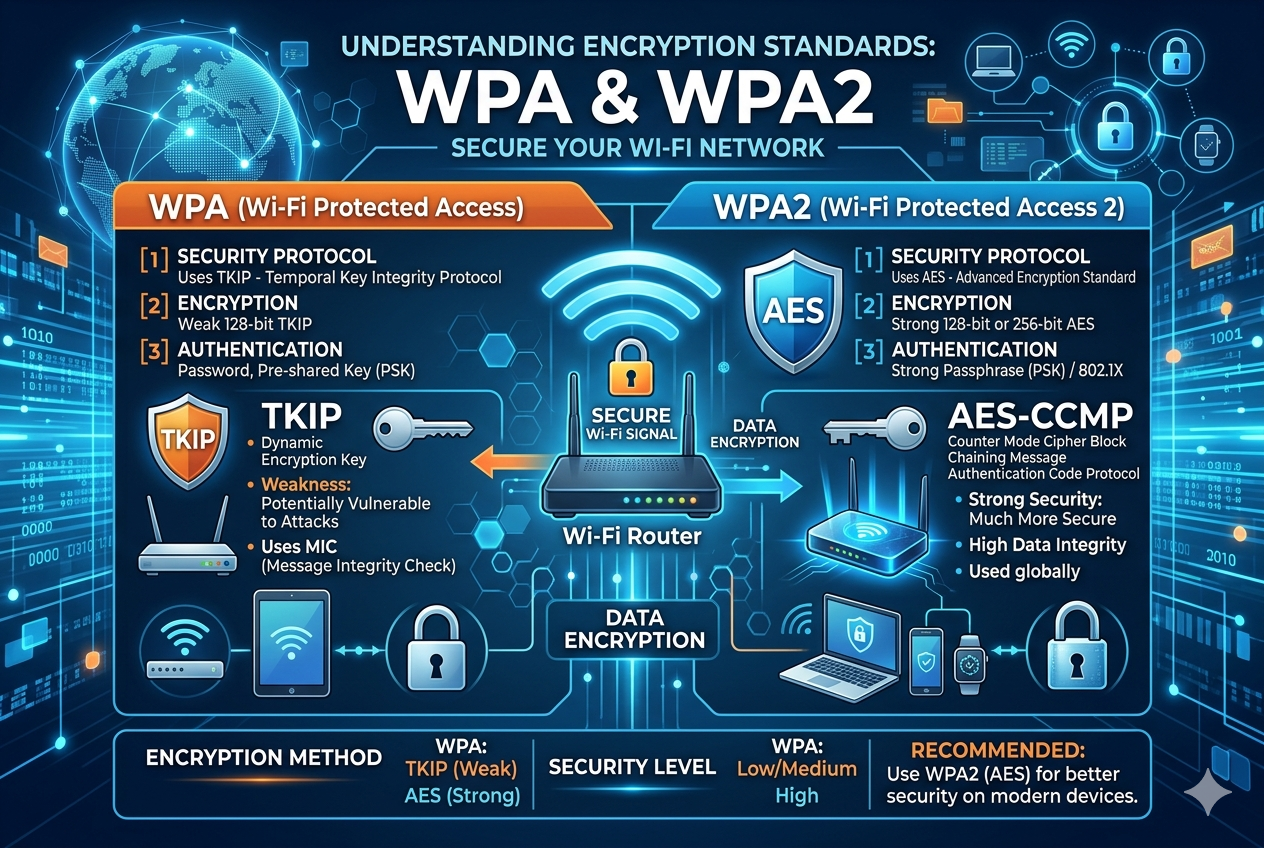
WPA2 is not just a simple upgrade over WPA; it is built on a more advanced security architecture designed to handle modern wireless threats. At its core, WPA2 separates authentication and encryption into structured layers, ensuring that each stage of communication is protected independently. This layered approach reduces the chances of a single vulnerability compromising the entire network.
In WPA2, security begins even before a device is allowed to transmit data. The system verifies identity, establishes trust, and only then allows encrypted communication. This strict process ensures that unauthorized devices cannot easily infiltrate the network or eavesdrop on traffic.
Personal Mode and Enterprise Mode in WPA2
WPA2 operates mainly in two different modes: Personal mode and Enterprise mode. These modes are designed for different environments and levels of security requirements.
In WPA2 Personal mode, also known as WPA2-PSK (Pre-Shared Key), all users share a single password to access the network. This mode is commonly used in homes and small offices because it is simple to set up and manage. However, since all users share the same key, security depends heavily on the strength of that password.
In contrast, WPA2 Enterprise mode is designed for organizations and larger networks. Instead of a single shared password, each user is given unique login credentials. This mode uses a centralized authentication server, which verifies each user individually before granting access. This significantly improves security because even if one account is compromised, the entire network is not immediately at risk.
Role of 802.1X Authentication
A critical component of WPA2 Enterprise is the 802.1X authentication framework. This system acts as a gatekeeper, controlling who can connect to the network. It works by using a process called the Extensible Authentication Protocol (EAP), which allows multiple authentication methods such as passwords, digital certificates, or smart cards.
When a user attempts to connect, their credentials are first verified by an authentication server. Only after successful verification is access granted. This multi-step process makes WPA2 Enterprise significantly more secure than WPA2 Personal.
The use of 802.1X ensures that even if attackers manage to intercept network traffic, they cannot easily gain access without proper authentication credentials.
Encryption Process in Depth
The encryption process in WPA2 is based on the Advanced Encryption Standard (AES), which uses complex mathematical algorithms to protect data. AES works by dividing data into blocks and then transforming each block through multiple rounds of encryption.
Each round involves substitution, permutation, and mixing of data, making it extremely difficult to reverse without the correct key. This process ensures that even if encrypted data is intercepted, it appears completely random and meaningless to attackers.
Unlike older systems, AES does not rely on simple patterns or predictable structures, which greatly increases its resistance to cryptographic attacks.
The Importance of Key Management
One of the most critical aspects of WPA2 security is key management. Encryption keys are not static; they are constantly generated, exchanged, and refreshed during communication.
WPA2 uses a process called key rotation, where temporary session keys are created for each connection. This means that even if one key is compromised, it cannot be used to decrypt past or future communication.
Proper key management ensures forward secrecy, which protects historical data even if current security is breached. This makes WPA2 far more resilient compared to older encryption systems.
Vulnerabilities in WPA2 Systems
Although WPA2 is highly secure, it is not completely immune to attacks. Over time, security researchers have discovered certain vulnerabilities that can be exploited under specific conditions.
One of the most well-known vulnerabilities is related to the handshake process. Attackers can capture handshake data and attempt to crack it offline using brute-force methods. However, this is only effective if weak passwords are used.
Another significant vulnerability discovered in WPA2 is the KRACK (Key Reinstallation Attack). This attack exploits weaknesses in the way encryption keys are handled during the handshake process. By forcing a victim device to reinstall an already-in-use key, attackers can potentially intercept or manipulate data.
While KRACK does not completely break WPA2 encryption, it highlights the importance of software updates and proper security patching.
KRACK Attack Explained Simply
The KRACK attack targets the four-way handshake used in WPA2. During normal operation, this handshake ensures that both the device and router agree on encryption keys.
In a KRACK scenario, an attacker tricks the device into reinstalling an already used encryption key. This causes the device to reset parameters such as packet counters, making it possible for the attacker to replay or decrypt certain data.
Although this sounds serious, most modern devices have been patched to prevent this vulnerability. Still, it serves as an important reminder that even strong encryption systems can have implementation flaws.
Differences in Security Between WPA, WPA2, and WPA3
WPA, WPA2, and WPA3 represent different stages in the evolution of Wi-Fi security. WPA was introduced as a temporary fix for WEP and used TKIP encryption, which is now considered weak.
WPA2 replaced WPA by introducing AES encryption, significantly improving security and making it suitable for long-term use. It became the global standard for wireless security for many years.
WPA3 is the latest development, offering even stronger protection. It introduces features such as individualized data encryption and better resistance to brute-force attacks. However, WPA2 is still widely used due to compatibility with existing devices.
Real-World Applications of WPA2
WPA2 is used in a wide range of environments, from homes and schools to large corporations and government institutions. Its flexibility allows it to be implemented in both simple and complex network structures.
In homes, WPA2 ensures that personal data such as browsing history, passwords, and financial information remain protected from nearby attackers. In businesses, it helps secure sensitive corporate data and internal communications.
Public Wi-Fi networks also rely on WPA2, although these networks often come with additional risks due to shared access. Even in such environments, WPA2 provides a basic layer of protection against casual attackers.
Importance of Secure Password Practices
Even the strongest encryption system can be weakened by poor password practices. A weak password is often the easiest way for attackers to gain access to a WPA2-protected network.
Strong passwords should be long, unpredictable, and include a mix of characters. Avoiding common words or patterns greatly reduces the chances of brute-force attacks succeeding.
Regularly updating passwords adds an additional layer of protection, especially in environments where multiple users access the same network.
Device Compatibility and Security Updates
For WPA2 to function securely, both the router and connected devices must support modern security standards. Outdated devices may not fully support AES encryption or may still rely on weaker protocols.
Security updates also play a crucial role. Manufacturers regularly release patches to fix vulnerabilities such as KRACK and improve overall system stability. Failing to install these updates can leave networks exposed to known threats.
Ensuring that all devices are up to date is one of the simplest yet most effective ways to maintain WPA2 security.
Limitations of WPA2 in Modern Networks
Despite its strength, WPA2 has limitations when used in today’s highly connected digital environment. One of the main issues is its reliance on passwords, which can still be guessed or stolen.
Another limitation is its vulnerability to offline attacks if handshake data is captured. While strong passwords reduce this risk, they do not eliminate it entirely.
Additionally, WPA2 does not provide strong protection against certain advanced attacks in highly targeted environments, which is why newer standards like WPA3 are being adopted.
Future of Wireless Encryption Standards
The future of wireless encryption is focused on stronger, more adaptive security systems. New standards aim to reduce reliance on static passwords and improve resistance against automated attacks.
Advanced encryption techniques, better authentication methods, and improved key management systems are being developed to address the limitations of current standards.
As cyber threats continue to evolve, encryption standards will also continue to advance, ensuring that wireless communication remains secure in an increasingly connected world.
Evolution of Wireless Security Beyond WPA2
Wireless security has continued to evolve as cyber threats become more advanced and sophisticated. While WPA2 remains widely used, it is no longer considered the final stage in Wi-Fi encryption development. Researchers and security experts identified that modern networks require stronger protection mechanisms, especially with the rise of smart devices, cloud computing, and large-scale data exchange.
The evolution beyond WPA2 focuses on improving authentication, strengthening encryption, and reducing vulnerabilities that attackers can exploit. This ongoing development ensures that wireless communication keeps pace with modern digital demands.
Introduction of WPA3 and Its Purpose
WPA3 was introduced as the next-generation wireless security standard designed to address the limitations of WPA2. Its primary goal is to provide stronger protection against password-based attacks and improve security for both personal and enterprise networks.
One of the major improvements in WPA3 is its resistance to brute-force attacks. Unlike WPA2, where attackers can capture handshake data and attempt offline password cracking, WPA3 makes this process significantly more difficult by limiting repeated login attempts and strengthening key exchange mechanisms.
WPA3 also introduces more secure encryption practices, ensuring that even weak passwords are better protected than before.
Simultaneous Authentication of Equals (SAE)
A key feature of WPA3 is the introduction of Simultaneous Authentication of Equals, commonly known as SAE. This replaces the traditional pre-shared key system used in WPA2 Personal mode.
SAE improves security by ensuring that both the device and the router contribute equally to the authentication process. Instead of relying solely on a shared password, SAE creates a secure handshake that prevents attackers from easily guessing credentials.
This method also protects against offline dictionary attacks, making it much harder for cybercriminals to break into networks even if they capture encrypted data.
Improved Protection in Public Wi-Fi Networks
Public Wi-Fi networks are often considered high-risk environments because multiple users share the same connection. WPA3 addresses this issue by introducing individualized data encryption.
With this feature, each user’s data is encrypted separately, even if they are connected to the same network. This means that one user cannot easily intercept or view another user’s traffic.
This improvement significantly enhances privacy and security in public places such as airports, cafes, and libraries, where open or shared networks are commonly used.
Forward Secrecy in WPA3
Another important advancement in WPA3 is the implementation of forward secrecy. This ensures that even if a password is compromised in the future, previously transmitted data remains secure.
Forward secrecy works by generating unique encryption keys for each session. These keys are not reused, meaning that past communications cannot be decrypted using a newly discovered password.
This feature is extremely important in protecting long-term data confidentiality, especially in environments where sensitive information is frequently transmitted.
Comparison Between WPA2 and WPA3 Security Models
WPA2 and WPA3 differ significantly in how they handle encryption and authentication. WPA2 relies heavily on shared passwords and traditional handshake methods, while WPA3 introduces more advanced cryptographic techniques.
WPA2 is still secure when properly configured, but it is more vulnerable to password-related attacks. WPA3 reduces this risk by eliminating many of the weaknesses associated with shared credentials.
Additionally, WPA3 improves protection in open networks, which was a major limitation in WPA2 systems. This makes WPA3 more suitable for modern wireless environments where security demands are higher.
Common Wireless Attacks and How They Work
Wireless networks are often targeted by attackers using various techniques designed to exploit weaknesses in encryption or user behavior. One common method is password cracking, where attackers attempt to guess or brute-force network credentials.
Another technique involves packet sniffing, where attackers intercept data transmitted over the network. If encryption is weak or improperly configured, this data can be analyzed and potentially decrypted.
Rogue access point attacks are also common. In this method, attackers create fake Wi-Fi networks that mimic legitimate ones. When users connect, their data can be monitored or stolen.
These attack methods highlight the importance of strong encryption standards and proper network configuration.
Role of Social Engineering in Network Security
Not all attacks target encryption directly. Social engineering is another powerful method used by attackers to gain access to wireless networks.
In social engineering, attackers manipulate users into revealing sensitive information such as passwords. This can be done through fake login pages, deceptive messages, or impersonation of trusted sources.
Even the strongest encryption system cannot protect against human error. This is why user awareness and education are essential parts of overall network security.
Importance of Network Configuration and Management
Proper network configuration plays a crucial role in maintaining wireless security. Even with strong encryption standards like WPA2 or WPA3, incorrect settings can expose networks to unnecessary risks.
Disabling outdated protocols, enabling strong encryption modes, and regularly updating firmware are essential practices. Additionally, limiting access to trusted devices can reduce the chances of unauthorized connections.
Network administrators must also monitor traffic patterns to detect unusual activity that may indicate potential security threats.
Impact of IoT Devices on Wireless Security
The rise of Internet of Things (IoT) devices has significantly increased the number of devices connected to wireless networks. These devices include smart home systems, security cameras, wearable technology, and industrial sensors.
While IoT devices offer convenience and automation, they also introduce new security challenges. Many of these devices have limited processing power and may not support advanced encryption standards.
If not properly secured, IoT devices can become entry points for attackers to access larger networks. This makes strong encryption and proper device management even more important in modern environments.
Cryptographic Strength of Modern Encryption Standards
Modern encryption standards like AES used in WPA2 and WPA3 rely on complex mathematical algorithms that are extremely difficult to break using traditional computing methods.
These algorithms work by transforming data into encrypted blocks using multiple rounds of substitution and permutation. The strength of encryption depends on key length, algorithm complexity, and proper implementation.
Even with powerful computers, breaking AES encryption without the correct key would take an impractical amount of time, making it highly secure for most applications.
Limitations of Even Advanced Encryption Systems
Despite their strength, even modern encryption systems are not completely immune to threats. Most vulnerabilities arise not from the encryption itself but from implementation errors, weak passwords, or outdated software.
Human error remains one of the biggest security risks. Poor password practices, failure to update devices, and misconfigured networks can all weaken even the strongest encryption systems.
Additionally, highly targeted attacks by well-funded organizations may exploit unknown vulnerabilities, although such cases are rare and usually addressed quickly through updates.
Best Practices for Securing Wireless Networks
Securing a wireless network requires a combination of strong encryption, proper configuration, and user awareness. Using WPA3 where possible provides the highest level of protection, but WPA2 remains secure when properly implemented.
Strong, unique passwords should always be used to prevent unauthorized access. Regularly updating router firmware helps protect against known vulnerabilities.
It is also important to disable unnecessary features such as remote administration if not needed, as these can create additional entry points for attackers.
Future Trends in Wireless Encryption
The future of wireless encryption is expected to focus on automation, artificial intelligence, and adaptive security systems. These technologies will help networks detect and respond to threats in real time.
New encryption models may reduce reliance on passwords altogether, using biometric authentication or device-based trust systems instead. This would significantly reduce the risk of password-related attacks.
As wireless communication continues to expand, encryption standards will evolve to support faster, more secure, and more intelligent networks.
Advanced Concepts in Wireless Encryption Systems
Wireless encryption systems are built on several advanced cryptographic concepts that ensure data remains secure while being transmitted over open networks. These systems do not simply scramble data in a basic way; instead, they use structured mathematical transformations that are extremely difficult to reverse without the correct key.
Modern encryption relies on principles such as substitution, permutation, and key expansion. These techniques work together to transform readable information into complex ciphertext that appears random to unauthorized users. The strength of a wireless security system depends heavily on how effectively these processes are implemented.
Role of Cryptographic Keys in Security
Cryptographic keys are at the core of all encryption systems, including WPA2 and WPA3. These keys act as digital passwords that control both encryption and decryption processes. Without the correct key, encrypted data cannot be understood.
In wireless networks, keys are not static. They are dynamically generated and exchanged between devices during the connection process. This ensures that each session has its own unique encryption setup, reducing the risk of long-term exposure.
Key length also plays an important role in security strength. Longer keys provide more possible combinations, making brute-force attacks significantly more difficult to succeed.
How Data Integrity is Maintained
Encryption alone is not enough to ensure secure communication. Data integrity is equally important because it ensures that information is not altered during transmission.
Wireless security systems use integrity checks to verify that data remains unchanged. These checks generate unique codes based on the original data content. When the data reaches its destination, the system recalculates the code and compares it with the original.
If even a small change has occurred, the system detects it immediately. This prevents attackers from secretly modifying messages or injecting false information into the communication stream.
Understanding Authentication Mechanisms
Authentication is the process of verifying the identity of a device or user before granting access to a network. In wireless encryption systems, authentication ensures that only authorized users can connect.
This process can involve passwords, digital certificates, or cryptographic handshakes. Each method has its own level of security and complexity.
In modern systems like WPA2 and WPA3, authentication is tightly integrated with encryption, meaning that both identity verification and data protection work together as a unified system.
The Importance of Session Keys
Session keys are temporary encryption keys created for a single communication session. Once the session ends, these keys are discarded.
This approach provides strong security because even if an attacker manages to obtain a session key, it cannot be used to access other sessions. Each new connection generates a completely new key, ensuring isolation between communication sessions.
Session keys also support forward secrecy, which protects past communications even if future keys are compromised.
Wireless Encryption and Network Layers
Wireless encryption operates at specific layers within network architecture. These layers ensure that data is protected at different stages of transmission.
At the lower levels, encryption focuses on securing the physical transmission of data over radio waves. At higher levels, it ensures that application data remains confidential and unaltered.
This multi-layered approach creates a strong defense system where attackers must overcome multiple security barriers to gain access to meaningful information.
Packet Transmission and Security Control
Data transmitted over wireless networks is broken into smaller units called packets. Each packet contains a portion of the overall data along with control information.
Encryption is applied to these packets before transmission. This ensures that even if packets are intercepted individually, they cannot be understood without proper decryption.
Security control mechanisms also monitor packet flow to detect anomalies such as duplicate packets, missing data, or unauthorized modifications.
Challenges in Wireless Security Implementation
Implementing wireless security systems is not without challenges. One major issue is maintaining compatibility across different devices and manufacturers. Older devices may not support newer encryption standards, creating security gaps.
Another challenge is balancing security with performance. Stronger encryption requires more processing power, which can impact network speed and efficiency, especially on low-power devices.
User behavior is also a challenge. Many security breaches occur not because of weak encryption but because users choose weak passwords or fail to update their devices.
Impact of Computational Power on Encryption
As computational power increases, the ability to attempt brute-force attacks also improves. This means that encryption standards must continuously evolve to stay ahead of potential threats.
Modern encryption systems are designed to remain secure even against highly powerful computers by using complex algorithms and large key spaces.
However, future advancements in quantum computing may introduce new challenges, as quantum systems could potentially solve certain cryptographic problems faster than traditional computers.
Introduction to Quantum Threats in Encryption
Quantum computing is an emerging technology that uses quantum mechanics to perform calculations. While still in development, it has the potential to break some traditional encryption methods.
This has led to the development of post-quantum cryptography, which aims to create encryption systems resistant to quantum attacks.
Wireless security standards of the future may incorporate these new cryptographic techniques to ensure long-term protection against evolving computational threats.
Network Monitoring and Intrusion Detection
Modern wireless security systems often include monitoring tools that detect suspicious activity in real time. These systems analyze network traffic patterns to identify unusual behavior.
If an intrusion attempt is detected, the system can take preventive actions such as blocking the source or alerting administrators.
This proactive approach helps reduce the impact of potential attacks and improves overall network resilience.
Importance of Firmware and Software Updates
Firmware and software updates play a crucial role in maintaining wireless security. These updates often include patches for newly discovered vulnerabilities.
Without regular updates, even secure systems like WPA2 can become vulnerable to known exploits. Attackers often target outdated systems because they are easier to compromise.
Keeping devices updated ensures that the latest security improvements are always in place.
User Awareness in Wireless Security
User awareness is one of the most important aspects of maintaining secure wireless networks. Even the strongest encryption system cannot fully protect against careless user behavior.
Users must understand the importance of strong passwords, safe browsing habits, and avoiding suspicious networks. Awareness training is especially important in organizations where many users share the same network.
Educated users are less likely to fall victim to phishing attacks or social engineering tactics.
Balancing Convenience and Security
One of the biggest challenges in wireless security is balancing convenience with protection. Users often prefer simple passwords and easy access, while security systems require complexity and strict controls.
Too much security can make systems difficult to use, while too little security can expose networks to risks. The goal is to find an optimal balance where security is strong but usability remains practical.
Modern encryption systems like WPA2 and WPA3 attempt to achieve this balance by automating many security processes.
Future of Wireless Encryption Technologies
The future of wireless encryption will likely involve more intelligent and adaptive systems. Artificial intelligence may play a role in detecting threats and automatically adjusting security settings.
New encryption methods may reduce dependence on passwords entirely, using device identity or biometric data instead.
As digital communication continues to expand, encryption systems will become more integrated into everyday life, operating silently in the background while ensuring maximum security.
Real-World Importance of Wireless Encryption in Daily Life
Wireless encryption is deeply embedded in everyday digital life, even when users are not directly aware of it. Whenever a device connects to a Wi-Fi network, encryption systems automatically begin working in the background to protect data. This includes activities such as browsing websites, sending messages, streaming content, or accessing online banking services.
Without encryption standards like WPA2, all of this information would travel in a readable form across the network, making it extremely easy for attackers to intercept and misuse it. Encryption ensures that even if data is captured, it remains useless without the correct decryption keys.
Wireless Security in Home Networks
Home networks are among the most common environments where WPA2 encryption is used. Most modern routers come with WPA2 enabled by default to ensure basic protection for users.
In a home environment, multiple devices such as smartphones, laptops, smart TVs, and IoT devices are connected simultaneously. Each of these devices exchanges data constantly, making encryption essential for privacy.
Even though home networks may seem less targeted than corporate systems, they are still vulnerable to attacks, especially if weak passwords or outdated settings are used.
Wireless Security in Business Environments
In business environments, wireless encryption plays a much more critical role due to the sensitive nature of the data being transmitted. Companies often handle financial records, client information, internal communications, and intellectual property.
WPA2 Enterprise is commonly used in these environments because it offers stronger authentication methods and centralized control. Each employee is assigned unique login credentials, reducing the risk of unauthorized access.
In addition, businesses often combine wireless encryption with firewalls, intrusion detection systems, and network segmentation to create multiple layers of protection.
Public Wi-Fi Risks and Encryption Challenges
Public Wi-Fi networks are widely used due to convenience, but they also present significant security risks. Even when WPA2 is enabled, shared access environments can still be targeted by attackers.
One of the main risks is data interception. Attackers connected to the same network may attempt to capture unencrypted or weakly protected data. Another risk is the creation of fake Wi-Fi hotspots designed to trick users into connecting.
Because of these risks, users are often advised to avoid accessing sensitive information such as banking accounts on public networks unless additional protection methods are used.
Role of VPNs Alongside Encryption
Virtual Private Networks (VPNs) are often used alongside wireless encryption to provide an additional layer of security. While WPA2 secures the local network connection, VPNs encrypt data further before it travels across the internet.
This means that even if a network is compromised, the data remains protected by another layer of encryption. VPNs are especially useful in public Wi-Fi environments where network security cannot always be trusted.
By combining WPA2 encryption with VPN technology, users can significantly enhance their overall digital security.
Encryption in Smart Devices and IoT Ecosystems
The growth of smart devices has expanded the importance of wireless encryption. Devices such as smart locks, security cameras, thermostats, and wearable technology rely heavily on wireless communication.
Each of these devices continuously sends and receives data over Wi-Fi networks. If not properly secured, they can become weak points in the network.
Encryption ensures that communication between IoT devices and control systems remains private. However, many IoT devices still struggle with limited processing power, which can restrict their ability to use advanced encryption methods.
Hidden Risks in Weak Configurations
Even when strong encryption standards like WPA2 are available, improper configuration can weaken overall security. For example, using default router settings or unchanged passwords can make networks easy targets for attackers.
Another common issue is enabling legacy compatibility modes that allow older, less secure protocols to connect. While this improves compatibility, it also reduces overall security strength.
Proper configuration is essential to ensure that encryption systems function as intended and provide maximum protection.
Wireless Signal Exposure and Security Boundaries
Unlike wired networks, wireless networks broadcast signals through the air, making them inherently more exposed. This physical characteristic creates unique security challenges.
Attackers do not need physical access to a device or router; they only need to be within range of the wireless signal. This makes encryption even more important, as it acts as the primary defense barrier.
Signal range control, combined with encryption, helps reduce unnecessary exposure and limits potential attack opportunities.
Role of Hashing in Wireless Security
Hashing is another important concept used in wireless encryption systems. It involves converting data into a fixed-length string of characters, which cannot be easily reversed.
In WPA2 and WPA3, hashing is used during authentication processes to verify passwords without transmitting them directly. This reduces the risk of password exposure during communication.
Even if hashed data is intercepted, it is extremely difficult to reconstruct the original information without significant computational effort.
Authentication Servers in Enterprise Networks
In enterprise environments, authentication servers play a central role in managing wireless access. These servers verify user credentials before allowing access to the network.
They maintain records of authorized users and enforce security policies across the organization. If a login attempt fails or appears suspicious, the server can deny access or trigger alerts.
This centralized system improves control and makes it easier to manage large numbers of users securely.
Encryption Overhead and Performance Impact
While encryption significantly improves security, it also introduces a certain level of computational overhead. This means that devices must perform additional processing to encrypt and decrypt data.
In most modern systems, this overhead is minimal and does not noticeably affect performance. However, in low-power devices or heavily loaded networks, it can sometimes impact speed.
Balancing encryption strength with performance efficiency is an important consideration in network design.
Adaptive Security in Modern Networks
Modern wireless systems are becoming increasingly adaptive, meaning they can adjust security settings based on conditions and threats. For example, if unusual activity is detected, the system may increase security levels or restrict access temporarily.
This adaptive approach allows networks to respond dynamically to potential threats instead of relying on fixed rules alone.
It represents a shift toward smarter and more responsive security architectures.
Importance of Secure Device Pairing
Device pairing is the process of connecting two devices securely over a wireless network. During this process, encryption keys are exchanged to establish trust between devices.
Secure pairing ensures that only intended devices can communicate with each other. If pairing is not properly secured, attackers may attempt to intercept or impersonate devices.
Modern encryption systems use secure handshake protocols to prevent unauthorized pairing attempts.
Human Factors in Wireless Security Failures
A significant number of wireless security breaches occur due to human error rather than technical weaknesses. Users often choose simple passwords, ignore updates, or connect to unknown networks without caution.
Phishing attacks and social engineering also exploit human behavior rather than system vulnerabilities. Attackers may trick users into revealing passwords or connecting to malicious networks.
This highlights the importance of combining technical security measures with user education.
Continuous Evolution of Encryption Standards
Encryption standards are not static; they continuously evolve to address new threats and technological advancements. Each new generation improves upon the weaknesses of the previous one.
From WEP to WPA, WPA2, and now WPA3, the progression shows a clear trend toward stronger security and better resilience against attacks.
Future standards will likely focus on automation, artificial intelligence integration, and resistance to emerging technologies such as quantum computing.
Conclusion
Wireless encryption plays a critical role in securing modern digital communication. From home networks to enterprise systems and public Wi-Fi environments, encryption ensures that data remains private and protected.
WPA2 has served as a reliable standard for many years, offering strong protection through AES encryption and secure authentication methods. However, evolving threats have led to the development of newer systems like WPA3.
Despite technological advancements, the effectiveness of wireless security ultimately depends on proper configuration, strong passwords, regular updates, and user awareness. As technology continues to grow, encryption will remain a fundamental pillar of digital safety and privacy.