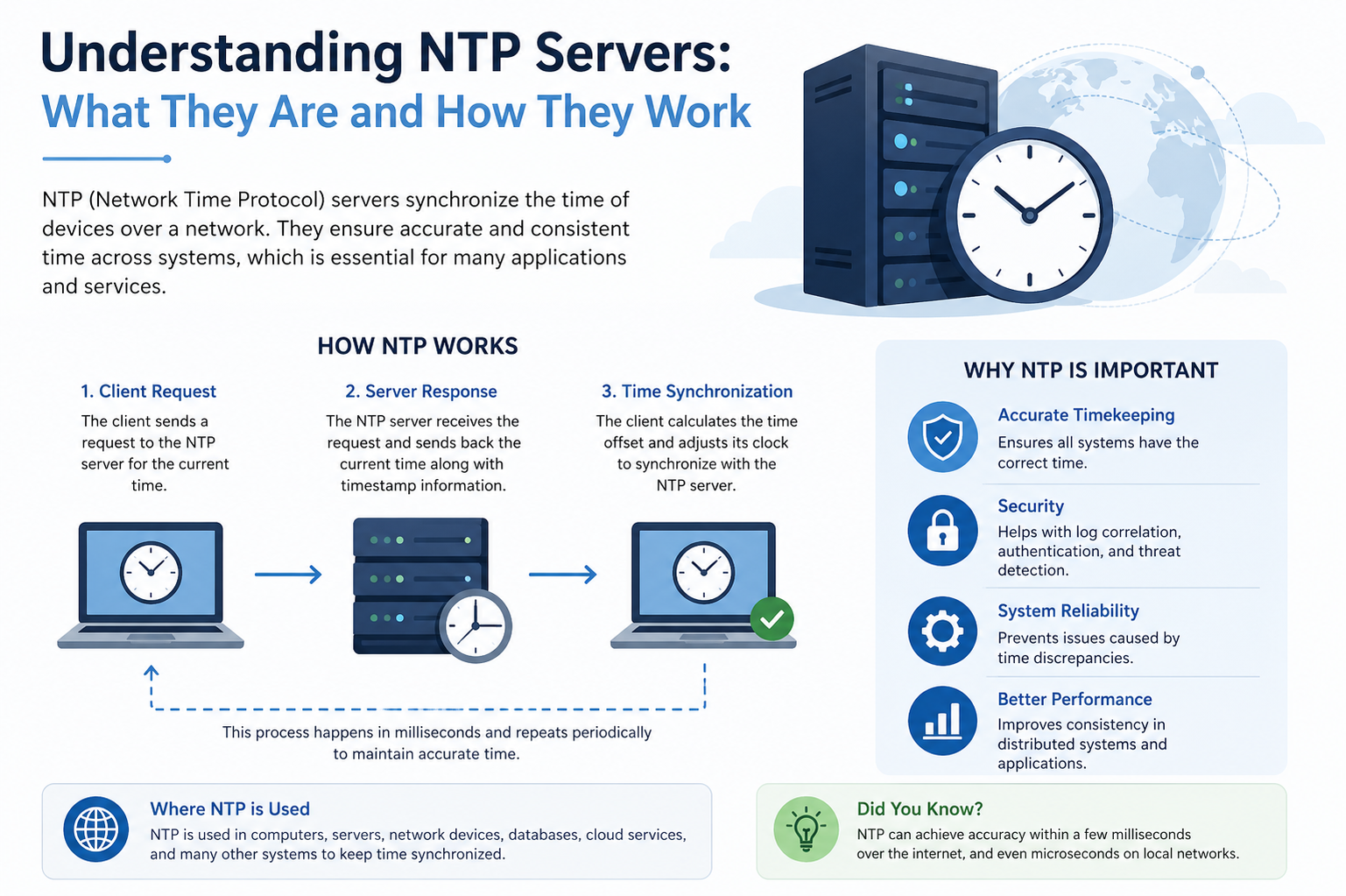
Network Time Protocol servers are fundamental components in modern digital communication systems, responsible for maintaining precise and synchronized time across devices. Every computer system relies on time for operations such as logging events, scheduling tasks, securing connections, and coordinating communication between systems. However, internal clocks in devices are not perfectly accurate and gradually drift over time. NTP servers solve this problem by acting as trusted time references that continuously correct and align system clocks.
The primary purpose of an NTP server is to ensure that every connected device operates on the same consistent time reference. This consistency is essential in environments where multiple systems interact, such as business networks, financial platforms, cloud computing systems, and communication infrastructures. Without synchronized time, systems may misinterpret data sequences, security validations may fail, and logs may become unreliable.
The Importance of Time Synchronization in Digital Systems
Time synchronization is more than just keeping clocks correct; it is about ensuring coordination and reliability across interconnected systems. In distributed computing environments, multiple servers work together to process data. If each server has a different time, it becomes difficult to determine the correct order of events. This can lead to serious issues such as data inconsistency or system errors.
In cybersecurity, accurate time is critical for verifying authentication tokens, tracking login attempts, and analyzing potential threats. Even a small time mismatch can cause security protocols to reject legitimate requests or fail to detect malicious activity. Similarly, in financial systems, transaction timestamps must be precise to ensure fairness and traceability. NTP servers provide the backbone for this level of accuracy.
How NTP Servers Obtain Accurate Time
NTP servers do not generate time on their own. Instead, they rely on highly accurate external time sources. These sources are often based on atomic clocks or coordinated universal time standards maintained by global timekeeping systems. Atomic clocks are extremely precise and lose or gain only a fraction of a second over millions of years, making them ideal references for time synchronization.
A primary NTP server connects directly to these highly accurate time sources. It then distributes this time to secondary servers, which in turn provide it to client devices. This ensures that even large and complex networks can maintain accurate time without every device needing direct access to an atomic clock.
The Working Mechanism of NTP Communication
The process of synchronization begins when a client device sends a request to an NTP server. This request includes the current time according to the client’s internal clock. The server responds by sending back a timestamp that includes precise time information along with details about when the response was generated.
The client then calculates the difference between its own time and the server’s time. It also considers network delay, which can affect the accuracy of communication. Based on these calculations, the client adjusts its internal clock slightly rather than making abrupt changes. This gradual adjustment helps maintain system stability while improving accuracy.
This exchange of requests and responses happens repeatedly at regular intervals. By continuously comparing and adjusting, devices maintain long-term synchronization with the reference time.
Stratum Levels and Hierarchical Structure
NTP systems are organized into a hierarchical structure known as strata. This structure defines the distance of a device from the primary time source. At the top level are stratum 0 devices, which include highly precise timekeeping instruments such as atomic clocks and GPS-based clocks. These devices are not directly connected to networks but serve as the ultimate time reference.
Stratum 1 servers are directly connected to stratum 0 sources and act as primary time distribution servers. They provide time to stratum 2 servers, which then pass it further down the chain. This layered approach allows NTP to scale efficiently across global networks while maintaining accuracy.
As the stratum level increases, the time accuracy slightly decreases due to network delays and processing time. However, even higher-level stratum servers still maintain sufficient precision for most applications.
Clock Drift and Why Synchronization Is Necessary
Every digital device has an internal clock powered by a quartz crystal oscillator. While these oscillators are generally reliable, they are not perfectly stable. Environmental factors such as temperature changes, aging hardware, and electrical variations can cause clocks to drift over time.
Clock drift means that a device may slowly start running faster or slower than actual time. Even a few seconds of difference can create issues in systems that depend on precise timing. For example, log files may appear out of order, scheduled tasks may fail, and authentication systems may reject valid sessions.
NTP servers continuously correct this drift by comparing device time with accurate reference time and making small adjustments to keep everything aligned.
NTP in Distributed and Cloud Environments
Modern computing environments often involve distributed systems where multiple servers work together across different geographical locations. In such systems, consistent timekeeping is essential for coordination. NTP servers ensure that all systems, regardless of location, share the same time reference.
In cloud environments, virtual machines are created and destroyed dynamically. Without synchronized time, managing these systems would become extremely complex. NTP ensures that logs, transactions, and processes remain consistent across all virtual instances.
This synchronization also supports load balancing, data replication, and backup processes, all of which depend on accurate timestamps to function correctly.
Security Applications of NTP
Accurate time is a critical element in cybersecurity. Many authentication systems rely on time-based tokens that expire after a short period. If system clocks are not synchronized, these tokens may be rejected, causing access issues or security vulnerabilities.
NTP servers also play a role in forensic analysis. When investigating security incidents, analysts rely on timestamps to reconstruct the sequence of events. If system clocks are inconsistent, it becomes difficult to determine what actually happened and when.
By ensuring all systems share the same time reference, NTP improves both security and accountability.
Network Efficiency and Performance Benefits
Beyond accuracy and security, NTP also contributes to overall network efficiency. When systems are synchronized, processes that depend on timing coordination run more smoothly. This includes database replication, distributed computing tasks, and communication protocols.
Without synchronization, systems may repeatedly retry failed operations or encounter conflicts due to mismatched timestamps. NTP reduces these issues by ensuring that all devices operate on a unified time framework.
Fault Tolerance and Redundancy in NTP Systems
NTP systems are designed with redundancy to ensure reliability. A single NTP server failure does not disrupt time synchronization because devices can switch to alternative servers. Many systems are configured to connect to multiple NTP sources simultaneously.
This redundancy ensures that even if one time source becomes unavailable or inaccurate, the system continues to function correctly using backup references. This makes NTP highly reliable for critical applications where downtime or inaccuracies are unacceptable.
The Role of NTP in Modern Digital Infrastructure
NTP servers are essential for maintaining accurate and consistent time across all types of digital systems. From small personal devices to large-scale global networks, synchronized time ensures smooth operation, reliable communication, and secure transactions.
By continuously correcting clock drift, distributing precise time references, and supporting hierarchical time structures, NTP forms a foundational layer of modern computing infrastructure. Its role may often go unnoticed, but without it, many of the systems that power communication, finance, security, and cloud computing would become unstable and unreliable.
How NTP Handles Network Delays and Time Accuracy
One of the most important challenges in time synchronization is dealing with network delay. When a device communicates with an NTP server, the time it takes for data to travel across the network can affect accuracy. NTP is designed to minimize this problem by carefully measuring round-trip delay and estimating the most accurate time offset possible.
When a client sends a request, it records the exact time of transmission. The server responds with timestamps that include the moment it received the request and the moment it sent the reply. By analyzing these values, the client can estimate how long the communication took and adjust for that delay. This method helps reduce errors caused by unpredictable network conditions.
Even in high-latency networks such as the internet, NTP remains effective because it uses statistical averaging over multiple exchanges. Instead of relying on a single measurement, it continuously refines its calculations over time to improve precision.
Polling Intervals and Continuous Adjustment
NTP does not constantly request time updates at a fixed rapid rate. Instead, it uses adaptive polling intervals. When a device first connects to an NTP server, it may synchronize frequently to quickly correct any large time differences. Once the system becomes stable and accurate, the interval between updates increases.
This adaptive approach reduces unnecessary network traffic while still maintaining high accuracy. If the system detects instability or drift, it automatically increases the frequency of synchronization requests again. This dynamic adjustment allows NTP to balance performance with precision efficiently.
Stability Through Gradual Clock Correction
Instead of abruptly changing the system clock, NTP makes gradual adjustments. This method is important because sudden changes in system time can disrupt running processes, scheduled tasks, and active network connections.
When a small correction is needed, the clock is slowly sped up or slowed down until it aligns with the correct time. This process is called “slewing.” In cases where the time difference is too large, a step adjustment may be applied, but this is done carefully to avoid system instability.
By using gradual correction methods, NTP ensures that time synchronization does not interfere with normal system operations.
Role of NTP in Data Logging and Monitoring Systems
Accurate timestamps are essential for logging systems that track events in software applications, servers, and networks. These logs are used for troubleshooting, performance analysis, and security auditing. Without synchronized time, log entries from different systems may appear out of order, making it difficult to understand what actually happened during an event.
NTP ensures that all systems record events using a consistent time reference. This allows administrators to reconstruct sequences of events accurately, even when data comes from multiple sources. In large-scale systems, this consistency is critical for diagnosing issues and maintaining operational reliability.
Impact on Database Consistency and Transactions
Databases rely heavily on accurate time for managing transactions and maintaining consistency. In distributed database systems, multiple nodes may process data simultaneously. If their clocks are not synchronized, conflicts can occur when determining which transaction happened first.
NTP helps maintain a unified timeline across all database nodes. This ensures that transactions are processed in the correct order and that data integrity is preserved. It also supports replication processes, where changes made in one database must be accurately reflected in others.
Without NTP, distributed databases would face significant challenges in maintaining consistency across multiple locations.
Use of NTP in Telecommunications and Internet Services
Telecommunication systems depend on precise timing to manage calls, data transmission, and network routing. Even small timing errors can result in dropped calls, packet loss, or synchronization failures between network components.
Internet service providers also rely on NTP to coordinate routers, switches, and servers. These systems must operate in harmony to handle large volumes of data efficiently. By ensuring all components share the same time reference, NTP improves overall network stability and performance.
GPS as a Time Source for NTP Systems
In addition to atomic clocks, GPS satellites are widely used as a reliable time source for NTP servers. Each GPS satellite contains highly accurate atomic clocks and continuously broadcasts time signals along with location data.
NTP servers equipped with GPS receivers can obtain precise time directly from these satellites. This method is especially useful in environments where direct access to traditional time servers is limited. GPS-based timing provides an independent and highly accurate reference that strengthens the overall reliability of NTP systems.
Security Risks and Protection in NTP Networks
Although NTP is essential for synchronization, it can also be targeted if not properly secured. Attackers may attempt to send false time information, causing systems to become desynchronized. This can lead to authentication failures, data corruption, or system instability.
To prevent such risks, modern NTP implementations use authentication mechanisms that verify the legitimacy of time sources. Only trusted servers are allowed to provide time updates, reducing the risk of manipulation. Network administrators also configure redundant servers to ensure that a single compromised source does not affect the entire system.
Scalability of NTP in Large Networks
One of the strengths of NTP is its ability to scale across extremely large networks. From small local networks to global internet infrastructure, NTP can support millions of devices simultaneously.
This scalability is achieved through its hierarchical structure and efficient communication design. Instead of all devices connecting to a single time source, time is distributed through multiple layers of servers. This reduces load on primary servers and ensures smooth operation even under heavy demand.
Real-World Dependence on Accurate Time Synchronization
Many everyday technologies depend on NTP without users realizing it. Online banking systems rely on synchronized time for secure transactions. Cloud storage services use it to manage file versions and updates. Communication platforms depend on it to ensure messages are delivered in correct order.
Even basic system functions like file creation timestamps and scheduled updates rely on accurate time. Without NTP, digital systems would become disorganized, unreliable, and prone to errors.
Limitations and Challenges of NTP Systems
Although NTP is highly effective, it is not perfect. Network congestion, high latency, and unstable connections can reduce accuracy. In extreme cases, synchronization may take longer or become less precise.
Another limitation is dependency on external time sources. If primary time servers become unavailable, systems must rely on secondary sources, which may introduce slight variations. However, redundancy and multiple server configurations help reduce these risks significantly.
Despite these challenges, NTP remains one of the most reliable and widely used time synchronization protocols in the world.
The Foundation of Digital Time Accuracy
NTP servers play a critical role in ensuring that digital systems operate with precise and consistent time. They manage network delays, correct clock drift, support distributed systems, and maintain stability across complex infrastructures.
From security systems to financial networks and cloud computing platforms, NTP quietly supports the backbone of modern technology. Its ability to synchronize time across millions of devices makes it an essential component of the global digital ecosystem.
Advanced NTP Architecture and Internal Algorithms
At a deeper level, NTP is not just a simple request-response system; it is built on carefully designed algorithms that continuously analyze time differences and network behavior. The protocol evaluates multiple time samples instead of relying on a single exchange. This statistical approach allows it to filter out anomalies caused by temporary network congestion or jitter.
Each synchronization cycle produces several key values, including offset, delay, and dispersion. Offset represents the difference between the client clock and the reference time. Delay measures the total round-trip time of the request and response. Dispersion estimates the uncertainty or error range in the measurement. By combining these values, NTP determines how much adjustment is needed and how confident it is in that correction.
Over time, the system builds a history of these measurements and selects the most stable and accurate sources. This continuous evaluation process ensures that time remains reliable even under changing network conditions.
Clock Discipline and Frequency Correction
Beyond simply adjusting the current time, NTP also corrects the frequency of the system clock. Every device clock has a natural tendency to run slightly fast or slow due to hardware imperfections. If only time offset corrections were applied, the system would repeatedly drift and require constant adjustments.
To solve this, NTP includes a mechanism called clock discipline. This process gradually adjusts the speed of the system clock so that it naturally stays aligned with accurate time. Instead of repeatedly correcting the same error, the system learns the drift pattern and compensates for it continuously.
This frequency correction is what allows modern systems to maintain long-term accuracy without frequent large adjustments.
Handling Leap Seconds and Time Irregularities
One of the complexities in global timekeeping is the occurrence of leap seconds. These are occasional one-second adjustments added to Coordinated Universal Time to account for irregularities in Earth’s rotation. NTP systems must handle these adjustments carefully to avoid sudden disruptions.
Instead of abruptly inserting or removing a second, many systems implement gradual adjustments or “smearing” techniques. This means the extra second is distributed over a period of time to prevent sudden jumps in system clocks. This approach ensures that applications continue running smoothly without unexpected time discontinuities.
Different operating systems and NTP implementations may handle leap seconds differently, but the goal remains the same: maintaining stability while aligning with global time standards.
Evolution from NTPv3 to NTPv4 and Modern Enhancements
The NTP protocol has evolved over decades to improve accuracy, security, and scalability. Earlier versions focused primarily on basic synchronization, while modern versions introduced more advanced features such as better filtering algorithms, improved security mechanisms, and support for larger networks.
NTP version 4 introduced significant improvements in precision and performance. It enhanced the way time samples are selected and processed, resulting in better stability in high-latency networks. It also improved compatibility with modern networking environments, making it suitable for today’s complex distributed systems.
These advancements have allowed NTP to remain relevant despite rapid changes in computing infrastructure.
Network Time Security and Protection Against Attacks
As reliance on accurate time has increased, so has the importance of securing time synchronization systems. One of the major risks in NTP networks is time spoofing, where attackers attempt to send false time information to disrupt systems.
To counter this, modern implementations have introduced cryptographic protection mechanisms known as Network Time Security. These systems verify the authenticity of time sources and ensure that data has not been tampered with during transmission.
By adding encryption and authentication layers, NTP systems can now resist manipulation attempts that could otherwise cause serious disruptions in financial systems, authentication services, and distributed applications.
Comparison of NTP with Other Time Synchronization Methods
While NTP is the most widely used protocol, other time synchronization methods also exist. Some systems use Precision Time Protocol, which is designed for environments requiring extremely high accuracy, such as industrial automation or telecommunications.
Compared to these specialized protocols, NTP is more versatile and scalable, making it suitable for general-purpose computing. It may not achieve the same nanosecond-level precision as specialized systems, but it provides sufficient accuracy for most applications while being easier to deploy and manage.
This balance between accuracy and usability is one of the reasons NTP remains the dominant time synchronization protocol worldwide.
Role of NTP in Virtualization and Containerized Systems
Modern computing environments increasingly rely on virtual machines and containerized applications. These systems can be created, paused, moved, or destroyed dynamically, which makes consistent timekeeping even more important.
NTP ensures that virtual environments maintain the same time reference as their host systems and other containers. Without synchronization, logs, scheduling systems, and distributed services running inside virtual environments would become inconsistent and unreliable.
In cloud-based infrastructures, where workloads are constantly shifting between physical machines, NTP plays a key role in maintaining continuity and coherence across the entire system.
Monitoring and Maintaining NTP Performance
To ensure reliable operation, administrators often monitor NTP performance using metrics such as offset stability, jitter levels, and synchronization accuracy. High jitter values may indicate unstable network conditions, while large offsets suggest potential synchronization issues.
Monitoring tools can detect when a server deviates from expected behavior and automatically switch to alternative time sources if needed. This proactive management helps maintain consistent accuracy across large-scale deployments.
Regular monitoring also helps identify network problems that may not be immediately visible but could affect time synchronization over time.
Best Practices for Deploying NTP in Networks
Proper configuration is essential for achieving optimal performance from NTP systems. One common best practice is to use multiple time sources instead of relying on a single server. This redundancy improves reliability and reduces the risk of synchronization failures.
Another important practice is to place internal NTP servers within local networks. This reduces external dependency and minimizes latency caused by internet communication. Devices within the same network can then synchronize more efficiently.
Security configuration is also important. Limiting access to trusted devices and enabling authentication helps prevent unauthorized manipulation of time data.
The Impact of NTP on Emerging Technologies
As technology evolves, the importance of precise timekeeping continues to grow. Emerging fields such as distributed artificial intelligence, blockchain systems, and real-time analytics depend heavily on synchronized time.
In distributed AI systems, multiple nodes work together to process data simultaneously. Accurate time ensures that results are combined correctly and efficiently. In blockchain networks, time is used to validate transactions and maintain consensus across distributed ledgers.
Even in edge computing environments, where data is processed closer to its source, NTP ensures coordination between distributed devices.
Long-Term Reliability and Future of NTP
Despite being developed decades ago, NTP continues to evolve and remain relevant. Its design flexibility allows it to adapt to new technologies and network environments. Continuous improvements in security, accuracy, and scalability ensure that it remains suitable for modern infrastructure.
Future developments are likely to focus on even stronger security mechanisms, better integration with cloud-native systems, and improved resilience in high-speed networks. However, the core principle of NTP—maintaining synchronized time across distributed systems—will remain unchanged.
The Foundational Role of Precise Time in Computing
NTP is far more than a background protocol; it is a foundational component of digital infrastructure. By ensuring accurate and consistent time across all systems, it enables reliable communication, secure authentication, and coordinated operations in complex environments.
From small local networks to global cloud platforms, NTP quietly supports the structure of modern computing. Its continuous evolution, combined with its robust design, ensures that it will remain essential for maintaining order and precision in the digital world.
High-Precision Time Sources Behind NTP Systems
NTP servers rely on extremely accurate external references to maintain correctness, and these sources form the foundation of the entire synchronization ecosystem. At the highest level, time is derived from atomic clocks, which measure time based on the vibrations of atoms such as cesium. These clocks are so precise that their deviation is extremely minimal over millions of years, making them the gold standard for timekeeping.
In addition to atomic clocks, Global Navigation Satellite Systems also play a major role in providing accurate time. Satellites continuously transmit signals that include precise timing information generated by onboard atomic clocks. NTP servers equipped with satellite receivers can use this data to maintain synchronization even in remote or isolated environments where direct access to traditional time infrastructure is not available.
These high-precision sources ensure that the entire NTP hierarchy is anchored to a stable and globally recognized time reference.
Jitter, Stability, and Network Variability in NTP
One of the key challenges in maintaining accurate synchronization is dealing with jitter, which refers to variations in delay between packets sent across a network. Even if the average network delay is stable, individual packets may arrive at slightly different times due to congestion, routing changes, or hardware performance differences.
NTP addresses this by collecting multiple samples and analyzing their consistency over time. Instead of trusting a single measurement, it evaluates patterns and selects the most stable data points. This statistical filtering helps reduce the impact of irregular network behavior.
Stability is achieved when the system consistently observes low variation in time offset values. When instability is detected, NTP automatically increases sampling frequency and adjusts its estimation strategy to regain accuracy.
Synchronization in High-Frequency and Real-Time Systems
In environments where speed and precision are critical, such as high-frequency trading platforms or real-time monitoring systems, even microsecond-level differences can have significant consequences. While NTP is not designed for extreme nanosecond precision, it still plays an important role in providing a stable baseline time reference.
These systems often use NTP in combination with more specialized timing technologies to ensure both scalability and precision. NTP provides the general synchronization layer across systems, while more advanced protocols handle ultra-fine adjustments where required.
This layered approach allows complex systems to maintain both global consistency and localized precision.
Role of NTP in Event Ordering and Causality
In distributed computing, understanding the order of events is essential for ensuring correct system behavior. When multiple systems interact, it is not enough to know what happened; it is also necessary to know when it happened relative to other events.
NTP provides a shared time reference that allows systems to establish a consistent event order. This concept is crucial in debugging, auditing, and data processing workflows. Without synchronized time, determining causality between events becomes unreliable, leading to confusion in system logs and analytics.
By maintaining a consistent timeline, NTP ensures that distributed systems can correctly interpret sequences of operations.
Energy Efficiency and Lightweight Design of NTP
Another important advantage of NTP is its lightweight nature. The protocol is designed to operate efficiently without consuming significant system resources or network bandwidth. It uses small packet sizes and simple communication exchanges, making it suitable for both high-performance servers and low-power devices.
This efficiency is especially important in environments with large numbers of connected devices, such as IoT ecosystems. In such systems, thousands or even millions of devices may require synchronization, and a lightweight protocol ensures scalability without overwhelming the network.
NTP’s minimal resource usage is one of the reasons it has remained widely adopted across diverse computing environments.
Integration of NTP in Operating Systems
Modern operating systems include built-in support for NTP or similar synchronization mechanisms. This integration ensures that time synchronization is handled automatically without requiring manual configuration in most cases.
When a system boots, it typically begins by querying configured time servers and gradually adjusts its clock until it aligns with accurate time. After initial synchronization, it continues to run background processes that maintain accuracy over time.
This seamless integration ensures that applications and services can rely on correct time without needing to implement their own synchronization logic.
Challenges in High-Latency and Unstable Networks
Although NTP is designed to handle a wide range of network conditions, extremely unstable or high-latency environments can still present challenges. Satellite connections, remote rural networks, or heavily congested systems may introduce delays that reduce synchronization precision.
In such cases, NTP compensates by extending observation periods and relying on long-term statistical stability rather than short-term accuracy. While this approach cannot completely eliminate errors, it helps maintain usable synchronization even under difficult conditions.
This adaptability is a key strength of the protocol and contributes to its widespread use across different types of networks.
Time Synchronization in Mobile and Wireless Devices
Mobile devices also rely on NTP or similar protocols to maintain accurate time. Smartphones, tablets, and other wireless devices frequently connect to changing networks, which makes consistent timekeeping more challenging.
To address this, mobile systems often combine NTP-based synchronization with network-provided time signals and GPS data. This hybrid approach ensures that devices maintain accurate time even when switching between different network environments.
Accurate time is especially important for mobile applications that depend on authentication, messaging, and location-based services.
Resilience and Fault Recovery in NTP Systems
One of the key strengths of NTP is its resilience. The system is designed to recover automatically from temporary failures or disruptions. If a time server becomes unavailable, clients can switch to alternative servers without manual intervention.
NTP also maintains historical data about previous synchronization states, allowing it to quickly stabilize after disruptions. This ability to recover gracefully ensures that systems remain functional even in the presence of network instability or server outages.
This resilience is essential for critical infrastructure where continuous operation is required.
Future Trends in Time Synchronization Technologies
As computing environments continue to evolve, time synchronization technologies are also advancing. Future developments are expected to focus on improved precision, stronger security, and deeper integration with cloud-native systems.
There is also growing interest in combining traditional NTP systems with newer distributed timing frameworks that can provide even higher accuracy in specialized environments. However, the core principles of NTP—hierarchical structure, statistical analysis, and gradual correction—are expected to remain central to future designs.
The continued relevance of NTP demonstrates its strong architectural foundation and adaptability.
NTP as the Silent Backbone of Digital Coordination
NTP remains one of the most essential yet often unnoticed technologies in modern computing. It ensures that devices across the world share a consistent understanding of time, enabling coordination, reliability, and security across complex systems.
From atomic clocks and satellite signals to distributed cloud networks and mobile devices, NTP connects all layers of digital infrastructure through a unified time reference. Its ability to handle variability, scale efficiently, and maintain long-term stability makes it a foundational element of the digital world.
Without NTP, modern computing systems would struggle to maintain order, consistency, and trust in time-dependent operations.
Conclusion
NTP servers are a fundamental part of modern digital infrastructure, ensuring that every connected system operates with a shared and accurate sense of time. From small personal devices to large-scale global networks, they provide the consistency needed for communication, coordination, and reliability across all computing environments.
By continuously correcting clock drift, managing network delays, and distributing precise time through a structured hierarchy, NTP maintains stability in systems where even minor time differences can lead to errors or inconsistencies. Its ability to adapt to changing network conditions, recover from disruptions, and scale across millions of devices makes it both powerful and dependable.
As technology continues to evolve, the importance of synchronized time only grows stronger. Whether in cybersecurity, cloud computing, financial systems, or real-time applications, NTP remains the invisible foundation that keeps everything aligned and functioning correctly.