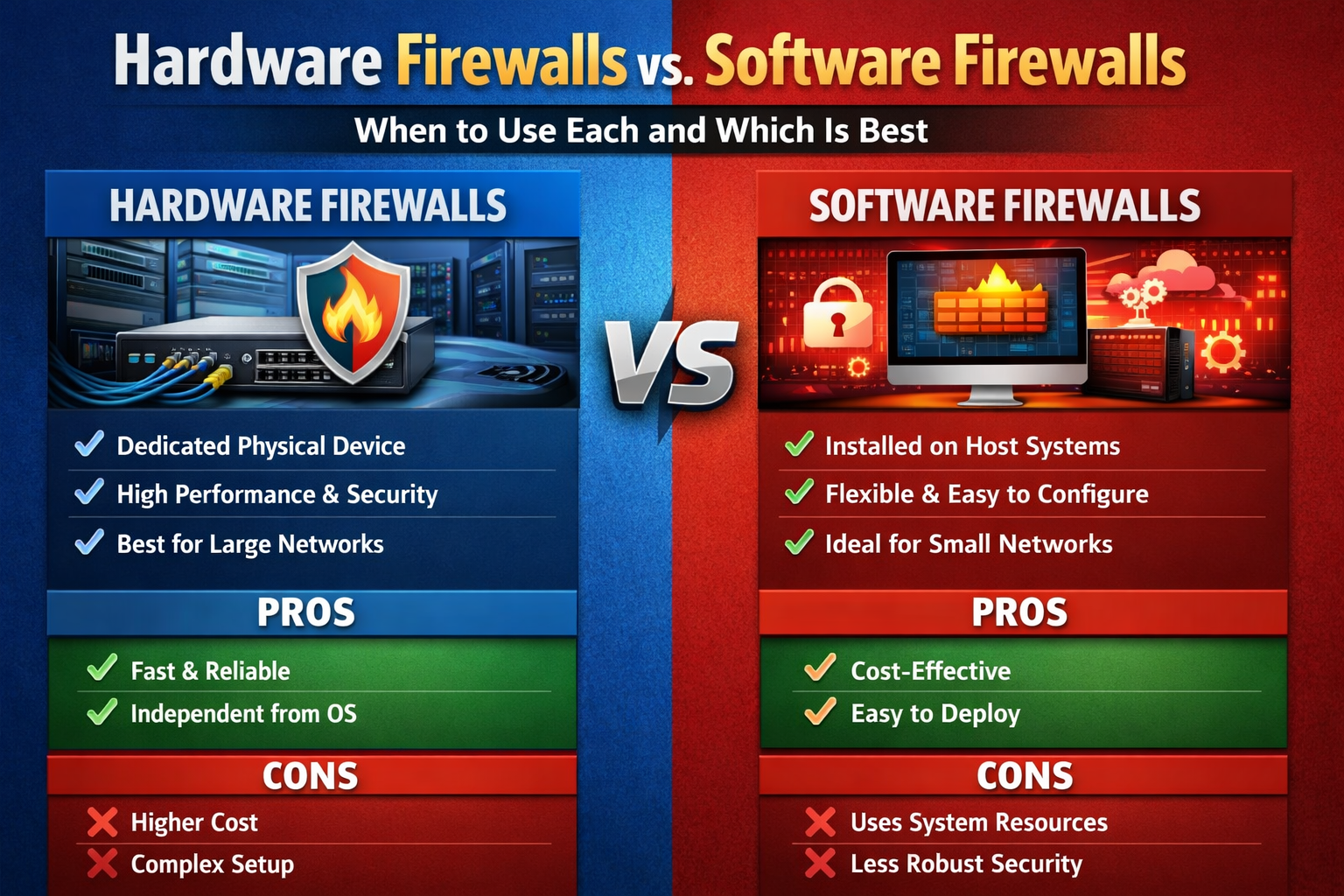
Both hardware firewalls and software firewalls are created to protect systems from cyber threats, but they work in very different ways. Their design, placement, and method of operation determine where they are most effective. Understanding these differences helps businesses and individuals choose the right security solution based on their specific needs.
How a Hardware Firewall Works
A hardware firewall is a physical device placed between the internet connection and the internal network. It acts as the first security checkpoint by inspecting incoming and outgoing traffic before it reaches computers, servers, or other connected devices. This allows every device on the network to receive the same level of protection from one central point.
Where Hardware Firewalls Are Commonly Used
Hardware firewalls are commonly used in offices, schools, hospitals, government institutions, and large organizations where multiple users depend on the same network. They help block suspicious traffic, prevent unauthorized access, and apply security rules across the entire infrastructure. Because they protect the network as a whole, they are considered strong perimeter defense systems.
How a Software Firewall Works
A software firewall is installed directly on individual devices such as desktop computers, laptops, servers, or mobile systems. Instead of protecting the full network, it focuses on securing a single machine. It monitors incoming and outgoing traffic for that specific device and allows users or administrators to create detailed security rules for applications and network behavior.
Device-Level Control and Monitoring
Software firewalls offer greater control at the endpoint level. For example, they can block a specific application from accessing the internet or warn users when an unknown program tries to connect online. This makes them especially useful for personal computers, remote workers, and employees who frequently connect to public or shared networks.
Traffic Inspection Differences
One major difference between hardware and software firewalls is how they inspect traffic. Hardware firewalls stop harmful traffic before it enters the internal network, making them effective against external attacks such as hacking attempts and malware delivery. Software firewalls work after the traffic reaches the device and are better for detecting suspicious behavior inside the system.
Impact on System Performance
Hardware firewalls work independently as separate devices, so they do not use the memory or processing power of individual computers. This helps maintain better device performance while still providing strong protection. Software firewalls use the resources of the device they are installed on, which can sometimes affect performance, especially on older systems.
Management and Administration
Hardware firewalls usually require professional management because they involve advanced setup, configuration, and monitoring. Network administrators often handle updates, security rules, and performance checks. These firewalls may also include advanced features such as intrusion prevention, virtual private network support, and centralized policy management.
Ease of Use for Software Firewalls
Software firewalls are generally easier for everyday users to manage. Many operating systems include built-in firewall protection with simple settings and notifications. Users can control internet access for specific programs without needing deep technical knowledge, making them ideal for home users and small businesses.
Cost and Budget Considerations
Hardware firewalls are usually more expensive because they involve physical equipment, installation costs, maintenance, and licensing fees for advanced features. This investment is often necessary for large organizations handling sensitive information. Software firewalls are more affordable and are often included with operating systems, making them a practical option for individuals and smaller businesses.
Scalability for Growing Businesses
As businesses grow and add more users and devices, hardware firewalls provide better scalability. They can be upgraded to support larger networks without requiring separate setup for every new system. This makes them valuable for organizations planning long-term expansion and stronger centralized protection.
Challenges of Managing Software Firewalls
Software firewalls can become difficult to manage in large environments because each device needs separate attention. Installing updates and maintaining security settings across many systems takes time and effort. This is why software firewalls alone are usually not enough for large enterprises with hundreds of connected devices.
Security Depth and Internal Threats
Hardware firewalls provide strong protection against outside threats, but they may not stop threats that originate from inside the network. For example, malware introduced through a USB drive or a harmful email attachment may bypass the network firewall. Software firewalls help in these cases because they monitor activity directly on the device itself.
Why Layered Security Is Important
Many cybersecurity professionals recommend using both hardware and software firewalls together. A hardware firewall protects the network from external threats, while software firewalls secure individual devices from internal risks and suspicious application behavior. This layered approach creates stronger and more reliable protection.
The Impact of Remote Work
Remote work has changed how businesses think about firewall security. In the past, hardware firewalls were enough because employees worked inside the office network. Today, many people work from home or travel with company laptops, which makes software firewalls more important for protecting devices outside the main office network.
Cloud Computing and Modern Firewall Needs
Cloud computing has also changed firewall strategies. Many businesses now use cloud platforms for storage, communication, and daily operations. This creates security challenges because data moves beyond the physical office network. In these cases, hardware firewalls, software firewalls, and cloud firewalls often work together to provide full protection.
The Role of User Behavior
Even the strongest firewall cannot protect a system if users ignore basic security practices. Clicking suspicious links, downloading unknown files, using weak passwords, or turning off security settings can create major risks. Firewalls are powerful tools, but they must be supported by responsible user behavior and strong security awareness.
The Importance of Updates and Maintenance
Firewalls must be updated regularly to remain effective. Cybercriminals constantly develop new attack methods, and outdated firewall rules may fail to recognize modern threats. Hardware firewalls require firmware updates and security reviews, while software firewalls need regular patches and monitoring to maintain strong protection.
Avoiding False Confidence
Some users believe that installing a firewall means complete security, but this is not true. Firewalls are only one part of a full cybersecurity strategy. They do not replace antivirus software, backups, encryption, employee training, or endpoint protection. Relying only on a firewall can leave serious security gaps.
Firewall Use in Regulated Industries
Industries such as healthcare, finance, and legal services require stronger firewall protection because they handle sensitive information and must follow strict compliance rules. Hardware firewalls help secure the network, while software firewalls protect individual systems and support security standards. A security failure in these sectors can lead to major financial and legal consequences.
Why Small Businesses Need Firewalls
Small businesses are often targeted by cybercriminals because they may have weaker security defenses. A properly configured software firewall combined with basic network protection can prevent many common attacks. As the business grows, adding a hardware firewall becomes an important step toward stronger long-term security.
Educational Institutions and Shared Networks
Schools, colleges, and universities manage large networks with many users and connected devices. Hardware firewalls help control traffic across the campus, while software firewalls protect staff systems and administrative records. This combination helps maintain both accessibility and strong data security.
Firewall Protection for Home Users
For home users, software firewalls are often enough for everyday protection, especially when combined with secure Wi-Fi settings, antivirus software, and regular system updates. However, homes with smart devices, remote work setups, and shared family networks may benefit from stronger router-level protection similar to a hardware firewall.
Smart Devices and Home Security
Gaming consoles, smart televisions, security cameras, and home automation devices have increased the need for stronger home network security. These devices often have limited built-in protection and can become targets for cyberattacks. A network-level firewall helps reduce these risks by controlling access to the home network.
Making the Right Firewall Decision
Choosing between hardware and software firewalls should always be based on risk assessment rather than assumptions. Businesses must consider the value of their data, the number of users, employee work locations, and the cost of downtime or data loss. This practical approach leads to smarter and more effective security planning.
The Real Answer: Both Have Value
Hardware and software firewalls are both important, but they serve different purposes. Hardware firewalls protect the network as a whole and provide centralized defense, while software firewalls offer detailed protection for individual devices. Neither should be ignored, and neither should be expected to solve every security problem alone.
Building Stronger Long-Term Security
The best protection comes from combining both types of firewalls with strong security policies, regular updates, employee awareness, and continuous monitoring. This creates a stronger defense against cyber threats and reduces the chances of data breaches, financial loss, and business disruption.
Adapting to Modern Cyber Threats
As cyber threats continue to grow in complexity, firewall strategies must also improve. Modern cybersecurity requires flexibility, layered defense, and continuous attention. Whether protecting a personal laptop or an entire business network, the main goal remains the same: preventing unauthorized access and keeping valuable information safe.
Advantages of Hardware Firewalls
Hardware firewalls provide strong protection by acting as the first line of defense between the internet and the internal network. Since they filter traffic before it reaches computers, servers, or connected devices, they help stop many threats before damage can occur. This makes them highly effective against hacking attempts, malware delivery, and unauthorized access from outside sources.
Centralized Security Management
One of the biggest advantages of hardware firewalls is centralized management. Instead of setting up protection on every individual computer, administrators can control security rules from one central location. This ensures consistency across the network and reduces the risk of weak security settings on specific devices.
Better Performance for Devices
Hardware firewalls work independently as separate physical devices, which means they do not use the memory, processor, or storage of the computers they protect. This allows employees and users to work without system slowdowns caused by security software running in the background. It is especially useful in business environments where performance and productivity are important.
Stronger Resistance Against Attacks
Because hardware firewalls exist outside the devices they protect, they are harder for attackers to disable. If malware infects a computer, it may try to turn off local security programs, but it usually cannot directly disable the external firewall device. This adds another layer of reliability and protection.
Scalability for Business Growth
As organizations grow, hardware firewalls can be upgraded to support more users, devices, and network traffic. This makes them a strong long-term investment for businesses planning expansion. Instead of replacing security systems completely, companies can improve their firewall capacity as their needs increase.
Disadvantages of Hardware Firewalls
Despite their strong protection, hardware firewalls also have some limitations. One major disadvantage is cost. They require physical equipment, installation, maintenance, and sometimes additional licensing fees for advanced features. This makes them more expensive than software firewalls, especially for small businesses and personal users.
Complex Setup and Configuration
Hardware firewalls often require technical expertise for proper setup and management. Incorrect configuration can create security weaknesses or block important business operations. Because of this, many organizations need trained IT professionals or cybersecurity experts to manage them effectively.
Limited Protection Against Internal Threats
Hardware firewalls are mainly designed to stop threats coming from outside the network. If malware enters through a USB drive, an infected email attachment, or insider activity, the firewall may not detect it because the threat bypassed the network entry point. This is why additional endpoint protection is still necessary.
Less Control Over Individual Applications
While hardware firewalls protect the overall network, they may not provide detailed control over specific applications running on individual devices. They are excellent for network-wide defense but less effective for monitoring which programs on a computer are trying to access the internet.
Advantages of Software Firewalls
Software firewalls protect devices by being installed directly on computers, laptops, servers, or mobile systems. They monitor traffic going in and out of that specific device and help detect suspicious activity. This makes them useful for personal users, remote workers, and businesses needing strong endpoint security.
Detailed Application-Level Control
One major advantage of software firewalls is the ability to control individual programs. Users can allow or block specific applications from accessing the internet. For example, a business can prevent unauthorized software from sending data online, which improves security and privacy.
Affordable and Easy to Install
Software firewalls are usually more affordable than hardware firewalls. Many operating systems already include built-in firewall protection, allowing users to start with basic security without extra cost. Premium versions may offer stronger features, but the overall expense remains lower than dedicated hardware solutions.
Protection for Remote and Mobile Users
Since software firewalls are installed directly on devices, protection remains active wherever the device goes. This is important for remote workers, freelancers, and employees who use laptops on public Wi-Fi networks, hotel internet, or home connections outside the office environment.
Improved Detection of Internal Threats
Software firewalls can detect unusual outbound traffic and suspicious activity already happening inside the device. If malware is installed on the system, the firewall may notice unexpected internet connections or unauthorized behavior. This helps protect against threats that hardware firewalls may miss.
Disadvantages of Software Firewalls
Software firewalls also have weaknesses that should be considered. One common issue is that they use the resources of the device they are installed on. This means they consume memory, processor power, and storage, which can reduce performance, especially on older computers.
Difficult Management in Large Networks
In large organizations, managing software firewalls across many devices can become challenging. Every computer may need separate installation, updates, and monitoring. Without centralized tools, maintaining strong security across hundreds of systems can take significant time and effort.
Risk of Users Disabling Protection
Some users disable software firewalls intentionally when facing internet connection problems or software conflicts. Others may turn them off without understanding the security risks. Since the firewall exists inside the device, it depends more heavily on user behavior and awareness.
Vulnerability to Malware Attacks
If a device becomes infected with advanced malware, the malicious software may attempt to disable or bypass the software firewall. Since the firewall operates within the same system being attacked, it can be more vulnerable compared to an external hardware firewall.
No Full Network-Wide Protection
A software firewall only protects the device where it is installed. It does not secure the entire network from one central point. This means every endpoint must be protected separately, which may not be practical for large organizations without additional network-level security.
Comparing Overall Security Strength
When comparing security strength, hardware firewalls are stronger for perimeter defense because they stop threats before they enter the network. Software firewalls are stronger for endpoint monitoring because they observe detailed activity directly on the device. Both are valuable, but each covers different security areas.
Comparing Cost and Long-Term Investment
Software firewalls are usually the better choice for users with limited budgets because they are affordable and easy to deploy. Hardware firewalls require a larger investment, but they provide stronger centralized security and better long-term value for growing businesses that handle sensitive information.
Choosing for Small Businesses
Small businesses often begin with software firewalls because they are simple and cost-effective. As the company grows and handles more customers, employees, and confidential data, adding a hardware firewall becomes an important step toward stronger overall protection.
Choosing for Large Enterprises
Large enterprises usually require hardware firewalls because they manage complex networks and must meet strict compliance standards. Centralized management and strong perimeter security are essential in these environments. Software firewalls still remain important, but they work best as part of a larger layered defense system.
Choosing for Home Users
For home users, software firewalls are often enough when combined with antivirus software, strong passwords, secure Wi-Fi settings, and regular updates. Homes with multiple smart devices, remote work setups, or advanced networking needs may also benefit from stronger router-level firewall protection.
Why Combining Both Is Best
The strongest cybersecurity strategy often comes from using both hardware and software firewalls together. Hardware firewalls protect the network boundary, while software firewalls protect individual systems inside that network. This layered approach reduces both external and internal security risks.
Building Stronger Long-Term Protection
Cyber threats continue to become more advanced, and relying on only one type of firewall can leave security gaps. Combining firewall protection with antivirus software, employee awareness, strong password policies, and regular monitoring creates a much stronger defense against attacks and data breaches.
Final Comparison and Practical Value
Hardware firewalls and software firewalls both have important roles in cybersecurity. Hardware solutions provide strong centralized protection and scalability, while software solutions offer flexibility, affordability, and detailed control at the device level. The best decision depends on the environment, risk level, and business goals.
The Best Choice Depends on Need
There is no single firewall that is best for everyone. A personal laptop, a small business office, and a large corporate network all have different security requirements. Understanding these needs helps users choose the right protection strategy and build stronger defense against modern cyber threats.
When to Use Hardware Firewalls
Hardware firewalls are most effective when an entire network needs protection from a central point. They are designed to secure multiple devices at once, making them ideal for businesses, schools, hospitals, and organizations where many users share the same internet connection. Since they inspect traffic before it enters the internal network, they help prevent threats before they can reach computers and servers.
Best for Business Networks
Businesses with multiple employees and shared systems benefit greatly from hardware firewalls because they provide network-wide protection. Instead of installing separate security controls on every device, the firewall creates a strong security boundary for the entire organization. This is especially useful for companies handling customer records, financial information, and confidential business data.
Useful for Offices with Multiple Devices
In office environments where desktops, laptops, printers, servers, and smart devices are connected to the same network, hardware firewalls offer stronger centralized control. They allow administrators to apply security rules across all devices at once, improving consistency and reducing the chances of weak security settings.
Important for Data-Sensitive Industries
Industries such as healthcare, banking, legal services, and government operations require strong protection because they manage sensitive and regulated information. Hardware firewalls are important in these environments because they help prevent unauthorized access and support compliance with security standards and privacy requirements.
Ideal for Companies with Dedicated IT Teams
Organizations with professional IT departments often choose hardware firewalls because these systems require proper configuration, monitoring, and updates. Network administrators can manage advanced settings such as intrusion prevention, traffic filtering, virtual private networks, and access control more effectively in structured business environments.
Helpful for Preventing External Attacks
Hardware firewalls are excellent for stopping attacks that come from outside the network. Hackers attempting unauthorized access, malware trying to enter through internet traffic, and suspicious connection requests can be blocked before they reach internal systems. This makes hardware firewalls strong perimeter defense tools.
Suitable for Growing Businesses
As companies expand and add more employees, departments, and connected devices, hardware firewalls provide the scalability needed to maintain strong security. Instead of redesigning the entire security structure, businesses can upgrade their firewall capacity and continue protecting the network efficiently.
When to Use Software Firewalls
Software firewalls are best used when individual devices need direct protection. They are installed on specific systems such as laptops, desktops, servers, and mobile devices. This makes them ideal for personal users, freelancers, remote workers, and businesses that need detailed control over endpoint security.
Best for Personal Computers and Laptops
Home users and professionals using personal computers benefit from software firewalls because they protect the device directly. They monitor incoming and outgoing traffic, helping prevent suspicious applications from accessing the internet or unauthorized connections from reaching the system.
Essential for Remote Workers
Employees working from home or traveling often connect to different internet networks outside the office. In these situations, software firewalls are extremely important because the device still needs protection even when it is not connected to the company’s internal network. Public Wi-Fi and hotel internet connections can create higher security risks.
Useful for Application-Level Control
Software firewalls are ideal when users need control over specific applications. They allow administrators or individuals to decide which programs can access the internet and which should be blocked. This is valuable for preventing unauthorized software from sending data or creating hidden security risks.
Helpful Against Internal Threats
If malware enters a device through an email attachment, infected download, or USB drive, a software firewall can help detect unusual behavior from inside the system. It monitors outbound traffic and suspicious activity that may not be visible to a network-level firewall. This improves endpoint-level protection.
Suitable for Small Businesses
Small businesses often start with software firewalls because they are affordable and easier to manage than dedicated hardware solutions. For businesses with a limited number of devices and a smaller budget, software firewalls provide strong initial protection without requiring major infrastructure investment.
Effective for Mobile and Flexible Work Environments
Modern work environments often involve employees using laptops, tablets, and mobile systems in different locations. Software firewalls provide continuous protection because security stays with the device rather than depending only on the office network. This flexibility is important in modern business operations.
Using Both for Maximum Security
In many cases, the best solution is not choosing one over the other, but using both hardware and software firewalls together. Hardware firewalls protect the network entrance, while software firewalls protect each device inside that network. This layered approach creates stronger overall security and reduces both external and internal risks.
Protection for Corporate Offices
Large corporate offices often use a hardware firewall at the network boundary and software firewalls on employee devices. This ensures that threats are blocked before entering the network while still monitoring internal activity on laptops, desktops, and servers. This combination is one of the strongest security strategies for professional environments.
Security for Remote Employees
Even when a company has a strong hardware firewall in the office, remote employees still need software firewalls on their laptops. Once employees leave the office network, the hardware firewall no longer protects them directly. Software firewalls ensure that security remains active wherever the device is used.
Supporting Cloud-Based Operations
Businesses using cloud services need both endpoint and network security. Hardware firewalls protect office infrastructure, while software firewalls protect devices accessing cloud platforms from different locations. This becomes especially important when employees handle sensitive information through online systems.
Home Networks with Smart Devices
Modern homes often include smart televisions, gaming systems, security cameras, and home automation devices connected to the internet. A simple network-level firewall through the router provides broad protection, while software firewalls on laptops and desktops add stronger personal security. This creates a balanced home cybersecurity setup.
Educational Institutions and Shared Access
Schools and universities often require both firewall types because they manage large shared networks and sensitive academic records. Hardware firewalls protect campus-wide internet traffic, while software firewalls secure faculty systems and administrative devices that store important personal and institutional information.
Healthcare and Financial Sectors
Hospitals and financial institutions must protect highly confidential records and meet strict compliance requirements. In these sectors, using both firewall types is essential. Hardware firewalls provide strong network defense, while software firewalls help secure workstations, servers, and devices used by employees handling critical information.
Avoiding Common Firewall Mistakes
Some organizations make the mistake of relying only on one type of firewall. Using only a hardware firewall may leave endpoint devices vulnerable to internal threats, while using only software firewalls may fail to protect the network perimeter effectively. Understanding where each firewall works best helps avoid dangerous security gaps.
Choosing Based on Risk Level
The right firewall choice depends on the level of risk involved. A home user with one laptop has very different security needs compared to a company with hundreds of employees and sensitive customer data. Security decisions should always be based on real risk assessment rather than assumptions or cost alone.
Considering Budget and Resources
Budget also plays an important role when deciding which firewall to use. Small businesses may begin with software firewalls because they are affordable, while larger organizations often invest in hardware firewalls for stronger centralized protection. The goal should always be finding the right balance between cost and security.
Long-Term Security Planning
Firewall decisions should support long-term growth and changing business needs. A company may start with software-based protection and later add hardware firewalls as operations expand. Planning ahead helps avoid major security problems and supports stronger infrastructure over time.
Why Firewall Strategy Matters
A firewall is not just a technical tool—it is a major part of business continuity and data protection. Security failures can lead to downtime, financial loss, damaged reputation, and legal consequences. Choosing the right firewall strategy helps reduce these risks and improves confidence in digital operations.
The Best Choice Depends on Environment
There is no single answer for every situation because different users and organizations have different security needs. Hardware firewalls are stronger for network-wide defense, while software firewalls are better for direct device protection. The best choice depends on the environment, the type of data being protected, and the level of security required.
Building a Stronger Future with Layered Security
As cyber threats continue to grow, relying on only one layer of defense is no longer enough. Combining hardware firewalls, software firewalls, antivirus tools, employee awareness, and regular monitoring creates stronger protection. This layered approach helps individuals and businesses stay secure in a constantly changing digital world.
Which Firewall Is Best for Different Environments
Choosing the best firewall depends on the environment where it will be used. A home user, a small business, and a large enterprise all have different security requirements. There is no single firewall that is perfect for every situation because security needs change based on the number of users, devices, data sensitivity, and operational risks. Understanding the environment helps in selecting the most effective firewall strategy.
Best Firewall for Home Users
Home users usually need simple but reliable protection for personal computers, laptops, smartphones, and smart home devices. In most cases, a software firewall is enough because it provides direct device-level security and is often already included in the operating system. It helps block suspicious applications, unauthorized connections, and unsafe network activity without requiring expensive equipment.
Router-Level Protection for Homes
Most modern home internet routers also provide basic firewall protection that works like a simple hardware firewall. This helps filter internet traffic before it reaches personal devices. When combined with a software firewall on laptops and desktops, home users receive stronger protection against common online threats such as malware, phishing attempts, and unauthorized access.
Security for Families Using Shared Networks
In households where multiple family members use the same Wi-Fi network, stronger network-level protection becomes more important. Children using online learning platforms, adults working remotely, and smart devices connected to the internet all increase the need for better security. A reliable router firewall combined with software firewalls on personal devices creates a safer digital environment.
Best Firewall for Small Businesses
Small businesses often begin with software firewalls because they are affordable and easier to manage. Startups and local offices with a limited number of employees may not need a dedicated hardware firewall in the early stages. Software firewalls provide sufficient protection for desktops, laptops, and office systems while helping control application-level access.
When Small Businesses Should Upgrade
As a business grows and starts handling more customer information, payment details, or confidential records, stronger protection becomes necessary. This is the stage where adding a hardware firewall becomes a smart decision. It improves centralized security, protects the full office network, and supports better long-term cybersecurity planning.
Best Firewall for Medium-Sized Companies
Medium-sized companies usually require both hardware and software firewalls because they manage more employees, devices, and business operations. A hardware firewall protects the office network from external threats, while software firewalls secure employee laptops, servers, and endpoint systems. This combination improves security without creating unnecessary complexity.
Managing Hybrid Work Environments
Many medium-sized businesses now support hybrid work where employees work both from the office and remotely. In these cases, software firewalls are especially important because employees need protection even when they are outside the company network. Hardware firewalls protect office infrastructure, but software firewalls ensure security continues on every connected device.
Best Firewall for Large Enterprises
Large enterprises require advanced firewall solutions because they handle large networks, sensitive information, and complex operations. A hardware firewall is essential in these environments because it provides centralized control, advanced monitoring, intrusion prevention, and support for large-scale traffic management. It becomes the foundation of enterprise-level network security.
Conclusion
Hardware firewalls and software firewalls both play an important role in protecting systems, networks, and sensitive data from cyber threats. While they serve the same purpose of controlling and monitoring network traffic, they work in different ways and are designed for different security needs. Hardware firewalls provide strong protection at the network level by filtering traffic before it reaches internal devices, while software firewalls focus on securing individual computers and monitoring application-level activity.
Choosing between the two depends on the size of the environment, the level of risk, and the type of protection required. Hardware firewalls are more suitable for businesses, organizations, and industries that manage multiple devices and sensitive information. They offer centralized control, stronger perimeter defense, and better scalability for long-term growth. Software firewalls, on the other hand, are ideal for personal users, remote workers, and small businesses because they provide affordable, flexible, and device-specific protection.
Neither hardware firewalls nor software firewalls should be considered a complete solution on their own. A hardware firewall may stop external threats but may not detect internal risks, while a software firewall protects a single device but cannot secure the entire network. This is why the most effective cybersecurity strategy often involves using both together. A layered security approach provides stronger protection by defending both the network boundary and the individual endpoints inside it.
Modern cyber threats continue to evolve, making firewall protection more important than ever. Businesses and individuals must combine firewalls with other security practices such as antivirus software, regular updates, strong passwords, employee awareness, and continuous monitoring. Firewalls are a critical first line of defense, but their true strength comes when they are part of a complete security strategy.