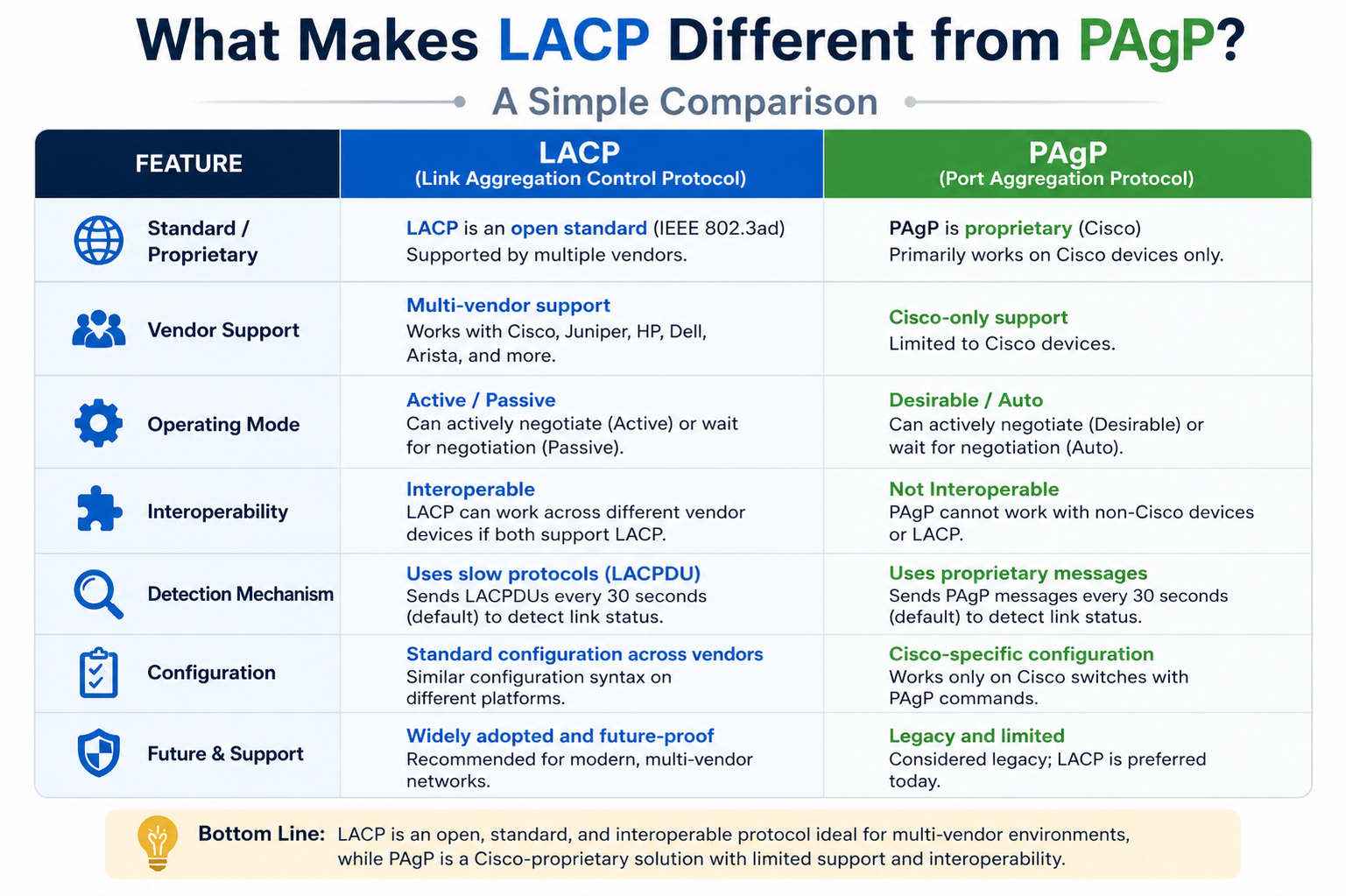
LACP (Link Aggregation Control Protocol) and PAgP (Port Aggregation Protocol) are two important technologies used in networking to combine multiple physical Ethernet links into a single logical link. This process is known as link aggregation or EtherChannel. The main purpose of both protocols is to increase bandwidth, improve redundancy, and ensure better load balancing across network links. Although they serve the same basic function, their design, behavior, compatibility, and real-world usage differ significantly. Understanding these differences helps in choosing the right protocol for a network environment.
Origin and Development
LACP is based on an open standard defined by the IEEE under the 802.3ad specification, which later became part of IEEE 802.1AX. Being an open standard means that it is not tied to any single vendor and can be implemented across different networking equipment manufacturers. This makes LACP highly flexible and widely adopted in modern enterprise and data center environments.
PAgP, on the other hand, was developed by Cisco as a proprietary protocol. This means it was designed specifically for Cisco devices and is not natively supported by other vendors. Because of this limitation, PAgP is mostly used in older or Cisco-exclusive networks. Over time, as networks became more diverse and multi-vendor environments became common, the popularity of PAgP declined in favor of LACP.
Compatibility and Interoperability
One of the biggest differences between LACP and PAgP is interoperability. LACP works across different brands of networking devices, including Cisco, Juniper, HP, Dell, and others. This makes it ideal for organizations that use equipment from multiple vendors. It reduces dependency on a single manufacturer and provides more flexibility in network design.
PAgP is restricted to Cisco devices only. It cannot form EtherChannel connections with non-Cisco equipment. This creates a limitation in heterogeneous environments. If a network contains mixed hardware, PAgP cannot be used, which forces administrators to rely on LACP or static aggregation instead.
Protocol Operation and Modes
LACP operates using two main modes: active and passive. In active mode, a device actively sends LACP packets to initiate negotiation with another device. In passive mode, a device waits for LACP packets from the other side before responding. A successful link aggregation occurs when at least one side is in active mode. This flexible approach allows LACP to adapt to different configurations while maintaining stability.
PAgP uses two different modes called desirable and auto. In desirable mode, the device actively attempts to form an EtherChannel by sending negotiation messages. In auto mode, the device remains passive and only responds if the other side initiates the process. However, unlike LACP, PAgP requires specific Cisco negotiation behavior, which limits its adaptability compared to the more standardized LACP.
Negotiation Mechanism
LACP uses standardized frames to exchange information between devices. These frames carry details such as system ID, port priority, and operational state. Both devices compare this information to determine whether the links can be bundled together. Because it follows IEEE standards, the negotiation process is predictable and consistent across vendors.
PAgP also uses negotiation messages but follows Cisco-specific rules. It exchanges information such as device ID, port channel group, and capabilities. While effective in Cisco environments, the lack of standardization means it cannot be interpreted by non-Cisco devices. This makes it less flexible in modern mixed networks.
Load Balancing Behavior
Both LACP and PAgP support load balancing across multiple links, but the way traffic is distributed depends on hashing algorithms configured on the device. These algorithms can use source and destination MAC addresses, IP addresses, or even TCP/UDP port numbers.
LACP tends to be more flexible because it is widely supported on modern hardware with advanced load-balancing options. It can efficiently distribute traffic in high-performance environments such as data centers and cloud networks.
PAgP also supports load balancing, but it is more limited due to its older design and Cisco-specific implementation. While it works well in smaller or traditional networks, it is less optimized for modern high-throughput requirements.
Failover and Redundancy
One of the key advantages of both protocols is redundancy. If one physical link in the aggregation fails, traffic is automatically redistributed across the remaining active links. This ensures minimal disruption and improves network reliability.
LACP provides faster and more predictable failover because of its continuous exchange of control packets. Devices constantly monitor link status and can quickly detect failures.
PAgP also provides failover capability, but its detection mechanism is less flexible compared to LACP. Since it is a proprietary protocol, its behavior is more tightly bound to Cisco’s implementation standards.
Scalability in Network Design
LACP is highly scalable and can support larger and more complex network architectures. It is commonly used in enterprise core networks, data centers, and cloud environments where high bandwidth and redundancy are essential. It supports up to 16 links in a single aggregation group, with 8 active forwarding links and 8 standby links depending on configuration.
PAgP is less scalable in comparison. While it also supports multiple links in an EtherChannel, its usage is generally limited to smaller Cisco-based environments. It is not commonly chosen for large-scale modern deployments due to its proprietary nature.
Vendor Dependency
LACP eliminates vendor dependency, making it suitable for organizations that prefer flexibility in hardware selection. It aligns with industry standards, allowing seamless integration across different systems.
PAgP creates vendor dependency because it only works within Cisco ecosystems. While this can be beneficial in fully Cisco-managed environments due to tighter integration and consistent behavior, it becomes a limitation when network expansion involves other vendors.
Configuration and Management
LACP configuration is widely supported across different platforms and follows a consistent standard. Network administrators can configure it in a similar way regardless of the device manufacturer, which simplifies management in multi-vendor environments.
PAgP configuration is specific to Cisco IOS commands and terminology. Administrators must be familiar with Cisco-specific syntax and behavior, which can increase complexity in mixed environments or when transitioning to other vendors.
Performance Considerations
In terms of performance, both protocols themselves do not directly increase speed but enable multiple links to function as a single logical channel. However, LACP often performs better in modern networks because it is supported on newer hardware with optimized ASIC-based forwarding and advanced load-balancing techniques.
PAgP performs adequately in traditional Cisco environments but does not benefit from the same level of optimization found in newer multi-vendor ecosystems.
Fault Detection and Recovery
LACP continuously exchanges control information between devices, which allows for quicker detection of link failures. This improves recovery time and ensures that traffic is rerouted efficiently.
PAgP also monitors link status but relies on Cisco-specific mechanisms. While it is reliable within its intended environment, it may not react as quickly or flexibly as LACP in complex or large-scale networks.
Modern Usage Trends
Today, LACP is the preferred choice in almost all modern network designs. Its open standard nature, scalability, and vendor neutrality make it suitable for enterprise, cloud, and hybrid environments.
PAgP is considered a legacy protocol. It is still found in older Cisco deployments but is gradually being replaced. Most new network designs avoid PAgP in favor of LACP to ensure compatibility and future-proofing.
Key Differences in Practice
In practical terms, LACP is designed for flexibility, interoperability, and modern networking demands, while PAgP is designed for simplicity within Cisco-only environments. LACP follows global standards, making it suitable for diverse infrastructures, whereas PAgP remains limited to a single vendor ecosystem. This fundamental difference influences almost every aspect of their behavior, from negotiation and compatibility to scalability and long-term usability.
Frame Structure and Communication Style
LACP communicates using standardized Ethernet frames defined by IEEE 802.3ad/802.1AX. These frames are known as LACP Data Units (LACPDUs). They are exchanged periodically between devices to maintain synchronization and verify that all links in the bundle are still active and properly configured. Because these frames follow a global standard, any compliant device can interpret them correctly regardless of vendor.
PAgP uses Cisco-proprietary packets to handle communication between devices. These packets carry similar types of information, such as device identity, port capabilities, and aggregation status. However, since the format is not standardized, only Cisco devices can interpret and respond to PAgP messages. This limits its flexibility in heterogeneous networks.
The standardized nature of LACP frames makes troubleshooting easier in multi-vendor environments, while PAgP requires Cisco-specific tools and knowledge for deeper analysis.
Convergence Time and Link Stability
LACP generally provides more predictable convergence behavior when links go up or down. Because devices continuously exchange LACPDUs at regular intervals, link failures are detected quickly. When a failure occurs, traffic is redistributed across remaining active links with minimal delay, improving overall network stability.
PAgP also maintains link awareness through periodic communication, but its convergence behavior is more dependent on Cisco’s internal implementation. In some cases, this can lead to slightly slower or less predictable failover compared to LACP, especially in complex topologies or larger deployments.
In modern high-availability networks, this difference becomes important because even small delays in failover can impact performance-sensitive applications.
Load Sharing Algorithms in Depth
Both protocols rely on underlying switching or routing devices to distribute traffic across aggregated links. However, the flexibility of load balancing is influenced more by platform support than the protocol itself.
LACP environments often integrate with more advanced load-balancing algorithms that can consider multiple parameters such as source and destination IP addresses, MAC addresses, VLAN IDs, and even Layer 4 port numbers. This allows more efficient utilization of all available links, especially in high-traffic environments.
PAgP supports similar load-balancing mechanisms, but these are typically more limited and closely tied to Cisco device capabilities. Older implementations may rely primarily on MAC-based or IP-based hashing, which can sometimes result in uneven traffic distribution depending on the traffic pattern.
Error Handling and Recovery Mechanisms
LACP has a robust mechanism for detecting inconsistencies between connected devices. If there is a mismatch in configuration, such as speed, duplex, or VLAN settings, LACP can prevent the link from joining the aggregation group. This helps avoid misconfigurations that could lead to network instability.
PAgP also performs compatibility checks before forming an EtherChannel, but its validation logic is Cisco-specific. While effective in Cisco-only environments, it may not provide the same level of standardized error handling across different hardware platforms.
Additionally, LACP’s continuous monitoring allows it to quickly remove faulty links from the aggregation group without disrupting the entire bundle.
Configuration Flexibility and Modes Interaction
LACP’s active-passive model allows more flexible configurations. For example, one device can be set to active mode while the other remains passive, still successfully forming an aggregated link. This flexibility reduces configuration errors and simplifies deployment in large-scale environments.
PAgP’s desirable-auto model is similar in concept but slightly less flexible in real-world usage. In many Cisco deployments, administrators often prefer using desirable mode on both ends to ensure consistent behavior. If both sides are set to auto, the EtherChannel will not form, which can lead to misconfiguration issues if not carefully managed.
This difference highlights LACP’s more forgiving and adaptable design compared to PAgP’s stricter pairing behavior.
Scalability in Modern Data Centers
LACP is widely used in modern data center architectures because it supports high-density link aggregation and integrates well with technologies such as virtualization, software-defined networking, and cloud computing environments. It can scale efficiently across large switching fabrics where hundreds or thousands of aggregated links may exist.
PAgP, by contrast, is rarely used in modern data centers. Its Cisco-only limitation and legacy design make it less suitable for environments that require interoperability and rapid scalability. While it can still function reliably in smaller Cisco-based networks, it does not align well with modern distributed architectures.
Security Considerations
LACP includes mechanisms that help prevent accidental or malicious misconfigurations. For instance, LACP can ensure that only properly configured ports join an aggregation group, reducing the risk of traffic loops or misrouted packets.
PAgP also includes validation checks, but its proprietary nature means its security model is less transparent and not widely reviewed outside Cisco’s ecosystem. In contrast, LACP benefits from broader industry scrutiny due to its open standard status, which often leads to faster identification and resolution of potential issues.
Device Compatibility in Real Deployments
In real-world deployments, LACP can connect devices from different vendors without special configuration changes. This is particularly important in enterprise environments where hardware diversity is common. For example, a network might include Cisco switches in the core, Juniper in the distribution layer, and other vendors at the edge, all seamlessly supporting LACP.
PAgP cannot operate in such environments. It requires both endpoints to be Cisco devices, which significantly limits its deployment scenarios. If a non-Cisco device is introduced into the network, PAgP must be replaced with LACP or static EtherChannel configuration.
Troubleshooting and Monitoring Differences
Troubleshooting LACP issues is generally easier because the protocol is standardized and widely documented. Network engineers can use consistent commands and tools across different vendors to analyze LACP status, neighbor information, and link health.
PAgP troubleshooting requires Cisco-specific commands and expertise. While Cisco provides detailed diagnostics, the lack of cross-vendor consistency can make it more difficult for engineers working in mixed environments or transitioning between platforms.
Monitoring tools in modern networks also tend to support LACP more extensively due to its widespread adoption.
Evolution and Industry Adoption
LACP has evolved alongside modern networking technologies and continues to be actively developed and maintained as part of IEEE standards. It is considered future-proof because it is not tied to any single vendor and adapts well to new networking paradigms.
PAgP has not seen significant evolution in recent years. It remains largely unchanged and is considered a legacy protocol. Cisco itself has shifted focus toward LACP in most modern product lines, reflecting the broader industry transition.
As a result, new network designs almost universally prefer LACP unless there is a specific requirement for maintaining legacy Cisco infrastructure.
Real-World Deployment Scenarios
In enterprise networks, LACP is typically used for server-to-switch connections, switch-to-switch uplinks, and data center interconnects. Its flexibility and interoperability make it ideal for environments where performance and redundancy are critical.
PAgP is mostly found in older campus networks or environments that have not yet migrated away from legacy Cisco configurations. It may still be used in internal segmentation within Cisco-only infrastructures but is rarely chosen for new deployments.
Long-Term Relevance
LACP continues to grow in relevance as networks become more complex and distributed. Its open standard foundation ensures it will remain supported across future technologies, including virtualization platforms and cloud-native networking systems.
PAgP’s relevance continues to decline as organizations modernize their infrastructure. While it still functions effectively within its original design scope, it does not align with the direction of modern networking, which emphasizes openness, interoperability, and scalability.
Real-World Performance Differences Between LACP and PAgP
In practical network environments, both LACP and PAgP aim to deliver improved bandwidth and redundancy, but their real-world performance differences become visible when networks scale or when different types of traffic are involved. LACP tends to perform more consistently in mixed and modern environments because it is designed around open standards and is optimized for interoperability. This allows it to take full advantage of diverse hardware capabilities and advanced switching features.
PAgP performs well in stable Cisco-only environments, but its performance benefits are mostly tied to traditional network setups. In modern infrastructures with dynamic workloads, virtualization, and cloud integration, LACP generally delivers smoother traffic distribution and better adaptability to changing network conditions.
Behavior Under Network Load
When network traffic increases significantly, LACP handles load distribution more efficiently because it can work with more advanced hashing algorithms supported by modern switches. These algorithms allow traffic to be spread more evenly across available links, reducing the risk of congestion on a single physical link.
PAgP also distributes traffic across multiple links, but its effectiveness depends heavily on the Cisco hardware generation and configuration. In some cases, traffic may become unevenly distributed if the hashing method does not match the traffic pattern, which can lead to underutilization of some links.
This difference becomes more noticeable in environments such as data centers, where high-volume east-west traffic flows require precise load balancing.
Impact on Network Design Philosophy
LACP aligns with modern network design principles such as flexibility, scalability, and vendor neutrality. It supports architectures where different network layers may use equipment from different manufacturers while still maintaining seamless link aggregation.
PAgP reflects an older design philosophy centered around closed, single-vendor ecosystems. While this can simplify control and troubleshooting within Cisco-only networks, it limits architectural freedom. As organizations move toward hybrid and multi-cloud environments, LACP naturally fits better into these evolving designs.
Behavior in Failover Scenarios
In failover situations, LACP is generally more responsive because of its continuous exchange of control packets between devices. When a link fails, LACP quickly detects the loss and removes the affected link from the aggregation group, redistributing traffic across the remaining active links almost immediately.
PAgP also detects link failures and adjusts accordingly, but its reaction time can be slightly less dynamic depending on device configuration and platform capabilities. In simpler Cisco environments, this difference may not be noticeable, but in high-performance networks, LACP’s faster convergence becomes an advantage.
Compatibility with Modern Networking Technologies
LACP integrates seamlessly with modern networking technologies such as virtualization platforms, software-defined networking (SDN), and cloud-based infrastructures. Virtual machines, containers, and distributed applications often rely on LACP-enabled links for stable and scalable connectivity.
PAgP does not integrate as naturally into these modern environments due to its proprietary nature. It is mostly confined to traditional physical network infrastructures and does not align well with abstracted or virtualized networking layers.
Administrative Overhead and Ease of Management
From an operational perspective, LACP reduces administrative overhead because it follows a standardized configuration model. Network engineers can apply similar configurations across different vendors, making it easier to manage large and diverse infrastructures.
PAgP requires Cisco-specific knowledge and configuration practices. While this can be efficient in purely Cisco environments, it increases complexity when engineers work across multiple platforms or migrate systems between vendors.
In large organizations, this difference in management simplicity often becomes a key reason for choosing LACP over PAgP.
Error Prevention and Configuration Safety
LACP includes built-in mechanisms to prevent incorrect configurations from forming an EtherChannel. If there is a mismatch in speed, duplex, VLAN tagging, or other critical parameters, LACP will prevent the link from joining the aggregation group. This helps avoid network instability caused by misconfigurations.
PAgP also performs compatibility checks, but its validation process is less standardized. While it is effective within Cisco environments, it does not provide the same universal consistency found in LACP, especially when troubleshooting across different device generations.
Hardware Utilization Efficiency
Modern network hardware is designed with LACP in mind, allowing better utilization of ASIC-based switching capabilities. This results in more efficient packet forwarding and reduced CPU overhead on network devices.
PAgP works efficiently on Cisco hardware, but it does not benefit from the same level of optimization across multi-vendor hardware platforms. As a result, LACP often achieves better overall hardware efficiency in mixed environments.
Network Redundancy and Reliability
Both protocols provide redundancy by ensuring that multiple physical links act as a backup for each other. If one link fails, traffic continues to flow through the remaining active links without interrupting connectivity.
LACP provides more predictable redundancy behavior due to its standardized monitoring and faster detection mechanisms. This makes it more suitable for mission-critical environments where downtime must be minimized.
PAgP also offers reliable redundancy within Cisco ecosystems, but its behavior is more dependent on device-specific implementation rather than universal standards.
Deployment Flexibility in Enterprise Networks
LACP is highly flexible in enterprise deployments because it can be used across access, distribution, and core layers regardless of vendor diversity. This allows organizations to design networks based on performance and cost rather than being restricted by protocol limitations.
PAgP is less flexible because it requires end-to-end Cisco compatibility. While this can simplify design in Cisco-only networks, it restricts architectural choices when scaling or integrating new systems.
Transition from PAgP to LACP in Modern Networks
Many organizations that previously relied on PAgP have migrated to LACP as part of network modernization efforts. This transition is driven by the need for interoperability, cloud integration, and long-term scalability.
Cisco itself has increasingly encouraged the use of LACP in newer hardware and software platforms, reflecting industry-wide adoption trends. As a result, PAgP is now mostly considered a legacy protocol.
Troubleshooting Complexity in Large Networks
In large-scale environments, troubleshooting LACP issues is generally more straightforward because the protocol behavior is consistent across vendors. Engineers can rely on standardized outputs and widely available documentation.
PAgP troubleshooting requires deeper familiarity with Cisco-specific tools and outputs. While experienced Cisco engineers may find this manageable, it becomes more challenging in environments where multiple vendors or hybrid systems are involved.
Long-Term Stability and Future Outlook
LACP is expected to remain the dominant link aggregation protocol for the foreseeable future due to its open standard foundation and continuous evolution under IEEE governance. It is well-suited for emerging technologies such as 5G, edge computing, and cloud-native architectures.
PAgP, however, has limited future relevance. It remains functional but is not evolving alongside modern networking requirements. Its use is gradually declining as organizations shift toward standardized and vendor-neutral solutions.
Migration from PAgP to LACP in Existing Networks
In many organizations that originally built their infrastructure on Cisco-only environments, PAgP was widely used for EtherChannel configurations. However, as networks expanded and diversified, migration toward LACP became a natural step. This transition is usually driven by the need for interoperability, cloud readiness, and reduced vendor dependency.
Migrating from PAgP to LACP typically involves reconfiguring existing port-channel interfaces and ensuring that both ends of the link support IEEE 802.3ad standards. Although the process is conceptually simple, it must be carefully planned to avoid temporary traffic disruption. In most cases, administrators disable the existing PAgP configuration, apply LACP settings, and verify that all links correctly negotiate under the new protocol.
This migration also often coincides with broader network modernization efforts, such as upgrading switching hardware or integrating hybrid cloud connectivity.
Configuration Differences in Practical Environments
From a configuration perspective, LACP and PAgP differ in syntax and operational logic. LACP uses keywords like active and passive to define negotiation behavior, while PAgP uses desirable and auto modes. Although both achieve similar outcomes, the underlying negotiation process is not interchangeable.
LACP configurations are generally more standardized across vendors, making it easier for network engineers to apply consistent templates. PAgP configurations are specific to Cisco IOS and require familiarity with Cisco’s command structure.
This difference becomes more important in large environments where automation tools are used. LACP integrates more smoothly with network automation frameworks due to its standardized nature.
Role in Modern Data Center Architectures
Modern data centers rely heavily on high-speed, redundant connections between switches, servers, and storage systems. LACP plays a critical role in enabling these architectures because it supports scalable link aggregation across different hardware platforms.
In leaf-spine architectures, LACP is commonly used to connect leaf switches to spine switches, ensuring consistent bandwidth distribution and redundancy. It also supports virtualization environments where multiple virtual machines generate dynamic and unpredictable traffic patterns.
PAgP is rarely used in modern data centers. Its limitations in interoperability and vendor dependency make it unsuitable for highly dynamic and scalable architectures. Most modern designs completely avoid PAgP in favor of LACP or static link aggregation.
Behavior in Virtualized Environments
Virtualization introduces additional complexity into network traffic patterns. Virtual machines, containers, and hypervisors often generate fluctuating traffic loads that require intelligent load balancing and redundancy mechanisms.
LACP adapts well to virtualization because it can efficiently distribute traffic across multiple physical links, ensuring that no single link becomes a bottleneck. It also works seamlessly with virtual switches and hypervisor networking stacks.
PAgP does not integrate as effectively into virtualized environments. Its Cisco-specific nature and older design make it less adaptable to dynamic workloads generated by modern virtualization platforms.
Protocol Efficiency and Resource Usage
LACP is designed to minimize overhead while maintaining continuous link monitoring. It uses lightweight control frames that do not significantly impact CPU or memory usage on network devices. This makes it highly efficient even in large-scale deployments with hundreds or thousands of aggregated links.
PAgP also operates efficiently within Cisco environments, but its implementation is more tightly coupled with Cisco hardware behavior. In modern multi-vendor environments, this can lead to less predictable efficiency compared to LACP’s standardized approach.
Stability in Large-Scale Networks
In large enterprise networks, stability is a critical requirement. LACP provides consistent behavior across different devices and vendors, which contributes to predictable network performance. Its standardized operation reduces the risk of unexpected behavior during scaling or hardware upgrades.
PAgP is stable within controlled Cisco environments, but its predictability decreases when network complexity increases or when integration with non-Cisco systems is required. This makes it less suitable for large-scale heterogeneous infrastructures.
Interoperability with Third-Party Systems
One of the strongest advantages of LACP is its ability to work seamlessly with third-party systems. Whether connecting servers, switches, firewalls, or storage devices from different manufacturers, LACP ensures consistent link aggregation behavior.
PAgP cannot interact with third-party systems at all. This lack of interoperability is one of the primary reasons it has been phased out in modern network design.
Operational Risk and Network Downtime
LACP reduces operational risk by enforcing strict but flexible negotiation rules. If configuration mismatches occur, links simply do not join the aggregation group, preventing unstable network states.
PAgP also prevents misconfigurations to some extent, but its behavior is less standardized across different Cisco platforms. This can occasionally lead to inconsistencies during upgrades or hardware replacements.
In high-availability environments, LACP’s predictable behavior significantly reduces the risk of downtime caused by configuration errors.
Support in Network Automation and DevOps
Modern networking increasingly relies on automation tools, Infrastructure as Code (IaC), and DevOps practices. LACP integrates smoothly into these workflows because it follows standardized configurations that can be easily templated and automated.
PAgP is less suited for automation because it is Cisco-specific and less widely supported in multi-vendor automation frameworks. While it can still be automated within Cisco environments, it does not offer the same level of flexibility as LACP.
Cost Implications in Network Design
From a cost perspective, LACP indirectly reduces expenses by allowing organizations to mix and match hardware from different vendors. This avoids vendor lock-in and provides more competitive pricing options for networking equipment.
PAgP increases dependency on Cisco hardware, which can limit procurement flexibility. While Cisco devices are known for their reliability, this dependency can lead to higher long-term infrastructure costs compared to more open designs.
Protocol Maturity and Industry Trust
LACP benefits from long-term standardization under IEEE, which gives it strong industry trust and continuous development. It is widely reviewed, tested, and implemented across global networking environments.
PAgP, while reliable within Cisco systems, does not have the same level of industry-wide validation. Its proprietary nature limits external review and broader adoption, which reduces its long-term trust compared to LACP.
Security and Predictability in Enterprise Networks
LACP contributes to network security indirectly by ensuring only properly configured links participate in aggregation. This reduces the chance of accidental loops or inconsistent forwarding behavior.
PAgP also enforces compatibility checks, but its proprietary design means its behavior is less transparent outside Cisco ecosystems. In environments requiring strict compliance and auditability, LACP is generally preferred.
Future of Link Aggregation Technologies
The future of link aggregation is strongly aligned with open standards and automation-driven networking. LACP fits naturally into this evolution due to its compatibility with software-defined networking, cloud infrastructure, and AI-driven network management systems.
PAgP is expected to remain in legacy environments for backward compatibility but is not evolving to meet future networking demands. Over time, its role will continue to diminish as organizations fully adopt standardized protocols.
Across All Parts
Across all technical, operational, and architectural dimensions, LACP consistently demonstrates greater flexibility, scalability, and future readiness compared to PAgP. While both protocols achieve the same fundamental goal of combining multiple physical links into a single logical channel, their approach and long-term relevance differ significantly.
LACP represents the modern standard for link aggregation, designed for interoperability and large-scale deployment across diverse environments. PAgP represents an earlier, Cisco-specific approach that remains functional but increasingly limited in modern networking scenarios.
As networks continue to evolve toward cloud integration, automation, and multi-vendor architectures, LACP remains the clear and dominant choice for link aggregation in almost all cases.
Advanced Troubleshooting Scenarios in LACP and PAgP
When link aggregation issues occur, the troubleshooting approach for LACP and PAgP differs mainly because of their design philosophies. LACP issues are usually easier to diagnose in mixed environments because the protocol is standardized. Common problems include mismatched configurations, such as speed or duplex inconsistencies, VLAN mismatches, or one side being incorrectly set to passive mode.
LACP provides clear indicators when a link fails to join a bundle. Interfaces will often show states such as “suspended” or “individual,” making it easier for engineers to identify misconfigurations. Because LACP continuously exchanges control packets, it also provides real-time insight into link health.
PAgP troubleshooting is more Cisco-specific and requires deeper familiarity with Cisco IOS outputs. Issues often arise when both ends are not correctly set to compatible modes, such as auto-auto, which prevents channel formation. While Cisco provides detailed diagnostic commands, interpreting them requires more vendor-specific knowledge compared to LACP.
Network Design Best Practices for LACP
In modern networks, LACP is recommended as the default protocol for link aggregation. Best practices include ensuring consistent configuration on both ends of the link, using active mode on at least one side, and verifying that all physical interfaces have identical settings such as speed, duplex, and VLAN membership.
It is also recommended to distribute links across different physical modules or line cards in modular switches. This increases redundancy in case of hardware failure. Additionally, using LACP with load balancing based on Layer 3 or Layer 4 information improves traffic distribution efficiency.
LACP is also commonly paired with redundant switch designs such as stacked switches or multi-chassis link aggregation (MLAG), further enhancing network resilience.
Best Practices for PAgP in Legacy Systems
In environments where PAgP is still used, best practices involve maintaining strict Cisco-only compatibility. Administrators should ensure that one side is set to desirable mode and the other is configured appropriately to avoid negotiation failures.
It is also important to document configurations carefully, as PAgP is less forgiving when changes are made without coordination between devices. Regular audits of EtherChannel configurations help prevent misalignment and network instability.
However, even in Cisco-only environments, many organizations are gradually transitioning away from PAgP to align with industry standards.
Impact on Network Scalability and Growth
Scalability is one of the most important factors in modern networking. LACP supports scalable growth by allowing easy addition of new links into an existing aggregation group without major reconfiguration. This makes it highly suitable for expanding enterprise networks and cloud-based infrastructures.
PAgP has more limited scalability due to its proprietary nature. While additional links can still be added, the process is less flexible and more dependent on Cisco-specific compatibility. This makes long-term expansion more complex in environments that may introduce non-Cisco devices in the future.
Role in High-Availability Architectures
High-availability networks depend on redundancy at every layer. LACP plays a key role in these architectures by ensuring that multiple physical links can fail without impacting overall connectivity. It is commonly used alongside technologies like spanning tree optimization, redundant power supplies, and dual-homed network designs.
PAgP also supports redundancy within Cisco environments, but its usage is generally limited to older high-availability designs. Modern architectures prefer LACP because it integrates more effectively with multi-vendor redundancy strategies and dynamic failover systems.
Energy Efficiency and Hardware Optimization
Although link aggregation protocols themselves do not directly impact power consumption, LACP contributes to more efficient hardware utilization. By evenly distributing traffic across multiple links, it prevents overloading of specific interfaces, which can indirectly improve overall system efficiency.
Modern switches designed with LACP optimization can better manage ASIC utilization, reducing unnecessary CPU involvement. PAgP, being older, does not benefit from the same level of hardware optimization in newer multi-vendor environments.
Standardization and Industry Direction
The networking industry has moved strongly toward open standards over the past decade, and LACP is a direct reflection of this trend. Its IEEE-based standardization ensures consistent behavior across vendors and platforms.
PAgP represents a proprietary approach that was more common in earlier networking eras when single-vendor environments were the norm. As networks evolved toward openness and interoperability, proprietary protocols like PAgP naturally lost prominence.
This shift toward standardization is one of the strongest reasons LACP is now the dominant protocol for link aggregation.
Practical Deployment Example Comparison
In a typical enterprise deployment using LACP, a server may connect to two different switches, each supporting LACP. The server and switches negotiate automatically, forming a single logical link that distributes traffic evenly. If one switch or cable fails, traffic continues without interruption.
In a PAgP-based deployment, the same setup would only work if both switches and the server support Cisco PAgP. If any device is non-Cisco, the aggregation cannot form, limiting design flexibility. This example clearly highlights the difference in real-world applicability.
Long-Term Maintenance Considerations
From a maintenance perspective, LACP simplifies long-term operations. Network teams can replace hardware, upgrade firmware, or expand infrastructure with minimal risk of breaking link aggregation configurations.
PAgP requires more careful coordination during maintenance activities. Because it is Cisco-specific, any hardware replacement or upgrade must ensure full compatibility with existing PAgP configurations, which increases operational complexity.
Industry Adoption Trends
Industry adoption clearly favors LACP. It is now the default recommendation in most network design guides, vendor documentation, and certification materials. Even Cisco itself promotes LACP in modern architectures, reflecting the broader shift away from proprietary aggregation protocols.
PAgP remains in use primarily for backward compatibility. Its presence is mostly limited to legacy systems that have not yet been migrated.
Final Conclusion
LACP and PAgP both serve the important function of combining multiple physical network links into a single logical connection, improving bandwidth and providing redundancy. However, their differences in design philosophy, compatibility, scalability, and long-term relevance are significant.
LACP stands out as a modern, open-standard protocol that supports multi-vendor environments, scalable architectures, and advanced networking technologies. It is highly adaptable, widely supported, and aligned with current and future networking trends such as cloud computing, virtualization, and automation.
PAgP, while historically important and still functional in Cisco-only environments, is a legacy proprietary protocol with limited flexibility. Its use is gradually declining as organizations move toward standardized, vendor-neutral networking solutions.
In conclusion, LACP is the preferred and future-ready choice for link aggregation in almost all modern networks, while PAgP remains relevant only in older or strictly Cisco-based infrastructures that have not yet transitioned to open standards.