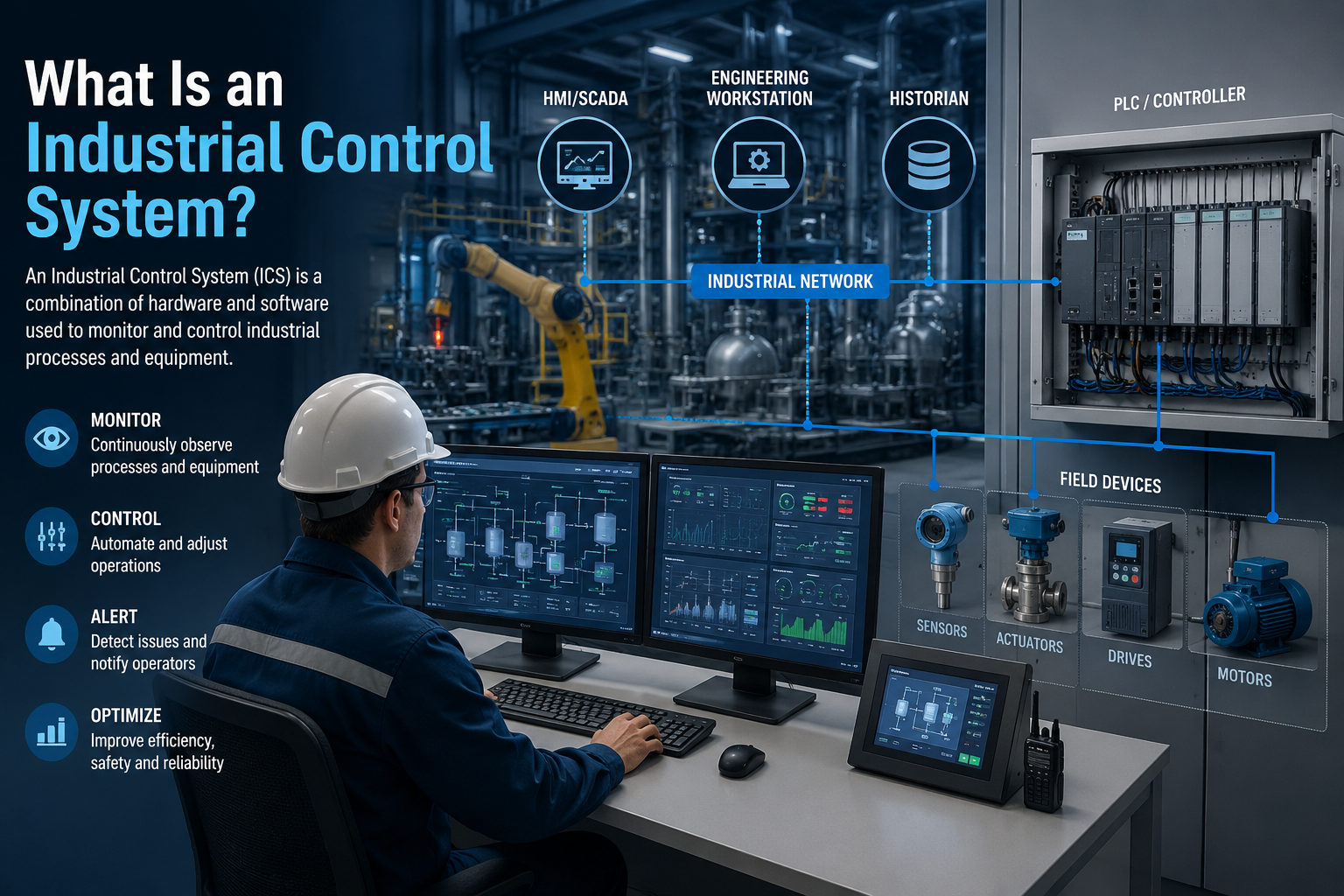
An Industrial Control System is a broad term used to describe the combination of hardware, software, and communication technologies that are designed to monitor, manage, and automate industrial processes. These systems are the foundation of modern industrial environments, enabling factories, power plants, transportation networks, and utility services to operate efficiently and safely with minimal manual intervention.
At a fundamental level, an Industrial Control System bridges the gap between the physical world and digital decision-making. It collects real-time data from machines and processes, interprets that data, and then takes action to maintain or adjust operations. This interaction between computation and physical systems is what makes industrial automation possible on a large scale.
Unlike standard computer systems that primarily handle information, Industrial Control Systems directly influence physical equipment. This makes them highly critical because any malfunction can affect not just digital data but real-world operations, safety, and infrastructure stability.
Evolution and Importance of Industrial Control Systems
The development of Industrial Control Systems has been closely tied to industrial advancement. In earlier times, industrial operations relied heavily on manual labor and mechanical controls. Operators would physically adjust valves, switches, and machinery based on observation and experience.
As industries grew in scale and complexity, this manual approach became inefficient and error-prone. The introduction of automated control systems revolutionized industrial operations by enabling machines to self-regulate based on sensor input and programmed logic.
Today, Industrial Control Systems are indispensable in nearly every critical infrastructure sector. They ensure uninterrupted power supply, maintain water quality, regulate manufacturing processes, and manage transportation systems. Without them, modern industrial society would struggle to maintain its current level of productivity and safety.
Core Architecture of Industrial Control Systems
The architecture of an Industrial Control System is typically layered and modular, designed to ensure reliability, scalability, and real-time performance.
At the lowest level are field devices such as sensors and actuators. Sensors gather physical data from the environment, while actuators perform actions based on system commands. These devices are directly connected to industrial equipment and form the interface between the physical and digital worlds.
Above this layer are controllers, which process incoming data and execute control logic. These controllers can be simple or highly advanced depending on the complexity of the system. They continuously evaluate sensor data and determine whether adjustments are needed.
The supervisory layer sits above controllers and provides centralized monitoring and coordination. This layer allows operators to view system performance, analyze trends, and issue manual commands when necessary.
Finally, the enterprise layer connects industrial operations with business systems. It enables data sharing, reporting, and long-term analysis to improve efficiency and decision-making.
Key Components of Industrial Control Systems
Industrial Control Systems consist of several essential components that work together to ensure smooth operation.
Sensors play a crucial role by capturing real-world data such as temperature, pressure, speed, and flow. These sensors convert physical conditions into electrical signals that can be processed by controllers.
Controllers act as the decision-making units of the system. They analyze incoming data and determine the appropriate response based on predefined rules or algorithms. Their speed and accuracy are critical for maintaining stable operations.
Actuators are responsible for executing physical actions. They might open or close valves, start or stop motors, or adjust mechanical systems based on controller instructions.
Human-machine interfaces allow operators to interact with the system. These interfaces provide visual dashboards, alerts, and control options that simplify complex industrial operations.
Communication networks connect all these components. They ensure that data flows seamlessly between devices, enabling real-time monitoring and control.
Types of Industrial Control Systems
There are several major types of Industrial Control Systems, each designed for specific industrial environments.
Supervisory Control and Data Acquisition systems are widely used for large-scale, geographically distributed operations. These systems collect data from remote locations and allow centralized monitoring and control.
Distributed Control Systems are used in complex industrial environments such as chemical plants and refineries. In these systems, control functions are distributed across multiple controllers rather than centralized in one unit. This improves reliability and reduces risk.
Programmable Logic Controllers are compact, rugged devices used for automation tasks in manufacturing and production lines. They are designed for high-speed, repetitive control tasks and are known for their durability.
Each of these systems can operate independently or be integrated depending on operational requirements.
How Industrial Control Systems Operate
The operation of an Industrial Control System follows a continuous feedback loop that ensures stability and efficiency.
First, sensors collect data from the industrial environment. This data is transmitted to controllers for processing. The controller evaluates whether the system is operating within acceptable parameters.
If everything is normal, the system continues operating without changes. However, if a deviation is detected, the controller sends commands to actuators to correct the issue.
This cycle repeats continuously, allowing the system to respond in real time to changing conditions. The speed of this feedback loop is essential, especially in environments where delays could result in safety risks or production losses.
Applications Across Industries
Industrial Control Systems are used in a wide variety of industries, each relying on automation to improve performance and safety.
In manufacturing, these systems control production lines, robotic systems, and quality assurance processes. They ensure consistency and reduce human error.
In energy production and distribution, Industrial Control Systems manage power generation facilities, electrical grids, and renewable energy systems. They help balance supply and demand while maintaining stability.
Water treatment plants use these systems to control filtration, chemical dosing, and distribution networks, ensuring safe drinking water.
Transportation systems rely on Industrial Control Systems for railway signaling, traffic control, and airport operations, helping prevent accidents and improve coordination.
The oil and gas industry uses these systems to monitor pipelines, control drilling operations, and manage refinery processes in hazardous environments.
Advantages of Industrial Control Systems
Industrial Control Systems offer several important advantages that make them essential in modern industry.
They significantly improve efficiency by automating repetitive and complex tasks. This reduces the need for manual intervention and allows human workers to focus on higher-level decision-making.
They enhance safety by continuously monitoring critical conditions and responding instantly to anomalies. This helps prevent accidents and equipment failures.
They improve accuracy and consistency in industrial processes. Automated systems are less prone to human error and can maintain precise control over operations.
They also enable scalability. As industrial operations grow, control systems can be expanded or upgraded without completely redesigning the infrastructure.
Challenges in Industrial Control Systems
Despite their benefits, Industrial Control Systems also face several challenges.
One major challenge is cybersecurity. As these systems become more connected to digital networks, they become vulnerable to cyberattacks. Unauthorized access or system manipulation can have serious consequences in industrial environments.
Another challenge is system complexity. Modern industrial environments involve multiple interconnected systems, making integration and maintenance difficult.
Reliability is also a critical concern. Since these systems often operate continuously, even minor failures can result in significant downtime or safety risks.
Additionally, upgrading legacy systems can be difficult. Many industrial facilities still rely on older systems that were not designed for modern connectivity or security requirements.
Cybersecurity in Industrial Control Systems
Cybersecurity is one of the most important aspects of modern Industrial Control Systems. Unlike traditional IT systems, these systems directly control physical processes, which means cyberattacks can lead to real-world damage.
Protecting these systems requires multiple layers of security, including network segmentation, access control, encryption, and continuous monitoring. Regular updates and security patches are also essential to reduce vulnerabilities.
One of the biggest challenges is balancing security with operational continuity. Industrial systems often run 24/7, making it difficult to implement security changes without disrupting operations.
As cyber threats continue to evolve, Industrial Control Systems must adopt more advanced security strategies to ensure resilience and safety.
Future of Industrial Control Systems
The future of Industrial Control Systems is being shaped by advancements in automation, artificial intelligence, and digital connectivity.
Artificial intelligence is increasingly being used to analyze large amounts of industrial data. This enables predictive maintenance, where systems can detect potential failures before they occur.
The integration of Internet of Things technology is also transforming industrial environments. Machines and devices are becoming more interconnected, allowing for real-time data sharing and improved coordination.
Cloud computing is further enhancing data storage and analysis capabilities, enabling more advanced monitoring and control strategies.
As industries move toward fully automated and smart systems, Industrial Control Systems will become more intelligent, adaptive, and efficient.
Conclusion
Industrial Control Systems are a fundamental part of modern industrial infrastructure. They enable automation, improve efficiency, enhance safety, and ensure the reliable operation of critical systems across multiple industries.
By combining sensors, controllers, actuators, and communication networks, these systems create a seamless connection between the physical and digital worlds. Their role in manufacturing, energy, transportation, and utilities makes them essential for modern society.
Although they face challenges such as cybersecurity risks and system complexity, continuous technological advancement is addressing these issues. The future of Industrial Control Systems is moving toward greater intelligence, connectivity, and automation.
As industries continue to evolve, these systems will remain at the core of industrial progress, shaping how goods are produced, resources are managed, and essential services are delivered.