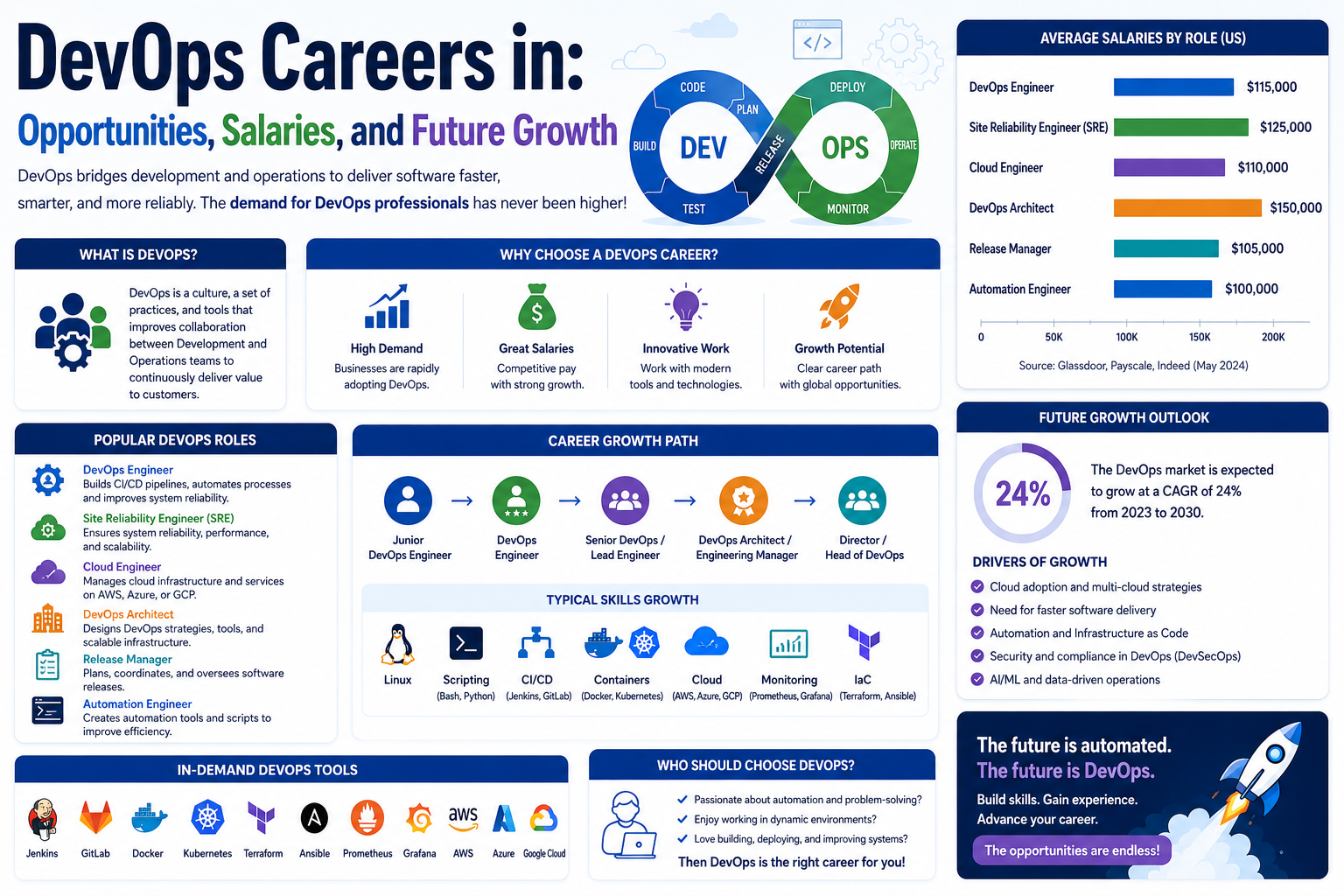
The technology industry has changed dramatically over the last decade. Businesses no longer release software once or twice a year and wait months to make updates. Modern companies now deploy applications continuously, release new features rapidly, and rely heavily on cloud infrastructure to stay competitive. Because of this transformation, organizations need professionals who can manage development workflows, automate deployments, maintain infrastructure reliability, and improve collaboration between technical teams. This demand is one of the biggest reasons DevOps has become such an important career path in 2026.
DevOps is often described as a combination of development and operations, but the reality is much broader than that simple definition. It is a working philosophy that focuses on improving communication between software developers and IT operations teams. The goal is to deliver software faster, more reliably, and with fewer errors. Over time, this philosophy evolved into a full career path that includes automation, cloud computing, infrastructure management, continuous integration, monitoring, scripting, and deployment optimization.
Today, companies around the world actively search for DevOps professionals because businesses depend on digital systems more than ever before. Websites, mobile applications, streaming services, banking platforms, healthcare systems, and e-commerce platforms all require stable and scalable infrastructure. If those systems fail, companies lose customers, revenue, and trust. DevOps professionals help prevent those problems by building reliable systems and automating repetitive tasks.
One of the reasons DevOps has grown so quickly is because traditional IT workflows often created delays and communication issues. In older environments, developers would write code and then hand it over to operations teams for deployment. These departments often worked separately and used different processes, priorities, and tools. Developers wanted to release software quickly, while operations teams focused on stability and minimizing risks. This disconnect created bottlenecks that slowed software delivery and caused frequent deployment failures.
DevOps emerged as a solution to these problems. Instead of treating development and operations as isolated departments, DevOps encourages collaboration and shared responsibility. Teams work together throughout the software lifecycle, from planning and coding to testing, deployment, monitoring, and maintenance. Automation also plays a major role because it reduces human error and speeds up repetitive processes.
As businesses adopted cloud computing and agile development practices, the need for DevOps expertise increased rapidly. Companies realized they could release software updates faster and improve system reliability by investing in automation and infrastructure optimization. This shift created a massive demand for professionals who understood both development and operations concepts.
Another major reason DevOps careers continue to grow is the increasing importance of customer experience. Modern users expect applications and websites to work flawlessly at all times. They also expect companies to release improvements and fixes quickly. Businesses that fail to meet these expectations often lose customers to competitors. DevOps professionals help organizations maintain high availability while accelerating software delivery, making them extremely valuable in competitive industries.
Cloud technology has further accelerated the growth of DevOps careers. Platforms such as Amazon Web Services, Microsoft Azure, and Google Cloud have transformed how organizations build and manage infrastructure. Instead of relying solely on physical servers located inside company offices, businesses can now deploy scalable applications across cloud environments within minutes. DevOps professionals are often responsible for configuring, automating, and maintaining these cloud-based systems.
The move toward cloud infrastructure has changed the nature of IT operations entirely. Traditional system administrators manually configured servers and networks. In modern DevOps environments, infrastructure is frequently managed using code and automation tools. This practice is known as Infrastructure as Code. Instead of manually setting up systems one by one, DevOps engineers create reusable configurations that automatically deploy consistent environments.
This automation improves efficiency and reduces the risk of configuration errors. It also allows organizations to scale quickly when traffic increases or new services are launched. Businesses value professionals who can manage these automated environments because they save time, reduce operational costs, and improve reliability.
Containerization technology has also played a huge role in the popularity of DevOps. Containers allow applications to run consistently across different environments by packaging software and its dependencies together. Docker became one of the most recognized container platforms, while Kubernetes emerged as a leading orchestration system for managing containers at scale.
Because containerization is now widely used across the technology industry, DevOps professionals who understand Docker and Kubernetes are highly sought after. Organizations rely on these technologies to improve scalability, streamline deployments, and maintain application consistency across development, testing, and production environments.
Continuous Integration and Continuous Delivery pipelines are another major component of modern DevOps work. These pipelines automate the process of testing and deploying code changes. Instead of manually handling software releases, automated systems can run tests, validate code, and deploy updates quickly and consistently.
This automation allows organizations to release software more frequently while reducing the likelihood of errors reaching production environments. Businesses appreciate these benefits because they improve productivity and customer satisfaction. As a result, professionals who can build and maintain CI/CD pipelines remain in strong demand.
The importance of cybersecurity has also influenced the evolution of DevOps careers. Organizations now face constant security threats, and traditional security practices often struggle to keep up with rapid software development cycles. This challenge led to the growth of DevSecOps, which integrates security directly into development and deployment pipelines.
In DevSecOps environments, security checks and compliance processes are automated alongside development workflows. Vulnerability scanning, access control, and configuration validation become part of the deployment process rather than separate tasks performed later. Professionals who understand both DevOps and security principles are becoming increasingly valuable because businesses want to release software quickly without compromising safety.
One of the strongest arguments in favor of DevOps as a career is the financial opportunity it provides. Salaries for DevOps-related positions are consistently among the highest in information technology. Organizations understand that downtime, deployment failures, and inefficient infrastructure can cost millions of dollars. They are willing to pay skilled professionals well because strong DevOps practices directly improve operational performance.
Entry-level DevOps positions often offer competitive salaries compared to many other technology roles. As professionals gain experience with cloud platforms, automation tools, and large-scale infrastructure, their earning potential increases significantly. Senior DevOps Engineers, Cloud Architects, and DevOps Managers frequently earn exceptionally high salaries in global technology markets.
Beyond salary, career flexibility is another major advantage. DevOps professionals develop skills across multiple technical disciplines. They often gain experience with Linux administration, networking, scripting, cloud computing, automation, monitoring, containers, and security practices. This broad technical foundation opens doors to many different career paths.
For example, someone working in DevOps may later transition into cloud architecture, cybersecurity, software engineering, platform engineering, site reliability engineering, or IT management. The versatility of DevOps experience makes it one of the most flexible career paths in modern technology.
The remote work movement has also increased the appeal of DevOps careers. Since cloud infrastructure and deployment pipelines can often be managed remotely, many organizations allow DevOps teams to work from home or operate in distributed environments. This flexibility gives professionals more freedom in choosing where and how they work.
Another reason DevOps attracts many people is the variety of work involved. Some IT roles become repetitive over time, focusing heavily on a narrow set of responsibilities. DevOps professionals, however, often work with many technologies and projects simultaneously. One day they may automate infrastructure deployment, while the next day they troubleshoot application performance issues or optimize monitoring systems.
This variety keeps the work engaging for people who enjoy learning and problem-solving. Technology changes rapidly, and DevOps professionals are usually exposed to emerging tools and industry trends earlier than many other roles. For individuals who enjoy continuous learning, this can make the career especially rewarding.
However, the fast-paced nature of DevOps is not ideal for everyone. The field requires adaptability and a willingness to keep learning new technologies. Tools and platforms evolve quickly, and professionals must stay updated to remain competitive. Someone who dislikes constant change may find DevOps stressful or overwhelming.
DevOps can also involve high-pressure situations. Since these professionals often manage critical infrastructure and deployment systems, they may be responsible for resolving outages or deployment failures quickly. Businesses rely heavily on digital services, which means downtime can have serious financial consequences.
Despite these pressures, many professionals enjoy the sense of responsibility and impact that comes with DevOps work. Their efforts directly influence system performance, software reliability, and business operations. Instead of working in isolation, DevOps professionals typically collaborate with developers, security teams, project managers, and business stakeholders.
Communication skills therefore play a major role in success. Technical expertise alone is not enough. A strong DevOps professional must explain problems clearly, coordinate with different teams, and help improve organizational workflows. Collaboration is one of the core principles behind DevOps, making interpersonal skills just as important as technical knowledge.
Problem-solving ability is another critical quality. DevOps environments often involve complex systems with many moving parts. Troubleshooting deployment issues, diagnosing infrastructure failures, and optimizing performance require analytical thinking and patience. Professionals who enjoy solving technical challenges often thrive in this field.
The broad nature of DevOps work also makes it appealing for people who enjoy both development and operations tasks. Some professionals prefer purely software-focused careers, while others enjoy infrastructure management. DevOps sits between these worlds, combining coding, automation, systems administration, and operational strategy.
Another reason DevOps remains attractive in 2026 is the increasing importance of digital transformation. Organizations in healthcare, finance, education, manufacturing, entertainment, telecommunications, and retail all depend heavily on technology infrastructure. As these industries modernize their systems, they require professionals who can automate workflows and manage scalable cloud environments.
This widespread adoption means DevOps expertise is valuable across many industries rather than being limited to technology companies alone. Professionals can work for startups, enterprise corporations, government agencies, consulting firms, or cloud service providers. The diversity of opportunities adds to the long-term stability of the career path.
Education and certification opportunities have also expanded significantly. Many online platforms now offer DevOps training focused on Linux, Docker, Kubernetes, AWS, Azure, Terraform, Jenkins, Git, and other industry-standard technologies. Certifications from major cloud providers and technology vendors can help professionals demonstrate expertise and improve job prospects.
At the same time, practical experience remains extremely important in DevOps. Employers often prefer candidates who can demonstrate hands-on skills with automation, scripting, infrastructure management, and cloud platforms. Personal projects, home labs, and open-source contributions can help aspiring DevOps professionals gain valuable experience even before landing their first job.
Another important aspect of DevOps is the culture of continuous improvement. Successful DevOps teams regularly analyze workflows, identify inefficiencies, and optimize processes. This mindset encourages innovation and experimentation. Professionals who enjoy improving systems and finding smarter ways to solve problems often find DevOps highly satisfying.
The relationship between DevOps and artificial intelligence is also beginning to grow. AI-powered monitoring tools, predictive analytics, and automated incident response systems are becoming more common in modern infrastructure environments. DevOps professionals who understand automation and data-driven operations may find even more opportunities as AI technologies continue evolving.
Still, it is important to remember that DevOps is not simply about learning tools. Many beginners focus heavily on software platforms while ignoring the cultural and collaborative aspects of the field. The true value of DevOps comes from improving communication, reducing friction between teams, and creating efficient development processes.
Organizations that successfully implement DevOps practices often experience faster deployment cycles, improved system reliability, better collaboration, and reduced operational costs. Because these improvements directly impact business performance, companies continue investing heavily in DevOps talent.
For people considering technology careers in 2026, DevOps offers a combination of strong demand, high salaries, career flexibility, and continuous learning opportunities. However, success requires dedication, adaptability, and a genuine interest in automation, infrastructure, and collaboration.
Some individuals are naturally drawn to the fast-moving and multidisciplinary nature of DevOps. Others may prefer more specialized technology roles with narrower responsibilities. Choosing the right career depends on personal interests, working style, and long-term goals.
Still, there is little doubt that DevOps remains one of the most influential and valuable career paths in modern information technology. As organizations continue relying on cloud platforms, automation, and scalable infrastructure, the demand for skilled DevOps professionals is likely to remain strong for years to come.
Why DevOps Professionals Are in High Demand
The demand for DevOps professionals continues to rise across the global technology industry in 2026. Businesses are no longer treating DevOps as an optional strategy or experimental approach. Instead, organizations now consider automation, cloud infrastructure, and continuous software delivery essential for staying competitive. As a result, companies actively search for professionals who can help modernize systems, improve operational efficiency, and accelerate software deployment cycles.
This demand exists because the entire digital economy depends on reliable technology infrastructure. Modern businesses rely on websites, mobile applications, cloud platforms, online payment systems, streaming services, customer portals, and remote collaboration tools. If those systems experience outages or poor performance, organizations can lose customers, revenue, and reputation almost immediately. DevOps professionals help reduce those risks by improving system stability and deployment reliability.
One of the biggest reasons DevOps roles remain highly valuable is the increasing speed of software development. Years ago, companies released software updates infrequently, sometimes only a few times each year. Today, many organizations deploy updates weekly, daily, or even multiple times per day. Customers expect rapid improvements, fast bug fixes, and new features delivered continuously.
Traditional IT processes cannot always support this level of speed. Manual deployments and disconnected teams often create delays and operational problems. DevOps practices solve these challenges by introducing automation, collaboration, and continuous integration pipelines. Companies therefore need professionals who understand how to build and maintain these systems effectively.
Organizations also recognize that automation saves both time and money. Repetitive manual tasks increase the likelihood of errors and consume valuable resources. DevOps professionals automate infrastructure provisioning, testing, monitoring, scaling, and deployments, allowing businesses to operate more efficiently. This efficiency directly impacts profitability, which is one reason companies continue investing heavily in DevOps talent.
Cloud adoption is another major factor driving demand. Businesses of all sizes are migrating from traditional on-premises infrastructure to cloud platforms. Amazon Web Services, Microsoft Azure, and Google Cloud have become central components of modern IT operations. Companies require professionals who understand how to deploy, manage, secure, and optimize cloud environments.
DevOps professionals often serve as the bridge between development teams and cloud infrastructure. They help organizations design scalable systems, automate deployments, and manage resources efficiently. As more companies move toward hybrid and multi-cloud environments, the need for cloud-savvy DevOps engineers continues to grow rapidly.
Another reason for strong demand is the complexity of modern software environments. Applications are no longer simple standalone programs running on single servers. Many businesses now operate distributed systems involving microservices, APIs, containers, databases, load balancers, and cloud-based infrastructure spread across multiple regions.
Managing these environments manually is extremely difficult. DevOps professionals use orchestration tools, monitoring platforms, and automation frameworks to maintain reliability and scalability. Their ability to manage complex infrastructure makes them critical to modern business operations.
Containerization technology has further expanded DevOps opportunities. Containers allow applications to run consistently across different systems and environments. Docker became widely popular because it simplified application packaging and deployment. Kubernetes later emerged as the leading orchestration platform for managing containers at scale.
Today, many companies rely heavily on containerized infrastructure. DevOps professionals who understand Kubernetes, Docker, Helm, and container networking are in particularly high demand. These technologies allow organizations to scale applications efficiently and maintain consistency between development and production environments.
Continuous Integration and Continuous Delivery pipelines are also central to modern software development. These pipelines automate code testing, validation, and deployment processes. Instead of waiting weeks or months to release updates, organizations can now deploy changes rapidly and safely.
DevOps professionals design and maintain these pipelines using tools such as Jenkins, GitHub Actions, GitLab CI/CD, CircleCI, and Azure DevOps. Their work helps organizations reduce deployment failures and improve software quality. Because automated delivery pipelines have become essential in competitive industries, professionals with CI/CD expertise remain highly valuable.
Cybersecurity concerns have added another layer of importance to DevOps careers. Organizations now face constant threats from ransomware, data breaches, phishing attacks, and infrastructure vulnerabilities. Security can no longer remain separate from development and operations processes.
This reality led to the growth of DevSecOps, which integrates security directly into the software development lifecycle. Automated vulnerability scanning, configuration analysis, compliance testing, and access management are now built into deployment pipelines. DevOps professionals with security expertise are especially attractive to employers because they help organizations balance speed and protection.
The rise of artificial intelligence and machine learning has also influenced DevOps demand. AI-powered applications require scalable infrastructure and automated deployment workflows. Many organizations use DevOps practices to support machine learning pipelines, cloud-based data processing, and AI-driven services.
At the same time, AI tools are beginning to assist DevOps teams by automating monitoring, incident detection, and predictive analytics. Professionals who understand both automation and infrastructure management may benefit greatly as AI adoption continues expanding across industries.
One reason DevOps professionals command high salaries is because their work directly impacts business performance. Efficient infrastructure improves customer experiences, reduces downtime, and accelerates product releases. Companies understand that reliable systems are essential for maintaining competitiveness in digital markets.
A failed deployment or prolonged outage can cost organizations enormous amounts of money. E-commerce platforms lose sales, streaming services lose subscribers, and financial institutions risk customer trust when systems fail. Businesses therefore place significant value on professionals who can maintain stability and recover quickly from issues.
Another advantage of DevOps careers is the wide variety of industries hiring for these roles. Technology companies are not the only employers seeking DevOps talent. Healthcare organizations, financial institutions, retail companies, telecommunications providers, entertainment platforms, educational institutions, and government agencies all require DevOps expertise.
This broad demand provides strong job security. Professionals are not limited to a single industry or type of organization. They can choose environments that align with their interests and career goals. Some prefer startups where they can work across many technologies, while others prefer enterprise organizations with large-scale infrastructure environments.
Remote work opportunities also remain a major benefit in 2026. Because DevOps work often revolves around cloud infrastructure and online collaboration tools, many companies allow employees to work remotely or in hybrid arrangements. This flexibility attracts professionals who value work-life balance and geographic freedom.
The career progression available within DevOps is another reason many people consider it an excellent long-term path. Entry-level professionals often begin as junior DevOps engineers, cloud support specialists, or infrastructure automation engineers. As they gain experience, they can progress into senior engineering, architecture, leadership, or consulting roles.
Senior DevOps Engineers frequently manage large-scale infrastructure systems and lead automation initiatives. DevOps Architects focus on designing scalable cloud environments and deployment strategies. Engineering Managers oversee teams responsible for infrastructure reliability and operational workflows.
Some professionals transition into Site Reliability Engineering roles, which emphasize system reliability, incident management, and performance optimization. Others move into Cloud Architecture, Platform Engineering, or Cybersecurity leadership positions. The versatility of DevOps skills creates many possible career directions.
One reason these career transitions are possible is because DevOps professionals gain exposure to many areas of technology. They often work with Linux systems, networking, scripting languages, cloud platforms, containers, monitoring tools, databases, APIs, and security frameworks. This broad technical foundation makes them adaptable and valuable across different disciplines.
Scripting and automation remain especially important skills within DevOps careers. Professionals frequently use languages such as Python, Bash, PowerShell, or Go to automate repetitive tasks and improve operational efficiency. Strong scripting abilities help DevOps engineers troubleshoot systems and build custom automation workflows.
Linux knowledge is also considered foundational in many DevOps environments. Since cloud infrastructure and containers frequently run on Linux-based systems, professionals benefit greatly from understanding Linux administration, command-line tools, file permissions, networking, and system processes.
Networking skills are equally valuable because modern infrastructure environments depend heavily on communication between systems and services. Understanding IP addressing, DNS, HTTP protocols, firewalls, load balancing, and network security helps DevOps professionals diagnose connectivity and performance issues effectively.
Monitoring and observability have become increasingly important in modern DevOps workflows. Businesses need visibility into application performance, infrastructure health, and system behavior. Tools such as Prometheus, Grafana, Datadog, Splunk, and ELK Stack help teams monitor environments and identify problems quickly.
DevOps professionals responsible for monitoring systems play a critical role in maintaining uptime and performance. Effective observability allows organizations to detect issues before they impact customers significantly. This proactive approach improves operational stability and customer satisfaction.
Database management and storage systems also intersect with DevOps responsibilities in many organizations. Applications depend heavily on reliable databases, and deployment pipelines often involve database configuration and migration processes. Familiarity with SQL, cloud storage, and backup strategies can therefore strengthen a DevOps professional’s skill set.
The increasing use of Infrastructure as Code has transformed how organizations manage environments. Tools such as Terraform, CloudFormation, and Ansible allow teams to define infrastructure configurations through code rather than manual setup processes. This approach improves consistency, scalability, and repeatability.
Professionals skilled in Infrastructure as Code are highly valued because they help organizations deploy environments rapidly while reducing human error. Automated infrastructure also simplifies disaster recovery and scaling operations.
Despite the many advantages of DevOps careers, the field does come with challenges. The pace of technological change can feel overwhelming at times. New tools, frameworks, and cloud services appear constantly, requiring professionals to continuously update their knowledge.
This constant learning is exciting for many people, but stressful for others. Professionals who dislike adapting to new technologies may struggle in DevOps environments. Success often depends on curiosity, self-motivation, and a willingness to experiment with unfamiliar systems.
DevOps work can also involve significant responsibility. Infrastructure outages, deployment failures, and security incidents may require urgent responses. Professionals sometimes need to troubleshoot systems under pressure, especially in organizations that provide critical online services.
Time management therefore becomes an important skill. DevOps professionals often balance project work, infrastructure maintenance, incident response, and ongoing optimization tasks simultaneously. Organizational abilities help prevent burnout and improve productivity.
Communication remains another critical factor in long-term success. DevOps professionals interact with developers, operations teams, security specialists, executives, and project managers. They must explain technical issues clearly and collaborate effectively across departments.
This collaborative aspect of DevOps is one reason the field appeals to people who enjoy teamwork. Unlike highly isolated technical roles, DevOps work often involves cross-functional problem-solving and shared decision-making.
Another appealing aspect of DevOps careers is the sense of impact professionals experience. Their work directly influences system reliability, deployment speed, customer experiences, and business performance. Successful automation and infrastructure improvements can dramatically improve how organizations operate.
For many professionals, this impact makes the work more rewarding than purely maintenance-focused IT roles. DevOps encourages innovation, optimization, and continuous improvement rather than simply maintaining existing systems.
Education pathways into DevOps have also become more accessible. Many aspiring professionals begin with Linux administration, cloud computing, or software development before transitioning into DevOps roles. Online learning platforms, certification programs, and hands-on labs provide opportunities to build practical experience.
Cloud certifications from AWS, Azure, and Google Cloud are especially valuable because many organizations prioritize cloud expertise. Kubernetes certifications and automation-focused training can also improve employability significantly.
However, employers generally value practical skills just as much as certifications. Building home labs, contributing to open-source projects, and creating personal automation projects can help candidates demonstrate real-world abilities.
Many successful DevOps professionals started in other IT fields such as system administration, networking, software development, or technical support. Their previous experience often helps them understand how different systems and teams interact within organizations.
This flexibility means people do not necessarily need to begin their careers directly in DevOps. The field welcomes professionals from multiple technical backgrounds, making it accessible to a wide range of individuals interested in automation and infrastructure.
As businesses continue embracing cloud platforms, automation, AI integration, and rapid software delivery, the demand for DevOps expertise is expected to remain strong. Organizations understand that efficient infrastructure and reliable deployment processes are essential for long-term success in the digital economy.
For people who enjoy technology, problem-solving, collaboration, and continuous learning, DevOps offers one of the most dynamic and rewarding career paths available in 2026. While the field requires dedication and adaptability, it also provides strong salaries, career flexibility, remote work opportunities, and exposure to cutting-edge technologies.
The combination of technical depth, business impact, and long-term growth potential explains why so many professionals continue viewing DevOps as one of the best careers in modern information technology.
Skills, Career Growth, and Long-Term Future of DevOps
Choosing a career in technology is about more than finding a job with good pay. Long-term success depends on whether the work matches your interests, strengths, personality, and goals. DevOps has become one of the most attractive career paths in the technology industry because it combines technical problem-solving, automation, cloud computing, collaboration, and continuous learning. However, succeeding in DevOps requires dedication and a willingness to adapt to rapidly changing technologies.
One of the most important things to understand about DevOps is that it is not built around a single technology or narrow specialty. Instead, DevOps professionals work across multiple areas of information technology. They interact with developers, operations teams, security professionals, cloud platforms, monitoring systems, deployment pipelines, and automation tools. Because of this, DevOps careers offer both variety and flexibility.
This wide range of responsibilities is one reason many professionals find DevOps exciting. Every project introduces new technical challenges and opportunities to improve systems. Instead of repeating the same tasks every day, DevOps engineers often work on automation, infrastructure optimization, cloud deployments, troubleshooting, monitoring, and performance improvements. The role constantly evolves as organizations adopt new technologies and business requirements change.
At the same time, the broad nature of DevOps means professionals must build a strong foundation of technical skills. Unlike some entry-level IT roles where specialization comes later, DevOps requires understanding how multiple systems work together. Professionals who enjoy learning different technologies and solving complex problems often thrive in this environment.
One of the first skills aspiring DevOps professionals should develop is Linux administration. Linux remains one of the most widely used operating systems in cloud computing and server environments. Many modern applications, containers, and cloud-based platforms run on Linux systems. Understanding the Linux command line, file systems, permissions, networking tools, processes, and shell scripting provides a strong technical foundation for DevOps work.
Linux knowledge becomes especially important when troubleshooting infrastructure problems or managing cloud environments. Since DevOps professionals frequently interact with servers and automation scripts, comfort with Linux systems is considered essential in many organizations.
Scripting and programming are also core components of DevOps careers. Automation is central to DevOps philosophy, and scripting allows professionals to eliminate repetitive manual tasks. Common scripting languages used in DevOps include Python, Bash, PowerShell, and sometimes Go.
Python is particularly popular because it is flexible, easy to learn, and widely supported across automation tools and cloud platforms. Bash scripting is useful for Linux environments, while PowerShell is commonly used in Windows-based infrastructure. Even basic scripting knowledge can dramatically improve efficiency and help professionals automate workflows.
Programming skills in DevOps are not always focused on building software applications. Instead, coding is often used for automation, infrastructure management, deployment pipelines, API integrations, and configuration management. Professionals who enjoy combining programming with infrastructure work often find DevOps especially rewarding.
Cloud computing skills have become another major requirement in modern DevOps careers. Organizations increasingly rely on cloud platforms such as Amazon Web Services, Microsoft Azure, and Google Cloud. These platforms provide scalable infrastructure, storage, networking, and managed services that support modern applications.
DevOps professionals frequently deploy and manage systems in cloud environments. Understanding virtual machines, cloud networking, storage services, identity management, scaling strategies, and cloud security is therefore extremely valuable. Cloud expertise significantly improves career opportunities and salary potential.
Amazon Web Services remains one of the most widely used cloud platforms in the industry. Many DevOps engineers begin by learning services such as EC2, S3, IAM, VPC, Lambda, and CloudWatch. Microsoft Azure and Google Cloud also offer strong career opportunities, especially in enterprise environments.
Infrastructure as Code has transformed how infrastructure is managed in DevOps environments. Instead of manually configuring servers and services, professionals define infrastructure using code and automation tools. This approach improves consistency, scalability, and deployment speed.
Terraform is one of the most popular Infrastructure as Code tools. It allows professionals to define cloud infrastructure using configuration files that can be version-controlled and reused. CloudFormation and Pulumi are also widely used in certain environments.
Configuration management tools such as Ansible, Puppet, and Chef help automate server configuration and application deployment. These tools allow organizations to manage large environments efficiently and reduce configuration drift. DevOps professionals skilled in infrastructure automation are highly valuable because they help organizations operate at scale.
Containerization is another major area of focus within DevOps. Containers package applications and their dependencies together, ensuring consistency across development, testing, and production environments. Docker became the standard platform for creating and managing containers because it simplified application deployment and portability.
Kubernetes later emerged as the leading orchestration platform for managing containers at scale. Many modern organizations rely heavily on Kubernetes to automate scaling, deployment, load balancing, and container management. Professionals with Kubernetes expertise are among the most sought-after candidates in the DevOps job market.
Learning containers and orchestration platforms may seem complex initially, but these technologies are central to modern infrastructure environments. Understanding how applications run inside containers and how orchestration systems manage workloads provides a major career advantage.
Version control systems also play a critical role in DevOps workflows. Git has become the industry standard for tracking code changes and supporting collaboration between teams. Platforms such as GitHub, GitLab, and Bitbucket provide repositories and CI/CD integration for software development and infrastructure projects.
DevOps professionals use version control not only for application code but also for infrastructure configurations, deployment scripts, and automation templates. Familiarity with branching strategies, pull requests, merges, and repository management is essential in collaborative environments.
Continuous Integration and Continuous Delivery pipelines are among the defining features of DevOps practices. These pipelines automate code testing, validation, and deployment processes. Instead of manually deploying software updates, organizations rely on automated workflows that improve speed and reliability.
Jenkins remains one of the most recognized CI/CD tools, although GitHub Actions, GitLab CI/CD, CircleCI, and Azure DevOps are also widely used. DevOps engineers design and maintain pipelines that automatically test applications, build artifacts, and deploy updates to production environments.
Automation pipelines reduce human error and allow businesses to release software more frequently. Because rapid deployment cycles are now essential in competitive industries, CI/CD expertise remains one of the most valuable DevOps skills.
Networking knowledge is another important component of DevOps careers. Applications, containers, cloud services, and deployment systems all depend on reliable communication between systems. Understanding networking concepts helps professionals troubleshoot connectivity issues and optimize infrastructure performance.
Important networking topics include IP addressing, DNS, HTTP protocols, firewalls, VPNs, load balancing, routing, and SSL certificates. While DevOps professionals are not always network engineers, having a strong networking foundation improves troubleshooting abilities significantly.
Monitoring and observability are equally important in modern infrastructure environments. Organizations need visibility into system performance, application behavior, and infrastructure health. DevOps professionals often configure monitoring systems that collect metrics, generate alerts, and support incident response.
Tools such as Prometheus, Grafana, Datadog, New Relic, Splunk, and ELK Stack are widely used for monitoring and log analysis. Effective observability helps organizations detect problems quickly and maintain high availability.
Incident management is another important responsibility within many DevOps roles. When systems fail or performance issues occur, DevOps teams often respond first. Professionals must identify root causes, restore services, and prevent future incidents.
This aspect of DevOps work can be stressful, especially during outages affecting critical systems. However, many professionals enjoy the challenge of troubleshooting complex problems and restoring operational stability. The ability to remain calm under pressure becomes extremely valuable in these situations.
Cybersecurity knowledge is becoming increasingly important in DevOps careers as well. Organizations now integrate security directly into deployment pipelines through DevSecOps practices. Automated vulnerability scanning, secrets management, access control, and compliance checks are becoming standard components of infrastructure workflows.
Professionals who understand both security and automation are highly valuable because they help organizations release software quickly without sacrificing protection. Security awareness also improves infrastructure reliability and reduces operational risks.
Soft skills are just as important as technical expertise in DevOps careers. Collaboration sits at the heart of DevOps philosophy, meaning communication skills play a major role in success. DevOps professionals regularly interact with developers, operations teams, project managers, security specialists, and executives.
The ability to explain technical issues clearly and work effectively with different departments helps improve workflows and reduce misunderstandings. Organizations value professionals who can combine technical knowledge with strong interpersonal communication.
Problem-solving ability is another key characteristic of successful DevOps engineers. Infrastructure environments are complex, and unexpected issues frequently arise. Professionals must analyze logs, investigate failures, optimize performance, and identify efficient solutions under time pressure.
Curiosity and adaptability are equally important. The technology landscape changes rapidly, and DevOps professionals must continuously learn new tools and practices. Individuals who enjoy experimentation and self-improvement often adapt well to this environment.
Career growth opportunities within DevOps are extensive. Many professionals begin in junior or entry-level roles focused on infrastructure support, cloud administration, or automation tasks. As they gain experience, they can move into more advanced engineering and leadership positions.
Senior DevOps Engineers typically oversee large infrastructure environments and mentor junior team members. DevOps Architects focus on designing scalable systems and automation strategies. Engineering Managers coordinate teams responsible for infrastructure operations and deployment pipelines.
Some professionals transition into Site Reliability Engineering roles, which focus heavily on reliability, performance optimization, and incident response. Others move into Cloud Architecture, Cybersecurity, Platform Engineering, or Infrastructure Consulting positions.
The versatility of DevOps experience is one of its greatest strengths. Since professionals gain exposure to multiple technical disciplines, they develop transferable skills that apply across many areas of technology. This flexibility provides long-term career stability even as industry trends evolve.
Remote work opportunities remain another major advantage of DevOps careers in 2026. Since cloud platforms and deployment systems can often be managed remotely, many organizations allow distributed teams and flexible work arrangements. This flexibility appeals to professionals seeking better work-life balance and geographic independence.
Freelancing and consulting opportunities are also growing in the DevOps space. Businesses frequently hire consultants to modernize infrastructure, implement cloud migrations, optimize CI/CD pipelines, or improve security practices. Experienced DevOps professionals can often command high consulting rates due to the specialized nature of their skills.
Artificial intelligence and machine learning are beginning to influence DevOps workflows as well. AI-powered monitoring tools can analyze infrastructure data, predict failures, and automate incident response. While AI may automate some operational tasks, it is unlikely to replace DevOps professionals entirely.
Instead, AI is expected to enhance DevOps workflows by reducing repetitive work and improving efficiency. Professionals who understand automation, cloud computing, and AI integration may find even greater career opportunities in the future.
One common misconception about DevOps is that learning tools alone guarantees success. While technical skills are important, successful DevOps implementation also depends heavily on mindset and organizational culture. DevOps is fundamentally about collaboration, automation, and continuous improvement.
Professionals who embrace teamwork and process optimization often contribute more effectively than those focused solely on tools and certifications. Understanding business goals and operational priorities helps DevOps engineers create solutions that provide real organizational value.
Burnout can sometimes become a challenge in DevOps careers, especially in organizations with poor operational practices or unrealistic expectations. Continuous deployments, infrastructure responsibilities, and incident response can create stressful workloads if teams are understaffed or poorly managed.
For this reason, work environment matters greatly. Healthy DevOps cultures emphasize automation, collaboration, reasonable on-call practices, and continuous improvement. Organizations that support learning and teamwork often provide more sustainable career experiences.
The future of DevOps appears extremely strong heading further into the decade. Cloud adoption continues increasing worldwide, businesses rely more heavily on digital infrastructure, and automation remains essential for competitive operations. Emerging technologies such as edge computing, AI services, serverless architecture, and hybrid cloud environments will likely create even more opportunities for DevOps professionals.
As companies continue modernizing infrastructure and accelerating software delivery, the need for skilled professionals capable of managing scalable and automated systems will remain high. DevOps expertise is no longer limited to technology companies alone. Healthcare providers, financial institutions, retailers, educational organizations, manufacturers, and government agencies all depend heavily on reliable infrastructure and automation.
This widespread demand provides long-term job security and career flexibility. Professionals with strong DevOps skills can work across industries and adapt to evolving technology trends more easily than specialists limited to narrow technical areas.
Conclusion
DevOps has evolved into one of the most valuable and influential career paths in modern information technology. What began as a philosophy focused on improving collaboration between development and operations teams has grown into a global movement centered around automation, cloud computing, scalability, and continuous improvement.
In 2026, DevOps remains an excellent career choice for individuals who enjoy technology, problem-solving, automation, and teamwork. The field offers strong salaries, diverse career opportunities, remote work flexibility, and exposure to some of the most important technologies shaping the future of IT.
At the same time, DevOps is not a simple or static career path. Success requires continuous learning, adaptability, and a willingness to work across multiple technical disciplines. Professionals must stay updated on cloud platforms, automation tools, containers, monitoring systems, security practices, and deployment technologies.
The career is especially rewarding for people who enjoy building efficient systems, solving infrastructure challenges, and improving operational workflows. Because DevOps professionals directly impact software reliability and business performance, their work remains highly valued across industries.
As organizations continue investing in cloud infrastructure, automation, cybersecurity, and digital transformation, DevOps expertise will likely remain in high demand for many years to come. For individuals willing to embrace continuous learning and collaborative problem-solving, DevOps offers a future-focused career with outstanding long-term potential.