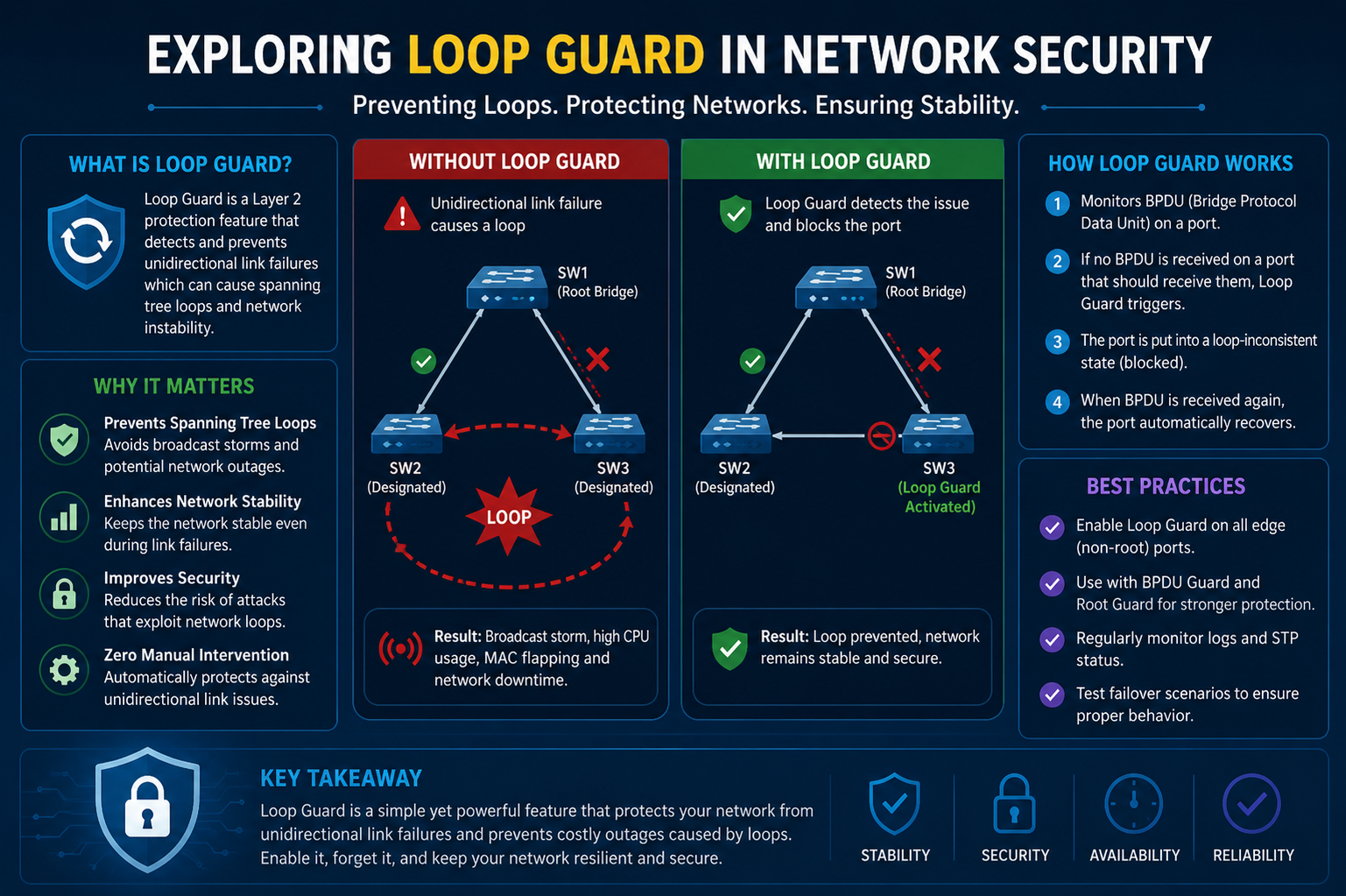
Loop Guard is a network protection feature designed to prevent switching loops that can disrupt communication and degrade overall network performance. It enhances redundancy mechanisms by ensuring that backup paths remain available without unintentionally creating instability. In modern networks, redundancy is critical for uptime, but it also introduces risks if not properly controlled. Loop Guard helps maintain balance by allowing redundancy while preventing harmful loop conditions.
Role of Redundancy in Network Stability
Redundant links are used in networks to provide alternative paths in case the primary path fails. These backup paths are usually kept in a blocked state to avoid loops. When the primary link goes down, one of the blocked links becomes active to maintain connectivity. However, this process depends on accurate information about the network state. If incorrect assumptions are made, a blocked port might become active at the wrong time, leading to a loop. Loop Guard ensures that such transitions only occur when the network condition is verified as safe.
How Loop Guard Detects Problems
Loop Guard works by monitoring control messages that are expected on specific ports. These messages confirm that the network topology is stable and functioning correctly. When a port stops receiving these expected messages, it may indicate a failure such as a unidirectional link issue. Instead of assuming the path is safe, Loop Guard treats the absence of messages as a warning sign. It prevents the port from transitioning into a forwarding state, reducing the risk of loop formation.
Loop-Inconsistent State Explained
When Loop Guard detects an issue, it places the affected port into a loop-inconsistent state. In this condition, the port is effectively blocked from forwarding traffic, even if it would normally be allowed to do so. This state acts as a safety mechanism, ensuring that no data is transmitted through a potentially unstable path. The port remains in this condition until it begins receiving the expected control messages again, at which point normal operation is restored automatically.
Handling Unidirectional Link Failures
One of the most common scenarios where Loop Guard proves valuable is during unidirectional link failures. In such cases, one side of a connection can send data while the other side cannot receive it properly. This creates confusion for standard network protocols, which may interpret the link as functioning normally. Loop Guard identifies this inconsistency by detecting missing control messages and prevents incorrect port state changes that could lead to loops.
Automatic Recovery and Stability
A major advantage of Loop Guard is its ability to recover automatically. Once the network condition returns to normal and control messages are received again, the affected port exits the loop-inconsistent state. It then resumes its correct role within the network topology without requiring manual intervention. This feature reduces downtime and simplifies network management, allowing systems to adapt quickly to changing conditions.
Importance in Complex Network Topologies
In large or complex networks with multiple redundant paths, the risk of unexpected failures increases. Traditional mechanisms may not always handle every edge case effectively. Loop Guard adds an extra layer of protection by addressing scenarios where control message loss could lead to incorrect decisions. This makes it especially useful in enterprise environments where stability is critical.
Preventing Broadcast Storms and Network Issues
Switching loops can cause broadcast storms, where frames circulate endlessly and consume excessive bandwidth. This can overload switches, increase CPU usage, and degrade overall network performance. Loop Guard helps prevent these issues by ensuring that only stable and verified paths are used for forwarding traffic. By stopping loops before they start, it protects the network from severe disruptions.
Deployment and Configuration Considerations
Loop Guard is typically enabled on ports that are more vulnerable to incorrect state transitions, particularly non-designated ports. Once configured, it operates quietly in the background, continuously monitoring conditions. It does not interfere with normal operations unless a potential issue is detected. This makes it an efficient solution that adds protection without increasing complexity.
Integration with Other Network Safeguards
Loop Guard is most effective when used alongside other network protection features. While it focuses on preventing loops caused by missing control messages, other mechanisms address different types of failures. Together, they form a layered defense strategy that improves overall network resilience. Each feature plays a specific role, and Loop Guard contributes by handling a critical but often overlooked scenario.
Enhancing Predictability and Control
By enforcing strict rules for port behavior, Loop Guard improves the predictability of network operations. Unexpected failures are handled in a controlled manner, reducing uncertainty and making troubleshooting easier. Network administrators can rely on consistent behavior, even in unusual situations, which simplifies management and increases confidence in the system.
Supporting High Availability Environments
In environments where uptime is essential, such as data centers or enterprise systems, even a short network disruption can have serious consequences. Loop Guard helps maintain continuous operation by preventing one of the most damaging types of failures. Its proactive approach ensures that risks are minimized before they impact the network.
Loop Guard plays a vital role in maintaining network stability and reliability. By preventing incorrect port transitions, detecting missing control messages, and ensuring safe recovery, it protects networks from loops and their associated problems. Its ability to work automatically and integrate with other safeguards makes it an essential feature in modern network design.
Advanced Behavior of Loop Guard
Loop Guard operates with a deeper level of intelligence than basic loop prevention mechanisms by continuously evaluating the consistency of control message flow across ports. It does not simply react to link failures but analyzes whether the logical state of the network aligns with expected behavior. This advanced monitoring allows it to identify subtle issues that might otherwise go unnoticed, especially in cases where the physical link appears active but communication is partially broken. By focusing on logical consistency rather than just physical connectivity, Loop Guard provides a more refined level of protection.
Interaction with Spanning Tree Mechanisms
Loop Guard works closely with spanning tree operations, enhancing their ability to maintain a loop-free topology. While spanning tree protocols decide which ports should forward or block traffic, Loop Guard ensures those decisions are not compromised by missing or inconsistent control information. It effectively acts as a safeguard that prevents spanning tree from making incorrect assumptions. When control messages are lost, Loop Guard overrides the normal behavior by holding the port in a safe state, ensuring that the integrity of the topology is preserved.
Comparison with Other Protection Features
Although Loop Guard is highly effective, it is not the only feature designed to prevent network instability. Other mechanisms focus on different types of failures, such as immediate shutdown of problematic ports or rapid detection of link issues. Loop Guard stands out because it specifically targets conditions where control messages are absent but the link itself is still active. Instead of disabling the port entirely, it keeps it in a controlled blocked state, which allows for smoother recovery once normal conditions return.
Impact on Network Performance
Loop Guard has minimal impact on normal network performance because it operates passively under stable conditions. It does not interfere with traffic flow or introduce delays when the network is functioning correctly. Its role becomes active only when an abnormal condition is detected. By preventing loops, it actually contributes to better performance, as loops can cause severe congestion, packet duplication, and excessive resource consumption. In this way, Loop Guard indirectly improves efficiency by avoiding disruptive scenarios.
Use in Layered Network Designs
Modern networks often follow layered architectures, where different parts of the network serve specific roles such as access, distribution, and core layers. Loop Guard is particularly useful in the distribution and core layers, where redundant links are common and the consequences of loops are more severe. In these layers, maintaining stability is critical because any disruption can affect large portions of the network. Loop Guard helps ensure that redundancy does not compromise reliability in these high-impact areas.
Behavior During Topology Changes
When a network undergoes a topology change, such as a link failure or the addition of new devices, spanning tree protocols recalculate the best paths for traffic. During this process, there may be brief periods of instability as the network converges to a new state. Loop Guard plays a protective role during these transitions by preventing ports from making premature state changes. It ensures that only verified and stable conditions allow a port to move into a forwarding state, reducing the risk of temporary loops during convergence.
Operational Visibility and Monitoring
Network administrators can monitor the status of Loop Guard through system logs and interface states. When a port enters a loop-inconsistent state, it is usually recorded as an event, providing visibility into potential issues. This information is valuable for troubleshooting, as it helps identify problematic links or devices that may be causing inconsistent communication. By offering clear indicators of abnormal conditions, Loop Guard not only prevents issues but also aids in diagnosing them.
Best Practices for Deployment
For optimal effectiveness, Loop Guard should be enabled on ports that are most vulnerable to incorrect transitions, particularly those that rely on consistent control message reception. It is important to understand the network topology and identify where redundant paths exist. Proper deployment ensures that Loop Guard provides maximum protection without interfering with legitimate network operations. Careful planning and testing can help ensure that it functions as intended in different scenarios.
Limitations and Considerations
While Loop Guard is highly beneficial, it is not a complete solution for all network issues. It specifically addresses problems related to missing control messages and does not protect against every type of failure. For example, it does not directly handle cases where incorrect configurations or hardware malfunctions cause other types of instability. Therefore, it should be used as part of a broader strategy that includes multiple protective features and good network design practices.
Role in Preventive Network Security
Loop Guard contributes to preventive network security by addressing potential issues before they escalate into major problems. Instead of reacting to loops after they occur, it stops them from forming in the first place. This proactive approach reduces the likelihood of downtime and ensures that the network remains stable even under unusual conditions. Preventive measures like Loop Guard are essential in maintaining the overall health of modern network infrastructures.
Adaptability in Evolving Networks
As networks grow and evolve, new devices and connections are constantly added. This increases complexity and the potential for unexpected interactions. Loop Guard adapts to these changes by continuously monitoring port behavior and ensuring that new conditions do not introduce instability. Its ability to function dynamically makes it suitable for both static and highly dynamic environments, where network conditions can change frequently.
Reducing Administrative Overhead
By automatically handling specific failure scenarios, Loop Guard reduces the need for manual intervention. Network administrators do not have to constantly monitor for loops or respond to minor inconsistencies, as the feature manages these situations in real time. This allows IT teams to focus on strategic tasks such as optimization and expansion, rather than spending time on reactive troubleshooting.
Contribution to Reliable Communication
Reliable communication is a fundamental requirement for any network, whether it supports business operations, cloud services, or user connectivity. Loop Guard helps maintain this reliability by ensuring that data flows through stable and verified paths. By preventing disruptions caused by loops, it supports consistent performance and minimizes the risk of packet loss or delays.
Loop Guard remains an essential component in advanced network environments, providing a focused solution to a specific but critical problem. Its ability to monitor control message flow, prevent incorrect port transitions, and recover automatically makes it a valuable addition to any network design. When combined with other protective mechanisms and best practices, it helps create a stable, efficient, and resilient network capable of handling both expected and unexpected challenges.
Deep Dive into Loop Guard Decision Process
Loop Guard follows a logical decision-making process that is based on the continuous evaluation of control message flow. Instead of reacting instantly to every minor fluctuation, it looks for consistent patterns that indicate whether a port is behaving as expected. When control messages are regularly received, the port is considered stable. However, when these messages suddenly stop, Loop Guard interprets this as a potential fault rather than a normal condition. This careful evaluation helps avoid unnecessary disruptions while still protecting the network from serious risks.
Understanding Port Roles and Their Importance
In a switched network, each port is assigned a specific role depending on its position within the topology. Some ports are responsible for forwarding traffic, while others remain in a blocked state to prevent loops. Loop Guard is particularly concerned with ports that are not actively forwarding traffic but are expected to receive control messages. These ports rely on accurate information to determine whether they should remain blocked or transition to a forwarding state. By monitoring these roles closely, Loop Guard ensures that changes only occur when they are safe and justified.
Behavior in Partial Network Failures
Not all network failures are complete outages; some are partial and more difficult to detect. For example, a link might still appear active while certain types of communication are failing. These partial failures can mislead standard protocols into making incorrect decisions. Loop Guard is designed to handle such scenarios by focusing on the absence of expected control messages rather than just the physical state of the link. This makes it highly effective in identifying hidden issues that could otherwise lead to instability.
Impact on Network Convergence Time
Network convergence refers to the time it takes for the network to stabilize after a change, such as a link failure. Loop Guard can influence this process by preventing ports from transitioning too quickly into forwarding states. While this may slightly delay convergence in some cases, it significantly reduces the risk of loops forming during the transition. The trade-off favors stability over speed, which is critical in maintaining a reliable network environment.
Integration in Large-Scale Enterprise Networks
In large enterprise networks, where hundreds or even thousands of switches are interconnected, maintaining stability becomes increasingly challenging. The complexity of such environments increases the likelihood of unusual failure conditions. Loop Guard provides a consistent layer of protection across the network, ensuring that even in large-scale deployments, the risk of loops remains controlled. Its ability to function independently on each port makes it scalable and suitable for widespread implementation.
Common Misconfigurations and Their Effects
While Loop Guard is designed to enhance stability, improper configuration can reduce its effectiveness. For example, enabling it on the wrong types of ports or failing to apply it where needed can leave parts of the network vulnerable. In some cases, incorrect settings may cause ports to remain blocked longer than necessary, impacting connectivity. Understanding where and how to deploy Loop Guard is essential to achieving the desired balance between protection and performance.
Relationship with Network Design Principles
Loop Guard aligns with key network design principles such as redundancy, fault tolerance, and controlled failover. It supports redundancy by ensuring that backup paths are used safely and only when appropriate. It enhances fault tolerance by preventing failures from escalating into larger issues. Additionally, it contributes to controlled failover by ensuring that transitions between primary and backup paths occur in a predictable and stable manner.
Troubleshooting Loop Guard Events
When a port enters a loop-inconsistent state, it often indicates an underlying issue that needs attention. Administrators can investigate these events by examining logs, checking link conditions, and verifying device configurations. Common causes include faulty cables, misconfigured devices, or unidirectional communication problems. Loop Guard not only prevents immediate issues but also provides valuable clues that help identify and resolve the root cause of the problem.
Role in Preventing Cascading Failures
One of the most dangerous aspects of network loops is their ability to trigger cascading failures. A single loop can quickly spread its effects across multiple devices, leading to widespread disruption. Loop Guard helps contain such situations by stopping the problem at its source. By preventing a single port from transitioning into an unsafe state, it reduces the likelihood of a chain reaction that could impact the entire network.
Balancing Protection and Flexibility
While Loop Guard is focused on protection, it is also designed to maintain flexibility in network operations. It does not permanently disable ports or restrict legitimate changes. Instead, it temporarily blocks unsafe transitions and allows normal operation to resume once conditions are verified. This balance ensures that the network remains both secure and adaptable, capable of responding to changes without compromising stability.
Importance in High-Traffic Environments
In networks that handle large volumes of traffic, the impact of a loop can be particularly severe. High traffic levels can amplify the effects of a loop, leading to rapid congestion and performance degradation. Loop Guard is especially valuable in these environments because it prevents such scenarios from occurring. By ensuring that only stable paths are used, it helps maintain consistent performance even under heavy load.
Future Relevance of Loop Guard
As networking technologies continue to evolve, the need for reliable loop prevention mechanisms remains constant. Even with advancements in protocols and hardware, the fundamental risks associated with redundancy and link failures still exist. Loop Guard continues to be relevant because it addresses a core issue that is unlikely to disappear. Its principles can also influence the development of future technologies that aim to improve network stability.
Enhancing Overall Network Confidence
A well-protected network allows administrators and users to operate with greater confidence. Knowing that safeguards like Loop Guard are in place reduces चिंता about unexpected failures and improves trust in the system. This confidence is particularly important in critical environments where reliability is essential for business operations and service delivery.
Loop Guard remains a critical feature for maintaining stability in modern networks. By focusing on control message consistency, preventing unsafe port transitions, and supporting automatic recovery, it addresses one of the most subtle yet impactful network risks. Its role in preventing loops, aiding troubleshooting, and supporting robust design makes it an indispensable part of a comprehensive network protection strategy.
Operational Scenarios Where Loop Guard Excels
Loop Guard proves especially effective in real-world scenarios where network behavior does not follow predictable patterns. In environments with fluctuating link quality or intermittent failures, it provides stability by ensuring that ports do not react impulsively to temporary disruptions. Instead of allowing rapid and potentially unsafe transitions, it enforces a cautious approach that prioritizes consistency. This makes it particularly useful in networks where physical infrastructure may be subject to wear, interference, or environmental challenges.
Behavior During Maintenance and Upgrades
During scheduled maintenance or network upgrades, temporary interruptions in communication are common. Devices may reboot, links may reset, and control messages may briefly stop. In such cases, Loop Guard helps maintain order by preventing unintended port state changes. While maintenance activities can introduce short-term instability, Loop Guard ensures that these changes do not result in long-term issues like switching loops. Once maintenance is complete and normal communication resumes, the network stabilizes automatically.
Interaction with Network Hardware Reliability
The effectiveness of Loop Guard is closely tied to the reliability of the underlying hardware. Faulty interfaces, degraded cables, or inconsistent signal quality can all lead to missing control messages. Loop Guard acts as a safeguard against these imperfections by identifying when hardware-related issues begin to affect logical communication. Rather than allowing these faults to propagate into larger problems, it isolates their impact by controlling port behavior.
Application in Data Center Environments
In data centers, where high availability and performance are critical, Loop Guard plays an important role in maintaining consistent operations. Data centers often rely on multiple redundant paths to ensure uninterrupted service. However, this redundancy increases the risk of loops if not carefully managed. Loop Guard provides an added layer of assurance by monitoring backup paths and ensuring they remain inactive unless truly needed. This helps maintain the delicate balance between redundancy and stability in such high-demand environments.
Impact on Network Resilience
Resilience refers to a network’s ability to withstand and recover from failures. Loop Guard contributes significantly to this capability by preventing failures from escalating into major disruptions. By detecting early signs of instability and taking preventive action, it ensures that the network remains operational even under adverse conditions. This proactive approach strengthens the overall resilience of the infrastructure and reduces the likelihood of widespread outages.
Configuration Strategies for Optimal Results
To achieve the best results, Loop Guard should be applied thoughtfully based on the network design. It is most effective on ports that depend on consistent control message reception to maintain their state. Administrators should analyze the topology and identify where redundant paths exist, ensuring that Loop Guard is enabled in areas where incorrect transitions could cause the most harm. Proper configuration ensures that the feature enhances stability without unnecessarily restricting normal operations.
Understanding False Positives and Their Management
In some cases, Loop Guard may interpret temporary interruptions as potential failures, leading to a loop-inconsistent state even when no serious issue exists. These situations, known as false positives, are usually brief and resolved automatically once communication is restored. While they may cause minor, temporary disruptions, they are generally preferable to the risk of allowing a loop to form. Careful network design and stable infrastructure can help minimize the occurrence of such events.
Contribution to Long-Term Network Health
Loop Guard is not just a reactive tool but also a contributor to long-term network health. By consistently preventing unsafe conditions, it reduces wear on network devices caused by excessive traffic and repeated failures. Over time, this helps maintain the efficiency and reliability of the infrastructure. A network that experiences fewer disruptions is easier to manage and more capable of supporting growth and new applications.
Use in Distributed Network Architectures
In distributed networks that span multiple locations, maintaining consistent behavior across all segments can be challenging. Differences in link quality, latency, and device performance can introduce variability. Loop Guard helps standardize behavior by enforcing the same protective logic across all relevant ports. This consistency is valuable in ensuring that all parts of the network operate under the same stability principles, regardless of their physical location.
Minimizing Human Error Impact
Human error is a common factor in network issues, whether through misconfiguration or unintended changes. Loop Guard provides a safety net by preventing certain types of mistakes from causing major problems. For example, if a configuration change results in unexpected control message loss, Loop Guard can stop the situation from escalating into a loop. This reduces the potential impact of errors and gives administrators more time to identify and correct them.
Alignment with Modern Network Automation
As networks become more automated, features like Loop Guard integrate well with systems that rely on dynamic adjustments and real-time decision-making. Automated environments can introduce rapid changes, which may increase the risk of instability if not properly controlled. Loop Guard ensures that even in highly dynamic systems, certain safety conditions are always enforced. This makes it a valuable component in automated and software-driven network architectures.
Ensuring Consistent User Experience
From an end-user perspective, network stability translates directly into performance and reliability. Interruptions caused by loops can lead to slow connections, dropped sessions, or complete service outages. Loop Guard helps maintain a consistent user experience by preventing these disruptions. By ensuring that traffic flows only through stable paths, it supports smooth and reliable communication across the network.
Adapting to Emerging Network Demands
As new technologies and applications place increasing demands on networks, the importance of stability continues to grow. High-bandwidth applications, real-time communication, and cloud-based services all require reliable connectivity. Loop Guard adapts to these demands by providing a steady foundation that prevents one of the most disruptive types of failures. Its role remains relevant as networks evolve to support more complex and demanding use cases.
Operational Visibility and Diagnostics
Loop Guard not only prevents loops but also provides meaningful insight into network behavior. When a port enters a loop-inconsistent state, it generates system logs and status updates that can be monitored by administrators. These alerts serve as early warning signals, helping identify irregularities such as missing control messages or unstable links. By analyzing these events, network teams can quickly pinpoint problem areas and take corrective action before issues escalate into larger disruptions.
Role in Proactive Network Monitoring
Modern network management emphasizes proactive monitoring rather than reactive troubleshooting. Loop Guard supports this approach by continuously evaluating port conditions and highlighting inconsistencies in real time. Instead of waiting for a loop to occur, it detects the conditions that could lead to one and acts immediately. This proactive behavior reduces downtime and ensures that the network remains stable even when unexpected situations arise.
Integration with Redundancy Planning
Redundancy is a fundamental principle in network design, but it must be carefully managed to avoid unintended consequences. Loop Guard strengthens redundancy planning by ensuring that backup links are only activated under safe and verified conditions. It prevents redundant paths from becoming active due to misleading or incomplete information. This controlled activation of backup paths ensures that redundancy enhances availability without introducing instability.
Handling Dynamic Network Changes
Networks are rarely static; devices are added, removed, or reconfigured regularly. These dynamic changes can temporarily disrupt control message flow and create uncertainty in the network topology. Loop Guard helps manage these transitions by preventing ports from reacting prematurely to incomplete information. It ensures that changes are fully validated before allowing any forwarding decisions, maintaining stability during periods of adjustment.
Importance in Mission-Critical Systems
In mission-critical environments, such as financial systems, healthcare networks, or large-scale enterprise operations, even a brief network disruption can have serious consequences. Loop Guard plays a crucial role in these settings by preventing one of the most damaging types of failures. Its ability to maintain consistent and reliable communication ensures that critical services remain available and uninterrupted.
Reducing Network Downtime and Recovery Effort
Network downtime often requires significant effort to diagnose and resolve, especially when caused by complex issues like switching loops. Loop Guard reduces both the frequency and severity of such incidents by preventing them from occurring in the first place. This not only minimizes downtime but also reduces the resources required for recovery. As a result, network teams can focus more on optimization and less on emergency troubleshooting.
Supporting Scalable Network Growth
As organizations expand, their networks must scale to accommodate new users, devices, and applications. With increased scale comes increased complexity and a higher risk of unexpected interactions. Loop Guard supports scalable growth by maintaining consistent protection across all relevant ports, regardless of network size. Its ability to function independently on each port makes it suitable for both small deployments and large, distributed infrastructures.
Enhancing Reliability in Hybrid Environments
Many modern networks operate in hybrid environments that combine on-premises infrastructure with cloud-based services. These environments introduce additional layers of complexity, including varying latency, multiple connection points, and diverse configurations. Loop Guard helps maintain reliability in such setups by ensuring that local switching behavior remains stable, even when external factors introduce variability.
Encouraging Best Practices in Network Design
The use of Loop Guard encourages adherence to best practices in network design, such as proper segmentation, redundancy planning, and consistent monitoring. By highlighting potential issues through its protective actions, it prompts administrators to review and refine their configurations. This continuous improvement process leads to stronger, more resilient network architectures over time.
Long-Term Benefits for Network Performance
Over the long term, Loop Guard contributes to improved network performance by preventing conditions that can degrade efficiency. Switching loops can cause excessive traffic, high CPU usage, and packet loss, all of which negatively impact performance. By eliminating these risks, Loop Guard helps maintain optimal operating conditions, ensuring that network resources are used efficiently.
Adapting to Future Networking Challenges
As networking technologies continue to evolve, new challenges will emerge, including increased automation, higher data volumes, and more complex topologies. Loop Guard remains relevant because it addresses a fundamental issue that persists across all network designs: the risk of loops. Its principles can be applied alongside emerging technologies, ensuring that stability remains a priority even as networks become more advanced.
Building Trust in Network Infrastructure
A stable and reliable network builds trust among users, administrators, and stakeholders. When systems operate smoothly without frequent disruptions, confidence in the infrastructure grows. Loop Guard contributes to this trust by quietly preventing one of the most disruptive types of failures. Its presence ensures that the network behaves predictably, even under challenging conditions.
Conclusion
Loop Guard stands as a vital feature in maintaining network stability, particularly in environments with redundant paths and complex topologies. By monitoring control message flow, preventing unsafe port transitions, and enabling automatic recovery, it effectively eliminates the risk of switching loops caused by inconsistent communication. Its integration with redundancy mechanisms, support for proactive monitoring, and ability to adapt to dynamic conditions make it an essential component of modern network design. Ultimately, Loop Guard enhances reliability, reduces downtime, and ensures that networks remain resilient and efficient in the face of evolving demands.
In addition to its core capabilities, Loop Guard also plays a significant role in strengthening overall network predictability and control. By ensuring that ports only transition when accurate and complete information is available, it minimizes unexpected behavior that can complicate troubleshooting. This predictability allows network administrators to better understand traffic flow patterns and maintain confidence in how the infrastructure responds to failures. Furthermore, Loop Guard supports long-term operational efficiency by reducing the frequency of critical incidents that require urgent attention. As networks continue to grow in size and complexity, having such a dependable safeguard becomes increasingly important. It not only protects against immediate risks but also contributes to a more structured and manageable environment. This consistent protection ensures that networks can handle both routine operations and unexpected challenges without compromising performance or stability.