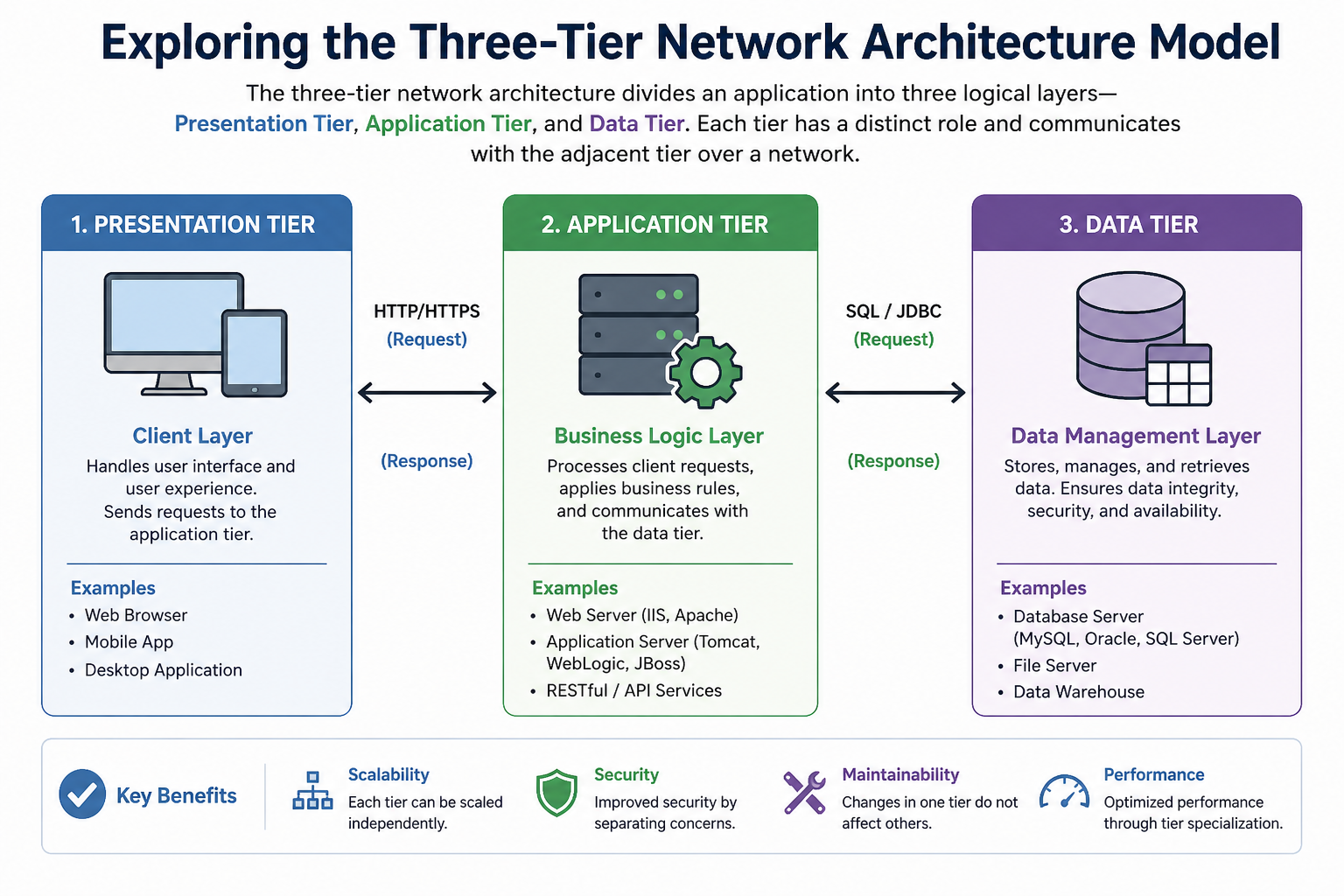
The three-tier network architecture is a structured design approach used to build scalable, efficient, and manageable networks. It divides a network into three logical layers, each with a specific function that contributes to overall performance and stability. This separation of responsibilities allows organizations to handle large volumes of traffic while maintaining control, security, and flexibility. Instead of relying on a flat network design where all devices share the same level of responsibility, this model introduces hierarchy, which significantly improves organization and reduces complexity.
The concept is widely adopted in enterprise environments where networks must support thousands of users, multiple applications, and continuous data flow. By segmenting the network into layers, administrators can optimize each section independently without affecting the entire system. This makes troubleshooting easier, upgrades smoother, and scaling more efficient.
Evolution and Purpose of Layered Network Design
As computer networks grew in size and complexity, flat designs became difficult to manage. Early networks lacked structure, which led to congestion, security vulnerabilities, and performance issues. To solve these challenges, hierarchical models were introduced, eventually evolving into the modern three-tier architecture.
The main purpose of this design is to create clear boundaries between different types of network functions. Instead of having all devices performing routing, switching, and processing tasks simultaneously, responsibilities are distributed across layers. This separation improves efficiency and ensures that each layer focuses only on its intended role.
Core Layer Function and Importance
The core layer serves as the backbone of the entire network infrastructure. Its primary responsibility is to transport data quickly and efficiently between different distribution layers. This layer is designed for speed, reliability, and minimal latency. It avoids performing complex tasks such as filtering or policy enforcement, as doing so could slow down data transmission.
The core layer typically consists of high-capacity routers and switches that are optimized for fast packet forwarding. Because it handles critical data movement, it is built with redundancy to ensure uninterrupted service even in case of failures. Stability and performance are the most important characteristics of this layer, making it essential for maintaining overall network connectivity.
Distribution Layer Role and Functionality
The distribution layer acts as a mediator between the core layer and the access layer. It plays a crucial role in controlling and managing traffic flow across the network. Unlike the core layer, it performs more advanced functions such as routing decisions, traffic filtering, policy enforcement, and load balancing.
This layer is often considered the intelligence point of the network because it determines how data should be handled before reaching the core or access layers. It also helps in segmenting the network into smaller logical units, improving both performance and security. By controlling traffic at this level, the distribution layer prevents unnecessary data from reaching the core, ensuring efficient bandwidth usage.
Access Layer and End Device Connectivity
The access layer is the entry point for all end-user devices. It connects devices such as computers, printers, phones, and IoT systems to the network. This layer is responsible for providing network access and ensuring that devices can communicate with the rest of the system.
It typically includes switches and wireless access points that manage device connections. Functions such as port security, VLAN assignment, and basic traffic control are handled here. The access layer ensures that only authorized devices can join the network, adding an important layer of security at the edge.
Data Flow Across the Three Layers
In a three-tier architecture, data follows a structured path as it moves through the network. When a device sends information, it first passes through the access layer. From there, it moves to the distribution layer, which evaluates and directs the traffic based on predefined policies. Finally, if needed, the data is forwarded to the core layer for high-speed transport to another part of the network.
This structured flow ensures that data is processed efficiently and securely. Each layer contributes to filtering, forwarding, and optimizing traffic, reducing the chances of congestion and improving overall network performance.
Scalability in Network Design
One of the major advantages of the three-tier architecture is its scalability. As organizations grow, their network requirements also increase. This model allows new devices, users, and applications to be added without redesigning the entire system.
Each layer can be expanded independently. For example, additional access switches can be added to support more users, or distribution switches can be upgraded to handle increased routing demands. This modular approach makes it easier to grow the network in a controlled and efficient manner.
Performance Optimization Techniques
Performance is a critical aspect of network design, and the three-tier model supports optimization at multiple levels. By separating functions, each layer can be tuned for specific tasks. The core layer focuses on speed, the distribution layer handles intelligent traffic control, and the access layer manages device connectivity.
This separation reduces congestion and ensures that no single layer becomes overloaded. It also allows network administrators to implement quality of service policies, prioritize important traffic, and balance loads effectively.
Security Implementation Across Layers
Security is integrated into each layer of the three-tier architecture. At the access layer, basic security measures such as port authentication and device filtering are applied. The distribution layer enforces more advanced policies, including access control lists and traffic inspection. The core layer, while primarily focused on speed, benefits from the security policies enforced at higher levels.
This layered security approach ensures that threats are detected and controlled at multiple points within the network. It reduces the risk of unauthorized access and helps maintain data integrity across the system.
Redundancy and Reliability
To ensure continuous operation, the three-tier architecture incorporates redundancy at different levels. Multiple paths are often created between layers so that if one connection fails, another can take over without disrupting the network.
The core layer is typically designed with the highest level of redundancy because it carries critical traffic. Distribution and access layers also include backup systems to enhance reliability. This design ensures high availability, which is essential for business continuity in modern organizations.
Design Principles of the Architecture
Several key principles guide the implementation of a three-tier network. These include modularity, scalability, resilience, and efficiency. Modularity ensures that each layer can function independently. Scalability allows the network to grow easily. Resilience ensures that failures do not disrupt operations. Efficiency ensures optimal use of resources and bandwidth.
Following these principles helps organizations build networks that are both powerful and manageable, even as demands increase over time.
Deployment in Enterprise Environments
The three-tier architecture is commonly used in large enterprises, universities, data centers, and government organizations. These environments require networks that can handle heavy traffic loads and support thousands of connected devices.
In such deployments, the access layer connects end users in offices or campuses, the distribution layer manages departmental traffic, and the core layer connects different buildings or data centers. This structure ensures smooth communication across all parts of the organization.
Advantages of the Three-Tier Model
This architecture offers several benefits. It improves scalability, simplifies management, enhances performance, and strengthens security. It also allows for easier troubleshooting since issues can be isolated to a specific layer. Additionally, the structured design reduces complexity in large networks, making them easier to maintain.
Another key advantage is flexibility. Each layer can be upgraded or modified without affecting the others, allowing organizations to adapt to new technologies and requirements.
Challenges and Limitations
Despite its advantages, the three-tier architecture also has some limitations. It can be more expensive to implement due to the need for multiple devices and infrastructure components. It may also introduce additional latency in smaller networks where such complexity is unnecessary.
For small organizations, a simpler network design may be more efficient. However, for large-scale environments, the benefits of structure and scalability outweigh the added complexity.
Best Practices for Implementation
Successful implementation requires careful planning. Network administrators should design each layer based on expected traffic loads and future growth. Redundancy should be built into critical points to avoid single points of failure. Security policies should be consistently applied across all layers.
Monitoring and regular maintenance are also essential to ensure optimal performance. Continuous evaluation helps identify bottlenecks and improve efficiency over time.
Interaction Between Layers in Real Network Operations
In practical environments, the three layers of the network do not operate in isolation. Instead, they continuously interact with each other to ensure smooth and efficient communication. When a user initiates a request, it begins at the access layer and moves upward if required, passing through the distribution layer before reaching the core. The response follows the reverse path, ensuring structured and controlled data movement.
This layered interaction ensures that each request is processed at the appropriate level of the network. The access layer handles device-level connectivity, the distribution layer evaluates policies and routing logic, and the core layer ensures rapid data transport. This separation of duties prevents overload and ensures that each layer performs only the tasks it is optimized for.
Traffic Segmentation and Control Mechanisms
One of the key strengths of the three-tier architecture is its ability to segment and control network traffic effectively. Segmentation is achieved primarily at the distribution layer, where policies are applied to separate different types of traffic based on organizational needs.
For example, traffic from administrative departments can be separated from guest or public traffic. This ensures that sensitive data remains isolated and protected. By controlling traffic flow in this way, the architecture reduces congestion and improves both performance and security across the network.
Role of Routing in the Distribution Layer
Routing is a critical function performed mainly at the distribution layer. Unlike the access layer, which focuses on connecting devices, the distribution layer determines the best path for data to travel across the network.
It uses routing protocols to exchange information between network segments and ensure efficient data delivery. This intelligent decision-making helps balance loads and avoid unnecessary traffic buildup in any single part of the network. It also allows communication between different VLANs or subnetworks within the same organization.
High-Speed Backbone Design in the Core Layer
The core layer is designed with one primary objective: speed. It acts as the high-speed backbone that connects all parts of the network together. Because of its role, it must be capable of handling large volumes of data with minimal delay.
To achieve this, the core layer avoids complex processing tasks. Instead, it focuses entirely on fast packet forwarding. High-performance switches and routers are used to ensure that data travels efficiently between distribution layers without interruption or bottlenecks.
Access Layer Security Enhancements
Security at the access layer plays a crucial role in protecting the entire network. Since this is the first point of entry for devices, it is often targeted for unauthorized access attempts. To prevent this, multiple security techniques are implemented.
Port security is commonly used to restrict which devices can connect to specific ports. Authentication systems ensure that only authorized users gain access. Additionally, VLAN segmentation is used to isolate different groups of devices, reducing the risk of internal threats spreading across the network.
Quality of Service Implementation
Quality of Service mechanisms are often applied within the three-tier architecture to prioritize certain types of network traffic. This is especially important in environments where multiple applications compete for bandwidth.
For example, real-time applications such as voice or video communication require low latency and high priority. The distribution layer is typically responsible for enforcing these QoS policies, ensuring that critical traffic is delivered smoothly without delay, even during peak usage periods.
Network Redundancy Strategies
Redundancy is a key design principle in the three-tier architecture. It ensures that the network remains operational even when a component fails. Redundant links, devices, and paths are strategically placed throughout the network.
At the core layer, redundancy is often implemented using multiple high-speed connections between switches. In the distribution layer, backup routing paths ensure continuous communication between segments. At the access layer, redundant switches may be used to prevent single points of failure for end devices.
Load Balancing Across the Network
Load balancing is another important function supported by the three-tier architecture. It ensures that no single device or path becomes overloaded with traffic. By distributing network load evenly, performance is improved and bottlenecks are reduced.
The distribution layer plays a major role in this process by analyzing traffic patterns and directing data through optimal paths. This ensures efficient use of network resources and improves overall responsiveness.
Virtualization in Modern Three-Tier Networks
Modern implementations of the three-tier architecture often incorporate virtualization technologies. Virtual networks allow multiple logical networks to exist on the same physical infrastructure.
This enhances flexibility and resource utilization. Virtual switches, routers, and segmented networks can be created within each layer, allowing organizations to adapt quickly to changing requirements without significant physical changes to infrastructure.
Monitoring and Network Management
Effective monitoring is essential for maintaining performance in a three-tier architecture. Network administrators use monitoring tools to track traffic flow, detect anomalies, and identify potential issues before they become critical.
Each layer provides different types of data for monitoring. The access layer offers information about device connections, the distribution layer provides routing and policy data, and the core layer offers insights into high-speed traffic flow. Together, this information helps maintain network health and stability.
Troubleshooting in a Layered Structure
One of the advantages of the three-tier architecture is simplified troubleshooting. When an issue arises, administrators can quickly identify which layer is affected.
If devices cannot connect, the problem is likely at the access layer. If routing or policy issues occur, the distribution layer is usually responsible. If there are widespread connectivity problems across the network, the core layer may be affected. This structured approach significantly reduces downtime and speeds up problem resolution.
Scalability for Future Growth
As organizations expand, their network must grow accordingly. The three-tier architecture supports this growth without requiring a complete redesign. New access switches can be added to support additional users, while distribution and core layers can be upgraded to handle increased traffic demands.
This scalability ensures that the network remains efficient even as demand increases over time. It allows businesses to expand operations without compromising performance or stability.
Energy Efficiency and Resource Optimization
Modern network designs also focus on energy efficiency. By organizing the network into layers, resources can be allocated more effectively, reducing unnecessary power consumption.
Devices in the core layer are optimized for performance, while access layer devices can be designed for lower power usage. This balanced approach helps reduce operational costs while maintaining high performance standards.
Comparison with Other Network Architectures
Compared to simpler network designs, the three-tier architecture offers significantly greater control and scalability. Flat network models may be easier to deploy initially but become difficult to manage as they grow.
In contrast, the layered approach introduces structure and hierarchy, making it more suitable for complex environments. While it may require more planning and resources, its long-term benefits outweigh the initial complexity.
Importance in Modern Enterprise Networks
Today’s enterprise networks rely heavily on structured architectures to handle increasing digital demands. With the rise of cloud computing, remote work, and data-intensive applications, the need for scalable and reliable networks has become more important than ever.
The three-tier architecture provides a strong foundation for supporting these demands. Its structured design ensures that organizations can maintain performance, security, and reliability even under heavy workloads.
Understanding of the Architecture Model
The three-tier network architecture represents a balanced and efficient approach to network design. By dividing responsibilities into access, distribution, and core layers, it creates a system that is both organized and powerful.
Each layer plays a unique role, yet all work together to ensure smooth communication and data flow. This combination of structure, scalability, and performance makes it one of the most widely adopted models in modern networking environments.
Performance Tuning at Each Layer
Performance optimization in a three-tier network requires attention to each individual layer rather than treating the network as a single system. At the core layer, optimization focuses on maximizing forwarding speed and minimizing latency. High-capacity switching hardware is configured to prioritize rapid packet movement without additional processing delays.
At the distribution layer, performance tuning involves refining routing decisions, balancing traffic loads, and applying efficient policy controls. This ensures that only necessary and well-structured traffic reaches the core layer. At the access layer, optimization focuses on ensuring stable device connectivity and reducing congestion at entry points.
Efficient Bandwidth Utilization
Bandwidth management is a critical factor in maintaining network efficiency. Without proper control, excessive traffic can overwhelm network links and degrade performance. The three-tier architecture addresses this through structured bandwidth allocation across layers.
The access layer ensures that devices do not consume more bandwidth than necessary. The distribution layer regulates traffic flow between segments, preventing unnecessary data from reaching the backbone. The core layer ensures that available bandwidth is used for high-speed transport between major network sections.
Latency Reduction Strategies
Reducing latency is essential for applications that require real-time communication. The three-tier architecture helps achieve this by limiting unnecessary processing at the core layer and pushing intelligent decisions to the distribution layer.
By filtering and organizing traffic before it reaches the core, the system reduces delays in data transmission. Efficient routing, optimized switching paths, and minimal processing at high-speed layers all contribute to lower latency across the network.
Fault Tolerance and Network Stability
Fault tolerance ensures that the network continues to function even when components fail. In a three-tier architecture, redundancy is built into each layer to maintain stability.
If a device at the access layer fails, alternate connections or switches can take over. At the distribution layer, redundant routing paths ensure uninterrupted communication between network segments. At the core layer, multiple high-speed links provide backup routes for critical data transfer.
This layered redundancy minimizes downtime and strengthens overall system reliability.
Scalable Network Expansion Techniques
Scalability is one of the strongest advantages of the three-tier model. As network demands increase, expansion can be done in a structured and controlled manner.
New access layer devices can be added without affecting the core structure. Distribution layer capacity can be increased by upgrading switches or adding additional routing capabilities. The core layer can be scaled using higher-capacity hardware or additional interconnection paths.
This modular expansion allows networks to grow without redesigning the entire infrastructure.
Security Hardening Across Layers
Security strengthening in a three-tier architecture involves applying multiple protective measures at different layers. At the access layer, authentication and port security prevent unauthorized device connections. VLAN segmentation isolates traffic and reduces exposure to internal threats.
At the distribution layer, access control policies and traffic inspection mechanisms filter malicious or unnecessary data. The core layer relies on the security measures enforced by other layers but may also include encryption or secure routing protocols for sensitive data transport.
This multi-layered security approach reduces vulnerabilities and strengthens overall protection.
Traffic Prioritization and Management
Not all network traffic carries the same importance. Some applications require higher priority due to their sensitivity to delay or interruption. The three-tier architecture supports traffic prioritization through structured policy enforcement.
The distribution layer plays a key role in identifying and prioritizing traffic based on predefined rules. Critical applications such as communication services are given higher priority, while less important traffic is assigned lower priority. This ensures efficient use of network resources and maintains service quality.
Role of Switching Technologies
Switching technology is fundamental to the operation of all three layers. At the access layer, switches connect end devices and manage local traffic. At the distribution layer, advanced switching functions help manage routing and policy enforcement. At the core layer, high-speed switching ensures rapid data transfer across the backbone.
Modern switching technologies support features such as VLAN tagging, link aggregation, and fast failover mechanisms, all of which contribute to improved performance and reliability.
Impact of Network Design on Application Performance
The structure of a network directly affects how applications perform. In a well-designed three-tier architecture, applications benefit from reduced latency, improved bandwidth availability, and consistent connectivity.
Applications that rely on continuous data flow, such as video conferencing or cloud services, perform better when network traffic is properly managed across layers. The separation of responsibilities ensures that application traffic is handled efficiently without unnecessary delays.
Integration with Modern Networking Technologies
Modern networks often integrate the three-tier architecture with advanced technologies such as cloud computing, virtualization, and software-defined networking. These technologies enhance flexibility and control within each layer.
Virtual networks can be created within physical infrastructure, allowing more efficient resource usage. Cloud integration enables distributed access to services, while software-defined networking allows centralized control over traffic flow and policies.
Challenges in Large-Scale Deployments
While the three-tier architecture is highly effective, large-scale deployments can introduce challenges. Managing multiple devices across layers requires careful planning and coordination. Misconfigurations can lead to inefficiencies or performance issues.
Additionally, maintaining consistency in policies across distribution layers can be complex in very large networks. Proper documentation, monitoring tools, and automation are often required to manage these challenges effectively.
Network Automation and Management Tools
Automation plays an increasingly important role in managing three-tier networks. Automated tools help configure devices, monitor performance, and detect issues in real time.
These tools reduce manual workload and minimize human error. They also allow for faster response to network changes, making it easier to maintain stability in dynamic environments.
Energy Management in Network Infrastructure
Energy efficiency is becoming a key consideration in network design. The three-tier architecture supports energy management by distributing workloads efficiently across devices.
Idle or low-traffic devices can enter energy-saving modes, while high-performance devices handle critical tasks. This balance helps reduce operational costs while maintaining network performance.
Future Trends in Three-Tier Architecture
As technology continues to evolve, the three-tier architecture is also adapting. Future networks are expected to become more automated, intelligent, and software-driven.
Artificial intelligence may play a role in optimizing traffic flow, predicting network issues, and improving security. Virtualization will continue to reduce dependence on physical hardware, making networks more flexible and scalable.
Architectural Strengths
The three-tier network architecture remains a strong and reliable model for building modern networks. Its layered structure improves organization, scalability, and performance while maintaining strong security and control.
By dividing responsibilities across access, distribution, and core layers, it ensures efficient data handling and stable communication. Its adaptability to modern technologies makes it a long-lasting solution for both current and future networking needs.
Streamlined Network Operations
Operational efficiency is one of the strongest advantages of the three-tier network architecture. By dividing the network into distinct layers, administrative tasks become more organized and easier to manage. Each layer has a clearly defined responsibility, which reduces confusion and minimizes overlap in functions.
This structured approach allows network teams to focus on specific areas rather than managing the entire system as a single complex unit. As a result, routine operations such as configuration, monitoring, and maintenance become more efficient and less time-consuming.
Centralized and Distributed Management Balance
The architecture supports a balanced approach between centralized and distributed network management. The distribution layer often acts as a control point where policies and routing decisions are managed, while the access layer handles local device-level operations.
This balance ensures that critical decisions are made closer to the data source, reducing delays, while still maintaining centralized control for consistency and governance. It improves overall coordination without creating unnecessary bottlenecks in network management.
Configuration Management Practices
Proper configuration management is essential in maintaining a stable three-tier network. Each layer requires specific configuration settings based on its role. The access layer focuses on device connectivity and basic security settings, the distribution layer manages routing and policies, and the core layer is configured for high-speed forwarding.
Consistency in configuration across devices ensures predictable behavior and reduces the risk of errors. Standardized templates and automated configuration tools are often used to maintain uniformity across large networks.
Monitoring and Performance Visibility
Continuous monitoring is crucial for maintaining network health. The three-tier architecture provides clear visibility into different parts of the network, making it easier to track performance metrics and detect anomalies.
Monitoring systems collect data from all three layers, including device status, traffic flow, bandwidth usage, and error rates. This information helps administrators identify performance issues early and take corrective actions before they impact users.
Incident Detection and Response
Rapid incident detection is essential for minimizing downtime. In a three-tier architecture, monitoring tools can quickly identify which layer is affected when a problem occurs.
If an issue is detected at the access layer, it may involve device connectivity or port failures. At the distribution layer, it may involve routing errors or policy conflicts. At the core layer, it could indicate backbone connectivity issues. This clear separation speeds up troubleshooting and response time.
Maintenance and Upgrade Procedures
Regular maintenance is necessary to ensure long-term network stability. The layered structure makes maintenance easier by allowing updates or changes to be applied to one layer without disrupting the entire system.
For example, access layer devices can be upgraded to support new user demands, while the distribution layer can be enhanced to improve routing efficiency. Core layer upgrades are typically less frequent but focus on increasing speed and capacity.
Network Documentation and Standardization
Proper documentation plays a vital role in managing a three-tier network. Clear records of configurations, topology, policies, and device roles help ensure smooth operations and faster troubleshooting.
Standardization across all layers reduces complexity and improves consistency. It also makes it easier for new administrators to understand the network structure and manage it effectively.
Risk Management and Network Resilience
Risk management in a three-tier architecture involves identifying potential points of failure and implementing strategies to reduce their impact. Redundancy, load balancing, and failover mechanisms all contribute to network resilience.
By distributing risk across multiple layers, the architecture ensures that a failure in one area does not cause a complete system breakdown. This improves overall reliability and service continuity.
Policy Enforcement Consistency
Policy enforcement is a key responsibility of the distribution layer, but it must remain consistent across the entire network. Policies related to security, access control, and traffic management must be applied uniformly to avoid conflicts or loopholes.
Consistency ensures that users experience the same level of service regardless of where they connect from within the network. It also strengthens security by preventing unauthorized access or misconfigurations.
Scalability in Operational Management
As networks grow, operational management must scale accordingly. The three-tier architecture supports this by allowing administrative responsibilities to be distributed across layers.
Instead of managing all devices centrally, responsibilities can be divided among teams or systems based on network layers. This improves efficiency and allows organizations to handle larger and more complex environments without overwhelming their IT resources.
Integration with Cloud-Based Systems
Modern networks often extend beyond physical infrastructure and integrate with cloud-based systems. The three-tier architecture adapts well to this model by supporting hybrid environments.
Access layers can connect users to cloud services, distribution layers manage routing between local and cloud resources, and core layers handle high-speed connectivity between major data centers. This integration enhances flexibility and expands network capabilities.
Automation in Network Operations
Automation has become a key component of modern network management. In a three-tier architecture, automation tools can handle repetitive tasks such as configuration updates, performance monitoring, and policy enforcement.
This reduces manual effort and minimizes the risk of human error. It also improves response times during network changes or incidents, making the system more efficient and reliable.
Load Distribution Efficiency
Efficient load distribution ensures that no single part of the network becomes overloaded. The distribution layer plays a major role in analyzing traffic patterns and distributing loads evenly across available paths.
This prevents congestion, improves response times, and ensures smooth data flow even during peak usage periods. Balanced load distribution also extends the lifespan of network hardware by preventing excessive strain on individual devices.
Interoperability with Other Network Models
The three-tier architecture is highly compatible with other networking models and technologies. It can be integrated with flat networks, hybrid designs, and software-defined networking environments.
This interoperability allows organizations to adopt new technologies without completely replacing existing infrastructure. It provides flexibility and ensures smooth transitions during network upgrades or expansions.
Long-Term Sustainability of the Architecture
The three-tier model is designed for long-term use and remains relevant even as technology evolves. Its structured approach ensures that networks can adapt to changing demands without requiring complete redesigns.
Sustainability is achieved through scalability, modularity, and flexibility. These characteristics allow organizations to extend the lifespan of their network infrastructure while maintaining high performance and reliability.
Final Operational Perspective
From an operational standpoint, the three-tier network architecture provides a stable, organized, and efficient framework for managing complex networks. Its layered design simplifies administration, improves performance, and enhances security.
By clearly separating responsibilities across access, distribution, and core layers, it creates a system that is easier to control, scale, and maintain. This makes it one of the most practical and widely adopted models for modern network environments.
Conclusion
The three-tier network architecture remains one of the most effective and widely adopted models for designing modern enterprise networks. Its structured approach divides the network into access, distribution, and core layers, each serving a distinct purpose that contributes to overall efficiency, scalability, and stability. This clear separation of responsibilities allows networks to operate in a more organized and predictable manner, even as complexity and demand increase.
By isolating functions across layers, the architecture improves performance and reduces congestion, ensuring that data flows smoothly from end devices to the backbone of the network. It also strengthens security by enabling layered protection, where access control, policy enforcement, and high-speed transport work together to safeguard information and resources.
Another major strength of this model is its scalability. Networks can expand gradually by adding or upgrading components at each layer without disrupting the entire system. This flexibility makes it suitable for growing organizations that require continuous improvement and adaptation to new technologies.
The architecture also enhances reliability through redundancy and fault tolerance. Multiple paths and backup systems ensure that failures in one part of the network do not lead to complete service disruption. This level of resilience is essential for maintaining business continuity in modern digital environments.
Overall, the three-tier network architecture provides a balanced combination of performance, manageability, and future readiness. Its layered design not only simplifies network operations but also supports long-term growth, making it a foundational model in enterprise networking.