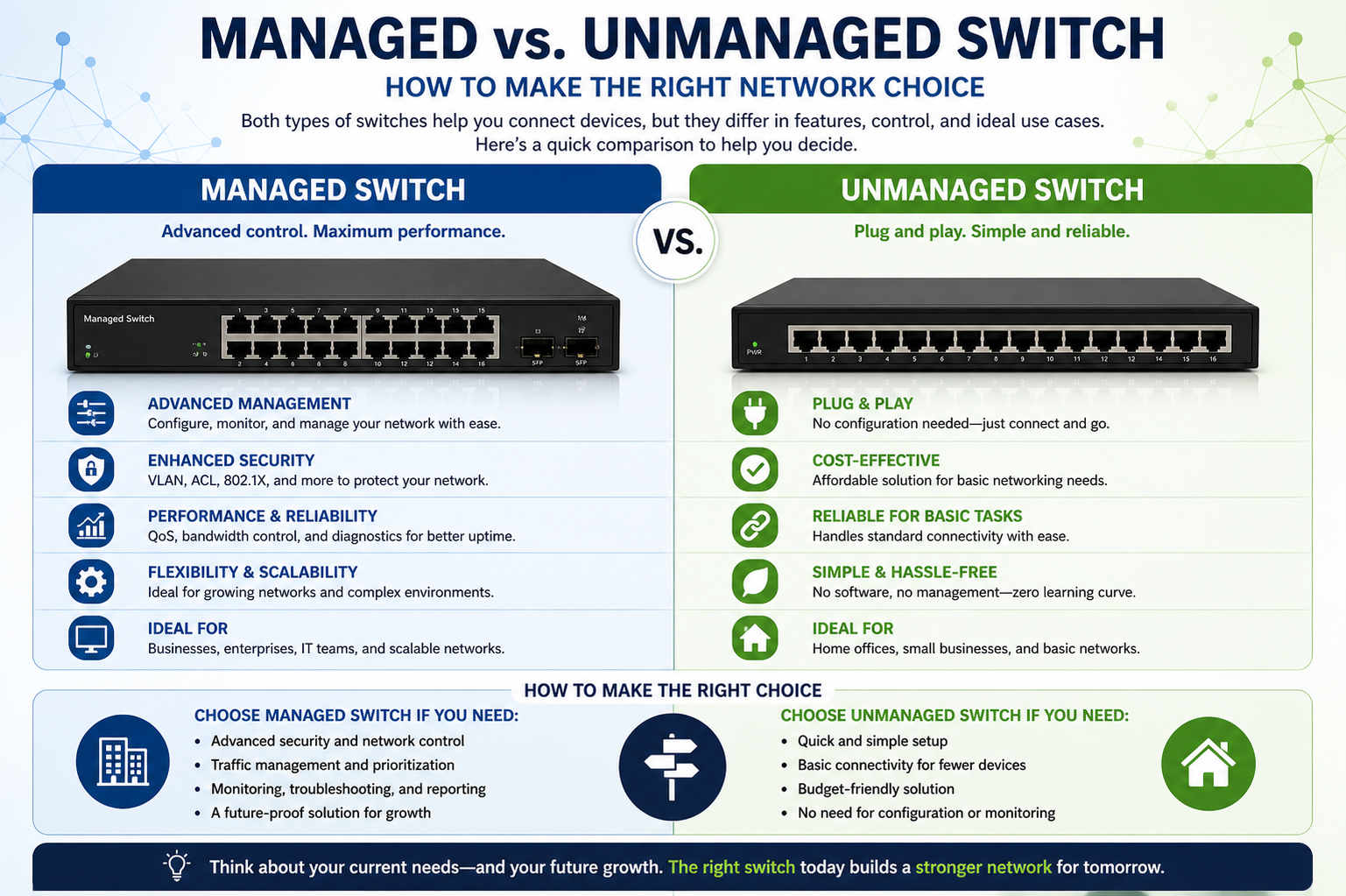
In modern networking environments, switches play a central role in ensuring that devices communicate efficiently and reliably. Whether in homes, offices, or large enterprise infrastructures, switches are responsible for directing data between connected devices so that information reaches its intended destination without delay or conflict. As network demands continue to grow, the choice between different types of switches becomes increasingly important. Two of the most commonly used options are managed and unmanaged switches, each designed with distinct purposes, capabilities, and levels of control.
Understanding the differences between these two types of switches is essential for building a network that performs well, remains secure, and can adapt to future requirements. While both serve the fundamental purpose of connecting devices, their functionality and flexibility vary significantly, making each suitable for different environments and use cases.
Understanding the Role of a Network Switch
A network switch is a hardware device that connects multiple devices within a local area network and intelligently forwards data between them. Unlike simpler networking devices, switches do not broadcast data to all connected devices; instead, they direct data only to the specific device that needs it. This improves efficiency, reduces congestion, and enhances overall network performance.
Switches operate at different levels of complexity. Some are designed for simple connectivity without configuration, while others offer advanced control features that allow administrators to fine-tune how data flows across the network. This distinction forms the basis of managed and unmanaged switch categories.
What is a Managed Switch
A managed switch is a highly configurable networking device that gives administrators full control over network traffic and behavior. It is designed for environments where performance optimization, security, and scalability are critical. With a managed switch, network administrators can monitor traffic patterns, configure individual ports, and apply specific rules to improve efficiency and reliability.
One of the key strengths of a managed switch is its ability to provide visibility into network activity. This allows administrators to identify bottlenecks, detect unusual behavior, and make informed decisions about network adjustments. It is particularly valuable in environments where multiple users and devices rely on stable and high-speed connectivity.
Advanced Configuration Capabilities
Managed switches offer a wide range of configuration options that go beyond simple connectivity. These include the ability to create virtual networks, prioritize specific types of traffic, and control how bandwidth is distributed across devices. This level of control allows organizations to tailor the network according to their specific operational requirements.
For example, critical applications such as video conferencing or data transfer systems can be prioritized to ensure smooth performance, even during periods of heavy network usage. This helps maintain productivity and prevents delays caused by network congestion.
Network Segmentation and VLAN Support
One of the most powerful features of managed switches is support for network segmentation through virtual local area networks. This allows a single physical network to be divided into multiple logical networks, each operating independently. By separating traffic in this way, organizations can improve both security and performance.
Network segmentation is particularly useful in environments where different departments or systems require isolated communication. It reduces unnecessary traffic between devices and limits exposure in case of security breaches, making the network more efficient and secure.
Traffic Management and Quality of Service
Managed switches also support traffic management features that help optimize data flow. Quality of Service functionality allows administrators to prioritize certain types of traffic over others. For instance, real-time applications such as voice and video communication can be given higher priority compared to less time-sensitive data.
This ensures that critical applications maintain consistent performance, even when the network is under heavy load. It is especially important in business environments where delays or interruptions can impact operations.
Enhanced Security Features
Security is another major advantage of managed switches. They provide tools to control access to the network, monitor activity, and prevent unauthorized usage. Features such as port security, access control lists, and authentication mechanisms help protect sensitive data and ensure that only authorized devices can connect to the network.
These security measures are essential in environments where data protection is a priority. They help reduce the risk of internal and external threats while maintaining control over network access.
Remote Monitoring and Management
Managed switches often include support for remote monitoring protocols that allow administrators to manage the network from a central location. This capability is especially useful in large organizations with multiple locations or complex network structures.
Remote management enables real-time monitoring of network performance, quick identification of issues, and immediate response to potential problems. This reduces downtime and improves overall network reliability.
What is an Unmanaged Switch
An unmanaged switch is a simple networking device designed for basic connectivity without the need for configuration or administration. It is typically used in small networks where ease of use and affordability are more important than advanced features.
Unmanaged switches operate on a plug-and-play basis. Once devices are connected, the switch automatically begins forwarding data between them without requiring any setup or customization. This makes it an ideal solution for users who need a straightforward and hassle-free networking option.
Simplicity and Ease of Use
The primary advantage of an unmanaged switch is its simplicity. There is no need for technical knowledge or configuration, making it accessible to anyone. Users can simply connect their devices and expect the network to function immediately.
This ease of use makes unmanaged switches particularly popular in home networks and small office environments where advanced control is not necessary.
Limited Functionality
While unmanaged switches are easy to use, they offer limited functionality compared to managed switches. They do not provide options for traffic prioritization, network segmentation, or performance monitoring. As a result, all connected devices share the same level of network access without any form of optimization or control.
This limitation makes unmanaged switches less suitable for environments where network performance and security are critical factors.
Cost Efficiency
Unmanaged switches are generally more affordable than managed switches. Their lower cost makes them an attractive option for users who need basic connectivity without additional features. This cost advantage is one of the main reasons they are widely used in residential and small-scale applications.
However, the lower price comes with reduced flexibility and control, which may not be suitable for growing or complex networks.
Key Differences Between Managed and Unmanaged Switches
The differences between managed and unmanaged switches primarily revolve around control, flexibility, and complexity. Managed switches offer advanced features that allow detailed control over network behavior, while unmanaged switches provide a simple and automatic solution without customization.
Managed switches are designed for environments where performance optimization, security, and scalability are important. In contrast, unmanaged switches are intended for basic networking needs where simplicity and ease of use are the main priorities.
Performance Considerations
Performance is another important factor when comparing these two types of switches. Managed switches are capable of optimizing traffic flow, reducing congestion, and ensuring consistent performance across the network. This makes them suitable for high-demand environments.
Unmanaged switches, on the other hand, do not offer performance optimization features. While they can handle basic data transfer efficiently, they may struggle in environments with heavy network usage or multiple high-demand applications.
Scalability and Future Growth
Managed switches are better suited for networks that are expected to grow or evolve over time. Their advanced features allow for easy expansion and reconfiguration as new devices or requirements are introduced.
Unmanaged switches are more static in nature. They are ideal for small, stable networks but may not be suitable for environments that require frequent changes or expansion.
Use Case Scenarios
Managed switches are commonly used in business environments, data centers, educational institutions, and any setting where network performance and security are critical. They are essential in situations where multiple users depend on stable and efficient connectivity.
Unmanaged switches are typically used in homes, small offices, and simple setups where users only need basic device connectivity without advanced control or monitoring.
Cost vs Value Consideration
When selecting between managed and unmanaged switches, cost is often one of the first factors considered, but it should not be the only deciding element. Unmanaged switches are generally more affordable because they require no configuration capabilities, advanced hardware resources, or software-based control systems. This makes them appealing for users who only need basic connectivity without additional complexity.
However, managed switches, while more expensive, offer significantly higher value in environments where performance, reliability, and security matter. The additional cost reflects the advanced features such as traffic control, monitoring tools, and security configurations. In many cases, investing in a managed switch can reduce long-term operational issues, improve efficiency, and prevent costly downtime, especially in business environments where network interruptions can affect productivity.
It is important to view cost not only as an upfront expense but also in terms of long-term benefits. A cheaper unmanaged solution may save money initially but could lead to limitations as the network grows or becomes more demanding.
Ease of Installation and Setup
One of the strongest advantages of unmanaged switches is their simplicity during installation. They require no configuration or technical expertise. Users only need to connect devices, and the switch automatically begins forwarding data. This plug-and-play functionality eliminates the need for specialized IT knowledge, making it ideal for non-technical users.
Managed switches, on the other hand, require proper setup and configuration before they can be fully utilized. Administrators may need to define VLANs, configure port settings, set security rules, and manage traffic policies. While this process requires technical understanding, it also provides complete control over how the network operates.
In environments where IT staff are available, this setup complexity is not a disadvantage. Instead, it becomes an opportunity to fine-tune the network for optimal performance. However, for users who prefer simplicity and quick deployment, unmanaged switches are more practical.
Network Security Differences
Security is one of the most critical areas where managed switches outperform unmanaged switches. Managed switches provide multiple layers of security controls, including port-based authentication, access restrictions, traffic monitoring, and the ability to isolate sensitive network segments.
These features allow administrators to protect internal systems from unauthorized access and reduce the risk of data breaches. For example, certain ports can be restricted so that only approved devices are allowed to connect, which significantly enhances network safety.
Unmanaged switches do not offer any built-in security configuration options. All connected devices are treated equally, and there is no way to control or restrict access beyond physical connection. While this may be sufficient for home use or very small networks, it becomes a limitation in environments where data protection is essential.
As cyber threats continue to evolve, network security has become a major consideration, making managed switches a preferred choice for businesses and institutions.
Performance Optimization and Traffic Control
Managed switches provide advanced tools to optimize network performance. One of the key capabilities is traffic prioritization, which ensures that important data packets are transmitted first. This is particularly useful for real-time applications such as video calls, online meetings, and cloud-based services.
In addition, managed switches can monitor network traffic in real time, allowing administrators to detect congestion points and adjust settings accordingly. This proactive approach helps maintain smooth performance even during peak usage periods.
Unmanaged switches do not have any traffic control features. They simply forward data without analyzing or prioritizing it. While this works well in simple environments with low traffic, performance issues may arise in more complex networks where multiple devices compete for bandwidth.
The ability to manage and optimize traffic makes managed switches more suitable for environments where consistent performance is essential.
Reliability and Network Stability
Network stability is another important factor when comparing these two types of switches. Managed switches contribute to higher stability by allowing administrators to identify and resolve issues quickly. If a problem occurs, monitoring tools can help pinpoint the source, whether it is a faulty device, overloaded port, or misconfigured setting.
This level of visibility reduces downtime and ensures that network issues are addressed before they escalate. In large organizations, this can significantly improve operational continuity.
Unmanaged switches do not provide monitoring or diagnostic tools. If a network issue occurs, it is often more difficult to identify the cause. Users may need to manually disconnect devices or test connections individually to find the problem. This lack of visibility can lead to longer troubleshooting times and reduced network reliability in complex setups.
Scalability and Expansion Potential
Scalability refers to how easily a network can grow and adapt to increasing demands. Managed switches are designed with scalability in mind. They allow administrators to expand networks by adding new devices, adjusting configurations, and reorganizing traffic flow without disrupting existing operations.
Features such as VLANs and link aggregation make it easier to build structured and efficient networks that can handle growth over time. This is particularly important for businesses that anticipate expansion or increased data usage.
Unmanaged switches offer limited scalability. While additional switches can be added physically, there is no way to logically manage or optimize the expanded network. As a result, performance and organization may become harder to maintain as the network grows.
For long-term planning, managed switches provide a more sustainable solution.
Maintenance and Troubleshooting
Maintenance is another area where managed switches offer significant advantages. With built-in monitoring tools, administrators can continuously observe network performance and identify potential issues before they become serious problems. This proactive approach reduces downtime and improves overall efficiency.
Troubleshooting is also much easier with managed switches. Since they provide detailed information about network activity, administrators can quickly isolate issues and apply targeted solutions.
Unmanaged switches, in contrast, offer no diagnostic features. When a problem occurs, users must rely on basic physical checks such as cable testing or device isolation. This reactive approach often takes more time and effort, especially in larger setups.
Environmental Suitability
The suitability of managed and unmanaged switches depends heavily on the environment in which they are used. Managed switches are best suited for environments that require structured networking, such as corporate offices, data centers, schools, and institutions where multiple users and systems operate simultaneously.
These environments benefit from the ability to control traffic, enhance security, and maintain high performance under heavy usage.
Unmanaged switches are ideal for environments where simplicity is more important than control. Homes, small offices, and temporary setups often rely on unmanaged switches because they provide quick and reliable connectivity without additional complexity.
Choosing the right switch depends on understanding the specific needs of the environment and how the network will be used.
Long-Term Network Planning
When planning a network for the long term, it is important to consider future growth, increasing data demands, and evolving security requirements. Managed switches provide the flexibility needed to adapt to these changes over time. Their advanced features allow networks to evolve without requiring complete hardware replacement.
Unmanaged switches, while effective in the short term, may become limiting as requirements grow. In such cases, replacing or upgrading the entire network infrastructure may become necessary.
This makes managed switches a more future-proof investment for organizations that expect continuous development.
Comparison Perspective
Both managed and unmanaged switches serve important roles in networking, but they are designed for different levels of complexity. Managed switches offer control, security, scalability, and performance optimization, making them suitable for demanding environments. Unmanaged switches focus on simplicity, affordability, and ease of use, making them ideal for basic networking needs.
Understanding the strengths and limitations of each option ensures that the right choice is made based on actual requirements rather than assumptions.
Real-World Applications of Managed Switches
Managed switches are widely used in environments where network performance, security, and control are essential. In corporate offices, they help ensure that multiple departments can operate efficiently without interfering with each other’s traffic. Finance teams, HR systems, and communication tools can all run on separate virtual networks, improving both organization and security.
In educational institutions, managed switches support thousands of connected devices, including computers, smart boards, and administrative systems. The ability to prioritize traffic ensures that learning platforms and digital classrooms remain stable even when network usage is high.
Data centers rely heavily on managed switches because they require precise control over massive volumes of data. These switches help maintain uptime, balance loads, and ensure that critical applications remain available at all times. Even small configuration changes can significantly improve performance in such environments.
Healthcare systems also benefit from managed switches, where patient data, diagnostic systems, and communication tools must operate securely and reliably. In these settings, even minor network disruptions can have serious consequences, making advanced control essential.
Real-World Applications of Unmanaged Switches
Unmanaged switches are commonly found in home networks where users simply need to connect devices like computers, printers, gaming consoles, and smart TVs. The simplicity of plug-and-play functionality makes them ideal for non-technical users who want a stable connection without configuration.
Small businesses often use unmanaged switches for basic networking tasks such as connecting office computers or sharing internet access. In these environments, network demands are usually low, and advanced features are not necessary.
Temporary setups, such as event spaces or pop-up offices, also rely on unmanaged switches due to their quick installation and ease of deployment. They provide immediate connectivity without requiring technical adjustments.
In surveillance systems, unmanaged switches are frequently used to connect IP cameras in small installations. Since the network requirements are straightforward, advanced configuration is usually unnecessary.
Limitations of Managed Switches
Despite their advanced capabilities, managed switches are not without limitations. One of the main drawbacks is complexity. Proper configuration requires technical knowledge, and incorrect settings can lead to network issues. This means that trained personnel are often required to manage the system effectively.
Another limitation is cost. Managed switches are more expensive than unmanaged alternatives, not only in terms of initial purchase but also in terms of maintenance and administration. For small-scale users, this investment may not always be justified.
Additionally, managed switches may require ongoing monitoring and updates to ensure optimal performance. This adds to the operational workload, especially in large environments where multiple switches are deployed.
However, these limitations are often outweighed by the benefits in professional and high-demand environments.
Limitations of Unmanaged Switches
Unmanaged switches also come with several limitations that restrict their use in more complex environments. The most significant drawback is the lack of control over network traffic. All connected devices share the same level of access, which can lead to congestion and performance issues when usage increases.
They also lack security features, making it difficult to protect sensitive data or restrict unauthorized access. This can be a serious concern in environments where data protection is important.
Another limitation is the absence of monitoring tools. Without visibility into network activity, troubleshooting becomes more difficult and time-consuming. Users often have to rely on manual checks to identify problems.
Unmanaged switches also do not support scalability features. As networks grow, they may struggle to maintain performance consistency, requiring eventual replacement with more advanced solutions.
Decision-Making Factors
Choosing between managed and unmanaged switches depends on several key factors. The size of the network is one of the most important considerations. Larger networks with multiple users and devices generally require managed switches to maintain performance and organization.
Security requirements also play a major role. If sensitive data is being transmitted, managed switches provide necessary protection features that unmanaged switches lack.
Budget is another factor. While unmanaged switches are more affordable, managed switches offer long-term value in environments where performance and reliability are critical.
Technical expertise should also be considered. Managed switches require skilled administration, while unmanaged switches can be used by anyone without training.
Future growth expectations are equally important. Networks that are expected to expand or evolve should be built with managed switches to avoid limitations later.
Hybrid Network Approaches
In some cases, organizations use a combination of both managed and unmanaged switches. This hybrid approach allows them to balance cost and functionality. Managed switches are used in core areas where control and performance are essential, while unmanaged switches are deployed in less critical areas where simplicity is sufficient.
For example, a business may use managed switches in server rooms and administrative departments while using unmanaged switches in guest areas or basic workstations. This approach ensures efficient resource allocation without unnecessary complexity.
Hybrid networks offer flexibility and cost optimization while still maintaining essential control where needed.
Technological Advancements in Switches
Modern managed switches have evolved significantly with advancements in networking technology. Many now support cloud-based management, allowing administrators to control networks remotely through web interfaces or applications. This reduces the need for physical access and simplifies large-scale management.
Automation features are also becoming more common, allowing switches to adjust configurations dynamically based on network conditions. This improves efficiency and reduces manual intervention.
Energy-efficient technologies have also been introduced, helping reduce power consumption in large network environments. These improvements make managed switches more sustainable and cost-effective over time.
Unmanaged switches have also improved in terms of speed and reliability, although their core functionality remains simple. They continue to serve as dependable solutions for basic networking needs.
Impact on Modern Networking
The choice between managed and unmanaged switches has a direct impact on how modern networks are built and operated. As digital systems become more complex, the need for control, security, and scalability continues to grow. Managed switches play a key role in supporting these demands by providing the necessary tools to handle advanced network environments.
At the same time, unmanaged switches remain relevant due to their simplicity and affordability. They ensure that basic connectivity remains accessible to all users, regardless of technical expertise.
Together, both types of switches contribute to the overall flexibility of modern networking infrastructure.
Long-Term Strategic Considerations
When building or upgrading a network, it is important to think beyond immediate needs. Organizations must consider how their network will evolve over time. Managed switches provide the adaptability required for long-term growth, while unmanaged switches are better suited for short-term or static environments.
Investing in the right type of switch can significantly influence network performance, maintenance costs, and scalability in the future. A well-planned network structure reduces the need for frequent upgrades and minimizes operational disruptions.
Performance Under Heavy Network Load
In environments where multiple devices continuously exchange large amounts of data, network performance becomes a critical factor. Managed switches are specifically designed to handle heavy network loads efficiently by distributing traffic intelligently and reducing congestion. They can prioritize essential applications and prevent less important traffic from slowing down the system.
When bandwidth demand increases, managed switches can adjust traffic flow dynamically to maintain stability. This ensures that important services such as cloud applications, communication tools, and data transfers continue to operate smoothly even during peak usage periods.
Unmanaged switches, however, do not have the ability to optimize or regulate traffic. They simply forward data between devices without analyzing or prioritizing it. As a result, when network usage becomes heavy, congestion can occur, leading to delays, packet loss, or reduced performance.
This difference makes managed switches far more reliable in environments where consistent performance is required under varying workloads.
Network Visibility and Monitoring
One of the most significant advantages of managed switches is the level of visibility they provide into network activity. Administrators can monitor traffic in real time, view device connections, and analyze performance metrics. This visibility helps in understanding how the network is being used and where improvements are needed.
Monitoring tools also allow early detection of potential issues such as unusual traffic spikes, unauthorized access attempts, or malfunctioning devices. By identifying problems early, administrators can take corrective action before they impact users.
Unmanaged switches offer no visibility or monitoring capabilities. Users cannot see how data is flowing through the network or identify potential bottlenecks. This lack of insight makes it difficult to manage or optimize network performance, especially as the system grows.
Fault Detection and Troubleshooting Efficiency
In managed switch environments, troubleshooting is significantly easier due to the availability of diagnostic tools. Administrators can quickly locate faulty ports, identify misconfigured devices, and analyze traffic logs to determine the cause of network issues.
This reduces downtime and allows faster recovery from problems. In critical environments, such efficiency can prevent disruptions that might otherwise affect productivity or services.
Unmanaged switches do not provide diagnostic information, so troubleshooting relies on manual inspection. This often involves disconnecting devices, testing cables, or restarting equipment until the issue is found. In larger networks, this process can be time-consuming and inefficient.
Configuration Flexibility
Managed switches offer extensive configuration flexibility, allowing networks to be customized based on specific requirements. Administrators can assign different roles to ports, control bandwidth allocation, and define communication rules between devices.
This flexibility allows organizations to design networks that align closely with their operational needs. For example, sensitive departments can be isolated from general traffic, or critical systems can be given priority access to network resources.
Unmanaged switches do not support any form of customization. All ports function equally, and there is no ability to modify how data is handled. While this simplicity is useful for basic setups, it limits adaptability in more complex environments.
Reliability in Critical Systems
In mission-critical systems where downtime is unacceptable, managed switches provide a higher level of reliability. Their ability to detect faults, reroute traffic, and maintain stable performance ensures continuous operation even when issues arise.
Many managed switches also support redundancy features, allowing backup paths for data in case of hardware failure. This further enhances reliability and reduces the risk of network outages.
Unmanaged switches lack redundancy and failover capabilities. If a problem occurs within the network, there is no automatic mechanism to compensate, which can lead to interruptions in service.
This makes unmanaged switches less suitable for environments where uninterrupted connectivity is essential.
Energy Efficiency and Resource Management
Modern managed switches often include energy-saving features that help reduce power consumption. These may include the ability to disable inactive ports, adjust power usage based on cable length, or optimize energy distribution during low usage periods.
These features not only reduce operational costs but also contribute to more sustainable network management practices. In large-scale environments, energy efficiency can have a significant impact on overall expenses.
Unmanaged switches generally operate at fixed power levels without optimization capabilities. While they may consume less power due to their simpler design, they do not offer intelligent energy management features.
Integration with Advanced Network Systems
Managed switches are designed to integrate seamlessly with advanced networking systems, including cloud-based platforms, centralized management tools, and enterprise-level infrastructure. This integration allows organizations to manage large and distributed networks from a single control point.
Such integration is essential in modern IT environments where networks span multiple locations and require centralized oversight. It simplifies administration and improves coordination across different systems.
Unmanaged switches operate independently and do not support integration with management systems. Each device functions on its own, which limits coordination in larger environments.
Learning Curve and Skill Requirements
Operating managed switches requires a certain level of technical knowledge. Network administrators must understand concepts such as VLANs, routing policies, and traffic prioritization to configure the system effectively.
This learning curve can be a barrier for small teams or organizations without dedicated IT staff. However, once properly configured, managed switches offer powerful control and long-term benefits.
Unmanaged switches require no technical expertise. Users can set them up immediately without any configuration. This makes them accessible to individuals and small businesses with limited technical resources.
The trade-off between ease of use and control is one of the most important considerations when choosing between the two types.
Deployment Flexibility
Managed switches offer greater deployment flexibility because they can be adapted to different network designs. Whether used in hierarchical structures, distributed systems, or hybrid environments, they can be configured to meet specific needs.
This flexibility allows organizations to build networks that are both scalable and efficient. Adjustments can be made without replacing hardware, which reduces long-term costs.
Unmanaged switches are less flexible in deployment. They are typically used in simple, flat network structures where no advanced configuration is required. While this works well for small setups, it limits architectural options in larger systems.
Long-Term Maintenance Requirements
Managed switches require ongoing maintenance to ensure optimal performance. This includes software updates, configuration adjustments, and regular monitoring. While this increases operational responsibility, it also ensures that the network remains secure and efficient.
Unmanaged switches require virtually no maintenance after installation. Once connected, they continue to operate without intervention. This makes them convenient but also limits adaptability over time.
In long-term planning, managed switches offer more control over network evolution, while unmanaged switches provide simplicity with minimal upkeep.
Overall Strategic Importance
The choice between managed and unmanaged switches plays a strategic role in shaping network infrastructure. Managed switches support structured growth, security enhancement, and performance optimization, making them essential for organizations that rely heavily on digital systems.
Unmanaged switches support accessibility and ease of deployment, ensuring that even the simplest networks can function effectively without technical complexity.
Both types of switches contribute to different layers of networking needs, and understanding their roles helps in designing efficient, scalable, and reliable systems.
Final Perspective on Network Selection
Selecting the right switch type is not just a technical decision but also a strategic one. It requires evaluating current requirements, future growth expectations, security needs, and available technical expertise.
Managed switches offer control, intelligence, and scalability, making them suitable for evolving and demanding environments. Unmanaged switches provide simplicity and cost-effectiveness, making them ideal for straightforward connectivity needs.
A well-informed decision ensures that the network remains efficient, stable, and capable of supporting its intended purpose both now and in the future.
Conclusion
Choosing between a managed and unmanaged switch ultimately depends on the specific needs of your network, both in the present and in the future. Managed switches are designed for environments that require greater control, advanced security, performance optimization, and scalability. They are ideal for businesses, institutions, and growing networks where reliability and efficient traffic management are essential for daily operations.
On the other hand, unmanaged switches are best suited for simple networking requirements where ease of use, quick setup, and affordability are the main priorities. They provide reliable basic connectivity without the need for configuration or technical expertise, making them a practical solution for home users and small-scale setups.
The key to making the right decision lies in understanding the complexity of your network, the level of control you require, and your long-term growth plans. While unmanaged switches offer simplicity and convenience, managed switches provide flexibility and future readiness. Selecting the appropriate option ensures a stable, efficient, and well-structured network that aligns with your needs both now and in the long run.