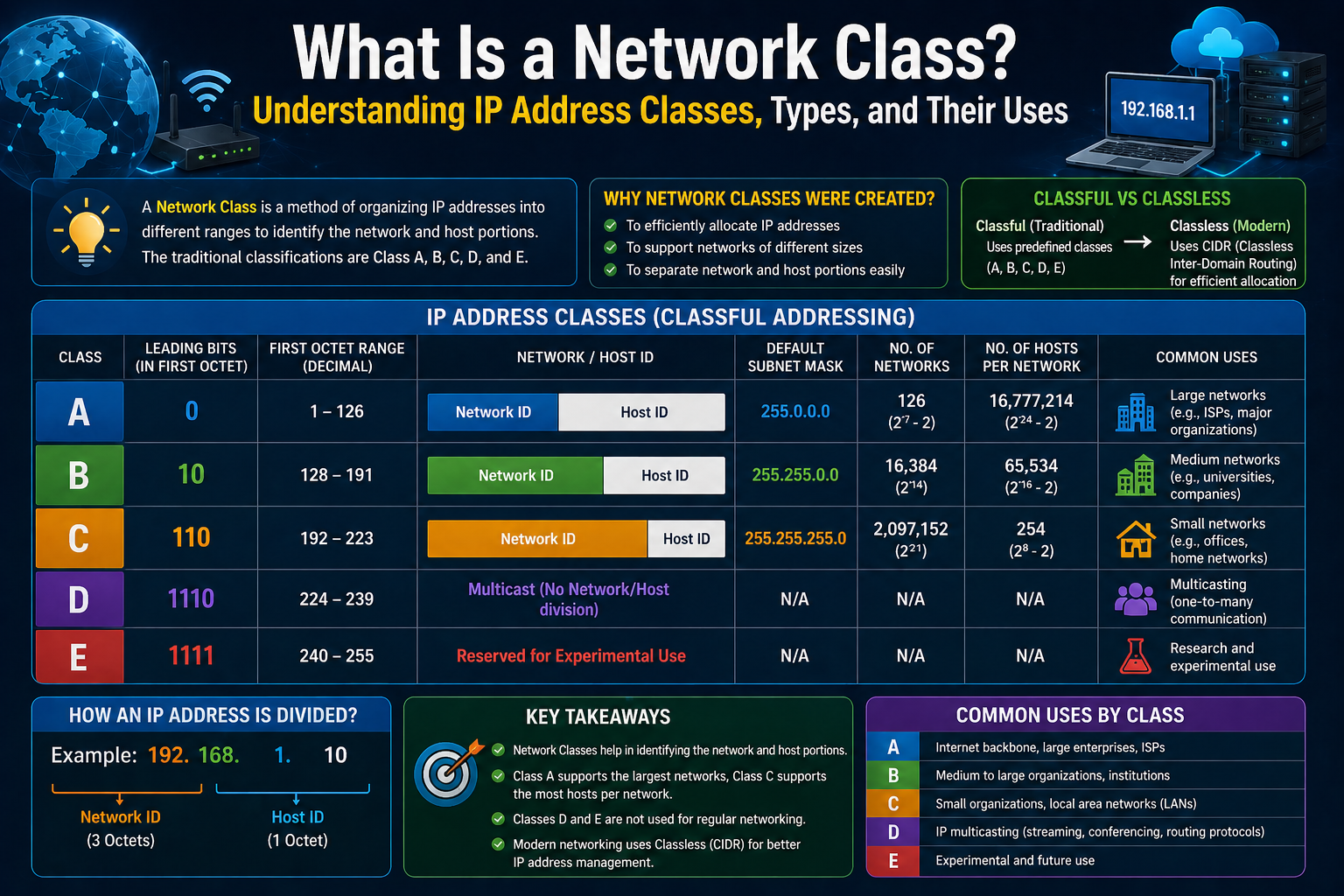
Network classes refer to an early system used in computer networking to organize and divide IP addresses into predefined groups based on network size and requirements. This classification system was introduced to simplify how IP addresses were allocated and managed across different organizations and environments. Instead of assigning IP addresses randomly, network classes created a structured approach that ensured order, scalability, and easier management of network resources. These classes primarily include Class A, Class B, and Class C, each designed to support networks of different sizes. In addition, Class D and Class E exist for specialized purposes, but they are not used for standard device addressing.
The core idea behind network classes is to divide an IP address into two main parts: the network portion and the host portion. The network portion identifies the specific network a device belongs to, while the host portion identifies individual devices within that network. This separation allows routers and networking devices to efficiently determine where data should be sent. Although this system is no longer the primary method used in modern networking, it played a foundational role in shaping how IP addressing works today.
Understanding IP Addressing in Network Classes
To fully understand network classes, it is necessary to understand how IP addressing works. An IPv4 address is a 32-bit numerical label assigned to devices connected to a network. It is usually written in a human-readable format using four decimal numbers separated by dots, such as 192.168.10.5. However, behind the scenes, computers interpret this address in binary form, which consists of 32 bits made up of zeros and ones.
Each IPv4 address is divided into four sections known as octets. Each octet contains 8 bits, and together they form the full 32-bit address. For example, the address 192.168.10.5 in binary form is represented as a long string of 1s and 0s. This binary structure is what allows computers to process and route network traffic efficiently.
The concept of network classes is directly tied to how these bits are divided between the network portion and the host portion. Depending on the class of the IP address, a different number of bits are reserved for identifying the network and the remaining bits are used for identifying devices within that network.
The Structure of Network Classes
Network classes are divided into specific categories based on the range of IP addresses they cover and the size of networks they support. Each class has a fixed structure that determines how many networks and hosts it can accommodate.
Class A networks are designed for extremely large organizations. They use a structure where the first portion of the IP address identifies the network, while the remaining three portions are used for host addresses. This allows a very large number of devices to exist within a single network. Because of this structure, Class A networks are capable of supporting millions of hosts.
Class B networks are intended for medium-sized organizations. They divide the IP address more evenly between network and host portions. This means they can support a moderate number of networks, each with a substantial number of devices. Class B provides a balance between scalability and manageability.
Class C networks are used for smaller organizations or local networks. In this structure, most of the IP address is reserved for the network portion, leaving fewer bits for host addresses. As a result, Class C networks support a smaller number of devices but allow for a greater number of individual networks.
Beyond these, Class D is reserved for multicast communication, which is used when data needs to be sent to multiple devices simultaneously. Class E is reserved for experimental and research purposes and is not used in regular networking environments.
How Network and Host Portions Are Defined
One of the most important concepts in network classes is the division between the network portion and the host portion of an IP address. This division determines how data is routed across networks.
In a Class A network, only the first segment of the IP address is used to identify the network, while the remaining segments are used for hosts. This means a single Class A network can support a very large number of devices.
In a Class B network, the first two segments are used for the network portion, while the remaining two segments are used for hosts. This creates a balanced structure suitable for medium-sized networks.
In a Class C network, the first three segments represent the network portion, leaving only the last segment for hosts. This limits the number of devices that can be connected but allows for a large number of separate networks.
This structure was initially defined using fixed rules, meaning that each class had a strict boundary between network and host portions. This rigidity was useful in early networking but later became a limitation as networks grew more complex.
Role of Subnet Masks in Network Classes
Subnet masks play a critical role in defining how IP addresses are interpreted within network classes. A subnet mask is a numerical value that helps separate the network portion of an IP address from the host portion.
For example, in a Class C network, a common subnet mask is 255.255.255.0. This indicates that the first three octets represent the network, while the last octet represents hosts. This makes it easy for devices to determine whether another device is on the same network or a different one.
Subnet masks work by applying a binary comparison between the IP address and the mask itself. Wherever the subnet mask has a value of 1 in binary, that portion of the IP address is considered part of the network. Wherever it has a value of 0, it is considered part of the host section.
This system allows routers and switches to efficiently determine how to forward data packets to their correct destinations. Without subnet masks, it would be extremely difficult to organize and manage large networks.
Importance of Network Classes in Early Networking
Network classes were extremely important in the early development of computer networking. At a time when the internet was still growing, this system provided a simple and structured way to allocate IP addresses. It ensured that large organizations could obtain enough addresses for their needs while also allowing smaller organizations to use fewer resources.
The classification system also helped reduce confusion by creating predictable rules for IP address assignment. Network engineers could easily determine the size and structure of a network simply by looking at its IP address.
This system worked well when the number of devices connected to networks was relatively small. However, as the internet expanded and more devices came online, the limitations of this rigid structure became more apparent.
Limitations of Fixed Network Classes
Although network classes provided an organized structure, they also introduced inefficiencies. One of the biggest issues was the lack of flexibility in IP address allocation.
For example, if an organization needed slightly more addresses than a Class C network could provide, it would have to move to a Class B network, which offered far more addresses than necessary. This resulted in wasted IP addresses and inefficient use of available resources.
Another limitation was the fixed boundary between network and host portions. Since these boundaries were predefined, network administrators had little control over how addresses were distributed within a network. This made it difficult to design networks that matched real-world requirements precisely.
As the number of devices connected to the internet grew rapidly, these limitations became increasingly problematic. A more flexible system was needed to ensure efficient use of IP addresses.
Transition Toward More Flexible Addressing
As networking technology evolved, a more advanced system was introduced to overcome the limitations of class-based addressing. This new approach allowed for more flexible division of IP addresses, enabling network administrators to allocate addresses based on actual needs rather than fixed categories.
This transition marked a major improvement in network design, allowing for better scalability and more efficient use of IP resources. It also reduced the problem of address wastage that was common in the earlier system.
Modern networking now relies on more advanced techniques that build upon the foundational concepts introduced by network classes. These newer methods allow for dynamic allocation and more precise control over network structures.
Foundational Concepts
Network classes represent an important stage in the evolution of computer networking. They provided the first structured method for organizing IP addresses and helped establish the basic principles of network segmentation. Although they are no longer the primary method used in modern systems, their concepts remain essential for understanding how IP addressing and network design developed over time.
The division of IP addresses into network and host portions, along with the use of subnet masks, laid the groundwork for more advanced networking techniques. Even today, understanding network classes is valuable for building a strong foundation in networking concepts and for interpreting older network systems that still rely on class-based structures.
Subnetting and Its Relationship with Network Classes
Subnetting is a method used to divide a larger network into smaller, more manageable sections. It builds directly on the foundation of network classes by taking the original concept of network and host separation and making it more flexible. While traditional network classes used fixed boundaries to define how IP addresses were divided, subnetting allows those boundaries to be adjusted based on actual network requirements. This makes it possible to use IP addresses more efficiently and design networks that better match real-world needs.
In the early class-based system, each network class had a fixed subnet mask. For example, a Class A network used a default subnet mask that reserved the first portion of the address for the network, while the remaining portion was reserved for hosts. However, this approach often led to wasted IP addresses because organizations either received too many or too few addresses for their actual needs. Subnetting solves this problem by allowing network administrators to break down networks into smaller segments, ensuring that IP addresses are used more efficiently.
Subnetting works by borrowing bits from the host portion of an IP address and using them to create additional sub-networks. Each subnet functions as its own smaller network within a larger one. This approach improves organization, reduces network congestion, and enhances security by isolating different sections of a network from one another.
Variable Length Subnet Masking and Flexibility
One of the most important advancements in modern networking is Variable Length Subnet Masking, which allows subnet masks to be adjusted dynamically. Unlike the fixed subnet masks used in traditional network classes, variable subnet masking enables administrators to define exactly how many bits are used for the network and how many are used for hosts.
This flexibility means that networks can be designed with much greater precision. Instead of being restricted to predefined sizes, network administrators can create subnets that closely match the number of devices they need to support. This reduces waste and improves overall efficiency in IP address usage.
Variable Length Subnet Masking also allows multiple subnets of different sizes to exist within the same larger network. This is particularly useful in large organizations where different departments may have different networking requirements. For example, one department may need a large number of IP addresses, while another may require only a small number. With flexible subnetting, both needs can be met within a single network structure.
Introduction to CIDR and Modern Addressing
Classless Inter-Domain Routing, often referred to as CIDR, is a modern system that replaced the rigid structure of network classes. It was introduced to solve the inefficiencies caused by fixed class-based addressing. CIDR allows IP addresses to be allocated in a more flexible and scalable manner.
Instead of relying on predefined classes, CIDR uses a notation system that specifies how many bits are used for the network portion of an address. This is represented using a slash notation, such as /24, which indicates that the first 24 bits of the address are used for the network. The remaining bits are used for host addresses.
This system eliminates the strict boundaries that existed in traditional network classes. As a result, IP address allocation becomes far more efficient, reducing waste and improving scalability across the global internet.
CIDR also plays a key role in routing efficiency. By allowing multiple smaller networks to be grouped together into a single routing entry, it reduces the size of routing tables and improves the speed of data transmission across networks.
How Subnetting Improves Network Efficiency
Subnetting improves network efficiency in several important ways. One of the most significant benefits is better utilization of IP addresses. Instead of assigning large blocks of addresses to networks that do not need them, subnetting allows addresses to be distributed more precisely based on actual requirements.
Another important benefit is improved network performance. By dividing a large network into smaller subnets, network traffic can be reduced within each segment. This reduces congestion and ensures that data flows more smoothly across the network.
Subnetting also enhances security by isolating different parts of a network. If one subnet experiences an issue or security breach, it does not necessarily affect other subnets. This isolation helps contain problems and reduces the overall risk to the entire network.
Additionally, subnetting makes network management easier. Administrators can organize devices into logical groups based on function, department, or location. This makes troubleshooting and maintenance more efficient and structured.
Practical Example of Subnetting in Action
To better understand how subnetting works, consider a network that uses a single large IP range. Without subnetting, all devices would exist within one large network. This could lead to congestion, difficulty in management, and increased security risks.
By applying subnetting, this large network can be divided into smaller segments. Each segment can represent a different department or function within an organization. For example, one subnet could be used for administrative systems, another for employee devices, and another for guest access.
Each of these subnets operates independently while still being part of the larger network structure. This allows for better control over traffic flow and improved organization of network resources.
The Shift from Classful to Classless Networking
The transition from classful networking to classless networking marked a major evolution in how IP addresses are managed. In classful systems, IP addresses were strictly divided into fixed categories, which limited flexibility and led to inefficient use of resources.
As the internet expanded and the number of connected devices increased, it became clear that a more adaptable system was needed. Classless networking introduced a more dynamic approach, allowing IP addresses to be allocated based on actual demand rather than fixed rules.
This shift significantly improved the scalability of the internet. It allowed service providers and organizations to make better use of available IP address space, ensuring that resources were not wasted.
Classless networking also improved routing efficiency by reducing the complexity of routing tables. Instead of managing large numbers of individual network entries, routers could group multiple networks together, making data transmission faster and more efficient.
Importance of Network Classes in Modern Understanding
Although network classes are no longer actively used in modern IP addressing systems, they remain important for educational and foundational purposes. Understanding network classes helps explain how early networking systems were structured and why more advanced methods were developed.
Network classes also provide a basis for understanding subnetting and CIDR. Many modern networking concepts are built upon the ideas introduced by class-based addressing, such as the division between network and host portions of an IP address.
In networking certifications and training, network classes are often taught to help learners understand the evolution of IP addressing. This historical perspective makes it easier to grasp more complex modern concepts.
Relationship Between Subnetting and CIDR
Subnetting and CIDR are closely related concepts that work together to create a flexible and efficient networking system. Subnetting focuses on dividing networks into smaller segments, while CIDR focuses on how IP address ranges are defined and allocated.
Together, they allow network administrators to design highly customized network structures. CIDR defines the size of the network block, while subnetting determines how that block is further divided internally.
This combination provides maximum flexibility in network design. It allows both large-scale internet service providers and small organizations to manage their networks efficiently without wasting IP address space.
Modern Networking and the Legacy of Network Classes
Even though modern networking no longer relies on strict class-based systems, the influence of network classes is still visible in how IP addressing is taught and understood. The basic idea of dividing an address into network and host portions remains central to all IP-based communication.
Modern systems have simply refined and improved this concept to make it more adaptable to today’s highly connected world. With the rise of cloud computing, mobile devices, and the Internet of Things, flexibility in IP address management has become more important than ever.
Network classes served as the foundation upon which these modern systems were built. Without them, the development of subnetting, CIDR, and advanced routing techniques would not have been possible.
Advanced Concepts
Subnetting and CIDR represent the evolution of network classes into a more flexible and efficient system. While network classes provided the initial structure for organizing IP addresses, they were eventually replaced due to their limitations.
Modern networking relies on dynamic and scalable methods that allow for precise control over IP address allocation. Subnetting enables networks to be divided into smaller segments, while CIDR provides a flexible framework for defining network sizes.
Together, these technologies ensure that global networks can continue to grow and adapt to increasing demand. Understanding these concepts provides a strong foundation for anyone studying networking or working in IT environments, as they explain both the history and the modern structure of IP addressing systems.
Transition from IPv4 Limitations to Modern Networking Needs
As computer networks expanded rapidly across the world, the limitations of the IPv4 addressing system became increasingly clear. IPv4 was built around a 32-bit structure, which provides approximately 4.3 billion unique addresses. At the time of its creation, this number seemed more than sufficient. However, with the rise of the internet, mobile devices, cloud computing, and connected systems, the available address space began to shrink quickly. Network classes, which were originally designed to organize IPv4 addresses, could not solve this growing shortage of addresses or the inefficiencies in allocation.
One of the main issues was that large organizations were often assigned entire blocks of addresses based on classful rules, even if they did not need that many. This led to significant waste of IP address space. Smaller organizations, on the other hand, sometimes struggled to obtain enough addresses to meet their needs. As the number of internet-connected devices grew, this imbalance became unsustainable. It became clear that a more scalable and flexible addressing system was required to support future growth.
This challenge pushed the networking world toward more advanced solutions such as CIDR and subnetting, which replaced rigid class-based structures with adaptable allocation methods. These modern approaches ensured that IP addresses could be distributed more efficiently, extending the lifespan of IPv4 and supporting the continued expansion of global networks.
Emergence and Importance of IPv6
To address the long-term limitations of IPv4, a new version of the Internet Protocol was introduced known as IPv6. Unlike IPv4, which uses a 32-bit address structure, IPv6 uses a 128-bit structure. This dramatically increases the number of possible IP addresses, allowing for an almost limitless supply of unique identifiers.
IPv6 was designed not only to solve the problem of address exhaustion but also to improve overall network efficiency and functionality. It eliminates many of the inefficiencies that were present in IPv4, including the need for complex workarounds like NAT in many environments. With IPv6, every device can potentially have its own globally unique address.
The structure of IPv6 addresses is also more flexible and efficient for modern networking requirements. Instead of relying on class-based divisions, IPv6 uses a hierarchical addressing system that supports better routing and network organization. This design makes it more suitable for large-scale global networks and emerging technologies.
Although IPv6 adoption has been gradual, it is increasingly becoming the standard for modern networking environments. As more devices come online, especially with the growth of the Internet of Things, IPv6 is expected to play a central role in future network infrastructure.
Role of Routing in Network Class Evolution
Routing is the process of moving data between different networks, and it is closely tied to how IP addresses are structured. In the era of network classes, routing was relatively straightforward because addresses were divided into fixed categories. Routers could easily determine the network portion of an address and forward data accordingly.
However, as networks grew larger and more complex, the limitations of class-based routing became apparent. The rigid structure of network classes led to inefficiencies in routing tables and made it difficult to manage large-scale networks. This is one of the reasons why classless systems like CIDR were introduced.
CIDR allowed multiple networks to be grouped together, reducing the size of routing tables and improving overall routing efficiency. Instead of treating each network class separately, routers could now handle address blocks more flexibly. This improved the speed and scalability of the internet as a whole.
Modern routing systems are built on these classless principles, allowing for dynamic and efficient data transfer across complex global networks. The evolution of routing directly reflects the shift away from strict network classes toward more adaptive systems.
Network Design and Organizational Structure
Network classes originally influenced how organizations designed their internal networks. Large organizations were typically assigned Class A or Class B networks, while smaller organizations used Class C networks. This structure provided a simple way to organize devices, but it was not always practical for real-world use.
In many cases, organizations found themselves with more IP addresses than they needed, or not enough to support growth. This led to inefficient network designs and unnecessary complexity in managing unused addresses. As a result, network administrators had to find ways to optimize their allocated address space.
With the introduction of subnetting and CIDR, network design became much more flexible. Organizations could now divide their networks into smaller segments based on actual needs rather than fixed class boundaries. This allowed for better resource management, improved performance, and easier troubleshooting.
Modern network design focuses on efficiency, scalability, and security. Instead of relying on predefined classes, networks are now built using flexible addressing schemes that adapt to organizational requirements. This shift has made it easier to design networks that can grow and evolve over time.
Security Implications of Network Structuring
Network structure plays an important role in security. In traditional class-based networking, large networks often contained many devices within a single address space. This made it more difficult to isolate security threats or control traffic flow effectively.
Subnetting introduced a major improvement in this area by allowing networks to be divided into smaller segments. Each subnet can be treated as a separate security zone, limiting the spread of potential threats. If one subnet is compromised, it does not necessarily affect the entire network.
This segmentation also allows for more granular control over access permissions. Network administrators can define rules for each subnet, controlling which devices can communicate with one another. This improves overall network security and reduces the risk of unauthorized access.
In modern network environments, security is closely integrated with network design. Proper structuring of networks using subnetting and CIDR is considered a fundamental part of building secure systems.
Impact of Network Classes on Modern Networking Education
Even though network classes are no longer actively used in real-world IP addressing, they remain an important part of networking education. Understanding network classes helps learners grasp the historical development of IP addressing and the reasons behind modern networking techniques.
Many networking concepts, such as subnetting, CIDR, and routing, are easier to understand when the foundational idea of network classes is known. They provide a simplified model that helps explain how IP addresses are divided and managed.
In professional certifications and training programs, network classes are often included as a foundational topic. This ensures that learners understand both the limitations of older systems and the advantages of modern approaches. It also helps develop a deeper understanding of how networks operate at a fundamental level.
Real-World Relevance of Classless Networking
In today’s world, nearly all modern networks rely on classless addressing systems. Internet service providers, cloud platforms, and enterprise networks use CIDR-based allocation to manage IP addresses efficiently. This allows them to scale their infrastructure while minimizing waste.
Classless networking also supports the rapid expansion of connected devices. With the growth of mobile technology, smart devices, and cloud services, the need for flexible IP allocation has become critical. CIDR and subnetting provide the tools necessary to manage this complexity effectively.
Modern networks are designed to be dynamic, adaptable, and highly scalable. These characteristics would not be possible without the transition away from rigid network classes.
Evolution of Networking Concepts Over Time
The development of network classes, subnetting, CIDR, and IPv6 reflects the continuous evolution of networking technology. Each stage was introduced to solve specific challenges related to scalability, efficiency, and resource management.
Network classes provided the initial framework for organizing IP addresses. Subnetting introduced flexibility within that framework. CIDR removed the rigid boundaries altogether, and IPv6 expanded the available address space to meet future demands.
This progression shows how networking systems evolve in response to technological growth. Each improvement builds on the concepts that came before it, creating a more efficient and scalable global network infrastructure.
Network Class Evolution
The evolution of network classes into modern classless systems represents a major advancement in computer networking. While network classes were essential in the early development of the internet, they eventually became too rigid to support growing global demands.
Modern networking relies on flexible and scalable systems that allow for efficient use of IP addresses and improved network performance. Subnetting, CIDR, and IPv6 have replaced traditional class-based structures, enabling networks to expand and adapt to new technologies.
Understanding this evolution provides valuable insight into how networks are designed and managed today. It highlights the importance of flexibility, efficiency, and scalability in modern network architecture, and shows how foundational concepts continue to influence advanced networking systems.
Modern Transition to IPv6 and Global Scalability
As digital transformation accelerated worldwide, the limitations of IPv4-based networking and classful addressing became impossible to ignore. The explosive growth of internet-connected devices such as smartphones, cloud systems, IoT devices, and enterprise infrastructure placed enormous pressure on existing IP allocation methods. Network classes, which once provided a structured way to distribute IP addresses, could no longer support the scale and flexibility required by modern networks.
This challenge led to the widespread adoption of IPv6, a next-generation addressing system designed to provide an almost unlimited number of unique IP addresses. Unlike IPv4, IPv6 eliminates the need for network classes entirely and instead uses a hierarchical structure that supports efficient routing and scalable network design. With its 128-bit address space, IPv6 ensures that address exhaustion is no longer a limiting factor for global connectivity.
The transition to IPv6 is not just about increasing address capacity. It also improves network efficiency, simplifies configuration in many environments, and supports advanced networking features. As more organizations adopt IPv6, the reliance on older class-based systems continues to decline, marking a major shift in how modern networks operate.
How Network Classes Influenced Modern Routing Systems
Even though network classes are no longer used in active IP allocation, their influence can still be seen in modern routing principles. Early routing systems relied heavily on class-based boundaries to determine how data should be forwarded between networks. Routers used fixed rules to identify whether an IP address belonged to Class A, B, or C, and then applied corresponding routing decisions.
As networks expanded, this rigid structure became inefficient. Routing tables grew larger and more complex, leading to slower performance and difficulty in managing global traffic. The introduction of classless systems such as CIDR allowed routers to handle IP addresses more flexibly by grouping multiple networks into single routing entries.
This improvement reduced routing overhead and significantly increased the speed of data transmission across large-scale networks. Modern routing protocols now rely on these classless principles, allowing for dynamic and efficient communication between networks around the world.
Network Design in Contemporary Infrastructure
In modern networking environments, design is no longer restricted by fixed address classes. Instead, network architects focus on scalability, efficiency, and security when designing systems. This shift has allowed organizations to build highly optimized infrastructures that can adapt to changing requirements.
Subnetting plays a key role in this process by allowing networks to be divided into logical segments. These segments can represent departments, services, or functional areas within an organization. By structuring networks in this way, administrators gain better control over traffic flow and resource allocation.
CIDR further enhances this flexibility by enabling precise control over IP address ranges. Instead of being limited to predefined blocks, network designers can allocate address space according to actual demand. This reduces waste and improves overall efficiency in large-scale environments such as data centers and cloud platforms.
Modern network design also emphasizes redundancy and resilience. By using structured addressing and segmentation, networks can continue functioning even if part of the system fails. This level of reliability was difficult to achieve under traditional class-based systems.
Security Advancements Through Network Structuring
Security is one of the most important aspects of modern networking, and network structure plays a significant role in maintaining it. In class-based systems, large networks often lacked proper segmentation, making it easier for issues or threats to spread across the entire system.
With subnetting and classless addressing, networks can now be divided into isolated segments, each with its own security policies and controls. This separation limits the impact of potential security breaches and allows administrators to apply targeted protections to specific parts of a network.
Firewalls, access control lists, and monitoring systems are often implemented at the subnet level, providing granular control over network traffic. This structured approach improves detection, containment, and response to security threats.
In addition, modern networks often use layered security models where multiple subnets work together with different levels of trust and access. This design would not be possible without the flexibility introduced by classless networking systems.
The Role of Network Classes in Education and Foundation Knowledge
Although network classes are no longer used in practical IP allocation, they remain an important part of networking education. They provide a simplified model for understanding how IP addresses are structured and how networks communicate.
Learning about network classes helps explain why modern systems like CIDR and subnetting were developed. It also provides historical context for how networking has evolved over time. Many networking certifications still include network classes as foundational knowledge because they help build a strong conceptual base.
Understanding network classes makes it easier to grasp more advanced topics such as subnetting calculations, routing behavior, and IP address planning. Even in modern environments, professionals may encounter legacy systems or documentation that still reference class-based addressing.
Real-World Application of Modern Addressing Systems
Today, most real-world networks operate entirely on classless addressing systems. Internet service providers, cloud platforms, and large enterprises rely on CIDR-based allocation to efficiently manage IP address space. This allows them to scale their infrastructure without wasting resources.
Modern applications such as video streaming, online gaming, cloud computing, and IoT systems require highly efficient and flexible networking structures. Classless addressing supports these demands by allowing precise control over how IP addresses are assigned and routed.
The ability to dynamically allocate and manage IP addresses is essential for supporting global connectivity. Without these advancements, modern digital infrastructure would not be able to function at its current scale.
Overall Evolution of Network Classes into Modern Networking
The journey from network classes to modern IP addressing systems reflects the continuous evolution of networking technology. Each stage was developed to solve specific challenges and improve upon the limitations of previous systems.
Network classes introduced the first structured approach to IP address organization. Subnetting added flexibility within that structure. CIDR removed rigid boundaries and introduced dynamic allocation. IPv6 expanded the address space to meet future demands. Together, these developments form the foundation of modern networking.
This evolution demonstrates how technology adapts over time to meet increasing demands for scalability, efficiency, and performance. While network classes are no longer used in active systems, their influence remains embedded in the fundamental principles of networking.
Final Conclusion
Network classes represent an important milestone in the history of computer networking. They provided an early method for organizing IP addresses and helped establish the foundational structure of network communication. Although they were eventually replaced due to their limitations, they played a critical role in shaping modern networking concepts.
The transition from classful addressing to classless systems such as CIDR and subnetting marked a major improvement in efficiency, flexibility, and scalability. These advancements allowed networks to grow beyond the constraints of fixed address boundaries and support the massive global expansion of internet-connected devices.
Today, IPv6 continues this evolution by providing a virtually unlimited address space and eliminating the need for class-based structures entirely. Modern networking is built on the principles that emerged from network classes but refined through decades of innovation.
Understanding network classes is still valuable because it provides insight into how networking systems developed and why modern techniques exist. It serves as the foundation upon which all advanced IP addressing and network design concepts are built.