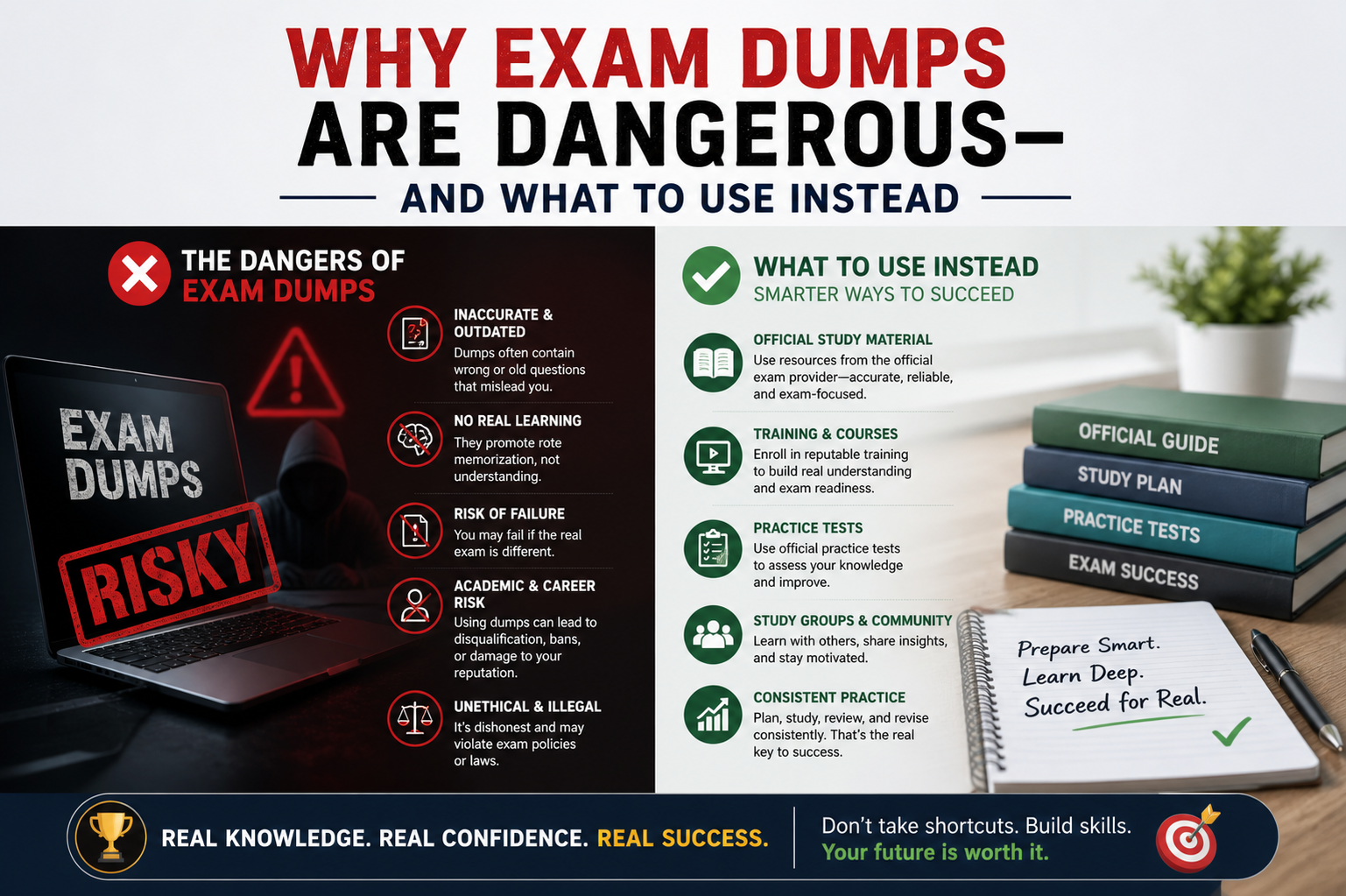
Many learners are drawn to exam dumps because of pressure, limited preparation time, or fear of failure. In competitive academic and professional environments, there is often an expectation to pass exams quickly and efficiently. This creates a situation where individuals look for shortcuts that promise fast results with minimal effort. Exam dumps appear attractive because they provide a sense of certainty—if the questions are known in advance, success seems more achievable.
Another reason people rely on these materials is a misunderstanding of how learning works. Some believe that repeated exposure to questions is enough to guarantee success, even if the underlying concepts are not fully understood. Others may have struggled with traditional study methods and turn to exam dumps out of frustration. However, this approach often ignores the deeper purpose of education and certification, which is to develop real competence rather than just pass an assessment.
The Illusion of Easy Success
Exam dumps create a powerful illusion of readiness. When learners repeatedly practice the same set of questions, they begin to recognize patterns and answers without truly understanding the subject matter. This recognition is often mistaken for mastery, but it is actually just memorization. As a result, learners may feel confident before an exam, only to discover gaps in their knowledge when faced with unfamiliar questions.
This false confidence can be particularly damaging. It discourages deeper study and reduces motivation to truly engage with the material. Once a learner believes they are prepared, they are less likely to continue studying or improving. Unfortunately, real exams are rarely identical to practice dumps, and even small variations can expose weak understanding.
Academic and Ethical Consequences
Using exam dumps can lead to serious academic and professional consequences. Many institutions and certification bodies consider them a violation of exam integrity policies. If a candidate is found using or relying on such materials, their results may be invalidated, and they may be disqualified from future attempts. In some cases, this can also result in permanent bans from certification programs.
Beyond formal penalties, there is also an ethical dimension. Exams are designed to measure individual knowledge and capability. Using unauthorized materials undermines this purpose and creates an unfair advantage over others who prepare honestly. Over time, this can damage trust in qualifications and reduce the value of certifications in general.
Ethical concerns also extend into professional life. If someone passes exams without genuine understanding, it may become apparent when they are required to apply their knowledge in real situations. This can harm reputation and credibility in the workplace.
Impact on Real-World Skills
One of the most significant problems with exam dumps is the lack of real skill development. Memorizing answers does not teach problem-solving, critical thinking, or practical application. In many fields, especially technical or professional domains, success depends on the ability to apply knowledge in unpredictable situations.
When learners rely on dumps, they often struggle when faced with tasks that require adaptation or analysis. Unlike memorized questions, real-world problems are rarely identical to study materials. This gap between theory and practice can lead to poor performance in job roles, internships, or advanced studies.
Over time, this weak foundation can limit career growth. Employers value individuals who can think independently and solve problems, not just those who can recall answers.
Psychological Effects of Shortcut Learning
Relying on exam dumps can also affect a learner’s mindset. Instead of developing confidence through understanding, confidence becomes tied to memorization of specific answers. This creates dependency on external materials rather than internal knowledge.
There can also be increased anxiety. Learners may worry about encountering unfamiliar questions, knowing they have not truly studied the subject. This fear can make exam situations more stressful and reduce performance even further.
In some cases, repeated reliance on shortcuts can reduce motivation to learn altogether. If success is always tied to memorization, learners may lose interest in deeper understanding, which limits personal and professional development.
Why Employers and Institutions Value Real Knowledge
Educational institutions and employers prioritize genuine understanding because it reflects true capability. Certifications and exams are designed to ensure that individuals meet a certain standard of knowledge and skill. When someone earns a qualification honestly, it signals that they can apply concepts in real situations, not just recall information.
In the workplace, this distinction becomes extremely important. Employers need individuals who can analyze problems, make decisions, and adapt to changing conditions. Someone who has only memorized answers may struggle when tasks do not match expected patterns. This is why real knowledge is always more valuable than shortcut-based learning.
Additionally, industries evolve over time. Skills that are relevant today may change in the future, and those who understand core concepts are better equipped to adapt.
Better Alternatives to Exam Dumps
Instead of relying on exam dumps, learners can use structured and ethical study methods that promote true understanding. Official study materials, textbooks, and guided courses are designed to cover the full scope of exam topics. These resources ensure that learners are exposed to both theoretical and practical aspects of the subject.
Practice exams provided by legitimate sources are also useful. They are designed to simulate real test conditions without violating ethical standards. These tools help learners become familiar with question formats while still requiring actual understanding.
Consistent revision and self-assessment are also important. Reviewing material regularly helps reinforce knowledge and identify weak areas that need improvement.
Active Learning Strategies
Active learning is one of the most effective alternatives to exam dumps. Instead of passively reading or memorizing, learners engage directly with the material. This can include summarizing concepts in their own words, teaching topics to others, or solving real-world problems related to the subject.
Engagement improves retention and understanding. When learners actively process information, they are more likely to remember it long term. This also helps them develop the ability to apply knowledge in different contexts, which is essential for both exams and professional work.
Another effective method is breaking complex topics into smaller parts and mastering each section individually before moving forward. This reduces overwhelm and improves comprehension.
Practice Testing the Right Way
Practice testing is valuable when done correctly. Instead of using leaked or unauthorized questions, learners should use verified practice exams or create their own questions based on study material. This encourages deeper thinking and helps identify areas that need further review.
Testing oneself under timed conditions can also improve exam performance. It helps build time management skills and reduces stress during actual exams. However, the goal should always be understanding, not memorizing patterns.
Reviewing mistakes after practice tests is equally important. It allows learners to understand why an answer was incorrect and how to approach similar problems in the future.
Building Long-Term Retention
Long-term retention is essential for meaningful learning. Techniques such as spaced repetition, where information is reviewed at increasing intervals, help strengthen memory over time. This method is far more effective than last-minute cramming or memorization from exam dumps.
Connecting new information with existing knowledge also improves retention. When learners relate concepts to real-life examples or previously learned material, they create stronger mental connections.
Consistency is key. Short, regular study sessions are often more effective than long, infrequent ones. This helps keep information fresh and reduces cognitive overload.
Developing Exam Readiness Without Shortcuts
True exam readiness comes from understanding, practice, and confidence built through effort. Learners should focus on mastering core concepts rather than memorizing answers. This includes understanding why solutions work, not just what the correct answers are.
Simulating exam conditions can also help. Practicing in a quiet environment with time limits prepares the mind for real test scenarios. This reduces anxiety and improves focus during the actual exam.
It is also important to track progress over time. Identifying strengths and weaknesses allows learners to adjust their study strategies effectively.
How to Structure a Strong Study Plan
A strong study plan includes clear goals, realistic timelines, and consistent review. Breaking subjects into manageable sections helps prevent overload and makes studying more efficient. Each session should focus on understanding rather than memorization.
Regular revision should be built into the plan to reinforce learning. It is also helpful to mix different types of study methods, such as reading, practicing, and discussing topics.
Flexibility is important as well. A good study plan allows adjustments based on progress and difficulty level. This ensures continuous improvement without unnecessary pressure.
Sustainable Learning
Sustainable learning is built on understanding, effort, and consistency. While exam dumps may appear to offer a shortcut, they ultimately weaken knowledge and limit long-term success. Real learning takes more time, but it leads to stronger skills, better confidence, and lasting results.
Choosing proper study methods not only improves exam performance but also prepares learners for real-world challenges. In the end, the goal is not just to pass an exam, but to gain knowledge that remains valuable throughout life.
Long-Term Consequences of Relying on Exam Dumps
Over time, dependence on exam dumps can significantly limit both academic growth and professional development. While it may initially help someone pass an exam, the lack of genuine understanding eventually becomes a serious obstacle. As subjects become more advanced, they build upon foundational knowledge. If that foundation is weak, learners often struggle to keep up with new concepts, leading to confusion and frustration.
In professional environments, this gap becomes even more visible. Tasks are rarely identical to exam questions, and employees are expected to adapt their knowledge to real situations. When someone has relied heavily on memorized answers rather than true comprehension, they may find it difficult to perform effectively. This can slow down career progress and reduce opportunities for advancement.
Another long-term consequence is the loss of self-confidence in one’s abilities. When success is achieved through shortcuts rather than effort, individuals may begin to doubt their skills in real-world scenarios. This can create a cycle of dependency, where learners continue seeking external help instead of trusting their own understanding.
Why Real Understanding Always Outperforms Memorization
Real understanding provides flexibility, while memorization is rigid. When a learner understands a concept deeply, they can apply it in different contexts, even when the question is unfamiliar or slightly modified. This adaptability is essential in both exams and real-life problem-solving.
Memorization, on the other hand, is limited. It works only when conditions remain exactly the same as what was studied. If a question is rephrased or presented in a different format, memorized answers often become useless. This is why learners who depend on exam dumps frequently struggle with application-based questions.
Understanding also improves retention. When information is learned conceptually, it is stored in long-term memory more effectively. This means less effort is required for revision, and knowledge remains accessible even after long periods.
The Role of Discipline in Effective Learning
Discipline is one of the most important factors in successful learning. Unlike shortcuts, disciplined study requires consistency, patience, and effort. It involves setting aside regular time for study, avoiding distractions, and committing to gradual improvement.
Many learners underestimate the value of discipline because it does not provide instant results. However, it builds strong foundations that support long-term success. Even when progress feels slow, disciplined learning ensures steady improvement and deeper understanding over time.
Without discipline, learners are more likely to rely on shortcuts such as exam dumps. These shortcuts may seem convenient, but they do not contribute to meaningful growth. In contrast, disciplined study creates lasting knowledge and stronger problem-solving abilities.
Building Confidence Through Genuine Preparation
True confidence comes from preparation, not prediction. When learners study properly, they develop a clear understanding of the subject and feel more secure in their ability to handle different types of questions. This confidence is stable because it is based on real knowledge.
In contrast, confidence built on exam dumps is fragile. It depends on recognizing familiar questions rather than understanding the subject. When unfamiliar problems appear, this confidence quickly disappears, often leading to panic or hesitation during exams.
Genuine preparation also reduces stress. When learners know they have studied thoroughly, they are less likely to worry about unexpected questions. This creates a calmer and more focused mindset during exams, which improves overall performance.
How Exam Dumps Affect Learning Integrity
Learning integrity refers to the honesty and authenticity of the learning process. When exam dumps are used, this integrity is compromised because the focus shifts from understanding to shortcut-based success. This not only affects individual growth but also impacts the value of certifications and qualifications in general.
If many learners rely on unauthorized materials, it becomes difficult to measure true competence. This reduces trust in certification systems and can make qualifications less meaningful over time. Employers and institutions may then find it harder to rely on exam results as a measure of ability.
Maintaining learning integrity ensures that achievements are meaningful and reflect real skill. It also promotes fairness, as all learners are evaluated based on the same standards of understanding.
Developing Critical Thinking Skills
One of the biggest disadvantages of exam dumps is that they do not encourage critical thinking. Critical thinking involves analyzing information, evaluating different possibilities, and making informed decisions. These skills are essential in both academic and professional environments.
When learners rely on memorized answers, they miss the opportunity to develop these abilities. They may become good at recalling information but struggle when asked to explain reasoning or solve complex problems.
On the other hand, proper study methods encourage questioning, analysis, and exploration of concepts. This helps learners become more independent thinkers who can handle unfamiliar challenges with confidence.
The Importance of Real Practice in Skill Development
Real practice is essential for developing competence in any subject. Unlike exam dumps, which provide pre-remembered answers, real practice involves solving new problems and applying knowledge in different situations.
This type of practice helps learners understand how concepts work in real scenarios. It also improves problem-solving speed and accuracy over time. Mistakes made during practice are valuable because they highlight areas that need improvement.
Through repeated real practice, learners build both skill and confidence. This combination is far more effective than memorization alone, especially in fields that require practical application.
Avoiding the Trap of Short-Term Thinking
Exam dumps often encourage short-term thinking, where the main goal is simply to pass an exam rather than understand the subject. While this may seem effective in the moment, it does not support long-term success.
Short-term thinking focuses on immediate results, often at the expense of future growth. Learners may pass one exam but struggle in later stages that require deeper knowledge. This creates a cycle of repeated difficulty and dependency on shortcuts.
Long-term thinking, on the other hand, focuses on building strong foundations that support continuous growth. It requires patience and effort but leads to much better outcomes in the long run.
Creating a Healthy Study Mindset
A healthy study mindset focuses on learning rather than just passing exams. It values understanding, improvement, and consistency. With this mindset, mistakes are seen as opportunities to grow rather than failures.
Learners with a healthy mindset are more likely to use proper study materials and engage deeply with the subject. They understand that real success comes from effort and persistence, not shortcuts.
This mindset also helps reduce stress. Instead of worrying about memorizing specific answers, learners focus on building overall knowledge and confidence.
Effective Ways to Replace Exam Dumps
Replacing exam dumps requires a shift in approach. Instead of relying on leaked or memorized content, learners should focus on structured learning methods. These include studying official resources, practicing real-world problems, and engaging with interactive learning tools.
Group discussions can also be helpful. Explaining concepts to others strengthens understanding and reveals gaps in knowledge. Similarly, asking questions and seeking clarification improves clarity and retention.
Another effective method is self-testing using original study material. This ensures that learning is based on understanding rather than repetition of memorized answers.
Building Consistency in Preparation
Consistency is one of the most important factors in successful learning. Studying regularly, even for short periods, is more effective than irregular long sessions. Consistency helps reinforce knowledge and prevents forgetting.
A consistent approach also makes learning less overwhelming. Instead of trying to absorb large amounts of information at once, learners can gradually build understanding over time.
This steady progress leads to better retention, improved confidence, and stronger performance in exams.
Meaningful Learning
Meaningful learning is about more than just passing exams. It is about developing skills, understanding concepts, and preparing for real-world challenges. While exam dumps may offer temporary success, they do not support true growth.
Choosing proper learning methods ensures that knowledge is long-lasting and useful beyond the exam itself. It builds confidence, improves thinking ability, and creates opportunities for future success.
In the end, the effort invested in real learning always delivers greater value than any shortcut ever could.
The Pressure That Pushes Learners Toward Shortcuts
In many learning environments, pressure plays a major role in why students and professionals turn to exam dumps. Tight deadlines, high expectations, and limited preparation time can create a sense of urgency that makes shortcuts seem appealing. When success feels like an immediate requirement rather than a gradual process, learners may prioritize passing over understanding.
This pressure is often amplified by competition. When peers appear to be progressing quickly or achieving certifications faster, others may feel forced to keep up. In such situations, exam dumps can look like a convenient solution. However, this approach ignores the fact that real understanding takes time and cannot be rushed without consequences.
Over time, relying on shortcuts due to pressure can create a cycle of dependency. Instead of building confidence through preparation, learners begin to rely on external sources to compensate for gaps in knowledge.
How Exam Dumps Distort the Learning Process
The learning process is designed to build knowledge step by step, starting from basic concepts and gradually progressing toward more complex ideas. Exam dumps disrupt this natural progression by skipping the learning phase entirely and focusing only on final answers.
This distortion prevents learners from understanding how answers are formed. Instead of learning the reasoning behind a solution, they only see the outcome. This weakens their ability to solve similar problems in different formats.
When the learning process is bypassed, knowledge becomes fragmented. Learners may remember isolated answers but lack the ability to connect concepts. This makes it difficult to handle comprehensive or application-based questions.
The Importance of Conceptual Clarity
Conceptual clarity is the foundation of strong academic and professional performance. It means understanding not just what the answer is, but why it is correct. Without this clarity, knowledge remains shallow and limited.
Exam dumps fail to provide conceptual clarity because they focus on repetition rather than explanation. As a result, learners may memorize answers without understanding the principles behind them. This creates gaps in knowledge that become more visible as topics become more advanced.
When learners focus on concepts, they develop the ability to analyze problems from different perspectives. This skill is essential in real-world environments where situations are rarely straightforward.
Why Shortcuts Fail in Advanced Learning Stages
Shortcuts like exam dumps may appear useful in early stages of learning, but they become ineffective as subjects grow more complex. Advanced topics require deeper understanding, logical reasoning, and the ability to apply knowledge in unfamiliar situations.
At this level, memorization is no longer sufficient. Learners must connect multiple concepts and use them together to solve problems. Those who have relied on shortcuts often struggle because they have not built the necessary foundation.
This gap becomes even more noticeable in professional certifications or higher education, where exams are designed to test application rather than recall.
The Role of Practice in True Mastery
True mastery comes from consistent and meaningful practice. This involves solving problems, making mistakes, and learning from them. Unlike exam dumps, which provide ready-made answers, real practice requires active engagement.
Through practice, learners develop problem-solving speed and accuracy. They also become more comfortable handling unfamiliar questions. Each mistake becomes a learning opportunity that strengthens understanding.
Over time, repeated practice builds confidence that is based on ability rather than memory. This type of confidence is stable and reliable, especially in high-pressure situations.
Developing Independent Thinking Skills
Independent thinking is the ability to analyze and solve problems without relying on external assistance. It is one of the most valuable skills in both education and the workplace.
Exam dumps discourage independent thinking because they encourage dependency on pre-made answers. Instead of analyzing problems, learners simply look for matching solutions. This weakens their ability to think critically.
Proper study methods, on the other hand, encourage learners to explore different approaches, ask questions, and evaluate solutions. This builds intellectual independence, which is essential for long-term success.
The Hidden Cost of Relying on Memorization
While memorization may help in the short term, it comes with hidden costs. One of the biggest costs is the lack of adaptability. When questions change slightly, memorized answers may no longer be useful.
Another cost is time. Although exam dumps may reduce study time initially, they often lead to repeated failures or reattempts, which ultimately require more time to fix gaps in knowledge.
There is also the cost of missed learning opportunities. Time spent memorizing answers could have been used to build real understanding and develop valuable skills.
How Proper Study Methods Build Long-Term Success
Proper study methods focus on understanding, application, and consistency. They include reading, practicing, reviewing, and testing knowledge in meaningful ways.
These methods help learners build strong foundations that support future learning. Once concepts are clearly understood, new topics become easier to grasp because they connect to existing knowledge.
Long-term success is built on this continuous growth. Instead of repeatedly relearning material, learners are able to expand their knowledge efficiently.
The Role of Feedback in Learning Improvement
Feedback is a critical part of effective learning. It helps learners identify mistakes, understand weaknesses, and improve performance. Without feedback, it is difficult to know whether understanding is correct or incomplete.
Exam dumps do not provide meaningful feedback because they focus on answers rather than explanations. As a result, learners may repeat the same mistakes without realizing it.
In contrast, proper study methods encourage review and correction. This allows learners to refine their understanding and strengthen weak areas over time.
Building Resilience Through Real Preparation
Resilience is the ability to handle challenges and recover from setbacks. In the context of learning, it means staying committed even when topics are difficult or progress is slow.
Real preparation builds resilience because it involves facing challenges directly. Learners must work through difficult problems, make mistakes, and continue improving.
This experience prepares them not only for exams but also for real-life situations where problem-solving under pressure is required.
The Difference Between Passing and Understanding
Passing an exam is a short-term achievement, while understanding a subject is a long-term asset. Exam dumps focus on the first, while proper learning focuses on the second.
A learner who passes through memorization may achieve certification, but may not be able to apply the knowledge effectively. On the other hand, a learner who understands the subject can use that knowledge in various situations beyond the exam.
This difference becomes especially important in professional environments where practical application is required.
Building Motivation Through Real Progress
Motivation is stronger when it is based on real progress rather than shortcuts. When learners see themselves improving through effort, they become more committed to the process.
Each successfully solved problem, each understood concept, and each improved test score builds confidence. This creates a positive cycle where motivation and learning reinforce each other.
Exam dumps, however, often create artificial progress. Since answers are already known, there is little sense of achievement, which can reduce long-term motivation.
Developing a Growth-Oriented Approach
A growth-oriented approach focuses on continuous improvement rather than immediate results. It emphasizes learning from mistakes, building skills, and expanding knowledge over time.
This mindset helps learners view challenges as opportunities rather than obstacles. Instead of avoiding difficult topics, they engage with them to improve understanding.
Over time, this approach leads to stronger performance, better adaptability, and greater long-term success.
Moving Beyond Shortcuts Toward Real Achievement
Real achievement comes from effort, discipline, and understanding. While shortcuts like exam dumps may offer temporary convenience, they do not contribute to meaningful growth.
Choosing proper learning methods leads to deeper knowledge, stronger skills, and greater confidence. It prepares learners not only for exams but also for real-life challenges that require critical thinking and problem-solving.
Ultimately, success built on understanding is far more valuable than success built on memorization.
Turning Knowledge Into Practical Ability
One of the most important outcomes of genuine learning is the ability to apply knowledge in real situations. Passing an exam is only one step; the real value lies in how effectively that knowledge can be used afterward. When learners focus on understanding rather than memorization, they develop the confidence to handle practical challenges.
Exam dumps fail in this area because they do not prepare individuals for application. Knowing an answer is not the same as knowing how to use it. In real-world scenarios, problems often require adaptation, creativity, and logical thinking. These skills can only be developed through meaningful learning and consistent practice.
By focusing on practical application during study, learners strengthen their ability to connect theory with real-life situations. This makes their knowledge more useful, relevant, and long-lasting.
The Role of Revision in Lasting Success
Revision is essential for reinforcing what has been learned. Without regular review, even well-understood concepts can fade over time. Effective revision involves revisiting topics, practicing problems, and testing understanding in different ways.
Exam dumps may give the impression that revision is unnecessary because answers are already known. However, this approach weakens long-term retention. True revision strengthens memory and deepens understanding, ensuring that knowledge remains accessible when needed.
Using techniques such as spaced repetition and active recall can make revision more effective. These methods encourage learners to engage with the material repeatedly, improving both retention and confidence.
Building Confidence That Lasts Beyond Exams
Confidence built through genuine preparation is one of the most valuable outcomes of learning. It is not limited to exam performance but extends to real-world situations where knowledge must be applied.
When learners rely on exam dumps, their confidence is often conditional. It depends on encountering familiar questions or predictable patterns. This type of confidence is unstable and can quickly disappear in unfamiliar situations.
In contrast, confidence built through understanding is consistent and reliable. It allows individuals to approach challenges with clarity and composure, even when facing new or complex problems. This kind of confidence supports both academic success and professional growth.
Adapting to Changing Knowledge and Environments
In many fields, knowledge is constantly evolving. New technologies, methods, and ideas require individuals to adapt and continue learning. Those who rely on memorization may struggle to keep up with these changes because their knowledge is not flexible.
A strong foundation of understanding makes adaptation easier. When core concepts are clear, new information can be integrated more effectively. This ability to learn and adapt is essential for staying relevant in any field.
Exam dumps do not support this adaptability. They focus on static answers rather than dynamic understanding, making it harder for learners to adjust to new challenges.
The Importance of Self-Evaluation
Self-evaluation is a key part of effective learning. It involves assessing one’s own understanding, identifying weaknesses, and making improvements. Without self-evaluation, it is difficult to measure progress or know where to focus effort.
Exam dumps do not encourage this process because they provide ready-made answers without requiring reflection. As a result, learners may believe they understand a topic when they actually do not.
Regular self-assessment through practice tests, problem-solving, and review helps learners stay on track. It ensures that preparation is based on real understanding rather than assumption.
Developing Discipline for Long-Term Growth
Discipline is the foundation of consistent learning. It involves maintaining focus, following a study plan, and staying committed even when motivation is low. While exam dumps may seem like a way to avoid effort, they do not contribute to long-term growth.
Disciplined learners build habits that support continuous improvement. They approach challenges with patience and persistence, knowing that progress takes time. This mindset leads to stronger skills and better outcomes.
Over time, discipline becomes a valuable asset that extends beyond exams into all areas of life.
Creating a Balanced Approach to Learning
A balanced approach to learning combines understanding, practice, and revision. It avoids extremes such as over-reliance on memorization or excessive focus on speed. Instead, it emphasizes steady progress and deep comprehension.
This approach allows learners to manage their time effectively while maintaining high-quality preparation. It also reduces stress by creating a structured and predictable study routine.
Balance ensures that learning remains sustainable. Rather than rushing through material, learners build knowledge gradually and confidently.
Encouraging Ethical Responsibility in Education
Ethical responsibility is an important aspect of education. It involves making choices that reflect honesty, fairness, and respect for the learning process. Using exam dumps goes against these principles by bypassing genuine effort.
Choosing ethical study methods ensures that achievements are meaningful and respected. It also contributes to a fair learning environment where all individuals are evaluated based on their true abilities.
By maintaining integrity in preparation, learners build a strong reputation and a sense of personal pride in their accomplishments.
Preparing for Continuous Improvement
Learning does not end with a single exam. It is an ongoing process that requires continuous effort and improvement. Each stage of learning builds upon the previous one, creating a path of growth and development.
Exam dumps interrupt this process by focusing only on immediate results. They do not encourage long-term thinking or continuous improvement.
A commitment to real learning ensures that knowledge continues to grow over time. It prepares individuals for future challenges and opportunities, making them more capable and confident.
Conclusion
Exam dumps may appear to offer a quick and easy solution, but they come with significant drawbacks that affect both short-term performance and long-term success. They create a false sense of confidence, limit true understanding, and weaken the skills needed for real-world application. Over time, this reliance on memorization can lead to gaps in knowledge, reduced confidence, and difficulty adapting to new challenges.
In contrast, genuine learning methods provide lasting benefits. By focusing on understanding, consistent practice, and ethical preparation, learners build strong foundations that support both academic and professional growth. They develop critical thinking, problem-solving abilities, and the confidence to handle unfamiliar situations.
The choice between shortcuts and real learning ultimately determines the quality of outcomes. While shortcuts may save time initially, they do not provide the depth and reliability needed for long-term success. Real effort, discipline, and commitment lead to meaningful achievements that extend far beyond exams.
In the end, success is not defined by how quickly an exam is passed, but by how well knowledge is understood and applied. Choosing the right approach ensures not only better exam results but also a stronger, more capable future.