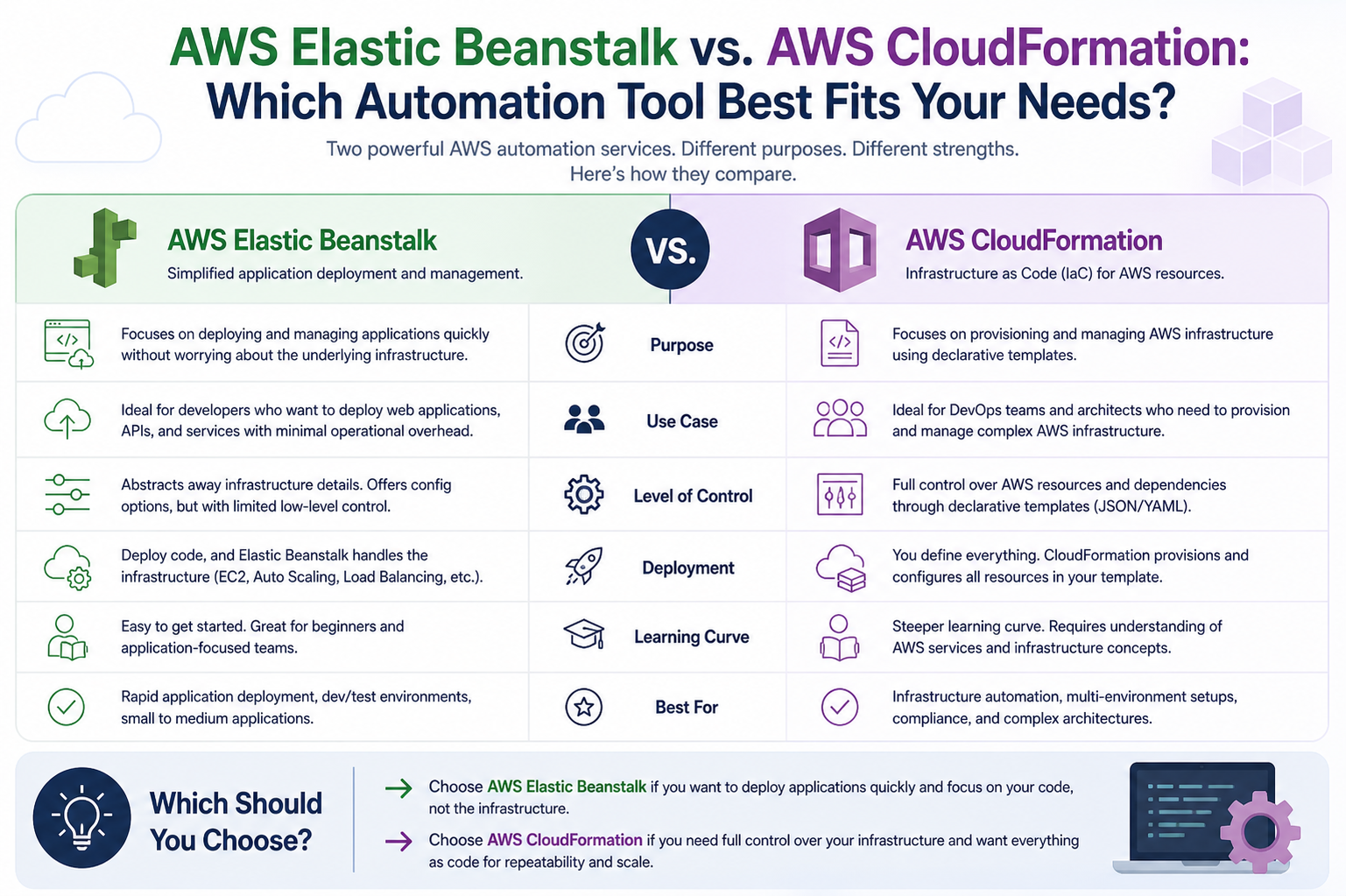
When organizations begin their journey into cloud computing, one of the first challenges they face is deciding how to automate infrastructure and application deployment. Amazon Web Services offers multiple solutions to simplify this process, but two of the most commonly discussed tools are AWS Elastic Beanstalk and AWS CloudFormation. While both tools aim to reduce manual effort and improve consistency, they approach automation from entirely different perspectives. Understanding these differences in depth is essential for making an informed decision that aligns with your technical goals, team expertise, and long-term scalability requirements.
The Core Philosophy Behind Automation in AWS
Automation in cloud environments is not just about saving time; it is about ensuring consistency, reliability, and scalability. AWS provides services that cater to different layers of this automation spectrum. On one end, there are tools like Elastic Beanstalk that prioritize ease of use and rapid deployment. On the other end, services like CloudFormation provide granular control, allowing teams to define every aspect of their infrastructure.
Elastic Beanstalk follows a platform-as-a-service approach, enabling developers to focus on writing code while AWS manages the infrastructure. In contrast, CloudFormation is rooted in the infrastructure-as-code philosophy, where every resource is explicitly defined and version-controlled. This distinction forms the foundation of how each tool operates and influences how teams interact with them.
A Deeper Look at AWS Elastic Beanstalk
Elastic Beanstalk is designed to simplify the deployment process for developers who may not have extensive experience managing cloud infrastructure. It supports multiple programming languages and frameworks, allowing users to upload their application code and let AWS handle the rest. The service automatically provisions resources such as EC2 instances, load balancers, auto-scaling groups, and monitoring tools.
One of the most appealing aspects of Elastic Beanstalk is its ability to manage the full application lifecycle with minimal input. Developers can deploy updates, roll back changes, and scale applications without needing to manually configure underlying resources. This level of abstraction significantly reduces the operational burden, making it an excellent choice for small teams or projects with tight deadlines.
However, this convenience comes with certain trade-offs. While Elastic Beanstalk allows some customization, it does not provide the same level of control as more advanced tools. Users are somewhat limited in how they can configure resources, which may become a constraint in complex environments.
A Comprehensive Understanding of AWS CloudFormation
CloudFormation takes a fundamentally different approach by allowing users to define infrastructure using code. Instead of manually creating resources through the AWS Management Console, you write templates that describe the desired state of your environment. These templates can include everything from compute resources and databases to networking configurations and security settings.
The power of CloudFormation lies in its ability to create repeatable and predictable environments. Once a template is defined, it can be reused across multiple stages of development, ensuring consistency and reducing the risk of configuration drift. This is particularly valuable for organizations that operate in highly regulated industries or require strict compliance standards.
Another advantage of CloudFormation is its integration with version control systems. Teams can track changes to infrastructure just as they would with application code, enabling better collaboration and auditability. This makes it easier to manage updates, roll back changes, and maintain a clear history of modifications.
Despite its advantages, CloudFormation has a steeper learning curve. Writing templates requires a solid understanding of AWS services and their interdependencies. Additionally, debugging template errors can be challenging, especially for beginners.
Deployment Speed vs. Customization Depth
One of the most significant differences between Elastic Beanstalk and CloudFormation is the balance between speed and customization. Elastic Beanstalk excels in scenarios where rapid deployment is a priority. Developers can launch applications within minutes without worrying about the underlying infrastructure.
CloudFormation, on the other hand, requires more time upfront to define templates and configurations. However, this initial investment pays off in the long run by providing greater flexibility and control. Teams can fine-tune every aspect of their infrastructure, ensuring it meets specific performance, security, and compliance requirements.
This trade-off is an important consideration when choosing between the two tools. If your primary goal is to get an application up and running quickly, Elastic Beanstalk is likely the better option. If you need a highly customized and scalable environment, CloudFormation is the more suitable choice.
Scalability and Resource Management
Both tools support scalability, but they handle it in different ways. Elastic Beanstalk automatically manages scaling based on predefined policies. It adjusts resources in response to traffic changes, ensuring that applications remain responsive under varying loads.
CloudFormation provides the building blocks for scalability but requires users to define scaling policies explicitly. This means you have more control over how resources are allocated and managed, but it also requires a deeper understanding of AWS services.
For organizations with predictable workloads, Elastic Beanstalk’s automated scaling may be sufficient. However, for applications with complex scaling requirements, CloudFormation offers the flexibility needed to implement advanced strategies.
Flexibility and Integration Capabilities
Flexibility is another area where CloudFormation stands out. It supports a wide range of AWS services and allows users to create highly customized architectures. This makes it an ideal choice for large-scale applications and enterprise environments.
Elastic Beanstalk, while flexible to some extent, is primarily focused on application deployment. It may not support all AWS services or configurations, which can limit its usefulness in certain scenarios.
Integration is also a key factor to consider. CloudFormation integrates seamlessly with other AWS services, enabling advanced automation workflows. It can be used in conjunction with CI/CD pipelines, monitoring tools, and security services to create a comprehensive automation strategy.
Elastic Beanstalk also supports integration, but its scope is more limited. It is best suited for straightforward deployment workflows rather than complex automation pipelines.
Cost Considerations and Resource Efficiency
Cost is always an important factor when choosing a cloud automation tool. Elastic Beanstalk itself does not incur additional charges, but you pay for the underlying resources it provisions. Its automated nature can sometimes lead to over-provisioning if not carefully managed.
CloudFormation also does not have a direct cost, but it allows for more precise control over resource allocation. This can help optimize costs by ensuring that only necessary resources are used.
Organizations that prioritize cost efficiency may find CloudFormation more appealing, as it enables detailed resource management. However, this requires careful planning and ongoing monitoring.
Security and Compliance Factors
Security is a critical consideration in any cloud environment. Both Elastic Beanstalk and CloudFormation support AWS security features, but they differ in how these features are implemented.
Elastic Beanstalk handles many security configurations automatically, which can be beneficial for beginners. However, this may limit the ability to implement custom security measures.
CloudFormation provides full control over security settings, allowing users to define policies, roles, and permissions in detail. This makes it a better choice for organizations with strict security requirements.
Learning Curve and Team Expertise
The level of expertise required to use each tool effectively is another important factor. Elastic Beanstalk is relatively easy to learn and use, making it accessible to developers with limited cloud experience.
CloudFormation, on the other hand, requires a deeper understanding of AWS services and infrastructure design. Teams may need to invest time in training and development to fully leverage its capabilities.
This difference can influence the choice of tool, especially for organizations with limited resources or tight timelines.
Long-Term Maintainability and Growth
As projects evolve, the need for maintainability becomes increasingly important. Elastic Beanstalk is well-suited for smaller applications and projects with straightforward requirements. However, as complexity grows, its limitations may become more apparent.
CloudFormation excels in long-term scenarios where infrastructure needs to be managed and updated over time. Its code-based approach allows for better documentation, versioning, and scalability.
Organizations planning for long-term growth may benefit from adopting CloudFormation early in their journey.
Combining Both Tools for Maximum Efficiency
In many cases, the choice between Elastic Beanstalk and CloudFormation is not mutually exclusive. Teams can use both tools together to leverage their respective strengths. For example, Elastic Beanstalk can be used for application deployment, while CloudFormation manages the underlying infrastructure.
This hybrid approach allows organizations to achieve a balance between simplicity and control. It enables rapid deployment while maintaining the flexibility needed for complex environments.
Choosing between AWS Elastic Beanstalk and AWS CloudFormation ultimately depends on your specific needs, goals, and level of expertise. Elastic Beanstalk offers a streamlined approach that prioritizes ease of use and speed, making it ideal for quick deployments and smaller projects. CloudFormation provides a powerful and flexible framework for managing infrastructure, making it suitable for complex and large-scale applications.
By understanding the strengths and limitations of each tool, you can make a decision that aligns with your workflow and ensures efficient, scalable, and secure cloud operations.
Advanced Deployment Strategies and Workflow Optimization
As cloud environments mature, deployment strategies become more sophisticated, requiring tools that can support advanced workflows. Elastic Beanstalk simplifies deployments through built-in mechanisms such as rolling updates, blue/green deployments, and environment cloning. These features allow developers to release new versions of applications with minimal downtime and reduced risk. The platform handles much of the complexity automatically, making it easier to maintain application availability during updates.
CloudFormation approaches deployment from a structural perspective. Instead of focusing solely on application updates, it manages the lifecycle of entire infrastructures. Using change sets, teams can preview modifications before applying them, reducing the chances of unexpected failures. Stack updates ensure that resources are modified in a controlled and predictable manner. This level of precision is particularly valuable in production environments where even small changes can have significant consequences.
Handling Complex Architectures
Modern applications often rely on multi-tier architectures involving web servers, application layers, databases, caching systems, and messaging services. Elastic Beanstalk supports some of these patterns but is primarily optimized for standard web applications. While it can be extended using configuration files, managing highly complex architectures can become challenging.
CloudFormation is specifically designed to handle such complexity. It allows you to define intricate relationships between resources, ensuring that dependencies are properly managed. For example, you can specify how a database should be created before an application server is launched, or how networking components should be configured to support secure communication. This makes CloudFormation an ideal choice for enterprise-level systems with multiple interconnected components.
Environment Consistency Across Stages
Maintaining consistency between development, testing, and production environments is a common challenge in software development. Elastic Beanstalk provides environment cloning, which helps replicate configurations across different stages. However, manual adjustments may still be required, especially when dealing with environment-specific settings.
CloudFormation excels in this area by using reusable templates. The same template can be deployed across multiple environments with minimal changes, ensuring consistency and reducing the risk of discrepancies. Parameters and mappings allow teams to customize configurations without altering the core template, making it easier to maintain uniformity across stages.
Monitoring, Logging, and Observability
Effective monitoring and logging are essential for maintaining application performance and diagnosing issues. Elastic Beanstalk integrates with AWS monitoring services to provide basic metrics, health checks, and logs. It offers a user-friendly interface for viewing application health and identifying potential problems.
CloudFormation does not provide monitoring directly but enables the configuration of monitoring tools as part of the infrastructure. This allows for a more tailored observability setup, where teams can define exactly how metrics, logs, and alerts should be handled. While this requires more effort, it results in a more robust and customizable monitoring solution.
Disaster Recovery and Fault Tolerance
Ensuring system resilience is a critical aspect of cloud architecture. Elastic Beanstalk includes built-in support for load balancing and auto-scaling, which helps maintain availability during traffic spikes or partial failures. However, advanced disaster recovery strategies may require additional configuration.
CloudFormation provides the flexibility to design comprehensive disaster recovery plans. You can define multi-region deployments, backup strategies, and failover mechanisms directly within templates. This level of control allows organizations to build highly resilient systems that can withstand a wide range of failure scenarios.
Version Control and Change Management
Version control is a cornerstone of modern development practices. Elastic Beanstalk supports application versioning, allowing developers to track and manage different releases. However, infrastructure changes are not as tightly integrated into version control workflows.
CloudFormation treats infrastructure as code, making it easy to integrate with version control systems. Every change to a template can be tracked, reviewed, and approved before deployment. This improves collaboration and ensures that all modifications are documented. Change management becomes more structured, reducing the likelihood of errors and misconfigurations.
Customization and Extensibility
Customization is an important factor when dealing with unique application requirements. Elastic Beanstalk allows some level of customization through configuration files and environment settings. However, its predefined structure can limit how far you can tailor the environment.
CloudFormation offers virtually unlimited customization. You can define custom resources, integrate with other AWS services, and even extend functionality using additional tools. This makes it suitable for highly specialized use cases where standard configurations are not sufficient.
Performance Optimization Techniques
Optimizing performance is essential for delivering a high-quality user experience. Elastic Beanstalk provides basic tools for scaling and resource management, which can help improve performance without requiring deep technical knowledge.
CloudFormation enables more advanced optimization techniques by allowing precise control over resource configurations. You can fine-tune instance types, networking settings, and scaling policies to achieve optimal performance. This level of detail is particularly useful for high-performance applications with specific requirements.
Team Collaboration and Role Separation
In larger organizations, different teams are often responsible for development, operations, and security. Elastic Beanstalk simplifies collaboration by providing a unified interface, but it may not fully support complex role separation.
CloudFormation aligns well with DevOps practices by enabling clear separation of responsibilities. Infrastructure templates can be managed by operations teams, while developers focus on application code. This separation improves efficiency and ensures that each team can work within its area of expertise.
Migration and Transition Strategies
Organizations moving to the cloud often need to migrate existing applications and infrastructure. Elastic Beanstalk can be a good starting point for simple applications, allowing teams to quickly transition without significant changes.
CloudFormation is better suited for large-scale migrations that require detailed planning and execution. It allows organizations to replicate existing environments in the cloud with high accuracy, ensuring a smoother transition.
Automation Beyond Deployment
Automation is not limited to deployment; it extends to maintenance, updates, and scaling. Elastic Beanstalk automates many routine tasks, reducing the need for manual intervention. This can save time and effort, especially for smaller teams.
CloudFormation enables end-to-end automation by integrating with other tools and services. It can be used to automate complex workflows, including infrastructure updates, security compliance checks, and resource optimization. This makes it a powerful tool for organizations aiming to achieve full automation.
Evaluating Long-Term Impact
When choosing between Elastic Beanstalk and CloudFormation, it is important to consider the long-term impact on your organization. Elastic Beanstalk offers a quick and easy solution, but it may not scale well with increasing complexity. CloudFormation requires more effort upfront but provides a मजबूत foundation for future growth.
The decision should be based on factors such as project size, team expertise, and long-term goals. By carefully evaluating these aspects, you can select a tool that not only meets your current needs but also supports your future ambitions.
Both Elastic Beanstalk and CloudFormation are valuable tools within the AWS ecosystem, each serving a distinct purpose. Elastic Beanstalk simplifies application deployment and management, making it accessible and efficient. CloudFormation provides the control and flexibility needed to build and manage complex infrastructures.
Understanding how these tools complement each other can help you create a balanced and effective automation strategy. By leveraging their strengths, you can build scalable, reliable, and efficient cloud environments that support your organization’s success.
Real-World Decision Making and Practical Trade-Offs
When teams move beyond theory and start implementing cloud solutions, the choice between Elastic Beanstalk and CloudFormation becomes more nuanced. Real-world environments rarely fit into neat categories, and decisions are often influenced by deadlines, team structure, budget constraints, and existing workflows. Elastic Beanstalk tends to appeal in situations where speed is critical and the architecture is relatively straightforward. It allows teams to launch quickly, validate ideas, and iterate without getting deeply involved in infrastructure planning.
CloudFormation, however, becomes increasingly valuable as systems grow in complexity and scale. In production-grade environments, where reliability and predictability are essential, having infrastructure defined as code provides a significant advantage. Teams can reproduce environments exactly, avoid manual configuration errors, and maintain consistency across deployments. This reliability often outweighs the initial effort required to set up templates.
Startup vs. Enterprise Perspective
Startups and small teams often prioritize agility over control. Elastic Beanstalk fits naturally into this mindset by reducing operational overhead and allowing developers to focus on building features. It enables rapid experimentation and faster time-to-market, which can be critical in competitive environments.
Enterprises, on the other hand, typically require structured processes, governance, and compliance. CloudFormation aligns well with these needs by offering detailed control over infrastructure and supporting standardized deployment practices. Large organizations benefit from its ability to enforce policies, manage permissions, and maintain audit trails.
That said, the distinction is not absolute. Some startups adopt CloudFormation early to avoid technical debt, while some enterprise teams use Elastic Beanstalk for specific workloads where simplicity is more important than customization.
Managing Technical Debt Over Time
One often overlooked factor is how each tool impacts technical debt. Elastic Beanstalk, while convenient, can sometimes obscure underlying infrastructure details. As applications evolve, teams may find it difficult to implement advanced configurations or troubleshoot issues due to this abstraction.
CloudFormation reduces this risk by making infrastructure explicit. Every component is defined and documented, which makes it easier to understand, modify, and extend over time. This transparency helps teams avoid hidden complexities and maintain a cleaner architecture.
However, poorly written templates can also introduce their own form of technical debt. If templates are not organized, documented, and maintained properly, they can become difficult to manage. This highlights the importance of adopting best practices regardless of the tool used.
Evolving with DevOps and Automation Trends
Modern software development increasingly embraces DevOps practices, emphasizing collaboration, automation, and continuous delivery. Elastic Beanstalk supports these practices by simplifying deployment pipelines and reducing manual steps. It integrates reasonably well with CI/CD tools, making it easier to automate application updates.
CloudFormation takes DevOps to a deeper level by enabling full infrastructure automation. It allows teams to treat infrastructure as part of the development lifecycle, integrating it into version control, testing, and deployment workflows. This approach supports advanced practices such as immutable infrastructure and automated rollbacks.
As organizations mature in their DevOps journey, they often gravitate toward tools like CloudFormation to achieve greater control and scalability.
Security at Scale
As applications grow, security requirements become more complex. Elastic Beanstalk provides built-in security features and sensible defaults, which can be sufficient for many use cases. However, these defaults may not meet the needs of highly regulated industries or applications handling sensitive data.
CloudFormation enables detailed security configurations, allowing teams to define roles, permissions, and policies with precision. This level of control is essential for implementing least-privilege access, enforcing compliance standards, and managing security at scale.
In environments where security is a top priority, the ability to explicitly define and audit configurations becomes a major advantage.
Operational Visibility and Debugging
Troubleshooting issues in cloud environments requires clear visibility into system behavior. Elastic Beanstalk provides a simplified view of application health, which is helpful for quick diagnostics. However, this abstraction can sometimes make it harder to identify root causes in complex scenarios.
CloudFormation offers greater transparency by exposing the full infrastructure setup. While it does not provide monitoring directly, it allows teams to integrate detailed logging and monitoring solutions. This makes it easier to trace issues across different components and understand how they interact.
The trade-off here is between simplicity and depth. Elastic Beanstalk is easier to use but may limit visibility, while CloudFormation requires more effort but provides deeper insights.
Vendor Lock-In Considerations
Both tools are tightly integrated into the AWS ecosystem, which raises questions about vendor lock-in. Elastic Beanstalk, due to its higher level of abstraction, can make it more challenging to migrate applications to other platforms. The convenience it offers may come at the cost of portability.
CloudFormation also ties infrastructure to AWS, but its explicit nature can make migrations more manageable. By clearly defining resources, teams can better understand what needs to be replicated or adapted in another environment.
Organizations concerned about long-term flexibility should carefully evaluate how each tool aligns with their portability goals.
Cost Management Strategies
Cost optimization becomes increasingly important as usage grows. Elastic Beanstalk simplifies resource management but may lead to inefficiencies if configurations are not carefully monitored. Automated provisioning can sometimes result in unused or underutilized resources.
CloudFormation provides the tools needed for precise cost control. By defining resources explicitly, teams can optimize usage and avoid unnecessary expenses. It also enables the implementation of cost management strategies such as tagging and resource tracking.
Effective cost management requires ongoing attention regardless of the tool, but CloudFormation offers more granular control for organizations looking to optimize spending.
Future-Proofing Your Cloud Strategy
Technology evolves rapidly, and the tools you choose today should support future growth and innovation. Elastic Beanstalk is well-suited for stable, predictable workloads but may struggle to adapt to highly dynamic or complex requirements.
CloudFormation, with its flexible and extensible nature, is better positioned to accommodate evolving needs. It supports a wide range of AWS services and can be extended to incorporate new technologies as they emerge.
Organizations planning for long-term scalability and innovation often find CloudFormation to be a more future-proof solution.
Balancing Simplicity and Control
Ultimately, the decision between Elastic Beanstalk and CloudFormation comes down to balancing simplicity and control. Elastic Beanstalk reduces complexity and accelerates development, making it ideal for teams that value speed and ease of use.
CloudFormation provides the control needed to build sophisticated, scalable, and secure systems. It requires more effort and expertise but offers greater flexibility and long-term benefits.
Many organizations find that a combination of both tools provides the best results. By using Elastic Beanstalk for rapid application deployment and CloudFormation for infrastructure management, they can achieve a balance that meets both short-term and long-term needs.
Choosing the right automation tool is not just a technical decision; it is a strategic one that affects how your team works, how your systems scale, and how your organization evolves. Elastic Beanstalk and CloudFormation each offer unique advantages, and understanding these strengths is key to making the right choice.
By carefully considering your requirements, expertise, and future goals, you can select a solution that supports efficient development, reliable operations, and sustainable growth in the cloud.
Best Practices for Effective Implementation
Successfully using Elastic Beanstalk or CloudFormation requires more than just understanding their features; it depends on how well they are implemented within your workflow. With Elastic Beanstalk, it is important to maintain clean application versions, use environment configurations wisely, and monitor performance regularly. Keeping environments organized and removing unused resources helps prevent unnecessary costs and confusion.
For CloudFormation, best practices revolve around writing clean, modular templates. Breaking large templates into smaller, reusable components makes them easier to manage and update. Using parameters, mappings, and outputs effectively can improve flexibility and readability. Proper naming conventions and documentation are also essential, especially when multiple team members are working on the same infrastructure.
Template Design and Maintainability
One of the defining aspects of CloudFormation is template design. Well-structured templates can significantly reduce complexity and improve maintainability. Organizing resources logically, grouping related components, and avoiding hard-coded values are key strategies. This approach ensures that templates remain adaptable as requirements change.
In contrast, Elastic Beanstalk minimizes the need for such design considerations by handling most infrastructure decisions automatically. However, developers should still pay attention to configuration files and environment settings to ensure that deployments remain consistent and predictable.
Automation Pipelines and Continuous Delivery
Integrating automation tools into CI/CD pipelines is a critical step for modern development practices. Elastic Beanstalk supports automated deployments by connecting with build and deployment services. This allows teams to push updates frequently and maintain a steady release cycle without manual intervention.
CloudFormation enhances automation pipelines by enabling infrastructure changes to be part of the same workflow as application updates. Teams can deploy new features alongside infrastructure modifications in a single, coordinated process. This reduces the risk of mismatches between code and infrastructure and ensures smoother releases.
Handling Updates and Rollbacks
Managing updates is a key aspect of any automation strategy. Elastic Beanstalk simplifies this process by providing built-in mechanisms for rolling updates and quick rollbacks. If a deployment fails, the platform can automatically revert to a previous version, minimizing downtime and disruption.
CloudFormation also supports rollbacks but does so at the infrastructure level. If a stack update fails, it automatically attempts to restore the previous state. While this is powerful, it requires careful planning to ensure that updates do not introduce conflicts or unintended changes.
Testing and Validation Strategies
Before deploying changes to production, thorough testing is essential. Elastic Beanstalk allows developers to create separate environments for testing, making it easier to validate changes before they go live. Cloning environments can speed up this process and ensure consistency.
CloudFormation supports testing through the use of staging environments and validation tools. Templates can be tested for syntax and logic before deployment, reducing the likelihood of errors. This approach aligns well with automated testing practices and helps maintain high-quality deployments.
Documentation and Knowledge Sharing
Clear documentation is vital for both tools. Elastic Beanstalk users should document environment configurations, deployment processes, and any custom settings. This ensures that team members can quickly understand and manage applications.
For CloudFormation, documentation becomes even more important due to the complexity of templates. Detailed explanations of resource definitions, dependencies, and parameters help teams collaborate effectively. Good documentation also makes it easier to onboard new team members and maintain long-term projects.
Performance Monitoring and Optimization
Monitoring performance is an ongoing process that directly impacts user experience. Elastic Beanstalk provides built-in monitoring features that give a quick overview of application health. Developers can use these insights to make adjustments and improve performance.
CloudFormation allows teams to design custom monitoring solutions tailored to their specific needs. By integrating monitoring tools into templates, organizations can create comprehensive observability systems that provide detailed insights into performance and resource usage.
Scaling Strategies for Growth
As applications grow, scaling becomes increasingly important. Elastic Beanstalk offers automatic scaling based on predefined rules, making it easy to handle increased traffic without manual intervention. This is particularly useful for applications with variable workloads.
CloudFormation provides more advanced scaling options by allowing teams to define custom policies and integrate multiple scaling mechanisms. This level of control is beneficial for applications with complex or unpredictable traffic patterns.
Governance and Policy Enforcement
In larger organizations, governance plays a crucial role in maintaining order and compliance. Elastic Beanstalk provides basic governance features, but its scope is limited compared to more advanced tools.
CloudFormation enables detailed governance by allowing teams to enforce policies through templates. Organizations can standardize configurations, control access, and ensure compliance with internal and external regulations. This makes it a powerful tool for managing large-scale environments.
Adapting to Changing Requirements
Technology and business requirements are constantly evolving. Elastic Beanstalk allows for quick adjustments, making it suitable for projects that require frequent changes and experimentation. Its simplicity enables teams to adapt بسرعة without significant overhead.
CloudFormation, while more structured, also supports adaptability through modular templates and reusable components. Changes can be implemented systematically, ensuring that updates are consistent and well-documented.
Building a Hybrid Strategy
Many organizations find that combining both tools provides the best results. Elastic Beanstalk can be used for rapid application deployment, while CloudFormation manages the underlying infrastructure. This hybrid approach allows teams to benefit from both simplicity and control.
By carefully integrating these tools, organizations can create a balanced workflow that supports both development speed and operational stability. This strategy is particularly effective in environments where different projects have varying requirements.
Common Pitfalls to Avoid
While both tools are powerful, there are common mistakes that teams should avoid. With Elastic Beanstalk, relying too heavily on default configurations can lead to performance or security issues. It is important to review and customize settings as needed.
For CloudFormation, overly complex templates can become difficult to manage. Keeping templates modular and well-organized helps prevent this problem. Additionally, failing to test changes thoroughly can result in deployment failures and downtime.
Final Conclusion
Elastic Beanstalk and CloudFormation each offer unique advantages, and their effectiveness depends on how they are used. Elastic Beanstalk excels in simplicity and speed, making it ideal for quick deployments and smaller projects. CloudFormation provides the control and flexibility needed for complex, large-scale systems.
By following best practices, avoiding common pitfalls, and aligning tool selection with project goals, organizations can maximize the benefits of both tools. Whether used individually or together, these services play a vital role in building efficient, scalable, and reliable cloud environments.