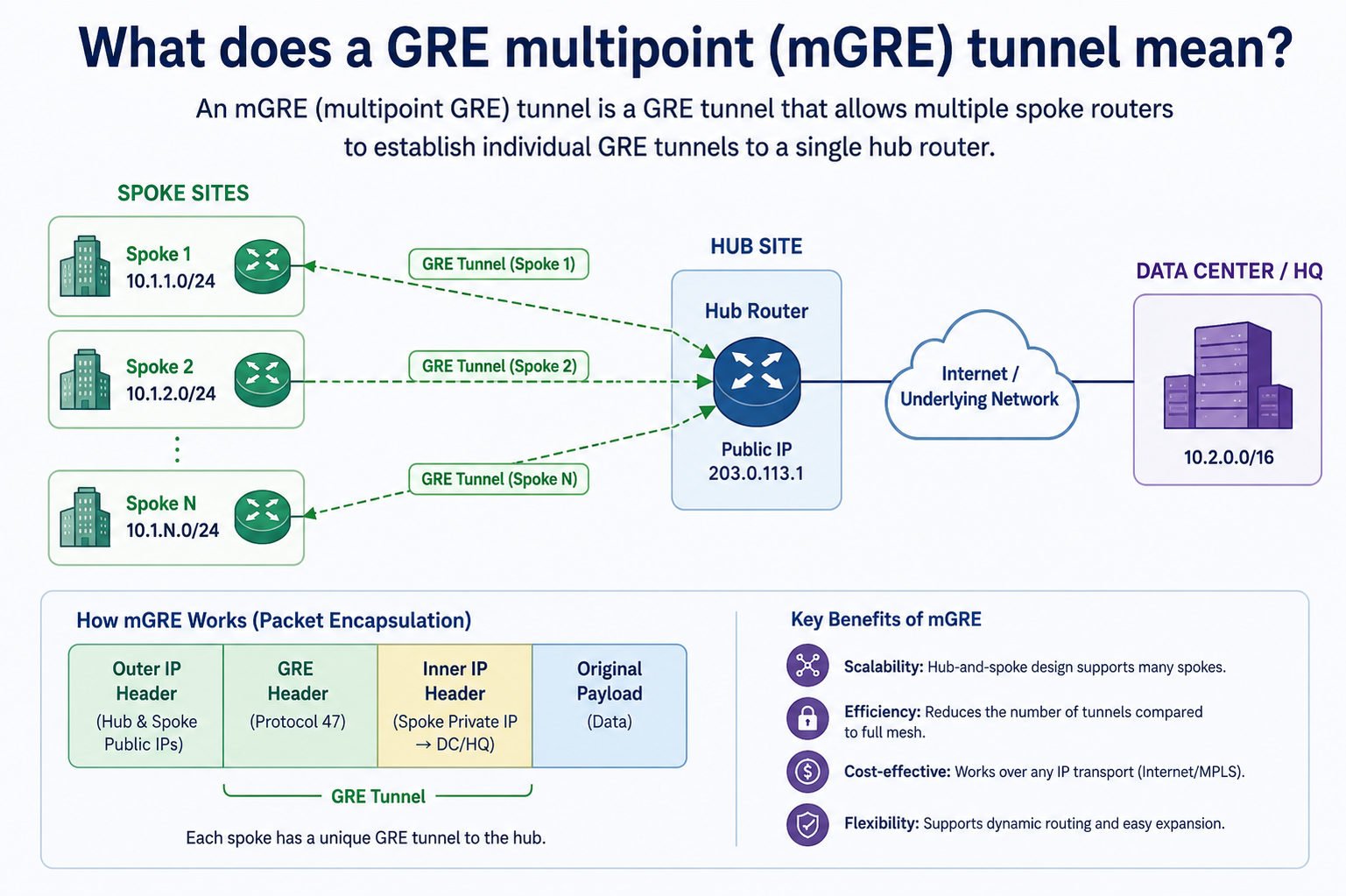
A GRE multipoint (mGRE) tunnel is a networking concept used in modern IP-based communication systems to enable scalable, flexible, and efficient connectivity between multiple network sites over an existing IP infrastructure. To understand what it means, it is important to first understand the basics of GRE and then extend that understanding to the multipoint variation.
GRE stands for Generic Routing Encapsulation, which is a tunneling protocol developed to encapsulate a wide variety of network layer protocols inside virtual point-to-point links over an IP network. In simple terms, GRE creates a virtual tunnel between two endpoints so that data packets can be carried securely or transparently across networks that may not natively support those packets. Traditional GRE tunnels are point-to-point, meaning each tunnel connects exactly two endpoints.
However, as networks evolved and organizations required more scalable solutions for connecting multiple branches, the concept of multipoint GRE, or mGRE, was introduced. Unlike traditional GRE tunnels that require separate tunnel interfaces for each connection, mGRE allows a single tunnel interface to support multiple remote endpoints. This significantly reduces configuration complexity and improves scalability in large networks.
In essence, a GRE multipoint tunnel means a single virtual tunnel interface that can dynamically communicate with multiple remote peers using GRE encapsulation over an IP network. It is widely used in dynamic VPN technologies such as DMVPN (Dynamic Multipoint Virtual Private Network), where multiple branch locations need to communicate with each other efficiently without requiring full mesh manual configuration.
Understanding GRE in Simple Terms
To fully grasp mGRE, it is important to understand how GRE works in its basic form. GRE encapsulates packets from one network protocol inside another protocol, typically IP. This encapsulation allows data to travel across incompatible or complex networks as if it were on a simple point-to-point link.
In a traditional GRE tunnel, there are two endpoints: a source and a destination. Each tunnel must be manually configured, and if a network has many sites, the number of required tunnels increases rapidly. For example, if there are 10 sites and each site needs to communicate with every other site, the number of tunnels becomes very large and difficult to manage.
This limitation led to the development of multipoint GRE, which simplifies this structure by allowing one tunnel interface to handle multiple connections dynamically.
What Makes mGRE Different
The main difference between GRE and mGRE lies in how they handle tunnel endpoints. In traditional GRE, the tunnel is strictly point-to-point. In contrast, mGRE allows a single tunnel interface to accept traffic from and send traffic to multiple remote endpoints.
This is achieved by not statically defining the destination address in the tunnel configuration. Instead, the system dynamically learns and builds tunnel connections based on incoming traffic or routing protocols. As a result, mGRE supports a hub-and-spoke or even dynamic mesh topology without requiring separate tunnel configurations for each connection.
This flexibility is particularly useful in large-scale enterprise networks where branches need to communicate with a central site and sometimes directly with each other.
How a GRE Multipoint Tunnel Works
The working mechanism of mGRE involves encapsulation, dynamic peer discovery, and routing integration. When a packet is sent from one site to another, the original packet is encapsulated inside a GRE packet. This GRE packet is then transmitted over the IP network.
At the receiving end, the GRE header is removed, and the original packet is delivered to its destination network.
In an mGRE setup, the tunnel interface does not have a fixed destination. Instead, it can send and receive encapsulated packets from multiple remote routers. These routers dynamically register themselves or are discovered through a control protocol. Once discovered, they can exchange routing information and establish communication paths.
This dynamic behavior eliminates the need for manually configuring individual tunnels for every connection.
Architecture of mGRE Networks
The architecture of a GRE multipoint tunnel typically consists of a central hub and multiple spokes. The hub is usually a central router or data center that manages the main tunnel interface. The spokes are branch routers that connect to the hub using mGRE tunnels.
Unlike traditional hub-and-spoke models, mGRE allows spokes to also communicate with each other directly, depending on the routing configuration and additional protocols used.
The mGRE tunnel interface acts as a shared virtual interface that all remote peers use to send and receive traffic. Routing protocols such as EIGRP, OSPF, or BGP are often used on top of mGRE to manage path selection and ensure efficient communication between sites.
Role in Dynamic VPNs
One of the most important applications of mGRE is in Dynamic Multipoint VPN (DMVPN) architectures. In DMVPN, mGRE forms the underlying tunnel technology that allows dynamic creation of VPN tunnels between sites.
In such systems, spokes initially connect to the hub using mGRE tunnels. When two spokes need to communicate directly, they can dynamically establish a direct tunnel without passing all traffic through the hub. This reduces latency, improves performance, and reduces load on central infrastructure.
The mGRE tunnel plays a critical role in enabling this dynamic behavior by supporting multiple endpoints on a single interface.
Advantages of GRE Multipoint Tunnels
One of the most significant advantages of mGRE is scalability. Since a single tunnel interface can support multiple peers, network administrators do not need to configure and maintain separate tunnels for every connection. This becomes extremely beneficial in large networks with dozens or hundreds of sites.
Another advantage is flexibility. mGRE supports dynamic peer discovery, which means new sites can be added without major reconfiguration. This makes network expansion much easier and faster.
mGRE also improves efficiency in network management. Instead of maintaining complex full-mesh configurations, administrators can rely on hub-based or dynamic topologies that are easier to monitor and troubleshoot.
Additionally, mGRE reduces configuration overhead and simplifies routing design when combined with dynamic routing protocols.
Limitations of mGRE
Despite its advantages, mGRE also has some limitations. One of the main concerns is that it requires additional protocols, such as NHRP (Next Hop Resolution Protocol), to function effectively in dynamic environments. Without such protocols, mGRE alone cannot fully support dynamic peer discovery.
Another limitation is security. Since mGRE encapsulates traffic over public or shared networks, it often needs to be combined with encryption technologies like IPsec to ensure data confidentiality and integrity.
Performance overhead can also be a consideration, as encapsulation adds additional headers to each packet, increasing bandwidth usage slightly.
Finally, troubleshooting mGRE networks can be more complex compared to simple point-to-point GRE tunnels due to their dynamic nature.
Real-World Applications
mGRE is widely used in enterprise WAN (Wide Area Network) deployments where multiple branch offices need to connect to a central headquarters. It is also used in service provider networks and large-scale distributed systems where scalability and flexibility are essential.
Organizations with geographically distributed locations benefit greatly from mGRE because it reduces the complexity of maintaining multiple static tunnels.
It is also commonly used in conjunction with VPN technologies to build secure, scalable communication infrastructures.
Why mGRE Matters in Modern Networking
In modern networking environments, static configurations are no longer efficient due to the dynamic nature of businesses and cloud-based systems. mGRE addresses this challenge by enabling dynamic, scalable, and flexible connectivity.
It allows networks to grow without proportional increases in configuration complexity. This is especially important for organizations that are expanding rapidly or operating in hybrid cloud environments.
By simplifying tunnel management and enabling dynamic communication paths, mGRE plays a key role in modern enterprise network design.
Conclusion
A GRE multipoint (mGRE) tunnel is an advanced networking mechanism that extends the traditional GRE concept by allowing a single tunnel interface to support multiple remote endpoints dynamically. It removes the limitations of point-to-point GRE tunnels and introduces scalability, flexibility, and efficiency in large network environments.
Through its ability to dynamically handle multiple peers, mGRE simplifies network architecture and supports modern technologies like DMVPN. While it does introduce some complexity in terms of configuration and security requirements, its advantages far outweigh its limitations in enterprise-scale deployments.
In summary, mGRE represents a powerful evolution in tunneling technology, enabling networks to become more adaptable, scalable, and efficient in handling modern communication demands.