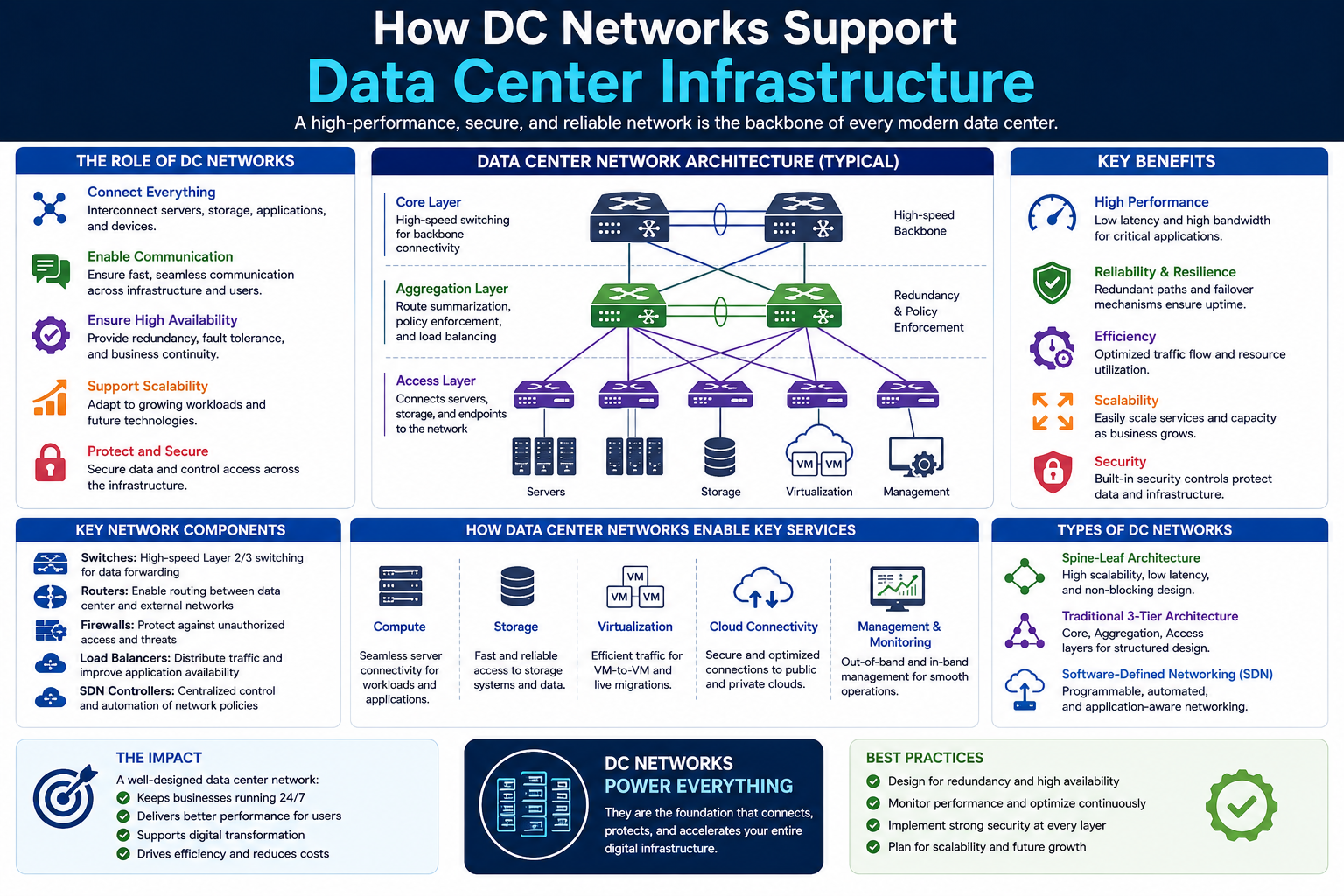
Data center network technology is one of the most important foundations of modern computing. Nearly every digital service people use today depends on data centers operating efficiently behind the scenes. Online banking systems, streaming services, cloud applications, e-commerce websites, social media platforms, enterprise software, and communication systems all rely on powerful and highly connected data center environments. Without these facilities, modern businesses and internet services would not function effectively.
A data center network is designed differently from a traditional office or campus network because its primary goal is not simply connecting users to printers or the internet. Instead, a data center network is built to support high-performance computing, virtualization, storage systems, cloud services, and massive internal traffic flows between servers and applications. These environments require extremely fast communication, scalability, redundancy, and flexibility.
Understanding DC network technology is essential for network engineers, cybersecurity professionals, cloud architects, and IT administrators. As organizations continue moving toward cloud infrastructure and virtualization, knowledge of data center networking becomes even more valuable. Modern enterprises depend on these networks to maintain uptime, protect information, and deliver services to customers around the world.
What Is DC Network Technology?
DC network technology refers to the networking infrastructure and design principles used inside data centers. The term “DC” stands for data center, which is a facility used to house computing systems, storage devices, networking hardware, and application platforms.
A data center network connects all these systems together so they can communicate efficiently. Servers must exchange information with databases, storage arrays, backup systems, firewalls, hypervisors, and external users. The network acts as the communication backbone that allows all operations to function smoothly.
Unlike small business networks, data center environments are designed to support extremely large workloads and very high traffic volumes. The infrastructure must be capable of operating continuously without downtime while handling thousands or even millions of simultaneous connections.
The purpose of a data center network extends beyond basic connectivity. It also supports application performance, virtualization, cloud computing, disaster recovery, security, scalability, and automation.
Modern data centers are designed to process enormous amounts of data at incredible speeds. This requires specialized architectures and technologies that differ significantly from traditional enterprise networking models.
The Role of Data Centers in Modern IT
Data centers are at the heart of the digital world. Every time someone streams a movie, uploads a file to cloud storage, accesses a social media platform, or performs an online search, a data center is involved.
Organizations use data centers to centralize computing resources. Instead of deploying servers and storage devices in scattered offices, businesses consolidate these systems into secure facilities where they can be managed efficiently.
Centralization offers several advantages. It improves resource utilization, simplifies maintenance, enhances security, supports scalability, and reduces operational costs.
Modern businesses rely on data centers for a wide range of functions. These include:
Application hosting
Database management
Virtual machine hosting
Cloud computing services
File storage
Disaster recovery
Artificial intelligence workloads
Backup operations
Business analytics
Remote access services
Because these services are mission-critical, the network infrastructure supporting them must be extremely reliable and high performing.
Data center networks are specifically engineered to meet these demands.
How Data Center Networks Differ from Campus Networks
Many IT professionals first learn networking through campus network environments. Campus networks are common in office buildings, universities, hospitals, and corporate campuses. These networks focus primarily on connecting users to resources.
Although campus and data center networks share some technologies, they are designed for different operational priorities.
Campus networks are centered around end-user access. Employees need internet connectivity, email access, file sharing, wireless networking, VoIP communication, and access to internal applications. The traffic flow in these environments is typically north-south, meaning users communicate with external resources or centralized servers.
Data center networks focus heavily on east-west traffic instead. East-west traffic refers to communication between internal systems such as servers, storage devices, databases, and virtualization platforms.
This distinction changes how the network is designed.
In a campus network, latency between servers may not always be critical. In a data center, even small delays can negatively affect application performance.
Campus networks are also geographically distributed. Organizations may connect multiple buildings, branch offices, and remote locations using WAN technologies and routing infrastructure.
Data centers are usually centralized within a single facility. Because of this, they rely more heavily on switching technologies and high-speed internal communication.
Another key difference involves scalability. Campus networks grow gradually as users and devices are added. Data centers may need to scale rapidly to support cloud services, virtualization clusters, or expanding application workloads.
The operational demands are therefore much higher in data center environments.
Common Components of a Data Center Network
Data center networks contain many specialized components working together to support applications and services.
Switches are among the most important devices in the environment. They provide high-speed communication between servers, storage systems, and other networking equipment.
Modern data center switches are optimized for low latency and high throughput. They support advanced features such as virtualization, automation, quality of service, and software-defined networking.
Routers are also used within data centers, although usually in smaller numbers compared to campus environments. Routing is typically focused on external connectivity and inter-network communication.
Servers form the core computing infrastructure of the data center. These systems run applications, databases, virtualization platforms, and cloud workloads.
Storage arrays provide centralized storage resources for applications and virtual machines. These systems often connect through specialized storage networking technologies.
Firewalls and security appliances protect the environment from unauthorized access and cyber threats.
Load balancers distribute traffic efficiently across application servers to improve performance and availability.
Cabling infrastructure is another critical component. Data centers use high-performance fiber optic and copper cabling to support extremely fast network speeds.
Power and cooling systems also play an essential role because networking equipment and servers generate significant heat and require uninterrupted electrical power.
All these systems work together to create a reliable and scalable computing environment.
Traditional Data Center Network Architecture
Historically, many data center networks followed a hierarchical three-layer design similar to campus networks.
This architecture consisted of the following layers:
Core layer
Distribution layer
Access layer
The access layer connected directly to servers and endpoint devices.
The distribution layer aggregated traffic from access switches and applied policies such as routing, filtering, and segmentation.
The core layer acted as the high-speed backbone interconnecting different parts of the network.
This model worked effectively for many years, especially when applications were primarily hosted on physical servers.
However, as virtualization and cloud computing became more common, traditional architectures began showing limitations.
Traffic patterns changed dramatically. Instead of users primarily accessing centralized applications, servers increasingly communicated with one another inside the data center.
This east-west traffic created congestion and inefficiencies in older hierarchical designs.
Organizations needed a more scalable and efficient approach.
The Evolution Toward Spine-Leaf Architecture
To solve the challenges associated with modern workloads, many organizations adopted spine-leaf architecture.
Spine-leaf design has become one of the most common network topologies in modern data centers.
In this model, the network is divided into two primary layers:
Leaf switches
Spine switches
Leaf switches connect directly to servers, storage devices, and other endpoints.
Spine switches provide high-speed interconnection between leaf switches.
Every leaf switch connects to every spine switch. However, spine switches do not connect directly to one another.
This design creates predictable traffic paths and minimizes latency.
One major advantage of spine-leaf architecture is scalability. Additional leaf switches can be added as server capacity grows without redesigning the entire infrastructure.
Another advantage is bandwidth efficiency. Multiple equal-cost paths exist between switches, allowing traffic to be distributed evenly.
The architecture also improves redundancy because multiple paths are always available.
Spine-leaf networks are especially well suited for virtualization, cloud computing, and software-defined networking environments.
They provide the flexibility and performance required by modern applications.
The Importance of Layer 2 Networking in Data Centers
Data center networks rely heavily on Layer 2 technologies because they provide flexibility for virtualization and workload mobility.
In traditional campus networks, Layer 3 routing is often emphasized to improve scalability and segmentation.
Data centers, however, frequently require extended Layer 2 connectivity.
One major reason involves virtual machine migration.
Virtualization platforms allow workloads to move dynamically between physical hosts. During these migrations, virtual machines often need to maintain their existing IP addresses and network configurations.
Layer 2 adjacency makes this possible.
Without Layer 2 support, moving workloads between servers would require significant reconfiguration and could interrupt applications.
Data center environments also require flexible resource allocation. Administrators may need to shift workloads quickly in response to maintenance requirements, hardware failures, or changing resource demands.
Layer 2 networking helps support these operational needs.
However, traditional VLAN technologies have scalability limitations. Modern environments may require thousands of isolated network segments.
To address this issue, technologies such as VXLAN were developed.
VXLAN extends Layer 2 connectivity across Layer 3 infrastructure by encapsulating Ethernet frames inside IP packets.
This allows organizations to build highly scalable virtualized networks while preserving Layer 2 flexibility.
Virtualization and Its Impact on Networking
Virtualization transformed data center operations dramatically.
Before virtualization, organizations typically deployed one application per physical server. This approach wasted resources because many servers operated far below their maximum capacity.
Virtualization introduced hypervisors that allow multiple virtual machines to run on a single physical server.
Each VM behaves like an independent computer while sharing hardware resources with other virtual machines.
This improved efficiency significantly.
Organizations could consolidate workloads, reduce hardware costs, improve scalability, and simplify management.
However, virtualization also introduced new networking challenges.
Virtual machines generate substantial east-west traffic as applications communicate internally.
VM mobility requires flexible network configurations.
Large virtualization clusters demand scalable and automated infrastructure.
Data center networks therefore evolved to support these requirements.
Modern switches include features specifically designed for virtualization environments.
Automation and orchestration tools also became more important because manual configuration methods could not keep pace with rapidly changing workloads.
The Rise of Cloud Computing
Cloud computing accelerated the growth and complexity of data center networks.
Public cloud providers operate enormous facilities containing thousands of servers and networking devices.
These environments must scale rapidly while maintaining performance and reliability.
Cloud computing models include:
Infrastructure as a Service
Platform as a Service
Software as a Service
All these services rely heavily on advanced data center networking technologies.
Cloud providers use highly automated infrastructure to deploy applications, allocate resources, and manage workloads efficiently.
Software-defined networking plays a major role in cloud environments because it enables centralized control and automation.
Instead of configuring devices manually, administrators can manage large portions of the network programmatically.
This improves consistency, scalability, and operational efficiency.
Cloud computing also increased the importance of multi-tenant security. Multiple customers may share the same physical infrastructure while remaining logically isolated.
Data center networks must therefore support advanced segmentation and security capabilities.
High-Speed Networking in Data Centers
Speed is one of the defining characteristics of modern data center networking.
Applications inside data centers exchange enormous amounts of information continuously.
Databases communicate with application servers.
Storage systems perform backups and replication.
Virtualization clusters synchronize workloads.
Cloud services process massive user requests.
All these operations require extremely fast connectivity.
Traditional office networks often use 1 Gigabit Ethernet connections.
Data centers typically deploy much faster technologies such as:
10 Gigabit Ethernet
25 Gigabit Ethernet
40 Gigabit Ethernet
100 Gigabit Ethernet
400 Gigabit Ethernet
These high-speed links reduce latency and improve overall application performance.
Low latency is especially important in environments such as financial trading systems, artificial intelligence platforms, and large-scale cloud services.
Modern switches are optimized to forward packets with minimal delay.
Fiber optic cabling is commonly used because it supports higher bandwidth and longer distances compared to copper connections.
High-speed networking is essential for maintaining efficient operations in modern data center environments.
Advanced Data Center Networking Concepts and Infrastructure
Modern data center environments are far more advanced than traditional server rooms used in earlier generations of IT infrastructure. As organizations continue adopting cloud computing, virtualization, automation, and large-scale digital services, data center networking has evolved into a highly specialized field. Engineers designing these environments must focus on scalability, redundancy, security, performance, and operational efficiency simultaneously.
Data center networks are no longer simple collections of switches and servers. They now function as intelligent ecosystems capable of adapting dynamically to changing workloads and business demands. Modern applications require continuous uptime, low latency, rapid scalability, and secure connectivity. To meet these expectations, organizations deploy sophisticated networking technologies that support automation, virtualization, storage systems, and software-defined infrastructure.
Understanding advanced DC network technology is essential for anyone pursuing careers in networking, cybersecurity, cloud computing, or systems administration. As enterprises modernize their infrastructure, knowledge of these technologies becomes increasingly valuable.
East-West Traffic in Data Centers
One of the defining characteristics of a data center network is the large volume of east-west traffic.
In traditional enterprise networks, most communication follows a north-south pattern. Users connect to external services, internet resources, or centralized applications. Traffic moves between internal users and external destinations.
Data centers operate differently.
Applications inside the data center constantly communicate with each other. Web servers interact with application servers. Application servers connect to databases. Virtual machines exchange information with storage systems and backup platforms.
This internal communication is called east-west traffic.
East-west traffic volumes can be enormous because modern applications are often distributed across multiple systems. A single user request may trigger communication between dozens of backend services.
As organizations adopt microservices architectures and containerized applications, east-west traffic becomes even more significant.
Traditional network architectures struggled to support these traffic patterns efficiently. Hierarchical designs forced traffic through multiple layers of infrastructure, increasing latency and creating bottlenecks.
Modern spine-leaf architectures address this issue by providing consistent low-latency paths between devices.
Efficient handling of east-west traffic is now one of the primary design goals of data center networking.
The Importance of Low Latency
Latency refers to the delay experienced when data travels across a network.
In many office environments, small amounts of latency may not noticeably affect users. In data centers, however, even minimal delays can create serious performance problems.
Applications operating inside data centers often require real-time communication between servers and storage systems.
Database operations are particularly sensitive to latency. Delayed database queries can slow entire applications.
Cloud computing platforms also rely heavily on low-latency communication because virtualized workloads interact continuously.
Financial institutions, streaming services, artificial intelligence systems, and gaming platforms all require extremely low network latency to function properly.
Data center switches are therefore designed specifically for high-speed packet forwarding with minimal processing delays.
Modern switching hardware uses specialized ASICs to process traffic extremely quickly.
Engineers also optimize network topology to reduce the number of hops traffic must traverse.
The spine-leaf model supports low latency because devices can communicate predictably through short and efficient traffic paths.
Reducing latency improves application responsiveness, user experience, and overall operational efficiency.
Redundancy in Data Center Networks
Redundancy is one of the most important principles in data center design.
Unlike small office networks, data centers cannot tolerate extended outages. Downtime may result in financial losses, service disruptions, damaged reputations, and operational failures.
To prevent outages, redundancy is built into nearly every component of the infrastructure.
Servers often contain multiple power supplies connected to separate electrical systems.
Storage systems replicate data across multiple devices or locations.
Network devices use redundant links and backup paths.
Switches and routers are commonly deployed in pairs to eliminate single points of failure.
If one device fails, another immediately takes over.
This design ensures continuous operation even during hardware failures or maintenance activities.
Redundant networking technologies include:
Link aggregation
Equal-Cost Multi-Path routing
Virtual Port Channels
Multi-Chassis Link Aggregation
Rapid Spanning Tree Protocol
Hot Standby Router Protocol
These technologies improve resiliency while also increasing available bandwidth.
Power redundancy is equally critical.
Most enterprise data centers include backup generators, battery systems, and uninterruptible power supplies.
Cooling systems are also duplicated because overheating can quickly damage equipment.
Redundancy is expensive, but it is necessary for maintaining high availability in mission-critical environments.
Storage Networking in Data Centers
Storage networking is another major component of DC network technology.
Applications generate massive amounts of data that must be stored securely and accessed efficiently.
Centralized storage systems allow organizations to consolidate resources, improve scalability, and simplify management.
Several storage networking technologies are commonly used in data centers.
Fibre Channel is one of the most well-known.
Fibre Channel is a high-speed networking technology designed specifically for storage communication. It provides reliable and low-latency connectivity between servers and storage arrays.
Storage Area Networks, often called SANs, commonly use Fibre Channel infrastructure.
Unlike standard Ethernet traffic, Fibre Channel focuses entirely on storage operations.
This specialization improves performance and reliability.
Although Ethernet-based storage technologies have become more common, Fibre Channel remains widely used in enterprise environments because of its maturity and efficiency.
Another popular technology is iSCSI.
iSCSI allows storage traffic to operate across standard IP networks.
This reduces costs because organizations can use existing Ethernet infrastructure instead of deploying separate Fibre Channel hardware.
NVMe over Fabrics is another emerging technology designed to support extremely fast storage communication.
As applications demand higher performance, storage networking continues evolving rapidly.
Efficient storage communication is essential for virtualization platforms, cloud computing services, databases, and backup operations.
Virtual LANs and Network Segmentation
Segmentation is a critical aspect of data center networking.
Large environments contain thousands of systems performing different functions. Without proper segmentation, security risks and operational problems increase significantly.
Virtual LANs, commonly called VLANs, help isolate traffic inside the network.
A VLAN creates a logical separation between devices even if they share the same physical switching infrastructure.
For example, web servers may operate in one VLAN while database servers use another.
This segmentation improves security and reduces unnecessary broadcast traffic.
Different departments or applications may also use separate VLANs.
Traditional VLAN technologies have limitations, however.
Standard VLAN implementations support a maximum of approximately four thousand VLAN identifiers.
Large cloud environments often require significantly more segmentation.
To overcome these limitations, technologies such as VXLAN were developed.
VXLAN enables large-scale virtualized networking by encapsulating Layer 2 traffic within Layer 3 packets.
This allows organizations to create millions of isolated network segments.
VXLAN is especially important in cloud computing and multi-tenant environments where scalability and flexibility are essential.
Modern data center networking depends heavily on advanced segmentation technologies.
The Role of Routing Protocols in Data Centers
Although data centers rely heavily on switching technologies, routing protocols still play an important role.
Routing protocols allow devices to exchange information about network paths and topology changes.
Two common routing protocols used in data centers are OSPF and BGP.
Open Shortest Path First is an interior gateway protocol commonly used within enterprise networks.
It calculates optimal routes dynamically and adapts quickly to network changes.
Border Gateway Protocol is widely used for large-scale routing environments and internet connectivity.
Modern spine-leaf architectures often use BGP extensively because it scales efficiently and supports Equal-Cost Multi-Path routing.
BGP allows traffic to distribute evenly across multiple paths, improving bandwidth utilization and redundancy.
Routing protocols are also essential for external connectivity.
Data centers frequently connect to internet providers, cloud platforms, branch offices, and disaster recovery sites.
Efficient routing ensures reliable communication between all these environments.
Modern routing designs emphasize scalability, automation, and resiliency.
Software-Defined Networking
Software-defined networking transformed the way modern data centers operate.
Traditional networking relies heavily on manual device configuration. Engineers must configure switches, routers, and security policies individually.
This approach becomes difficult to manage in large-scale cloud environments.
Software-defined networking separates the control plane from the data plane.
The control plane determines how traffic should flow.
The data plane forwards packets according to those decisions.
By centralizing the control plane, administrators can manage large portions of the network programmatically.
This enables automation, orchestration, and rapid deployment of services.
Software-defined networking improves operational efficiency because policies can be applied consistently across the infrastructure.
It also simplifies scalability.
Cloud providers rely heavily on software-defined networking because manual configuration cannot keep pace with rapidly changing workloads.
SDN technologies also support virtualization and network segmentation more effectively.
Modern automation tools integrate closely with software-defined networking platforms to streamline infrastructure management.
As data center environments continue growing in complexity, SDN becomes increasingly important.
Automation and Orchestration
Automation is one of the most significant trends in modern data center networking.
Traditional network administration relied heavily on manual processes.
Engineers configured devices individually using command-line interfaces.
This approach is slow, error-prone, and difficult to scale.
Modern data centers may contain thousands of devices and virtualized workloads.
Managing such environments manually is impractical.
Automation tools help organizations deploy configurations consistently and efficiently.
Scripts and orchestration platforms can provision network services automatically.
Infrastructure as Code is another important concept.
Instead of configuring infrastructure manually, engineers define configurations using code and templates.
This improves consistency and simplifies change management.
Automation also reduces operational risks because standardized processes minimize human errors.
Cloud computing environments depend heavily on orchestration systems capable of deploying applications and networking resources dynamically.
As organizations continue adopting DevOps methodologies, automation becomes even more essential.
Data center engineers increasingly require programming and scripting skills alongside traditional networking knowledge.
Security in Data Center Networks
Security is a major concern in every data center environment.
Data centers store sensitive information and host critical applications.
Cyberattacks targeting these environments can result in severe financial and operational consequences.
Modern data center security involves multiple layers of protection.
Firewalls help control traffic entering and leaving the environment.
Intrusion detection and prevention systems monitor for suspicious activity.
Segmentation technologies isolate workloads and reduce attack surfaces.
Access controls restrict unauthorized users from accessing systems and resources.
Encryption protects sensitive information during transmission and storage.
Microsegmentation has become especially important in virtualized environments.
Traditional security models focused primarily on protecting the network perimeter.
Modern threats often originate internally or move laterally after breaching the perimeter.
Microsegmentation limits communication between workloads, reducing the ability of attackers to move through the environment.
Zero Trust security principles are also becoming more common.
Zero Trust assumes no device or user should be trusted automatically.
Every access request must be authenticated and authorized continuously.
Security automation is another growing trend.
Automated systems can detect threats, isolate compromised workloads, and respond to incidents rapidly.
Data center security continues evolving as cyber threats become more sophisticated.
The Growth of Hyperconverged Infrastructure
Hyperconverged infrastructure combines computing, storage, and networking into integrated platforms.
Traditional data centers often used separate systems for servers, storage arrays, and networking equipment.
This created operational complexity.
Hyperconverged infrastructure simplifies deployment and management by consolidating these components.
Software-defined technologies manage resources centrally.
Virtualization platforms play a major role in hyperconverged environments.
Organizations benefit from simplified scalability, improved resource utilization, and reduced hardware requirements.
Hyperconverged solutions are especially popular in private cloud and remote office deployments.
They also support disaster recovery and virtualization initiatives effectively.
As infrastructure becomes increasingly software-driven, hyperconverged platforms continue gaining popularity.
Monitoring and Performance Management
Monitoring is essential in modern data center networks.
Large-scale environments generate enormous amounts of operational data.
Administrators must monitor performance, bandwidth utilization, latency, hardware health, and security events continuously.
Network monitoring tools provide visibility into traffic patterns and system behavior.
Performance analytics help identify bottlenecks before they affect users.
Automated alerting systems notify engineers about hardware failures, unusual traffic, or security incidents.
Artificial intelligence and machine learning are increasingly used for predictive analytics.
These technologies help organizations identify problems proactively instead of reacting after failures occur.
Monitoring also supports capacity planning.
As workloads grow, administrators need visibility into resource utilization trends.
Effective monitoring improves reliability, security, and operational efficiency throughout the data center environment.
The Future of DC Network Technology and Modern Data Center Innovation
Data center network technology continues evolving rapidly as organizations demand faster applications, greater scalability, stronger security, and more reliable digital services. Businesses around the world increasingly depend on cloud computing, artificial intelligence, big data analytics, virtualization, and remote collaboration tools. All these technologies require highly advanced data center infrastructure capable of supporting massive workloads with minimal downtime.
Modern data centers are no longer limited to traditional enterprise facilities containing rows of physical servers. They now include hyperscale cloud environments, edge computing sites, containerized platforms, software-defined infrastructure, and highly automated ecosystems capable of adapting dynamically to changing demands.
The future of DC network technology is closely tied to automation, intelligent infrastructure, high-speed connectivity, sustainability, and distributed computing models. Organizations must continue modernizing their networks to remain competitive in an increasingly digital world.
Understanding the future direction of data center networking is important for IT professionals preparing for careers in cloud engineering, cybersecurity, networking, virtualization, and infrastructure management.
The Expansion of Cloud Data Centers
Cloud computing has dramatically changed how organizations deploy and manage IT resources.
Instead of purchasing and maintaining large amounts of on-premises hardware, businesses increasingly rely on cloud providers for infrastructure, storage, applications, and computing power.
This shift created enormous demand for hyperscale data centers.
Hyperscale facilities are massive environments designed to support millions of users and workloads simultaneously. These facilities contain thousands of servers, networking devices, and storage systems operating together at extremely high efficiency.
Cloud providers require highly scalable network architectures capable of expanding rapidly without disrupting existing services.
Spine-leaf topology became popular largely because of hyperscale cloud environments.
Cloud data centers prioritize automation, virtualization, and software-defined networking because manual management is impossible at such large scales.
Applications hosted in cloud environments must remain available continuously. Even brief outages may affect millions of users worldwide.
As cloud adoption continues increasing, data center networks will become even more sophisticated and highly automated.
Hybrid cloud models are also growing in popularity.
Many organizations combine public cloud services with private data center infrastructure. This creates the need for seamless integration between different environments.
Data center networking technologies must therefore support secure and efficient communication across multiple platforms and geographic locations.
The Rise of Edge Computing
Edge computing is another major trend influencing the future of data center networking.
Traditional cloud models rely heavily on centralized data centers. However, some applications require processing closer to users or devices.
Edge computing addresses this need by deploying smaller computing environments near the source of data generation.
For example, autonomous vehicles, industrial sensors, smart cities, streaming platforms, and IoT devices generate enormous amounts of information that often requires immediate processing.
Sending all this data to distant centralized facilities may create unacceptable latency.
Edge computing reduces delays by processing information locally.
This approach improves application responsiveness and reduces bandwidth consumption.
Edge environments still depend heavily on data center networking technologies.
These smaller facilities require efficient routing, automation, security, and high-speed communication with centralized cloud platforms.
The growth of 5G networks is accelerating edge computing adoption because low-latency connectivity enables more real-time applications.
As edge computing expands, networking professionals will need to manage increasingly distributed infrastructure environments.
This will create new challenges involving scalability, monitoring, security, and orchestration.
Artificial Intelligence and Data Center Networks
Artificial intelligence is transforming modern data center operations.
AI workloads require enormous computing power and generate extremely high network traffic volumes.
Machine learning models process massive datasets distributed across clusters of servers and storage systems.
These workloads demand ultra-fast networking and low latency.
Traditional networking approaches are often insufficient for AI environments.
Modern AI data centers increasingly rely on high-performance interconnect technologies capable of supporting extremely large-scale processing operations.
Graphics processing units and specialized AI accelerators also require fast communication between systems.
Networking infrastructure must therefore support very high bandwidth and minimal packet loss.
Artificial intelligence is not only influencing workloads but also improving network management itself.
AI-driven monitoring tools analyze traffic patterns, detect anomalies, predict failures, and automate troubleshooting.
Machine learning systems can identify performance issues before users experience disruptions.
Predictive analytics also help organizations optimize resource allocation and capacity planning.
As artificial intelligence adoption grows, data center networks will continue evolving to support both AI workloads and AI-powered management systems.
Containerization and Kubernetes Networking
Containers have become one of the most important technologies in modern application development.
Unlike traditional virtual machines, containers package applications and dependencies into lightweight environments that can deploy rapidly and scale efficiently.
Containerized applications are highly portable and support DevOps workflows effectively.
Kubernetes emerged as the leading orchestration platform for managing containerized environments.
Large-scale Kubernetes clusters require advanced networking capabilities because containers communicate constantly across multiple hosts and services.
Container networking introduces unique challenges involving scalability, service discovery, segmentation, and security.
Traditional networking models were not designed for highly dynamic containerized environments.
Modern data center networking solutions now integrate directly with Kubernetes and container orchestration platforms.
Software-defined networking technologies help automate container communication and policy enforcement.
Microservices architectures further increase networking complexity.
Instead of monolithic applications, organizations increasingly deploy applications as collections of smaller interconnected services.
These services generate significant east-west traffic inside the data center.
Efficient networking becomes essential for maintaining performance and reliability in containerized environments.
The Importance of Automation in Future Data Centers
Automation is becoming central to every aspect of data center operations.
Modern environments are simply too large and dynamic to manage manually.
Organizations increasingly rely on automated systems to deploy infrastructure, configure networking devices, monitor performance, and respond to incidents.
Infrastructure as Code is one of the most significant developments in this area.
Instead of configuring systems manually, engineers define infrastructure using code-based templates and automation tools.
This approach improves consistency and reduces configuration errors.
Automation platforms can deploy entire network environments rapidly and repeatedly.
Continuous integration and continuous deployment pipelines also depend heavily on automated networking processes.
As organizations adopt DevOps methodologies, collaboration between developers and infrastructure teams becomes increasingly important.
Network automation tools support this collaboration by enabling rapid deployment and dynamic configuration changes.
Intent-based networking is another emerging trend.
In intent-based systems, administrators define desired operational outcomes instead of configuring individual devices manually.
The infrastructure automatically implements and maintains those policies.
Automation will continue reshaping how data center networks are designed and managed.
Software-Defined Data Centers
The software-defined data center concept extends virtualization and automation principles across the entire infrastructure stack.
In a software-defined data center, computing, storage, networking, and security resources are managed through software abstraction layers.
This approach improves flexibility and simplifies management.
Traditional infrastructure relied heavily on dedicated hardware appliances with manual configuration.
Software-defined technologies replace many hardware-specific functions with centralized software platforms.
Software-defined networking plays a major role in this transformation.
Administrators can manage network policies centrally and automate configuration changes dynamically.
Software-defined storage virtualizes storage resources similarly.
These technologies improve scalability and resource utilization while reducing operational complexity.
Cloud providers rely extensively on software-defined infrastructure because it supports rapid deployment and large-scale automation.
Enterprise organizations are increasingly adopting similar approaches within private data centers.
Software-defined environments also integrate more effectively with orchestration tools and virtualization platforms.
As digital transformation initiatives continue growing, software-defined data centers will become even more common.
Data Center Interconnect Technologies
Organizations often operate multiple data centers across different geographic locations.
These facilities may support disaster recovery, business continuity, regional services, or cloud integration.
Efficient communication between facilities is therefore extremely important.
Data center interconnect technologies provide high-speed connectivity between locations.
These connections must support reliable data replication, workload migration, backup operations, and application synchronization.
Latency becomes especially important when applications depend on real-time communication between sites.
Fiber optic technologies play a major role in long-distance interconnect solutions.
Multiprotocol Label Switching and software-defined WAN technologies are also commonly used.
Cloud integration further increases the importance of interconnect infrastructure.
Organizations frequently transfer workloads and data between private facilities and public cloud environments.
Efficient interconnect solutions help maintain performance and security across hybrid infrastructures.
As businesses continue expanding globally, interconnect technologies will remain critical components of data center networking strategies.
Cybersecurity Challenges in Modern Data Centers
Cybersecurity threats continue evolving rapidly, making security one of the most important aspects of data center operations.
Modern data centers host sensitive information, financial systems, healthcare records, customer databases, and critical applications.
A successful cyberattack can result in severe financial losses and operational disruption.
Traditional perimeter-based security models are no longer sufficient.
Modern threats often originate internally or exploit compromised accounts and applications.
Zero Trust architecture is becoming increasingly important in data center environments.
Zero Trust assumes that no user or device should be trusted automatically.
Every request must be authenticated, authorized, and continuously verified.
Microsegmentation also plays a critical role in modern security strategies.
Instead of allowing unrestricted communication between workloads, microsegmentation limits traffic based on strict policies.
This reduces the ability of attackers to move laterally through the environment.
Encryption is another essential security measure.
Data must remain protected during transmission and storage.
Automation also improves security operations.
Security orchestration platforms can detect threats and respond automatically to incidents.
Artificial intelligence increasingly supports cybersecurity analytics by identifying suspicious patterns and anomalies.
As cyber threats continue growing in sophistication, data center security technologies will continue evolving rapidly.
Energy Efficiency and Sustainable Data Centers
Energy consumption is a major concern for modern data centers.
Large facilities require enormous amounts of electricity to power servers, networking equipment, cooling systems, and storage infrastructure.
As data center demand increases globally, sustainability becomes increasingly important.
Organizations are investing heavily in energy-efficient technologies and environmentally responsible practices.
Modern processors and networking devices are designed to reduce power consumption while maintaining performance.
Cooling systems are also evolving significantly.
Traditional cooling methods consume substantial amounts of energy.
Advanced cooling technologies such as liquid cooling and hot aisle containment improve efficiency.
Renewable energy sources are becoming more common in large-scale data center operations.
Many organizations now power facilities using solar, wind, or hydroelectric energy.
Efficient resource utilization also helps reduce environmental impact.
Virtualization and cloud computing allow organizations to consolidate workloads and reduce unnecessary hardware deployment.
Sustainability initiatives are expected to remain major priorities for future data center development.
The Role of Certifications and Professional Skills
As data center technologies become more advanced, IT professionals must continuously update their skills.
Modern networking careers increasingly require knowledge of cloud computing, automation, virtualization, cybersecurity, and software-defined infrastructure.
Traditional networking skills remain important, but employers also seek professionals familiar with scripting languages, orchestration tools, and cloud platforms.
Certifications continue playing a valuable role in career development.
Networking certifications focused on data center technologies help validate technical knowledge and practical skills.
Cloud certifications are also becoming increasingly important because of widespread cloud adoption.
Hands-on experience remains essential.
Professionals working with modern data center environments benefit greatly from practical exposure to virtualization platforms, automation tools, and advanced networking technologies.
Continuous learning is critical in this rapidly evolving industry.
Technology changes quickly, and professionals must adapt to remain competitive.
The Future of High-Speed Networking
Network speeds continue increasing as application demands grow.
Many modern data centers already deploy 100 Gigabit Ethernet connections extensively.
400 Gigabit Ethernet adoption is also expanding rapidly.
Future environments may rely even more heavily on ultra-high-speed networking technologies to support artificial intelligence, real-time analytics, and cloud-scale workloads.
Fiber optic infrastructure remains essential because it supports high bandwidth and low latency.
Optical networking technologies continue improving efficiency and scalability.
Low-latency networking will become increasingly important as applications demand near real-time responsiveness.
Industries such as autonomous transportation, healthcare, gaming, and financial services all depend heavily on fast communication.
Future networking technologies will focus not only on bandwidth but also on reducing delays and improving operational efficiency.
Conclusion
DC network technology has become one of the most important foundations of modern digital infrastructure. Data centers support cloud computing, virtualization, artificial intelligence, business applications, online services, and countless other technologies that organizations and individuals rely on every day.
Modern data center networks differ significantly from traditional campus environments because they prioritize scalability, low latency, redundancy, high-speed communication, and automation. Technologies such as spine-leaf architecture, software-defined networking, virtualization, VXLAN, automation platforms, and cloud integration have transformed how these environments operate.
The future of data center networking will continue evolving rapidly. Edge computing, artificial intelligence, containerization, automation, and sustainable infrastructure are already reshaping the industry. Organizations increasingly depend on highly flexible and intelligent infrastructure capable of adapting dynamically to changing workloads and business demands.
For IT professionals, understanding DC network technology is more valuable than ever. Skills involving networking, cloud computing, virtualization, cybersecurity, and automation will continue growing in importance as digital transformation accelerates across industries worldwide.
Modern data centers are no longer simply rooms filled with servers. They are highly advanced ecosystems powering the global digital economy, and their networks form the backbone that keeps modern technology connected, scalable, and operational.