Computer networking has evolved from simple connections between a few machines to complex global systems connecting billions of devices. In the early stages, communication between computers was limited and required direct physical connections. As technology developed, the need for scalable communication systems led to structured networking models where devices could identify each other and exchange data efficiently. This evolution introduced addressing systems like IP and MAC addresses, which became the foundation of modern networking.
Understanding the Purpose of Addressing in Networks
In any communication system, identifying the sender and receiver is essential. Without proper addressing, data would be lost or delivered to the wrong destination. Networking uses addressing systems to solve this problem. These addresses act like identifiers that guide data packets through multiple devices, networks, and communication paths. The two most important addressing methods in networking are logical addressing and physical addressing, represented by IP and MAC addresses respectively.
Deep Understanding of IP Address Structure
An IP address is a numerical label assigned to each device connected to a network. It is designed to identify both the device and its location within a network structure. IP addresses come in two main versions, IPv4 and IPv6. IPv4 uses a 32-bit format, which allows a limited number of unique addresses, while IPv6 uses a 128-bit format, designed to support a vastly larger number of devices in the growing internet ecosystem.
An IP address is divided into network and host portions. The network portion identifies the specific network, while the host portion identifies the device within that network. This structure allows efficient routing of data across different networks while ensuring that devices are uniquely identifiable within their local environment.
How IP Addressing Enables Global Communication
The primary role of an IP address is to enable communication between devices across different networks. When data is sent from one device to another over the internet, it travels through multiple routers and intermediate systems. Each router reads the destination IP address and determines the best possible path for forwarding the data. This process continues until the data reaches its final destination network. Without IP addressing, global communication between devices would not be possible.
Introduction to MAC Addressing System
A MAC address, or Media Access Control address, is a unique identifier assigned to a network interface card. Unlike IP addresses, MAC addresses are hardware-based and permanently embedded into the device during manufacturing. This makes them globally unique and stable throughout the lifetime of the device.
MAC addresses operate at a lower level of networking compared to IP addresses. They are primarily used for communication within a local network, such as a home or office network. While IP addresses guide data across networks, MAC addresses ensure that data reaches the correct device within a local segment.
Structure and Format of MAC Addresses
A MAC address is typically represented as a 48-bit hexadecimal number. It is usually displayed in groups separated by colons or hyphens for readability. The structure of a MAC address includes two main parts: the Organizationally Unique Identifier and the device-specific identifier. The first part identifies the manufacturer of the network interface, while the second part ensures that each device has a unique identity.
Role of MAC Addresses in Local Communication
Within a local network, devices rely on MAC addresses to communicate directly. When a device wants to send data to another device on the same network, it uses the MAC address to ensure accurate delivery. This process eliminates the need for routing through external networks and makes local communication faster and more efficient.
Understanding the Relationship Between IP and MAC Addresses
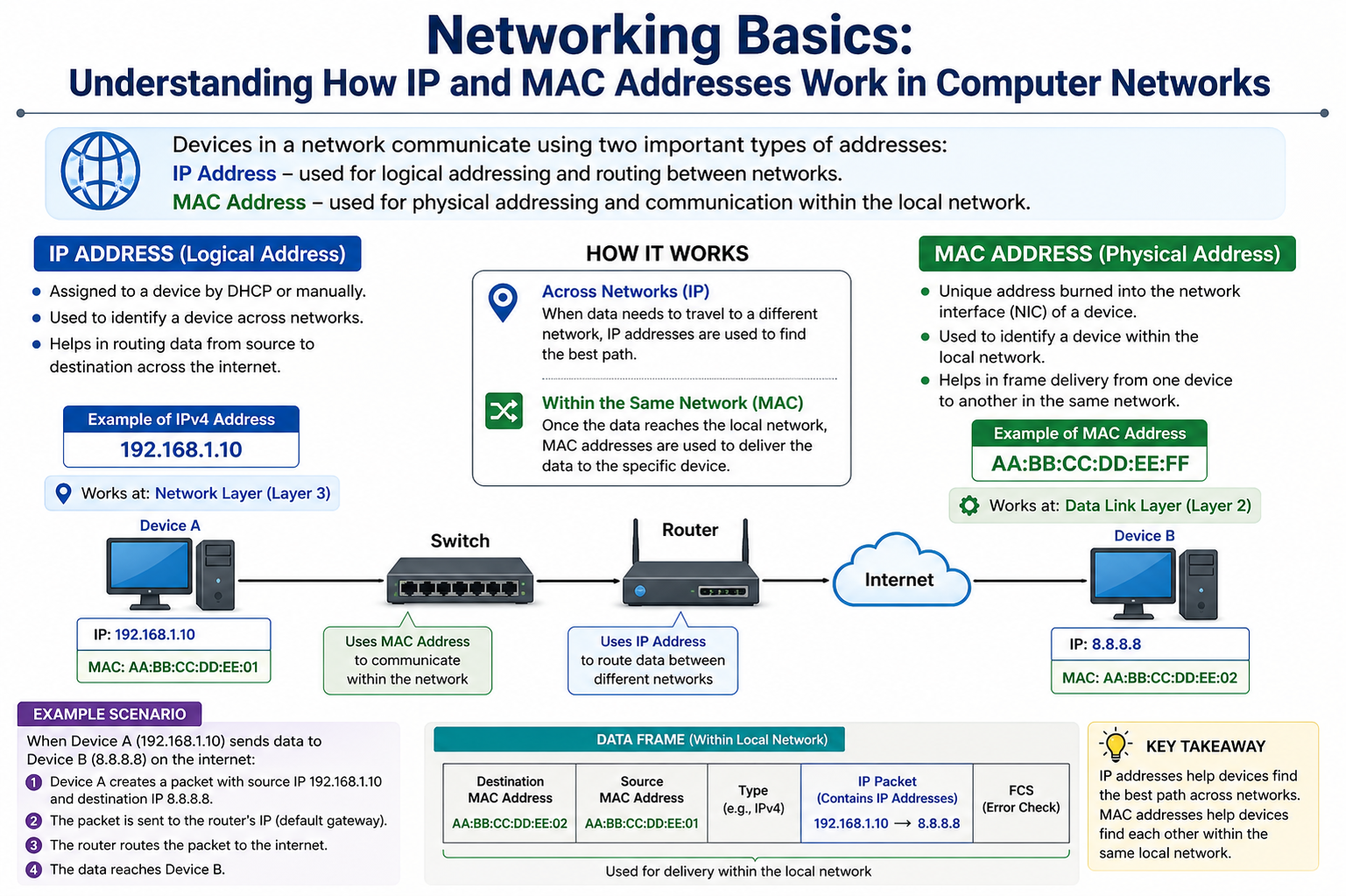
IP and MAC addresses work together to enable complete communication in networking systems. The IP address is responsible for identifying the destination network and device location, while the MAC address is used for actual delivery within the local network. This combination ensures that data is properly routed across the internet and then accurately delivered to the intended device.
When a device sends data, it first checks whether the destination is within the same network or a different one. If it is within the same network, the MAC address is used directly. If it is outside the local network, the data is sent to a router using IP addressing, and the router then handles further delivery.
Introduction to Data Transmission Process
Data transmission in networks occurs in the form of packets. Each packet contains both IP and MAC address information along with the actual data being transmitted. These packets travel through multiple devices, including switches and routers, before reaching their final destination. Each device along the path reads specific address information to determine how to forward the packet.
Role of Routers in IP-Based Communication
Routers play a critical role in managing IP-based communication. They analyze the destination IP address of incoming packets and decide the most efficient path for forwarding them. Routers operate across different networks and ensure that data can travel long distances across the internet. They do not rely on MAC addresses for external communication but use them within local segments when necessary.
Role of Switches in MAC-Based Communication
Switches operate primarily at the local network level and rely on MAC addresses to forward data. When a switch receives data, it checks the destination MAC address and sends the data directly to the correct device. This reduces unnecessary traffic and improves efficiency within local networks. Switches maintain a table of MAC addresses to track which device is connected to which port.
Address Resolution Process in Networking
One important mechanism in networking is the process of mapping IP addresses to MAC addresses. When a device knows the IP address of another device but not its MAC address, it uses a system to discover it within the local network. This ensures that data can be properly delivered even when only partial information is available.
Importance of Subnetting in IP Address Management
Subnetting is a technique used to divide larger networks into smaller, more manageable sections. It improves performance, enhances security, and allows efficient use of IP addresses. By dividing networks into sub-networks, administrators can reduce congestion and organize devices more effectively. Subnetting also helps in controlling traffic flow within large organizations.
Public and Private IP Address Usage
IP addresses are categorized into public and private types. Public IP addresses are used for communication over the internet and are globally unique. Private IP addresses are used within internal networks and are not directly accessible from the internet. This separation improves security and conserves the limited number of public IP addresses available.
Dynamic and Static IP Address Assignment
IP addresses can be assigned dynamically or statically. Dynamic IP addresses are assigned automatically by a network system and may change over time. Static IP addresses are manually configured and remain constant. Dynamic assignment is commonly used in large networks for flexibility, while static assignment is used when consistent identification is required.
Security Considerations in IP and MAC Usage
Security plays an important role in networking. IP addresses can sometimes be used to track device location or activity, while MAC addresses can be used for device identification within networks. To enhance security, modern networks use encryption, firewalls, and authentication systems to protect data and prevent unauthorized access.
Common Challenges in Networking Systems
Networking systems face several challenges such as address conflicts, routing inefficiencies, and security threats. IP address conflicts occur when two devices are assigned the same IP address. MAC spoofing is another issue where attackers attempt to disguise their device identity. These challenges are addressed using proper network configuration and security protocols.
Future of Networking and Addressing Systems
As the number of connected devices continues to grow, networking systems are evolving to become more scalable and efficient. IPv6 has already been introduced to handle the increasing demand for IP addresses. Future networking technologies will likely focus on automation, improved security, and faster data transmission methods.
Encapsulation and How Data Travels in Layers
When data is sent across a network, it does not move as a single block. Instead, it is broken into smaller units called packets, and each packet is wrapped with additional information at different layers of the networking system. This process is known as encapsulation. Each layer adds its own header, which contains important details such as source and destination addresses, error checking information, and protocol data.
At the sending side, data starts at the application level and moves down through multiple layers before being transmitted physically over the network. At each stage, more information is added to help guide the data correctly. When the data reaches the destination, the process is reversed, and each layer removes its corresponding information until the original message is restored.
Role of the OSI Model in Understanding Networking
The OSI model is a conceptual framework that helps explain how data moves across a network. It divides networking functions into seven layers, each with a specific role. The lower layers deal with physical transmission and addressing, while the upper layers handle applications and user interaction.
IP addresses mainly operate at the network layer, which is responsible for routing data between different networks. MAC addresses operate at the data link layer, which handles communication within the same local network. This separation allows networks to function efficiently by dividing responsibilities into manageable sections.
Understanding Address Resolution Process in Detail
When a device knows the IP address of another device but needs to find its MAC address, it uses a process that maps logical addresses to physical addresses. This process is essential because devices on a local network communicate using MAC addresses, even though IP addresses are used for broader routing.
In this process, a device broadcasts a request asking which device owns a specific IP address. The device with that IP responds with its MAC address, allowing direct communication to begin. This mechanism ensures that data is delivered correctly within local networks without confusion.
Dynamic Host Configuration and IP Assignment
In modern networks, IP addresses are often assigned automatically using a system that manages device configurations. This system ensures that each device receives a unique IP address without manual setup. It also provides additional network information such as default gateway and subnet mask, which are essential for communication.
This automatic assignment simplifies network management, especially in environments with many devices. It prevents conflicts and ensures smooth connectivity even when devices frequently join or leave the network.
Role of DNS in IP-Based Communication
Human users prefer using names instead of numerical addresses. To bridge this gap, a system exists that translates domain names into IP addresses. When a user enters a website name, the system finds the corresponding IP address and directs the request to the correct server.
This process happens quickly and transparently, allowing users to access websites without needing to remember numerical IP addresses. It acts as a directory system for the internet, making navigation simple and efficient.
Network Address Translation and IP Sharing
In many private networks, multiple devices share a single public IP address when accessing the internet. This is achieved through a process that modifies IP information as data passes through a router. The router keeps track of internal devices and ensures that responses are sent back to the correct device.
This method helps conserve public IP addresses and adds a layer of security by hiding internal network structures from external systems. It is widely used in homes, offices, and large organizations.
Switching vs Routing in Network Communication
Switching and routing are two fundamental processes in networking. Switching occurs within a local network and uses MAC addresses to forward data between devices. It is fast and efficient because it does not involve external networks.
Routing, on the other hand, occurs between different networks and uses IP addresses to determine the best path for data transmission. Routers analyze destination information and decide how to forward packets across multiple networks until they reach their final destination.
Both processes work together to ensure smooth communication at different levels of the network.
Importance of Subnet Masks in IP Configuration
A subnet mask is used to divide an IP address into network and host portions. It helps devices understand which part of the address refers to the network and which part refers to the specific device. This separation is important for routing decisions and network organization.
Subnet masks allow administrators to create smaller networks within larger ones, improving efficiency and reducing traffic congestion. They also help in managing IP address allocation more effectively.
MAC Address Filtering and Network Security
In some networks, access control is managed using MAC addresses. Only devices with approved MAC addresses are allowed to connect. This adds an extra layer of security by restricting unauthorized devices from joining the network.
However, MAC addresses can be changed or spoofed in some cases, so this method is usually combined with other security techniques for stronger protection. It is commonly used in controlled environments like corporate networks.
IP Address Conflicts and Troubleshooting Issues
Sometimes, two devices may accidentally receive the same IP address in a network. This leads to conflicts where communication becomes unstable or fails completely. Devices may disconnect or experience connectivity issues.
Network administrators resolve this by ensuring proper IP assignment and using automated systems that prevent duplication. Restarting network services or renewing IP configurations can also help resolve such issues.
MAC Address Table and Switching Efficiency
Switches maintain a record of MAC addresses associated with connected devices. This allows them to quickly forward data without broadcasting it to the entire network. Over time, this table becomes more efficient as the switch learns device locations.
This learning process improves network performance and reduces unnecessary data traffic. It ensures that communication within a local network remains fast and organized.
IPv6 and Future Expansion of Addressing Systems
As the number of connected devices continues to grow, the limitations of older addressing systems become more apparent. A newer version of IP addressing was introduced to solve this problem by providing a much larger address space.
This system supports a virtually unlimited number of devices, making it suitable for future technologies such as smart homes, Internet of Things devices, and large-scale global networks. It also improves efficiency and security in modern communication systems.
Real World Example of IP and MAC Interaction
When a user sends a request to open a website, multiple processes occur in the background. The device first uses the IP address to reach the server over the internet. Once the request reaches the local network of the server, MAC addresses ensure that the data is delivered to the correct machine.
This layered interaction ensures that data travels efficiently across long distances while still reaching the correct device at the final stage.
Common Misunderstandings in Networking Concepts
Many people confuse IP and MAC addresses as serving the same purpose. In reality, they operate at different levels and have distinct roles. Another common misunderstanding is that IP addresses are permanent, while in most cases they change depending on the network environment.
Understanding the difference between logical and physical addressing is essential for grasping how networks function.
Advanced Role of Routers in Complex Networks
Routers are not just simple forwarding devices; they play a much deeper role in managing traffic across large and complex networks. In modern systems, routers maintain routing tables that contain information about different network paths. These tables are constantly updated to ensure that data always takes the most efficient route.
When network conditions change due to congestion or failures, routers dynamically adjust their decisions. This ability to adapt makes them essential for maintaining stability in large-scale communication systems such as the internet. They also support multiple protocols that help in exchanging routing information between different networks.
How Network Protocols Support Communication
Protocols are sets of rules that define how data is transmitted and received across a network. Without protocols, devices would not understand each other, even if they were physically connected. These rules ensure that data formatting, addressing, error checking, and delivery processes are standardized.
IP operates as part of the internet protocol suite, which works alongside other protocols like TCP and UDP. These protocols handle different aspects of communication, such as ensuring reliable delivery or enabling faster but less controlled data transfer. Together, they create a balanced system for efficient communication.
Understanding Data Packet Structure in Depth
Every piece of data sent across a network is divided into packets. Each packet contains not only the actual data but also important control information. This includes source and destination IP addresses, MAC addresses at the local level, and sequence information that helps in reassembling data correctly.
Packets are designed to travel independently across the network. This means they may take different routes to reach the same destination. Once all packets arrive, they are reassembled in the correct order to form the original message. This method improves efficiency and allows networks to handle large amounts of data simultaneously.
Role of Error Detection and Correction in Networking
During data transmission, errors can occur due to interference, congestion, or hardware issues. To prevent corrupted data from being processed, networks use error detection methods. Each packet includes additional information that helps the receiving device check whether the data has been damaged during transmission.
If an error is detected, the system may request retransmission of the affected packet. This ensures that communication remains accurate and reliable, even in unstable network conditions.
MAC Address Persistence and Hardware Identity
A MAC address is deeply tied to the hardware of a device. It is embedded into the network interface card and remains unchanged under normal conditions. This permanence makes MAC addresses useful for identifying devices within a network.
Even if a device changes its IP address, its MAC address remains the same, which allows local networks to consistently recognize it. However, in some advanced cases, MAC addresses can be modified through software, although this is not common in standard networking environments.
Broadcasting and Its Role in Local Networks
Broadcasting is a method used to send data to all devices within a local network. Instead of targeting a specific device, the message is delivered to every connected device. This is often used when a device does not yet know the exact MAC address of the destination.
While broadcasting is useful, it can also create unnecessary traffic if used excessively. For this reason, networks are designed to minimize broadcast usage and rely more on direct communication methods whenever possible.
Unicast, Multicast, and Broadcast Communication Types
There are different ways data can be transmitted in a network. Unicast communication involves sending data from one device to another specific device. Multicast communication involves sending data to a selected group of devices. Broadcast communication sends data to all devices within a network.
Each method serves a different purpose depending on the type of application. For example, video streaming services often use multicast to efficiently deliver content to multiple users at once.
Role of Gateways in Network Connectivity
A gateway acts as a bridge between different networks, allowing communication between systems that use different protocols or architectures. It is often the entry and exit point of a local network connecting to external networks.
Gateways work closely with IP addressing to ensure that data leaving a local network is properly directed toward its destination. Without gateways, isolated networks would not be able to communicate with external systems.
Importance of Network Layers Separation
Separating networking functions into layers allows systems to operate more efficiently and independently. Each layer focuses on a specific task, such as physical transmission, addressing, routing, or application handling.
This separation makes troubleshooting easier because issues can be isolated to specific layers. It also allows developers to improve one part of the network without affecting others.
Collision Handling in Network Communication
In earlier networking systems, data collisions were common when multiple devices tried to send data simultaneously. Modern networks use advanced techniques to reduce or eliminate collisions. These include controlled access methods and intelligent switching mechanisms.
Switches help by directing traffic only to intended recipients, reducing the chances of overlapping transmissions. This improves overall network performance and stability.
Role of Network Interface Cards in Addressing
A network interface card is responsible for connecting a device to a network. It contains the MAC address and handles communication between the device and the network medium. It also converts data from digital form into signals that can be transmitted over cables or wireless connections.
Without this hardware component, devices would not be able to participate in network communication.
Wireless Networking and Addressing Behavior
In wireless networks, the same principles of IP and MAC addressing apply, but communication occurs through radio signals instead of physical cables. Devices still use MAC addresses for local identification and IP addresses for broader communication.
Wireless networks introduce additional challenges such as signal interference and range limitations, but addressing systems remain essential for maintaining order and structure.
Network Performance Optimization Techniques
Networks use various methods to improve performance, such as load balancing, traffic prioritization, and efficient routing. These techniques ensure that data flows smoothly even during high traffic conditions.
By optimizing how IP packets are routed and how MAC-based switching is handled, networks can deliver faster and more reliable communication experiences.
Security Risks Related to Addressing Systems
While IP and MAC addresses are essential for communication, they can also be exploited if not properly protected. Attackers may attempt to impersonate devices or intercept data by manipulating addressing information.
To prevent such issues, modern networks use encryption, authentication systems, and monitoring tools. These measures help protect both data and device identities.
Network Monitoring and Traffic Analysis
Network administrators continuously monitor traffic to ensure smooth operation. They analyze IP flows and MAC-level communication patterns to detect unusual behavior or performance issues.
This monitoring helps in identifying problems early and maintaining network stability. It also assists in optimizing resource usage and improving overall efficiency.
Future Trends in Networking Technologies
Networking is moving toward more intelligent and automated systems. Future networks will rely heavily on artificial intelligence to manage routing, security, and performance optimization.
With the expansion of connected devices, addressing systems will continue to evolve, ensuring that communication remains efficient and scalable
Network Addressing in Real World Applications
In practical environments, IP and MAC addresses are used constantly without users even noticing them. Every time a device connects to the internet, sends a message, or accesses a website, these addressing systems work in the background. In homes, offices, schools, and large enterprises, they ensure that millions of devices can communicate simultaneously without confusion or conflict.
For example, when multiple devices are connected to the same Wi-Fi network, each device is assigned an IP address so that the router can manage communication. At the same time, each device uses its MAC address to ensure that data packets are delivered to the correct hardware inside the local network.
How Home Networks Use IP and MAC Coordination
In a typical home network, a single router manages all connected devices such as smartphones, laptops, smart TVs, and IoT devices. The router assigns IP addresses dynamically and keeps track of MAC addresses for internal communication.
When a device requests data from the internet, the router translates that request and forwards it using the public IP address. When the response comes back, the router uses MAC addresses to deliver the data to the correct device inside the home network. This coordination allows multiple devices to share a single internet connection efficiently.
Enterprise Networks and Advanced Address Management
In large organizations, network management becomes more complex due to the high number of devices and users. Administrators divide networks into segments and assign IP addresses strategically to maintain order and performance.
MAC addresses are often used in combination with security systems to control access to sensitive areas of the network. Only authorized devices are allowed to connect, and their MAC addresses are registered in secure databases. This helps organizations maintain control over their internal communication systems.
Mobile Networks and Dynamic Addressing Systems
Mobile networks operate differently from fixed wired networks, but they still rely heavily on IP addressing. When a mobile device connects to a cellular network, it is assigned an IP address dynamically based on available network resources.
As the device moves between different towers or regions, its IP address may change, but its MAC address remains tied to its hardware. This allows the network to maintain consistent device identification even while the device is moving.
Role of Addressing in Cloud Computing Systems
Cloud computing systems rely heavily on IP addressing to manage communication between virtual machines, servers, and user devices. Each virtual resource is assigned an IP address to ensure it can be accessed over the internet or within private cloud networks.
MAC addresses are also used within virtualized environments to identify virtual network interfaces. Even though these interfaces are not physical, they still follow the same addressing principles as traditional hardware.
Virtual Networks and Software-Defined Addressing
Modern networking includes virtual networks that operate entirely through software. In these systems, IP and MAC addresses are often assigned dynamically by software controllers.
These virtual environments allow multiple isolated networks to exist on the same physical hardware. Each virtual network behaves like a real network, with its own addressing system, routing rules, and security controls.
Load Distribution and Traffic Management
In high-traffic environments, networks must distribute data efficiently to prevent overload. IP addresses help in directing traffic to different servers based on load balancing techniques.
MAC addresses ensure that once data reaches a local system, it is delivered correctly to the intended device or virtual machine. This combination improves speed, reliability, and overall system performance.
Impact of Addressing on Internet Speed and Efficiency
Efficient use of IP and MAC addressing directly impacts network speed and performance. Proper routing ensures that data takes the shortest or least congested path, while accurate MAC delivery prevents unnecessary retransmissions.
Poor configuration of addressing systems can lead to delays, packet loss, or network congestion. This is why network design and address management are critical for maintaining high performance.
Addressing in Internet of Things (IoT) Devices
IoT devices such as smart sensors, home automation systems, and wearable technology rely heavily on IP and MAC addressing. Each device must have a unique identity to communicate with other systems and send or receive data.
As the number of IoT devices increases, efficient IP management becomes more important. MAC addresses ensure that even small embedded devices can be uniquely identified within local networks.
Role of Firewalls in Controlling Address-Based Traffic
Firewalls monitor network traffic based on IP and MAC information. They decide which data packets are allowed to enter or leave a network based on predefined rules.
IP filtering helps control external access, while MAC filtering restricts internal device communication. Together, they enhance network security by blocking unauthorized or suspicious activity.
Packet Forwarding and Decision Making in Networks
When a packet arrives at a network device, decisions are made based on its IP and MAC information. Routers use IP addresses to determine where the packet should go next, while switches use MAC addresses to deliver it locally.
This layered decision-making process ensures that data flows efficiently through complex networks without unnecessary delays or confusion.
Network Segmentation for Better Performance
Large networks are often divided into smaller segments to improve performance and manageability. Each segment operates with its own range of IP addresses and MAC-based communication rules.
This segmentation reduces traffic congestion and improves security by limiting access between different parts of the network.
Address Aging and Dynamic Updates in Networks
Network devices do not always store MAC address information permanently. In many systems, MAC tables are updated dynamically, and inactive entries are removed after a certain period.
This process, known as aging, ensures that network resources are used efficiently and outdated information does not affect communication accuracy.
Global Internet Structure and Address Coordination
The internet is a massive system of interconnected networks, and IP addressing is what holds it together. Each network follows global standards to ensure that IP addresses do not conflict and communication remains consistent.
MAC addresses, while local in nature, support this global system by ensuring accurate delivery within each individual network segment.
Challenges in Large Scale Network Management
Managing IP and MAC addresses in large-scale systems comes with challenges such as address exhaustion, misconfiguration, and security threats. As networks grow, maintaining accurate records becomes increasingly important.
Automation tools and advanced management systems are used to handle these challenges efficiently and reduce human error.
Future of Intelligent Networking Systems
Future networks are expected to become more intelligent, with automated systems managing IP allocation, routing decisions, and security enforcement. Artificial intelligence will play a major role in optimizing traffic flow and predicting network behavior.
Even in these advanced systems, the fundamental roles of IP and MAC addresses will remain essential, as they form the core structure of digital communication.
IP and MAC addresses are the foundation of all modern communication systems. IP addresses enable global connectivity by directing data across networks, while MAC addresses ensure accurate delivery within local environments.
Together, they support everything from simple home networks to complex global internet infrastructures. As technology continues to evolve, these addressing systems will remain central to ensuring fast, reliable, and secure communication across all digital platforms.
Conclusion
IP and MAC addresses are the core building blocks of modern computer networking, working together to make digital communication possible across both small local networks and the global internet. IP addresses handle logical identification and routing, ensuring that data can travel between different networks and reach the correct destination across long distances. MAC addresses, on the other hand, provide physical identification at the hardware level, ensuring accurate delivery of data within a local network.
Together, these addressing systems create a structured and reliable communication process where data can move efficiently from one device to another without confusion or loss. IP addresses guide the overall path of information, while MAC addresses handle precise delivery at the final stage. This layered approach allows networks to function smoothly even when handling massive amounts of data and millions of connected devices.
As networking technology continues to evolve, especially with the growth of cloud computing, mobile systems, and IoT devices, the importance of IP and MAC addressing becomes even more significant. Future systems will focus on improving scalability, automation, and security, but the fundamental principles of addressing will remain unchanged as the foundation of all digital communication.