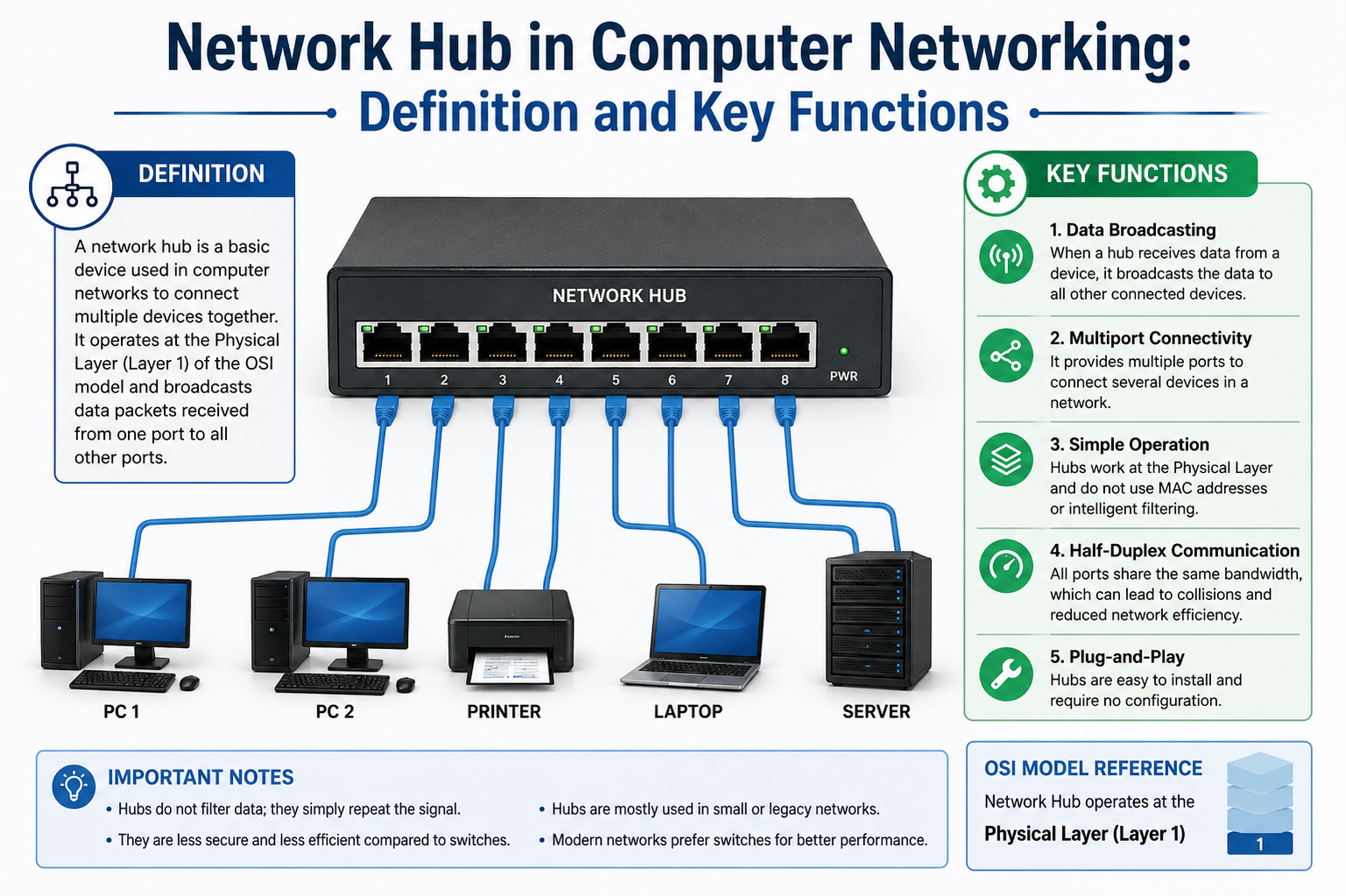
A network hub is one of the earliest and simplest networking devices used to connect multiple computers or devices within a local area network. It functions as a central connection point, allowing devices to communicate by sharing a common communication medium. In its basic form, a hub does not perform any intelligent processing of data. Instead, it operates by receiving incoming electrical or digital signals and retransmitting them to all connected ports.
This simple mechanism makes the hub easy to use and inexpensive, which is why it was widely used in early networking environments. However, its simplicity also brings limitations, especially when compared to modern networking devices such as switches and routers. Despite this, understanding the hub is important because it forms the foundation of networking concepts and helps explain how data transmission evolved over time.
Working Principle of a Network Hub
The working principle of a network hub is based on signal broadcasting. When a device connected to the hub sends data, the hub receives the signal through one of its ports. Instead of analyzing or directing the data to a specific destination, the hub regenerates the signal and broadcasts it to all other connected ports.
This means every device connected to the hub receives the same data, regardless of whether it is the intended recipient. Each device then checks the data to determine if it is relevant. If the data is not meant for it, the device simply ignores it.
Because of this broadcasting behavior, hubs operate in a shared bandwidth environment. All connected devices must compete for the same communication channel, which can lead to congestion and data collisions when multiple devices attempt to transmit data at the same time.
Physical Layer Operation in Networking
A network hub functions at the physical layer of the OSI model. This is the lowest layer, responsible for transmitting raw bit streams over a physical medium such as cables or wireless signals. Since the hub operates at this level, it does not understand data packets, addresses, or protocols.
Its only role is to regenerate and forward electrical signals. It does not perform tasks such as filtering, routing, or switching. This makes it a very basic device in terms of functionality. However, its simplicity ensures fast signal forwarding without delay caused by processing or decision-making.
Because hubs do not interpret data, they are considered “dumb” devices in networking terminology. This distinguishes them from more advanced devices that use intelligence to manage network traffic efficiently.
Types of Network Hubs
Network hubs can be broadly categorized into different types based on their functionality and usage. The most common type is the passive hub, which simply connects devices without any signal amplification. It does not regenerate or strengthen signals, which limits its effectiveness over longer distances.
Another type is the active hub. Unlike passive hubs, active hubs regenerate and amplify incoming signals before broadcasting them. This helps maintain signal strength and improves communication quality across connected devices. Active hubs require a power source to operate because of their signal processing function.
There are also intelligent or smart hubs, which include basic monitoring capabilities. These hubs can detect network issues and provide limited management features. However, even smart hubs lack the advanced traffic control features found in modern switches.
Each type of hub serves the same fundamental purpose of connecting devices, but they differ in performance and efficiency.
Role of Hubs in Data Transmission
In a hub-based network, data transmission follows a simple broadcast model. When a device sends data, the hub distributes it to all connected devices without discrimination. This creates a single collision domain, meaning all devices share the same communication space.
As a result, only one device can successfully transmit data at a time. If two devices send data simultaneously, a collision occurs, causing data loss and requiring retransmission. This reduces the overall efficiency of the network, especially as the number of connected devices increases.
Despite this limitation, hubs played a significant role in early networking systems where traffic volume was low and performance demands were minimal.
Advantages of Using a Network Hub
One of the main advantages of a network hub is its simplicity. It is easy to install and does not require complex configuration. Users can connect multiple devices quickly without advanced technical knowledge.
Another advantage is its low cost. Compared to switches and routers, hubs are inexpensive, making them suitable for small-scale or temporary networks. They also allow easy network expansion by providing multiple ports for additional devices.
Hubs can also act as basic signal repeaters in small networks, helping maintain connectivity over short distances. Their straightforward design makes them reliable in environments where advanced traffic management is not required.
Disadvantages and Limitations
Despite their simplicity, network hubs have several significant disadvantages. The most important limitation is the lack of traffic management. Since hubs broadcast data to all devices, network efficiency decreases as more devices are added.
Another major issue is the high chance of data collisions. Because all devices share the same communication channel, simultaneous transmissions can lead to interference and data loss. This requires frequent retransmissions, further slowing down the network.
Hubs also lack security features. Since data is sent to all connected devices, any device can potentially access information not intended for it. This makes hubs unsuitable for environments where data privacy is important.
Additionally, hubs do not support full-duplex communication. Devices connected through a hub typically operate in half-duplex mode, meaning they can either send or receive data at one time, but not both simultaneously.
Network Collisions and Efficiency Issues
One of the most critical problems in hub-based networks is data collision. A collision occurs when two or more devices attempt to transmit data at the same time over the shared medium. When this happens, the data packets interfere with each other and become corrupted.
To handle collisions, devices must wait and retransmit data after a random delay. This process reduces network efficiency and increases latency. As the number of devices grows, the probability of collisions increases significantly, making hubs unsuitable for large networks.
This inefficiency is one of the main reasons hubs have been replaced by switches in modern networking environments.
Comparison with Switches and Routers
When compared to switches, hubs are far less efficient. A switch intelligently forwards data only to the intended recipient device by using MAC addresses. This reduces unnecessary traffic and eliminates collisions in most cases.
Routers, on the other hand, operate at a higher layer and are used to connect different networks. They manage data traffic between multiple networks and provide advanced routing capabilities.
In contrast, a hub simply broadcasts all data to every device without any filtering or decision-making. This fundamental difference makes hubs outdated in modern networking systems, although they are still useful for educational purposes and basic network setups.
Role of Hubs in Modern Networking History
Although hubs are rarely used in modern networks, they played an important role in the development of computer networking. In early LAN setups, hubs were widely used to connect multiple computers in offices and small organizations.
They provided a simple way to share files, printers, and internet connections before more advanced devices became affordable. Over time, as network demands increased, switches replaced hubs due to their better performance and efficiency.
Today, hubs are mostly found in legacy systems or used for learning purposes in networking education.
Collision Domains and Network Structure
A collision domain refers to a network segment where data packets can collide with one another during transmission. In a hub-based network, all connected devices belong to a single collision domain.
This means that any device transmitting data affects all others in the network. The larger the collision domain, the higher the chance of network congestion and performance degradation.
Modern switches divide networks into multiple collision domains, greatly improving efficiency. This is one of the key reasons why switches have replaced hubs in most environments.
Hub Functionality and Relevance
Network hubs represent the simplest form of networking devices, focusing purely on connectivity without intelligence or traffic management. They operate by broadcasting data to all connected devices, making them easy to use but inefficient for modern networking needs.
While hubs are no longer widely used in professional environments, they remain important for understanding the basics of network communication. Their limitations helped drive the development of more advanced devices like switches and routers, which form the backbone of today’s high-performance networks.
Evolution of Network Hubs in Computer Networks
The development of network hubs is closely tied to the early evolution of computer networking. In the beginning stages of local area networks, there was a need for a simple device that could connect multiple computers without requiring complex configuration. Hubs fulfilled this requirement by acting as a central point of connection where all devices could communicate through a shared medium.
In those early networks, data traffic was minimal, and the number of connected devices was relatively small. Because of this, the inefficiencies of hubs were not immediately noticeable. However, as organizations began expanding their digital infrastructure and more devices were added to networks, the limitations of hubs became more apparent. The broadcast nature of hubs led to congestion, frequent data collisions, and reduced performance.
This gradual shift in network demand eventually led to the development of more intelligent devices such as switches. These devices were designed to overcome the limitations of hubs by introducing data filtering and dedicated communication paths. As a result, hubs slowly transitioned from being a standard networking component to a legacy device used primarily for basic or educational purposes.
Data Flow Mechanism in Hub-Based Networks
In a hub-based network, data flow follows a very simple but inefficient mechanism. When a device sends a data frame, the hub receives it through one of its ports and immediately retransmits it to all other ports. This means that every connected device receives the same signal, regardless of whether it is the intended destination.
Each device then examines the data and determines whether it should process it or ignore it. This constant broadcasting creates unnecessary traffic within the network. Since multiple devices share the same communication channel, only one transmission can successfully occur at a time without interference.
This structure leads to what is known as a shared bandwidth environment. In such an environment, the available network speed is divided among all connected devices, reducing overall performance as more devices join the network.
Hub Operation and Signal Handling
The primary function of a hub is signal regeneration and forwarding. When an electrical signal enters the hub, it may weaken due to distance or interference. The hub regenerates this signal to restore its original strength before sending it to all connected devices.
However, unlike modern networking devices, the hub does not modify, interpret, or analyze the content of the signal. It simply repeats it. This lack of intelligence makes the hub extremely fast in forwarding signals but inefficient in managing network traffic.
Since hubs operate at the physical layer, they deal only with raw bits and electrical pulses rather than structured data packets. This further limits their ability to control or optimize communication within the network.
Network Performance Challenges with Hubs
One of the most significant challenges in hub-based networks is performance degradation. As the number of connected devices increases, the likelihood of simultaneous data transmission also increases. This leads to frequent collisions where multiple signals interfere with each other.
When a collision occurs, the data becomes corrupted and must be retransmitted. This process not only wastes bandwidth but also increases network delay. Over time, the network becomes slower and less efficient, especially under heavy traffic conditions.
Another performance issue arises from the broadcast nature of hubs. Since every data frame is sent to all devices, unnecessary processing occurs on each device, even when the data is irrelevant. This further reduces overall system efficiency.
Security Concerns in Hub Networks
Security is another major limitation of hub-based networking. Because all data is broadcast to every connected device, any device on the network can potentially intercept and view the transmitted data. This creates a serious risk of unauthorized access to sensitive information.
Unlike switches, which send data only to specific recipients, hubs do not provide any form of data isolation. This makes them highly vulnerable in environments where confidentiality is important.
Additionally, hubs do not support advanced security features such as encryption, access control, or traffic monitoring. As a result, they are not suitable for modern networks where cybersecurity is a critical requirement.
Collision Handling and Network Recovery
In hub-based networks, collision handling is managed by the connected devices rather than the hub itself. When a collision is detected, devices use a method called backoff strategy, where they wait for a random period before attempting to retransmit the data.
This process reduces the chance of repeated collisions but does not eliminate the underlying problem. As traffic increases, the number of retransmission attempts also increases, leading to further delays and inefficiencies.
This self-managed recovery system places additional burden on devices, reducing overall network performance and reliability.
Role of Hubs in Small and Educational Networks
Despite their limitations, hubs still find relevance in certain environments. In very small networks where only a few devices are connected, the impact of collisions and broadcast traffic is minimal. In such cases, hubs can provide a simple and cost-effective solution for basic connectivity.
Hubs are also commonly used in educational settings to teach fundamental networking concepts. Because they clearly demonstrate how data is broadcast and how collisions occur, they help students understand the basic principles of network communication.
By observing hub behavior, learners can better appreciate the need for more advanced networking devices such as switches and routers.
Comparison of Hub Behavior with Modern Network Devices
When comparing hubs to modern network devices, the differences are significant. A hub broadcasts data to all devices without any filtering, while a switch intelligently forwards data only to the intended recipient. This difference alone drastically improves network efficiency in switch-based systems.
Routers go even further by managing traffic between different networks and determining the best path for data transmission. They operate at higher layers of the networking model and provide advanced features such as routing protocols, firewall protection, and network address translation.
In contrast, hubs remain limited to basic signal forwarding at the physical layer, making them unsuitable for complex networking environments.
Impact of Hubs on Network Scalability
Scalability refers to the ability of a network to grow and handle increased traffic without performance degradation. In hub-based networks, scalability is very limited. As more devices are added, the amount of broadcast traffic increases significantly.
Since all devices share the same bandwidth and collision domain, performance decreases rapidly with growth. This makes hubs unsuitable for large or expanding networks.
Modern networking devices solve this problem by dividing networks into smaller segments and using intelligent traffic management techniques. This allows networks to scale efficiently without major performance issues.
Troubleshooting Hub-Based Networks
Troubleshooting in hub-based networks is relatively simple due to their basic design. Since all devices are connected through a single central point, identifying physical connectivity issues is straightforward.
However, diagnosing performance problems is more challenging. Issues such as collisions, congestion, and signal degradation are common but difficult to isolate because the hub does not provide diagnostic information or traffic monitoring.
Network administrators often rely on external tools to analyze traffic and identify bottlenecks in hub-based systems.
Historical Importance in Networking Development
Although hubs are considered outdated today, their role in networking history is significant. They provided the foundation for early LAN development and made it possible for multiple computers to communicate in a shared environment.
Without hubs, the transition from isolated systems to connected networks would have been more complex and expensive. They served as a stepping stone toward the development of more advanced networking technologies.
Their simplicity also made them widely accessible, helping businesses and institutions adopt networking solutions during the early stages of digital transformation.
Transition from Hubs to Switch-Based Networks
The transition from hubs to switches marked a major milestone in networking technology. Switches introduced the ability to learn device addresses and forward data selectively, which eliminated many of the inefficiencies associated with hubs.
This shift significantly improved network performance, reduced collisions, and enhanced security. As a result, hubs were gradually phased out of most commercial and enterprise networks.
Today, switches dominate modern networking environments, while hubs are mostly used in specialized or educational scenarios.
Future Relevance of Network Hubs
In modern networking, hubs have very limited practical relevance. However, they still serve as useful tools for learning and understanding basic network behavior. Their simplicity makes them ideal for demonstrating fundamental concepts such as broadcasting, collisions, and shared bandwidth.
While they are unlikely to return as mainstream networking devices, their historical importance and educational value ensure that they remain part of networking curricula and basic network setups.
Final Understanding of Network Hubs
A network hub represents the simplest form of network connectivity device, designed to connect multiple devices in a shared communication environment. It operates by broadcasting data to all connected devices without any form of intelligence or filtering.
Although hubs are easy to use and inexpensive, their limitations in performance, security, and scalability make them unsuitable for modern networking needs. However, their role in the evolution of computer networks is undeniable, as they laid the foundation for more advanced technologies that power today’s interconnected digital world.
Real-World Use Cases of Network Hubs
Network hubs were once widely used in small office and home networks where simplicity and cost-effectiveness were more important than performance. In such environments, a hub made it easy to connect multiple computers together for basic file sharing, printer access, and simple communication. Since configuration requirements were minimal, users could quickly set up a functioning network without specialized technical knowledge.
In very small environments with low traffic, hubs could still perform adequately. For example, in temporary setups such as training labs or experimental network demonstrations, hubs provide a straightforward way to observe how devices communicate over a shared medium. Their predictable behavior makes them useful in controlled scenarios where performance is not the primary concern.
However, as soon as network traffic increases or multiple users begin transmitting data simultaneously, hubs begin to show their weaknesses. This is why their usage has declined significantly in professional and enterprise environments.
Technical Limitations in Detail
One of the key technical limitations of a network hub is the absence of data intelligence. Unlike modern devices that inspect data frames and make forwarding decisions, a hub treats every incoming signal identically. This means it cannot differentiate between source and destination addresses.
Because of this limitation, hubs create a single collision domain where all devices share the same communication space. This leads to frequent interference when multiple devices attempt to send data at the same time. The resulting collisions reduce throughput and increase retransmission delays.
Another limitation is the inability to support full-duplex communication. In hub-based networks, devices generally operate in half-duplex mode, meaning they can either send or receive data at a given time but cannot do both simultaneously. This further restricts communication speed and efficiency.
Additionally, hubs lack any form of bandwidth optimization. Since all devices share the same channel, available bandwidth is divided equally among them, regardless of actual usage needs. This results in poor resource utilization, especially in networks with uneven traffic distribution.
Broadcast Storms and Network Congestion
A significant issue in hub-based networks is the possibility of broadcast storms. Since hubs forward all incoming data to every connected device, excessive traffic can quickly overwhelm the network. When multiple devices continuously send data, the network becomes saturated with unnecessary broadcasts.
This leads to severe congestion, where legitimate data struggles to reach its destination efficiently. In extreme cases, the network may become nearly unusable due to constant collisions and retransmissions.
Broadcast storms highlight one of the fundamental weaknesses of hubs: their inability to control or limit traffic flow. Modern networking devices avoid this issue by implementing filtering, segmentation, and intelligent forwarding mechanisms.
Physical Structure and Port Functionality
A network hub typically consists of multiple ports that serve as connection points for devices. Each port functions identically, meaning there is no distinction between input and output ports. Any signal received on one port is immediately repeated across all others.
Internally, the hub contains simple electronic circuitry responsible for signal regeneration and distribution. There is no memory, processing unit, or address table involved in its operation. This minimalistic design contributes to its low cost and ease of manufacturing.
The absence of intelligent hardware also means that hubs do not require software configuration or firmware updates. This plug-and-play nature makes them easy to deploy, especially in non-critical environments.
Energy and Power Considerations
Most active hubs require an external power source to operate. This is because signal amplification and regeneration require electrical energy. Passive hubs, on the other hand, do not use power but also do not enhance signal strength, limiting their effective range.
Power consumption in hubs is generally low compared to modern networking devices, but this advantage is outweighed by their inefficiency in handling network traffic. As networking technology advanced, energy-efficient switches and routers replaced hubs while providing significantly better performance.
Network Design Impact of Hubs
The presence of hubs in a network significantly influences its design structure. Since all devices share a single collision domain, network architects must carefully limit the number of connected devices to avoid excessive congestion.
This restriction makes hub-based networks less flexible and less scalable. In contrast, modern networks use hierarchical designs with switches and routers to segment traffic and improve performance.
Hubs also limit the ability to implement advanced network topologies. While simple star configurations are possible, more complex and efficient designs are not feasible due to the broadcast nature of hubs.
Why Hubs Became Obsolete
The primary reason hubs became obsolete is their inability to handle increasing network demands. As internet usage expanded and applications became more data-intensive, the limitations of hubs became critical.
Slow data transmission, frequent collisions, and lack of security made hubs unsuitable for modern computing environments. Businesses required faster, more reliable, and more secure communication systems, which hubs could not provide.
Switches emerged as a superior alternative by introducing intelligent forwarding based on MAC addresses. This eliminated unnecessary traffic and significantly improved network performance, leading to the gradual replacement of hubs in most environments.
Educational Importance of Network Hubs
Despite their outdated status, network hubs remain important in educational contexts. They provide a clear and simple model for understanding fundamental networking concepts such as signal broadcasting, collision domains, and shared bandwidth.
By studying hubs, learners can better appreciate how data flows in a network and why more advanced devices are necessary. Practical demonstrations using hubs help visualize how collisions occur and how network inefficiencies arise.
This foundational understanding is essential for building knowledge about more complex networking technologies.
Future Perspective and Legacy
Although network hubs are no longer used in modern infrastructure, their legacy remains significant. They represent an important stage in the evolution of computer networking and helped pave the way for more advanced technologies.
Their simple design and operation provided the groundwork for understanding network communication at a basic level. Even though they have been replaced by switches and routers, the principles they demonstrate are still relevant in networking education.
In future networking systems, the focus continues to move toward higher efficiency, automation, and intelligence. While hubs do not play a role in this advancement, their contribution to early networking development ensures they remain an important part of networking history.
A network hub is a basic connectivity device that operates by broadcasting data to all connected devices without filtering or intelligence. While it is simple, inexpensive, and easy to use, it suffers from major limitations such as collisions, congestion, and poor scalability.
These drawbacks led to its replacement by more advanced networking devices. However, hubs still hold educational value and historical importance in understanding how computer networks evolved from simple shared communication systems to highly efficient, intelligent infrastructures used today.
Internal Architecture of a Network Hub
A network hub is built using very simple internal hardware components compared to modern networking devices. At its core, it contains a repeater system that is responsible for receiving electrical signals from one port and regenerating them for all other ports. There is no processing unit, memory table, or intelligent switching mechanism involved in this process.
The internal structure is designed to focus purely on signal distribution. When a signal enters the hub, it is amplified and retransmitted instantly. This ensures that all connected devices receive the same signal strength, reducing the chances of signal degradation over short distances.
Because of this minimal design, hubs are highly reliable in terms of basic connectivity. However, reliability in connectivity does not translate into efficiency or performance in complex networking environments. The lack of internal decision-making capability is the main reason why hubs are considered outdated in modern systems.
Signal Propagation Behavior in Hubs
Signal propagation in a hub-based network is uniform and uncontrolled. Once a signal enters the hub, it is copied and sent out through all available ports. This behavior is known as broadcast propagation.
Unlike intelligent devices that forward data selectively, hubs do not maintain any record of connected devices or their addresses. This means that every signal is treated equally, regardless of its destination.
This uniform propagation leads to inefficiency because every device must process all incoming signals. Even if the data is not intended for a specific device, it still consumes processing time and network resources. Over time, this behavior significantly reduces overall network efficiency.
Half-Duplex Communication Environment
Network hubs operate in a half-duplex communication mode, which is one of their most important technical limitations. In half-duplex mode, data transmission can occur in only one direction at a time. A device can either send or receive data, but not both simultaneously.
This restriction is due to the shared communication medium created by the hub. Since all devices are connected to the same channel, simultaneous two-way communication is not possible without causing interference.
Modern networking devices overcome this limitation by supporting full-duplex communication, allowing simultaneous sending and receiving of data. This results in much higher performance and smoother communication.
Collision Detection and Network Behavior
In hub-based networks, collision detection is handled indirectly by connected devices using protocols such as Carrier Sense Multiple Access with Collision Detection. Devices first check whether the network is free before transmitting data. If two devices transmit at the same time, a collision occurs.
When a collision is detected, both devices stop transmission and wait for a random backoff time before retrying. This method reduces repeated collisions but does not eliminate them entirely.
As the number of devices increases, the probability of collisions rises significantly. This leads to repeated interruptions in data flow and reduces the efficiency of the entire network.
Bandwidth Sharing Mechanism
In a network hub environment, bandwidth is shared equally among all connected devices. Since all devices use the same communication channel, available bandwidth is not dedicated to any single device.
This shared model means that the more devices connected to the hub, the less bandwidth each device effectively receives. Even if only one device is actively transmitting data, others still remain part of the same shared environment.
This inefficient bandwidth utilization is one of the main reasons hubs cannot support modern high-speed networking requirements.
Latency and Delay Issues in Hub Networks
Latency refers to the time delay between data transmission and reception. In hub-based networks, latency is often higher due to collisions, retransmissions, and shared bandwidth limitations.
Every time a collision occurs, data must be retransmitted, adding additional delay. Similarly, when multiple devices compete for access to the network, they must wait for their turn, further increasing response time.
These delays make hubs unsuitable for applications that require real-time communication, such as video conferencing, online gaming, or large-scale data processing.
Impact of Network Load on Hub Performance
Network load has a direct impact on the performance of a hub. Under low load conditions, hubs can function adequately since collisions are rare. However, as network traffic increases, performance drops sharply.
High load conditions result in frequent collisions, increased retransmissions, and severe congestion. Since hubs do not have traffic management capabilities, they cannot prioritize or organize data flow.
This makes performance unpredictable and inconsistent, especially in environments where multiple users access the network simultaneously.
Lack of Traffic Segmentation
One of the major weaknesses of network hubs is the absence of traffic segmentation. In modern networking, segmentation allows networks to be divided into smaller, manageable sections to improve efficiency.
Hubs do not support this feature because all devices are part of a single broadcast domain and collision domain. This means that any data sent by one device affects the entire network.
Without segmentation, it becomes impossible to isolate traffic or optimize performance based on usage patterns.
Comparison of Logical Operation vs Physical Operation
Hubs operate purely at the physical layer, meaning they only deal with raw electrical signals. They do not understand logical addressing or data structure.
In contrast, switches operate at the data link layer and use MAC addresses to make forwarding decisions. Routers operate at even higher layers and manage communication between different networks using IP addresses.
This distinction highlights the simplicity of hubs compared to more advanced networking devices. While hubs focus only on physical signal transmission, modern devices incorporate logical intelligence for efficient communication.
Network Efficiency Decline with Expansion
As a hub-based network expands, efficiency decreases rapidly. Each additional device increases the amount of shared traffic and the likelihood of collisions.
This creates a nonlinear performance decline, meaning that adding more devices does not just slightly reduce performance but can significantly degrade the entire network.
This lack of scalability is one of the strongest reasons why hubs have been replaced in almost all modern network infrastructures.
Reliability vs Efficiency Trade-off
Hubs are considered reliable in terms of basic connectivity because they have very few components that can fail. However, this reliability comes at the cost of efficiency.
Since there is no complex processing or decision-making, hubs rarely experience internal software or configuration issues. But their inability to manage traffic makes them inefficient in practical use cases.
This trade-off between simplicity and performance is a key factor in understanding why hubs are no longer preferred.
Environmental and Deployment Considerations
Hubs are generally easy to deploy in small environments because they require minimal setup. They are plug-and-play devices that do not need configuration or specialized installation.
However, in larger environments, their limitations outweigh their ease of use. Network administrators prefer devices that offer control, monitoring, and optimization features, which hubs lack.
This has led to their replacement in almost all enterprise and industrial networking systems.
Final Technical Understanding
From a technical perspective, a network hub is a basic signal distribution device that operates without intelligence or decision-making capability. It simply repeats incoming signals to all connected devices, creating a shared communication environment.
While this simplicity makes hubs easy to understand and use, it also introduces major limitations in performance, security, and scalability.
Modern networking has moved far beyond this model, adopting intelligent devices that manage traffic efficiently and support high-speed communication. However, the foundational role of hubs remains important in understanding the evolution of networking technology.
Conclusion
A network hub is one of the most basic devices in computer networking, designed to connect multiple devices within a local network by acting as a simple central point of communication. Its primary function is to receive incoming data from one device and broadcast it to all other connected devices without any form of filtering, processing, or intelligence. This straightforward behavior makes hubs easy to use and inexpensive, which contributed to their popularity in early networking systems.
However, the same simplicity that defines hubs also creates significant limitations. Because all devices share the same communication channel, issues such as data collisions, network congestion, and inefficient bandwidth usage frequently occur. As the number of connected devices increases, network performance decreases sharply, making hubs unsuitable for larger or modern networks. Additionally, the lack of security features and traffic control further reduces their practicality in today’s data-driven environments.
Despite these drawbacks, network hubs played an important role in the early development of computer networks. They helped establish the foundation for device connectivity and enabled basic communication between computers in local environments. Over time, they were gradually replaced by more advanced technologies such as switches and routers, which offer intelligent data forwarding, improved speed, and better network management.
In modern networking, hubs are rarely used except in educational settings or very small-scale setups where performance demands are minimal. Even though they are largely obsolete, understanding how hubs work is essential for grasping the evolution of networking technology and the reasons behind the development of more efficient systems.