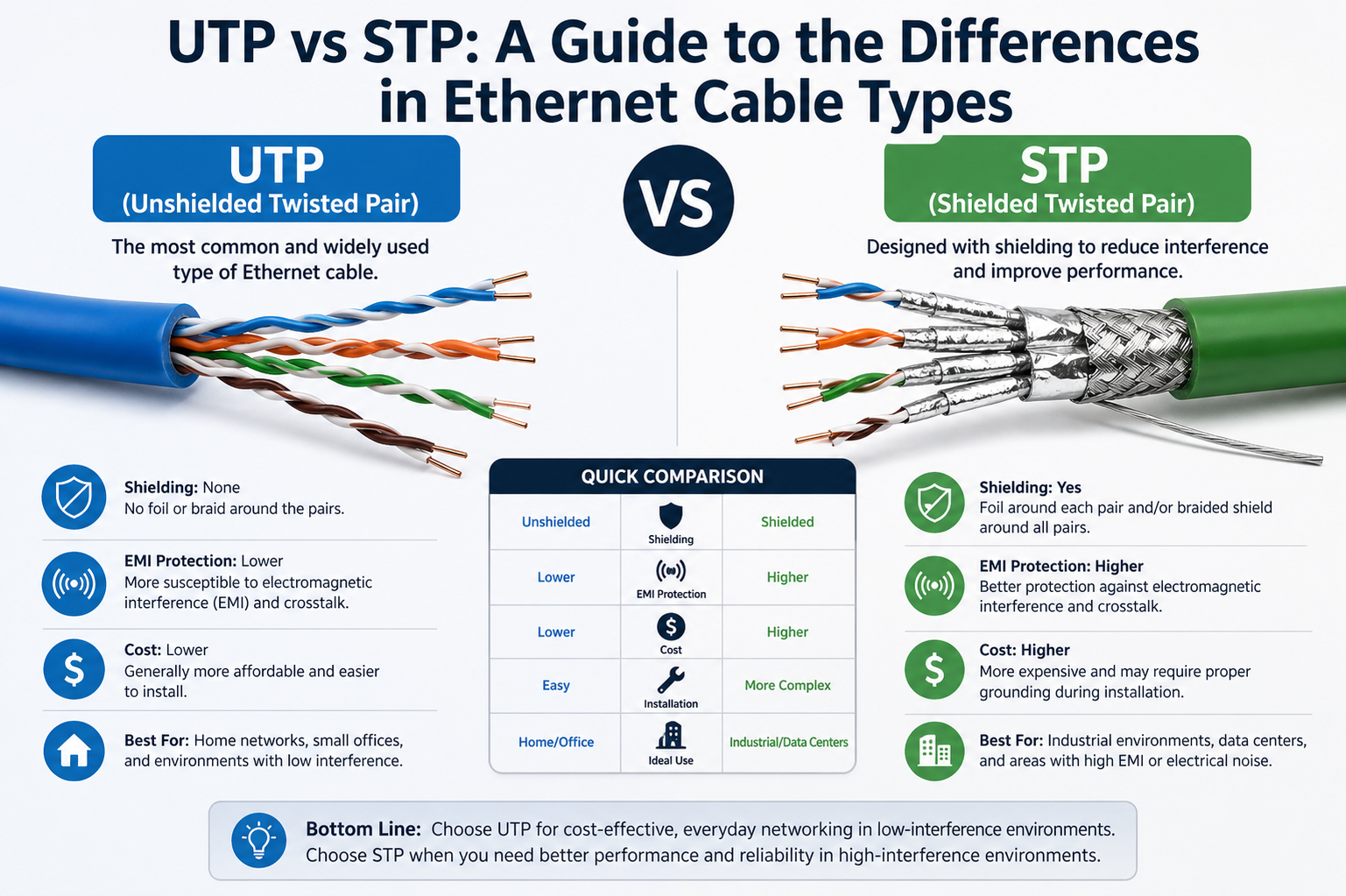
Ethernet cables are the backbone of wired networking systems, enabling devices to communicate and exchange data efficiently. Among the most widely used types are twisted pair cables, which are designed to minimize interference and maintain signal quality over distances. These cables come in different variations, but UTP (Unshielded Twisted Pair) and STP (Shielded Twisted Pair) are the most common categories. Both serve the same fundamental purpose of transmitting data, yet they differ significantly in construction, performance, and suitability for different environments. Understanding these differences is essential for designing reliable and efficient network systems.
Structure of Twisted Pair Cables
Twisted pair cables consist of pairs of copper wires twisted together in a helical pattern. This twisting is not random; it is carefully engineered to reduce electromagnetic interference and crosstalk between adjacent pairs. Each pair carries a balanced signal, where one wire transmits the signal while the other carries the inverse, helping cancel out external noise. The main distinction between cable types lies in whether additional shielding is applied around these twisted pairs. UTP cables rely solely on twisting for protection, while STP cables incorporate extra shielding layers to enhance noise resistance.
Deep Dive into UTP Design
UTP cables are designed with simplicity and efficiency in mind. They contain multiple twisted pairs of copper wires enclosed in a simple outer jacket without any metallic shielding. This minimalistic structure makes them lightweight and flexible, which greatly simplifies installation and routing through buildings and network racks. The absence of shielding also reduces production costs, making UTP cables an economical choice for large-scale deployments. Despite lacking additional protective layers, their twisted pair design still provides a reasonable level of resistance against interference in typical environments.
Performance Characteristics of UTP
The performance of UTP cables depends largely on environmental conditions and cable category. In low-interference environments such as residential homes and small offices, UTP cables perform efficiently and reliably. They support high-speed data transmission suitable for internet browsing, video streaming, and local network communication. However, in environments with significant electromagnetic interference, such as industrial facilities, performance may degrade due to signal distortion. The effectiveness of UTP cables is therefore closely tied to proper installation practices and maintaining distance from electrical sources.
Common Categories of UTP
UTP cables are classified into different categories based on their performance capabilities, including bandwidth and data transmission speed. Lower categories are suitable for basic networking needs, while higher categories support faster speeds and improved signal integrity over longer distances. Each category is designed to meet specific networking standards, ensuring compatibility with modern communication systems. As technology advances, higher-category UTP cables have become more common in both commercial and residential applications, supporting increasingly demanding digital environments.
Real World Applications of UTP
UTP cables are widely used in everyday networking scenarios due to their affordability and ease of installation. They are commonly found in home internet connections, office LAN setups, and educational institutions. Their flexibility allows them to be easily routed through walls, ceilings, and network conduits. Because most standard environments do not have high levels of electromagnetic interference, UTP cables are sufficient for delivering stable and efficient network performance in these settings.
Limitations of UTP
Despite their widespread use, UTP cables do have limitations. The most significant drawback is their susceptibility to external interference in electrically noisy environments. Without shielding, signals traveling through UTP cables can be affected by nearby power lines, machinery, and other electronic devices. This can lead to data loss, reduced transmission quality, and network instability. Additionally, UTP cables are less suitable for long-distance high-speed transmissions in environments where signal integrity must be strictly maintained.
Deep Dive into STP Design
STP cables are engineered with enhanced protection in mind. Unlike UTP cables, they include an additional shielding layer that surrounds the twisted wire pairs. This shielding acts as a barrier against external electromagnetic interference, ensuring that data signals remain stable and accurate even in challenging environments. The construction of STP cables is more complex, as it involves careful layering of insulating and conductive materials to achieve optimal protection without compromising flexibility.
Types of Shielding in STP
STP cables can use different types of shielding depending on the level of protection required. Some designs use foil shielding wrapped around each individual pair, while others use braided shielding that covers all pairs collectively. In advanced configurations, a combination of both methods is used for maximum interference protection. Each shielding type is designed to address specific environmental challenges, ensuring reliable performance in high-noise areas such as factories, hospitals, and data centers.
Performance Advantages of STP
The primary advantage of STP cables is their ability to maintain signal integrity in environments with high electromagnetic interference. The shielding significantly reduces noise, allowing data to be transmitted more accurately and consistently. This results in fewer transmission errors and improved network reliability. STP cables are particularly beneficial in critical systems where data accuracy is essential, such as industrial automation, medical equipment networks, and high-performance computing environments.
Environments Where STP Excels
STP cables are best suited for environments where electrical interference is unavoidable. Industrial plants with heavy machinery, manufacturing units, and locations with dense electrical wiring benefit greatly from STP installations. They are also used in environments where high-security data transmission is required, as the shielding provides an additional layer of signal protection. In such settings, the improved stability of STP cables outweighs their higher cost and installation complexity.
Limitations of STP
While STP cables offer superior protection, they also come with certain disadvantages. They are generally more expensive than UTP cables due to the additional materials and manufacturing complexity. Their thicker construction makes them less flexible, which can complicate installation in tight or complex spaces. Additionally, proper grounding is essential for STP cables to function effectively; without correct grounding, the shielding may not perform as intended, reducing its benefits.
Signal Interference and Noise Explained
Signal interference occurs when unwanted external signals disrupt the transmission of data through network cables. This can be caused by electromagnetic fields generated by electrical devices, radio frequency sources, or even nearby cables carrying high voltage. In UTP cables, the absence of shielding means that twisted pairs must rely solely on their design to minimize this interference. In contrast, STP cables use physical shielding to block or reduce these external influences, resulting in cleaner and more stable data transmission.
Installation Differences
Installing UTP cables is generally simpler due to their lightweight and flexible nature. They can be easily routed through buildings without requiring special grounding considerations. STP cables, however, require more careful installation practices. Proper grounding is essential to ensure that the shielding effectively diverts interference away from the signal-carrying wires. This makes STP installation more technically demanding and time-consuming compared to UTP.
Cost and Maintenance Comparison
Cost is a major factor when choosing between UTP and STP cables. UTP cables are more affordable and widely available, making them suitable for large-scale deployments with budget constraints. STP cables, due to their additional shielding materials and construction complexity, are more expensive. Maintenance requirements also differ, as STP systems require proper grounding checks and occasional inspection to ensure shielding effectiveness, whereas UTP systems generally require less maintenance.
Durability and Lifespan Factors
Both UTP and STP cables are designed for long-term use, but their durability depends on environmental conditions. UTP cables perform well in stable environments but may degrade faster if exposed to excessive interference or physical stress. STP cables, while more robust against interference, can be physically bulkier and may require more careful handling during installation. Proper installation and environmental management play key roles in extending the lifespan of both cable types.
Network Speed and Bandwidth Considerations
Both UTP and STP cables can support high-speed data transmission depending on their category and quality. However, STP cables maintain more consistent performance in high-interference environments, which can indirectly support higher effective speeds by reducing retransmissions and errors. UTP cables can achieve similar speeds in clean environments but may experience fluctuations when exposed to noise. Bandwidth capabilities are more dependent on cable category than shielding alone.
EMI and RFI Protection Differences
Electromagnetic interference (EMI) and radio frequency interference (RFI) are major factors affecting network performance. UTP cables rely on twisting techniques to minimize these effects, which works well in low-interference environments. STP cables, however, use shielding to actively block these disturbances, offering a higher level of protection. This makes STP cables more suitable for environments where EMI and RFI are persistent challenges.
Choosing Between UTP and STP
The choice between UTP and STP cables depends on the specific requirements of the network environment. For general home and office use, UTP cables are usually sufficient due to their cost-effectiveness and ease of installation. For industrial or high-interference environments, STP cables provide the reliability needed for stable communication. Evaluating factors such as budget, installation complexity, and environmental conditions is essential when making a selection.
Future of Ethernet Cabling
As networking technology continues to evolve, both UTP and STP cables remain relevant in different contexts. Advances in cable design and shielding techniques are improving performance across both types. While wireless technology is expanding rapidly, wired connections still play a critical role in ensuring stable, high-speed, and secure data transmission. The demand for reliable infrastructure ensures that twisted pair cables will continue to be an important part of networking systems for years to come.
UTP in Modern Networking Infrastructure
UTP cables continue to play a dominant role in modern networking due to their practicality and scalability. In large office buildings, educational campuses, and residential complexes, UTP cabling systems are widely deployed because they are easy to install in bulk and cost-efficient to maintain. Their compatibility with standard networking equipment also makes them a universal choice for most Ethernet-based systems. Even as network speeds increase and digital demands grow, UTP cables have evolved through improved categories that support higher bandwidths and faster data transmission without requiring major changes in infrastructure.
How UTP Handles Signal Transmission
The way UTP cables transmit data is based on balanced signal transmission across twisted pairs. Each pair of wires carries signals in opposite directions, which helps cancel out a portion of external noise through a process known as differential signaling. This design is highly effective in controlled environments where interference is minimal. However, since there is no physical shielding, any strong electromagnetic source nearby can still introduce distortion into the signal. This makes proper cable management and physical separation from power lines an important consideration when using UTP systems.
Scalability of UTP Networks
One of the strongest advantages of UTP cabling is its scalability. Network administrators can easily expand existing systems by adding more UTP cables without requiring major redesigns or expensive modifications. This flexibility makes UTP ideal for growing organizations where network expansion is frequent. The simplicity of its design allows for quick deployment, which is especially useful in environments where downtime must be minimized. Because of this, UTP remains a backbone technology in structured cabling systems worldwide.
STP in High-Performance Environments
STP cables are often chosen in environments where performance reliability is more important than cost. Data centers, industrial automation systems, and critical communication networks rely on STP because it minimizes data corruption caused by external interference. In such environments, even small disruptions in signal quality can lead to significant operational issues. The shielding in STP cables ensures that data remains stable even when multiple high-power electrical systems are operating nearby.
How STP Reduces Interference
The shielding in STP cables works by creating a protective barrier around the internal wire pairs. This barrier absorbs or redirects electromagnetic interference away from the signal-carrying conductors. Depending on the design, the shielding may cover individual pairs or the entire bundle of wires. In some advanced configurations, multiple layers of shielding are used to achieve maximum protection. This allows STP cables to maintain signal clarity even in extremely noisy electrical environments.
Importance of Grounding in STP Systems
Proper grounding is essential for STP cables to function correctly. The shielding layer must be connected to a ground point so that any absorbed interference can be safely discharged. Without proper grounding, the shielding can actually become ineffective or even introduce additional noise into the system. This requirement adds complexity to installation but is necessary to achieve the full benefits of STP technology. Skilled installation practices are therefore crucial when deploying STP networks.
Comparing Installation Complexity
Installation complexity is one of the key differences between UTP and STP systems. UTP cables are straightforward to install and do not require special grounding procedures, making them suitable for quick deployments. STP cables, on the other hand, require more careful handling, precise termination, and proper grounding. This makes STP installations more time-consuming and technically demanding. In large-scale projects, these differences can significantly affect project timelines and labor costs.
Environmental Impact on Cable Performance
The performance of both UTP and STP cables is influenced by environmental conditions. In clean environments with minimal electrical interference, UTP cables perform efficiently and deliver stable connectivity. However, in environments with heavy machinery, fluorescent lighting systems, or high-voltage equipment, interference levels increase significantly. In such cases, STP cables provide a clear advantage by maintaining signal integrity despite external disturbances. Choosing the correct cable type based on environmental conditions is essential for network reliability.
Data Integrity and Error Reduction
Data integrity refers to the accuracy and reliability of transmitted information. STP cables excel in maintaining high data integrity because their shielding reduces the likelihood of signal corruption. This results in fewer transmission errors and reduced need for data retransmission. UTP cables, while effective in low-noise environments, may experience occasional errors in high-interference areas. These errors can lead to slower network performance and reduced efficiency in data-heavy applications.
Cost Efficiency Considerations
Cost remains a major factor in cable selection. UTP cables are significantly more cost-effective, both in terms of material and installation expenses. This makes them the preferred option for large-scale deployments where budget constraints are a concern. STP cables, while more expensive, justify their cost in environments where performance and reliability are critical. The decision between the two often comes down to balancing budget limitations with performance requirements.
Bandwidth and Speed Capabilities
Both UTP and STP cables can support high-speed Ethernet standards depending on their category rating. Higher-category cables are capable of handling faster data rates and greater bandwidth. However, STP cables maintain more consistent performance in challenging environments, ensuring that high-speed connections remain stable. UTP cables can achieve similar theoretical speeds, but real-world performance may vary depending on interference levels.
Durability in Physical Installations
Durability is another important factor when comparing these cable types. UTP cables are generally thinner and more flexible, which makes them easier to install but slightly more vulnerable to physical damage if not properly protected. STP cables, due to their additional shielding layers, are thicker and more robust, offering better protection against both physical and electrical damage. However, their rigidity can make them harder to route through tight spaces or complex installations.
Use in Residential vs Industrial Settings
UTP cables are predominantly used in residential and office environments where network demands are moderate and interference levels are low. They are sufficient for everyday internet usage, streaming, and general communication needs. STP cables are more commonly found in industrial, commercial, and specialized environments where high reliability is essential. The difference in usage reflects the varying demands of these environments rather than the superiority of one cable over the other.
Maintenance Requirements
Maintenance requirements also differ between UTP and STP systems. UTP networks are relatively low-maintenance and typically require minimal ongoing attention once installed. STP systems, however, may require periodic checks to ensure proper grounding and shielding integrity. Any issues with grounding can reduce the effectiveness of the shielding, so regular inspection is important in high-performance environments.
Signal Stability Over Distance
Signal stability can degrade over long distances, especially in environments with interference. STP cables help maintain better stability over extended runs by reducing external noise impact. UTP cables may experience more noticeable signal degradation over distance if interference is present. However, both cable types are subject to standard Ethernet distance limitations, meaning signal repeaters or switches may still be required in large installations.
Choosing the Right Cable for Networks
Selecting between UTP and STP depends on a careful evaluation of network needs. If the environment is stable, interference is minimal, and cost efficiency is important, UTP cables are the ideal choice. If the environment involves high electrical activity, sensitive data transmission, or industrial systems, STP cables provide the necessary reliability. Understanding the trade-offs between cost, performance, and installation complexity ensures the right decision for long-term network success.
Conclusion of Comparison Insight
UTP and STP cables each serve distinct roles in networking infrastructure. UTP cables offer simplicity, affordability, and flexibility, making them suitable for general use. STP cables provide enhanced protection, stability, and performance in demanding environments where interference is a concern. Rather than one being universally better than the other, their effectiveness depends entirely on where and how they are used. Proper selection ensures efficient communication, reduced errors, and reliable network performance across different applications.
UTP Cable Categories and Their Evolution
UTP cables are not a single uniform standard; they are divided into different categories that define their performance levels, including speed, bandwidth, and transmission quality. Over time, these categories have evolved to support increasing network demands. Early categories were suitable for basic voice communication and low-speed data transfer, while modern categories support high-speed internet, advanced enterprise networks, and data-intensive applications. Each advancement in category design improves insulation quality, reduces interference susceptibility, and enhances overall signal clarity.
How Higher Category UTP Improves Performance
As UTP categories increase, improvements are made in wire quality, twisting precision, and internal spacing between pairs. These refinements reduce crosstalk, which is the unwanted signal interference between adjacent wire pairs. Better insulation materials also help preserve signal strength over longer distances. Higher category UTP cables are therefore capable of supporting faster transmission speeds and more stable connections, making them suitable for modern high-bandwidth applications such as video conferencing, cloud computing, and large-scale data transfer.
Limitations of Increasing UTP Categories
Although higher category UTP cables improve performance, they do not eliminate interference entirely. Since they still lack shielding, they remain vulnerable in environments with strong electromagnetic activity. Additionally, higher category cables tend to be more expensive and less flexible than lower categories. This creates a trade-off between performance and practicality. In most everyday environments, mid-range categories are sufficient, while higher categories are reserved for specialized or high-demand setups.
STP Cable Variations and Shielding Methods
STP cables are also available in multiple variations depending on how shielding is applied. Some designs include shielding around individual twisted pairs, while others apply shielding around the entire cable bundle. There are also hybrid designs that combine both methods for maximum protection. The level of shielding determines how effectively the cable can resist external interference. More advanced shielding designs are typically used in environments with extreme electrical noise or where data integrity is critical.
Effectiveness of Multi-Layer Shielding
Multi-layer shielding in STP cables significantly enhances their ability to block unwanted interference. Each layer serves a specific purpose, such as reflecting electromagnetic waves or absorbing electrical noise. This layered defense system ensures that the internal signal remains stable even when exposed to strong external disturbances. However, this added protection also increases the physical thickness and rigidity of the cable, which can affect installation flexibility.
Trade-Off Between Flexibility and Protection
One of the key differences between UTP and STP cables is the balance between flexibility and protection. UTP cables are highly flexible and easy to bend, making them ideal for tight spaces and complex routing. STP cables, due to their shielding layers, are thicker and less flexible. This makes them more difficult to install in confined areas but significantly more reliable in challenging environments. Choosing between them often involves balancing ease of installation against the need for interference protection.
Role of Twisting in Noise Reduction
Both UTP and STP cables rely on twisted wire pairs to reduce interference. The twisting pattern is carefully engineered so that external noise affects both wires in a pair equally, allowing the system to cancel out the interference. This technique, known as common-mode noise rejection, is a fundamental principle in Ethernet cabling. While this method is effective, it is not sufficient alone in high-interference environments, which is why STP adds shielding as an additional protective layer.
Impact of External Electrical Devices
External electrical devices such as motors, transformers, fluorescent lighting, and power cables can generate electromagnetic fields that interfere with network signals. In environments with many such devices, UTP cables may experience degraded performance. STP cables, however, are designed to withstand these conditions by blocking or redirecting external noise. This makes them more suitable for industrial and commercial environments where electrical activity is constant and unavoidable.
Network Stability in Critical Systems
In systems where uninterrupted communication is essential, such as financial networks, healthcare systems, or industrial control systems, network stability is a top priority. STP cables are often preferred in these scenarios because they reduce the risk of signal corruption. Even small disruptions in data transmission can lead to operational errors or system failures. The enhanced protection offered by STP cables ensures a more stable and predictable network environment.
Installation Environment Considerations
Before selecting a cable type, it is important to evaluate the installation environment. Factors such as nearby electrical equipment, building structure, and network density all influence performance. In environments with minimal interference, UTP cables provide a cost-effective solution. In contrast, environments with heavy electrical usage require the additional protection offered by STP cables. Proper assessment ensures optimal performance and reduces the likelihood of future network issues.
Grounding Challenges in STP Systems
While STP cables offer superior protection, they introduce additional technical requirements during installation. Proper grounding is essential to ensure that the shielding functions correctly. If grounding is not properly implemented, the shielding can become ineffective or even introduce noise into the system. This makes installation more complex and requires skilled technicians who understand grounding principles and electrical safety standards.
Maintenance and Long-Term Reliability
Long-term reliability of network cabling depends on both installation quality and environmental conditions. UTP systems generally require minimal maintenance once installed, making them suitable for low-maintenance environments. STP systems, however, may require periodic inspections to ensure that shielding and grounding remain effective. This ensures consistent performance over time, especially in environments where electrical conditions may change.
Signal Degradation Factors
Signal degradation occurs when transmitted data loses strength or clarity over distance or due to interference. In UTP cables, degradation can occur more quickly in noisy environments because there is no shielding to protect the signal. STP cables reduce this risk by blocking external interference, resulting in cleaner signal transmission. However, both cable types are still subject to physical limitations such as maximum transmission distance defined by Ethernet standards.
Industrial Applications of STP
In industrial environments, STP cables are widely used to connect machinery, control systems, and monitoring equipment. These environments often contain high levels of electromagnetic interference, making UTP cables unreliable. STP cables ensure that communication between devices remains accurate and uninterrupted. This is critical for maintaining operational efficiency and safety in industrial processes.
Residential Preference for UTP
In residential environments, UTP cables are the preferred choice due to their simplicity and cost-effectiveness. Homes typically do not have significant sources of electromagnetic interference, making shielding unnecessary. UTP cables are sufficient for internet browsing, streaming, gaming, and smart home systems. Their ease of installation also makes them ideal for home networking projects.
Future Trends in Twisted Pair Technology
As networking technology continues to evolve, improvements in twisted pair cabling are focused on increasing speed, reducing interference, and enhancing efficiency. Advances in materials and manufacturing techniques are allowing both UTP and STP cables to support higher data rates than ever before. While fiber optics are gaining popularity for ultra-high-speed connections, twisted pair cables remain essential due to their affordability and compatibility with existing infrastructure.
Final Perspective on UTP and STP Roles
UTP and STP cables each occupy an important place in networking design. UTP cables provide a simple, cost-effective solution for general-purpose networking, while STP cables deliver enhanced protection for environments where interference is a major concern. Neither type is universally superior; instead, their effectiveness depends on the specific application. Understanding their differences allows for better network planning, improved performance, and more reliable communication systems.
UTP Cable Signal Behavior in Real Conditions
In real-world environments, UTP cables perform differently depending on surrounding electrical activity and installation quality. Although the twisted pair design helps reduce interference, external noise can still affect signal clarity when cables run close to power lines or heavy electrical equipment. Over short distances in clean environments, UTP cables maintain strong and stable performance. However, as distance increases or interference sources become more concentrated, signal quality may gradually weaken. Proper cable routing and separation from electrical wiring play a major role in maintaining reliable performance.
Role of Crosstalk in UTP Performance
Crosstalk is one of the most important factors affecting UTP cable performance. It occurs when signals from one wire pair interfere with another within the same cable. This can lead to data errors and reduced transmission efficiency. Modern UTP designs reduce crosstalk by improving twist rates and maintaining precise spacing between pairs. However, since there is no shielding, crosstalk cannot be fully eliminated, especially in high-density cable installations. This is why proper installation practices and cable management are essential in UTP networks.
Physical Installation Practices for UTP
The performance of UTP cables is heavily influenced by how they are installed. Avoiding sharp bends, excessive stretching, and close contact with power cables helps maintain signal quality. Structured cabling systems often use organized pathways such as conduits and cable trays to reduce interference risks. Good installation practices ensure that the natural advantages of UTP cables are fully utilized, allowing them to perform reliably even in moderately complex environments.
STP Cable Resistance to External Noise
STP cables are specifically designed to resist external electrical noise, making them highly effective in environments with strong electromagnetic fields. The shielding acts as a protective barrier that absorbs or redirects interference before it reaches the internal conductors. This allows STP cables to maintain consistent performance even when placed near industrial machines, generators, or high-voltage systems. The result is a more stable and predictable network connection in challenging conditions.
Shielding Effectiveness in Different Scenarios
The effectiveness of STP shielding depends on the type of interference present in the environment. Low-frequency interference is easier to block, while high-frequency noise may require more advanced shielding designs. In environments with multiple sources of interference, layered shielding provides better protection. However, the overall effectiveness still depends on proper grounding and installation quality, as shielding alone cannot function optimally without a complete electrical path to dissipate unwanted signals.
Importance of Cable Grounding in Detail
Grounding is a critical component of STP cable performance. It provides a safe path for unwanted electrical energy to dissipate into the earth. Without proper grounding, the shielding layer may accumulate interference instead of eliminating it. This can reduce performance and even introduce additional noise into the system. Grounding must be carefully planned and implemented according to electrical standards to ensure that the shielding performs its intended function effectively.
Comparing Signal Stability in Dynamic Environments
In environments where electrical activity fluctuates frequently, such as manufacturing plants or transportation hubs, STP cables offer superior signal stability. UTP cables may experience intermittent disruptions under such conditions due to their lack of shielding. These disruptions can lead to packet loss or retransmission delays. STP cables minimize these issues by maintaining a consistent signal path, ensuring smoother communication even in dynamic environments.
Cost Implications Over Large Networks
When deploying large-scale networks, cost becomes a significant factor in cable selection. UTP cables offer substantial savings in both material and installation expenses, making them ideal for extensive deployments such as office complexes or educational institutions. STP cables, while more expensive, are typically reserved for specific sections of a network where interference protection is essential. This selective use helps balance cost efficiency with performance requirements.
Maintenance Challenges in Large Installations
Large network installations require ongoing maintenance to ensure consistent performance. UTP systems are generally easier to maintain due to their simpler structure and lack of grounding requirements. STP systems, however, require periodic inspection of grounding connections and shielding integrity. Any degradation in these components can affect overall network performance. Proper documentation and maintenance planning are important for ensuring long-term reliability in STP-based networks.
Impact of Cable Length on Performance
Cable length plays an important role in determining network performance for both UTP and STP cables. As the length increases, signal strength naturally decreases due to resistance and attenuation. While STP cables help reduce interference-related degradation, they do not eliminate the physical limitations of signal loss over distance. Proper network design often includes switches or repeaters to maintain signal strength across long distances, regardless of cable type.
Temperature and Environmental Effects
Environmental factors such as temperature, humidity, and exposure to sunlight can affect cable performance over time. UTP cables are generally more sensitive to extreme conditions due to their simpler construction. STP cables, with their additional protective layers, offer slightly better resistance to environmental stress. However, both types require proper installation conditions to ensure long-term durability and performance stability.
Flexibility vs Structural Strength Trade-Off
UTP cables offer greater flexibility, making them easier to install in tight spaces or complex routing systems. This flexibility is particularly useful in residential and office environments where cables must navigate through walls and ceilings. STP cables, on the other hand, prioritize structural strength and interference protection, resulting in a more rigid design. This trade-off means that STP cables are better suited for fixed industrial installations rather than frequently modified setups.
Data Transmission Reliability Factors
Reliable data transmission depends on several factors, including cable quality, installation practices, and environmental conditions. UTP cables provide reliable performance in controlled environments but may struggle in high-interference areas. STP cables offer enhanced reliability by minimizing external disruptions. In critical systems, this reliability is essential for maintaining continuous communication without data loss or delay.
Role of Ethernet Standards in Cable Performance
Ethernet standards define how data is transmitted over network cables, including both UTP and STP types. These standards ensure compatibility between devices and define performance expectations such as speed and distance. While the cable type influences signal quality, adherence to Ethernet standards ensures consistent communication across different network components. Both UTP and STP cables can support modern Ethernet standards when properly designed and installed.
Long-Term Network Planning Considerations
When designing a network, long-term scalability and reliability must be considered. UTP cables offer a cost-effective foundation for networks expected to expand gradually. STP cables provide a more robust solution for environments where performance stability is a long-term priority. Many large networks use a combination of both cable types, applying each where it is most effective to balance cost and performance.
Energy Efficiency in Data Transmission
Energy efficiency is an often-overlooked aspect of network cabling. UTP cables generally consume less power in terms of signal transmission infrastructure due to their simpler design. STP cables do not directly consume more power, but their installation complexity and grounding requirements may indirectly affect system design. Efficient network planning ensures that energy usage remains optimized while maintaining performance standards.
Industrial Safety and Cable Selection
In industrial environments, cable selection can also impact operational safety. STP cables reduce the risk of data errors in control systems, which can be critical in automated processes. Reliable communication helps prevent equipment malfunction and improves overall system safety. UTP cables may still be used in less critical areas, but STP cables are preferred where precise control and monitoring are required.
Key Functional Differences
UTP and STP cables differ primarily in their approach to handling interference. UTP relies on twisted pair design and environmental suitability, making it ideal for low-interference settings. STP uses shielding and grounding to actively block external noise, making it suitable for high-interference environments. Both serve essential roles in modern networking, and their effectiveness depends on proper selection based on environmental and operational needs.
Conclusion
UTP and STP Ethernet cables both play essential roles in modern networking, but they are designed to serve different environments and performance needs. UTP cables focus on simplicity, affordability, and flexibility, making them highly suitable for everyday networking in homes, offices, and other low-interference settings. Their twisted pair structure is effective enough for most standard applications, especially where electromagnetic noise is minimal and cost efficiency is important.
STP cables, on the other hand, are built for environments where external interference is a serious concern. With their additional shielding and grounding requirements, they provide a much higher level of protection against electromagnetic and radio frequency interference. This makes them ideal for industrial settings, data centers, and critical systems where stable and accurate data transmission is essential.
Ultimately, neither cable type is universally better than the other. The right choice depends entirely on the installation environment, performance expectations, and budget considerations. UTP is best for general-purpose networking where ease of use and cost matter most, while STP is preferred where reliability and interference protection are top priorities. Understanding these differences ensures better network design, improved performance, and long-term stability in any networking setup.