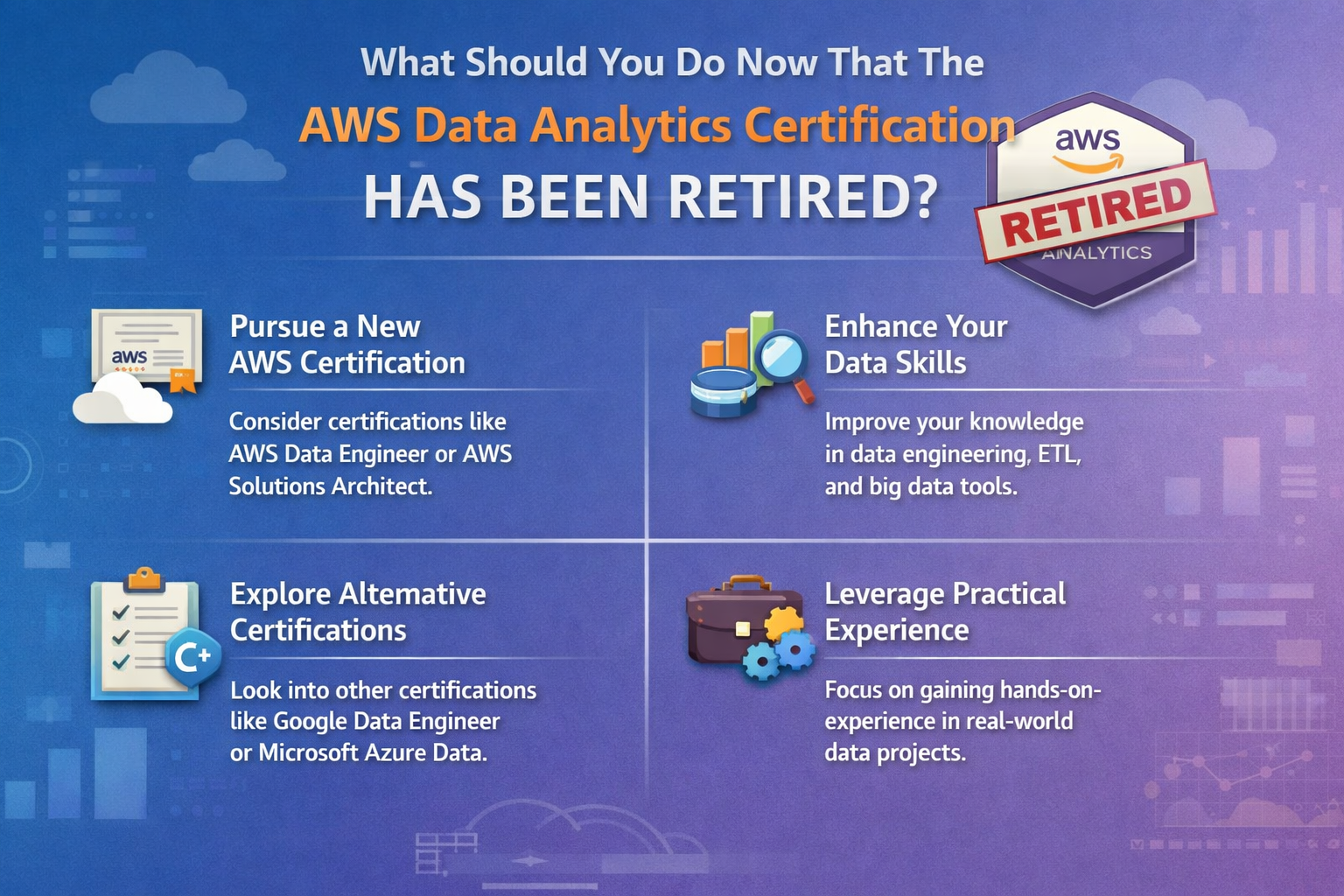
The retirement of the AWS Data Analytics certification has created uncertainty for many learners who were either preparing for it or planning to start. This certification was previously designed to validate skills in building, securing, and maintaining analytics solutions on AWS. However, as cloud technologies evolve rapidly, certification structures are periodically updated to better reflect current industry needs. The retirement does not reduce the importance of data analytics skills; instead, it signals a shift toward more integrated and modern learning paths that cover broader cloud data capabilities.
For professionals and students, this change should not be seen as a setback. Instead, it represents an opportunity to realign learning goals with the current direction of cloud computing. AWS continues to expand its ecosystem, and data analytics is now deeply embedded across multiple services rather than being isolated under a single certification.
Why AWS Retired the Data Analytics Certification
One of the main reasons certifications are retired in cloud platforms is technological evolution. AWS continuously introduces new services and improves existing ones, which makes older certification structures less aligned with real-world workflows. Data analytics today is not limited to standalone tools or services; it is integrated with machine learning, artificial intelligence, data lakes, real-time streaming, and automation.
Instead of maintaining separate certifications that may become outdated, AWS often merges overlapping knowledge areas into newer certifications. This ensures that learners are evaluated on relevant and up-to-date skills rather than legacy concepts. It also helps employers trust that certified professionals understand current architectures and tools used in production environments.
Another reason is the shift in industry demand. Companies now expect data professionals to be versatile, capable of working across multiple cloud services, not just analytics-specific tools. This has led to a restructuring of certification paths to focus more on end-to-end solutions rather than isolated domains.
Impact on Learners and Professionals
For individuals who were preparing for the AWS Data Analytics certification, the immediate impact may feel disruptive. Study plans, practice exams, and preparation timelines suddenly lose their direct purpose. However, the knowledge gained during preparation is not wasted. Most of the foundational concepts such as data storage, processing, visualization, and pipeline creation remain highly valuable.
Employers are not focused on the name of a certification alone. They care more about practical ability to design scalable data systems, handle large datasets, and derive insights using cloud platforms. Therefore, learners can confidently continue building on their existing knowledge without starting from scratch.
The key adjustment required is redirecting efforts toward updated certifications or broader skill sets that include analytics as part of a larger cloud data engineering or machine learning workflow.
Shifting Focus Toward Broader Cloud Data Skills
Instead of focusing on a single certification, it is now more effective to develop a wider understanding of cloud data ecosystems. Modern data roles require knowledge across multiple layers, including data ingestion, storage, transformation, analysis, and visualization.
Understanding how data flows through cloud systems is more important than memorizing service-specific details. For example, learning how data lakes are built, how streaming data is processed in real time, and how analytics tools connect with machine learning models provides a stronger foundation for real-world applications.
Hands-on practice plays a major role in this shift. Working on personal or professional projects helps reinforce theoretical knowledge. Building pipelines, experimenting with datasets, and creating dashboards allow learners to simulate real industry scenarios.
Alternative AWS Certification Paths
Although the AWS Data Analytics certification is no longer available, several other certification paths can help learners achieve similar or even better outcomes.
One important path is cloud data engineering. This focuses on designing and managing systems that collect, store, and process data at scale. It covers many of the same concepts but in a broader architectural context.
Another valuable direction is machine learning and artificial intelligence. Since modern analytics is closely connected with predictive modeling and automation, understanding how data supports AI systems is increasingly important.
Cloud architecture certifications are also useful because they provide a strong understanding of how all services connect together. This is essential for designing efficient and scalable data systems in real-world environments.
By choosing a combination of these paths, learners can build a more flexible and future-proof skill set.
Strengthening Core Data Analytics Foundations
Even without a specific certification, core analytics knowledge remains essential. This includes understanding how to collect, clean, process, and interpret data. These fundamentals are applicable across all industries and technologies.
Working with structured and unstructured data helps build adaptability. Structured data involves traditional databases, while unstructured data includes logs, images, and real-time streams. Modern systems often use both, so familiarity with each type is important.
Data visualization is another key area. Being able to present insights clearly helps bridge the gap between technical analysis and business decision-making. This skill is highly valued across all data-related roles.
Importance of Hands-On Experience
Practical experience often matters more than certifications alone. Employers increasingly prefer candidates who can demonstrate real-world problem-solving abilities.
Building small projects is an effective way to gain this experience. For example, creating a simple data pipeline that collects information, processes it, and presents insights can provide valuable learning. Similarly, working with publicly available datasets helps improve analytical thinking.
Experimenting with different AWS services also builds confidence. Instead of focusing on exam preparation alone, exploring how services interact in real environments leads to deeper understanding.
Adapting to Industry Trends in Data Analytics
The field of data analytics is evolving rapidly. Businesses are no longer satisfied with static reports; they want real-time insights, predictive analytics, and automated decision-making systems.
This shift means that data professionals must understand not only how to analyze data but also how to build systems that continuously process and learn from data. Integration with artificial intelligence and machine learning is becoming standard practice.
Cloud platforms like AWS are adapting to these changes by offering more unified services that combine storage, processing, and intelligence. This reduces the need for isolated certifications and encourages a more holistic learning approach.
Building a Future-Proof Learning Strategy
To stay relevant, learners should focus on adaptability rather than fixed certification paths. Technology will continue to change, and rigid learning structures may become outdated quickly.
A strong strategy involves continuous learning, regular practice, and staying updated with new tools and services. Reading documentation, experimenting with cloud environments, and following industry trends can help maintain long-term growth.
It is also useful to combine technical skills with analytical thinking. Understanding business problems and translating them into data solutions is a key differentiator in modern roles.
Long-Term Career Perspective
From a career perspective, the retirement of a certification should not be seen as a limitation. Instead, it reflects the natural progression of the industry. Professionals who adapt quickly and expand their skill sets often find better opportunities in evolving markets.
Data analytics remains one of the most in-demand fields globally. Organizations continue to rely heavily on data-driven decision-making, and this trend is only increasing. The tools may change, but the underlying need for skilled data professionals remains constant.
Those who focus on building strong fundamentals, practical experience, and a broad understanding of cloud ecosystems will remain competitive regardless of certification changes.
Moving Beyond Certification-Driven Learning
With the AWS Data Analytics certification no longer available, it becomes important to shift the mindset from exam-focused preparation to skill-focused development. In the modern cloud industry, certifications are useful for validation, but they are no longer the only measure of expertise. Employers increasingly look for individuals who can solve real problems, design scalable systems, and work confidently with data in practical environments.
This means learning should not revolve around passing a single exam. Instead, it should focus on understanding how data systems operate in real-world scenarios. The ability to work with pipelines, manage large-scale datasets, and derive insights from raw information carries far more weight than memorizing certification-specific topics.
Expanding Knowledge into Modern Data Ecosystems
Data analytics today is no longer a standalone discipline. It is deeply connected with other areas such as cloud computing, machine learning, artificial intelligence, and automation. Because of this, learners need to expand their understanding beyond traditional analytics boundaries.
Modern data ecosystems involve multiple components working together. Data is collected from various sources, stored in distributed systems, processed using scalable frameworks, and then analyzed using advanced tools. Understanding this entire flow is essential for anyone who wants to build a strong career in cloud data roles.
This broader perspective helps professionals become more adaptable. Instead of relying on one specific certification or tool, they develop the ability to work across different systems and technologies.
Importance of Data Engineering Skills
One of the most important areas to focus on after the retirement of the AWS Data Analytics certification is data engineering. Data engineering forms the backbone of all analytics systems. It involves designing and maintaining the infrastructure that allows data to flow smoothly from source to destination.
This includes building data pipelines, managing storage solutions, handling batch and real-time processing, and ensuring data quality. These skills are in high demand because organizations rely heavily on clean, structured, and accessible data to make decisions.
By learning data engineering concepts, individuals naturally cover many of the topics that were previously part of the analytics certification, but in a more practical and industry-relevant way.
Role of Cloud Services in Modern Analytics
Cloud platforms like AWS play a central role in modern data analytics. Instead of relying on traditional on-premise systems, companies now use cloud-based solutions for flexibility, scalability, and cost efficiency.
Understanding how cloud services interact is more important than focusing on isolated tools. For example, knowing how storage services connect with processing engines and visualization tools helps build a complete picture of data workflows.
This systems-level understanding is what employers value the most. It shows that a professional can design end-to-end solutions rather than just operate individual services.
Hands-On Projects as a Learning Priority
Practical experience is one of the strongest ways to build confidence in data analytics and cloud computing. Working on real or simulated projects allows learners to apply theoretical knowledge in meaningful ways.
Projects such as building a data pipeline, analyzing business datasets, or creating dashboards help develop problem-solving skills. These activities also expose learners to common challenges such as data cleaning, transformation errors, and performance optimization.
Over time, project work builds a portfolio that can be used to demonstrate skills to potential employers. This is often more impactful than any single certification.
Developing Problem-Solving Thinking
Beyond technical skills, one of the most important abilities in data analytics is problem-solving. This involves understanding business questions and translating them into data-driven solutions.
Instead of focusing only on tools, learners should practice thinking about how data can answer real questions. For example, instead of simply learning how to build a dashboard, it is more valuable to understand what insights the dashboard should provide and why those insights matter.
This shift in thinking helps bridge the gap between technical knowledge and business value, which is essential in modern data roles.
Staying Updated with Evolving Technologies
The cloud and data industry evolves rapidly. New services, tools, and frameworks are introduced regularly, while older ones are improved or replaced. Because of this, continuous learning is essential.
Professionals should stay informed about updates in cloud platforms, emerging data tools, and industry trends. This can be done through experimentation, reading technical documentation, and working with new services in practice environments.
Staying updated ensures that skills remain relevant and aligned with current industry expectations.
Combining Multiple Skill Areas for Career Growth
A strong career in data analytics today is not built on a single specialization. Instead, it comes from combining multiple related skill areas. These may include data engineering, cloud architecture, analytics, visualization, and even machine learning.
When these skills are combined, they create a more complete professional profile. This allows individuals to work on a wider range of projects and increases career opportunities.
Instead of relying on a single certification path, building a blended skill set is more effective for long-term growth.
Shifting From Certification Mindset to Industry Mindset
One of the most important changes after the retirement of the AWS Data Analytics certification is the shift in mindset. Rather than focusing on passing exams, learners should focus on how skills are used in real industries.
In real-world environments, problems are rarely structured like exam questions. They are complex, dynamic, and often require creative solutions. This means that adaptability and practical thinking are more valuable than memorized knowledge.
Developing an industry mindset prepares professionals for actual job roles rather than just certification exams.
Long-Term Relevance of Data Analytics Skills
Even though specific certifications may change or be retired, the demand for data analytics skills continues to grow. Organizations across all industries rely on data to make decisions, improve efficiency, and understand customer behavior.
This ensures that data professionals will remain in demand for the foreseeable future. What changes is not the importance of the field, but the tools and methods used within it.
By focusing on core principles and practical skills, learners can remain relevant regardless of certification changes.
The retirement of the AWS Data Analytics certification should be seen as a transition toward a more modern and integrated learning approach. Instead of narrowing focus to a single credential, learners are encouraged to build broader, more practical, and more adaptable skills.
By combining cloud knowledge, data engineering concepts, hands-on experience, and problem-solving ability, professionals can create a strong foundation for long-term success in the data industry.
Building Real-World Readiness in Cloud Data Careers
After the retirement of the AWS Data Analytics certification, the focus naturally shifts toward real-world readiness rather than exam preparation. In modern cloud-based roles, success depends on how well a professional can apply knowledge in practical environments. Companies are increasingly less interested in whether someone has a specific certification and more interested in whether they can design, implement, and maintain working data solutions.
This means learners should prioritize exposure to real-world scenarios. Working with messy datasets, dealing with incomplete information, and optimizing slow data pipelines are all common challenges in production environments. Understanding how to handle these situations builds a level of confidence that cannot be achieved through theory alone.
Strengthening Understanding of Data Architecture
A key area that becomes more important after the certification change is data architecture. Data architecture refers to how data is organized, stored, processed, and accessed across systems. A strong understanding of architecture allows professionals to see the bigger picture rather than focusing only on individual tools.
In cloud environments, data architecture often includes multiple layers such as ingestion systems, storage solutions, processing engines, and analytics platforms. Each layer has a specific role, and all layers must work together efficiently to ensure smooth data flow.
By understanding these relationships, learners can design better systems and troubleshoot issues more effectively when problems arise in real environments.
Importance of Scalability in Modern Data Systems
Scalability is one of the most important concepts in cloud data analytics. As organizations grow, the amount of data they generate increases significantly. Systems that work for small datasets may fail when handling large-scale operations.
Because of this, cloud professionals must understand how to design systems that can grow with demand. This includes choosing the right storage options, optimizing processing workflows, and ensuring that systems can handle increased load without performance degradation.
Scalability is no longer optional; it is a core requirement in nearly all modern data roles.
Developing Analytical Thinking Skills
While technical knowledge is essential, analytical thinking is equally important. Analytical thinking involves breaking down complex problems into smaller parts, identifying patterns in data, and drawing meaningful conclusions.
In data analytics, this skill helps transform raw data into actionable insights. Instead of simply processing data, professionals must understand what the data represents and how it can be used to solve real business problems.
This ability becomes especially important when working with large datasets where patterns are not immediately visible.
Working with Real-Time Data Systems
Another major shift in modern cloud analytics is the growing importance of real-time data processing. Businesses no longer rely only on historical data; they also need immediate insights to make fast decisions.
Real-time systems process data as it is generated, allowing organizations to react quickly to changes. This includes monitoring user activity, tracking system performance, and analyzing live events.
Understanding how streaming data works and how it integrates with cloud services is becoming a key skill for data professionals.
Enhancing Technical Flexibility
After the retirement of the AWS Data Analytics certification, flexibility becomes a major advantage. Instead of focusing on a fixed set of services or tools, learners should aim to become adaptable across different technologies.
Cloud platforms evolve quickly, and new tools are introduced regularly. Professionals who can quickly learn and adapt to new systems will always have an advantage in the job market.
This flexibility also helps in solving complex problems, as different situations may require different tools or approaches.
Importance of Collaboration in Data Projects
Data analytics is rarely a solo activity in real-world environments. Most projects involve collaboration between data engineers, analysts, developers, and business teams.
Understanding how to communicate effectively with non-technical stakeholders is an important skill. It ensures that insights are clearly understood and properly used in decision-making processes.
Good collaboration also helps align technical solutions with business goals, making projects more successful overall.
Transitioning Toward Advanced Cloud Roles
With the shift away from a single analytics certification, learners now have more opportunities to move toward advanced cloud roles. These include positions in data engineering, cloud architecture, machine learning engineering, and DevOps-related data roles.
These advanced roles require a deeper understanding of systems, automation, and scalability. They also involve more responsibility in designing and maintaining production-level environments.
By building strong foundational skills, learners can gradually progress into these higher-level positions.
Continuous Practice as a Long-Term Strategy
One of the most effective ways to stay relevant in this field is continuous practice. Cloud technologies cannot be mastered through theory alone. Regular hands-on work helps reinforce concepts and improve problem-solving speed.
Experimenting with different datasets, building small applications, and testing cloud services all contribute to long-term skill development. Over time, this consistent practice builds confidence and technical depth.
It also ensures that knowledge stays current as technologies evolve.
Adapting to a Project-Based Learning Approach
Instead of focusing on structured certification paths, a project-based learning approach is now more effective. This method involves learning through building and solving real problems rather than following predefined exam objectives.
Each project introduces new challenges, which helps develop critical thinking and technical adaptability. It also allows learners to explore different areas of cloud computing and data analytics in a practical way.
This approach closely mirrors real industry work, making it highly valuable for career preparation.
Building a Strong Professional Foundation
Ultimately, the goal after the retirement of the AWS Data Analytics certification is not to replace it with another exam but to build a strong and flexible professional foundation. This foundation includes technical skills, practical experience, analytical thinking, and adaptability.
Professionals who focus on these areas will remain competitive even as technologies and certifications continue to change. The key is not relying on a single credential but developing a well-rounded skill set that can evolve with the industry.
Evolving Beyond Traditional Certification Paths
As cloud technology continues to evolve, the retirement of the AWS Data Analytics certification reflects a broader shift in how skills are recognized and developed. Instead of relying on a single certification to define expertise, the industry is moving toward a more dynamic model where practical knowledge, adaptability, and continuous learning matter more than static credentials.
This change encourages learners to think beyond structured exam preparation and focus on building capabilities that can be applied in real environments. It also highlights the importance of staying flexible in a field where tools and services change rapidly.
Building Depth in Cloud Data Platforms
Modern data professionals are expected to understand cloud platforms at a deeper level rather than just knowing how to use individual services. This includes understanding how different services interact, how data moves across systems, and how infrastructure supports analytics at scale.
In cloud environments, data platforms are designed as interconnected systems rather than isolated tools. Storage, processing, analytics, and visualization components all work together. A strong understanding of these relationships allows professionals to design more efficient and reliable solutions.
This depth of understanding is becoming more important than surface-level familiarity with specific services.
The Shift Toward Integrated Skill Sets
One of the most significant changes in the industry is the shift toward integrated skill sets. Instead of specializing narrowly in one area like data analytics alone, professionals are now expected to have overlapping knowledge across multiple domains.
This includes cloud computing, data engineering, analytics, automation, and sometimes even machine learning. The ability to combine these areas effectively is what creates value in modern roles.
This integrated approach helps professionals handle more complex responsibilities and contributes to better career growth opportunities.
Importance of Automation in Data Workflows
Automation plays a major role in modern cloud data systems. Many repetitive tasks such as data ingestion, transformation, and monitoring are now automated using cloud services and scripts.
Understanding how to design automated workflows is an important skill for data professionals. It helps reduce manual effort, improve accuracy, and increase system efficiency.
Automation also allows teams to focus more on analysis and decision-making rather than routine operational tasks.
Developing Strong Data Pipeline Knowledge
Data pipelines are at the core of cloud analytics systems. They define how data moves from its source to its final destination, where it is analyzed and used for decision-making.
A strong understanding of pipeline design helps professionals ensure that data is processed efficiently and reliably. This includes handling data ingestion, transformation, validation, and storage.
Well-designed pipelines also improve scalability and reduce system failures, making them a critical part of any data architecture.
Understanding Security and Governance in Data Systems
As data becomes more valuable, security and governance become increasingly important. Cloud data professionals must understand how to protect sensitive information and ensure compliance with regulations.
This includes controlling access to data, encrypting information, and monitoring system activity. Governance also involves maintaining data quality and ensuring that data is accurate and reliable.
These responsibilities are essential in enterprise environments where data security is a top priority.
Adapting to Continuous Cloud Innovation
Cloud platforms evolve at a rapid pace, with new services and features being introduced regularly. This constant innovation means that professionals must be willing to continuously learn and adapt.
Instead of focusing on mastering a fixed set of tools, it is more effective to develop the ability to quickly understand and apply new technologies.
This mindset ensures long-term relevance in a fast-changing industry.
Importance of Cross-Functional Knowledge
Modern data roles often require collaboration across different teams, including software engineers, analysts, business leaders, and operations teams. Because of this, cross-functional knowledge is becoming increasingly important.
Understanding how different teams use data helps improve communication and ensures that technical solutions align with business goals.
This ability to bridge technical and non-technical domains is highly valued in cloud data careers.
Real-World Problem Solving Over Theoretical Learning
One of the biggest changes after the retirement of the AWS Data Analytics certification is the emphasis on real-world problem solving. Instead of focusing on theoretical exam scenarios, professionals are encouraged to work on practical challenges.
Real-world problems are often complex and do not have predefined solutions. They require critical thinking, experimentation, and iterative improvement.
This type of learning builds stronger technical judgment and prepares professionals for actual industry demands.
Developing a Portfolio of Practical Work
A strong portfolio is becoming more important than certification titles alone. A portfolio demonstrates what a professional can actually do rather than what they have studied.
Projects such as building data pipelines, creating dashboards, analyzing datasets, or designing cloud architectures can all be included in a portfolio.
This provides tangible proof of skills and helps in job applications and interviews.
Long-Term Skill Development Strategy
In a rapidly evolving field like cloud data analytics, long-term success depends on continuous skill development. Instead of treating learning as a one-time effort, it should be seen as an ongoing process.
This includes regularly practicing new tools, revisiting core concepts, and exploring emerging technologies. Over time, this approach builds deep expertise and adaptability.
Professionals who adopt this mindset are better prepared for future changes in the industry.
Career Growth in a Changing Certification Landscape
Even though the AWS Data Analytics certification has been retired, career opportunities in data analytics and cloud computing continue to expand. Organizations still require skilled professionals who can manage and analyze large volumes of data.
What has changed is the path to proving those skills. Instead of relying on a single certification, professionals now demonstrate competence through experience, projects, and broader certifications.
This creates more flexible and diverse career pathways.
The retirement of the AWS Data Analytics certification marks an important transition in the cloud industry. It signals a move away from narrow certification-based learning toward broader, more practical, and more adaptable skill development.
By focusing on real-world experience, integrated knowledge, and continuous learning, professionals can build strong and future-ready careers in cloud data analytics and beyond.
Embracing a Modern Data Career Mindset
The retirement of the AWS Data Analytics certification ultimately highlights a broader transformation in the cloud and data industry. The focus is no longer centered on isolated certifications but on building adaptable professionals who can work across complex, evolving systems. This shift encourages learners to develop a mindset that values practical problem-solving, continuous learning, and real-world application over exam-based preparation.
In today’s environment, success in data careers depends on the ability to understand how systems work together rather than memorizing individual services. Cloud platforms are deeply interconnected, and professionals are expected to navigate this complexity with confidence and flexibility.
Strengthening Real Industry Alignment
One of the most important outcomes of this transition is stronger alignment with real industry needs. Organizations are increasingly looking for professionals who can handle end-to-end data workflows, from ingestion and processing to analysis and decision-making.
This requires a blend of technical and analytical skills. It is not enough to know how to use tools; professionals must also understand why certain systems are designed in specific ways and how they support business objectives. This alignment between technical execution and business value is what defines modern data roles.
Focusing on Continuous Skill Evolution
The cloud industry does not remain static, and neither should skill development. Continuous improvement has become a core requirement for anyone working in data-related fields. New services, frameworks, and methodologies are introduced regularly, making ongoing learning essential.
Instead of preparing for a single certification milestone, professionals should adopt a mindset of ongoing growth. This includes exploring new technologies, revisiting foundational concepts, and applying knowledge in different scenarios.
This continuous evolution ensures long-term relevance in a highly competitive field.
Expanding Into Advanced Data Capabilities
As the industry moves forward, data professionals are expected to expand into more advanced capabilities. These include working with machine learning models, real-time analytics systems, automated data pipelines, and large-scale distributed architectures.
This expansion requires both depth and breadth of knowledge. Depth allows professionals to specialize in key areas, while breadth ensures they can integrate multiple systems effectively. The combination of both creates a strong and versatile skill profile.
Importance of Independent Learning
With the shift away from a single certification path, independent learning has become more important than ever. Professionals must take responsibility for their own growth by exploring resources, building projects, and experimenting with cloud environments.
This self-driven approach helps develop problem-solving skills and encourages deeper understanding. It also allows learners to move at their own pace and focus on areas that are most relevant to their career goals.
Independent learning also fosters curiosity, which is essential in a rapidly changing technical landscape.
Building Confidence Through Practical Exposure
Confidence in cloud data roles comes primarily from experience. Working on real or simulated projects helps professionals understand how systems behave under different conditions.
This exposure is crucial because real-world systems are often unpredictable. Issues such as performance bottlenecks, data inconsistencies, and system failures are common. Learning how to handle these challenges builds resilience and technical confidence.
Over time, this practical exposure becomes one of the strongest assets in a professional’s skill set.
Developing a Strategic Career Approach
In the absence of a single defining certification, career planning becomes more strategic. Professionals must think carefully about the direction they want to take and the skills required to reach their goals.
This includes choosing between roles such as data engineering, cloud architecture, analytics, or machine learning. Each path requires a different combination of skills, but all are interconnected within the broader cloud ecosystem.
A strategic approach helps ensure that learning efforts are focused and aligned with long-term career objectives.
Balancing Technical and Analytical Growth
Successful data professionals balance technical expertise with analytical thinking. Technical skills enable them to build systems, while analytical skills help them interpret data and derive meaningful insights.
Both aspects are equally important. Without technical knowledge, analysis cannot be implemented effectively. Without analytical thinking, technical systems lack purpose and direction.
Balancing these two areas creates well-rounded professionals who can contribute effectively to any organization.
Preparing for the Future of Cloud Data
The future of cloud data analytics is moving toward greater automation, intelligence, and integration. Systems are becoming more autonomous, and data-driven decision-making is becoming faster and more sophisticated.
Professionals who understand these trends will be better positioned to adapt. This includes being familiar with automation tools, real-time analytics systems, and AI-driven data processing.
Preparing for this future requires a proactive approach to learning and adaptation.
Conclusion
The retirement of the AWS Data Analytics certification is not an endpoint but a transformation in how data skills are developed and recognized. It reflects the industry’s shift toward more integrated, practical, and evolving skill sets rather than static certification paths.
For learners and professionals, this change opens new opportunities to grow beyond exam preparation and focus on real-world expertise. By developing hands-on experience, strengthening core data and cloud knowledge, and adopting a continuous learning mindset, individuals can build strong and future-proof careers.
Ultimately, success in the modern data landscape is defined not by a single certification, but by the ability to adapt, solve problems, and continuously evolve with technology.