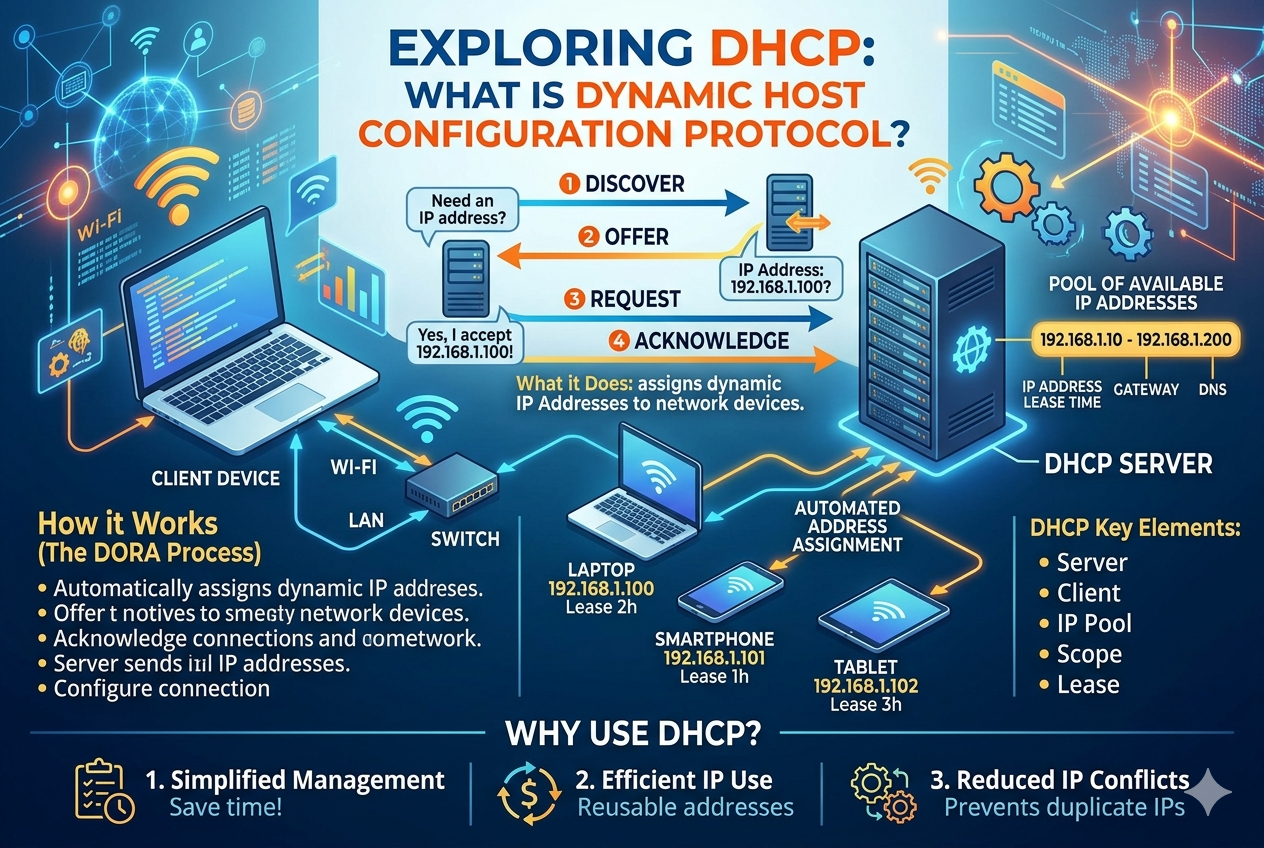
Dynamic Host Configuration Protocol (DHCP) is a fundamental networking protocol designed to automate the process of assigning IP addresses and other essential network configuration parameters to devices. In a network environment, every device must have a unique IP address to communicate effectively. Without DHCP, network administrators would need to manually configure each device, which becomes inefficient and error-prone, especially in large-scale networks. DHCP simplifies this process by dynamically allocating addresses and managing them in a structured and automated way.
DHCP operates in both small and large networks, including home networks, enterprise systems, educational institutions, and public internet access points. Its primary role is to ensure that devices can join a network seamlessly without requiring manual configuration. This automation reduces administrative workload and ensures consistency in network configuration across all connected devices.
At its core, DHCP follows a client-server model. The DHCP server is responsible for maintaining a pool of available IP addresses and distributing them to client devices when requested. The client is any device such as a computer, smartphone, printer, or IoT device that needs network access. When a client connects to a network, it sends a request to the DHCP server, which responds by assigning the necessary configuration settings.
DHCP not only assigns IP addresses but also provides additional information required for proper network communication. This includes subnet mask, default gateway, and DNS server information. These settings are essential for enabling devices to communicate both within the local network and with external networks such as the internet.
The introduction of DHCP significantly improved the scalability and manageability of networks. Before DHCP, network administrators had to manually assign static IP addresses to every device, which often led to conflicts, duplication, and misconfiguration. DHCP eliminated these challenges by introducing dynamic allocation and centralized control.
How DHCP Works in a Network Environment
The working mechanism of DHCP is based on a structured communication process between the client and the server. This process is commonly referred to as the DHCP handshake and involves multiple steps to ensure secure and accurate IP assignment.
When a device connects to a network, it begins by broadcasting a message known as a DHCP discovery. This message is sent to identify any available DHCP server in the network. Since the device does not yet have an IP address, it uses a general broadcast to reach all possible servers.
Once the DHCP server receives this request, it responds with a DHCP offer. This offer includes an available IP address and other network configuration details. The server selects the address from its pool of unused IPs and temporarily reserves it for the requesting device.
After receiving the offer, the client responds with a DHCP request message. This step indicates that the device accepts the offered configuration and requests formal assignment of the IP address. This ensures that the server is aware of the client’s acceptance.
Finally, the DHCP server sends a DHCP acknowledgment message, confirming that the IP address has been officially assigned to the device. At this point, the device can fully participate in network communication using the assigned configuration.
This entire process occurs within seconds, making it seamless and invisible to the user. The automation provided by DHCP ensures that devices can connect quickly without requiring manual setup.
IP Address Leasing and Management
One of the key features of DHCP is the concept of leasing. Instead of permanently assigning an IP address to a device, DHCP assigns it for a limited period known as a lease time. This lease can vary depending on network policies and requirements.
When the lease period is close to expiration, the device must renew its IP address by communicating again with the DHCP server. If the device is still active, the lease is typically renewed automatically. If the device is no longer connected, the IP address is returned to the pool of available addresses.
This leasing mechanism ensures efficient utilization of IP addresses, especially in networks with a large number of devices. It prevents IP exhaustion and allows addresses to be reused dynamically.
DHCP servers maintain detailed records of all leased IP addresses, including their duration and status. This helps network administrators monitor usage and manage resources effectively.
Components of DHCP Architecture
The DHCP system consists of several important components that work together to manage IP allocation efficiently. The primary component is the DHCP server, which holds the configuration database and IP address pool. It is responsible for responding to client requests and managing leases.
The DHCP client is any device that requests network configuration from the server. Clients can include computers, mobile devices, printers, and other network-enabled hardware.
Another important component is the DHCP relay agent. In large networks with multiple subnets, the relay agent helps forward DHCP requests between clients and servers that are not on the same network segment. This ensures that DHCP services can function across complex network infrastructures.
Together, these components create a flexible and scalable system capable of managing large numbers of devices efficiently.
Advantages of DHCP in Modern Networking
DHCP offers numerous advantages that make it an essential protocol in modern networks. One of its primary benefits is automation. By eliminating manual IP configuration, DHCP reduces human error and saves significant time for network administrators.
Another advantage is centralized management. Administrators can control all IP address assignments from a single server, making it easier to monitor and adjust network settings as needed.
DHCP also improves scalability. As networks grow, new devices can be added without requiring manual configuration. This makes it ideal for dynamic environments where devices frequently join and leave the network.
Additionally, DHCP reduces IP conflicts. Since the server ensures that each IP address is unique and properly managed, the risk of duplicate assignments is minimized.
The protocol also enhances flexibility. Devices can move between networks and still receive appropriate configuration automatically, allowing seamless connectivity.
Limitations and Challenges of DHCP
Despite its advantages, DHCP also has certain limitations. One potential issue is dependency on the DHCP server. If the server fails, new devices may not be able to obtain IP addresses, disrupting network connectivity.
Security is another concern. Unauthorized devices could potentially request and receive IP addresses if proper security measures are not in place. This can lead to unauthorized access or network misuse.
DHCP also relies on dynamic allocation, which may not be suitable for devices that require fixed IP addresses, such as servers or network printers. In such cases, static IP configuration is still necessary.
In some environments, managing lease times and address pools can become complex, especially in very large or distributed networks.
Role of DHCP in Internet Connectivity
DHCP plays a critical role in enabling internet connectivity for most modern devices. When a device connects to a home or office network, it typically receives all necessary configuration settings from a DHCP server, which allows it to access the internet without manual setup.
Internet service providers often use DHCP to assign public IP addresses to routers, which then distribute private IP addresses to devices within the local network. This layered approach ensures efficient management of IP resources while maintaining connectivity.
Without DHCP, connecting to the internet would require manual configuration of multiple settings, making the process much more complicated for users.
DHCP in Enterprise and Large Networks
In enterprise environments, DHCP is an essential component of network infrastructure. Large organizations often have thousands of devices that require network access. Managing these manually would be impractical.
DHCP allows centralized control of IP distribution across departments, floors, or entire buildings. It also supports integration with other network services such as DNS and authentication systems.
Advanced DHCP configurations in enterprise networks may include reservations, where specific devices are always assigned the same IP address, and failover systems to ensure continuous service availability.
These features make DHCP highly adaptable to complex networking needs.
DHCP Architecture in Detail
The architecture of Dynamic Host Configuration Protocol is designed to support efficient communication between multiple devices and centralized management of network resources. It is built around a client-server model, where the DHCP server holds the responsibility of managing IP address distribution, while the clients are devices that request network configuration.
The DHCP server maintains a structured database known as a scope. This scope defines the range of IP addresses available for assignment within a specific network. Along with the IP pool, the server also stores configuration parameters such as subnet masks, gateway addresses, and DNS settings. This centralized storage ensures that all devices receive consistent network configuration.
The DHCP client is usually built into modern operating systems, meaning users do not need to install additional software. When a device is set to obtain an IP address automatically, it becomes a DHCP client and begins the communication process with the server whenever it connects to a network.
In larger environments, DHCP relay agents play an important role. These agents forward DHCP messages between clients and servers that are located on different network segments. Without relay agents, DHCP would be limited to a single subnet, reducing its effectiveness in complex infrastructures.
This architecture allows DHCP to function across diverse network topologies, from small home networks to large enterprise systems with multiple subnets and VLANs.
DHCP Message Types and Communication Flow
DHCP communication is based on a series of structured messages exchanged between the client and server. Each message type serves a specific purpose in the IP allocation process.
The process begins with a discovery message sent by the client. Since the device does not yet have an IP address, it broadcasts this message to locate any available DHCP server on the network. This ensures that even in unknown environments, the client can initiate communication.
The server responds with an offer message. This message includes an available IP address along with configuration details. The server temporarily reserves this IP for the client during the negotiation process.
After receiving the offer, the client sends a request message. This confirms that the client accepts the offered configuration and requests formal assignment of the IP address.
The final step is the acknowledgment message sent by the server. This confirms that the IP address has been permanently assigned for the duration of the lease period. Once this step is completed, the client can begin normal network communication.
This sequence ensures that IP assignment is coordinated, conflict-free, and efficient.
DHCP Lease Renewal and Expiration Process
IP address leasing is a critical concept in DHCP that ensures efficient use of network resources. When a device receives an IP address, it is not permanently assigned. Instead, it is granted for a specific duration known as the lease time.
As the lease approaches expiration, the client automatically attempts to renew it. This process begins when half of the lease time has elapsed. The client sends a renewal request directly to the original DHCP server without broadcasting it to the entire network.
If the server responds positively, the lease is extended, and the device continues using the same IP address. If no response is received, the client continues using the address until the lease reaches its final expiration stage.
If the lease expires completely without renewal, the device must release the IP address and restart the DHCP discovery process. This ensures that unused addresses return to the pool for reassignment.
This renewal mechanism helps maintain stability while ensuring efficient utilization of IP resources across the network.
Static vs Dynamic IP Allocation in DHCP
DHCP primarily uses dynamic IP allocation, but it also supports static allocation through reservations. Dynamic allocation means that IP addresses are assigned automatically from a pool and may change over time. This is ideal for general-purpose devices like laptops, smartphones, and tablets.
Static allocation, on the other hand, assigns a fixed IP address to a specific device based on its MAC address. This ensures that the device always receives the same IP address whenever it connects to the network.
Reserved static assignments are commonly used for servers, printers, and network infrastructure devices that require consistent addressing. This hybrid approach allows DHCP to maintain flexibility while supporting stability where needed.
By combining both methods, DHCP provides a balanced approach to network management.
DHCP Security Considerations
Although DHCP simplifies network management, it also introduces certain security concerns. One major issue is the possibility of unauthorized DHCP servers operating within a network. These rogue servers can assign incorrect IP configurations, leading to connectivity problems or security breaches.
To prevent such issues, network administrators often implement security measures such as DHCP snooping. This feature allows only trusted servers to assign IP addresses while blocking unauthorized sources.
Another security concern is IP address exhaustion attacks, where malicious devices request large numbers of IP addresses to deplete the available pool. This can disrupt network services and prevent legitimate devices from connecting.
Proper network segmentation, monitoring, and access control are essential to mitigate these risks.
DHCP in Wireless Networks
DHCP plays a crucial role in wireless networking environments such as Wi-Fi networks. When a device connects to a wireless access point, it typically receives its IP configuration through DHCP.
This automatic assignment allows users to connect to wireless networks without manual configuration. It is especially important in public spaces such as airports, cafes, and offices where large numbers of devices connect frequently.
Wireless networks often rely heavily on DHCP due to the dynamic nature of device connectivity. Devices constantly join and leave the network, making manual IP management impractical.
DHCP ensures that connectivity remains seamless and efficient in such environments.
Integration of DHCP with Other Network Services
DHCP does not operate in isolation. It works closely with other network services to provide complete connectivity solutions. One of the most important integrations is with the Domain Name System (DNS). DHCP can automatically provide DNS server information to clients, enabling them to resolve domain names into IP addresses.
It also integrates with routing services by supplying default gateway information. This allows devices to communicate beyond their local network and access external systems such as the internet.
In enterprise environments, DHCP may also integrate with directory services for authentication and access control. This ensures that only authorized devices receive network configuration.
These integrations make DHCP a foundational component of modern network infrastructure.
Performance and Efficiency of DHCP Systems
DHCP is designed to operate efficiently even in large-scale environments. Its communication process is lightweight, requiring minimal bandwidth and processing power. This ensures that IP assignment occurs quickly without affecting overall network performance.
Servers are capable of handling thousands of requests simultaneously, making DHCP suitable for enterprise-level deployments. Load balancing techniques and failover configurations can further enhance performance and reliability.
Caching mechanisms within clients also help reduce unnecessary network traffic by storing previously assigned configuration details.
Overall, DHCP is optimized for speed, scalability, and reliability.
Troubleshooting Common DHCP Issues
Despite its reliability, DHCP can sometimes experience issues that affect network connectivity. One common problem is IP address conflicts, which occur when two devices are assigned the same IP address. This can disrupt communication and cause network instability.
Another issue is failure to obtain an IP address. This usually happens when the DHCP server is unavailable or the address pool is exhausted.
Incorrect configuration settings can also lead to connectivity problems, such as inability to access external networks.
Troubleshooting typically involves checking server availability, verifying configuration settings, and ensuring that network cables and wireless connections are functioning properly.
DHCP Functional Overview
DHCP is a powerful and essential protocol that simplifies network configuration through automation and centralized management. Its structured communication process, leasing mechanism, and integration with other network services make it highly efficient for both small and large networks.
By reducing manual effort and minimizing configuration errors, DHCP ensures smooth connectivity across diverse environments. Its ability to dynamically allocate and manage IP addresses makes it a cornerstone of modern networking infrastructure.
Advanced DHCP Features in Modern Networks
Modern implementations of Dynamic Host Configuration Protocol include several advanced features that enhance flexibility, scalability, and control over network configurations. These features are particularly important in enterprise environments where networks are large, complex, and constantly changing.
One of the key advanced features is DHCP reservation. This allows administrators to permanently assign a specific IP address to a device based on its MAC address while still using DHCP for management. Unlike fully dynamic allocation, reservations ensure that critical devices such as servers, network printers, and security systems always receive the same IP address without manual configuration.
Another important feature is DHCP options. These are additional configuration parameters that a DHCP server can provide to clients beyond basic IP settings. Examples include time server information, boot server details for network booting, and custom configuration settings required by specific applications. DHCP options make the protocol highly adaptable to specialized networking requirements.
DHCP also supports failover configurations in many enterprise systems. In a failover setup, two DHCP servers share the responsibility of managing IP address allocation. If one server fails, the other automatically takes over, ensuring uninterrupted network service. This improves reliability and reduces downtime in critical environments.
These advanced features demonstrate how DHCP has evolved from a simple IP assignment protocol into a comprehensive network management solution.
DHCP in Cloud and Virtualized Environments
With the rise of cloud computing and virtualization technologies, DHCP has become even more important. In virtual environments, hundreds or thousands of virtual machines may be created and destroyed dynamically. DHCP plays a crucial role in assigning IP addresses to these virtual machines automatically.
In cloud-based systems, DHCP helps manage large-scale, distributed networks where resources are constantly changing. Virtual networks rely heavily on DHCP to ensure that newly created instances can immediately connect to the network without manual configuration.
Additionally, software-defined networking (SDN) environments integrate DHCP as part of their automated network management systems. This allows for centralized control and dynamic allocation of network resources across multiple physical and virtual locations.
DHCP ensures that cloud infrastructure remains flexible, scalable, and efficient in handling rapid changes in resource demand.
Role of DHCP in Internet Service Provider Networks
Internet Service Providers (ISPs) use DHCP extensively to manage IP address distribution for their customers. When a user connects to the internet through a router or modem, the ISP’s DHCP server assigns a public IP address to the device or gateway.
This process allows millions of users to connect to the internet without requiring static IP configurations. ISPs maintain large pools of IP addresses and dynamically allocate them based on demand.
In many cases, ISPs also use DHCP in combination with Network Address Translation (NAT). While DHCP assigns private IP addresses within local networks, NAT allows multiple devices to share a single public IP address. This combination improves IP address utilization efficiency on a global scale.
DHCP is therefore a critical component in maintaining internet accessibility for users worldwide.
DHCP and Network Scalability
One of the most significant advantages of DHCP is its ability to support network scalability. As organizations grow, the number of connected devices increases rapidly. Manually managing IP addresses in such environments would be impractical and inefficient.
DHCP allows networks to expand seamlessly by automatically assigning IP addresses to new devices as they join. This dynamic allocation ensures that administrators do not need to reconfigure the network each time a new device is added.
Scalability is further enhanced by the use of multiple DHCP servers in large environments. These servers can be distributed across different locations and subnets, working together to manage IP allocation efficiently.
This scalability makes DHCP suitable for everything from small home networks to global enterprise infrastructures.
DHCP Performance Optimization Techniques
To ensure optimal performance, DHCP systems often implement various optimization techniques. One such technique is address pool segmentation. By dividing IP address ranges into smaller pools for different departments or network segments, administrators can reduce congestion and improve allocation efficiency.
Another optimization method is lease time tuning. Shorter lease times are useful in highly dynamic environments where devices frequently connect and disconnect, while longer lease times are better suited for stable networks with fewer changes.
Caching mechanisms on client devices also help reduce unnecessary DHCP traffic. Once a device has obtained configuration settings, it stores them locally and only contacts the server when renewal is required.
Load balancing across multiple DHCP servers further improves performance by distributing requests evenly and preventing overload on a single server.
These techniques ensure that DHCP remains efficient even under heavy network traffic.
Common DHCP Misconfigurations and Their Impact
Misconfigurations in DHCP settings can lead to significant network issues. One common mistake is incorrect IP address pool configuration. If the pool is too small, devices may fail to obtain an IP address, leading to connectivity problems.
Another issue is overlapping scopes between multiple DHCP servers. This can result in IP conflicts where different devices are assigned the same address, causing network instability.
Incorrect subnet mask configuration can also prevent devices from communicating properly within the network or accessing external resources.
Improper lease time settings may lead to frequent renewals or premature expiration of IP addresses, affecting network performance.
Careful planning and regular monitoring are essential to avoid these issues and maintain a stable DHCP environment.
DHCP and Network Automation
DHCP plays a key role in modern network automation strategies. As networks become more complex, automation is essential for reducing manual intervention and improving efficiency.
DHCP integrates with other automation tools to dynamically configure devices as they connect to the network. This includes assigning IP addresses, configuring routing information, and providing access to required network services.
In automated environments, DHCP works alongside technologies such as configuration management systems and orchestration platforms. This integration allows entire network infrastructures to be deployed and managed with minimal human involvement.
Network automation powered by DHCP improves consistency, reduces errors, and accelerates deployment times.
Future of DHCP in Networking
The future of DHCP is closely tied to the evolution of networking technologies. As IPv6 becomes more widely adopted, DHCP is adapting to support larger address spaces and more complex configurations.
In IPv6 networks, DHCPv6 is used to manage address assignment and configuration. It offers similar functionality to traditional DHCP but is designed to handle the vastly increased number of available IP addresses.
Emerging technologies such as edge computing, Internet of Things (IoT), and 5G networks will further increase the importance of DHCP. These environments involve massive numbers of connected devices that require automatic configuration and management.
DHCP is expected to continue evolving to support higher levels of automation, security, and integration with intelligent network systems.
Advanced DHCP Concepts
Dynamic Host Configuration Protocol has evolved into a sophisticated and essential component of modern networking infrastructure. Beyond simple IP address assignment, it now supports advanced features, integration with cloud systems, and large-scale automation.
Its ability to adapt to changing network environments, support scalability, and integrate with emerging technologies ensures its continued relevance in the future of networking. DHCP remains a foundational protocol that enables seamless connectivity across virtually all types of modern digital communication systems.
DHCP in IPv6 Networks (DHCPv6 Overview)
With the transition from IPv4 to IPv6, networking has become more advanced and capable of supporting a vastly larger number of devices. In this environment, Dynamic Host Configuration Protocol has also evolved into DHCPv6, which is specifically designed for IPv6 addressing and configuration.
DHCPv6 performs similar functions to traditional DHCP but is adapted to handle the expanded address space of IPv6. Instead of working with limited IPv4 addresses, it manages extremely large pools of IPv6 addresses, ensuring that every device can receive a unique and globally routable address when required.
In IPv6 networks, DHCPv6 can operate in different modes depending on network design. In some cases, devices may use stateless address autoconfiguration, where they generate their own IP address, while DHCPv6 is used only to provide additional configuration information such as DNS servers. In other cases, DHCPv6 can operate in a stateful mode, where it fully assigns and manages IP addresses, similar to traditional DHCP.
This flexibility makes DHCPv6 suitable for modern large-scale networks, including cloud infrastructure, smart cities, and IoT ecosystems.
Stateless vs Stateful DHCP in Modern Networking
DHCP can operate in two primary modes: stateless and stateful configuration. Each mode serves different networking needs and provides different levels of control.
In stateful DHCP, the server fully manages IP address assignment. It tracks which device receives which address and maintains a lease database. This is the most common mode used in traditional IPv4 networks. It ensures centralized control and avoids address conflicts.
In stateless configuration, the server does not assign IP addresses but instead provides additional network information such as DNS servers, domain settings, and routing details. The device itself generates its own IP address, often using built-in mechanisms like IPv6 autoconfiguration.
Stateless DHCP is commonly used in modern IPv6 environments where devices can independently create unique addresses while still requiring centralized configuration support.
Both modes can work together in hybrid networks to provide flexibility and efficiency.
DHCP and Internet of Things (IoT) Devices
The rapid growth of Internet of Things (IoT) devices has significantly increased the importance of DHCP in modern networks. IoT devices such as smart sensors, cameras, appliances, and wearable technology require network connectivity but often have limited processing capabilities.
DHCP simplifies IoT deployment by automatically assigning IP addresses and configuration settings without manual intervention. This allows large numbers of devices to be deployed quickly and efficiently.
In IoT environments, DHCP must handle frequent device connections and disconnections. Many IoT devices operate intermittently, requiring dynamic IP allocation and short lease times to maximize address availability.
DHCP also supports the scalability required for IoT ecosystems, where thousands or even millions of devices may be connected within a single network infrastructure.
As IoT continues to expand, DHCP remains a critical protocol for ensuring seamless connectivity and device management.
DHCP and Network Address Translation (NAT)
DHCP often works alongside Network Address Translation (NAT) to manage IP address usage efficiently. While DHCP assigns private IP addresses to devices within a local network, NAT translates these private addresses into a single public IP address for communication over the internet.
This combination allows multiple devices within a private network to share a single public IP address, significantly conserving global IPv4 address space.
For example, in a home network, DHCP assigns unique private IP addresses to smartphones, laptops, and smart devices. The router then uses NAT to translate all outgoing traffic into one public IP address provided by the internet service provider.
This layered approach ensures efficient use of IP resources while maintaining secure and organized internal networking.
DHCP Troubleshooting Techniques and Diagnostics
Troubleshooting DHCP issues requires a systematic approach to identify and resolve configuration or connectivity problems. One of the most common troubleshooting steps is verifying whether the DHCP server is operational and reachable within the network.
If devices fail to obtain an IP address, administrators typically check server logs to identify errors or failed lease attempts. These logs provide valuable information about request patterns and potential configuration issues.
Another important diagnostic step is checking the IP address pool availability. If the pool is exhausted, new devices will be unable to receive addresses until existing leases expire or are released.
Network tools can also be used to test DHCP communication flow, ensuring that discovery, offer, request, and acknowledgment messages are being exchanged correctly.
Proper monitoring and diagnostics help maintain reliable DHCP performance and prevent network disruptions.
Security Enhancements in DHCP Systems
As networks have become more complex, securing DHCP infrastructure has become increasingly important. One of the most effective security measures is DHCP snooping, which prevents unauthorized DHCP servers from operating within the network.
DHCP snooping works by filtering DHCP messages and allowing only trusted servers to assign IP addresses. This prevents rogue servers from providing incorrect network configurations.
Another security enhancement is IP source guard, which ensures that devices use only the IP addresses assigned to them by DHCP. This prevents IP spoofing and unauthorized network access.
Encryption and authentication mechanisms are also being integrated into advanced DHCP implementations to improve security in enterprise and cloud environments.
These security features ensure that DHCP remains reliable and protected against malicious activities.
DHCP in Enterprise Network Design
In enterprise environments, DHCP is an essential part of network architecture. Large organizations often design their networks with multiple DHCP servers distributed across different locations to ensure redundancy and reliability.
Each department or branch office may have its own DHCP scope, allowing for organized IP address management based on functional requirements.
Enterprise networks also use DHCP reservations extensively to ensure that critical systems always receive consistent IP addresses. This is important for servers, security systems, and network infrastructure components.
Load balancing and failover configurations are commonly implemented to ensure continuous availability of DHCP services even during hardware or network failures.
These design strategies help maintain stability and efficiency in large-scale business environments.
Performance Challenges in Large DHCP Deployments
Although DHCP is highly efficient, large-scale deployments can face performance challenges. One of the main issues is high request traffic during peak usage times, such as when many devices connect simultaneously.
This can lead to delays in IP assignment if the server is not properly optimized or scaled.
Another challenge is managing large IP address pools across multiple subnets. Without proper segmentation, address conflicts and allocation inefficiencies may occur.
Server synchronization in failover environments is also critical. If DHCP servers are not properly synchronized, inconsistencies in lease data can lead to connectivity issues.
To address these challenges, organizations use load balancing, distributed server architectures, and optimized lease management strategies.
Future Trends and Evolution of DHCP Technology
The future of DHCP is closely linked to advancements in networking technologies such as artificial intelligence, automation, and edge computing. As networks become more intelligent, DHCP is expected to integrate with automated decision-making systems.
Future DHCP implementations may include predictive allocation, where IP addresses are assigned based on usage patterns and device behavior.
Integration with AI-driven network management systems could allow DHCP to dynamically adjust configurations for optimal performance and security.
With the continued growth of IPv6, DHCPv6 will become increasingly important in managing large-scale global networks.
Additionally, the rise of edge computing and 5G networks will require highly responsive and distributed DHCP systems capable of handling real-time device connectivity across vast geographic areas.
These advancements will ensure that DHCP continues to evolve as a core component of modern networking infrastructure.
Final Conclusion
Dynamic Host Configuration Protocol remains one of the most essential protocols in modern networking. It enables automatic IP address assignment, simplifies network management, and supports a wide range of environments from small home networks to global enterprise systems.
Through its evolving features, integration with emerging technologies, and ability to scale with growing network demands, DHCP continues to play a foundational role in ensuring seamless connectivity and efficient communication between devices across the digital world.