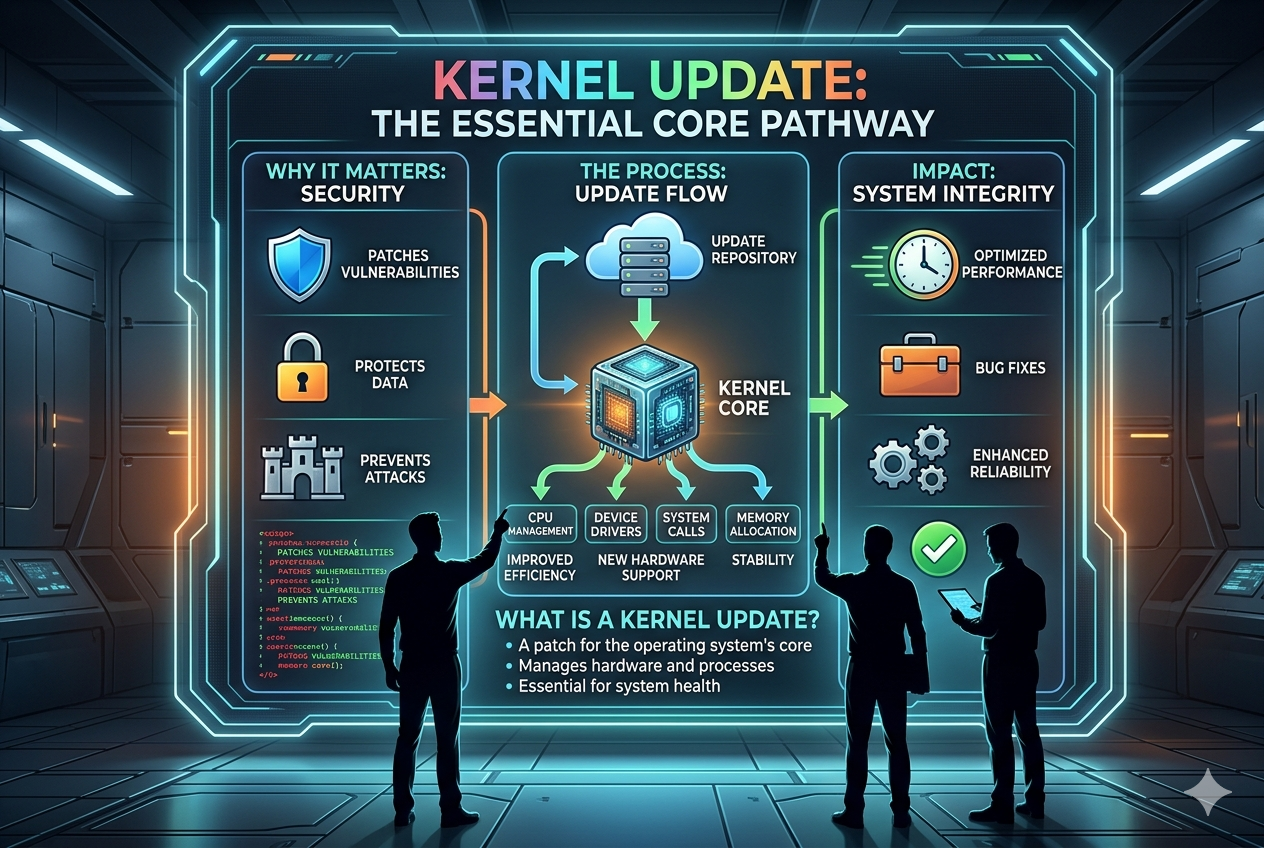
The kernel is the most fundamental part of an operating system, acting as the core bridge between hardware and software. Every action performed on a computer, from opening a file to browsing the internet, passes through the kernel. It manages memory, processes, input and output devices, and system resources in a highly controlled way. Without the kernel, applications would not be able to communicate with the hardware, and the system would not function at all. Because it sits at such a critical level, even small changes to the kernel can have a wide impact on the entire system.
The kernel operates in a privileged mode, meaning it has unrestricted access to system resources. This makes it extremely powerful but also highly sensitive. Any flaw or inefficiency in the kernel can directly affect system performance, stability, and security. That is why maintaining and updating it is considered one of the most important tasks in system maintenance.
What a Kernel Update Actually Means
A kernel update is the process of improving or modifying this core system component. It can include bug fixes, security patches, performance enhancements, and support for newer hardware or technologies. Unlike regular software updates that affect individual applications, kernel updates impact the entire operating system at a foundational level.
When developers release a kernel update, they are essentially refining how the operating system interacts with hardware and manages internal processes. These updates are carefully designed and tested because even a small error can affect the stability of the whole system. Kernel updates may be minor, focusing on small fixes, or major, introducing significant changes in performance and compatibility.
How the Kernel Controls the System
To understand why kernel updates are important, it helps to understand what the kernel actually does. It manages system memory by allocating space to different applications and ensuring that they do not interfere with each other. It also handles process scheduling, deciding which tasks should be executed and when, so that the system runs efficiently even under heavy load.
In addition, the kernel manages device communication. When you use a keyboard, mouse, printer, or storage device, the kernel acts as the translator between hardware and software. It ensures that signals from hardware are correctly interpreted by applications and that instructions from software reach the hardware in the right format. Because of this central role, improving the kernel can significantly enhance how smoothly a system operates.
Why Kernel Updates Are Necessary
Kernel updates are necessary for several reasons, but the most important ones are security, performance, and compatibility. Over time, vulnerabilities are discovered in the kernel that could be exploited by malicious software or attackers. These weaknesses must be fixed quickly to prevent unauthorized access or damage to the system.
Performance improvements are another major reason. As technology evolves, operating systems need to handle more complex tasks and larger workloads. Kernel updates optimize how system resources are used, reducing delays, improving responsiveness, and allowing better multitasking.
Compatibility is also a key factor. New hardware devices are constantly being released, and without kernel updates, the operating system may not recognize or properly support them. Updates ensure that the system remains compatible with modern technology.
Security Improvements in Kernel Updates
One of the most critical aspects of kernel updates is security enhancement. Since the kernel has full control over the system, it is a prime target for cyberattacks. If attackers manage to exploit a kernel vulnerability, they can gain deep access to the system, potentially controlling it entirely.
Kernel updates patch these vulnerabilities by fixing flaws in code and strengthening system defenses. They may also introduce new security mechanisms that make it harder for unauthorized programs to gain access to sensitive areas of the system. Regular updates reduce the risk of malware infections, data breaches, and system compromise.
In many cases, security-related kernel updates are released urgently when a serious vulnerability is discovered. This shows how critical the kernel is in maintaining overall system safety.
Performance Enhancements Through Kernel Updates
Another major benefit of kernel updates is improved system performance. The kernel is responsible for allocating CPU time, managing memory usage, and controlling input/output operations. When these processes are optimized, the entire system becomes faster and more efficient.
Updates may reduce memory leaks, improve scheduling algorithms, or enhance disk access speeds. These improvements allow applications to run more smoothly and reduce system lag. In multitasking environments, kernel updates help balance system load more effectively, ensuring that no single process overwhelms the system.
Even small optimizations at the kernel level can lead to noticeable improvements in everyday usage, especially on systems running multiple applications at once.
Hardware Compatibility and Support
As new hardware is developed, operating systems must evolve to support it. Kernel updates play a crucial role in this process. They include new drivers or improve existing ones, allowing the system to communicate with modern devices.
Without kernel updates, newer hardware may not function properly or may not be recognized at all. This includes processors, graphics cards, storage devices, and peripherals. By updating the kernel, the operating system remains compatible with technological advancements, extending the lifespan and usability of the system.
This is especially important in environments where new hardware is frequently introduced, such as servers, data centers, and modern computing setups.
Stability Improvements in the System
System stability is another major reason kernel updates are important. A stable system is one that runs without frequent crashes, freezes, or unexpected behavior. Kernel bugs can cause serious issues because they affect the entire system at a fundamental level.
Kernel updates fix these bugs and improve error handling, making the system more reliable. They ensure that processes run smoothly and that resources are managed correctly even under heavy workloads. Stability improvements are particularly important for servers and critical systems where downtime can have serious consequences.
The Process of Kernel Updates
Kernel updates are carefully developed and tested before being released. Developers first identify issues or areas for improvement in the existing kernel. They then write and test new code to address these problems. This testing phase is extremely important because any mistake in the kernel can have widespread effects.
Once the update is ready, it is distributed to users through system update mechanisms. Depending on the operating system, the update may be installed automatically or require user approval. After installation, the system typically needs to restart so the new kernel can take effect.
Risks Associated with Kernel Updates
Although kernel updates are essential, they are not without risks. Since the kernel is such a critical component, any error in an update can lead to system instability or even prevent the system from booting. This is why updates are thoroughly tested before release.
In rare cases, a kernel update may introduce compatibility issues with certain hardware or software. However, these issues are usually identified and resolved quickly through additional patches. Despite these risks, the benefits of kernel updates far outweigh the potential drawbacks.
Rollback and Recovery Options
Modern operating systems often include mechanisms to roll back kernel updates if something goes wrong. This means that if a new update causes issues, the system can revert to the previous stable version. This safety feature helps reduce the risk associated with updating such a critical component.
Recovery options ensure that users can restore system functionality without losing data or requiring complex troubleshooting. This makes kernel updates safer and more manageable for everyday users.
Long-Term Importance of Kernel Updates
Over time, kernel updates play a major role in the evolution of operating systems. They allow systems to adapt to new technologies, improve efficiency, and maintain strong security standards. Without regular updates, an operating system would become outdated, slower, and more vulnerable to threats.
Kernel development is continuous, with developers constantly working to refine and improve system performance. This ongoing process ensures that modern computing systems remain powerful, secure, and reliable.
How Kernel Updates Improve Security at a Deeper Level
Kernel updates do much more than just patch visible issues; they often strengthen the internal architecture of the operating system to prevent future attacks. Many security threats target the lowest levels of a system because that is where the most control exists. The kernel, being the central authority, is a prime focus for attackers attempting privilege escalation or unauthorized access. Updates reduce these risks by tightening permission controls, improving isolation between processes, and reinforcing memory protection techniques.
Modern kernel updates also include advanced mitigation strategies against exploits such as buffer overflows, race conditions, and privilege escalation vulnerabilities. These improvements work silently in the background, making it significantly harder for malicious code to manipulate system behavior. As cyber threats evolve, kernel updates evolve alongside them, ensuring that security mechanisms remain effective against newer and more sophisticated attacks.
Memory Management Improvements in Kernel Updates
One of the most critical responsibilities of the kernel is managing system memory, and kernel updates often bring significant improvements in this area. Memory management determines how efficiently applications share available RAM without interfering with one another. Poor memory handling can lead to system crashes, slowdowns, or unresponsive behavior.
Updates may introduce smarter memory allocation techniques, improved caching systems, and better handling of virtual memory. These refinements help ensure that active applications receive the resources they need while unused memory is efficiently recycled. In high-performance environments, even small improvements in memory handling can lead to noticeable gains in speed and responsiveness.
Kernel updates may also address memory leaks, which occur when applications fail to release memory they no longer need. Over time, such leaks can slow down or destabilize a system. Fixing these issues at the kernel level ensures long-term stability and efficiency.
Process Scheduling and System Responsiveness
Another major area affected by kernel updates is process scheduling, which determines how tasks are prioritized and executed. A modern operating system often runs hundreds or even thousands of processes simultaneously, and the kernel must decide how to distribute CPU time among them.
Kernel updates often refine scheduling algorithms to make them more efficient and fair. This ensures that no single process dominates system resources while background tasks continue to function smoothly. Improved scheduling can make a system feel more responsive, even when running heavy workloads.
In some updates, developers introduce completely new scheduling models designed for specific types of hardware or usage patterns. These enhancements help improve performance on multi-core processors and systems that handle demanding tasks such as gaming, data processing, or virtualization.
Impact on Battery Life and Power Efficiency
Kernel updates are also important for optimizing power usage, especially in laptops and mobile devices. The kernel controls how hardware components are used, and inefficient management can lead to unnecessary energy consumption.
Updates often include power-saving improvements that reduce CPU usage when full performance is not required. They may also improve how background processes are managed, ensuring that inactive tasks do not drain resources. Better power management leads to longer battery life and cooler system operation.
These improvements are especially valuable for portable devices, where energy efficiency directly affects usability. Over time, kernel-level power optimizations can make a significant difference in how long a device lasts on a single charge.
Driver Integration and Hardware Communication
The kernel plays a central role in how the operating system communicates with hardware through device drivers. Kernel updates frequently include improved or newly added drivers that allow better interaction with hardware components.
When new hardware is released, older kernels may not support it properly. Updates solve this by adding compatibility layers or refining existing drivers. This ensures that users can take advantage of new technology without needing to change their entire system.
In addition to new support, kernel updates also fix bugs in existing drivers. These fixes can resolve issues like device malfunction, connectivity problems, or performance drops. As a result, hardware runs more smoothly and reliably after updates.
Reducing System Crashes and Unexpected Errors
System crashes often originate from issues at the kernel level. Because the kernel controls critical system operations, even small bugs can lead to serious failures. Kernel updates aim to identify and eliminate these problems before they affect users.
Developers analyze crash reports, system logs, and performance data to detect patterns that indicate underlying issues. Once identified, these issues are addressed through patches and improvements. Over time, this reduces the frequency of unexpected system failures.
Improved error handling is another important aspect of kernel updates. Instead of allowing a system to crash, updated kernels can often recover gracefully from certain types of errors, maintaining stability and preventing data loss.
Enhancing Multitasking Capabilities
Modern computing often involves multitasking, where multiple applications run simultaneously. Kernel updates improve how efficiently the system handles these tasks by optimizing resource distribution and process coordination.
Better multitasking support means smoother switching between applications, reduced lag, and improved overall responsiveness. This is particularly important for users who run demanding applications at the same time, such as video editing software, web browsers, and background services.
Kernel improvements ensure that the system remains stable even under heavy workloads, allowing users to work more efficiently without interruptions.
Role of Kernel Updates in Virtualization and Cloud Systems
Kernel updates are especially important in virtualization and cloud computing environments. These systems rely heavily on efficient resource management and isolation between multiple virtual machines.
Updates often improve virtualization performance by enhancing how the kernel handles multiple operating systems running on the same hardware. This includes better memory allocation, improved CPU scheduling, and stronger isolation between virtual environments.
In cloud systems, kernel updates contribute to scalability and stability, allowing servers to handle large numbers of users and processes efficiently. These improvements are essential for maintaining reliable online services and infrastructure.
Long-Term System Health and Maintenance
Regular kernel updates are a key part of maintaining long-term system health. Over time, systems naturally accumulate inefficiencies, outdated code, and security vulnerabilities. Kernel updates help clean up and improve these areas continuously.
Without updates, systems gradually become slower, less secure, and less compatible with modern software and hardware. Consistent updates ensure that the system remains stable and efficient throughout its lifecycle.
This ongoing maintenance process is essential not only for personal devices but also for enterprise systems, servers, and critical infrastructure.
Challenges in Developing Kernel Updates
Creating kernel updates is a highly complex process that requires deep technical expertise. Developers must ensure that new changes do not interfere with existing system functionality. Since the kernel affects everything, even a small mistake can have widespread consequences.
Extensive testing is required before any update is released. This includes simulation environments, real-world testing, and performance benchmarking. Developers must also ensure compatibility across a wide range of hardware configurations.
Balancing innovation with stability is one of the biggest challenges in kernel development. While new features and improvements are important, they must never compromise system reliability.
Kernel Update Importance
Kernel updates are essential for maintaining a secure, efficient, and stable computing environment. They improve security by closing vulnerabilities, enhance performance through better resource management, and ensure compatibility with evolving hardware and software technologies. Beyond that, they strengthen system reliability, reduce crashes, and improve overall user experience.
As technology continues to advance, kernel updates will remain a crucial part of operating system development. They ensure that systems can adapt to new challenges while maintaining strong performance and security standards over time.
Kernel Updates and System Performance Optimization Over Time
Kernel updates play a long-term role in shaping how efficiently a system performs as it continues to age and handle new workloads. Over time, computing demands increase as applications become more complex and resource-intensive. Without ongoing kernel improvements, even powerful systems can start to feel slow or less responsive. Updates help prevent this by refining how the system distributes processing power, manages memory, and prioritizes tasks.
Performance optimization at the kernel level is not just about making things faster in the short term. It is about ensuring that the operating system continues to operate efficiently under evolving conditions. This includes adapting to new programming techniques, modern software demands, and increasingly parallel workloads that require better coordination between CPU cores.
Kernel Role in File System Efficiency
The kernel is also responsible for managing how data is stored and retrieved through the file system. Kernel updates often bring improvements to file system performance, making reading and writing data faster and more reliable. This affects everything from opening applications to copying large files and accessing stored information.
Improved file system handling reduces fragmentation issues and enhances caching mechanisms, allowing frequently accessed data to load more quickly. Updates may also introduce better error recovery methods to prevent data corruption in case of unexpected shutdowns or system failures.
These improvements are especially important for systems that handle large volumes of data, such as servers, databases, and professional workstations.
Improved Network Performance Through Kernel Updates
Modern operating systems rely heavily on network connectivity, and the kernel plays a key role in managing network communication. Kernel updates often include improvements to networking protocols, data transmission efficiency, and connection stability.
These enhancements can result in faster internet speeds, reduced latency, and more stable connections. In environments where large amounts of data are transmitted, such as cloud services or online applications, even small improvements at the kernel level can have a significant impact.
Kernel updates may also strengthen security in network communication by improving encryption handling and reducing vulnerabilities in network protocols. This helps protect sensitive data during transmission.
Kernel Updates and Real-Time System Behavior
In some systems, especially those used in industrial applications, robotics, or audio/video processing, real-time performance is critical. Kernel updates can improve how quickly and predictably the system responds to inputs.
Real-time kernel improvements focus on reducing delays and ensuring that high-priority tasks are executed immediately when needed. This is essential in environments where timing is crucial, such as medical devices, automated systems, or live broadcasting equipment.
By improving responsiveness and reducing latency, kernel updates help ensure that systems behave consistently and reliably under strict timing requirements.
Background Process Management Enhancements
Modern systems often run many background processes that users may not directly see. These processes handle tasks such as updates, syncing data, system monitoring, and application services. The kernel is responsible for managing these processes efficiently.
Kernel updates often improve how background tasks are scheduled and executed, ensuring they do not interfere with active user tasks. This helps maintain a smooth user experience even when many services are running simultaneously.
Better background process management also improves energy efficiency and reduces unnecessary system load, contributing to overall performance stability.
Compatibility With Software Evolution
Software development is constantly evolving, and applications are regularly updated with new features and technologies. Kernel updates ensure that the operating system remains compatible with these changes.
As programming frameworks and system requirements evolve, the kernel must adapt to support new system calls, libraries, and execution methods. Without these updates, newer applications may not function correctly or may experience reduced performance.
Kernel updates help maintain a strong foundation that allows software innovation to continue without being limited by outdated system architecture.
Error Logging and System Diagnostics Improvements
Kernel updates often improve how systems record and analyze errors. Better logging mechanisms allow developers and system administrators to understand issues more clearly and respond more effectively.
Enhanced diagnostics help identify performance bottlenecks, security vulnerabilities, and hardware malfunctions. This leads to faster troubleshooting and more efficient system maintenance.
Improved error reporting also helps in future kernel development, as developers can use collected data to refine and optimize upcoming updates.
Kernel Updates in Multi-User Environments
In systems where multiple users access the same machine or server, kernel updates are essential for maintaining fairness and stability. The kernel ensures that resources are distributed evenly among users while preventing any single user from overwhelming the system.
Updates often improve isolation between user processes, ensuring that one user’s activity does not negatively affect another’s performance. This is especially important in shared environments such as educational institutions, corporate networks, and cloud platforms.
Better multi-user management leads to a more stable and predictable system experience for all users involved.
Security Hardening Through Continuous Kernel Development
Security hardening refers to strengthening the system against potential threats by reducing vulnerabilities and limiting attack surfaces. Kernel updates play a major role in this process by continuously refining security mechanisms.
This includes restricting unauthorized access to sensitive system areas, improving authentication processes, and reinforcing memory protection. Updates may also disable outdated or insecure features that could pose risks.
As cyber threats continue to evolve, kernel-level security improvements remain one of the most effective ways to protect systems from advanced attacks.
Kernel Updates and System Longevity
One of the long-term benefits of kernel updates is extending the usable life of a system. Instead of becoming obsolete due to software or hardware limitations, systems can continue functioning effectively through continuous improvements.
Updates ensure that older hardware remains usable with newer software environments, delaying the need for expensive upgrades or replacements. This is particularly valuable for organizations managing large-scale infrastructure.
By maintaining compatibility and performance over time, kernel updates help maximize the return on investment in computing systems.
Challenges in Maintaining Kernel Stability During Updates
Maintaining stability while introducing changes is one of the most difficult aspects of kernel development. Since the kernel interacts with every part of the system, even small modifications must be carefully evaluated.
Developers must ensure that performance improvements do not introduce new bugs or security risks. This requires extensive testing across different hardware configurations and usage scenarios.
Balancing innovation with reliability is a continuous challenge, but it is essential for maintaining trust in the operating system.
Kernel Update Significance
Kernel updates are a vital part of keeping modern computing systems efficient, secure, and adaptable. They influence nearly every aspect of system behavior, from performance and memory management to security and hardware compatibility.
As technology continues to advance, the role of kernel updates becomes even more important. They ensure that operating systems remain capable of supporting new innovations while maintaining stability and protection. Without them, systems would quickly become outdated, insecure, and inefficient.
Kernel Updates and User Experience Improvement
Kernel updates have a direct and indirect impact on the overall user experience, even though most users never interact with the kernel itself. A well-optimized kernel makes the system feel faster, more responsive, and more stable during everyday use. Actions such as opening applications, switching between tasks, or loading files become smoother because the underlying system processes are handled more efficiently.
When kernel performance improves, users often notice fewer delays, reduced freezing, and better multitasking capabilities. Even background improvements, such as optimized memory usage or better scheduling, contribute to a more seamless experience. In this way, kernel updates quietly shape how comfortable and reliable a device feels over time.
Kernel Updates and System Resource Balance
One of the most important responsibilities of the kernel is maintaining balance among system resources like CPU, memory, disk usage, and input/output operations. Kernel updates often refine how this balance is managed, ensuring that no single process consumes excessive resources.
Improved resource balancing allows the system to run multiple applications without slowing down. It also ensures that background tasks do not interfere with active user tasks. This creates a more stable environment where performance remains consistent even under heavy usage.
Over time, these improvements help prevent system overloads and ensure that hardware is used in the most efficient way possible.
Kernel Updates in Modern Computing Environments
In modern computing environments such as cloud platforms, virtualization systems, and large-scale servers, kernel updates play an even more critical role. These systems handle thousands of operations simultaneously and must remain highly stable under continuous load.
Kernel improvements in these environments focus on scalability, isolation, and performance optimization. They ensure that virtual machines run independently without interfering with one another and that resources are distributed efficiently across large networks.
As cloud computing continues to expand, kernel updates become essential for maintaining reliable digital infrastructure that supports global services and applications.
Automation and Kernel Update Deployment
In many modern systems, kernel updates are delivered and installed automatically. This automation helps ensure that systems remain up to date without requiring manual intervention. It reduces the risk of missing critical security patches or performance improvements.
However, automatic updates are carefully managed to avoid disruptions. Systems often schedule updates during low-usage periods or require a restart to complete installation safely. This balance between automation and control ensures that users benefit from improvements without experiencing unnecessary interruptions.
Automated update systems also help organizations maintain large networks of devices more efficiently, reducing maintenance workload and improving consistency.
Kernel Updates and System Optimization for New Technologies
As new technologies emerge, such as artificial intelligence, advanced graphics processing, and high-speed networking, the kernel must evolve to support them. Kernel updates often include optimizations that allow systems to take advantage of these innovations.
For example, improvements in parallel processing help systems handle AI workloads more efficiently. Similarly, updates to graphics handling and memory management improve performance in gaming and multimedia applications.
By adapting to new technological demands, kernel updates ensure that operating systems remain relevant in a rapidly changing digital landscape.
The Importance of Testing Before Kernel Release
Before any kernel update is released to users, it undergoes extensive testing. This process is essential because even a small error in the kernel can cause major system failures. Testing includes checking compatibility with different hardware configurations, running performance benchmarks, and simulating real-world usage scenarios.
Developers also test for security vulnerabilities to ensure that no new risks are introduced. Only after passing all these stages is the update considered safe for public release.
This careful approach helps maintain trust in operating systems and reduces the risk of widespread system issues.
Kernel Updates and Data Protection
Data protection is another important area influenced by kernel updates. Since the kernel controls how data is accessed and stored, improvements at this level can enhance overall data safety.
Kernel updates may introduce better file protection mechanisms, improved encryption handling, and stronger access controls. These features help prevent unauthorized access and reduce the risk of data corruption or loss.
In systems where sensitive information is stored, such as financial or personal data, kernel-level protection is essential for maintaining privacy and security.
Impact of Kernel Updates on Long-Term System Reliability
Over time, consistent kernel updates contribute significantly to the reliability of a system. They help prevent performance degradation, reduce the likelihood of crashes, and ensure that hardware and software continue to work together efficiently.
Without regular updates, systems gradually become outdated and more prone to errors. With updates, however, systems remain stable and functional for many years, even as technology continues to evolve.
This long-term reliability is one of the key reasons why kernel maintenance is considered essential in both personal and enterprise computing environments.
Kernel Updates and Real-World System Dependence
Modern society depends heavily on computing systems for communication, business, healthcare, education, transportation, and entertainment. At the center of all these systems is the kernel, quietly managing everything behind the scenes. Kernel updates ensure that these critical systems continue to function without interruption, even as demands increase and technologies evolve.
In real-world environments such as hospitals or financial institutions, system stability is not just a matter of convenience but necessity. Kernel updates help maintain this stability by preventing crashes, improving response times, and ensuring that essential services remain operational. Even a small improvement at the kernel level can prevent major disruptions in these high-dependency environments.
Kernel Updates and Fault Tolerance
Fault tolerance refers to a system’s ability to continue functioning even when parts of it fail. Kernel updates often improve fault tolerance by strengthening error-handling mechanisms and isolating system processes more effectively.
When an application crashes, a well-designed kernel ensures that the rest of the system continues to operate normally. Updates enhance this capability by improving recovery processes and reducing the chances of system-wide failure. This makes modern operating systems far more resilient than older versions.
Better fault tolerance is especially important in mission-critical systems where downtime must be minimized at all costs.
Kernel Role in Hardware Evolution Support
As hardware technology advances rapidly, the kernel must continuously evolve to support new architectures and processing methods. Kernel updates ensure that operating systems remain compatible with innovations such as multi-core processors, high-speed storage devices, and advanced graphics units.
These updates optimize how the system interacts with modern hardware, allowing it to fully utilize available performance capabilities. Without such updates, even powerful hardware would be limited by outdated system software.
This ongoing adaptation ensures that users can upgrade their hardware without needing to replace their entire operating system environment.
Kernel Updates and System Efficiency in High-Load Scenarios
High-load scenarios occur when a system is processing a large number of tasks simultaneously. This is common in servers, data centers, and enterprise environments. Kernel updates improve how efficiently the system handles these situations by optimizing scheduling, memory usage, and resource allocation.
Better efficiency under load means fewer slowdowns and more consistent performance. Systems can handle spikes in demand without crashing or becoming unresponsive. This reliability is crucial for services that must remain available around the clock.
Kernel-level improvements ensure that even under extreme usage, systems continue to function smoothly and predictably.
Energy Optimization in Advanced Systems
Energy efficiency is becoming increasingly important in both mobile and large-scale computing systems. Kernel updates play a key role in reducing unnecessary power consumption by managing hardware usage more intelligently.
By controlling how and when system components are active, the kernel helps reduce energy waste. Updates often improve idle-state management, allowing hardware to enter low-power modes when not in use. This leads to lower energy consumption and longer battery life in portable devices.
In large data centers, these optimizations can also significantly reduce operational costs and environmental impact.
Kernel Updates and Software Development Compatibility
Software developers rely on stable and predictable system behavior when building applications. Kernel updates help maintain this stability by providing consistent system interfaces and improving compatibility with modern development frameworks.
As programming languages and tools evolve, the kernel must support new methods of execution, memory handling, and system communication. Updates ensure that developers can build modern applications without worrying about underlying system limitations.
This compatibility encourages innovation and allows software ecosystems to grow without restrictions.
Security Evolution Through Continuous Kernel Improvement
Security threats are constantly evolving, and attackers are always looking for new ways to exploit system weaknesses. Kernel updates respond to these challenges by introducing stronger defenses and removing outdated or vulnerable components.
Modern kernel security improvements may include stricter access controls, better isolation between processes, and advanced monitoring of system behavior. These enhancements make it significantly more difficult for malicious programs to gain control or access sensitive data.
Continuous kernel improvement ensures that systems remain protected against both known and emerging threats.
Final Conclusion
Kernel updates are one of the most important elements in maintaining a modern operating system. They improve security by fixing vulnerabilities, enhance performance by optimizing resource management, and ensure compatibility with new hardware and software technologies. Beyond technical improvements, they also contribute to a smoother user experience, better system stability, and longer device lifespan.
Although users rarely see the kernel directly, its influence is present in every action performed on a computer. From running applications to managing memory and securing data, the kernel plays a central role in system operation. Regular updates ensure that this core component continues to function efficiently and safely in an ever-evolving technological environment.
In simple terms, kernel updates are the foundation of system progress, keeping devices fast, secure, and reliable over time.