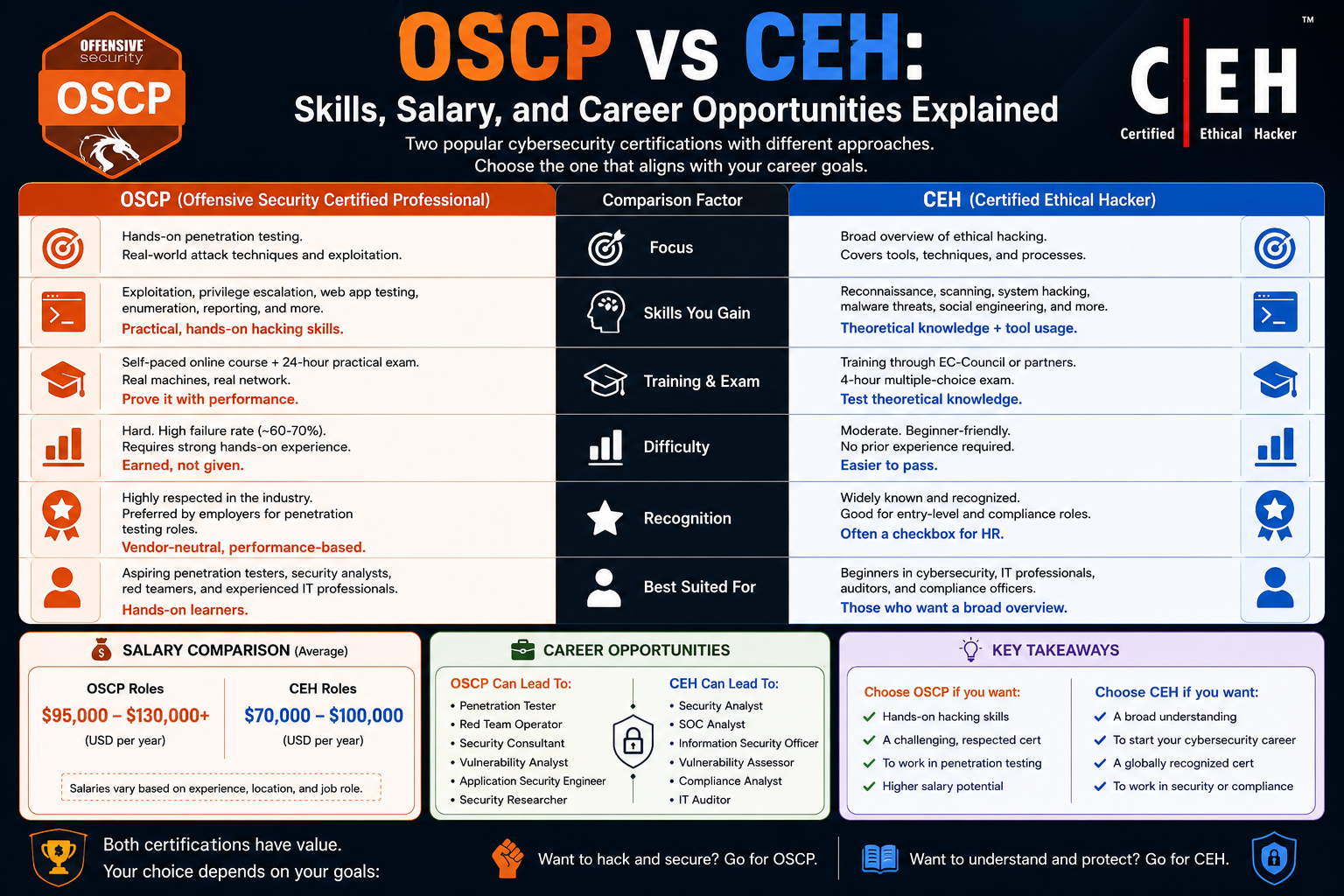
Cybersecurity has become one of the fastest-growing industries in the world. Organizations of every size are constantly searching for professionals who can secure systems, identify vulnerabilities, and protect valuable information from cybercriminals. As cyber threats continue evolving, certifications have become a major way for IT professionals to validate their skills and stand out in a highly competitive job market.
Among the most respected certifications in offensive security are the Offensive Security Certified Professional (OSCP) and the Certified Ethical Hacker (CEH). Both credentials focus on cybersecurity and ethical hacking, but they are designed for very different audiences and career goals. Choosing between them can be difficult for aspiring security professionals because each certification offers unique advantages.
Some professionals want deep technical penetration testing experience, while others prefer a broader understanding of cybersecurity operations and ethical hacking methodologies. Understanding the purpose and structure of these certifications is essential before investing time and money into training.
The OSCP certification is widely recognized for its practical and hands-on nature. It emphasizes offensive security techniques, penetration testing methodologies, and real-world exploitation skills. On the other hand, the CEH certification focuses more on ethical hacking concepts, attack frameworks, security tools, and foundational cybersecurity knowledge.
Both certifications can open doors to excellent career opportunities, but they lead professionals toward different paths within cybersecurity. Before deciding which certification to pursue, it is important to understand how they differ in training style, technical requirements, exam format, and industry perception.
This guide explores the foundations of both OSCP and CEH while helping you understand which certification aligns best with your career aspirations and learning preferences.
What Is the OSCP Certification?
The Offensive Security Certified Professional certification is one of the most respected credentials in penetration testing and offensive security. Developed by Offensive Security, the OSCP is designed to test practical cybersecurity skills in realistic environments.
Unlike many traditional certifications that rely heavily on multiple-choice exams, OSCP focuses on hands-on penetration testing. Candidates must demonstrate their ability to identify vulnerabilities, exploit systems, escalate privileges, and document their findings professionally.
The certification is closely associated with the PEN-200 training course, which teaches students how to conduct penetration testing against various systems and services. Students work in virtual lab environments where they attack intentionally vulnerable machines to gain practical experience.
OSCP training emphasizes learning through experimentation and problem solving. Candidates are expected to think critically and adapt to unfamiliar situations rather than simply memorizing commands or definitions.
Topics covered in OSCP training typically include:
- Information gathering
- Vulnerability analysis
- Buffer overflows
- Web application attacks
- Password attacks
- Privilege escalation
- Tunneling and pivoting
- Active Directory exploitation
- Exploit modification
- Report writing
One of the reasons OSCP is highly respected is because passing requires real technical ability. Candidates must demonstrate that they can perform practical offensive security tasks under pressure.
The certification is especially valuable for professionals pursuing careers in penetration testing, red teaming, vulnerability research, or offensive security consulting.
What Is the CEH Certification?
The Certified Ethical Hacker certification was developed by the EC-Council and focuses on teaching ethical hacking methodologies and cybersecurity concepts from a broader perspective.
Rather than specializing deeply in penetration testing, CEH introduces candidates to a wide range of cybersecurity domains. The goal is to help professionals understand how attackers operate so they can better defend organizational systems.
CEH covers numerous ethical hacking topics, including:
- Reconnaissance
- Footprinting
- Enumeration
- Malware threats
- Social engineering
- Wireless security
- Web application vulnerabilities
- Cryptography
- Network attacks
- Cloud security concepts
The certification is structured to provide a well-rounded understanding of ethical hacking processes and cybersecurity operations.
Many candidates pursue CEH because it serves as an accessible entry point into cybersecurity. It does not require the same level of technical depth as OSCP, making it attractive for beginners and professionals transitioning into security roles from networking or systems administration backgrounds.
CEH is also commonly recognized in government, enterprise, and compliance-focused environments. Because of its long-standing reputation and broad coverage, many organizations include CEH in job requirements for security analysts and related positions.
Although CEH includes practical concepts and attack demonstrations, the certification is more theory-oriented compared to OSCP. The emphasis is on understanding tools, methodologies, and frameworks rather than mastering advanced exploitation techniques.
The Philosophy Behind OSCP
One of the defining characteristics of OSCP is its philosophy of learning by doing.
Offensive Security built the certification around the idea that practical experience is more valuable than memorized knowledge. Students are encouraged to approach problems independently, troubleshoot failures, and develop persistence through hands-on practice.
This philosophy is reflected throughout the entire learning experience. Instead of simply watching demonstrations, candidates actively compromise vulnerable systems and experiment with exploitation techniques.
The OSCP environment intentionally provides limited guidance because penetration testers in real-world environments rarely receive step-by-step instructions. Candidates learn to:
- Research vulnerabilities
- Analyze services manually
- Chain multiple attack techniques together
- Adapt to unexpected obstacles
- Document successful exploitation methods
Many students initially find the OSCP learning process frustrating because it requires patience and persistence. However, these same challenges are part of what makes the certification respected in the cybersecurity community.
Employers understand that passing OSCP demonstrates not only technical skill but also determination, critical thinking, and practical troubleshooting ability.
This focus on independent learning closely mirrors the realities of offensive security work, where professionals constantly encounter unfamiliar technologies and complex environments.
The Philosophy Behind CEH
The CEH certification follows a broader educational philosophy.
Instead of concentrating heavily on practical exploitation, CEH aims to provide a comprehensive overview of ethical hacking and cybersecurity methodologies. The certification introduces candidates to many different aspects of cybersecurity without requiring advanced specialization.
The CEH approach is designed to build foundational awareness and understanding. Candidates learn about attack vectors, security controls, risk mitigation, and organizational security concepts.
This methodology makes CEH suitable for professionals who need cybersecurity knowledge but may not work directly in offensive security roles.
For example, security analysts, compliance professionals, auditors, incident responders, and managers often benefit from understanding how attacks occur even if they are not personally exploiting systems.
CEH training also emphasizes familiarity with cybersecurity terminology, frameworks, and standard security tools. This broader perspective can help professionals communicate effectively across different cybersecurity teams and organizational departments.
Because CEH covers many domains at a high level, candidates gain exposure to a wide variety of concepts that may later guide them toward specialized career paths.
The certification’s educational style is generally more structured and classroom-oriented than OSCP, making it easier for some learners to follow.
Understanding Offensive Security
To fully appreciate the OSCP certification, it is important to understand offensive security itself.
Offensive security refers to proactive security testing designed to identify weaknesses before malicious attackers can exploit them. Professionals in offensive security intentionally simulate attacks against systems, networks, and applications to uncover vulnerabilities.
This field includes:
- Penetration testing
- Red teaming
- Exploit development
- Vulnerability research
- Adversary simulation
The primary objective is to think like an attacker while helping organizations improve their security posture.
Offensive security professionals must understand operating systems, networking, programming, web technologies, authentication systems, and exploitation techniques. They also need creativity and problem-solving ability because every environment presents unique challenges.
OSCP training reflects this reality by forcing candidates to work through realistic attack scenarios independently.
Unlike defensive security roles, offensive security often involves active exploitation and lateral movement within systems. Professionals must understand not only how vulnerabilities work but also how to combine techniques effectively.
This is why OSCP places such a strong emphasis on practical skill development.
Understanding Ethical Hacking
Ethical hacking is a broader concept that encompasses both offensive techniques and security awareness practices.
An ethical hacker legally tests systems and applications with permission from the organization. The goal is to identify weaknesses before malicious actors discover them.
Ethical hacking involves multiple stages, including:
- Reconnaissance
- Scanning
- Enumeration
- Exploitation
- Post-exploitation
- Reporting
CEH focuses heavily on these methodologies and introduces candidates to the overall ethical hacking lifecycle.
The certification also explores many common cybersecurity threats, attack vectors, and security technologies. This broad exposure helps professionals understand how different security domains connect within an organization.
Ethical hacking is not limited to penetration testing. It also includes security assessments, vulnerability management, awareness training, and risk mitigation efforts.
Because of this wider scope, CEH appeals to professionals interested in general cybersecurity operations rather than purely offensive roles.
The certification provides valuable context for understanding how attackers think and how organizations defend against cyber threats.
Technical Skills Required for OSCP
OSCP candidates benefit significantly from prior technical experience.
Although there are no strict prerequisites, professionals without networking, Linux, or scripting knowledge often struggle with the material.
Key technical areas that support OSCP success include:
- TCP/IP networking
- Linux command-line usage
- Windows administration basics
- Python scripting
- Bash scripting
- Web technologies
- Active Directory fundamentals
OSCP requires comfort with terminal-based environments because much of the work involves command-line tools and manual exploitation techniques.
Candidates must also learn how to troubleshoot failed attacks and analyze unfamiliar services. This often involves reading technical documentation, modifying public exploits, and experimenting with different attack approaches.
The certification rewards persistence and curiosity. Many successful candidates spend months building home labs and practicing on vulnerable systems before attempting the exam.
Because the learning curve can be steep, OSCP is generally better suited for individuals who already enjoy technical problem solving and independent experimentation.
Technical Skills Required for CEH
CEH is more accessible to candidates with limited technical backgrounds.
While cybersecurity fundamentals are still important, the certification does not require the same depth of exploitation expertise as OSCP.
Candidates benefit from understanding:
- Basic networking
- Operating system concepts
- Security terminology
- Web application fundamentals
- Common attack vectors
- Cybersecurity tools
CEH preparation typically involves studying concepts rather than performing advanced practical attacks.
This makes the certification attractive for professionals entering cybersecurity from help desk, networking, or systems administration roles.
Because the exam focuses heavily on theoretical knowledge, candidates often spend more time reviewing study guides, watching instructional videos, and practicing multiple-choice questions.
However, practical experience still improves understanding significantly. Candidates who experiment with labs and security tools during preparation often gain deeper insight into the concepts covered by the certification.
CEH provides a strong starting point for professionals who want to build foundational cybersecurity knowledge before pursuing more advanced technical certifications later in their careers.
Exam Structure and Testing Style
One of the most important differences between OSCP and CEH is the way each certification tests candidates. The exam structure directly affects how students prepare, how stressful the certification process becomes, and what skills employers believe the certification represents.
The OSCP exam is famous for being highly practical and technically demanding. Candidates enter a controlled virtual environment containing vulnerable systems that they must exploit within a strict time limit. Instead of answering questions from a list, candidates perform real penetration testing activities.
The OSCP exam requires students to:
- Enumerate target systems
- Discover vulnerabilities
- Exploit services
- Escalate privileges
- Move laterally where necessary
- Document findings professionally
The exam environment is intentionally designed to simulate realistic penetration testing scenarios. Students often face unfamiliar systems and unexpected obstacles that require creativity and patience to overcome.
In contrast, the CEH exam follows a more traditional certification structure. Candidates answer multiple-choice questions covering a wide range of cybersecurity and ethical hacking concepts.
The CEH exam focuses on:
- Ethical hacking methodologies
- Security frameworks
- Common vulnerabilities
- Security tools
- Networking concepts
- Threat types
- Security best practices
This difference in testing philosophy changes the entire learning experience. OSCP candidates spend most of their time practicing attacks in labs, while CEH candidates often focus more heavily on reading, studying terminology, and memorizing concepts.
For many professionals, the exam style alone determines which certification feels more suitable.
Why the OSCP Exam Is Considered Difficult
The OSCP exam has developed a reputation as one of the toughest cybersecurity certifications available. Many professionals consider it a major milestone in offensive security careers because of its technical complexity and intense pressure.
Several factors contribute to the exam’s difficulty.
First, the OSCP requires practical exploitation ability rather than memorized knowledge. Candidates must independently compromise systems without step-by-step instructions.
Second, the exam is extremely time-intensive. Students may spend many continuous hours troubleshooting problems, researching vulnerabilities, and experimenting with attack methods.
Third, the exam environment often includes intentional challenges that force candidates to think critically. Standard exploitation methods may fail, requiring adaptation and creativity.
The certification also tests:
- Patience
- Persistence
- Documentation skills
- Research ability
- Time management
- Technical troubleshooting
Many candidates fail the OSCP exam on their first attempt, not because they lack intelligence, but because the certification demands a very specific combination of technical knowledge and practical experience.
The learning process itself can be mentally exhausting. Students frequently encounter situations where progress feels impossible until they discover a small overlooked detail.
This challenging environment mirrors real-world penetration testing, where attackers must continuously adapt to unexpected security controls and technical obstacles.
Why the CEH Exam Is More Accessible
Compared to OSCP, the CEH certification is generally considered more accessible to beginners and intermediate IT professionals.
The exam emphasizes broad knowledge rather than deep technical execution. Candidates are expected to understand cybersecurity concepts, ethical hacking terminology, and common attack methods.
This structure makes preparation more predictable and manageable for many learners.
CEH candidates can prepare through:
- Study guides
- Video courses
- Practice exams
- Flashcards
- Structured training programs
Because the exam relies heavily on multiple-choice questions, students can often identify weak areas and review them systematically.
The broader scope of CEH also means candidates are exposed to many cybersecurity domains without needing advanced expertise in any single area.
While the exam is still challenging, the learning process tends to feel less overwhelming than OSCP preparation.
Professionals who prefer organized coursework and clearly defined study objectives often appreciate the CEH format.
Hands-On Skills vs Theoretical Knowledge
The distinction between hands-on skills and theoretical knowledge is central to understanding the difference between OSCP and CEH.
OSCP prioritizes technical execution.
CEH prioritizes conceptual understanding.
In OSCP training, students actively compromise systems and troubleshoot technical issues. They gain practical experience using offensive security tools and exploitation techniques.
This hands-on approach develops skills such as:
- Manual enumeration
- Privilege escalation
- Exploit modification
- Shell management
- Pivoting between systems
- Active Directory exploitation
Students learn how attacks actually work in practice rather than simply reading about them.
CEH, meanwhile, introduces candidates to cybersecurity concepts from a higher-level perspective. Students learn:
- Attack categories
- Security terminology
- Ethical hacking phases
- Defensive awareness
- Common vulnerabilities
- Security methodologies
The certification teaches what attacks are and how they affect organizations, but it generally does not require advanced exploitation capability.
Neither approach is inherently better. The value depends entirely on career goals and preferred learning styles.
Some professionals thrive in technical lab environments, while others prefer structured conceptual learning.
How Employers View OSCP
The OSCP certification carries substantial weight among technical cybersecurity professionals.
Hiring managers, penetration testing teams, and offensive security consultants often respect OSCP because it validates practical skill rather than theoretical memorization.
Many employers believe OSCP-certified professionals can contribute more quickly to penetration testing engagements because they already possess hands-on experience.
Technical interviewers frequently recognize the challenges associated with the certification and understand the effort required to pass.
OSCP holders are often associated with:
- Advanced technical ability
- Independent problem solving
- Offensive security expertise
- Real-world penetration testing capability
- Persistence under pressure
In highly technical cybersecurity environments, OSCP may carry more prestige than certifications focused primarily on theory.
Some consulting firms and red team organizations even prioritize OSCP candidates during hiring because the certification aligns closely with the work performed in offensive security roles.
However, OSCP’s technical focus also means it may be less relevant for managerial, governance, or compliance-oriented cybersecurity positions.
How Employers View CEH
The CEH certification holds strong recognition across the broader cybersecurity industry.
Because it has existed for many years and maintains global visibility, CEH frequently appears in job descriptions and HR screening systems.
Many organizations view CEH as proof that a candidate understands cybersecurity fundamentals and ethical hacking methodologies.
CEH is particularly valuable in environments involving:
- Compliance requirements
- Government contracting
- Security awareness
- Risk management
- Security operations centers
- Incident response teams
The certification is often recognized by non-technical recruiters and hiring departments that may not fully understand specialized offensive security certifications.
This broader recognition can help candidates qualify for interviews and entry-level security positions more easily.
While technical professionals sometimes criticize CEH for lacking deep practical testing, the certification still provides substantial career value in many organizations.
For professionals entering cybersecurity, CEH often serves as a strong first certification that demonstrates foundational knowledge.
Career Paths After OSCP
OSCP certification often leads professionals toward highly technical cybersecurity roles.
Common career paths include:
- Penetration Tester
- Red Team Operator
- Offensive Security Consultant
- Security Researcher
- Application Security Tester
- Vulnerability Assessment Specialist
These roles focus heavily on identifying vulnerabilities and simulating cyberattacks against organizational systems.
Penetration testers perform security assessments on networks, applications, and infrastructure to help organizations improve their defenses.
Red team professionals simulate sophisticated attacks that test not only technical controls but also organizational detection and response capabilities.
OSCP-certified professionals may also specialize further in areas such as:
- Web application security
- Wireless penetration testing
- Active Directory attacks
- Cloud security testing
- Exploit development
The certification provides a strong technical foundation that can support many advanced offensive security career paths.
Career Paths After CEH
CEH supports a broader range of cybersecurity roles.
Because the certification covers many domains, it applies well to positions involving security operations, analysis, compliance, and risk management.
Common roles for CEH-certified professionals include:
- Security Analyst
- SOC Analyst
- Information Security Analyst
- Incident Response Specialist
- Security Consultant
- Compliance Analyst
- Security Administrator
These positions often involve monitoring systems, investigating threats, managing vulnerabilities, and supporting organizational security programs.
CEH-certified professionals may also work in governance and policy-related environments where broad cybersecurity understanding is more important than advanced offensive expertise.
The certification provides flexibility for professionals still exploring which cybersecurity specialization interests them most.
It also creates a solid foundation for pursuing more advanced certifications later.
Salary Expectations for OSCP Professionals
OSCP-certified professionals often work in high-paying technical security roles.
Because offensive security expertise remains in strong demand, experienced penetration testers and red team specialists frequently earn excellent salaries.
Several factors influence earnings, including:
- Technical skill level
- Years of experience
- Geographic location
- Industry specialization
- Consulting versus internal roles
- Security clearance requirements
Entry-level penetration testers may earn moderate salaries initially, but compensation often increases rapidly with experience.
Senior offensive security professionals can earn significantly higher salaries because of the specialized expertise required for advanced security assessments.
The certification itself does not guarantee high income, but it strengthens credibility in competitive technical job markets.
Employers are often willing to pay premium salaries for professionals who can realistically simulate attacks and identify critical vulnerabilities.
Salary Expectations for CEH Professionals
CEH-certified professionals also enjoy strong earning potential across many cybersecurity domains.
Because CEH applies to a wider range of positions, salary ranges can vary substantially depending on the role.
Security analysts and SOC analysts may begin with lower salaries than offensive security specialists, but experienced professionals can still achieve excellent compensation over time.
Professionals using CEH in management, consulting, compliance, or leadership roles may eventually earn salaries comparable to highly technical security specialists.
Salary growth often depends on:
- Experience
- Additional certifications
- Industry demand
- Leadership responsibilities
- Specialized technical knowledge
For many professionals, CEH acts as a starting point that opens doors to broader cybersecurity opportunities.
As professionals gain experience, they often pursue additional certifications that align more closely with their long-term specialization.
The Importance of Practical Labs
Practical labs play a major role in OSCP preparation.
Students spend hundreds of hours practicing attacks against vulnerable systems. These labs help candidates develop technical instincts and troubleshooting skills that cannot easily be learned from books alone.
Lab environments teach students how to:
- Enumerate services systematically
- Identify hidden vulnerabilities
- Escalate privileges
- Maintain persistence
- Troubleshoot failed attacks
- Understand attacker workflows
Many OSCP candidates discover that repetition and experimentation are essential for mastering offensive security concepts.
Practical labs also expose students to realistic frustrations similar to those encountered during real penetration testing engagements.
CEH candidates may also benefit from labs, but they are generally less central to the certification process.
Because CEH focuses more on conceptual understanding, many students successfully prepare using study guides and practice exams without extensive technical lab work.
However, combining theoretical study with practical experimentation often improves long-term retention and understanding.
Time Commitment for OSCP Preparation
Preparing for OSCP requires a substantial investment of time and energy.
Many candidates spend several months studying consistently before attempting the exam.
Preparation commonly includes:
- Daily lab practice
- Reading technical documentation
- Learning scripting
- Practicing privilege escalation
- Reviewing networking concepts
- Experimenting with vulnerabilities
The learning process can become overwhelming without proper time management and persistence.
Some candidates dedicate hundreds of hours to preparation because the exam demands practical confidence rather than superficial familiarity.
Balancing OSCP preparation with full-time work can also be difficult due to the technical intensity involved.
Success often depends on consistency and willingness to continue learning despite setbacks.
Time Commitment for CEH Preparation
CEH preparation is generally more structured and predictable.
Candidates often study over several weeks or months depending on prior experience and available time.
Preparation typically includes:
- Reading official materials
- Watching training videos
- Reviewing cybersecurity terminology
- Practicing multiple-choice questions
- Studying attack methodologies
- Memorizing security concepts
Because the exam structure is more traditional, many candidates find it easier to organize study schedules and measure progress.
Professionals transitioning into cybersecurity often appreciate the manageable learning curve associated with CEH preparation.
The certification still requires dedication and focus, but the process tends to feel less technically exhausting than OSCP training.
Learning Styles and Personality Fit
Choosing between OSCP and CEH often comes down to personality and learning preferences.
OSCP tends to attract individuals who:
- Enjoy technical experimentation
- Prefer hands-on learning
- Like solving difficult problems
- Feel comfortable troubleshooting independently
- Enjoy hacking labs and challenges
These learners often thrive in environments where exploration and persistence matter more than memorization.
CEH tends to appeal to individuals who:
- Prefer structured learning
- Enjoy broad conceptual understanding
- Want organized study materials
- Appreciate predictable exam preparation
- Prefer learning frameworks and methodologies
Understanding your preferred learning style can make certification preparation significantly more enjoyable and effective.
The best certification is often the one that aligns naturally with how you learn and the type of cybersecurity work you ultimately want to perform.
Choosing the Right Certification for Your Career Goals
One of the most important factors when deciding between OSCP and CEH is understanding your long-term career direction. Many professionals make the mistake of selecting certifications based solely on popularity or salary expectations without considering whether the certification actually aligns with the work they want to perform every day.
Cybersecurity contains many different specializations. Some professionals work in highly technical offensive security roles, while others focus on security operations, compliance, governance, cloud security, risk management, or incident response. OSCP and CEH support different paths within this broader ecosystem.
OSCP is heavily focused on offensive security and penetration testing. It is best suited for professionals who want to attack systems ethically to uncover vulnerabilities before malicious actors can exploit them. The certification rewards technical curiosity, persistence, and hands-on experimentation.
CEH, on the other hand, provides a broader understanding of ethical hacking and cybersecurity concepts. It supports a wider variety of job roles and offers flexibility for professionals who may not want to specialize deeply in penetration testing.
Before choosing either certification, professionals should ask themselves several important questions:
- Do I enjoy working in terminal environments?
- Am I comfortable troubleshooting technical problems for long periods?
- Do I want to specialize in offensive security?
- Do I prefer broad knowledge over technical depth?
- Am I seeking a beginner-friendly certification?
- Do I enjoy structured study methods?
- What type of cybersecurity role interests me most?
These questions help determine which certification better matches personal interests and professional goals.
Why Offensive Security Continues to Grow
Offensive security has become increasingly valuable as organizations face more advanced cyber threats. Businesses no longer rely solely on defensive security controls because modern attackers constantly evolve their techniques.
Organizations now invest heavily in proactive security testing to identify vulnerabilities before cybercriminals can exploit them.
This has created strong demand for professionals skilled in:
- Penetration testing
- Red teaming
- Adversary simulation
- Vulnerability research
- Security assessments
OSCP aligns closely with these growing areas of cybersecurity.
Companies want professionals who can realistically simulate attacks against networks, applications, cloud systems, and infrastructure. The ability to identify weaknesses before real attackers discover them can prevent data breaches, financial losses, and reputational damage.
Offensive security professionals also help organizations validate whether existing security controls actually work under realistic conditions.
As ransomware attacks, cloud threats, and targeted intrusions continue increasing, the value of practical offensive security expertise is likely to remain strong for many years.
Why Broad Cybersecurity Knowledge Still Matters
Although offensive security receives significant attention, organizations also need professionals with broad cybersecurity understanding.
Security operations involve far more than penetration testing alone.
Businesses require professionals who understand:
- Risk management
- Security monitoring
- Compliance frameworks
- Incident response
- Security architecture
- Governance policies
- Threat intelligence
- User awareness training
CEH supports this broader perspective by exposing candidates to many cybersecurity concepts and methodologies.
Not every organization requires advanced penetration testers, but nearly every organization needs security analysts, incident responders, compliance specialists, and security administrators.
Professionals with broad cybersecurity awareness often become valuable team members because they understand how different security functions connect across an organization.
CEH also helps professionals communicate effectively with both technical and non-technical stakeholders, which becomes increasingly important in larger business environments.
The Role of Certifications in Modern Hiring
Certifications have become a major component of cybersecurity hiring practices.
Employers often use certifications to:
- Validate technical knowledge
- Filter job candidates
- Measure commitment to learning
- Meet compliance requirements
- Standardize hiring expectations
However, certifications alone do not guarantee career success.
Practical experience, communication skills, problem-solving ability, and continuous learning remain equally important.
OSCP tends to impress highly technical hiring managers because of its practical difficulty. Many penetration testing firms recognize the certification as proof that a candidate possesses real offensive security capability.
CEH often performs well during HR screening and organizational compliance reviews because of its global recognition and broad acceptance.
Some organizations specifically require CEH for government or regulatory reasons, while others prioritize OSCP for offensive security positions.
Understanding how employers view each certification can help candidates make smarter career decisions.
The Value of Real-World Experience
While certifications provide valuable knowledge, real-world experience remains one of the most important aspects of cybersecurity career development.
Employers consistently value professionals who can demonstrate:
- Practical troubleshooting ability
- Communication skills
- Team collaboration
- Technical adaptability
- Real project experience
OSCP preparation naturally builds practical experience because candidates spend extensive time attacking systems and solving technical problems.
CEH provides valuable theoretical understanding but may require additional hands-on practice for professionals pursuing technical offensive security roles.
Many successful cybersecurity professionals combine certifications with:
- Home labs
- Capture-the-flag competitions
- Freelance projects
- Internships
- Bug bounty programs
- Open-source contributions
Experience helps bridge the gap between certification knowledge and real-world cybersecurity operations.
Candidates who combine certifications with practical projects often stand out more strongly during technical interviews.
Common Mistakes When Choosing Between OSCP and CEH
Many professionals approach cybersecurity certifications with unrealistic expectations.
One common mistake is assuming that one certification is universally better than the other. In reality, both certifications serve different purposes and support different career paths.
Another mistake involves underestimating the technical difficulty of OSCP. Some beginners attempt OSCP too early without sufficient networking, Linux, or scripting experience.
This can lead to frustration and burnout.
Similarly, some professionals dismiss CEH as too theoretical without recognizing its value in broad cybersecurity roles and compliance-driven environments.
Other common mistakes include:
- Pursuing certifications only for salary expectations
- Ignoring personal learning preferences
- Focusing entirely on certification prestige
- Neglecting practical skill development
- Avoiding foundational cybersecurity knowledge
Choosing the right certification requires honest self-assessment rather than following industry trends blindly.
Professionals should focus on certifications that align naturally with both their interests and long-term goals.
Can Beginners Start with OSCP?
Some beginners wonder whether they should start directly with OSCP instead of pursuing foundational certifications first.
Technically, there are no strict prerequisites for OSCP. Anyone can attempt the certification.
However, beginners without strong technical backgrounds often struggle significantly.
OSCP assumes familiarity with:
- Networking fundamentals
- Linux administration
- Basic scripting
- Web technologies
- Command-line tools
Candidates lacking these fundamentals may spend excessive time learning basic concepts before even reaching advanced penetration testing topics.
For beginners, a gradual learning path is often more effective.
Many professionals first build foundational skills through:
- Networking studies
- Linux training
- Basic scripting practice
- Introductory cybersecurity courses
- Home lab experimentation
Once comfortable with these areas, transitioning into OSCP preparation becomes far more manageable.
That said, highly motivated beginners who enjoy technical problem solving can still succeed with OSCP if they commit enough time and persistence.
Why CEH Appeals to Career Changers
CEH remains especially popular among professionals transitioning into cybersecurity from other IT fields.
System administrators, network engineers, help desk professionals, and compliance specialists often pursue CEH because it introduces cybersecurity concepts in a structured and approachable way.
The certification provides broad exposure to ethical hacking without immediately requiring advanced exploitation skills.
This makes CEH useful for professionals who want to:
- Explore cybersecurity careers
- Build foundational knowledge
- Improve security awareness
- Qualify for entry-level security roles
- Understand attacker methodologies
CEH also helps professionals identify which areas of cybersecurity interest them most before committing to advanced specialization.
For example, a CEH candidate may later decide to specialize in:
- Penetration testing
- Cloud security
- Digital forensics
- Incident response
- Security operations
- Governance and compliance
The certification serves as a gateway into many different cybersecurity paths.
The Importance of Continuous Learning
Cybersecurity evolves constantly.
Attack techniques, defensive technologies, cloud platforms, and security tools change rapidly. Professionals who stop learning quickly fall behind.
Neither OSCP nor CEH represents the end of cybersecurity education.
Successful professionals continuously expand their knowledge through:
- Advanced certifications
- Security conferences
- Research blogs
- Hands-on labs
- Threat intelligence reports
- Community participation
- Technical experimentation
OSCP holders often pursue advanced offensive security certifications later, while CEH professionals may branch into specialized domains depending on career interests.
Continuous learning is particularly important because modern attackers constantly develop new methods for bypassing security controls.
Cybersecurity professionals must remain adaptable and curious throughout their careers.
How OSCP Builds Problem-Solving Ability
One of the greatest strengths of OSCP is its ability to develop technical problem-solving skills.
Candidates repeatedly encounter situations where standard techniques fail. Success often depends on analyzing small details, researching unfamiliar technologies, and experimenting creatively.
This process teaches professionals how to think critically under pressure.
Rather than memorizing fixed procedures, OSCP candidates learn how to:
- Approach unfamiliar systems logically
- Break complex problems into smaller parts
- Adapt attack methods dynamically
- Research vulnerabilities independently
- Troubleshoot failed exploitation attempts
These skills transfer directly into real-world offensive security work.
Many employers value problem-solving ability even more than tool familiarity because tools change constantly while analytical thinking remains universally valuable.
OSCP’s emphasis on persistence and adaptability helps candidates build confidence in their technical abilities over time.
How CEH Builds Security Awareness
CEH’s greatest strength lies in its broad cybersecurity awareness.
The certification introduces candidates to numerous attack vectors, security concepts, and defensive considerations across multiple domains.
This broad perspective helps professionals understand how cyber threats affect organizations from both technical and operational viewpoints.
CEH candidates develop awareness of:
- Social engineering attacks
- Malware threats
- Wireless vulnerabilities
- Web application risks
- Security frameworks
- Cloud security concerns
- Cryptographic concepts
- Compliance considerations
This broad exposure can improve communication between technical and non-technical teams within organizations.
Security awareness is especially valuable for professionals working in environments where cybersecurity intersects with business operations, governance, and compliance requirements.
Industry Demand for OSCP and CEH
Both OSCP and CEH continue experiencing strong industry demand, although demand varies depending on role type and organization.
OSCP demand remains high in:
- Penetration testing firms
- Offensive security teams
- Red team environments
- Security consulting companies
- High-security industries
Organizations increasingly recognize the importance of realistic security testing and proactive vulnerability discovery.
CEH demand remains strong in:
- Government environments
- Enterprise organizations
- Security operations centers
- Compliance-driven industries
- Entry-level cybersecurity hiring
Because CEH is widely recognized globally, it often appears in hiring requirements for general cybersecurity positions.
Professionals should research job postings within their target industries to understand which certifications employers prioritize most frequently.
Combining OSCP and CEH Together
Some cybersecurity professionals eventually earn both certifications.
This combination can provide both broad cybersecurity awareness and deep practical offensive security capability.
CEH may help establish foundational understanding early in a career, while OSCP later demonstrates advanced technical specialization.
Combining certifications can strengthen resumes for professionals pursuing leadership positions in cybersecurity because it demonstrates versatility across both conceptual and technical domains.
However, candidates should avoid collecting certifications without purpose.
The most valuable certification strategy is one that supports clear career objectives and practical skill development.
Mental Challenges of Cybersecurity Certification Preparation
Cybersecurity certification preparation can become mentally demanding, especially for technical certifications like OSCP.
Candidates often experience:
- Frustration
- Self-doubt
- Fatigue
- Information overload
- Burnout
OSCP preparation can be particularly stressful because progress is not always linear. Candidates may spend hours troubleshooting a single vulnerability or failed exploit.
Maintaining motivation becomes essential.
Successful candidates often develop routines involving:
- Consistent study schedules
- Regular breaks
- Hands-on practice balance
- Goal tracking
- Community engagement
CEH preparation tends to feel more structured, but candidates can still become overwhelmed by the large amount of theoretical material.
Understanding that cybersecurity learning is a long-term process helps reduce unrealistic expectations during certification preparation.
The Future of Cybersecurity Certifications
Cybersecurity certifications will likely remain important as organizations continue facing sophisticated digital threats.
However, employers increasingly prioritize practical ability alongside certification credentials.
This trend benefits certifications like OSCP that emphasize hands-on skill validation.
At the same time, organizations still need professionals with broad security awareness and governance understanding, ensuring continued relevance for certifications like CEH.
Future cybersecurity professionals will likely need a combination of:
- Technical expertise
- Communication skills
- Business awareness
- Adaptability
- Continuous learning habits
Certifications alone will never replace practical experience, but they remain valuable tools for career development and professional credibility.
Conclusion
Choosing between OSCP and CEH ultimately depends on your career goals, learning preferences, and technical interests.
OSCP is ideal for professionals passionate about offensive security, penetration testing, and hands-on technical challenges. Its rigorous practical focus makes it highly respected among technical cybersecurity teams and employers seeking real-world offensive security skills.
CEH is better suited for professionals seeking broad cybersecurity knowledge, ethical hacking awareness, and flexibility across multiple security domains. Its structured approach and global recognition make it especially valuable for beginners and professionals transitioning into cybersecurity.
Neither certification is universally superior. Each serves different purposes within the cybersecurity industry.
If you enjoy solving technical problems, experimenting in labs, and working deeply with offensive security concepts, OSCP may be the better path. If you prefer structured learning, broad security awareness, and versatility across cybersecurity roles, CEH may fit your goals more naturally.
The most important factor is choosing the certification that aligns with the type of cybersecurity professional you want to become. Both certifications can lead to rewarding careers, strong salaries, and long-term growth opportunities when combined with practical experience and continuous learning.
Cybersecurity is constantly evolving, and professionals who remain curious, adaptable, and committed to learning will continue finding opportunities regardless of which certification path they choose.