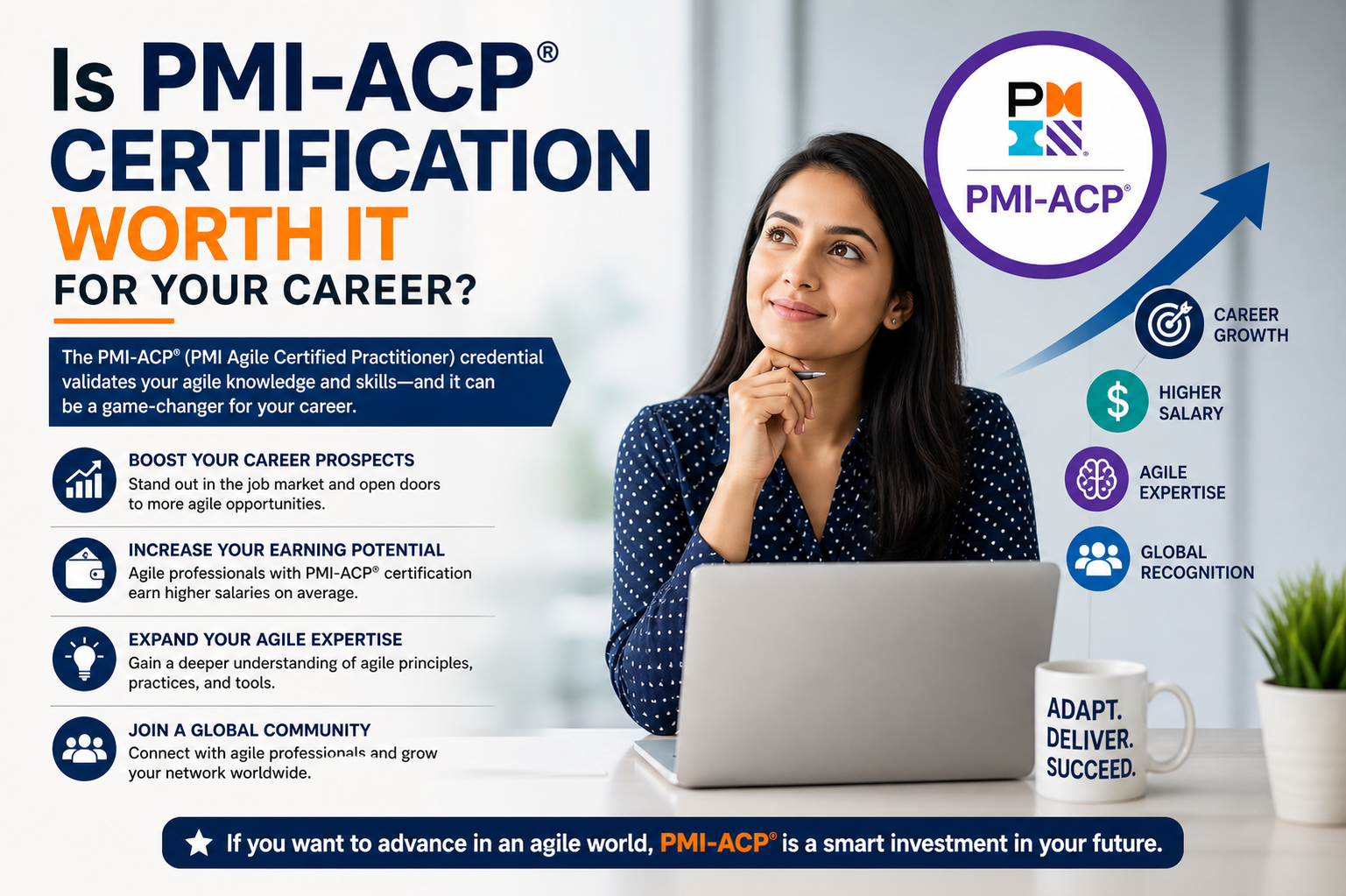
The PMI-ACP certification has become one of the most discussed credentials in the Agile project management space. As organizations continue shifting toward Agile ways of working, professionals are increasingly evaluating whether investing time and effort into this certification is truly worthwhile. The answer is not the same for everyone, but understanding its deeper impact on career growth, skill development, and industry positioning can help you make a more informed decision.
Understanding the PMI-ACP Certification in a Modern Context
The PMI-ACP certification is designed to validate a professional’s knowledge of Agile principles and practices across multiple frameworks rather than focusing on a single methodology. Unlike certifications that concentrate solely on Scrum or Kanban, PMI-ACP takes a broader approach. It covers iterative development, adaptive planning, continuous improvement, and team collaboration techniques that are widely used in Agile environments.
In today’s workplace, Agile is no longer limited to software development teams. It is being adopted in marketing, operations, finance, and product development. This expansion has increased the relevance of certifications that provide a well-rounded understanding of Agile practices. PMI-ACP fits into this space by offering a structured way to demonstrate both theoretical understanding and practical application.
Growing Demand for Agile Professionals
One of the strongest arguments in favor of the PMI-ACP certification is the increasing demand for Agile professionals. Organizations are moving away from rigid, traditional project management methods and adopting more flexible and adaptive frameworks. This shift is driven by the need to respond quickly to market changes, customer feedback, and technological advancements.
As a result, roles such as Agile Project Manager, Scrum Master, Product Owner, and Agile Coach are becoming more common. Employers often prefer candidates who can demonstrate formal knowledge of Agile principles combined with real-world experience. PMI-ACP helps bridge this gap by providing a recognized validation of Agile expertise.
However, demand alone does not guarantee career growth. The value of the certification depends on how effectively you can apply Agile practices in real projects. Employers are increasingly focused on practical ability rather than just certifications, which makes experience equally important.
How PMI-ACP Enhances Professional Skill Sets
Beyond job opportunities, the certification plays a significant role in developing professional skills. Agile is not just a methodology; it is a mindset that emphasizes flexibility, collaboration, and continuous improvement. The PMI-ACP certification encourages professionals to adopt this mindset in a structured manner.
One of the key areas of skill development is adaptive planning. Unlike traditional project management, where plans are fixed upfront, Agile requires continuous adjustments based on feedback and changing requirements. This helps professionals become more comfortable with uncertainty and change.
Another important area is stakeholder engagement. Agile environments require constant communication with clients, product owners, and team members. PMI-ACP training helps professionals develop stronger collaboration skills, ensuring that expectations are managed effectively throughout the project lifecycle.
Risk management is also approached differently in Agile environments. Instead of trying to eliminate risks at the beginning, Agile focuses on identifying and addressing risks continuously. This dynamic approach is a valuable skill in modern project environments where uncertainty is common.
Career Advancement and Role Transition Opportunities
For many professionals, the PMI-ACP certification acts as a bridge to more advanced roles. Individuals working in traditional project management often use this certification to transition into Agile-focused positions. Similarly, team members such as developers, analysts, and testers use it to move into leadership or coordination roles.
In career progression terms, PMI-ACP can support movement into positions that require strategic thinking and team leadership. These roles often come with higher responsibility and better compensation. However, it is important to understand that certification alone is not enough to secure such roles. Practical experience, leadership ability, and communication skills are equally important.
In competitive job markets, having PMI-ACP can help your profile stand out. It signals to employers that you have taken the initiative to understand Agile methodologies in depth. This can be especially useful when applying for roles in organizations that are actively undergoing Agile transformation.
The Role of Experience in Maximizing Certification Value
While PMI-ACP provides structured knowledge, its real value is unlocked when combined with practical experience. Agile is inherently experiential, meaning that its principles are best understood through real project work rather than theoretical study alone.
Professionals who already work in Agile environments tend to benefit the most from this certification. They can immediately relate the concepts to their day-to-day responsibilities, making the learning more meaningful. On the other hand, individuals without Agile experience may find the certification challenging to apply in practice.
Employers often look for a balance between certification and hands-on experience. This means that PMI-ACP should be seen as a complement to experience rather than a replacement for it. The combination of both significantly increases career value.
Industry Recognition and Global Acceptance
One of the strengths of PMI-ACP is its global recognition. It is offered by a well-established organization in the project management field, which gives it credibility across industries and regions. This recognition makes it easier for professionals to pursue international job opportunities or work with global teams.
However, it is important to note that Agile certifications vary in popularity depending on the region and industry. In some sectors, Scrum-specific certifications may be more commonly requested, while in others, broader Agile certifications like PMI-ACP are preferred.
Despite this variation, PMI-ACP remains respected due to its comprehensive coverage of Agile practices. It is often viewed as a strong indicator of a professional’s commitment to Agile principles and continuous learning.
Time Commitment and Learning Curve
Pursuing PMI-ACP requires a meaningful investment of time and effort. Candidates are expected to have prior Agile experience as well as formal training hours before they can qualify for the exam. This ensures that individuals entering the certification process already have a foundational understanding of Agile practices.
The exam itself covers multiple domains, including Agile tools, techniques, principles, and mindset. This broad scope means that preparation cannot be superficial. Candidates must engage in consistent study, practice scenarios, and real-world application to fully grasp the material.
While the learning curve can be demanding, it is also one of the reasons the certification holds value. The difficulty ensures that certified professionals have a solid understanding of Agile concepts rather than just theoretical familiarity.
Cost vs Long-Term Career Benefits
When evaluating whether PMI-ACP is worth it, cost is an important factor to consider. This includes not only exam fees but also training costs and the time invested in preparation. For some professionals, this can be a significant commitment.
However, the long-term career benefits often outweigh the initial investment. Professionals who successfully apply Agile principles in their work tend to see improvements in job opportunities, salary potential, and career growth. The certification can also lead to increased confidence in handling complex projects and managing teams.
That said, the return on investment varies depending on how actively you use the knowledge gained. If the certification is not applied in real work scenarios, its value may diminish over time.
Strategic Value in Agile Transformation
Many organizations are currently undergoing Agile transformation, shifting from traditional hierarchical structures to more flexible team-based models. This creates a strong demand for professionals who understand how to guide teams through this transition.
PMI-ACP-certified professionals are often seen as valuable contributors in such environments. They can help implement Agile frameworks, train team members, and support organizational change. This strategic role can significantly enhance career visibility and long-term growth potential.
In this context, the certification is not just a personal achievement but also a tool for contributing to broader organizational goals. This makes it particularly valuable for professionals aiming for leadership positions in Agile environments.
Real-World Application of PMI-ACP Knowledge
One of the most important aspects of the PMI-ACP certification is how it translates into real-world work environments. Agile is not a theoretical framework that exists only in books or exams; it is a practical approach that evolves based on team behavior, project complexity, and customer needs. Professionals who earn the certification are expected to apply its principles in dynamic and often unpredictable project settings.
In practice, PMI-ACP knowledge helps professionals improve sprint planning, backlog prioritization, and iterative delivery cycles. These are not just technical activities but also coordination efforts that require strong communication and decision-making skills. Certified professionals often find themselves better equipped to facilitate meetings, resolve conflicts, and ensure that teams stay aligned with project goals.
Another major area of application is continuous improvement. Agile environments encourage teams to regularly reflect on their performance and identify ways to improve. PMI-ACP training reinforces this mindset by introducing structured techniques such as retrospectives and feedback loops. When applied effectively, these practices can significantly improve team productivity and project outcomes.
Impact on Leadership and Team Influence
Beyond technical skills, PMI-ACP certification also influences leadership capabilities. Agile leadership is different from traditional top-down management. Instead of directing every task, Agile leaders focus on enabling teams, removing obstacles, and fostering collaboration. This shift in mindset is one of the most valuable outcomes of the certification.
Professionals with PMI-ACP often develop stronger facilitation skills, which are essential for guiding Agile teams. They learn how to encourage participation, ensure equal contribution from team members, and maintain focus on delivering value. These skills are particularly important in cross-functional teams where different expertise must come together effectively.
Influence in Agile environments is not based on authority alone but on trust and communication. Certified professionals are often seen as more credible because they understand both the principles and practical application of Agile frameworks. This helps them gain the confidence of stakeholders and team members, which is critical for successful project execution.
Challenges in Achieving Certification Value
While PMI-ACP offers many benefits, it is not without challenges. One of the most common issues professionals face is the gap between theoretical knowledge and real-world application. Understanding Agile concepts in an exam setting is different from applying them in complex organizational environments.
Many organizations claim to follow Agile practices but do not fully implement them. This creates inconsistencies that can make it difficult for certified professionals to apply what they have learned. In such cases, individuals may find themselves adapting PMI-ACP principles to partially Agile or hybrid environments.
Another challenge is maintaining relevance over time. Agile frameworks continue to evolve, and new tools and practices are regularly introduced. Professionals must continue learning even after obtaining certification to stay current. Without ongoing development, the initial benefits of PMI-ACP may gradually diminish.
Comparison with Other Agile Certifications
In the broader Agile certification landscape, PMI-ACP is often compared with other certifications focused on specific frameworks. While some certifications concentrate heavily on Scrum roles or tools, PMI-ACP takes a more comprehensive approach. It covers multiple methodologies and emphasizes principles that apply across different Agile environments.
This broad coverage can be both an advantage and a limitation. On one hand, it provides versatility and a deeper understanding of Agile as a whole. On the other hand, professionals seeking highly specialized roles may still need additional certifications focused on specific frameworks.
Employers often evaluate certifications based on job requirements. In some cases, a combination of certifications and experience is preferred over a single credential. PMI-ACP fits well into this ecosystem as a foundational Agile certification that can be supplemented with specialized knowledge.
Long-Term Career Sustainability
One of the strongest arguments in favor of PMI-ACP is its contribution to long-term career sustainability. The shift toward Agile methodologies is not a temporary trend but a long-term transformation in how organizations operate. This means that professionals with Agile expertise are likely to remain in demand for years to come.
The certification helps professionals build a skill set that is adaptable across industries. Agile is used in technology, finance, healthcare, manufacturing, and many other sectors. This cross-industry applicability increases career flexibility and reduces dependency on a single domain.
In addition, Agile emphasizes soft skills such as communication, collaboration, and adaptability. These skills remain valuable regardless of technological or methodological changes. This makes PMI-ACP a relevant credential even as tools and frameworks continue to evolve.
Salary Growth and Financial Impact
While salary should not be the only factor in career decisions, it is often an important consideration. Professionals with PMI-ACP certification may experience improved earning potential, especially when combined with relevant experience. Organizations value individuals who can effectively lead Agile initiatives and improve project efficiency.
However, salary impact is not guaranteed and varies widely based on location, industry, and role. In highly Agile-driven organizations, certification can contribute to higher compensation packages. In less Agile-focused environments, the financial impact may be more limited.
The key factor is how the certification is used in practice. Professionals who actively apply Agile principles to improve outcomes are more likely to see financial benefits compared to those who treat certification as a purely academic achievement.
Employer Perspective on PMI-ACP
From an employer’s perspective, PMI-ACP certification serves as a signal of commitment and foundational knowledge. It indicates that a candidate has invested time in understanding Agile methodologies and is serious about working in Agile environments.
However, employers also look beyond certifications. They assess problem-solving ability, adaptability, and real project experience. In many cases, certification is used as an initial screening factor rather than the sole deciding factor.
Organizations that are in the early stages of Agile adoption may place higher value on certified professionals who can help guide transformation. In more mature Agile environments, practical experience and proven results may carry more weight than certification alone.
Personal Growth and Mindset Shift
One of the less visible but highly important benefits of PMI-ACP is the mindset shift it encourages. Agile is not just a set of practices but a way of thinking that emphasizes flexibility, collaboration, and continuous learning.
Professionals who go through the certification process often develop a stronger ability to handle uncertainty. They become more comfortable with change and more open to iterative improvement. This mindset is valuable not only in professional settings but also in personal development.
The emphasis on feedback and adaptation helps individuals become more reflective in their work. Instead of following rigid plans, they learn to adjust based on outcomes and stakeholder input. This adaptability is one of the key reasons Agile professionals are in demand.
Limitations to Be Aware Of
Despite its advantages, PMI-ACP is not a guaranteed pathway to career success. It does not replace experience, leadership ability, or domain expertise. Professionals who rely solely on certification without applying Agile principles may not see significant career benefits.
Another limitation is that some organizations may not fully recognize or prioritize PMI-ACP compared to other Agile certifications. This means its value can be context-dependent. Professionals should evaluate how widely the certification is accepted in their target industry or region.
Additionally, the certification requires continuous learning. Agile is an evolving field, and staying relevant requires ongoing engagement with new practices and tools.
Long-Term Relevance of PMI-ACP in a Changing Job Market
The job market is continuously evolving, and roles related to project management are no exception. Traditional project management approaches are increasingly being replaced or supplemented by Agile frameworks as organizations demand faster delivery cycles and more adaptive planning. In this environment, the PMI-ACP certification maintains its relevance because it is built around principles rather than rigid methodologies.
Unlike tools or frameworks that may lose relevance as technology evolves, Agile principles remain consistent. Concepts such as iterative development, customer feedback loops, and continuous improvement are not tied to a specific software or industry trend. This gives PMI-ACP a degree of longevity that makes it a stable career investment for many professionals.
At the same time, the job market is becoming more competitive. Employers are no longer satisfied with surface-level Agile knowledge. They expect professionals to demonstrate the ability to apply Agile principles effectively in complex, real-world environments. This means that PMI-ACP remains valuable, but it must be complemented with practical experience and strong performance outcomes.
How PMI-ACP Supports Organizational Agility
Organizations today are not just adopting Agile at the team level but are aiming for enterprise-wide agility. This requires coordination across departments, alignment of business goals, and cultural transformation. PMI-ACP-certified professionals often play a key role in this process.
They help teams transition from traditional project structures to Agile workflows by introducing iterative planning and adaptive execution. This transition is not always smooth, as it requires changes in mindset, communication patterns, and decision-making processes. Certified professionals act as facilitators in this shift, helping organizations reduce resistance and improve adoption rates.
In larger organizations, PMI-ACP knowledge can also support scaling Agile practices. This involves coordinating multiple teams working on interconnected projects while maintaining consistency and alignment. Professionals with a strong understanding of Agile principles are better positioned to manage these complexities.
Evolving Role of Agile Professionals
The role of Agile professionals has expanded significantly over the years. Initially, Agile was primarily associated with software development teams. Today, it is used in product management, business operations, marketing strategies, and even organizational planning.
This evolution means that PMI-ACP-certified professionals are no longer limited to technical environments. They are increasingly involved in strategic decision-making and cross-functional collaboration. This shift enhances the career value of the certification, as it opens doors to leadership and advisory roles.
However, this expanded role also brings higher expectations. Professionals are expected not only to understand Agile practices but also to apply them in diverse and sometimes non-technical environments. This requires strong communication skills, business understanding, and the ability to adapt Agile principles to different contexts.
Common Misconceptions About PMI-ACP
There are several misconceptions about the PMI-ACP certification that can influence how professionals perceive its value. One common misunderstanding is that the certification guarantees job placement or promotion. In reality, certification alone is not enough to secure career advancement. It must be supported by practical experience and demonstrated performance.
Another misconception is that PMI-ACP is only useful for software professionals. While it is widely used in IT environments, Agile principles are applicable across many industries. Professionals in finance, healthcare, manufacturing, and even education can benefit from understanding Agile practices.
Some also believe that PMI-ACP is a one-time achievement that does not require further learning. In reality, Agile is a continuously evolving discipline. Staying relevant requires ongoing engagement with new practices, tools, and industry trends.
Balancing Certification with Practical Experience
One of the most important factors in determining the value of PMI-ACP is the balance between certification and experience. While the certification provides a structured understanding of Agile principles, real-world experience is what brings those principles to life.
Professionals who actively work in Agile environments are able to reinforce their learning through daily practice. They encounter challenges such as changing requirements, stakeholder conflicts, and delivery constraints, all of which help deepen their understanding of Agile concepts.
On the other hand, individuals who obtain the certification without applying it in practice may struggle to fully realize its benefits. Employers often look for candidates who can demonstrate how they have used Agile principles to improve project outcomes, not just those who have studied them.
Strategic Career Positioning with PMI-ACP
In terms of career strategy, PMI-ACP can serve as a positioning tool. It signals to employers that a professional is committed to Agile methodologies and has invested in structured learning. This can be particularly useful when transitioning between roles or industries.
For mid-career professionals, the certification can help reposition them toward Agile-focused roles, especially if they are moving away from traditional project management. For early-career professionals, it can provide a competitive advantage when entering the job market.
However, strategic positioning requires more than just certification. It involves aligning skills, experience, and career goals with the demands of Agile roles. Professionals who combine PMI-ACP with hands-on experience and continuous learning are more likely to achieve long-term success.
Future Outlook for PMI-ACP Professionals
The future outlook for PMI-ACP-certified professionals remains positive, especially as organizations continue to adopt Agile practices at scale. The demand for individuals who can manage complexity, support collaboration, and deliver value incrementally is expected to grow.
However, the nature of Agile roles will continue to evolve. Automation, artificial intelligence, and advanced project management tools are changing how teams operate. This means that Agile professionals will need to focus more on strategic thinking, leadership, and adaptability rather than routine task management.
PMI-ACP provides a strong foundation for this future, but professionals must continue to develop additional skills to remain competitive. These include data-driven decision-making, digital tool proficiency, and advanced communication abilities.
Is PMI-ACP Worth It in the End?
The overall value of PMI-ACP depends on how it is approached and applied. For professionals who are actively working in or transitioning into Agile environments, it offers meaningful benefits in terms of knowledge, credibility, and career opportunities.
It is particularly valuable for those seeking to build a strong foundation in Agile principles while maintaining flexibility across different frameworks. Its broad coverage makes it suitable for professionals who want a comprehensive understanding rather than specialization in a single methodology.
However, it is not a standalone solution for career advancement. Its effectiveness is maximized when combined with real-world experience, continuous learning, and strong professional skills. Without these elements, its impact may be limited.
Advanced Career Impact of PMI-ACP Certification
As professionals progress further in their Agile careers, the PMI-ACP certification begins to show its value in more advanced and strategic ways. At this stage, it is no longer just about understanding Agile practices or contributing to team-level execution. Instead, it becomes about influencing organizational direction, improving delivery systems, and contributing to long-term business outcomes.
Experienced professionals with PMI-ACP often find themselves moving into roles that require a broader perspective. These may include Agile transformation lead, senior Scrum Master, delivery manager, or Agile consultant positions. In such roles, the focus shifts from managing tasks to shaping how entire teams and departments work together.
The certification helps provide a structured foundation for these responsibilities. It ensures that professionals understand not only individual frameworks but also how different Agile approaches can be combined or adapted based on organizational needs. This flexibility becomes especially important in complex environments where no single methodology fits all situations.
PMI-ACP and Organizational Decision-Making
One of the less discussed but highly valuable aspects of PMI-ACP is its influence on decision-making processes within organizations. Agile environments rely heavily on iterative decisions rather than long-term fixed planning. This requires professionals who can evaluate changing conditions and make informed choices quickly.
PMI-ACP-trained professionals are often better equipped to contribute to these decisions because they understand key Agile principles such as value prioritization, incremental delivery, and stakeholder feedback integration. These principles help ensure that decisions are aligned with customer needs and business objectives.
In leadership discussions, this ability becomes highly valuable. Instead of focusing only on execution details, PMI-ACP-certified professionals can contribute insights on process optimization, risk reduction, and delivery efficiency. This elevates their role from operational contributors to strategic thinkers.
Influence on Cross-Functional Collaboration
Modern organizations rely heavily on cross-functional collaboration, where multiple departments work together toward shared goals. PMI-ACP certification supports this environment by teaching professionals how to facilitate communication and alignment across diverse teams.
Agile environments often include developers, designers, analysts, product owners, and business stakeholders working together. Each group has its own priorities and working style. PMI-ACP-trained professionals are better prepared to bridge these differences and ensure smooth collaboration.
This ability is especially important in large-scale projects where miscommunication can lead to delays, inefficiencies, or conflicting priorities. By applying Agile principles effectively, certified professionals help create a more unified and productive working environment.
Adapting to Hybrid Work Environments
The rise of remote and hybrid work models has further increased the importance of Agile practices. Teams are no longer co-located, which makes communication, coordination, and transparency more challenging. PMI-ACP certification provides tools and frameworks that help address these challenges.
Agile practices such as daily stand-ups, sprint reviews, and retrospectives become even more important in distributed environments. They ensure that teams remain aligned despite physical distance. PMI-ACP-trained professionals understand how to structure and facilitate these practices effectively in virtual settings.
Additionally, Agile emphasizes transparency and continuous feedback, which are essential in hybrid work models. Professionals who understand these principles can help maintain productivity and accountability even when teams are working across different time zones and locations.
Limitations in Highly Structured Organizations
Despite its strengths, PMI-ACP certification may face limitations in organizations that still rely heavily on traditional hierarchical structures. In such environments, decision-making is often centralized, and processes are rigidly defined. This can reduce the flexibility needed to fully implement Agile practices.
In these cases, PMI-ACP-certified professionals may need to adapt their approach. Instead of applying Agile principles in their pure form, they may have to work within constraints and gradually introduce changes. This requires patience, negotiation skills, and the ability to influence without formal authority.
While this can be challenging, it also presents an opportunity. Professionals who successfully introduce Agile thinking in traditional environments can have a significant impact on organizational transformation over time.
Continuous Learning Beyond PMI-ACP
One of the most important realities of Agile careers is that learning does not stop with certification. PMI-ACP provides a strong foundation, but Agile itself is constantly evolving. New frameworks, tools, and practices continue to emerge as organizations refine their approach to agility.
Professionals who remain successful in this field are those who commit to continuous learning. This includes staying updated on industry trends, experimenting with new techniques, and learning from real project experiences. PMI-ACP can serve as a starting point, but long-term growth depends on ongoing development.
This continuous learning mindset is also aligned with Agile principles themselves. Agile encourages reflection, adaptation, and improvement, which naturally extends to professional development.
Strategic Value in Competitive Job Markets
In highly competitive job markets, PMI-ACP certification can serve as a differentiating factor. When multiple candidates have similar experience levels, certification can help establish credibility and demonstrate commitment to Agile practices.
However, its impact is strongest when combined with measurable achievements. Employers are increasingly interested in outcomes such as improved delivery speed, increased team efficiency, or successful project outcomes. Professionals who can connect their certification knowledge to real-world results are more likely to stand out.
In this sense, PMI-ACP acts as an enhancer rather than a replacement for experience. It strengthens a candidate’s profile but does not define it entirely.
Return on Investment Over Time
When evaluating whether PMI-ACP is worth it, long-term return on investment is an important consideration. While the initial cost and effort may seem significant, the long-term benefits can accumulate over time.
These benefits include improved job opportunities, higher earning potential, stronger leadership capabilities, and increased professional credibility. However, the return on investment is not automatic. It depends on how actively the certification is used in professional practice.
Professionals who apply Agile principles consistently tend to see greater returns compared to those who treat certification as a one-time achievement. The more the knowledge is applied, the more valuable it becomes over time.
Evolving Expectations from Agile Professionals
As Agile continues to mature as a discipline, expectations from professionals are also evolving. Organizations now expect Agile practitioners to contribute not only to project execution but also to business strategy and innovation.
This means that PMI-ACP-certified professionals must develop a broader skill set that goes beyond methodology. They are expected to understand business goals, customer needs, and market dynamics. This holistic understanding allows them to align Agile practices with organizational success.
The certification provides a strong foundation for this evolution, but it must be supported by continuous skill development in areas such as leadership, communication, and strategic thinking.
Final Perspective on Career Worth
At an advanced career stage, PMI-ACP certification becomes less about entry-level validation and more about reinforcing expertise and credibility. It supports professionals in taking on more complex responsibilities and contributes to their ability to influence organizational outcomes.
Its true worth lies in its adaptability. It is not limited to a single role, industry, or career stage. Instead, it evolves with the professional, providing value at different points in their career journey.
For those committed to long-term growth in Agile environments, PMI-ACP remains a meaningful and strategic certification. However, its impact is maximized only when it is integrated with experience, continuous learning, and practical application.
PMI-ACP Certification Value
The PMI-ACP certification continues to be a strong professional asset for individuals who are serious about building a career in Agile project management. In today’s rapidly changing business environment, organizations are increasingly shifting toward Agile practices to improve flexibility, speed, and customer satisfaction. This shift has created consistent demand for professionals who understand Agile principles and can apply them effectively in real-world situations.
One of the key strengths of PMI-ACP is its broad coverage of multiple Agile methodologies rather than focusing on a single framework. This makes it particularly useful for professionals who work in diverse environments or plan to move between different industries. It helps build a strong foundation in Agile thinking, including adaptability, collaboration, and continuous improvement.
However, its true value is realized only when combined with practical experience. Employers are not just looking for certified professionals; they want individuals who can solve problems, manage teams, and deliver results in complex project environments. PMI-ACP provides the knowledge, but experience builds the expertise.
Conclusion
The PMI-ACP certification can be a valuable career investment, but its worth depends on how and where you plan to use it. It is most beneficial for professionals working in Agile environments or those transitioning from traditional project management roles into Agile-focused positions. The certification provides a strong understanding of Agile principles, improves practical project delivery skills, and enhances your ability to work effectively in fast-paced, adaptive teams.
However, it is important to recognize that PMI-ACP is not a shortcut to career success on its own. Its real impact comes when it is combined with hands-on experience, continuous learning, and the ability to apply Agile concepts in real project situations. Employers value professionals who can demonstrate results, not just certifications.
In the long run, PMI-ACP can support career growth, leadership opportunities, and better job prospects, especially in organizations that actively practice or are transitioning to Agile methodologies. It strengthens your professional credibility and helps you stay relevant in a job market that increasingly values adaptability and collaboration.
Ultimately, the certification is worth it for those who are committed to building a career in Agile project management and are willing to actively apply what they learn. For such professionals, PMI-ACP becomes more than a credential—it becomes a practical tool for long-term career development and success.