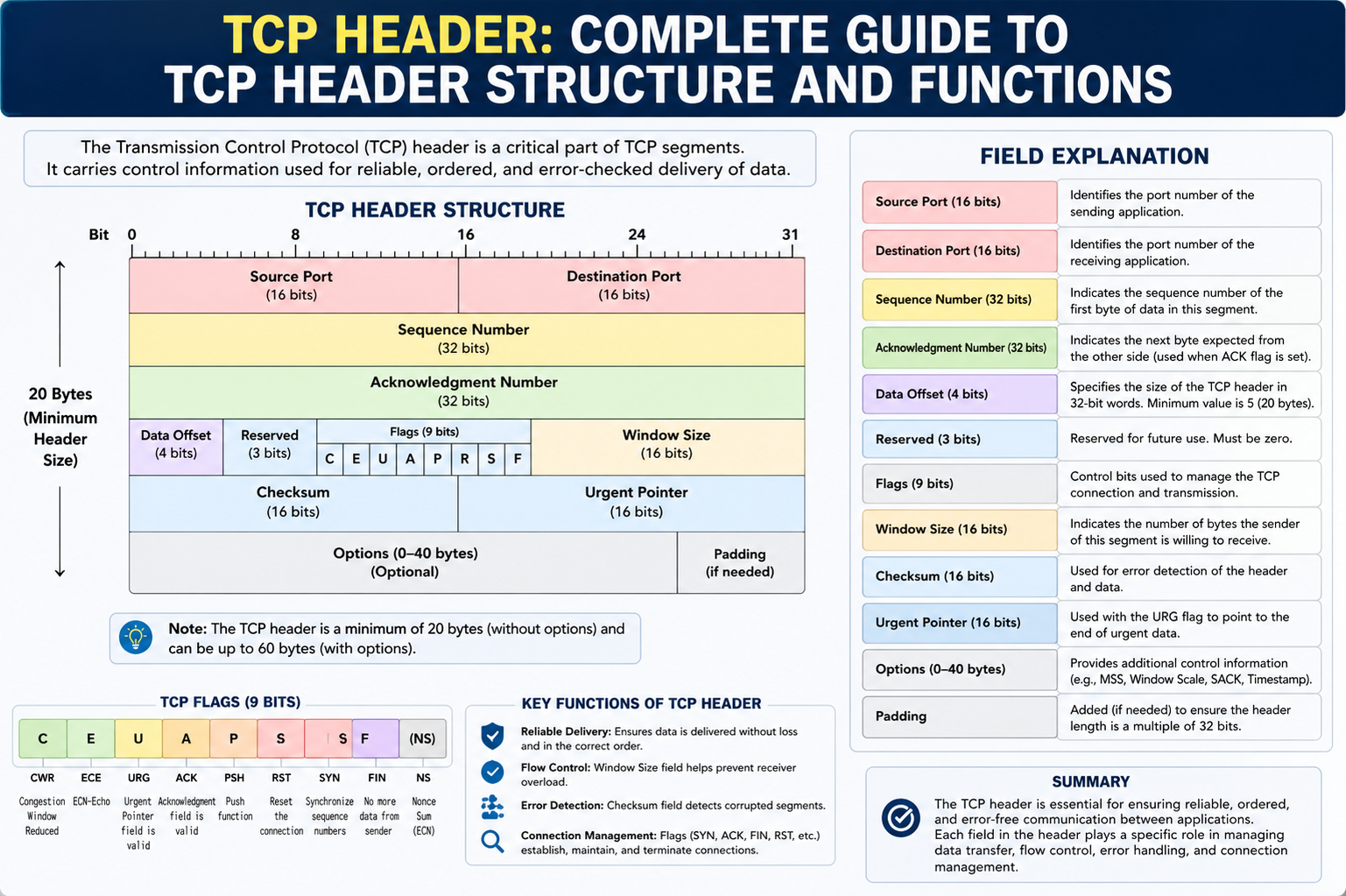
The TCP header is one of the most essential components of network communication because it enables reliable data transfer between devices over interconnected systems. In modern networking, communication is not just about sending data; it is about ensuring that the data arrives correctly, in order, and without loss or duplication. This reliability is achieved through the Transmission Control Protocol, and the TCP header is the structured set of information that makes this possible. It acts like a control panel attached to every data segment, guiding how information should be handled from sender to receiver.
Without the TCP header, data transmission would be chaotic and unreliable. Packets could arrive in the wrong order, get lost in transit, or become corrupted without detection. The TCP header solves these issues by embedding essential metadata within each segment, allowing devices to coordinate communication in a structured and dependable way. It ensures that both ends of a connection understand how data is being transmitted, tracked, and verified.
The importance of the TCP header becomes even more significant in environments where accuracy is critical, such as web browsing, file transfers, email communication, and online transactions. Every time a webpage loads or a file is downloaded, the TCP header is actively working in the background to ensure seamless delivery.
Overview of TCP Communication Process
To fully understand the TCP header, it is important to first understand how TCP communication works. TCP operates as a connection-oriented protocol, meaning it establishes a connection between sender and receiver before any data is transmitted. This connection is maintained throughout the communication session and is properly closed once the exchange is complete.
During this process, data is broken into smaller segments. Each segment is attached to a TCP header before being sent across the network. These headers provide instructions and tracking information that allow the receiving system to reconstruct the original message accurately.
The communication process involves three main stages: connection establishment, data transfer, and connection termination. The TCP header plays a role in all these stages by controlling synchronization, sequencing, acknowledgment, and session management. This structured approach is what makes TCP one of the most reliable protocols in networking.
Basic Structure of the TCP Header
The TCP header has a structured format that contains multiple fields, each designed to perform a specific function. Although the header may appear complex, each part serves a clear purpose in managing communication.
At a basic level, the TCP header includes fields for source and destination ports, sequence numbers, acknowledgment numbers, control flags, window size, checksum, urgent pointer, and optional parameters. These fields collectively ensure that data transmission is organized, error-free, and efficient.
The size of a standard TCP header is typically 20 bytes, but it can be extended if optional fields are included. Despite its relatively small size, the TCP header carries a significant amount of control information that governs the entire communication process.
Source Port and Destination Port Functions
One of the first elements in the TCP header is the source port and destination port. These fields are responsible for identifying the sending and receiving applications involved in communication.
The source port represents the application on the sender’s device that is transmitting the data. It acts like an address label indicating where the data originated. On the other hand, the destination port identifies the application on the receiving device that should process the incoming data.
These port numbers are essential because multiple applications can run simultaneously on a single device. Without port identification, the system would not know which application should receive the data. For example, web traffic, email services, and file transfers all use different ports to ensure proper delivery.
This mechanism allows TCP to support multiple simultaneous connections without confusion, making it highly efficient for modern multitasking environments.
Sequence Number and Its Role in Data Ordering
The sequence number is one of the most important fields in the TCP header because it ensures that data is delivered in the correct order. Since data is often broken into multiple segments before transmission, these segments may arrive at the destination in a different order than they were sent.
The sequence number assigns a unique position to each byte of data, allowing the receiving system to rearrange segments correctly. This ensures that even if packets arrive out of order, the original message can still be reconstructed accurately.
Sequence numbers also help in detecting missing data. If a sequence number is skipped, the receiver knows that a segment was lost during transmission and can request retransmission. This feature is essential for maintaining data integrity in unreliable network conditions.
Acknowledgment Number and Reliable Communication
The acknowledgment number works closely with the sequence number to ensure reliable communication. While the sequence number tracks outgoing data, the acknowledgment number confirms successful receipt of incoming data.
When a device receives data, it sends back an acknowledgment number indicating the next expected sequence number. This confirms that all previous data has been received correctly. If the sender does not receive an acknowledgment, it assumes that the data was lost and retransmits it.
This process creates a feedback loop that guarantees data reliability. It ensures that both sender and receiver remain synchronized throughout the communication session.
Role of Control Flags in TCP Header
Control flags are special indicators within the TCP header that manage the state and behavior of a connection. These flags determine how data should be processed at different stages of communication.
Each flag serves a unique purpose. For example, some flags are used to establish a connection, while others are used to acknowledge data or terminate a session. There are also flags that control urgent data transmission or reset a connection in case of errors.
These flags ensure that both devices understand the current state of communication and respond appropriately. They play a vital role in connection management and help maintain smooth data flow between systems.
Window Size and Flow Control Mechanism
The window size field is responsible for managing the flow of data between sender and receiver. It determines how much data can be sent before receiving an acknowledgment.
This mechanism prevents network congestion by ensuring that the sender does not overwhelm the receiver with too much data at once. Instead, data is transmitted in controlled amounts based on the receiver’s capacity to process it.
Flow control is essential for maintaining efficiency in communication, especially in networks with varying speeds and loads. The window size can dynamically change based on network conditions, allowing TCP to adapt to different environments.
Checksum and Error Detection Process
The checksum field is used for detecting errors in transmitted data. Before sending a segment, the sender calculates a checksum value based on the data content. This value is then included in the TCP header.
When the segment reaches the destination, the receiver recalculates the checksum and compares it with the original value. If both values match, the data is considered valid. If there is a mismatch, it indicates that the data has been corrupted during transmission.
In such cases, the corrupted segment is discarded, and the sender is requested to retransmit the data. This ensures that only accurate and uncorrupted information is delivered.
Urgent Pointer and Priority Data Handling
The urgent pointer field is used when certain data within a segment requires immediate attention. It marks a specific position in the data stream that should be processed urgently by the receiver.
This feature is useful in situations where critical information must be delivered quickly, without waiting for the rest of the data stream. It allows TCP to prioritize important data while still maintaining overall sequence control.
The urgent pointer ensures that time-sensitive information is not delayed, improving responsiveness in critical applications.
Options Field and Extended Functionality
The options field in the TCP header is optional and provides additional functionality beyond the standard header structure. It can be used to enhance performance, adjust communication parameters, or enable advanced features.
This field allows flexibility in TCP operations, making it adaptable to different network requirements. Although not always used, it plays an important role in optimizing communication in specialized scenarios.
Connection Establishment and the Role of TCP Header
The TCP header plays a major role during connection establishment, commonly known as the handshake process. This process ensures that both sender and receiver are ready to communicate before actual data transmission begins.
During this stage, control flags and sequence numbers are used to synchronize both ends of the connection. This ensures that communication starts in a structured and reliable manner.
The handshake process is essential for creating a stable communication session and preventing data loss at the beginning of transmission.
TCP Header Fundamentals
The TCP header is a foundational component of reliable network communication. It integrates multiple fields that work together to ensure data integrity, proper sequencing, flow control, error detection, and connection management.
By combining these functions into a single structured format, the TCP header enables seamless communication across complex and diverse networks. Its design ensures that data is transmitted accurately and efficiently, making it one of the most important elements in modern networking systems.
TCP Connection Establishment in Detail
The process of establishing a TCP connection is one of the most important functions supported by the TCP header because it ensures that both devices are properly synchronized before data transmission begins. This process is commonly known as the three-way handshake, and it uses several fields from the TCP header, including sequence numbers and control flags, to create a reliable communication channel.
In the first step, the sender initiates communication by sending a segment with a synchronization flag. This segment includes an initial sequence number that acts as a starting reference for future data exchange. The receiver then responds with its own synchronization message along with an acknowledgment of the sender’s sequence number. Finally, the sender confirms the acknowledgment, and the connection is established.
This structured exchange ensures that both sides agree on initial sequence values and are ready to begin data transfer. The TCP header plays a central role in this process by carrying synchronization information and managing acknowledgment flow. Without this mechanism, data could be misaligned or lost at the start of communication.
TCP Data Transmission and Segment Management
Once a connection is established, the TCP header becomes actively involved in managing data transmission. Data is divided into smaller segments, and each segment is attached to its own TCP header before being sent across the network. This segmentation allows large amounts of data to be transmitted efficiently without overwhelming the network.
During transmission, the sequence number field ensures that each segment is properly ordered. Even if packets travel through different routes and arrive at different times, the receiving system uses sequence numbers to reconstruct the original message correctly. This ability to reorganize data is essential for maintaining accuracy in communication.
At the same time, acknowledgment numbers confirm receipt of data segments. If any segment is missing or delayed, the sender is notified and retransmits the required information. This continuous feedback loop ensures that no data is lost during transmission, making TCP highly reliable.
Flow Control and Network Stability
Flow control is another critical function managed by the TCP header, particularly through the window size field. Flow control ensures that data is transmitted at a rate that the receiver can handle. Without flow control, a fast sender could overwhelm a slower receiver, leading to data loss and network congestion.
The window size dynamically adjusts based on the receiver’s capacity. If the receiver is busy or overloaded, it reduces the window size, signaling the sender to slow down. If the receiver has more capacity, it increases the window size, allowing more data to be transmitted.
This adaptive mechanism helps maintain balance in network communication. It ensures that both devices operate efficiently without overloading each other. Flow control is especially important in high-traffic networks where multiple connections are active simultaneously.
Error Handling and Data Integrity in TCP Header
One of the strongest features of TCP is its ability to detect and correct errors using the checksum field in the TCP header. Every time a segment is transmitted, a checksum is calculated based on its content. This value is included in the header and sent along with the data.
When the segment reaches its destination, the receiver recalculates the checksum. If the values match, the data is considered intact. If there is a mismatch, it indicates that the data has been corrupted during transmission. In such cases, the segment is discarded, and the sender is asked to retransmit it.
This process ensures that only accurate and uncorrupted data is delivered. It protects communication from noise, interference, and packet corruption, which are common in network environments. The checksum mechanism is simple but extremely effective in maintaining data integrity.
Data Sequencing and Reassembly Process
Data sequencing is one of the most important roles of the TCP header because it ensures that fragmented data is correctly reassembled at the destination. Since network packets may take different paths, they often arrive out of order.
The sequence number field solves this problem by assigning a unique identifier to each byte of data. When segments arrive at the receiver, they are temporarily stored and rearranged according to their sequence numbers. This ensures that the original message is reconstructed exactly as it was sent.
This process is essential for applications that require accurate data delivery, such as file transfers, video streaming, and web browsing. Without sequencing, data would appear disorganized and unusable.
Acknowledgment System and Reliable Delivery
The acknowledgment system is a core feature of TCP that ensures reliable delivery of data. Every time a segment is received, the receiver sends back an acknowledgment indicating successful receipt. This acknowledgment includes the next expected sequence number, which helps maintain synchronization between sender and receiver.
If the sender does not receive an acknowledgment within a certain time frame, it assumes that the segment was lost and retransmits it. This retry mechanism ensures that all data eventually reaches its destination.
The acknowledgment system creates a continuous cycle of confirmation and correction, making TCP one of the most dependable communication protocols in networking.
Connection Termination and TCP Header Role
Just as TCP establishes connections in a structured way, it also terminates them in an organized manner. The TCP header uses control flags to manage the closing of a connection. This process ensures that both devices agree to end communication and that no data is left unprocessed.
The termination process involves a sequence of messages that confirm both sides have finished sending and receiving data. Once the final acknowledgment is exchanged, the connection is safely closed.
This controlled shutdown prevents data loss and ensures that all transmitted information has been properly delivered before ending the session.
TCP Header Efficiency in Modern Networking
The TCP header is designed for efficiency, allowing it to function effectively even in complex and high-speed networks. Despite containing multiple fields, it remains compact and optimized for performance. Each field has a specific role, and together they ensure smooth communication.
Modern applications rely heavily on TCP because of its reliability and structured approach to data transmission. Whether it is browsing websites, sending emails, or transferring files, the TCP header ensures that data flows smoothly between systems.
Its ability to manage sequencing, error correction, flow control, and connection handling makes it a fundamental part of internet communication.
Importance of TCP Header in Real-World Applications
In real-world scenarios, the TCP header plays a silent but critical role in nearly every digital interaction. When a user opens a website, the browser sends requests that are broken into TCP segments. These segments are then transmitted, verified, and reassembled using the TCP header.
Similarly, when downloading files, streaming videos, or using online applications, the TCP header ensures that data is delivered accurately and without interruption. Its reliability is the reason why users experience smooth and consistent connectivity across the internet.
Without the TCP header, modern digital communication would be unreliable and prone to frequent errors, making it impossible to support today’s connected world.
TCP Header Functions and Operations
The TCP header is a powerful and essential component of network communication that ensures data is transmitted reliably, accurately, and in the correct order. Through its structured fields, it manages everything from connection establishment to data transmission, error detection, flow control, and connection termination.
Its role in maintaining synchronization between devices and ensuring error-free communication makes it one of the most important elements in networking. The TCP header not only supports efficient data transfer but also guarantees the stability and reliability of modern internet communication systems.
TCP Flags and Their Functional Importance
TCP flags are small but extremely powerful components within the TCP header that control how data is handled during communication. Each flag represents a specific signal that instructs the receiving or sending system on what action to perform. These flags are essential for managing connection states, controlling data flow, and ensuring proper synchronization between devices.
Some of the most important TCP flags include SYN, ACK, FIN, RST, PSH, and URG. Each of these plays a unique role in communication. The SYN flag is used to initiate a connection, while the ACK flag confirms receipt of data. The FIN flag is responsible for terminating a connection in an orderly manner, ensuring that both devices agree to close the session.
The RST flag is used to reset a connection in case of errors or unexpected issues. The PSH flag tells the receiving system to immediately process the data without waiting for buffering, which is useful for real-time communication. The URG flag indicates that certain data within the segment is urgent and should be prioritized.
These flags work together to control the behavior of TCP communication at every stage. Without them, managing complex network interactions would be difficult, and communication would lack proper coordination.
PSH and URG Flags in Data Prioritization
The PSH (Push) flag plays an important role in ensuring that data is delivered and processed quickly. When this flag is set, it instructs the receiving system to immediately pass the data to the application layer without waiting for additional buffering. This is especially useful in applications where real-time response is critical, such as online gaming or live communication.
The URG (Urgent) flag works alongside the urgent pointer field in the TCP header. It indicates that a portion of the data should be treated with higher priority than normal data. When this flag is active, the receiving system identifies the urgent segment and processes it immediately, even if other data is still being handled.
These two flags ensure that time-sensitive information is delivered efficiently, improving the responsiveness of network applications.
TCP Sliding Window Mechanism Explained
The sliding window mechanism is a key feature of TCP that works closely with the window size field in the TCP header. It is responsible for controlling how much data can be sent before requiring an acknowledgment from the receiver. This mechanism ensures that data flows smoothly without overwhelming the network or the receiving system.
In this system, the sender maintains a “window” of data segments that are allowed to be transmitted. As acknowledgments are received, the window slides forward, allowing new data to be sent. This continuous movement creates a balance between sending speed and receiving capacity.
The sliding window mechanism improves network efficiency by allowing multiple segments to be transmitted before waiting for confirmation. It reduces delays and increases overall throughput, making communication faster and more effective.
Congestion Control and TCP Header Role
Congestion control is another critical function supported indirectly by the TCP header. It ensures that network traffic does not exceed the capacity of the network infrastructure. When too much data is sent at once, congestion can occur, leading to packet loss and delays.
TCP manages congestion by adjusting the rate of data transmission based on network conditions. If packet loss is detected or delays increase, the sender reduces the transmission rate. This is achieved through mechanisms that work alongside sequence numbers, acknowledgments, and window size adjustments.
The TCP header plays a role in this process by carrying the necessary information that allows the sender and receiver to detect congestion and respond accordingly. This adaptive behavior ensures stable communication even in busy or overloaded networks.
Retransmission and Lost Packet Recovery
One of the strongest features of TCP is its ability to recover lost data through retransmission. If a data segment is lost during transmission or arrives corrupted, it is detected using sequence numbers and acknowledgment responses.
When the sender does not receive an acknowledgment for a specific segment within a given time, it assumes that the segment was lost. The TCP header information helps identify exactly which segment needs to be retransmitted. The sender then resends the missing data, ensuring that the receiver eventually gets a complete and accurate message.
This automatic recovery system makes TCP highly reliable, especially in unstable or noisy network environments where packet loss is common.
TCP Header and Multiplexing of Applications
The TCP header supports multiplexing, which allows multiple applications to communicate over the same network connection simultaneously. This is achieved through the use of source and destination port numbers.
Each application running on a device is assigned a unique port number. The TCP header uses these port numbers to ensure that data is delivered to the correct application. For example, a web browser, email client, and file transfer application can all operate at the same time without interfering with each other.
This ability to handle multiple connections efficiently makes TCP suitable for modern multitasking environments where many applications rely on network access simultaneously.
Connection Reliability Through Stateful Communication
TCP is a stateful protocol, meaning it keeps track of the state of communication between sender and receiver. The TCP header plays a central role in maintaining this state information throughout the connection.
Each segment contains sequence numbers, acknowledgment numbers, and flags that help both devices understand the current status of communication. This allows TCP to maintain a continuous and synchronized connection until it is properly closed.
Stateful communication ensures that data transfer is consistent and organized, preventing confusion or duplication during transmission.
TCP Header and Real-Time Data Considerations
Although TCP is primarily designed for reliability, it can also support near real-time communication when needed. The TCP header helps manage this through features like window scaling, acknowledgment timing, and push flags.
However, because TCP prioritizes reliability over speed, it introduces some delay due to error checking and retransmission mechanisms. Despite this, it remains widely used because of its accuracy and stability.
In applications where data integrity is more important than speed, such as file transfers and web browsing, TCP performs exceptionally well.
Security Considerations in TCP Communication
While the TCP header itself does not provide encryption, it plays a role in maintaining secure and stable communication when combined with other protocols. Sequence numbers and acknowledgment mechanisms make it difficult for unauthorized data manipulation to go undetected.
Any attempt to inject or modify data must follow strict sequence rules, otherwise the connection will reset or reject the segment. This adds a layer of protection against basic network attacks and data corruption.
In modern systems, TCP is often combined with additional security protocols to ensure both reliability and confidentiality.
Role of TCP Header in Internet Infrastructure
The TCP header is deeply integrated into the foundation of internet communication. Every time data is transferred over the internet, TCP ensures that it is delivered in a structured and reliable manner.
It supports essential services such as web browsing, email communication, file sharing, and remote access. Without TCP headers, the internet would not be able to function with the level of stability and accuracy we experience today.
Its structured design allows it to operate across different networks, devices, and operating systems without compatibility issues.
TCP Header Functions
The TCP header is a highly organized and multifunctional component that enables reliable communication across networks. It manages connection setup and termination, ensures data sequencing, controls flow, detects errors, and handles retransmission of lost packets.
Through its various fields and flags, it creates a stable and synchronized communication system that supports modern digital interactions. Its importance in networking cannot be overstated, as it forms the backbone of reliable internet communication.
By combining control, reliability, and efficiency, the TCP header ensures that data reaches its destination accurately and in the correct order, making it one of the most essential elements of the Transmission Control Protocol.
TCP Header Checksum Deep Working Principle
The checksum field in the TCP header is one of the most critical mechanisms for ensuring data integrity during transmission. Its main purpose is to detect any corruption that may occur while data travels across a network. Since data passes through multiple routers, switches, and transmission mediums, there is always a risk of interference or signal degradation. The checksum helps identify such issues before the data is accepted by the receiver.
When a sender prepares a TCP segment, it performs a mathematical calculation based on the contents of the segment, including the header and data. This calculated value is placed in the checksum field. When the segment reaches its destination, the receiver performs the same calculation again. If the result matches the original checksum value, the data is considered intact. If it does not match, the segment is discarded, and a retransmission is requested.
This simple yet powerful mechanism ensures that corrupted data never gets processed, maintaining the reliability of communication at all times.
TCP Header and Pseudo Header Concept
An important concept related to the TCP checksum is the pseudo header. Although it is not part of the actual TCP header transmitted over the network, it is used during checksum calculation to improve error detection accuracy.
The pseudo header includes information from the IP layer, such as source IP address, destination IP address, protocol type, and TCP length. By including this additional information, TCP ensures that data is not only checked for internal errors but also verified within the context of network routing.
This integration between TCP and IP layers strengthens error detection and ensures that data reaches the correct destination without being misrouted or corrupted.
TCP Header and Segmentation Process in Data Transfer
When large amounts of data are transmitted over a network, TCP breaks the data into smaller segments. Each of these segments is attached to a TCP header before transmission. This process is known as segmentation.
Segmentation is necessary because networks have limits on the maximum packet size they can handle. By dividing data into smaller units, TCP ensures efficient transmission without overwhelming the network.
Each segment carries its own TCP header, which includes sequence numbers and control information. This allows the receiver to reassemble the segments in the correct order, regardless of the path they take through the network.
Reassembly of Data at Receiver Side
At the receiving end, TCP uses the information stored in the header to reconstruct the original message. Since segments may arrive out of order, the sequence numbers play a key role in organizing them correctly.
The receiver stores incoming segments temporarily and arranges them based on their sequence values. Once all segments are received and verified, they are combined to form the original data.
If any segment is missing, TCP waits for retransmission before completing the reassembly process. This ensures that no part of the data is lost or incorrectly placed.
TCP Header and Latency Considerations
While TCP is highly reliable, it introduces a certain level of delay known as latency. This delay is mainly caused by processes such as acknowledgment handling, error checking, and retransmission of lost segments.
The TCP header contributes to this process by carrying control information that must be processed at every step. Although this slightly slows down communication, it ensures accuracy and reliability.
In applications where precision is more important than speed, such as file downloads or web browsing, this trade-off is highly beneficial.
TCP Header in Persistent Connections
TCP supports persistent connections, where a single connection remains open for multiple data exchanges. This is commonly used in web applications to reduce the overhead of repeatedly establishing new connections.
The TCP header plays a role in maintaining these long-lasting connections by continuously managing sequence numbers, acknowledgments, and window sizes. It ensures that communication remains stable throughout the session.
Persistent connections improve efficiency by reducing connection setup time and allowing faster data exchange between client and server.
Half-Open and Closed Connection States
TCP connections can exist in different states, including half-open and fully closed states. These states are managed using control flags in the TCP header.
A half-open state occurs when one side believes the connection is active while the other side has already closed it. This can happen due to network failures or unexpected interruptions. TCP uses reset and acknowledgment mechanisms to resolve such inconsistencies.
A properly closed connection ensures that both sender and receiver agree that communication has ended, preventing data loss or confusion.
TCP Header Role in Network Reliability
The TCP header is central to the reliability of modern networks. It ensures that every piece of data sent across the internet is tracked, verified, and confirmed.
By combining sequencing, acknowledgment, error detection, and flow control, it creates a structured communication system that minimizes errors and maximizes efficiency.
This reliability is the reason why TCP is widely used in critical applications where data accuracy is essential.
TCP Header and Application Layer Interaction
The TCP header acts as a bridge between the transport layer and the application layer. It ensures that data generated by applications is properly packaged, transmitted, and delivered.
When an application sends data, TCP attaches a header and prepares it for transmission. At the receiving end, TCP removes the header and delivers the data to the appropriate application using port numbers.
This seamless interaction allows applications to communicate over networks without worrying about underlying transmission complexities.
TCP Header Scalability in Modern Networks
Modern networks require protocols that can scale efficiently with increasing traffic demands. The TCP header supports scalability through features like window scaling and adaptive flow control.
These features allow TCP to handle high-speed networks and large data transfers effectively. As network speeds increase, TCP adapts its behavior to maintain performance and reliability.
This scalability ensures that TCP remains relevant in evolving network environments.
TCP Header and Error Recovery Mechanisms
Error recovery is one of the strongest features of TCP. The header plays a key role in identifying and correcting transmission errors through sequence tracking and acknowledgment feedback.
When errors are detected, TCP initiates retransmission of affected segments. This ensures that the final delivered data is complete and accurate.
This self-correcting behavior makes TCP highly dependable even in unstable network conditions.
TCP Header Contribution to Internet Stability
The TCP header contributes significantly to the overall stability of the internet. It ensures that communication between billions of devices remains organized and error-free.
By managing traffic flow, preventing congestion, and ensuring data integrity, TCP helps maintain smooth operation of global networks.
Without the TCP header, the internet would lack the structure needed for reliable communication.
Final Understanding of TCP Header System
The TCP header is a comprehensive control structure that governs how data is transmitted across networks. It manages every aspect of communication, including connection setup, data transfer, error detection, flow control, and connection termination.
Its combination of multiple fields and mechanisms creates a highly reliable system that supports modern digital communication. From simple web browsing to complex data transfers, the TCP header ensures that information reaches its destination accurately, efficiently, and in the correct order.
It remains one of the most important foundations of networking technology and continues to play a vital role in the functioning of the internet.
Conclusion
The TCP header is a fundamental part of reliable network communication and serves as the control structure that makes data transfer over the internet accurate, organized, and dependable. It carries essential information such as sequence numbers, acknowledgment numbers, port details, control flags, window size, checksum, and other fields that work together to manage every stage of communication.
Through these fields, the TCP header ensures that data is properly segmented, transmitted, received, and reassembled in the correct order. It also plays a key role in error detection and recovery, making sure that any lost or corrupted data is identified and retransmitted. This guarantees that the final delivered information remains complete and accurate.
Another major strength of the TCP header is its ability to manage flow control and congestion. By adjusting data transmission rates according to network conditions, it prevents overload and maintains stable communication even in busy or high-traffic environments. Its acknowledgment system also ensures continuous synchronization between sender and receiver, which strengthens reliability.
In real-world applications, the TCP header operates silently in the background whenever users browse websites, send emails, download files, or use online services. It provides the structure needed for smooth and uninterrupted communication across global networks.
Overall, the TCP header is not just a part of the Transmission Control Protocol—it is the core mechanism that ensures trust, stability, and precision in modern digital communication.