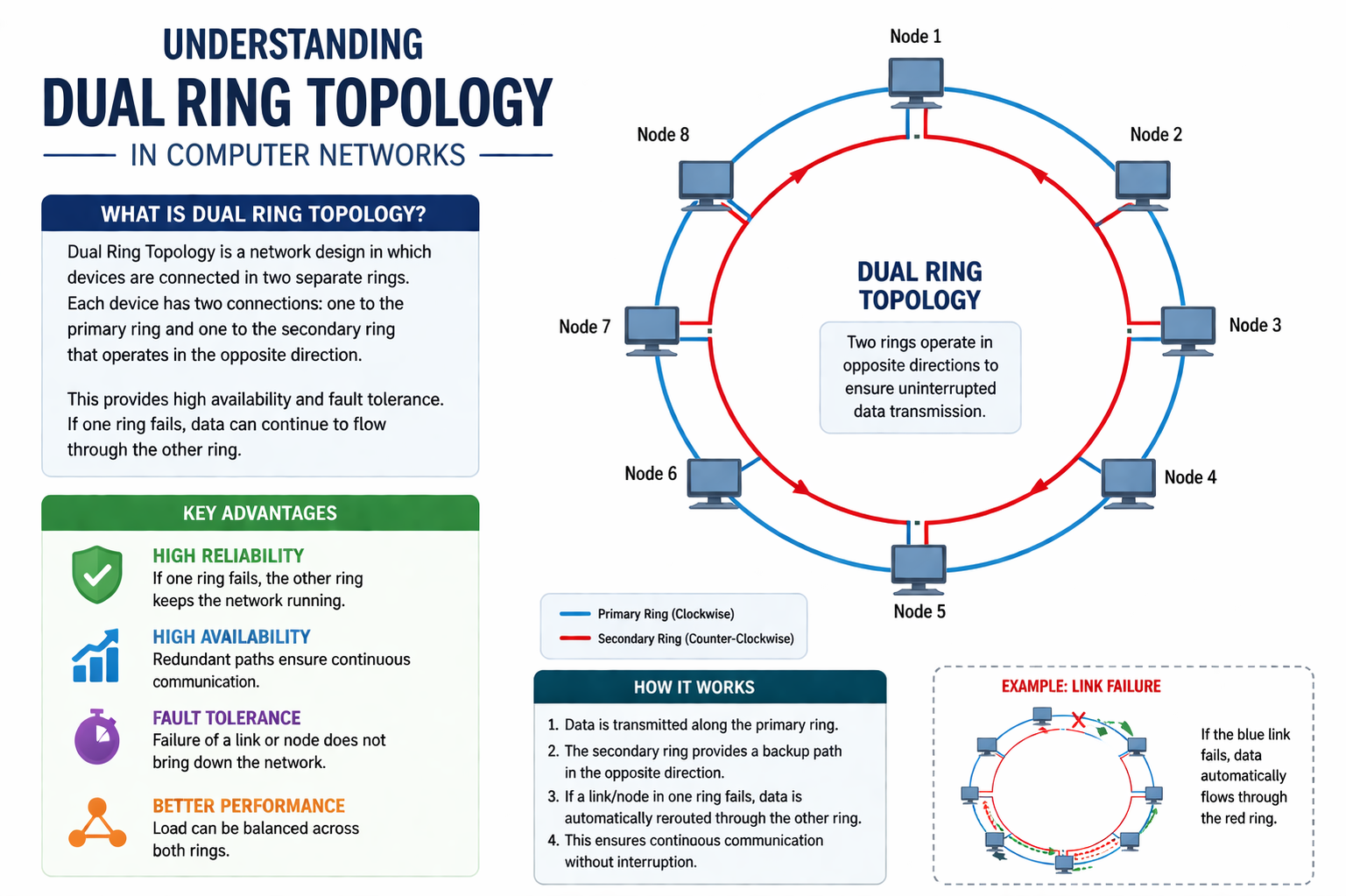
A dual ring topology is an advanced network arrangement designed to improve reliability, speed, and fault tolerance in data communication systems. It is built upon the concept of a ring structure, where each device in the network is connected to exactly two other devices, forming a continuous loop. In a dual ring setup, this structure is duplicated, creating two independent but interconnected rings that support data transmission in opposite directions. This architecture is widely valued in environments where uninterrupted communication and high performance are essential.
Basic Concept of Ring-Based Network Structure
In a simple ring topology, devices are connected in a circular format, and data travels from one device to another until it reaches its destination. Each device acts as both a receiver and a transmitter, passing information along the network. While this design is efficient in small networks, it can become vulnerable if a single connection fails, as it may disrupt the entire communication flow.
A dual ring topology enhances this basic structure by introducing a second ring that runs parallel to the first. This additional ring provides an alternative pathway for data, ensuring that communication continues even when one path is compromised. The two rings work together to maintain smooth and consistent data flow.
Structure and Arrangement of Dual Ring Systems
In a dual ring topology, every device is connected to two neighboring devices on each ring. This creates two separate loops that overlap in terms of connected nodes but operate independently in terms of data transmission. One ring typically carries data in a clockwise direction, while the other carries data in a counterclockwise direction.
This arrangement ensures that data has multiple routes to reach its destination. If one direction experiences congestion or a break in connectivity, the system automatically redirects the data through the other ring. This redundancy is one of the most important strengths of this topology.
Working Mechanism of Dual Ring Topology
The working principle of a dual ring topology is based on simultaneous data transmission through two paths. When a device sends data, it can choose either ring depending on availability and network conditions. In many systems, data is transmitted on both rings at the same time, providing a backup mechanism in case one transmission path fails.
Each device in the network plays an active role in forwarding data. If a device receives data that is not intended for it, it simply passes it along to the next node. This continues until the data reaches its destination. The presence of two rings ensures that even if one device or connection fails, the second ring can maintain communication without interruption.
Data Flow and Direction Control
The direction of data flow in dual ring topology is carefully managed to prevent collisions and ensure smooth communication. By using two opposite directions, the system reduces the chances of data congestion. This bidirectional flow also allows for faster delivery of information, as data can take the shortest available path.
In many implementations, intelligent control mechanisms monitor network conditions and decide which ring should be used for transmission. This dynamic routing helps maintain efficiency and balance the load across the network.
Fault Tolerance and Redundancy
One of the most significant advantages of dual ring topology is its fault tolerance. Fault tolerance refers to the ability of a network to continue functioning even when part of it fails. In this structure, redundancy is built into the system through the second ring.
If a cable is cut or a device stops working, the network does not collapse. Instead, the data is rerouted through the alternate ring. This ensures continuous communication and minimizes downtime. This feature makes dual ring topology highly suitable for critical systems where reliability is essential.
Performance Efficiency and Load Distribution
Dual ring topology also improves network performance by distributing data traffic more efficiently. Since there are two paths available, the load is shared between them. This prevents any single path from becoming overloaded, which can slow down communication in simpler network designs.
By balancing traffic, the network can maintain consistent speed and responsiveness even during peak usage periods. This makes it particularly useful in environments where large volumes of data are transmitted continuously.
Scalability and Network Expansion
Although dual ring topology is more complex than simpler structures, it offers a reasonable level of scalability. Additional devices can be added to the network by connecting them to the existing ring structure. However, careful planning is required to ensure that the integrity of both rings is maintained.
As the network grows, managing connections and ensuring smooth communication becomes more challenging. Despite this, the dual ring design still supports expansion better than many single-path systems due to its redundant structure.
Reliability in Critical Systems
Dual ring topology is often used in environments where reliability cannot be compromised. Systems such as telecommunications networks, industrial control systems, and large organizational infrastructures rely on continuous data flow. In such cases, even a brief interruption can cause significant problems.
The dual ring structure ensures that communication remains stable under various conditions. Its ability to self-correct through alternative routing paths makes it a dependable choice for mission-critical applications.
Comparison with Single Ring Structure
Compared to a single ring topology, the dual ring design offers significant improvements in reliability and performance. A single ring is more vulnerable because any break in the loop can disrupt the entire network. In contrast, a dual ring provides a backup path that maintains communication even during failures.
While a single ring may be simpler and less expensive to implement, it lacks the resilience and efficiency of a dual ring system. The trade-off between cost and performance is an important consideration when choosing a network design.
Complexity and Maintenance Challenges
Despite its advantages, dual ring topology introduces a higher level of complexity. Managing two interconnected rings requires more sophisticated hardware and software coordination. Network administrators must carefully monitor both rings to ensure proper functioning.
Troubleshooting issues can also be more time-consuming because problems may occur in either ring or in the interaction between them. This makes maintenance more demanding compared to simpler network structures.
Cost Considerations
The implementation of a dual ring topology generally requires more resources than basic network designs. Additional cabling, network devices, and configuration tools are needed to establish and maintain both rings. This increases the overall cost of deployment.
However, many organizations consider this cost justified due to the improved reliability and reduced risk of downtime. In environments where continuous operation is essential, the benefits outweigh the expenses.
Real-World Applications
Dual ring topology is commonly used in large-scale communication systems where stability is a priority. It is often found in metropolitan area networks that connect multiple locations within a city. These systems require fast and reliable data transmission over long distances.
It is also used in industrial environments where automated systems rely on constant communication between machines. In such settings, even a small disruption can affect productivity, making redundancy essential.
Network Recovery and Self-Healing Capability
One of the most valuable features of dual ring topology is its self-healing capability. When a failure occurs, the system automatically detects the issue and redirects traffic through the alternate ring. This process happens quickly, often without any noticeable disruption to users.
This automatic recovery mechanism reduces the need for manual intervention and helps maintain high availability. It is one of the reasons why this topology is preferred in critical infrastructure systems.
Signal Transmission and Integrity
Maintaining signal quality is important in any network system. In dual ring topology, the presence of two paths helps preserve signal integrity by reducing congestion and interference. Data can be transmitted more efficiently, reducing delays and packet loss.
Since data has multiple routes, it is less likely to experience delays caused by heavy traffic on a single path. This contributes to smoother and more reliable communication.
Advantages in Modern Networking Environments
In modern digital environments, where data demands are constantly increasing, dual ring topology offers several important benefits. It supports high-speed communication, ensures redundancy, and improves overall network stability.
Its ability to handle failures gracefully makes it suitable for systems that require uninterrupted service. As organizations continue to rely on digital infrastructure, such resilient designs become increasingly valuable.
Limitations and Practical Constraints
Despite its strengths, dual ring topology is not without limitations. The increased complexity can make installation and management more difficult. It also requires more hardware resources, which can be a constraint for smaller organizations.
Additionally, while it offers redundancy, it does not completely eliminate the possibility of network failure. If both rings are damaged simultaneously, communication can still be disrupted.
Importance in Network Design Strategy
Choosing the right network topology is a critical decision in system design. Dual ring topology represents a balance between performance and reliability. It is particularly useful in scenarios where uptime is more important than cost efficiency.
Network architects often consider this topology when designing systems that must remain operational under adverse conditions. Its structured redundancy makes it a strong candidate for high-availability environments.
Continuing Understanding Dual Ring Topology in Computer Networks
Building further on the structure and behavior of dual ring topology, it becomes important to understand how its internal mechanisms interact under different network conditions. The strength of this topology does not only lie in its physical design but also in the way data is managed, monitored, and redirected within the system. These operational aspects make it a highly adaptive and resilient networking approach.
Data Protection and Transmission Safety
One of the key concerns in any network is ensuring that data reaches its destination without corruption or loss. In a dual ring topology, data protection is enhanced through redundancy and controlled transmission paths. Since data can travel in two opposite directions, the system naturally reduces the risk of data loss caused by a single point of failure.
In addition, many implementations include error detection mechanisms that monitor transmitted data. If a packet is lost or corrupted during transmission, it can be retransmitted through the alternate ring. This improves overall data integrity and ensures that communication remains reliable even under unstable conditions.
Load Balancing in Dual Ring Networks
Load balancing is an important function in dual ring topology, as it ensures that no single part of the network becomes overwhelmed with traffic. Since there are two active rings, data can be distributed evenly between them based on network conditions.
When one ring experiences higher traffic, the system can redirect some of the data load to the other ring. This dynamic distribution helps maintain smooth performance and prevents delays in communication. It also reduces congestion, which is a common issue in simpler network structures.
Role of Network Nodes in Communication
Each device or node in a dual ring topology plays an active role in maintaining communication flow. These nodes are not passive receivers; instead, they participate in forwarding data along the network. When a node receives a data packet, it checks whether the packet is intended for it. If not, it forwards the packet to the next node in the sequence.
This continuous forwarding process ensures that data circulates efficiently throughout the network. Even if one node becomes inactive, the second ring ensures that communication can continue without interruption, maintaining system stability.
Direction Switching and Adaptive Routing
A major advantage of dual ring topology is its ability to switch data paths dynamically. When a fault is detected in one direction of the ring, the system can automatically switch traffic to the opposite direction. This process is known as adaptive routing.
Adaptive routing ensures that data transmission is not dependent on a single fixed path. Instead, the network continuously evaluates available routes and selects the most efficient one. This flexibility improves performance and reduces the impact of hardware failures.
Network Stability Under High Traffic Conditions
During periods of high data usage, many network systems experience slowdowns or congestion. Dual ring topology addresses this issue by distributing traffic across two separate paths. This helps maintain stability even when demand increases significantly.
Because data does not rely on a single route, bottlenecks are reduced. The network can continue to function efficiently, even under heavy load. This makes dual ring topology suitable for environments where traffic levels are unpredictable or constantly high.
Synchronization Between Rings
Although the two rings operate independently, they must remain synchronized to ensure consistent data flow. Synchronization involves maintaining coordination between both rings so that data is transmitted in an organized manner.
This process helps prevent duplication, collisions, or misrouting of data packets. Proper synchronization ensures that both rings complement each other rather than operate in conflict. It is a critical factor in maintaining the efficiency of the entire system.
Failure Detection Mechanisms
Dual ring topology includes mechanisms that continuously monitor the health of the network. These systems detect faults such as broken connections, inactive nodes, or data transmission errors.
Once a failure is detected, the system quickly isolates the problem and reroutes traffic through the functional ring. This rapid response minimizes disruption and helps maintain uninterrupted communication. Failure detection is essential for maintaining the reliability that dual ring networks are known for.
Self-Healing Network Behavior
The concept of self-healing is one of the most advanced features of dual ring topology. A self-healing network is capable of automatically recovering from failures without requiring manual intervention.
When a disruption occurs, the system immediately identifies an alternative path and redirects data flow. This ensures that users experience minimal downtime. Self-healing capabilities are particularly valuable in critical systems where even a short interruption can have serious consequences.
Impact on Network Latency
Latency refers to the time it takes for data to travel from one point to another. In dual ring topology, latency is generally reduced because data has multiple available paths. The system can choose the shortest or least congested route for transmission.
However, in some cases, if the network is not properly managed, the additional complexity can slightly increase processing time. Despite this, the overall impact on latency is usually positive due to improved routing efficiency.
Security Considerations in Dual Ring Systems
While dual ring topology primarily focuses on performance and reliability, security is also an important factor. Since data travels through multiple nodes, each point in the network must be secured to prevent unauthorized access or interception.
Security measures such as encryption and access control are often implemented to protect data as it moves through the network. Ensuring security across both rings is essential for maintaining the integrity of the entire system.
Advantages in Large-Scale Environments
Dual ring topology is particularly effective in large-scale environments where multiple devices and high data volumes are involved. Its ability to maintain stable communication across long distances makes it suitable for expansive networks.
In such environments, the redundancy and load-sharing features help ensure that performance remains consistent. This is especially important in organizational or industrial systems where downtime can lead to significant operational losses.
Limitations in Small-Scale Usage
Although dual ring topology offers many advantages, it may not be ideal for small-scale networks. The complexity and cost involved in setting up two ring structures may outweigh the benefits in smaller environments.
In such cases, simpler topologies may be more practical. However, as network demands grow, transitioning to a dual ring structure can become beneficial for improving reliability and performance.
Comparison of Efficiency with Other Topologies
When compared to other network structures, dual ring topology stands out in terms of fault tolerance and redundancy. Unlike linear or single-path designs, it provides multiple routes for data transmission.
This makes it significantly more resilient to failures. While other topologies may offer simplicity or lower cost, they often lack the same level of stability and performance under stress conditions.
Maintenance and Monitoring Requirements
Maintaining a dual ring network requires continuous monitoring of both rings. Network administrators must ensure that all nodes are functioning correctly and that data is flowing efficiently.
Regular maintenance checks help identify potential issues before they become serious problems. Monitoring tools are often used to track network performance and detect anomalies in real time.
Evolution of Dual Ring Technology
Over time, dual ring topology has evolved to incorporate more advanced technologies and intelligent systems. Modern implementations often include automated monitoring, dynamic routing algorithms, and improved fault detection mechanisms.
These advancements have made dual ring networks more efficient and easier to manage compared to earlier versions. As networking technology continues to evolve, dual ring systems remain an important foundation for reliable communication structures.
Future Relevance of Dual Ring Networks
Even with the rise of newer networking technologies, dual ring topology continues to hold relevance in specific applications. Its reliability and redundancy make it suitable for systems where uptime is critical.
As data demands increase globally, the need for stable and fault-tolerant network designs remains strong. Dual ring topology is likely to continue playing a role in supporting these requirements, especially in large-scale infrastructure systems.
Extended Understanding
Dual ring topology represents a highly reliable and efficient network design that prioritizes continuous communication and fault tolerance. Through its dual-path structure, adaptive routing, and self-healing capabilities, it ensures that data transmission remains stable under various conditions.
While it introduces complexity and requires careful management, its benefits in terms of reliability, performance, and scalability make it a valuable choice in modern networking environments.
Advanced Behavior and Operational Dynamics of Dual Ring Topology
Dual ring topology becomes even more interesting when examined at the operational and architectural level in real networking environments. Beyond its basic structure and fault tolerance features, it functions as a coordinated system where timing, routing intelligence, and hardware interaction all work together to maintain uninterrupted communication. Understanding these deeper dynamics helps explain why this topology is still relevant in critical network infrastructures.
Token-Based Communication in Ring Systems
In many dual ring implementations, communication is controlled using a method known as token passing. A token is a small data frame that circulates through the network, granting permission to devices to transmit data. Only the device holding the token can send information, which helps prevent data collisions.
In a dual ring setup, tokens may circulate in both rings simultaneously but in opposite directions. This allows more than one transmission opportunity at a time, increasing efficiency compared to a single ring structure. The controlled nature of token passing also ensures orderly communication and reduces the chances of network congestion.
Collision Avoidance and Network Discipline
One of the major strengths of dual ring topology is its inherent ability to reduce or eliminate data collisions. Since devices must wait for permission (or token access) before sending data, the chances of two devices transmitting simultaneously on the same path are greatly minimized.
This structured communication system improves network discipline. Each node understands when it is allowed to transmit, which results in smoother data flow and fewer transmission errors. This becomes especially important in environments with high data traffic.
Timing Coordination Between Nodes
Proper timing coordination is essential in dual ring topology. Each device must remain synchronized with the network to ensure smooth data transfer. Even a small delay in one node can affect the flow of data across the entire ring.
To maintain timing accuracy, network protocols are often used to regulate communication intervals. These protocols help ensure that data is passed at consistent speeds, preventing delays or bottlenecks. Synchronization between nodes is especially critical when both rings are actively transmitting data.
Behavior During Network Congestion
When network traffic becomes extremely high, dual ring topology demonstrates adaptive behavior to maintain stability. Instead of allowing congestion to block communication, the system distributes traffic across both rings more aggressively.
In some cases, priority rules are applied, where important data is transmitted first while less critical information is delayed slightly. This prioritization ensures that essential communication continues without disruption even under heavy load conditions.
Role of Protocols in Managing Dual Rings
Networking protocols play a crucial role in the functioning of dual ring topology. These protocols define how data is transmitted, how errors are handled, and how devices communicate with each other.
They also manage the interaction between the two rings, ensuring that both operate harmoniously. Without proper protocol management, the dual ring structure could become inefficient or prone to synchronization issues. Therefore, protocols act as the guiding framework that keeps the system stable and organized.
Data Prioritization and Traffic Control
Not all data in a network has equal importance. Dual ring topology can support traffic prioritization, where certain types of data are given preference over others. For example, real-time communication data may be prioritized over background file transfers.
This prioritization ensures that time-sensitive information is delivered quickly and reliably. By controlling traffic flow in this way, the network maintains both efficiency and responsiveness even during peak usage.
Impact of Hardware Quality on Performance
The performance of a dual ring network is heavily influenced by the quality of the hardware used. Cables, connectors, network cards, and switches all play a role in determining how effectively the system operates.
High-quality hardware reduces the risk of failure and improves data transmission speed. On the other hand, weak or outdated components can introduce delays, errors, or even partial network failures. Therefore, hardware selection is a critical factor in achieving optimal performance.
Network Expansion Challenges in Dual Ring Systems
Expanding a dual ring network is more complex than expanding simpler topologies. Adding new devices requires careful integration to ensure that both rings remain balanced and synchronized.
Each new node must be properly configured to communicate with both rings without disrupting existing traffic flow. If expansion is not carefully managed, it can lead to inefficiencies or instability within the network structure.
Redundancy Beyond Physical Connections
While the most visible form of redundancy in dual ring topology is the presence of two physical rings, there is also logical redundancy built into the system. This includes alternative routing paths, backup transmission strategies, and failover mechanisms.
These additional layers of redundancy ensure that even if multiple issues occur simultaneously, the network can still maintain partial or full functionality. This makes dual ring topology highly resilient in unpredictable environments.
Performance Optimization Techniques
To maximize efficiency, various optimization techniques are used in dual ring networks. These may include traffic shaping, load balancing algorithms, and intelligent routing decisions.
Such techniques help ensure that both rings are used effectively without overloading one side. Optimization also improves response time and reduces unnecessary delays in data transmission.
Behavior During Partial Network Failure
When a partial failure occurs in one part of the network, dual ring topology responds by isolating the affected segment. Data is then rerouted through the functioning ring, allowing communication to continue without interruption.
This ability to isolate and bypass faulty sections prevents widespread disruption. It ensures that even if a section of the network is compromised, the remaining structure continues to operate efficiently.
Importance of Monitoring Systems
Continuous monitoring is essential for maintaining a healthy dual ring network. Monitoring systems track performance metrics such as latency, packet loss, and node activity.
By analyzing this data, administrators can identify potential issues before they escalate into major failures. Monitoring also helps in optimizing performance by providing insights into traffic patterns and system behavior.
Energy Efficiency Considerations
In modern networking environments, energy efficiency has become an important factor. Dual ring topology can be designed to optimize power usage by reducing unnecessary data retransmissions and balancing network load.
Efficient routing and reduced congestion contribute to lower energy consumption across the system. This makes dual ring networks more sustainable in large-scale deployments.
Integration with Modern Network Technologies
Dual ring topology is often integrated with newer networking technologies to enhance its capabilities. It can work alongside optical fiber systems, high-speed switches, and advanced routing protocols.
This integration allows it to maintain relevance even as networking technology evolves. By combining traditional reliability with modern enhancements, dual ring systems remain effective in contemporary infrastructures.
Scalability in Enterprise Environments
In enterprise-level networks, scalability is a key requirement. Dual ring topology supports gradual expansion while maintaining stability. However, scaling must be carefully planned to avoid disrupting existing communication flows.
With proper design, large organizations can extend their networks across multiple locations while still benefiting from redundancy and fault tolerance.
Real-Time Communication Support
Dual ring topology is well-suited for real-time communication systems where delays must be minimized. Applications such as voice communication, video transmission, and industrial automation benefit from its low-latency and high-reliability design.
The ability to quickly reroute data ensures that real-time applications continue functioning smoothly even in the presence of network disruptions.
Long-Term Reliability and System Stability
Over long periods of operation, dual ring topology demonstrates strong stability due to its redundant design. Continuous data flow, automatic recovery mechanisms, and balanced load distribution contribute to long-term reliability.
This makes it suitable for infrastructure systems that are expected to operate continuously without frequent downtime.
Advanced Understanding
At an advanced level, dual ring topology is more than just a physical network structure. It is a coordinated system of data flow control, redundancy management, timing synchronization, and intelligent routing.
Its ability to handle failures, distribute traffic, and maintain stability under varying conditions makes it a powerful networking solution. While it requires careful design and maintenance, its operational advantages continue to make it a valuable architecture in complex and high-demand environments.
Practical Deployment and Real-World Implementation of Dual Ring Topology
In real networking environments, dual ring topology is not just a theoretical design but a structured solution applied in systems that require continuous uptime and strong fault tolerance. Its deployment involves careful planning of physical layout, logical configuration, and performance optimization. Engineers must consider distance between nodes, cable types, transmission speed, and redundancy alignment to ensure both rings function in harmony.
The implementation process usually begins with designing the physical ring structure, followed by configuring devices to support bidirectional communication. Once the hardware is in place, network protocols are applied to manage data flow, synchronization, and error handling. Proper testing is essential before full deployment to ensure that both rings operate correctly under different load conditions.
Role in High Availability Systems
High availability systems depend on uninterrupted access to network resources, and dual ring topology is well-suited for such environments. Its dual-path design ensures that even if one pathway fails, communication continues through the alternate route without noticeable interruption.
This makes it especially valuable in systems where downtime can lead to operational loss or service disruption. Industries that rely on continuous monitoring, automated control systems, and real-time data processing benefit significantly from this topology.
Performance Under Stress Conditions
When subjected to heavy network stress, dual ring topology demonstrates strong resilience due to its distributed structure. Instead of collapsing under pressure, the network adapts by balancing traffic across both rings.
Even during peak usage, the system maintains a steady flow of data by redirecting packets dynamically. This adaptability reduces congestion and prevents system overload, ensuring that performance remains stable even in demanding conditions.
Maintenance Strategies for Long-Term Stability
Maintaining a dual ring network requires regular inspection and proactive management. Administrators must monitor both physical and logical components of the system to ensure optimal performance.
Preventive maintenance includes checking cable integrity, verifying node responsiveness, and analyzing traffic patterns. Early detection of potential issues helps prevent major disruptions. Routine updates to network configurations and protocols also contribute to long-term stability.
Troubleshooting in Dual Ring Networks
Troubleshooting in dual ring topology can be more complex compared to simpler network structures due to the presence of two interconnected paths. When an issue arises, administrators must determine whether the fault lies in one ring, both rings, or a specific node.
Diagnostic tools are often used to trace data flow and identify broken connections or misconfigured devices. Once the issue is identified, the system can often continue operating using the unaffected ring while repairs are carried out.
Advantages in Mission-Critical Applications
Dual ring topology is widely used in mission-critical applications where reliability is non-negotiable. Systems such as emergency communication networks, industrial automation, and large-scale monitoring systems depend on uninterrupted connectivity.
The redundancy built into the structure ensures that even unexpected failures do not halt operations. This makes it a dependable choice for environments where system failure is not an option.
Limitations in Modern High-Speed Networks
Despite its strengths, dual ring topology has certain limitations in modern high-speed networking environments. As data volumes continue to grow, more advanced topologies and hybrid systems are often preferred for greater flexibility.
The complexity of managing two rings can also limit scalability in extremely large networks. Additionally, newer technologies may offer faster and more efficient routing methods compared to traditional ring-based systems.
Technological Evolution and Adaptation
Over time, dual ring topology has evolved to integrate with modern networking technologies. It is often combined with fiber-optic communication systems, intelligent switching devices, and automated routing protocols.
These enhancements have improved its speed, efficiency, and adaptability. As networking demands continue to increase, dual ring systems have adapted to remain relevant in specialized use cases.
Importance in Hybrid Network Designs
In many modern infrastructures, dual ring topology is used as part of a hybrid network design. It may be combined with star, mesh, or bus structures to create a more flexible and scalable system.
This hybrid approach allows organizations to take advantage of multiple topologies while minimizing their individual limitations. Dual ring segments often serve as the backbone for reliable data transmission within these complex architectures.
Future Potential of Dual Ring Architecture
Although newer networking models continue to emerge, dual ring topology still holds potential in future network designs. Its fundamental strengths in redundancy, reliability, and fault tolerance make it valuable for systems that require stability above all else.
As networks become more complex, simplified yet reliable structures like dual rings may continue to play a supporting role in critical infrastructure systems.
Final Conclusion
Dual ring topology is a robust and reliable network design that enhances communication by providing two independent paths for data transmission. Its structure ensures continuous connectivity, even in the presence of faults or failures, making it highly suitable for systems where uptime is essential.
Through its key features such as redundancy, load balancing, fault tolerance, and self-healing capabilities, it delivers stable and efficient network performance. While it introduces additional complexity and cost compared to simpler topologies, its advantages in reliability and resilience make it a preferred choice in critical and large-scale environments.
Overall, dual ring topology represents a well-balanced networking solution that combines structural redundancy with efficient data flow management. Its continued use in specialized applications highlights its importance as a dependable architecture in the field of computer networking.