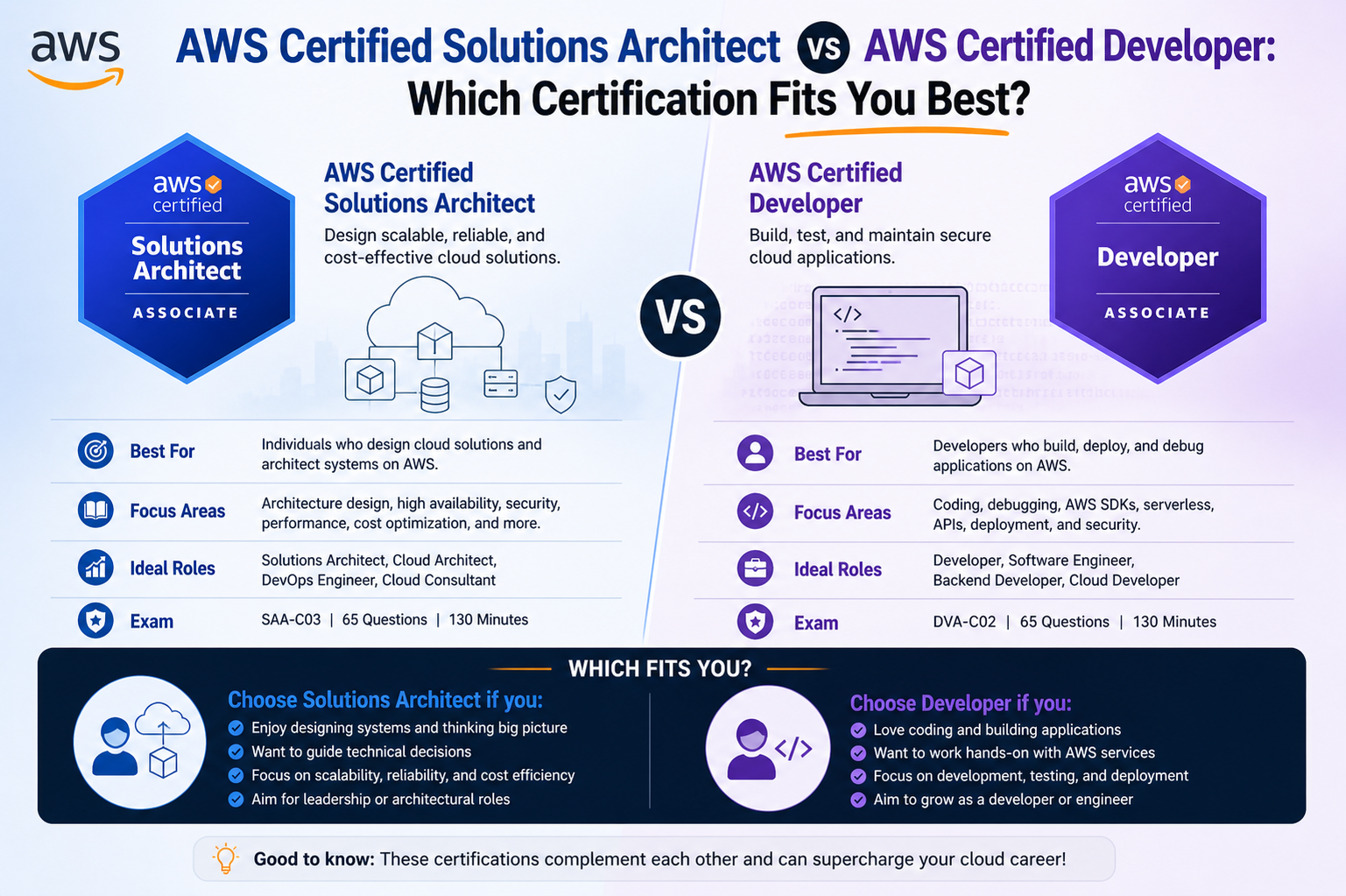
AWS certifications have become one of the most recognized credentials in the cloud computing industry. They validate technical skills and demonstrate a professional’s ability to work with cloud infrastructure and services. Among the most popular certifications, the AWS Certified Solutions Architect and AWS Certified Developer often create confusion for beginners and even experienced IT professionals. Both are powerful career paths, but they are designed for different mindsets and job roles.
The cloud industry is not just about learning tools; it is about understanding how systems are designed, deployed, and maintained at scale. This is where the distinction between these two certifications becomes important. One focuses on designing complete cloud ecosystems, while the other focuses on building applications that run within those ecosystems.
What AWS Certified Solutions Architect Really Focuses On
The AWS Certified Solutions Architect certification is centered around designing cloud-based solutions that are secure, scalable, and cost-efficient. It is less about writing code and more about understanding how different AWS services interact to create a complete system.
A solutions architect is responsible for making high-level design decisions. This includes selecting the right storage options, choosing the appropriate compute services, designing networking architectures, and ensuring that systems are fault-tolerant. The goal is to build solutions that can handle real-world demands such as high traffic, security requirements, and budget constraints.
This certification trains individuals to think like system designers. Instead of focusing on a single application, they learn how multiple applications, databases, and services come together to form a complete architecture. It also emphasizes best practices for reliability, performance optimization, and operational efficiency.
In real-world roles, solutions architects often work closely with business stakeholders. They translate business requirements into technical solutions. This means they must understand both the technical and non-technical aspects of a project. They need to balance performance, cost, and security while ensuring that the system meets business goals.
Core Skills Developed in Solutions Architect Certification
One of the key strengths of this certification is that it builds a strong foundation in architectural thinking. Candidates learn how to design distributed systems that can scale globally. They also gain knowledge of disaster recovery strategies, data backup solutions, and multi-region deployments.
Another important area is security. Solutions architects must ensure that systems are designed with proper access control, encryption, and compliance standards. This includes managing identity and access management, securing data storage, and designing secure network architectures.
Cost optimization is also a major focus. Cloud resources can become expensive if not managed properly. Solutions architects are trained to choose services that deliver the best performance at the lowest cost. They learn how to monitor usage and optimize infrastructure without affecting performance.
Overall, this certification builds strategic thinking skills that are essential for designing large-scale cloud systems.
Who Should Choose AWS Certified Solutions Architect
This certification is ideal for individuals who enjoy system design, problem-solving, and working on high-level architecture. It is well suited for those who prefer planning over coding. If you are interested in how systems are built rather than how individual applications are coded, this path may be the right choice.
It is also a great option for professionals aiming for roles such as cloud architect, solution designer, or infrastructure consultant. These roles often require strong analytical skills and the ability to design complex systems that meet business needs.
People with experience in IT infrastructure, networking, or system administration often find this certification a natural progression in their careers.
What AWS Certified Developer Really Focuses On
The AWS Certified Developer certification takes a different approach. It is focused on building, deploying, and maintaining applications that run on AWS. This certification is designed for software developers who want to enhance their skills in cloud-native application development.
Instead of system design, this path emphasizes coding and application lifecycle management. Developers learn how to write applications that interact with AWS services such as databases, storage systems, and serverless computing platforms.
A key part of this certification is understanding how to use AWS SDKs and APIs. Developers must know how to integrate cloud services into their applications effectively. This includes writing code that is scalable, efficient, and secure.
Deployment is another important aspect. Developers are trained to deploy applications using AWS tools and services. They learn how to automate deployment processes, manage application versions, and monitor application performance in the cloud environment.
Core Skills Developed in Developer Certification
This certification builds strong programming and application development skills in a cloud context. Developers gain hands-on experience with writing code that interacts directly with AWS services.
One of the main areas of focus is serverless computing. Developers learn how to build applications without managing traditional servers. Instead, they use services that automatically scale based on demand. This approach allows for faster development and easier maintenance.
Another important skill is debugging and troubleshooting cloud applications. Developers must be able to identify and fix issues in distributed systems. This requires a deep understanding of how applications behave in a cloud environment.
Security is also part of the learning process. Developers must ensure that their applications follow best practices for authentication, authorization, and data protection. They learn how to secure APIs and manage user access effectively.
Overall, this certification strengthens practical coding skills combined with cloud integration knowledge.
Who Should Choose AWS Certified Developer
The Developer certification is best suited for individuals who enjoy writing code and building applications. If you are already a software developer or want to become one, this certification can help you specialize in cloud-based development.
It is also ideal for those who want to work in roles such as backend developer, cloud application developer, or DevOps engineer. These roles require strong programming skills and the ability to work with cloud services on a daily basis.
Students or professionals with a background in computer science or software engineering often find this path more aligned with their interests.
How These Two Certifications Differ in Real-World Scenarios
In practical terms, the difference between these two certifications becomes clear when you look at how projects are handled in companies.
A solutions architect is involved at the beginning of a project. They design the entire system and decide which AWS services should be used. They focus on ensuring that the system is scalable, secure, and cost-effective before development begins.
A developer, on the other hand, comes into the picture during implementation. They take the design and turn it into working software. They write code, integrate services, and ensure that the application functions as expected in the cloud environment.
While their roles are different, they often work closely together. A strong collaboration between architects and developers is essential for building successful cloud solutions.
Career Impact and Growth Opportunities
Both certifications open strong career opportunities in the cloud industry, but they lead to slightly different career paths.
Solutions architects often move into senior design and consulting roles. They may work as cloud architects, enterprise architects, or technical leads responsible for designing large-scale systems.
Developers often progress into senior development roles, DevOps positions, or cloud engineering careers. They may also specialize in building microservices, serverless applications, or cloud-native software solutions.
In both cases, AWS skills are highly in demand, and professionals with these certifications often enjoy strong job prospects and competitive salaries.
Choosing the Right Path
Choosing between the AWS Certified Solutions Architect and AWS Certified Developer certification ultimately depends on your personal interests and career direction. If you are more interested in designing systems and thinking at a high level about architecture, the solutions architect path will suit you better. If you enjoy coding and building applications that run in the cloud, the developer path is the right choice.
Both certifications are valuable, and neither is superior to the other. They simply represent different sides of cloud computing. One focuses on designing the system, while the other focuses on building it. Understanding your strengths and interests will help you make the right decision for your career growth.
Learning Curve and Preparation Approach
The learning curve for the AWS Certified Solutions Architect and AWS Certified Developer certifications differs significantly because the nature of skills required for each role is different. One focuses on conceptual and design thinking, while the other is more practical and code-oriented.
For the Solutions Architect path, the learning journey starts with understanding AWS core services at a broad level. Candidates must develop the ability to see how services fit together rather than focusing on how each service is implemented in code. This requires building a strong understanding of architecture patterns such as multi-tier applications, microservices, and event-driven systems. The challenge here is not memorization but understanding design trade-offs.
Learners often need to spend time practicing scenario-based thinking. For example, instead of asking “what does this service do,” the question becomes “which service combination solves this business requirement most efficiently.” This shift in thinking is what makes the certification challenging for beginners.
On the other hand, the Developer certification requires a more hands-on approach. Candidates must spend time writing code, deploying applications, and interacting with AWS services through APIs and SDKs. The learning process is more technical and practical. Developers often work with programming languages such as Python, Java, or Node.js while integrating cloud services into applications.
This means the preparation involves more lab-based practice. Candidates need to understand how applications behave in real cloud environments, including how they scale, how they fail, and how they recover.
Exam Structure and Question Style Differences
The exam structure for both certifications is designed to test real-world understanding rather than simple theory, but the style of questions differs.
The Solutions Architect exam is heavily scenario-based. Most questions describe a business problem and require the candidate to choose the best architectural solution. There may be multiple correct answers, but the focus is on selecting the most optimal one based on cost, performance, security, and scalability.
These questions often include trade-offs. For example, one solution might be cheaper but less scalable, while another might be more secure but more expensive. The candidate must evaluate all factors and choose the best fit for the situation.
The Developer exam, however, focuses more on implementation-level understanding. Questions often involve code snippets, debugging scenarios, and application behavior in AWS environments. Candidates are expected to know how applications interact with services like Lambda, DynamoDB, S3, and API Gateway.
There is also a strong emphasis on deployment workflows, continuous integration, and troubleshooting application issues. Instead of architectural decisions, the exam tests whether the candidate can build and maintain functional cloud applications.
Difficulty Comparison Between the Two Certifications
Both certifications are considered moderately to highly challenging, but the difficulty depends on individual background and experience.
For someone with a strong IT infrastructure or system design background, the Solutions Architect exam may feel more intuitive. However, for those without experience in architecture thinking, it can be difficult to adjust to scenario-based reasoning.
The Developer exam can be more challenging for individuals who are not comfortable with coding or software development concepts. Even though AWS services are used extensively, understanding programming logic and debugging techniques is essential.
In general, neither certification is objectively easier. The difficulty is relative to whether you are more comfortable with designing systems or writing code.
Real-World Job Responsibilities Comparison
In real job roles, Solutions Architects and Developers contribute differently to cloud projects, but both are essential.
A Solutions Architect typically begins work at the planning stage of a project. They analyze business requirements and design the overall cloud architecture. Their responsibilities include selecting AWS services, defining system structure, and ensuring the design meets performance and security standards.
They often create architecture diagrams, design documentation, and technical proposals. They also work with stakeholders to ensure that the proposed solution aligns with business goals and budget constraints.
A Developer, however, focuses on building the actual application based on the architecture provided. They write code, implement features, integrate AWS services, and ensure the application runs efficiently in the cloud.
Developers also handle bug fixing, performance optimization, and deployment automation. Their work is more execution-focused, while architects are more design-focused.
In many organizations, these roles overlap, especially in smaller teams where professionals may perform both responsibilities.
Tools and Services Used in Each Role
While both certifications cover AWS services, the depth of usage differs.
Solutions Architects use a wide range of AWS services at a design level. They work with services such as EC2, S3, VPC, IAM, RDS, and CloudFront to design scalable systems. Their focus is on how these services connect rather than how they are programmed.
They also use monitoring and management tools to ensure system reliability. Understanding cost management tools is also important because architects must design solutions that are financially efficient.
Developers, however, go deeper into service integration. They use AWS SDKs to interact with services programmatically. They work closely with Lambda functions, DynamoDB queries, API Gateway integrations, and CI/CD pipelines.
They also use developer tools for debugging, testing, and deployment. Their focus is on how applications behave when interacting with AWS services in real time.
Career Growth and Long-Term Opportunities
Both certifications offer strong long-term career growth, but they lead to different professional directions.
Solutions Architects often grow into senior architecture roles such as Cloud Architect, Enterprise Architect, or Technical Consultant. These roles involve designing large-scale systems for enterprises and guiding technical strategy.
With experience, they may also move into leadership positions where they influence technology decisions at an organizational level. Their expertise becomes valuable in shaping cloud adoption strategies.
Developers, on the other hand, can grow into Senior Developer, Cloud Engineer, or DevOps Engineer roles. They may specialize in building cloud-native applications, automation systems, or serverless architectures.
Over time, developers often expand their skills into full-stack cloud engineering, combining both development and deployment expertise.
Salary and Industry Demand Perspective
Both roles are in high demand, and AWS skills are highly valued across industries. However, salary ranges can vary depending on experience, location, and job role.
Solutions Architects often command higher salaries in enterprise environments because their role involves strategic decision-making and system design responsibility. Their work directly impacts infrastructure cost and performance at scale.
Developers also earn competitive salaries, especially when they specialize in cloud-native development and automation. As companies continue to adopt serverless and microservices architectures, demand for AWS developers continues to grow rapidly.
Common Mistakes Candidates Make
Many candidates struggle with both certifications due to common mistakes.
For Solutions Architect candidates, one major mistake is focusing too much on memorizing services instead of understanding architecture patterns. This leads to confusion during scenario-based questions.
Another mistake is ignoring cost optimization, which is a key factor in almost every architectural decision.
For Developer candidates, a common mistake is not practicing enough hands-on coding with AWS services. Reading theory alone is not enough. Practical experience is essential.
Another issue is weak understanding of debugging and error handling in distributed systems, which is heavily tested in the exam.
Final Comparison of Both Paths
When comparing both certifications side by side, it becomes clear that they serve different purposes in the cloud ecosystem.
The Solutions Architect path is about designing systems, making strategic decisions, and ensuring cloud infrastructure is efficient and scalable. It is more conceptual and planning-focused.
The Developer path is about building applications, writing code, and integrating cloud services into functional software. It is more practical and execution-focused.
Both paths complement each other and are often used together in real-world projects.
Choosing Your Direction
The decision between these two certifications should not be based on difficulty or popularity. Instead, it should be based on your natural strengths and long-term interests.
If you enjoy thinking about system design, architecture patterns, and high-level problem solving, the Solutions Architect certification will feel more aligned with your mindset.
If you enjoy coding, building applications, and working hands-on with technology, the Developer certification will be a better fit.
Both paths lead to strong careers in cloud computing, and both are equally valuable in the industry.
How Companies Actually Use These Roles Together
In real-world cloud projects, the AWS Certified Solutions Architect and AWS Certified Developer roles are not competing roles but complementary ones. Most organizations rely on both skill sets to successfully build and maintain cloud-based systems.
A Solutions Architect typically defines the blueprint of the system. They decide how the application should be structured, what services should be used, and how different components will interact. Their responsibility is to ensure the system is reliable, scalable, secure, and cost-efficient before development begins.
Once this blueprint is ready, Developers step in to bring it to life. They write the code, build the application logic, and integrate AWS services according to the architecture provided. Without developers, the design remains theoretical; without architects, development lacks direction.
In larger organizations, this separation of responsibilities is very clear. However, in startups or small teams, one person may perform both roles, switching between design and development tasks depending on project needs.
Real-World Example of a Cloud-Based Application
To understand the difference better, consider a simple example of an online shopping platform hosted on AWS.
A Solutions Architect would design the system structure. They might decide to use a load balancer to distribute traffic, EC2 instances for application hosting, S3 for storing product images, and a database service like RDS or DynamoDB for managing user and product data. They would also design security layers using IAM roles and ensure the system can handle traffic spikes during sales events.
A Developer would then take this design and implement the application. They would write backend code for user authentication, product listing, cart management, and order processing. They would integrate the application with AWS services using SDKs and ensure that data is correctly stored and retrieved.
This example clearly shows how both roles depend on each other to build a complete working system.
Thinking Style: Architect vs Developer Mindset
One of the most important differences between these certifications is the way you are expected to think.
A Solutions Architect must think in terms of systems, trade-offs, and long-term impact. Every decision they make affects performance, cost, scalability, and security. They must constantly ask questions like: “What happens if traffic doubles?” or “How will this system recover from failure?” Their thinking is broad and strategic.
A Developer, however, thinks in terms of functionality, logic, and implementation. Their focus is on writing efficient code, fixing bugs, and ensuring the application behaves correctly. They are more concerned with how to make something work rather than how the entire system is structured.
Both mindsets are valuable, but they serve different purposes in the software development lifecycle.
Impact on Cloud Adoption in Organizations
Organizations adopting AWS at scale rely heavily on Solutions Architects during the early stages of cloud migration. These professionals design migration strategies, decide which workloads should move to the cloud, and ensure minimal disruption during the transition.
They also define governance models, cost control mechanisms, and security frameworks that guide the entire cloud environment.
Once the architecture is in place, Developers and DevOps teams take over to build, migrate, and optimize applications. They ensure that existing systems are modernized and new applications are cloud-native.
Without architects, cloud adoption becomes chaotic. Without developers, it becomes theoretical and incomplete. Both roles are essential for successful digital transformation.
Hands-On vs Strategic Work Balance
Another major difference lies in the balance between hands-on and strategic work.
The Solutions Architect role is more strategic. While they do work with AWS consoles and sometimes create prototypes, their primary focus is planning and design. They spend more time analyzing requirements, creating diagrams, and discussing solutions with stakeholders.
The Developer role is more hands-on. Developers spend most of their time writing code, testing applications, deploying services, and fixing issues. Their work is continuous and highly technical on a day-to-day basis.
This difference is important for individuals choosing between the two paths, as it directly affects daily job satisfaction.
Tools and Workflow in Real Projects
In real projects, Solutions Architects often use tools for designing system diagrams, documentation, and architecture planning. They may also use AWS pricing calculators, monitoring dashboards, and security review tools to validate their designs.
Developers work with integrated development environments, version control systems, CI/CD pipelines, and testing frameworks. They interact directly with AWS services using code and automate deployment processes.
While both roles use AWS heavily, the way they interact with it is fundamentally different. Architects use AWS to design systems; developers use AWS to build systems.
Career Switching Between the Two Paths
One common question is whether professionals can switch between these two certifications later in their career. The answer is yes, and it is actually quite common.
Many developers transition into Solutions Architect roles after gaining experience in building applications. As they gain a better understanding of system behavior, scalability challenges, and infrastructure design, they naturally move toward architecture roles.
Similarly, some architects move into development or DevOps roles to gain more hands-on experience with implementation and automation.
In cloud computing, career paths are flexible, and skills from one role often strengthen the other.
Industry Demand Trends
The demand for both AWS Solutions Architects and Developers continues to grow as more companies move to the cloud. However, the nature of demand is slightly different.
Solutions Architects are in high demand in enterprise environments where large-scale systems are being designed or migrated. Companies need experts who can ensure cloud adoption is efficient and well-structured.
Developers are in high demand across startups, product companies, and enterprises building cloud-native applications. As more applications move to serverless and microservices architectures, AWS developers are becoming increasingly important.
Both roles are expected to remain relevant for many years as cloud computing continues to expand.
Long-Term Skill Value
From a long-term perspective, both certifications build valuable skill sets, but they evolve differently over time.
Solutions Architects develop strong analytical, design, and strategic thinking skills. These skills remain valuable even as technology changes because system design principles are largely stable.
Developers develop deep technical and programming skills that evolve with new frameworks, languages, and AWS services. Their learning is continuous and often more dynamic.
In both cases, professionals who stay updated with AWS advancements and cloud trends will continue to remain competitive in the job market.
Final Decision Framework for Choosing the Right Certification
Choosing between these two certifications becomes easier when you evaluate yourself based on a few key questions.
If you enjoy designing systems, analyzing business requirements, and making high-level technical decisions, the Solutions Architect path is likely the better fit. It suits individuals who prefer planning, structure, and strategic thinking.
If you enjoy writing code, building applications, and solving technical implementation problems, the Developer path will align more with your interests. It suits individuals who prefer hands-on work and continuous coding challenges.
It is also important to consider your long-term career vision. If you see yourself moving into leadership, consulting, or enterprise architecture roles, Solutions Architect is a strong foundation. If you see yourself growing as a software engineer, DevOps specialist, or cloud developer, then Developer certification is more appropriate.
How Skills Evolve After Certification
After earning either the AWS Certified Solutions Architect or AWS Certified Developer certification, the real learning begins in practical environments. Certifications open the door, but real expertise develops through hands-on experience in live projects.
For Solutions Architects, skill growth usually moves toward deeper architectural complexity. Over time, they begin working on multi-account AWS environments, hybrid cloud setups, and enterprise-scale migrations. Their decisions start affecting not just a single application but entire ecosystems of interconnected services.
They also develop stronger business alignment skills. This means they become better at translating business goals into technical architecture. For example, instead of just designing a system that works, they design systems that directly improve revenue, reduce operational cost, or improve user experience.
For Developers, skill evolution moves toward advanced application design and automation. They start working with microservices, event-driven architectures, and serverless-first designs. Their code becomes more optimized for scalability and cloud efficiency.
Over time, many developers also expand into DevOps practices, learning infrastructure as code, CI/CD automation, and cloud monitoring systems. This expands their role beyond just coding into full application lifecycle ownership.
Depth of AWS Knowledge Required in Each Path
Both certifications require a solid understanding of AWS services, but the depth and direction of knowledge differ.
Solutions Architects need broad knowledge across many services. They must understand what each service does and how it fits into system design. Their strength lies in connecting services together to solve complex problems.
They are expected to know when to use services like EC2 versus Lambda, when to choose SQL versus NoSQL databases, and how to design fault-tolerant systems across multiple regions.
Developers, however, need deeper knowledge of fewer services but at an implementation level. They must understand how to write code that interacts with AWS services, handle API requests, manage authentication flows, and process data efficiently.
Their knowledge is more technical and execution-focused. Instead of just knowing what a service does, they must know how to use it in real code.
Problem-Solving Approach Difference
The way each role approaches problem-solving is another major distinction.
Solutions Architects approach problems from a system-wide perspective. They break down requirements into components and design a complete solution that balances performance, scalability, and cost. Their decisions often involve trade-offs between multiple factors.
For example, they may decide whether to prioritize speed over cost or availability over simplicity depending on business needs.
Developers approach problems from a functional perspective. They focus on how to implement a specific feature or fix a technical issue within an application. Their problem-solving is more code-centric and detail-oriented.
Instead of designing the entire system, they focus on ensuring each part of the system works correctly and efficiently.
How These Roles Fit Into Modern Cloud Trends
Modern cloud computing is evolving rapidly with trends like serverless architecture, containerization, and AI-driven automation. Both roles adapt differently to these trends.
Solutions Architects are increasingly responsible for designing serverless-first and cloud-native architectures. They must understand how to design systems using event-driven models, distributed services, and scalable APIs.
They also play a key role in adopting new AWS services and ensuring organizations transition smoothly to modern cloud practices.
Developers are heavily involved in building these modern applications. They write serverless functions, manage containerized applications using tools like Docker and orchestration platforms, and integrate AI or machine learning APIs into applications.
Their role is becoming more automation-driven, requiring them to build faster, more scalable, and more efficient systems.
Common Career Misconceptions
Many beginners believe that one certification is “better” than the other, but this is a misunderstanding of how cloud careers work.
A common misconception is that Solutions Architect is only for senior professionals. In reality, many beginners start with this certification because it helps build a strong foundation in cloud design.
Another misconception is that Developers do not need to understand architecture. In reality, good developers must understand system design principles to build scalable applications.
Similarly, some believe that Developers earn less or have fewer opportunities. However, in modern cloud environments, skilled AWS developers are equally in demand and often move into high-paying DevOps and engineering roles.
How Companies Evaluate These Skills
In job interviews, companies evaluate Solutions Architects and Developers differently.
For Solutions Architect roles, candidates are often tested on scenario-based questions. They are asked to design systems, explain trade-offs, and justify architectural decisions. Interviewers look for clarity in thinking and ability to handle complex requirements.
For Developer roles, candidates are tested on coding skills, debugging ability, and understanding of cloud integrations. They may be asked to write code, fix issues, or design small application components.
Both roles require strong problem-solving skills, but the evaluation style reflects the nature of their work.
Hybrid Roles in the Industry
In many modern companies, especially startups and agile teams, the line between architect and developer is becoming blurred.
Professionals often work as cloud engineers or full-stack cloud developers, where they handle both design and implementation. In such roles, individuals are expected to understand architecture while also being able to code and deploy applications.
This hybrid skill set is becoming increasingly valuable as companies look for professionals who can handle end-to-end cloud solutions.
Long-Term Career Stability
Both certifications offer strong long-term stability because cloud computing is now a core part of almost every industry.
Solutions Architects enjoy stability due to their involvement in high-level planning and enterprise decision-making. Their skills remain relevant even as technologies change because architecture principles are long-lasting.
Developers enjoy stability because applications will always need to be built, maintained, and improved. As long as companies build software, cloud developers will remain essential.
The key difference is that architects influence systems at a strategic level, while developers influence systems at an execution level.
Final Clarity on Choosing the Right Path
When deciding between these two certifications, the most important factor is not difficulty or salary but mindset alignment.
If you naturally think in systems, enjoy solving large-scale problems, and like planning how everything fits together, the Solutions Architect path will feel more natural.
If you enjoy writing code, solving technical implementation challenges, and building functional applications, the Developer path will suit you better.
Both paths can eventually lead to senior cloud roles, leadership positions, and high-paying opportunities. The difference lies in how you prefer to work rather than where the industry is heading.
Final Conclusion
The AWS Certified Solutions Architect and AWS Certified Developer certifications represent two essential pillars of cloud computing. One focuses on designing the blueprint of systems, while the other focuses on building those systems in real environments.
Neither is superior to the other. Instead, they complement each other and often work together in real-world cloud projects. Understanding your strengths, interests, and long-term career goals is the key to making the right choice.
In the evolving world of cloud technology, success does not depend on choosing the “best” certification, but on choosing the path that aligns with how you think, solve problems, and build your career in the cloud ecosystem.