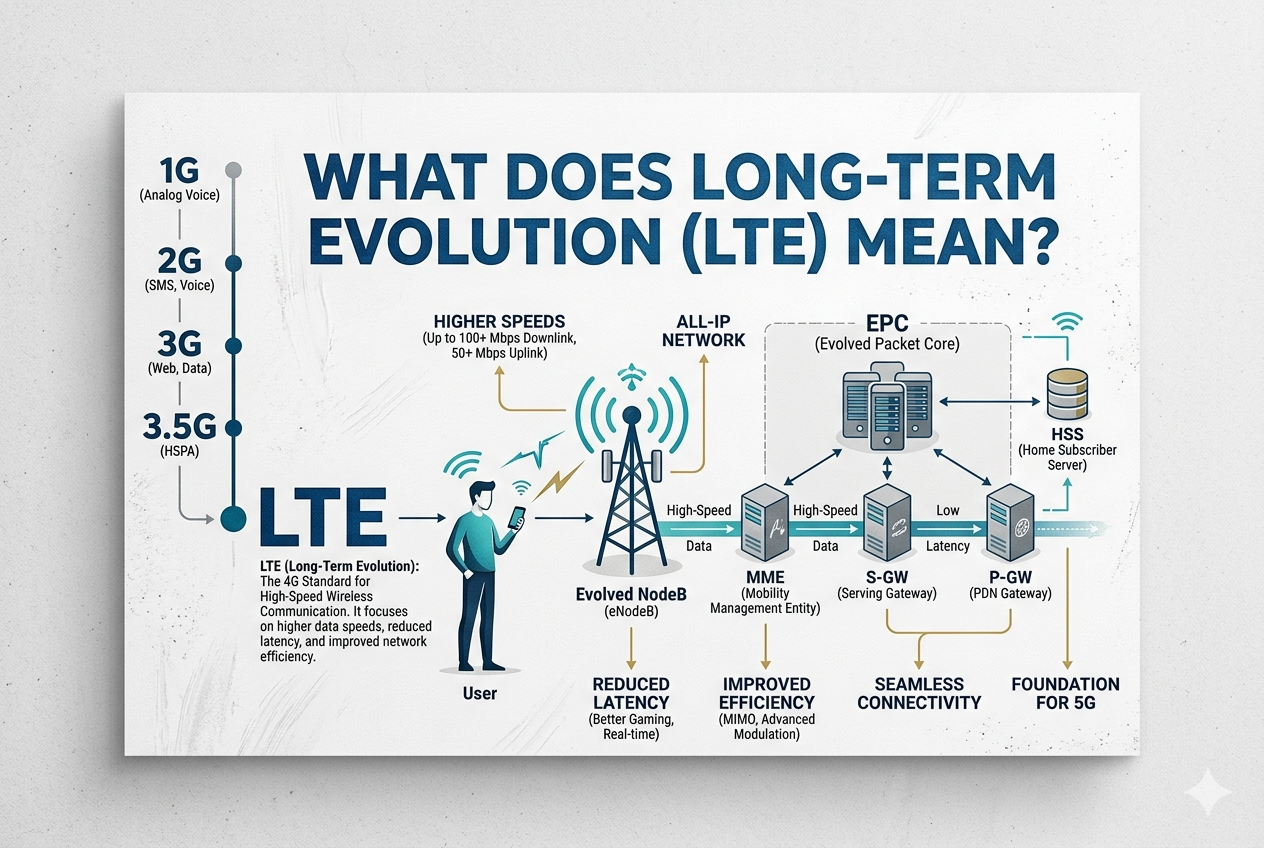
Long-Term Evolution, commonly known as LTE, represents a major milestone in the development of mobile communication systems. It is a wireless broadband technology designed to significantly enhance the speed, capacity, and efficiency of mobile networks. LTE was introduced to meet the growing global demand for faster internet access on mobile devices, driven by the increasing use of smartphones, streaming platforms, cloud services, and real-time applications.
LTE is not just an incremental improvement over previous mobile standards; it is a transformation in how data is transmitted between devices and networks. It moves away from older circuit-switched communication methods and instead relies on a fully packet-based system. This shift allows for more efficient use of network resources and enables multiple types of data services to operate seamlessly over the same infrastructure.
Evolution of Mobile Communication Leading to LTE
Before LTE, mobile networks evolved through several generations. The first generation focused on analog voice communication, while the second generation introduced digital voice and basic messaging services. The third generation brought mobile internet access, allowing users to browse websites and use early data-driven applications.
However, as mobile usage expanded rapidly, these earlier systems struggled to keep up with increasing data demands. Video streaming, social media, online gaming, and cloud-based applications required a more powerful and efficient network. LTE emerged as a solution to these limitations, offering a platform capable of supporting high-speed data transmission and improved user experiences.
Core Principles of LTE Technology
LTE is built on a set of core principles that define its performance and efficiency. One of the most important principles is the use of all-IP networking, which means that both voice and data are transmitted as internet protocol packets. This simplifies communication and allows for faster and more flexible data handling.
Another key principle is the reduction of latency. Latency refers to the delay between sending and receiving data. LTE significantly reduces this delay, making real-time applications such as video calls and online gaming much smoother and more responsive.
LTE also focuses on high spectral efficiency, which means it can transmit more data using the same amount of frequency spectrum compared to older technologies. This is achieved through advanced radio techniques and optimized signal processing methods.
Network Architecture of LTE
The LTE network is composed of two main parts: the radio access network and the core network. The radio access network is responsible for connecting mobile devices to the system through cell towers. These towers communicate directly with smartphones, tablets, and other wireless devices.
The core network manages data routing, internet connectivity, and overall network control. It ensures that data reaches its intended destination efficiently and securely. Unlike older systems, LTE’s architecture is simplified and more streamlined, reducing complexity and improving performance.
This structure allows LTE networks to handle large volumes of users and data traffic while maintaining stability and speed.
Radio Technology and Data Transmission
LTE uses advanced radio technologies to achieve high-speed communication. One of the key technologies used is Orthogonal Frequency Division Multiple Access. This method divides the available frequency spectrum into multiple smaller sub-frequencies, allowing several data streams to be transmitted simultaneously without interference.
This approach greatly increases efficiency and reduces signal congestion. It also improves coverage and reliability, especially in urban areas where many users are connected at the same time.
Multiple Input Multiple Output technology is another important component of LTE. It uses multiple antennas at both the transmitter and receiver ends to improve signal strength and data throughput. This results in faster downloads, better upload speeds, and more stable connections.
Speed and Performance Improvements
One of the most noticeable advantages of LTE is its high data speed. Compared to earlier mobile networks, LTE can deliver significantly faster download and upload rates. This makes it possible to stream high-definition videos, download large files, and use data-intensive applications without interruptions.
In addition to speed, LTE also improves network responsiveness. Lower latency ensures that actions such as opening apps, loading web pages, and sending messages happen almost instantly. This creates a smoother and more natural user experience.
Network performance is also more consistent under LTE. Even when many users are connected at the same time, the system is designed to manage traffic efficiently and minimize slowdowns.
Voice Services Over LTE
LTE initially focused on data services, but it also supports voice communication through a system known as Voice over LTE. This technology allows voice calls to be transmitted as data packets over the LTE network rather than using traditional voice circuits.
As a result, voice calls benefit from clearer audio quality, faster call setup times, and improved reliability. It also allows users to use voice and data services simultaneously without interruption.
Spectrum Efficiency and Capacity
LTE is designed to make optimal use of available frequency spectrum. Spectrum is a limited resource, so efficient usage is essential for supporting large numbers of users.
Through advanced modulation and coding techniques, LTE can transmit more information within the same bandwidth compared to older systems. This increases network capacity and reduces congestion, especially in densely populated areas.
This efficiency is one of the key reasons LTE has become a global standard for mobile communication.
Mobility and Seamless Connectivity
One of the strengths of LTE is its ability to maintain stable connections even when users are moving at high speeds. Whether traveling in vehicles or trains, LTE networks are designed to provide continuous service without frequent disconnections.
This is achieved through advanced handover mechanisms that allow devices to switch between cell towers smoothly without interrupting ongoing communication.
Security Features in LTE Networks
Security is an important aspect of LTE technology. The system includes multiple layers of protection to ensure that data remains secure during transmission. Authentication mechanisms verify user identity before granting access to the network.
Encryption is used to protect data from unauthorized access, ensuring that communication remains private and secure. These security features make LTE suitable for both personal and business use, including sensitive transactions and communications.
Limitations of LTE Technology
Although LTE offers many advantages, it also has certain limitations. Network performance can still be affected by factors such as distance from cell towers, physical obstructions, and network congestion in extremely dense areas.
Additionally, while LTE provides high speeds, it is not always sufficient for extremely advanced applications that require ultra-low latency and extremely high bandwidth, such as some emerging technologies and future communication systems.
Despite these limitations, LTE remains highly effective and widely used across the world.
Real-World Applications of LTE
LTE supports a wide range of applications in everyday life. It enables smooth video streaming on mobile devices, fast internet browsing, and reliable communication through messaging and video calls.
It also plays an important role in business environments, where employees rely on mobile connectivity for remote work, cloud computing, and real-time collaboration tools.
In transportation systems, LTE supports navigation services, ride-sharing platforms, and connected vehicle technologies. It also contributes to emergency services by enabling fast and reliable communication during critical situations.
Importance of LTE in Modern Connectivity
LTE has become a foundational technology in modern communication systems. It bridges the gap between older mobile networks and newer, more advanced systems. Its ability to deliver high-speed, low-latency, and reliable connectivity has transformed how people access and use digital services.
From personal communication to global business operations, LTE plays a central role in keeping the world connected. It supports the growing demand for mobile internet and continues to serve as a backbone for wireless communication in many regions.
Ongoing Relevance and Future Transition
Even with the emergence of newer technologies, LTE continues to remain highly relevant. It is often used alongside more advanced networks to ensure wide coverage and compatibility. Many devices and systems still rely on LTE due to its stability and global availability.
As mobile communication continues to evolve, LTE serves as a strong foundation that supports the transition toward more advanced wireless technologies. Its influence remains significant in shaping the future of global connectivity.
Advanced LTE Technologies and Enhancements
LTE is not a single fixed system but a continuously evolving technology framework that has undergone multiple enhancements since its introduction. These improvements are designed to increase speed, capacity, and reliability while preparing networks for future communication demands. One of the most important developments in this evolution is LTE-Advanced, which significantly boosts performance compared to the original LTE standard.
LTE-Advanced introduces features such as carrier aggregation, which allows multiple frequency bands to be combined into a single data channel. This results in much higher data speeds and better utilization of available spectrum. It also improves overall network efficiency by balancing traffic more effectively across different frequencies. Another enhancement includes improved Multiple Input Multiple Output configurations, which further increase data throughput and signal stability.
These advancements make LTE capable of supporting increasingly demanding applications such as ultra-high-definition video streaming, advanced cloud computing services, and real-time interactive platforms.
Carrier Aggregation and Its Role in Performance
Carrier aggregation is one of the most important techniques used in advanced LTE systems. It allows a mobile device to connect to multiple frequency bands simultaneously. Instead of relying on a single channel, data is transmitted across several carriers, which significantly increases total bandwidth.
This process improves download and upload speeds while reducing network congestion. It is especially useful in areas where network demand is high, such as cities, stadiums, and business districts. By combining fragmented spectrum resources, LTE networks can deliver a more consistent and powerful user experience.
Carrier aggregation also enhances flexibility for network operators, allowing them to optimize performance based on available frequency resources.
Improved Latency and Real-Time Communication
One of the key goals of LTE development is reducing latency to support real-time communication. Latency refers to the time it takes for data to travel from the source to the destination. In earlier mobile technologies, higher latency often caused delays in communication, especially in interactive applications.
LTE significantly reduces this delay, making it suitable for services that require instant response. These include video conferencing, online gaming, live streaming, and financial transactions. Lower latency ensures smoother interactions and more reliable performance in time-sensitive applications.
Advanced LTE versions continue to improve latency performance, bringing mobile networks closer to real-time responsiveness.
Role of LTE in Internet of Things Connectivity
LTE plays an important role in supporting the growing ecosystem of connected devices known as the Internet of Things. These devices include smart sensors, wearable technology, home automation systems, and industrial monitoring equipment.
LTE provides the necessary infrastructure for these devices to communicate efficiently over long distances. It supports both high-bandwidth and low-power communication needs, depending on the application. This flexibility makes LTE suitable for a wide range of IoT use cases, from smart cities to healthcare monitoring systems.
The reliability and widespread availability of LTE networks make them an essential component of IoT development.
Energy Efficiency and Network Optimization
Energy efficiency is another important aspect of LTE technology. Mobile devices and network infrastructure are designed to optimize power consumption while maintaining high performance. This is achieved through intelligent resource management and adaptive signal processing techniques.
LTE networks can adjust transmission power based on signal strength and user demand, reducing unnecessary energy usage. This not only improves battery life for mobile devices but also lowers operational costs for network providers.
Efficient energy use is particularly important in large-scale deployments, where thousands of devices and base stations operate simultaneously.
Global Adoption and Network Expansion
LTE has achieved widespread global adoption and is now one of the most commonly used mobile communication standards in the world. Its deployment spans across urban, suburban, and rural areas, providing connectivity to billions of users.
Telecommunication companies continue to expand LTE coverage to reach underserved regions, helping to bridge the digital divide. This global expansion has played a major role in increasing internet accessibility and supporting economic development in many countries.
The widespread availability of LTE ensures that users can stay connected even in remote locations where other types of broadband infrastructure may be limited.
Integration with Existing Mobile Networks
LTE is designed to work alongside older mobile technologies such as 3G and even 2G networks. This compatibility ensures a smooth transition for users and operators as networks are upgraded.
When LTE coverage is not available, devices can automatically switch to older networks without interrupting basic communication services. This seamless integration helps maintain connectivity in areas where LTE infrastructure is still developing.
It also allows mobile operators to gradually upgrade their systems without completely replacing existing infrastructure.
Impact of LTE on Digital Services
The introduction of LTE has had a profound impact on digital services and applications. It has enabled the widespread adoption of video streaming platforms, mobile banking, social media applications, and cloud-based productivity tools.
High-speed connectivity allows users to access content instantly and interact with services in real time. Businesses benefit from improved communication, faster data access, and enhanced customer engagement.
LTE has also contributed to the growth of remote work and online education by providing reliable mobile internet access.
Quality of Service and Network Management
LTE networks are designed with advanced quality of service mechanisms that prioritize different types of data traffic. For example, voice calls and video conferencing may be given higher priority than standard data downloads to ensure smooth performance.
This intelligent traffic management helps maintain a consistent user experience even during peak usage times. Network operators can dynamically allocate resources based on demand, ensuring efficient utilization of available capacity.
Quality of service features are essential for maintaining reliability in modern mobile communication systems.
Security and Data Protection Enhancements
LTE includes advanced security protocols to protect user data and communication. These security measures include authentication systems that verify user identity before allowing network access, as well as encryption techniques that secure data during transmission.
These protections help prevent unauthorized access and ensure that sensitive information remains confidential. Security is especially important for services such as online banking, corporate communication, and personal messaging.
LTE security standards are continuously updated to address emerging threats and maintain network integrity.
Challenges in LTE Deployment
Despite its advantages, LTE deployment can face several challenges. One of the main issues is the cost of infrastructure development, which includes building new base stations and upgrading existing systems. In rural or remote areas, this process can be slow due to geographical and economic constraints.
Another challenge is spectrum availability, as mobile networks must compete for limited frequency resources. Efficient spectrum management is necessary to ensure optimal performance.
Network congestion can also occur in densely populated areas, requiring continuous optimization and expansion.
Transition Toward Future Technologies
LTE serves as an important foundation for next-generation mobile technologies. While newer systems continue to emerge, LTE remains a critical part of global communication infrastructure.
It acts as a bridge between older networks and more advanced technologies, ensuring continuity and reliability during technological transitions. Many modern systems still rely on LTE as a backup or complementary network layer.
Its role in shaping the future of wireless communication remains significant, as it continues to support billions of users worldwide.
LTE in Rural and Remote Connectivity
LTE has played a crucial role in extending mobile internet access to rural and remote regions where traditional wired infrastructure is limited or expensive to deploy. By using wireless base stations, LTE networks can cover wide geographic areas and provide internet access to communities that previously had little or no connectivity.
In many developing regions, LTE serves as the primary source of broadband access. It enables users in villages and remote towns to access essential digital services such as education platforms, healthcare information, and financial tools. This connectivity helps reduce the digital gap between urban and rural populations and supports inclusive economic growth.
The flexibility of LTE infrastructure allows network operators to deploy temporary or fixed installations depending on local needs, making it a practical solution for diverse environments.
Role of LTE in Education and Learning Systems
LTE has significantly influenced the education sector by enabling mobile learning and remote education. Students can access online classes, digital libraries, and educational applications through smartphones and tablets connected to LTE networks.
This accessibility is especially important in areas where physical educational resources are limited. LTE supports video lectures, interactive learning platforms, and real-time communication between students and teachers, making education more flexible and accessible.
During situations where traditional classroom learning is disrupted, LTE ensures continuity in education by enabling remote participation and digital collaboration.
LTE in Healthcare and Telemedicine
The healthcare industry has also benefited greatly from LTE technology. Telemedicine services rely on stable and fast internet connections to allow doctors and patients to communicate remotely. Through LTE networks, medical consultations, diagnostic services, and follow-up appointments can be conducted without physical visits.
LTE supports the transmission of medical data such as images, reports, and real-time patient monitoring information. This is particularly useful in emergency situations where quick communication can save lives.
In rural areas, LTE helps connect healthcare providers with specialists in urban hospitals, improving the overall quality of medical care available to patients.
Impact on Business and Industry
LTE has transformed the way businesses operate by enabling mobile productivity and real-time communication. Employees can work remotely, access cloud-based systems, and collaborate with colleagues from different locations using LTE-connected devices.
Businesses use LTE for video conferencing, data sharing, customer service applications, and mobile point-of-sale systems. This flexibility improves efficiency and allows organizations to operate more dynamically.
Industries such as logistics, transportation, and field services also rely on LTE for tracking systems, communication tools, and operational coordination.
LTE in Transportation Systems
Modern transportation systems increasingly depend on LTE connectivity for efficient operation. Public transport networks use LTE for real-time tracking, scheduling updates, and passenger information systems.
Ride-sharing services rely heavily on LTE to match drivers with passengers, calculate routes, and process payments. Navigation systems in vehicles use LTE to provide live traffic updates and route optimization.
In aviation and maritime industries, LTE supports communication and monitoring systems that enhance safety and operational efficiency.
Entertainment and Media Consumption
LTE has revolutionized entertainment by making high-quality media content accessible on mobile devices. Streaming services for music, movies, and videos depend on LTE’s high-speed data capabilities to deliver smooth playback experiences.
Users can watch high-definition content, listen to music, and engage with online gaming platforms without needing wired internet connections. This mobility has changed how people consume entertainment, making it more flexible and personalized.
Social media platforms also benefit from LTE, allowing users to upload and share content instantly from anywhere.
Network Reliability and Redundancy
Reliability is one of the key strengths of LTE networks. The system is designed with redundancy mechanisms that ensure continuous service even when parts of the network experience issues.
If one base station becomes overloaded or fails, nearby stations can take over the traffic load. This distributed structure helps maintain consistent connectivity for users.
LTE networks also use advanced monitoring systems to detect and resolve performance issues quickly, minimizing downtime and service interruptions.
Advancements Toward LTE-Advanced Pro
LTE-Advanced Pro represents an even more refined version of LTE technology. It introduces additional improvements in speed, efficiency, and network intelligence. This version bridges the gap between LTE and next-generation mobile systems.
It supports enhanced carrier aggregation, improved spectrum usage, and better support for IoT devices. LTE-Advanced Pro also introduces features that enable smarter network management through automation and data-driven optimization.
These enhancements help prepare mobile networks for future demands while maintaining compatibility with existing LTE infrastructure.
Coexistence with 5G Networks
As newer technologies like 5G continue to expand, LTE still plays an important supporting role. In many regions, LTE and 5G networks operate together to ensure continuous coverage and smooth connectivity.
LTE often acts as a fallback network when 5G signals are weak or unavailable. This coexistence ensures that users always remain connected regardless of location or network conditions.
The integration between LTE and 5G also allows for gradual network upgrades without disrupting existing services.
Future Outlook of LTE Technology
Even as mobile communication continues to evolve, LTE remains a vital part of global connectivity. Its reliability, widespread availability, and strong performance ensure that it will continue to be used for many years.
LTE will likely continue to support billions of devices worldwide, especially in regions where newer technologies are still being deployed. It will also remain important for IoT systems, industrial applications, and basic mobile communication.
The future of LTE lies in its integration with advanced technologies and its role as a stable backbone for global wireless communication systems.
LTE in Smart Cities Development
LTE plays a foundational role in the development of smart cities by enabling seamless communication between devices, systems, and infrastructure. Smart cities rely on real-time data exchange to manage transportation, energy consumption, public safety, and environmental monitoring, and LTE provides the connectivity needed for these systems to function efficiently.
Traffic lights, surveillance cameras, parking systems, and public utilities can all be connected through LTE networks, allowing city administrators to monitor and control operations more effectively. This improves urban efficiency, reduces congestion, and enhances the overall quality of life for residents.
LTE also supports emergency response systems by enabling fast communication between first responders and control centers, ensuring quicker reaction times during critical situations.
LTE in Agriculture and Smart Farming
Modern agriculture increasingly depends on digital technologies, and LTE has become an important enabler of smart farming practices. Farmers can use LTE-connected sensors to monitor soil conditions, weather patterns, crop health, and irrigation systems in real time.
This data-driven approach helps improve productivity and resource management. For example, irrigation systems can be automatically adjusted based on soil moisture levels, reducing water waste and improving crop yield.
LTE connectivity also allows farmers to access market information, agricultural advice, and remote monitoring tools, even in rural areas where traditional internet infrastructure is limited.
Industrial Automation and LTE Networks
LTE is widely used in industrial environments to support automation and machine-to-machine communication. Factories and production facilities rely on LTE-connected systems to monitor equipment, track performance, and manage operations efficiently.
In industrial automation, LTE enables real-time data exchange between machines, sensors, and control systems. This improves production accuracy, reduces downtime, and enhances safety in hazardous environments.
Because LTE provides reliable wireless connectivity, it reduces the need for complex wired infrastructure, making industrial setups more flexible and scalable.
LTE in Public Safety and Emergency Services
Public safety organizations depend on fast and reliable communication networks, and LTE has become a key technology in this area. Police, fire departments, and emergency medical services use LTE to coordinate operations and share critical information in real time.
LTE supports features such as video streaming from incident sites, location tracking of personnel, and instant communication between teams. This improves situational awareness and helps responders make faster decisions during emergencies.
Dedicated LTE networks for public safety ensure priority access even during high network congestion, making communication more reliable during crises.
Energy Sector and Smart Grid Systems
The energy sector has also adopted LTE technology to improve efficiency and monitoring capabilities. Smart grids use LTE connectivity to manage electricity distribution, monitor consumption patterns, and detect faults in real time.
Utility companies can remotely control power systems, reduce outages, and optimize energy distribution based on demand. LTE-connected smart meters provide consumers with detailed information about their energy usage, helping them manage consumption more effectively.
This integration of LTE into energy systems contributes to more sustainable and efficient power management.
LTE Device Ecosystem and Compatibility
The LTE ecosystem includes a wide range of devices such as smartphones, tablets, routers, wearable gadgets, and IoT sensors. Most modern mobile devices are designed to be compatible with LTE networks, ensuring widespread accessibility.
This compatibility allows users to stay connected across different devices without interruptions. LTE routers also enable wireless broadband access in homes and offices, providing an alternative to traditional wired internet connections.
The diversity of LTE-compatible devices has contributed to its global adoption and continued relevance.
Software and Network Optimization in LTE
LTE networks rely heavily on advanced software systems for optimization and management. These systems monitor network performance, allocate resources dynamically, and ensure efficient traffic handling.
Artificial intelligence and machine learning techniques are increasingly used in LTE networks to predict traffic patterns and optimize performance automatically. This helps reduce congestion and improve user experience.
Software-defined networking also allows operators to configure and manage LTE infrastructure more flexibly, adapting quickly to changing demands.
Challenges in Expanding LTE Coverage
Despite its widespread adoption, expanding LTE coverage continues to present challenges. Geographic barriers such as mountains, deserts, and remote islands can make infrastructure deployment difficult and costly.
In addition, regulatory issues and spectrum allocation policies can slow down network expansion in some regions. Ensuring consistent coverage in densely populated urban areas also requires continuous investment in infrastructure upgrades.
Network operators must balance cost, performance, and accessibility when expanding LTE services.
Environmental Impact of LTE Infrastructure
Like all large-scale communication systems, LTE infrastructure has an environmental footprint. Cell towers, base stations, and supporting equipment require energy to operate continuously.
However, LTE networks are designed with energy efficiency in mind, and ongoing improvements aim to reduce power consumption. Renewable energy sources such as solar and wind are increasingly being used to power remote LTE installations.
Efforts to optimize network efficiency also help reduce overall environmental impact while maintaining high performance.
LTE and Digital Inclusion
One of the most important contributions of LTE is its role in promoting digital inclusion. By providing affordable and accessible mobile internet, LTE helps connect people who might otherwise be excluded from the digital world.
This connectivity enables access to education, healthcare, employment opportunities, and government services. It empowers individuals and communities by giving them the tools to participate in the digital economy.
LTE continues to play a key role in reducing the global digital divide.
Future Integration with Emerging Technologies
LTE is expected to remain an important part of the global communication landscape even as new technologies emerge. It will continue to integrate with systems such as artificial intelligence, edge computing, and advanced IoT networks.
These integrations will enhance LTE’s capabilities and extend its usefulness in various industries. LTE’s adaptability ensures that it can support evolving technological demands while maintaining stable performance.
Its role as a supporting layer for future innovations makes it a long-term component of global connectivity infrastructure.
LTE’s Ongoing Significance
LTE has established itself as one of the most important technologies in modern communication history. Its ability to deliver fast, reliable, and widespread connectivity has transformed how people live, work, and interact.
From urban smart systems to rural connectivity, LTE supports a wide range of applications that influence nearly every aspect of modern life. It continues to serve as a stable and efficient foundation for mobile communication.
As technology evolves, LTE remains a critical link between past mobile generations and future innovations, ensuring continuous global connectivity and digital progress.
Conclusion
Long-Term Evolution (LTE) stands as one of the most influential advancements in mobile communication, reshaping how people access and use the internet on a global scale. It has delivered significant improvements in speed, reliability, and network efficiency compared to earlier generations, making high-quality mobile connectivity widely accessible.
LTE has not only enhanced personal communication but has also driven transformation across industries such as education, healthcare, transportation, agriculture, and business. Its ability to support real-time applications, large-scale data transfer, and widespread device connectivity has made it a critical foundation for modern digital ecosystems.
Even as newer technologies continue to emerge, LTE remains deeply relevant due to its stability, global coverage, and compatibility with existing systems. It continues to serve as a reliable backbone for connectivity in many regions and acts as a supporting layer for advanced networks.
Overall, LTE has played a central role in bridging the digital divide and enabling the modern connected world, and its impact will continue to be felt as communication technologies evolve further.