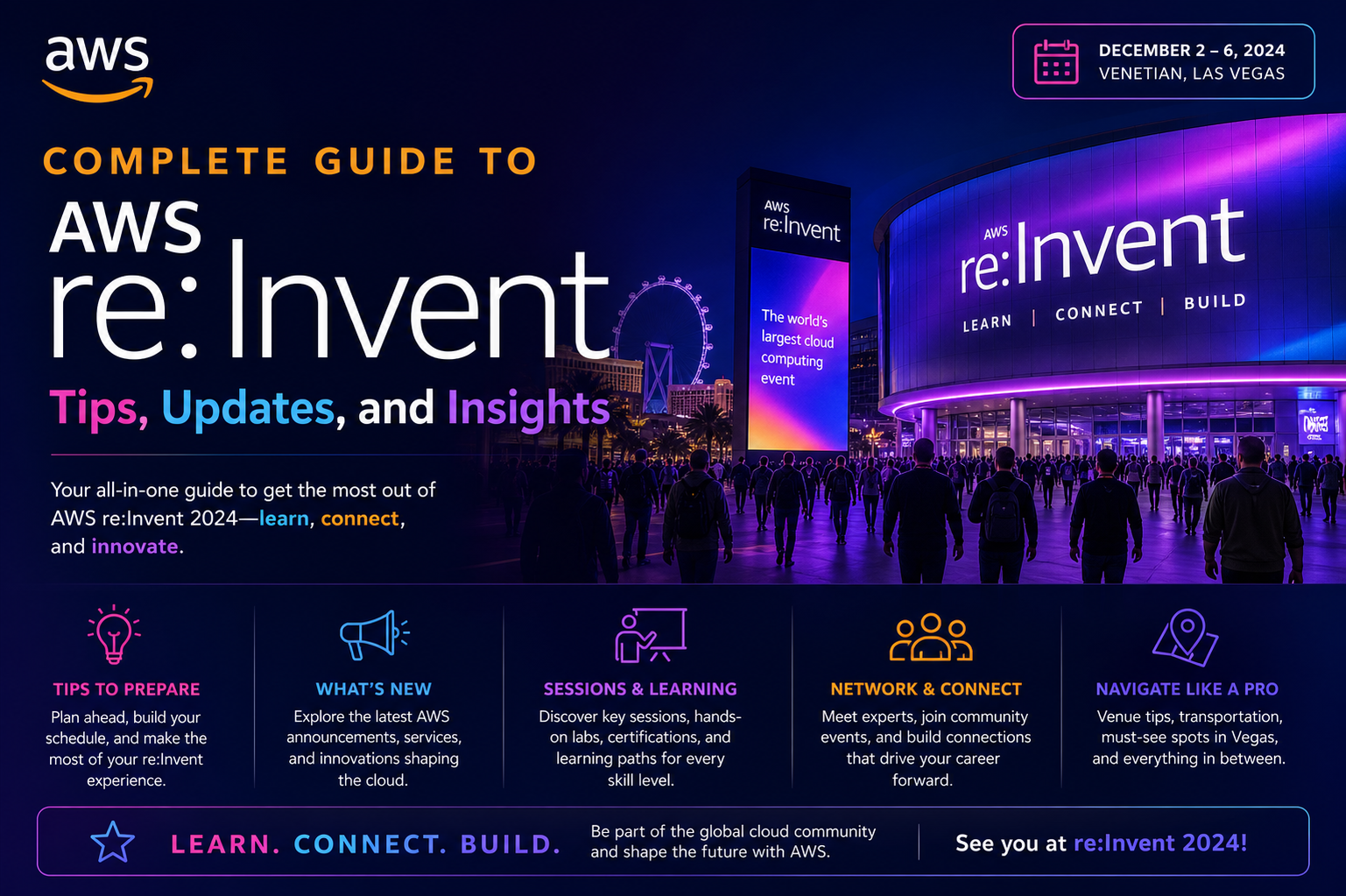
AWS re:Invent is a globally recognized technology conference that brings together cloud computing professionals, developers, architects, and business leaders from across the world. It is designed as a knowledge-sharing platform where advancements in cloud infrastructure, artificial intelligence, data engineering, and software development are introduced and explored in depth. The event has become a major reference point for understanding the direction of modern enterprise technology and how organizations are evolving in a cloud-first world.
At its core, the event is not just about announcements but about shaping how technology is used in real-world applications. It provides a structured environment where both beginners and experienced professionals can learn how cloud services are designed, deployed, and optimized at scale.
Importance of AWS re:Invent in the Tech Ecosystem
AWS re:Invent holds a significant position in the global technology ecosystem because it directly influences how cloud services evolve. Many of the innovations presented during the event become foundational tools used by startups, enterprises, and government organizations.
The importance of the event also lies in its ability to connect theory with practice. Instead of only discussing concepts, it demonstrates how cloud technologies solve real business challenges such as improving system reliability, reducing operational costs, and enabling faster product development cycles. This practical focus makes it highly valuable for decision-makers and technical teams alike.
Evolution of Cloud Computing and AWS Role
Cloud computing has transformed the way digital systems are built and maintained. Instead of relying on physical infrastructure, organizations now use scalable cloud platforms to manage applications and data. AWS has played a central role in this transformation by continuously expanding its ecosystem of services.
Over the years, AWS has introduced capabilities that support computing power, storage solutions, networking systems, and advanced machine learning tools. These developments have allowed companies of all sizes to innovate faster without heavy upfront infrastructure investment. AWS re:Invent acts as a stage where this evolution is showcased, highlighting both incremental improvements and groundbreaking innovations.
Core Themes of the Event
One of the defining characteristics of AWS re:Invent is its focus on key technological themes that shape the future of cloud computing. These themes typically include artificial intelligence, machine learning, data analytics, security, application modernization, and infrastructure optimization.
Artificial intelligence and machine learning are often central topics, reflecting the growing demand for intelligent systems that can process large amounts of data and generate insights. Similarly, cloud security remains a major focus as organizations prioritize protecting sensitive data and ensuring compliance with global standards.
Application modernization is another important theme, emphasizing how legacy systems can be transformed into cloud-native architectures that are more scalable and efficient. These themes collectively provide a roadmap for how businesses can adapt to technological change.
Learning Experience and Technical Depth
The learning experience at AWS re:Invent is structured to accommodate different levels of expertise. Technical sessions dive deep into architecture patterns, system design principles, and service configurations. These sessions are often led by engineers and experts who work directly on AWS services, providing first-hand insights into how the systems operate.
Hands-on workshops allow participants to apply what they learn in real-time environments. This practical approach strengthens understanding and helps professionals gain confidence in using cloud tools effectively. The combination of theory and practice makes the learning experience highly impactful for long-term skill development.
Keynotes and Strategic Vision
Keynote presentations are one of the most anticipated elements of AWS re:Invent. These sessions typically outline the strategic direction of cloud computing and introduce major innovations that will shape future development.
During these presentations, emphasis is often placed on how technology can solve large-scale global challenges. Topics such as automation, sustainability, scalability, and digital transformation are commonly discussed. These sessions also highlight how businesses can leverage cloud platforms to innovate faster and operate more efficiently.
The strategic vision presented during keynotes often sets the tone for the entire technology industry, influencing product roadmaps and enterprise adoption strategies.
Innovation and Service Expansion
AWS is known for continuously expanding its portfolio of services, and re:Invent serves as the primary platform for announcing these updates. New services and enhancements are typically introduced across various domains, including computing, storage, databases, networking, and artificial intelligence.
These innovations are designed to simplify complex processes and provide developers with more powerful tools. For example, advancements in serverless computing allow applications to run without managing underlying infrastructure, while improvements in machine learning services make it easier to build intelligent applications without deep expertise in data science.
Each innovation introduced during the event contributes to a broader ecosystem that supports modern application development at scale.
Real-World Applications and Industry Impact
One of the most valuable aspects of AWS re:Invent is its focus on real-world applications. Organizations from industries such as healthcare, finance, retail, and manufacturing share how they use cloud technologies to solve practical problems.
In healthcare, cloud systems are used to manage patient data securely and enable advanced diagnostics. In finance, they support fraud detection systems and real-time transaction processing. Retail businesses use cloud platforms to personalize customer experiences and optimize supply chains.
These examples demonstrate how cloud computing is not just a technical concept but a powerful tool that drives business transformation across industries.
Developer Experience and Tooling
Developers play a central role in the AWS ecosystem, and the event places strong emphasis on improving their experience. New tools, frameworks, and services are often introduced to simplify development workflows and improve productivity.
These tools help developers build, test, and deploy applications more efficiently. Automation features reduce manual effort, while integrated development environments support faster debugging and optimization. The goal is to enable developers to focus more on innovation rather than infrastructure management.
This focus on developer experience ensures that cloud technology remains accessible and efficient for a wide range of users.
Security and Compliance Focus
Security remains a foundational pillar of cloud computing, and AWS re:Invent dedicates significant attention to this area. Sessions often cover topics such as identity management, encryption, network security, and regulatory compliance.
As organizations move more sensitive workloads to the cloud, ensuring data protection becomes critical. AWS continuously enhances its security services to help organizations maintain control over their environments while meeting global compliance standards.
This emphasis on security builds trust and encourages wider adoption of cloud technologies across industries with strict regulatory requirements.
Scalability and Performance Optimization
Scalability is one of the key advantages of cloud computing, and AWS re:Invent frequently highlights techniques for optimizing system performance. This includes strategies for load balancing, distributed computing, and efficient resource management.
Organizations learn how to design systems that can handle increasing workloads without compromising performance. These insights are particularly valuable for businesses experiencing rapid growth or fluctuating demand patterns.
By focusing on scalability, AWS ensures that its services can support applications ranging from small startups to global enterprises.
Future Direction of Cloud Technology
AWS re:Invent provides a glimpse into the future of cloud computing. Emerging trends such as artificial intelligence integration, edge computing, and automation are increasingly shaping the direction of the industry.
The future of cloud technology is expected to focus on greater intelligence, automation, and efficiency. Systems will become more adaptive, capable of responding to changes in real time and optimizing performance automatically.
This evolution will continue to redefine how applications are built and how businesses operate in a digital environment.
Advanced Architectural Patterns in AWS Ecosystem
As cloud adoption continues to mature, architectural design has become one of the most critical areas of focus. AWS re:Invent places strong emphasis on how modern systems are structured to achieve reliability, scalability, and efficiency. Advanced architectural patterns such as microservices, event-driven design, and serverless architectures are widely discussed because they allow organizations to build flexible systems that can evolve over time without major disruptions.
Microservices architecture breaks applications into smaller, independent services that can be developed, deployed, and scaled separately. This approach improves agility and reduces dependency between components. Event-driven systems, on the other hand, allow services to communicate through events, enabling real-time responsiveness and better resource utilization. Serverless computing further simplifies architecture by removing the need to manage underlying servers, allowing developers to focus purely on application logic.
These architectural approaches are not just theoretical concepts but are widely used in production systems across industries, making them essential knowledge for modern cloud professionals.
Artificial Intelligence and Machine Learning Integration
Artificial intelligence and machine learning have become central to cloud innovation, and AWS re:Invent consistently highlights their growing importance. The integration of AI into cloud services enables organizations to process large volumes of data, identify patterns, and generate actionable insights at scale.
Machine learning models are increasingly being embedded into everyday applications such as recommendation engines, fraud detection systems, and predictive analytics platforms. AWS provides tools that simplify model training, deployment, and monitoring, allowing developers and data scientists to build intelligent systems without needing highly specialized infrastructure knowledge.
Generative AI has also become a major focus area, enabling the creation of content, code, and conversational systems. This shift is transforming how businesses interact with data and automate complex workflows, making AI a foundational element of modern digital strategies.
Data Management and Analytics Evolution
Data is at the core of every digital system, and AWS re:Invent highlights how organizations can manage and analyze data more effectively. Modern cloud-based data architectures are designed to handle both structured and unstructured data at massive scale.
Data lakes and data warehouses play a key role in centralizing information, making it easier for organizations to perform analytics and derive insights. Real-time data processing has also become increasingly important, enabling businesses to react instantly to changes in user behavior, market trends, or system performance.
Advanced analytics tools allow organizations to visualize data, build predictive models, and make data-driven decisions. This shift toward data-centric decision-making is one of the most significant transformations in modern business environments.
Cloud Security Advancements and Best Practices
Security continues to be one of the most critical concerns in cloud computing. AWS re:Invent addresses this through deep discussions on security frameworks, threat detection systems, and compliance management strategies.
Modern cloud security is built on a shared responsibility model, where both the provider and the customer play important roles. AWS provides infrastructure-level security, while customers are responsible for securing their applications and data configurations.
Advanced security practices include identity and access management, encryption at rest and in transit, continuous monitoring, and automated threat detection. These practices ensure that cloud environments remain secure even as they scale and become more complex.
Automation and DevOps Transformation
Automation has fundamentally changed how software is developed and deployed. AWS re:Invent highlights the importance of DevOps practices, which combine development and operations into a unified workflow focused on continuous integration and continuous delivery.
Automation tools help streamline processes such as code deployment, infrastructure provisioning, and system monitoring. This reduces human error and increases deployment speed, allowing organizations to release updates more frequently and reliably.
Infrastructure as code is another key concept, enabling teams to manage cloud resources using code-based configurations rather than manual processes. This improves consistency and makes environments easier to replicate and manage.
Edge Computing and Distributed Systems
Edge computing is becoming increasingly important as demand for real-time processing grows. Instead of relying solely on centralized cloud data centers, edge computing brings computation closer to the source of data generation.
This approach reduces latency and improves performance for applications such as IoT devices, autonomous systems, and real-time analytics platforms. AWS re:Invent often explores how edge computing integrates with traditional cloud infrastructure to create hybrid systems that combine scalability with speed.
Distributed systems also play a key role in ensuring high availability and fault tolerance. By distributing workloads across multiple regions and availability zones, systems can remain operational even during failures or disruptions.
Cost Optimization and Cloud Efficiency
One of the practical aspects of cloud computing is managing costs effectively. AWS re:Invent provides insights into optimizing cloud usage without compromising performance.
Cost optimization strategies include selecting appropriate service models, using reserved or spot instances, and implementing resource monitoring tools. Organizations are encouraged to continuously evaluate their usage patterns and eliminate unnecessary resources.
Efficient cloud design ensures that businesses only pay for what they use, making it easier to scale operations without excessive financial burden. This flexibility is one of the key advantages of cloud adoption.
Sustainability in Cloud Computing
Sustainability has become an important topic in technology discussions, and AWS re:Invent highlights efforts to reduce environmental impact through efficient cloud infrastructure.
Cloud providers are increasingly focusing on energy-efficient data centers, renewable energy usage, and optimized hardware utilization. These initiatives help reduce carbon footprints while maintaining high levels of performance and scalability.
Organizations are also encouraged to design applications that use resources efficiently, further contributing to sustainability goals. This alignment between technology and environmental responsibility is becoming a major priority in the industry.
Developer Innovation and Future Tools
Developers continue to be at the center of cloud innovation. AWS re:Invent showcases new tools and frameworks designed to simplify development and accelerate innovation.
These tools often focus on improving productivity, reducing complexity, and enabling faster experimentation. Enhanced debugging tools, integrated development environments, and automated testing frameworks allow developers to build more reliable applications in less time.
The continuous evolution of developer tools ensures that cloud platforms remain adaptable to changing technological needs and emerging programming paradigms.
Industry Transformation Through Cloud Adoption
Cloud computing has had a transformative impact on industries worldwide. AWS re:Invent highlights how organizations across sectors are leveraging cloud technology to reinvent their operations.
In financial services, cloud platforms enable real-time transaction processing and advanced risk analysis. In healthcare, they support secure data sharing and advanced diagnostics. In manufacturing, cloud systems improve supply chain visibility and operational efficiency.
This widespread adoption demonstrates how cloud computing has moved beyond being a technical solution to becoming a core business enabler.
Hybrid Cloud and Multi-Cloud Strategies
Modern organizations rarely rely on a single infrastructure model. Instead, many adopt hybrid cloud or multi-cloud strategies to balance flexibility, performance, and risk management. AWS re:Invent often emphasizes how businesses can seamlessly integrate on-premises systems with cloud environments to create unified and scalable architectures.
Hybrid cloud setups allow organizations to retain certain workloads in private infrastructure while leveraging the cloud for scalability and advanced services. This is especially useful for industries with strict regulatory or data residency requirements. Multi-cloud strategies, on the other hand, involve using services from multiple cloud providers to avoid vendor lock-in and improve resilience.
These approaches require careful planning around data synchronization, networking, and security, but they offer significant advantages in terms of flexibility and business continuity.
Resilience and High Availability Design
One of the core principles of cloud architecture is ensuring that systems remain available even during failures. AWS re:Invent places strong focus on designing resilient systems that can automatically recover from disruptions without impacting users.
High availability is achieved through the use of multiple availability zones and regions, ensuring that workloads are distributed across independent infrastructure. This reduces the risk of downtime caused by hardware failures, network issues, or regional outages.
Fault-tolerant design patterns such as automatic failover, load balancing, and replication are commonly used to maintain system stability. These strategies are essential for mission-critical applications where downtime can result in significant business impact.
Cloud-Native Development Practices
Cloud-native development has become a dominant approach in modern software engineering. It focuses on building applications specifically designed to operate in cloud environments, taking full advantage of scalability, automation, and distributed computing.
This approach typically involves the use of containers, microservices, and orchestration tools that enable applications to run consistently across different environments. Cloud-native systems are designed to be loosely coupled, highly scalable, and easily maintainable.
AWS re:Invent highlights how cloud-native practices improve deployment speed, system reliability, and development efficiency, making them a key pillar of modern application design.
Containers and Orchestration Systems
Containers have become a fundamental building block of cloud computing. They allow applications to be packaged with all their dependencies, ensuring consistent behavior across different environments.
Orchestration systems manage these containers at scale, handling deployment, scaling, and monitoring automatically. This simplifies the management of complex distributed systems and improves resource utilization.
The combination of containers and orchestration enables organizations to build highly portable applications that can run efficiently across development, testing, and production environments.
Serverless Architecture Expansion
Serverless computing continues to expand as organizations seek ways to reduce infrastructure management overhead. In serverless architectures, developers focus solely on writing code while the cloud provider manages execution, scaling, and resource allocation.
This model is particularly effective for event-driven applications, APIs, and background processing tasks. It allows systems to scale automatically based on demand, ensuring cost efficiency and performance optimization.
AWS re:Invent frequently showcases new advancements in serverless technologies, demonstrating how they simplify application development and reduce operational complexity.
Networking and Cloud Connectivity
Networking plays a critical role in cloud performance and reliability. AWS re:Invent highlights advanced networking concepts that enable secure and efficient communication between cloud resources.
Virtual private networks, load balancers, and content delivery systems are commonly used to optimize traffic flow and reduce latency. These tools ensure that applications remain responsive even under heavy load conditions.
Improved networking architectures also support hybrid and multi-cloud environments, allowing seamless connectivity between different systems and regions.
Identity and Access Management
Controlling access to cloud resources is essential for maintaining security and compliance. Identity and access management systems ensure that only authorized users and services can interact with specific resources.
Role-based access control is widely used to define permissions based on user responsibilities. This minimizes security risks by limiting unnecessary access and enforcing strict authentication mechanisms.
AWS re:Invent emphasizes best practices in identity management, including the principle of least privilege, multi-factor authentication, and continuous access monitoring.
Monitoring, Observability, and Logging
As systems become more complex, monitoring and observability become essential for maintaining performance and reliability. AWS re:Invent highlights tools and techniques that provide real-time visibility into system behavior.
Monitoring involves tracking system metrics such as CPU usage, memory consumption, and response times. Observability goes a step further by providing insights into system internals through logs, traces, and events.
These capabilities allow teams to detect issues early, diagnose problems quickly, and optimize system performance effectively.
Machine Learning Operations (MLOps)
As machine learning becomes more widely adopted, managing ML models at scale has become a critical challenge. MLOps addresses this by combining machine learning with DevOps practices.
It focuses on automating the lifecycle of machine learning models, including training, deployment, monitoring, and updating. This ensures that models remain accurate and relevant over time.
AWS re:Invent highlights how MLOps helps organizations operationalize AI systems, making them more reliable and easier to manage in production environments.
Application Modernization Strategies
Many organizations still rely on legacy systems that were not designed for cloud environments. Application modernization involves transforming these systems to take advantage of cloud-native capabilities.
This process may include refactoring applications, migrating workloads, or replacing outdated systems with modern cloud-based solutions. The goal is to improve scalability, performance, and maintainability.
AWS re:Invent provides guidance on modernization strategies that minimize disruption while maximizing long-term benefits.
Global Infrastructure and Regional Expansion
One of the key strengths of cloud computing is its global reach. AWS operates a vast network of data centers distributed across multiple regions worldwide, enabling low-latency access and high availability.
Regional expansion allows organizations to deploy applications closer to end users, improving performance and user experience. It also supports compliance with local regulations and data residency requirements.
This global infrastructure ensures that cloud services remain reliable and accessible across different geographic locations.
Innovation Culture and Developer Ecosystem
Beyond technology, AWS re:Invent also emphasizes the importance of innovation culture. It encourages developers and organizations to experiment, iterate, and continuously improve their solutions.
The developer ecosystem plays a crucial role in driving innovation. Community contributions, open-source tools, and shared knowledge help accelerate technological advancement.
This collaborative environment fosters creativity and enables faster adoption of new technologies across industries.
Cloud Migration Approaches and Strategy Planning
Cloud migration is one of the most important steps for organizations transitioning from traditional infrastructure to cloud-based systems. AWS re:Invent often emphasizes that migration is not a single action but a structured process that requires planning, assessment, and phased execution.
Different migration strategies are used depending on business needs. Some organizations choose a simple lift-and-shift approach, where existing applications are moved to the cloud with minimal changes. Others prefer refactoring, where applications are redesigned to fully utilize cloud-native capabilities. In more complex cases, systems may be rebuilt entirely or replaced with managed cloud services.
A successful migration strategy focuses on minimizing downtime, ensuring data integrity, and optimizing long-term performance. Careful planning also helps reduce risk and improve cost efficiency during the transition.
Data Security and Compliance Frameworks
As organizations move critical workloads to the cloud, maintaining strong security and compliance becomes essential. AWS re:Invent highlights frameworks that help businesses align with industry standards and regulatory requirements.
Compliance is especially important in sectors such as finance, healthcare, and government, where data protection laws are strict. Cloud platforms provide built-in tools for auditing, reporting, and governance to help organizations meet these requirements.
Security frameworks typically include encryption, access control, network protection, and continuous monitoring. These measures ensure that data remains protected throughout its lifecycle, whether it is stored, processed, or transmitted.
Automation in Infrastructure Management
Automation has become a defining feature of modern cloud environments. Instead of manually managing infrastructure, organizations now rely on automated systems to handle provisioning, scaling, and configuration.
Infrastructure automation reduces human error and improves consistency across environments. It also allows teams to deploy resources faster and respond quickly to changing demands.
AWS re:Invent showcases tools and practices that enable infrastructure to be defined as code, making it easier to version, replicate, and manage complex systems efficiently.
Cost Management and Financial Optimization
One of the key benefits of cloud computing is the ability to optimize costs based on actual usage. However, without proper management, cloud expenses can still become inefficient.
Cost optimization strategies include selecting appropriate pricing models, monitoring resource usage, and eliminating unused services. Organizations are encouraged to continuously analyze their spending patterns to identify opportunities for savings.
AWS re:Invent emphasizes financial accountability in cloud environments, ensuring that businesses maintain control over their budgets while scaling operations effectively.
Artificial Intelligence in Business Operations
Artificial intelligence is increasingly being integrated into business operations to improve decision-making and efficiency. AWS re:Invent highlights how AI is transforming industries by enabling automation and intelligent analysis.
AI-powered systems can analyze large datasets, detect anomalies, and generate predictions that support strategic planning. Businesses use these capabilities to improve customer experiences, optimize supply chains, and enhance operational efficiency.
The integration of AI into cloud platforms has made advanced analytics more accessible, allowing organizations of all sizes to benefit from intelligent systems.
Real-Time Processing and Streaming Data
In today’s digital environment, real-time data processing has become essential. Businesses need to respond instantly to events such as user interactions, system changes, and market fluctuations.
Streaming data architectures allow continuous processing of information as it is generated. This enables applications to deliver real-time insights and actions without delay.
AWS re:Invent often highlights how streaming systems are used in industries like finance, where real-time transaction monitoring is critical, and in retail, where customer behavior analysis drives personalized experiences.
Developer Productivity and Workflow Enhancement
Improving developer productivity is a major focus area in cloud innovation. AWS re:Invent introduces tools and services designed to streamline development workflows and reduce complexity.
These tools support faster coding, automated testing, and simplified deployment processes. Integrated environments allow developers to focus more on building features rather than managing infrastructure.
Enhanced productivity tools also improve collaboration between development and operations teams, leading to more efficient software delivery cycles.
Container Ecosystem and Scalability Improvements
Containers continue to play a central role in modern application deployment. They provide a lightweight and portable way to package applications, ensuring consistent performance across environments.
Scalability is significantly improved when containers are combined with orchestration systems, allowing applications to automatically adjust to changing workloads.
AWS re:Invent showcases how container ecosystems support large-scale applications by improving flexibility, resource efficiency, and deployment speed.
Disaster Recovery and Business Continuity Planning
Ensuring system resilience in the face of unexpected failures is critical for any organization. Disaster recovery strategies are designed to restore operations quickly after disruptions.
Cloud environments make it easier to implement backup systems, replicate data across regions, and automate recovery processes. This reduces downtime and minimizes business impact during outages.
AWS re:Invent emphasizes the importance of proactive planning for business continuity to ensure that systems remain operational under all conditions.
Edge Integration with Cloud Systems
Edge computing continues to evolve as a complement to centralized cloud infrastructure. It enables data processing closer to where it is generated, reducing latency and improving responsiveness.
This is particularly useful for applications that require real-time decision-making, such as autonomous systems, industrial automation, and smart devices.
AWS re:Invent explores how edge and cloud systems work together to create distributed architectures that balance speed, scalability, and reliability.
Innovation Through Continuous Deployment
Continuous deployment practices allow organizations to release updates frequently and reliably. This approach reduces the time between development and production, enabling faster innovation cycles.
Automated pipelines ensure that code changes are tested and deployed efficiently, reducing the risk of errors and improving system stability.
AWS re:Invent highlights how continuous deployment supports agile development methodologies and accelerates digital transformation.
Global Scalability and User Experience Optimization
As applications grow, ensuring consistent performance across different regions becomes essential. Global scalability strategies focus on distributing workloads to improve speed and reliability for users worldwide.
Content delivery systems, regional deployments, and caching mechanisms help reduce latency and improve user experience. These techniques ensure that applications remain responsive regardless of geographic location.
AWS re:Invent emphasizes how global infrastructure supports seamless digital experiences at scale.
Emerging Technologies Shaping the Future of Cloud Computing
Cloud computing continues to evolve rapidly, and AWS re:Invent often highlights technologies that are expected to define the next phase of digital transformation. Emerging areas such as quantum computing, advanced generative AI, autonomous systems, and intelligent automation are gradually being integrated into cloud ecosystems.
These technologies aim to solve complex computational problems, improve decision-making accuracy, and enable systems to operate with minimal human intervention. While still evolving, they represent a shift toward highly intelligent and adaptive cloud environments where systems can learn, predict, and optimize in real time.
The focus on emerging technologies shows how cloud platforms are no longer just infrastructure providers but innovation engines driving future breakthroughs.
Intelligent Automation and Self-Optimizing Systems
One of the most significant developments in cloud computing is the rise of intelligent automation. Systems are increasingly designed to monitor themselves, detect inefficiencies, and apply optimizations without manual input.
This includes automatic scaling of resources, performance tuning, and predictive maintenance. By analyzing system behavior continuously, cloud environments can adjust configurations dynamically to maintain optimal performance.
AWS re:Invent emphasizes how self-optimizing systems reduce operational overhead and allow organizations to focus more on innovation rather than maintenance.
Human-Centered Cloud Design
As technology becomes more advanced, there is also a growing focus on making systems more accessible and user-friendly. Human-centered design ensures that cloud tools are intuitive, efficient, and adaptable to different skill levels.
This includes simplifying interfaces, improving documentation, and creating tools that support both technical and non-technical users. The goal is to reduce complexity while maintaining powerful functionality.
AWS re:Invent highlights how improving usability leads to broader adoption and more effective use of cloud technologies across industries.
Industry-Specific Cloud Solutions
Different industries have unique challenges, and cloud platforms are increasingly offering tailored solutions to meet these needs. Instead of generic tools, organizations now have access to specialized services designed for sectors such as healthcare, finance, education, and manufacturing.
These solutions address specific requirements like regulatory compliance, data sensitivity, and operational complexity. Industry-focused cloud systems help organizations adopt technology more efficiently and with less customization effort.
This specialization reflects the maturity of cloud computing as it adapts to diverse business environments.
The Role of Data-Driven Decision Making
Data has become one of the most valuable assets for modern organizations. Cloud platforms enable businesses to collect, store, and analyze vast amounts of data to support strategic decision-making.
Data-driven decision-making relies on accurate insights derived from analytics, machine learning models, and real-time processing systems. This allows organizations to respond faster to market changes and improve operational efficiency.
AWS re:Invent consistently highlights how data is transforming business strategies and enabling more informed and precise decisions.
Sustainability and Responsible Computing Practices
Sustainability is becoming a central theme in technology development. Cloud providers are investing in energy-efficient infrastructure and renewable energy sources to reduce environmental impact.
Responsible computing also involves optimizing workloads to reduce unnecessary resource consumption. This includes improving code efficiency, optimizing storage usage, and designing systems that minimize waste.
AWS re:Invent emphasizes the importance of aligning technological growth with environmental responsibility, ensuring long-term sustainability for digital infrastructure.
Evolution of Developer Ecosystems and Collaboration
The developer ecosystem continues to expand as more tools, frameworks, and communities emerge around cloud technologies. Collaboration plays a key role in driving innovation and sharing knowledge across global teams.
Open-source contributions, community-driven projects, and shared learning platforms help accelerate development and improve overall system quality.
AWS re:Invent highlights how collaboration within the developer ecosystem leads to faster innovation cycles and stronger technological advancement.
Cloud Governance and Organizational Control
As cloud environments grow in complexity, governance becomes increasingly important. Organizations need clear policies and controls to manage resources, security, and compliance effectively.
Cloud governance frameworks help define roles, responsibilities, and operational guidelines. This ensures that cloud usage remains consistent, secure, and aligned with business objectives.
Proper governance also improves transparency and accountability, making it easier to manage large-scale cloud deployments.
Long-Term Strategic Value of Cloud Adoption
Cloud adoption is not just a technical upgrade but a long-term strategic decision. It enables organizations to scale operations, innovate faster, and respond to market demands with greater agility.
The strategic value of cloud computing lies in its flexibility, cost efficiency, and ability to support continuous innovation. Over time, it becomes a foundational part of business growth and digital transformation.
AWS re:Invent reinforces the idea that cloud computing is essential for organizations aiming to remain competitive in a rapidly evolving digital landscape.
Final Conclusion
AWS re:Invent represents far more than a technology event; it is a comprehensive reflection of how cloud computing is shaping the future of global industries. Across its various themes—ranging from architecture, artificial intelligence, security, and automation to sustainability and innovation—it demonstrates the depth and breadth of modern cloud ecosystems.
The insights shared through the event highlight a clear direction toward intelligent, automated, and highly scalable systems that can adapt to changing needs in real time. Organizations are no longer just adopting cloud technology; they are building their entire digital strategies around it.
As cloud computing continues to evolve, its influence will expand even further into every aspect of technology and business. The ideas and innovations showcased in AWS re:Invent will continue to guide this transformation, shaping how applications are built, how data is used, and how industries operate in the digital age.