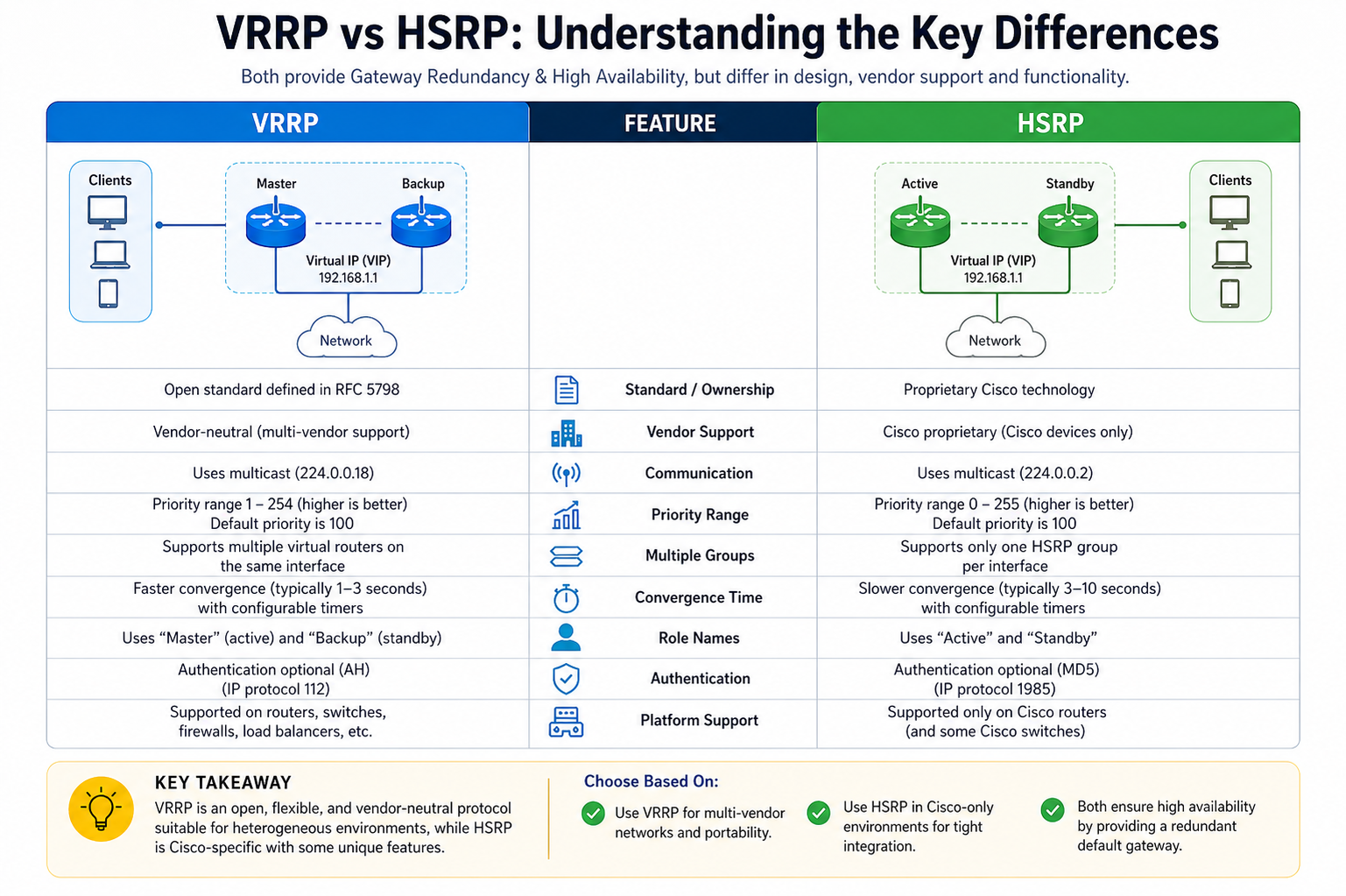
VRRP and HSRP are foundational technologies used in enterprise networks to ensure uninterrupted gateway availability. While the basic idea behind both is simple—providing a backup router when the primary fails—the internal behavior, configuration philosophy, and operational design reveal important distinctions that network engineers must understand in depth. These differences become especially significant in large-scale environments where uptime, convergence speed, and interoperability are critical.
Architectural Design Philosophy
The architectural approach of VRRP and HSRP reflects their design goals. VRRP was created as an open standard with the intention of ensuring compatibility across different networking equipment vendors. Its design is intentionally simple and flexible, allowing multiple devices to participate in a virtual router group without strict dependency on proprietary implementation details.
HSRP, in contrast, was designed with a more controlled ecosystem in mind. It focuses on providing highly stable redundancy within a single vendor environment, optimizing for predictable behavior and tight integration with other proprietary networking features. This difference in philosophy influences how each protocol behaves under stress conditions and how easily it can be integrated into mixed hardware environments.
Role Election Process
In VRRP, routers in a group compete based on priority values to determine which device becomes the master router. The router with the highest priority is elected as the master, and all other routers remain in backup mode. If multiple routers have the same priority, the highest IP address is used as a tie-breaker. This ensures a deterministic selection process.
HSRP uses a similar election method but introduces more structured role definitions. One router becomes the active router, while another becomes the standby router. Additional routers, if present, remain in a listening state. The election process in HSRP is influenced not only by priority values but also by interface tracking and configured preemption behavior, making its role selection slightly more feature-rich.
Failover Behavior and Convergence
Failover performance is one of the most critical aspects of both protocols. VRRP typically offers faster convergence due to its lightweight design. When the master router fails, backup routers quickly detect the absence of advertisement messages and initiate a new election process. The transition is designed to minimize downtime and restore connectivity within seconds.
HSRP also provides rapid failover, but its behavior is influenced by configurable timers such as hello and hold intervals. These timers define how quickly a standby router detects failure of the active router. While this allows for tuning based on network requirements, it can also introduce slightly longer convergence times if not optimized properly. However, in stable environments, HSRP’s failover is highly reliable and predictable.
Communication Mechanisms
VRRP and HSRP both rely on periodic advertisement messages to maintain group awareness. VRRP uses IP multicast communication to send advertisements from the master router to backup routers. These messages confirm that the master is still active and functioning correctly.
HSRP also uses multicast-based communication but with a different structure for message exchange. The active router periodically sends hello packets to inform standby routers of its operational status. If these messages stop, standby routers assume a failure has occurred and initiate failover procedures. Although the underlying concept is similar, the packet structure and timing details differ between the two protocols.
Priority and Preemption Handling
Priority settings play a central role in both VRRP and HSRP. In VRRP, priority values determine which router should act as the master. A router with a higher priority will take over if preemption is enabled and it becomes available again after a failure or recovery event.
HSRP also uses priority-based selection but offers more granular control over preemption behavior. In many implementations, preemption is disabled by default, meaning a newly available higher-priority router will not automatically reclaim the active role unless explicitly configured to do so. This helps maintain stability in networks where frequent role switching could cause unnecessary disruptions.
Interface and Route Tracking
One of the more advanced features in HSRP is interface tracking. This allows the protocol to monitor the status of specific interfaces or routes and dynamically adjust priority values based on network conditions. If a critical uplink fails, the priority of the active router can be reduced, triggering a switchover to the standby router even if the primary device itself is still operational.
VRRP supports similar functionality but in a more limited form depending on implementation. Some versions allow tracking of interface states to adjust priority dynamically, but the feature set is generally less extensive compared to HSRP’s tracking capabilities. This makes HSRP more suitable in environments requiring fine-grained control over failover decisions.
Load Sharing Capabilities
Although both VRRP and HSRP are primarily designed for redundancy rather than load balancing, they can be configured in ways that allow limited traffic distribution. VRRP supports multiple virtual router groups, enabling different routers to act as master for different groups. This allows traffic to be shared across multiple devices while still maintaining redundancy.
HSRP can achieve similar results using multiple groups as well. By assigning different routers as active for different VLANs or segments, network administrators can distribute traffic loads effectively. However, this requires careful planning to ensure consistency and avoid routing inefficiencies.
Compatibility and Interoperability
One of the most important practical differences between VRRP and HSRP is interoperability. VRRP’s open-standard nature allows it to work across devices from different manufacturers. This makes it a preferred choice in heterogeneous network environments where hardware diversity is common.
HSRP is typically restricted to specific vendor ecosystems, meaning it cannot be used in mixed environments without compatibility limitations. However, within its intended ecosystem, it often provides deeper integration with routing and switching features, which can enhance overall network performance and manageability.
Security Considerations
Both protocols include mechanisms to prevent unauthorized devices from participating in the redundancy group. VRRP supports authentication methods that allow routers to verify the identity of peers before accepting their advertisements. This helps prevent malicious or misconfigured devices from disrupting network stability.
HSRP also supports authentication, often with more configurable options depending on implementation. However, both protocols have evolved over time, and modern network designs typically rely on additional security layers such as network segmentation and access control to protect redundancy protocols from interference.
Timer Adjustments and Network Stability
Timers play a crucial role in balancing failover speed and network stability. VRRP uses advertisement intervals to control how frequently the master router sends status updates. Shorter intervals result in faster failover but may increase network overhead.
HSRP uses hello and hold timers to achieve similar control. The hello timer defines how often messages are sent, while the hold timer determines how long a standby router waits before assuming failure. Fine-tuning these values is essential in environments where both speed and stability are important.
Scalability in Large Networks
In large-scale deployments, both VRRP and HSRP can scale effectively, but their behavior differs slightly. VRRP’s simplicity allows it to scale easily across multiple devices and network segments without introducing significant complexity. However, managing large numbers of VRRP groups may require careful planning.
HSRP, with its more feature-rich design, provides better control in complex enterprise environments. Features like interface tracking, priority adjustments, and detailed state control make it more suitable for networks with strict performance requirements and hierarchical designs.
Operational Monitoring and Troubleshooting
Monitoring VRRP typically involves checking master and backup status, priority values, and advertisement timers. Since the protocol is simpler, troubleshooting is generally straightforward, focusing on connectivity and timer mismatches.
HSRP offers more detailed operational states such as initial, learn, listen, speak, standby, and active. These states provide deeper insight into the protocol’s behavior but also require more advanced understanding during troubleshooting. This additional complexity can be beneficial in diagnosing subtle network issues but may increase operational overhead.
Real-World Deployment Scenarios
In real-world deployments, VRRP is often chosen for multi-vendor environments, service provider networks, and cloud-integrated infrastructures. Its simplicity and compatibility make it ideal for environments where flexibility is a priority.
HSRP is commonly deployed in enterprise campuses, data centers, and organizations standardized on a single vendor ecosystem. Its advanced feature set and predictable behavior make it suitable for environments where tight control and integration are required.
Final Perspective on VRRP and HSRP
Both VRRP and HSRP are essential technologies in modern networking, serving the same fundamental purpose but through different design philosophies. VRRP emphasizes openness, simplicity, and interoperability, while HSRP focuses on feature richness, stability, and ecosystem integration. Understanding their differences allows network engineers to choose the right protocol based on operational requirements, infrastructure design, and long-term scalability needs.
Advanced Behavior of VRRP and HSRP in Network Environments
Building on the foundational differences between VRRP and HSRP, it becomes important to understand how these protocols behave in more advanced networking scenarios. In real enterprise deployments, redundancy is not just about failover—it also involves optimization, stability under load, and predictable convergence under complex failure conditions. Both protocols handle these aspects differently based on their design philosophy.
State Transition Mechanisms
VRRP operates with a relatively simple state model. A router can be in one of three primary states: master, backup, or initialize. The simplicity of these states allows for fast decision-making during failover events. When a master router fails, backup routers immediately begin evaluating their priority values to determine the new master. This minimal state complexity helps reduce processing overhead and improves convergence speed.
HSRP, however, uses a more detailed set of states that include initial, learn, listen, speak, standby, and active. Each state represents a specific stage in the protocol’s decision-making and operational process. While this adds complexity, it also provides better visibility into the protocol’s behavior. Network administrators can precisely identify where a device is in the failover process, which can be extremely useful during troubleshooting or performance analysis.
Timer Sensitivity and Network Responsiveness
The responsiveness of both protocols heavily depends on timer configuration. VRRP uses advertisement intervals that define how frequently the master router sends updates to backup routers. A shorter interval allows faster detection of failure but increases network chatter. A longer interval reduces overhead but can delay failover response.
HSRP uses hello and hold timers, which offer more granular control. The hello timer defines how often hello packets are sent, while the hold timer determines how long a standby router waits before declaring the active router unavailable. This separation allows administrators to fine-tune responsiveness based on network stability requirements. In environments where uptime is critical, these timers are often carefully adjusted to balance speed and reliability.
Network Load Behavior During Failover
During failover events, both VRRP and HSRP must quickly redirect traffic to the new active gateway. VRRP typically handles this transition with minimal delay due to its lightweight structure. When the master router fails, backup routers already have most of the required information and can immediately assume control.
HSRP also performs efficiently during failover, but its behavior is slightly more controlled. The standby router transitions to active mode only after confirming failure through missed hello packets and timer expiration. This structured process reduces the risk of false positives but may introduce a slight delay compared to VRRP in certain scenarios.
Impact of Network Topology
The effectiveness of VRRP and HSRP can vary depending on network topology. In simple flat networks, both protocols perform similarly and provide reliable redundancy. However, in hierarchical or segmented networks, differences become more apparent.
VRRP’s simplicity makes it easy to deploy across multiple network layers without extensive configuration adjustments. It is particularly effective in environments where devices from different vendors must coexist without complex integration requirements.
HSRP, on the other hand, is better suited for structured enterprise topologies where routing policies, interface tracking, and controlled failover behavior are important. Its advanced features allow it to adapt more effectively to changes in network conditions across multiple layers.
Scalability Considerations in Large Deployments
As networks grow in size, redundancy protocols must handle increasing complexity without introducing instability. VRRP scales efficiently due to its minimal configuration requirements and lightweight operation. However, managing multiple VRRP groups across large infrastructures can become administratively challenging if not properly organized.
HSRP scales well in large environments but requires more careful planning. Its additional features, such as priority tuning and interface tracking, allow for more precise control but also increase configuration complexity. In large enterprise networks, this trade-off is often acceptable because of the improved control and predictability HSRP offers.
Redundancy in Multi-VLAN Environments
Both VRRP and HSRP are commonly used in environments with multiple VLANs, where redundancy is required for each network segment. VRRP handles this by allowing multiple virtual router instances to operate independently. Each VLAN can have its own VRRP group, enabling flexible distribution of gateway responsibilities.
HSRP also supports multiple groups per interface, allowing similar segmentation. However, its integration with VLANs is often more tightly controlled, enabling better coordination between routing policies and redundancy behavior. This makes it particularly effective in enterprise campus networks where VLAN segmentation is heavily used.
Failure Detection Accuracy
Failure detection is a critical component of both protocols. VRRP relies primarily on missed advertisement packets to detect failures. If the master router stops sending advertisements within a defined interval, backup routers assume it has failed and begin the election process.
HSRP uses a combination of hello packets and hold timers to improve detection accuracy. This dual-timer system helps reduce the chance of false failovers caused by temporary network congestion. As a result, HSRP is often considered slightly more conservative in failure detection, prioritizing stability over speed in uncertain conditions.
Behavior During Network Instability
In unstable network environments, such as those experiencing packet loss or intermittent connectivity issues, the differences between VRRP and HSRP become more noticeable. VRRP’s faster reaction time can sometimes lead to more frequent role changes if the network conditions are unstable.
HSRP’s more controlled approach helps reduce unnecessary failovers by requiring consistent missed hello packets before initiating a state change. This makes it more resilient in environments where temporary disruptions are common, such as wireless backhaul networks or congested WAN links.
Administrative Control and Configuration Flexibility
VRRP offers straightforward configuration options, making it easy to deploy and manage. However, its simplicity can also limit advanced control in complex scenarios. Most configurations revolve around priority settings, virtual IP assignment, and basic tracking options.
HSRP provides a richer set of configuration controls. Administrators can fine-tune priority behavior, enable or disable preemption, configure interface tracking, and adjust timers with greater precision. This level of flexibility allows for highly customized redundancy strategies tailored to specific business requirements.
Interoperability in Mixed Environments
One of VRRP’s strongest advantages is its interoperability. Since it is based on an open standard, it can operate seamlessly across different hardware platforms. This makes it ideal for organizations that use a combination of networking vendors or are transitioning between infrastructures.
HSRP does not offer the same level of interoperability because it is tied to a specific ecosystem. While this limits its use in mixed environments, it enhances consistency and feature integration within supported platforms. Organizations that prioritize standardized hardware often find this trade-off acceptable.
Protocol Efficiency and Resource Usage
From a resource utilization perspective, VRRP is generally more lightweight. It consumes fewer system resources due to its simpler state model and reduced processing requirements. This can be beneficial in environments with limited hardware capacity or where efficiency is a priority.
HSRP, while slightly more resource-intensive, provides additional capabilities that justify the overhead in enterprise environments. Its richer feature set and enhanced control mechanisms require more processing but deliver greater operational flexibility.
Behavior in High-Availability Architectures
In high-availability architectures, both protocols are often combined with other redundancy mechanisms such as link aggregation, dynamic routing protocols, and load balancers. VRRP integrates smoothly into such architectures due to its simplicity and predictable behavior.
HSRP integrates deeply with enterprise-grade high-availability designs, offering enhanced coordination with routing policies and interface monitoring. This makes it particularly effective in mission-critical environments where downtime must be minimized at all costs.
Long-Term Operational Stability
Over extended periods, stability becomes a key measure of redundancy protocol effectiveness. VRRP maintains stability through its minimal design, reducing the number of variables that can affect behavior. However, its simplicity may require additional external mechanisms for advanced optimization.
HSRP provides long-term stability through controlled failover behavior and extensive monitoring capabilities. While it requires more configuration effort, it offers predictable performance in complex and evolving network environments.
Overall Comparative Insight
When examining VRRP and HSRP in advanced scenarios, the core distinction remains consistent: VRRP prioritizes simplicity and openness, while HSRP emphasizes control and feature depth. Both achieve the same fundamental goal of gateway redundancy but approach it from different engineering philosophies. The choice between them ultimately depends on network complexity, vendor ecosystem, and operational requirements.
Operational Tuning and Performance Optimization of VRRP and HSRP
As network infrastructures evolve, redundancy protocols like VRRP and HSRP are often fine-tuned beyond their default configurations to achieve optimal performance. This tuning process involves adjusting timers, priorities, tracking mechanisms, and convergence behavior to align with business requirements. Understanding how each protocol responds to optimization efforts is essential for building highly resilient networks.
Fine-Tuning Timer Values for Stability and Speed
One of the most impactful optimization techniques involves adjusting timer values. In VRRP, the advertisement interval plays a central role in determining how quickly backup routers detect failure. Reducing this interval improves failover speed but increases control traffic on the network. Increasing it reduces overhead but may delay failover response during outages.
HSRP provides more granular timer control through separate hello and hold timers. The hello timer determines how often active routers send status updates, while the hold timer defines how long standby routers wait before assuming failure. By carefully balancing these two values, administrators can achieve a tailored trade-off between responsiveness and stability. In highly sensitive environments, such as financial trading systems, timers are often tuned aggressively for near-instant failover.
Priority Manipulation for Dynamic Role Control
Both VRRP and HSRP rely heavily on priority values to determine active roles. However, advanced configurations often involve dynamic priority adjustments based on network conditions.
In VRRP, priority values can be manually configured or adjusted through interface tracking. This allows a router’s priority to decrease if a critical link fails, ensuring that a more stable router becomes the master. This mechanism is especially useful in multi-uplink environments where not all paths are equally reliable.
HSRP extends this concept further by allowing more detailed priority tracking. Administrators can tie priority values to multiple interface states, ensuring that a router only remains active if all critical paths are operational. This dynamic adjustment helps maintain optimal routing paths and avoids suboptimal gateway selection during partial failures.
Role of Preemption in Network Stability
Preemption behavior significantly impacts how quickly a network returns to its preferred state after recovery. In VRRP, preemption is often enabled by default, meaning a higher-priority router will automatically reclaim the master role when it becomes available again. While this ensures optimal routing, it can sometimes lead to temporary instability if devices frequently recover and rejoin the network.
HSRP treats preemption more cautiously. It is commonly disabled by default, requiring manual activation. This design choice prioritizes stability over strict role hierarchy enforcement. In environments where constant switching could disrupt traffic flows, disabling preemption helps maintain consistency even when higher-priority devices return online.
Convergence Optimization Techniques
Convergence speed is a critical performance metric in redundancy protocols. VRRP typically achieves faster convergence due to its minimal state transitions and lightweight communication model. However, convergence can still be improved by optimizing timer settings and ensuring stable Layer 2 connectivity between participating routers.
HSRP convergence can be optimized through careful tuning of hello and hold timers, along with interface tracking adjustments. Additionally, ensuring that routing protocols and redundancy mechanisms are aligned prevents delays caused by inconsistent route updates. In well-optimized networks, HSRP can achieve convergence speeds comparable to VRRP while maintaining greater control over failover conditions.
Impact of Layer 2 and Layer 3 Dependencies
Both VRRP and HSRP rely on underlying network layers to function correctly. At Layer 2, proper switch configuration is essential to ensure that multicast traffic is delivered efficiently between routers. Any instability at this layer can directly affect redundancy performance.
At Layer 3, routing table stability plays a crucial role. VRRP, due to its simplicity, is less dependent on complex routing interactions. HSRP, however, often operates in environments where routing policies, dynamic protocols, and redistribution mechanisms interact closely with redundancy behavior. This makes proper coordination between routing and redundancy essential for optimal performance.
Load Distribution Strategies Using Redundancy Groups
Although neither VRRP nor HSRP is primarily designed for load balancing, both can be used creatively to distribute traffic across multiple routers. This is achieved by configuring multiple virtual router groups and assigning different routers as active or master for each group.
In VRRP, this approach is straightforward and highly flexible. Different routers can serve as masters for different VLANs or subnets, allowing traffic distribution across multiple devices. This improves resource utilization while maintaining redundancy.
HSRP also supports multi-group configurations, but its structured design allows for more controlled load distribution. Administrators can align active and standby roles with specific traffic patterns, ensuring predictable behavior under varying load conditions. This is particularly useful in enterprise environments where traffic segmentation is well defined.
Impact of Network Congestion on Protocol Performance
Network congestion can significantly influence redundancy protocol behavior. VRRP, due to its frequent advertisement mechanism, may be more sensitive to packet loss during congestion. Missed advertisements can sometimes trigger unnecessary failover events if not properly tuned.
HSRP mitigates this issue through its dual-timer system, which provides a buffer against temporary congestion. The hold timer ensures that brief packet losses do not immediately result in failover, improving stability in congested environments. This makes HSRP slightly more resilient in networks with variable traffic loads.
Behavior in Multi-Path and Redundant Topologies
In networks with multiple redundant paths, VRRP and HSRP must ensure consistent gateway selection across all segments. VRRP handles this by maintaining independent group states, which allows each segment to operate autonomously. This reduces interdependence but requires careful configuration to avoid routing inconsistencies.
HSRP integrates more closely with structured topologies, often aligning redundancy groups with routing hierarchies. This allows for more predictable behavior in complex environments such as multi-layer campus networks or data center fabrics. Its ability to coordinate with routing policies makes it highly effective in structured redundancy designs.
Troubleshooting Performance Bottlenecks
When performance issues arise in VRRP or HSRP deployments, troubleshooting typically focuses on a few key areas. In VRRP, administrators often check advertisement intervals, multicast delivery, and priority mismatches. Since the protocol is simple, most issues are related to connectivity or configuration errors.
HSRP troubleshooting is more detailed due to its multiple states and timers. Administrators may need to examine interface tracking configurations, hello/hold timer mismatches, and state transitions. While this adds complexity, it also provides deeper insight into the root cause of issues, making long-term maintenance more precise.
Scalability Under High-Density Environments
In high-density environments such as large campuses or data centers, scalability becomes a key concern. VRRP scales effectively due to its lightweight nature, but managing a large number of groups requires careful organization to avoid configuration sprawl.
HSRP scales well in structured environments but requires more planning. Its additional features provide better control over large deployments, but also increase configuration complexity. In practice, organizations often choose HSRP when predictability and control are more important than simplicity.
Reliability Under Hardware Failures
Both protocols are designed to handle hardware failures gracefully, but their behavior differs slightly. VRRP responds quickly to master failures by triggering a new election among backups. This ensures minimal downtime but may result in brief instability if multiple devices compete for master status.
HSRP handles hardware failures more conservatively. The standby router takes over only after confirming failure through missed hello messages, reducing the risk of false failovers. This conservative approach enhances stability in environments where hardware reliability is variable.
Long-Term Network Maintenance Considerations
From a maintenance perspective, VRRP requires less ongoing configuration management due to its simplicity. However, scaling and optimization may require additional external tools or monitoring systems.
HSRP demands more active management but provides richer diagnostic information and control options. Over time, this allows network administrators to fine-tune performance and maintain consistent redundancy behavior even as network conditions evolve.
Strategic Selection Between VRRP and HSRP
Ultimately, selecting between VRRP and HSRP is a strategic decision influenced by network design goals. VRRP is ideal for environments that prioritize openness, simplicity, and interoperability. HSRP is better suited for environments that require advanced control, tight integration, and predictable behavior in complex infrastructures.
Both protocols remain essential tools in modern networking, and understanding their operational nuances allows engineers to design resilient, high-performance networks capable of handling diverse failure scenarios and evolving traffic demands.
Advanced Deployment Scenarios and Real-World Usage of VRRP and HSRP
In real enterprise and service provider networks, VRRP and HSRP are rarely used in isolation. They are typically part of larger high-availability designs that include dynamic routing protocols, load balancing systems, and multi-layer redundancy strategies. Understanding how these protocols behave in complex deployments helps in designing networks that remain stable under heavy load and unexpected failures.
Integration with Dynamic Routing Protocols
Both VRRP and HSRP often operate alongside dynamic routing protocols such as OSPF or EIGRP. These routing protocols handle path selection across the wider network, while VRRP and HSRP manage local gateway redundancy.
In VRRP deployments, routing protocols are generally unaffected by redundancy transitions because the virtual IP remains consistent regardless of which router is active. However, rapid changes in master selection can cause temporary routing recalculations if not properly stabilized.
HSRP integrates more closely with routing behavior through features like interface tracking. When a tracked interface fails, HSRP can reduce priority, indirectly influencing routing decisions. This tighter coupling allows for more intelligent failover decisions, ensuring traffic is routed through the most optimal path available at any given time.
Data Center Deployment Patterns
In modern data centers, redundancy is critical due to the high volume of traffic and strict uptime requirements. VRRP is often used in multi-vendor environments where flexibility is essential. Its simplicity allows it to scale across leaf-spine architectures without introducing excessive configuration complexity.
HSRP is commonly used in traditional enterprise data center designs where infrastructure is standardized. Its advanced tracking and priority mechanisms make it well-suited for environments where precise control over gateway selection is required. In such environments, HSRP helps ensure deterministic behavior even during partial failures.
Campus Network Redundancy Design
In campus networks, both protocols are widely used to provide gateway redundancy at the distribution layer. VRRP is often preferred in designs where multiple vendors are present or where simplicity is prioritized for ease of maintenance.
HSRP is frequently used in structured campus architectures where access, distribution, and core layers are clearly defined. Its ability to integrate with VLAN segmentation and routing policies makes it highly effective in managing traffic flows across large organizational networks.
Service Provider Edge Scenarios
In service provider environments, VRRP is often favored due to its open-standard nature and interoperability across different hardware platforms. Providers that operate diverse infrastructure benefit from VRRP’s ability to function consistently regardless of vendor differences.
HSRP is less commonly used in multi-vendor service provider environments but may appear in controlled edge deployments where infrastructure standardization is enforced. Its predictable behavior and strong integration with routing policies make it suitable for tightly managed edge networks.
High Availability Pairing with Firewall and Load Balancers
Both VRRP and HSRP are frequently paired with firewalls and load balancers to ensure uninterrupted traffic flow. In such scenarios, redundancy protocols manage gateway availability while firewalls and load balancers handle traffic inspection and distribution.
VRRP integrates smoothly in these environments due to its simplicity, allowing firewalls or load balancers to quickly adapt to gateway changes. HSRP, with its structured failover behavior, ensures that stateful devices can maintain session consistency during transitions, reducing disruption in security-sensitive environments.
Impact of Asymmetric Routing
Asymmetric routing can introduce challenges in redundancy environments. VRRP, due to its flexible nature, can sometimes lead to inconsistent return paths if not carefully configured in multi-router setups. This can result in inefficient routing or temporary packet loss.
HSRP handles asymmetric routing more predictably due to its tighter control over active and standby roles. By ensuring that only one router actively handles traffic per group, it reduces the likelihood of routing inconsistencies. However, improper configuration can still lead to suboptimal path selection.
Behavior During Partial Network Failures
Partial failures, such as link degradation or interface-specific issues, are critical scenarios where redundancy protocols are tested. VRRP responds quickly to changes in master availability but may not always distinguish between full and partial failures unless enhanced tracking is configured.
HSRP performs better in partial failure scenarios due to its interface tracking capabilities. When a specific link fails, HSRP can adjust priority without requiring a full router failure. This allows traffic to be rerouted even when the device itself remains operational but suboptimal.
Multi-Region and Distributed Network Environments
In geographically distributed networks, VRRP is often preferred due to its simplicity and ease of deployment across different regions. Its minimal configuration requirements make it suitable for WAN environments where consistency is more important than granular control.
HSRP is more commonly used in centralized enterprise environments where regional networks are tightly managed. Its ability to enforce structured redundancy policies ensures consistent behavior across distributed sites, especially when combined with centralized network management systems.
Failure Isolation and Containment Strategies
VRRP isolates failures at the group level, meaning that issues in one redundancy group do not necessarily affect others. This makes it highly effective in segmented networks where independent failover domains are required.
HSRP also supports failure isolation but tends to operate within more structured boundaries. Its design encourages centralized control of redundancy behavior, which can simplify management in large-scale environments but may reduce flexibility in highly segmented networks.
Operational Predictability in Long-Term Use
Over long periods of operation, predictability becomes a key advantage of redundancy protocols. VRRP maintains consistent behavior due to its minimal state complexity, making it easier to predict failover patterns even in changing network conditions.
HSRP provides even greater predictability in controlled environments due to its structured state transitions and configurable behavior. While it requires more careful planning, it delivers highly consistent performance once properly configured.
Security and Attack Surface Considerations
Both protocols must be protected from unauthorized access or spoofing attempts. VRRP relies on authentication mechanisms to prevent rogue devices from joining redundancy groups. However, its simplicity means that additional network security measures are often required to ensure full protection.
HSRP includes similar authentication capabilities but benefits from tighter integration with enterprise security policies. In environments where network access control is strictly enforced, HSRP can be more easily integrated into broader security frameworks.
Operational Complexity vs Flexibility Trade-Off
A key distinction between VRRP and HSRP lies in the balance between operational complexity and flexibility. VRRP offers high flexibility with minimal configuration overhead, making it easy to deploy and maintain.
HSRP introduces higher operational complexity but compensates with advanced control features. This makes it more suitable for environments where fine-tuned redundancy behavior is necessary, even at the cost of increased administrative effort.
Evolving Role in Modern Network Architectures
As modern networks evolve toward automation and intent-based networking, both VRRP and HSRP continue to play important roles. VRRP remains relevant in cloud-native and multi-vendor environments where simplicity and compatibility are essential.
HSRP continues to be widely used in enterprise environments that rely on structured infrastructure and advanced network policies. Its deep integration with routing and tracking systems ensures it remains a strong choice for traditional high-availability designs.
Final Comparative Perspective Across All Parts
Across all deployment scenarios, VRRP and HSRP consistently achieve the same core objective—maintaining uninterrupted gateway availability. VRRP excels in openness, simplicity, and interoperability, making it ideal for flexible and diverse environments. HSRP excels in structured control, advanced tracking, and predictable behavior, making it ideal for enterprise-grade infrastructure.
Together, they represent two complementary approaches to solving the same networking challenge, each optimized for different operational priorities and architectural philosophies.
Conclusion
VRRP and HSRP both serve the same essential purpose of providing gateway redundancy and ensuring continuous network availability, but they approach this goal with different design philosophies and operational models. VRRP stands out for its open-standard nature, simplicity, and interoperability across multi-vendor environments, making it a flexible choice for diverse and evolving network infrastructures. Its lightweight structure allows for fast failover and easy deployment, especially in environments where minimizing complexity is a priority.
HSRP, on the other hand, is designed with deeper integration, enhanced control, and advanced configuration capabilities. It offers more detailed state management, stronger tracking mechanisms, and greater control over failover behavior, which makes it particularly effective in structured enterprise networks where stability and predictability are critical.
Ultimately, the choice between VRRP and HSRP depends on the specific requirements of the network environment. If openness, compatibility, and simplicity are the main goals, VRRP is often the preferred option. If advanced control, fine-tuned failover behavior, and ecosystem integration are more important, HSRP becomes the stronger candidate. Both protocols remain fundamental tools in modern networking, ensuring high availability and resilience in different architectural contexts.