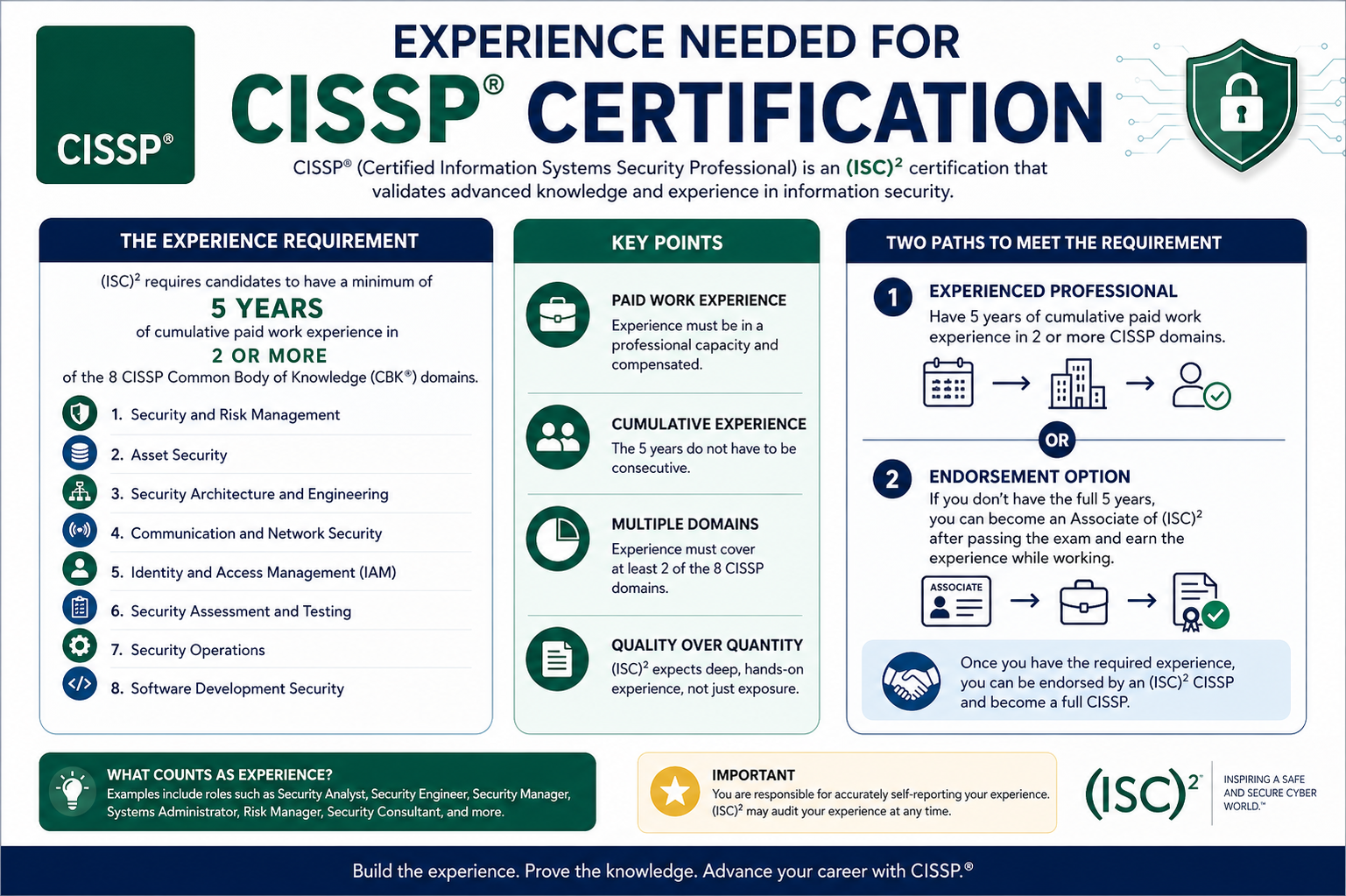
The CISSP certification places a strong emphasis on professional experience because it is designed for individuals who are already working in the field of information security. Unlike entry-level certifications that focus primarily on theoretical knowledge, CISSP evaluates whether a candidate has developed the ability to apply security principles in real operational environments. The experience requirement is therefore a core element of the certification framework, ensuring that certified professionals are capable of handling complex security challenges in real-world scenarios.
This requirement is not simply a formality but a reflection of the advanced nature of the certification itself. Information security is a discipline that demands judgment, practical decision-making, and an understanding of how security controls behave under real conditions. The experience requirement ensures that candidates have been exposed to these realities before being recognized as certified professionals.
Core Philosophy Behind the Experience Requirement
The underlying philosophy of CISSP experience criteria is based on the idea that security knowledge alone is not sufficient. Organizations rely on professionals who can interpret risks, respond to incidents, and design secure systems in environments that are constantly changing. The certification body expects candidates to have encountered real operational challenges such as system vulnerabilities, policy enforcement issues, risk assessments, and security architecture decisions.
This philosophy emphasizes applied knowledge over theoretical study. While exam preparation builds a strong conceptual foundation, experience ensures that candidates understand how those concepts behave in practice. For example, understanding encryption in theory is different from implementing encryption policies in a live enterprise system with compliance requirements, user constraints, and performance considerations. The experience requirement bridges this gap.
Understanding the Security Domains in Practical Terms
The experience requirement is tied to recognized security domains that cover the broad landscape of cybersecurity practice. These domains include areas such as security and risk management, asset security, security architecture and engineering, communication and network security, identity and access management, security operations, and software development security.
Each domain represents a specific area of responsibility within an organization. Security and risk management involves developing policies and assessing organizational risks. Asset security focuses on protecting data and ensuring proper classification and handling. Security architecture and engineering deals with designing secure systems and infrastructures. Communication and network security involves protecting network environments and ensuring secure data transmission.
Identity and access management focuses on ensuring that only authorized individuals can access systems and resources. Security operations involve monitoring, detecting, and responding to security events. Software development security ensures that applications are designed and built with security in mind from the beginning. Experience in at least two of these domains is required to demonstrate sufficient breadth of knowledge.
Nature of Acceptable Professional Experience
Acceptable experience for CISSP certification must be directly related to information security functions. This means the work performed should involve responsibilities such as implementing security controls, managing risk, conducting security assessments, responding to incidents, or designing secure systems.
Roles that commonly contribute to qualifying experience include security analyst positions, security engineering roles, network security administration, IT auditing with security focus, and risk management positions. Even system administration or software development roles may qualify if security responsibilities are a significant part of the job function.
The key factor is not the job title itself but the actual tasks performed. A candidate working as a system administrator may qualify if their duties include firewall configuration, access control management, or vulnerability mitigation. Similarly, a developer may qualify if they are responsible for secure coding practices and application security testing.
Depth and Breadth of Experience Expectations
The experience requirement is designed to ensure both depth and breadth of knowledge. Depth refers to how extensively a candidate has worked within a specific domain, while breadth refers to exposure across multiple domains.
A candidate might have deep experience in network security, such as managing enterprise firewalls and intrusion detection systems, but they must also demonstrate experience in at least one additional domain. This ensures that certified professionals are not overly specialized in a narrow area but instead have a well-rounded understanding of security principles.
This balance is important because real-world security challenges often span multiple domains. For example, a security incident may involve network vulnerabilities, identity access issues, and operational response simultaneously. Professionals must be able to understand and coordinate across these areas.
Examples of Relevant Professional Roles
Many different professional roles can contribute to CISSP eligibility as long as security responsibilities are involved. A security analyst typically works with monitoring systems, analyzing threats, and responding to incidents. A security engineer focuses on designing and implementing security controls across systems and networks.
A risk management professional evaluates organizational risks and helps define mitigation strategies. A compliance or audit specialist may assess whether systems meet regulatory requirements and internal policies. A penetration tester evaluates system vulnerabilities by simulating attacks, which contributes to understanding security weaknesses.
Even professionals in cloud security roles, DevSecOps environments, or incident response teams may qualify if their work aligns with recognized domains. The certification values diverse experience as long as it is relevant and verifiable.
Evaluation of Professional Experience
The evaluation process for experience is structured and requires validation from an existing certified professional. This endorsement ensures that the candidate’s claimed experience is legitimate and aligns with the certification standards.
The evaluation focuses on verifying that the candidate has worked in qualifying roles and has performed security-related duties over the required period. The experience must be cumulative, meaning it can be gathered across multiple roles or organizations as long as it meets the minimum requirement.
The emphasis is on consistency and authenticity. Candidates are expected to provide clear descriptions of their responsibilities, showing how their work aligns with security domains. This prevents misrepresentation and maintains the integrity of the certification process.
Common Misunderstandings About Experience Requirements
One common misunderstanding is that only job titles with “security” in them qualify. In reality, many roles without the word security in the title still involve significant security responsibilities. For example, a network administrator may handle firewall rules, VPN configurations, and intrusion prevention systems, all of which are relevant.
Another misconception is that experience must come from a single continuous job. In fact, experience can be accumulated across multiple positions, provided it is relevant and meets the domain requirements. Some candidates also mistakenly believe that academic knowledge alone is sufficient, but formal education can only partially substitute for experience and cannot fully replace it.
It is also often assumed that experience must be recent and continuous. While continuity is helpful, the key requirement is relevance and cumulative duration rather than strict uninterrupted employment.
Educational Substitution and Its Role
Formal education can play a supporting role in meeting the experience requirement. Candidates who hold a four-year degree in a related field may be eligible for a reduction in the required experience. This acknowledges that structured academic programs provide foundational knowledge that can complement practical experience.
However, this substitution does not eliminate the need for real-world exposure. Even with educational credit, candidates must still demonstrate significant professional experience across multiple security domains. The substitution is intended to recognize academic preparation while maintaining the certification’s practical focus.
This balance ensures that candidates are not only theoretically prepared but also practically capable of performing security responsibilities in real environments.
Associate Pathway for Early Candidates
For individuals who are highly motivated but do not yet meet the full experience requirement, there is an alternative pathway. Candidates may choose to take the certification exam first and, upon passing, become an Associate while they complete the required experience.
This approach allows individuals to validate their knowledge early while continuing to gain practical exposure. Once the required experience is achieved within the allowed timeframe, the full certification can be granted. This pathway is particularly useful for early-career professionals aiming to accelerate their progression in the cybersecurity field.
The associate status still reflects a strong level of knowledge, even though full professional experience is still in development.
Documentation and Verification of Experience
Proper documentation is a critical part of the experience validation process. Candidates must clearly describe their roles, responsibilities, and the security domains they have worked in. This documentation should demonstrate how their work aligns with recognized security functions.
Verification by an endorsed professional ensures that the experience is credible and meets established standards. This step reinforces the trustworthiness of the certification and ensures that all certified professionals meet consistent criteria.
Clear documentation also helps avoid delays in the evaluation process. Candidates who maintain detailed records of their responsibilities throughout their career are better positioned to demonstrate eligibility when applying for certification.
Transition Toward Advanced Professional Competence
The experience requirement is ultimately designed to prepare individuals for the level of responsibility expected from certified professionals. Information security roles often involve high-stakes decision-making where errors can lead to significant organizational impact. The requirement ensures that candidates have already been exposed to such environments before earning certification.
By combining structured knowledge with practical experience, the certification aims to produce professionals who can operate confidently in complex and evolving security landscapes. This foundation supports long-term career growth and prepares individuals for leadership roles in cybersecurity.
Continuity and Progression of Professional Experience
The experience requirement for CISSP certification is not only about meeting a fixed number of years but also about demonstrating continuous professional growth in the field of information security. Employers and certification evaluators look for a clear progression in responsibilities, where a candidate moves from foundational tasks toward more advanced and strategic security roles over time. This progression shows that the individual is not simply performing repetitive duties but is actively expanding their understanding of security principles and applying them in increasingly complex environments.
In practical terms, this may involve starting with basic system monitoring or user access management and gradually moving toward responsibilities such as security architecture design, risk analysis, or incident response leadership. This growth reflects the development of judgment and decision-making skills, which are essential for CISSP-level professionals.
Integration of Technical and Managerial Exposure
Another important aspect of qualifying experience is the balance between technical and managerial exposure. Information security is a field that requires both hands-on technical ability and the capacity to understand organizational risk at a strategic level. The CISSP framework recognizes that professionals must be capable of bridging the gap between technical teams and business leadership.
Technical experience may include configuring security systems, analyzing logs, implementing encryption, or conducting vulnerability assessments. Managerial or strategic experience may involve developing security policies, conducting risk assessments, ensuring compliance with regulatory requirements, or coordinating incident response efforts across departments.
Candidates are expected to demonstrate familiarity with both aspects, even if their role is primarily technical or primarily managerial. This dual exposure ensures that certified professionals can operate effectively in multidisciplinary environments.
Relevance of Industry Context in Experience Evaluation
The context in which experience is gained also plays a significant role in evaluation. Different industries have different security requirements, threat landscapes, and regulatory environments. For example, experience gained in financial services may involve strict compliance standards and high levels of data protection, while experience in technology startups may focus more on rapid deployment and cloud security.
Healthcare environments introduce additional concerns such as patient data protection and regulatory compliance, while government organizations often deal with national security considerations and classified information handling. Each of these contexts contributes valuable insights into how security principles are applied in different operational settings.
The CISSP experience requirement does not restrict candidates to a specific industry, but it values exposure to environments where security is a critical function. This diversity of experience strengthens a candidate’s ability to adapt to different organizational needs.
Importance of Hands-On Security Decision Making
A key element of qualifying experience is involvement in real decision-making processes related to security. This goes beyond simply following procedures or executing assigned tasks. Candidates must demonstrate that they have participated in decisions that affect security posture, risk levels, or system design.
For example, deciding how to implement multi-factor authentication across an organization, selecting encryption standards for sensitive data, or determining how to respond to a security breach are all examples of decision-making responsibilities. These experiences show that the candidate understands not only how systems work but also how security choices impact business operations.
Such decision-making experience is critical because CISSP-certified professionals are often expected to advise leadership teams and influence organizational security strategy.
Exposure to Incident Response and Security Operations
Experience in incident response and security operations is particularly valuable for CISSP eligibility. These areas involve dealing with real-time security events such as malware infections, unauthorized access attempts, data breaches, and system vulnerabilities.
Working in incident response requires the ability to quickly analyze situations, contain threats, and coordinate recovery efforts. Security operations involve continuous monitoring of systems, identifying anomalies, and ensuring that security controls are functioning effectively.
This type of experience develops critical skills such as situational awareness, problem-solving under pressure, and structured response planning. These skills are essential for professionals operating at an advanced level in cybersecurity.
Role of Risk Management Experience
Risk management is another central component of qualifying experience. It involves identifying potential threats to organizational assets, assessing their likelihood and impact, and implementing strategies to reduce or manage those risks.
Professionals involved in risk management must understand both technical vulnerabilities and business priorities. For example, they may need to decide whether to invest in new security technologies, accept certain risks due to operational constraints, or implement compensating controls to reduce exposure.
This type of experience is particularly important because CISSP emphasizes not just technical security but also strategic decision-making aligned with business objectives.
Security Architecture and Design Exposure
Experience in security architecture and system design is highly valued in the CISSP framework. This area involves designing systems that are secure by default, ensuring that security controls are integrated into infrastructure, applications, and networks from the beginning.
Professionals in this domain may work on designing secure network topologies, implementing segmentation strategies, selecting authentication mechanisms, or defining secure communication protocols. They may also evaluate existing systems and recommend improvements to strengthen security posture.
This experience demonstrates an understanding of how different security components interact within complex systems, which is essential for advanced-level professionals.
Identity and Access Management Experience
Identity and access management is a critical domain that focuses on controlling who can access systems and resources within an organization. Experience in this area includes managing user authentication systems, implementing role-based access controls, and ensuring proper authorization mechanisms.
Professionals working in this domain often deal with user provisioning, password policies, single sign-on systems, and privileged access management. They must also ensure that access controls align with organizational policies and compliance requirements.
This experience is important because access control is one of the fundamental pillars of information security, directly impacting data protection and system integrity.
Software and Application Security Experience
Experience in software development security is increasingly important in modern environments where applications are a primary target for cyber threats. This domain involves ensuring that applications are designed and developed with security in mind from the earliest stages.
Professionals in this area may perform secure code reviews, implement secure development lifecycle practices, or conduct application security testing. They may also work closely with development teams to identify and remediate vulnerabilities before deployment.
This type of experience helps candidates understand how security must be integrated into software systems rather than added as an afterthought.
Communication and Network Security Experience
Network security experience involves protecting data as it moves across networks and ensuring that communication systems are secure. This includes configuring firewalls, managing virtual private networks, monitoring network traffic, and detecting unauthorized access attempts.
Professionals in this domain must understand how data flows through networks and how attackers may attempt to exploit vulnerabilities. They must also be able to design secure communication channels that protect confidentiality and integrity.
This experience is essential because networks are often the primary entry point for cyber threats.
Value of Cross-Domain Experience Integration
One of the most important aspects of CISSP experience is the ability to integrate knowledge across multiple domains. Real-world security challenges rarely exist within a single domain. Instead, they involve interconnected issues that require a holistic understanding.
For example, a security incident may involve network vulnerabilities, compromised user credentials, and system misconfigurations simultaneously. A professional with cross-domain experience is better equipped to analyze such situations and develop effective responses.
This integration of knowledge demonstrates maturity in the field and is a key indicator of readiness for CISSP certification.
Development of Professional Judgment
As candidates accumulate experience, they develop professional judgment, which is one of the most critical competencies for CISSP-level roles. Professional judgment involves making informed decisions when complete information is not available and balancing security requirements with operational needs.
This skill is developed over time through exposure to real-world scenarios where perfect solutions do not exist. Professionals learn to evaluate trade-offs, prioritize risks, and choose appropriate controls based on context.
The experience requirement ensures that candidates have had sufficient exposure to such situations before being certified.
Ethical Responsibility in Security Practice
Information security professionals are expected to adhere to high ethical standards, and experience plays a role in developing this ethical awareness. Working in security-related roles often involves access to sensitive information, critical systems, and confidential data.
Through experience, professionals learn the importance of confidentiality, integrity, and responsible behavior. They also develop an understanding of legal and regulatory obligations related to data protection and privacy.
This ethical foundation is essential for maintaining trust in security professionals and is an implicit part of the CISSP experience expectation.
Preparation for Leadership Roles in Security
Ultimately, the experience requirement prepares candidates for leadership roles in cybersecurity. CISSP-certified professionals are often expected to guide security strategy, advise management, and oversee complex security programs.
The accumulation of diverse and meaningful experience ensures that candidates are not only technically competent but also capable of understanding organizational priorities and communicating effectively with stakeholders.
This leadership readiness is one of the defining characteristics of the certification and is directly supported by the structured experience requirement.
Advanced Depth of Security Exposure
As candidates progress in their professional journey toward CISSP eligibility, the depth of security exposure becomes increasingly important. Early-stage experience may involve executing defined procedures or supporting security operations, but advanced experience reflects a shift toward ownership of security outcomes. This includes taking responsibility for designing solutions, evaluating risks independently, and contributing to strategic security improvements within an organization.
At this level, professionals are expected to understand not only how security systems function but also why certain approaches are chosen over others. They begin to evaluate trade-offs between security strength, system performance, usability, and cost. This ability to analyze competing priorities is a defining characteristic of experienced security practitioners and is central to CISSP-level competency.
Exposure to Enterprise-Level Security Environments
Enterprise environments introduce complexity that significantly shapes the quality of professional experience. Large organizations typically operate with distributed systems, multiple security layers, and diverse user groups, all of which require coordinated security management. Working in such environments exposes candidates to challenges such as scaling security controls, managing large identity systems, and enforcing consistent policies across global infrastructures.
In enterprise settings, security decisions often have wide-reaching consequences. A single configuration change or policy update may affect thousands of users or critical business operations. This environment forces professionals to think at scale and develop a structured approach to security planning and implementation.
Such exposure is highly valuable because CISSP-certified professionals are expected to understand security at an organizational level rather than only at an individual system level.
Incident Handling in Complex Scenarios
Advanced experience in incident handling goes beyond basic response activities and involves managing complex, multi-layered security events. These incidents may include coordinated attacks, insider threats, or large-scale system compromises that affect multiple business units simultaneously.
Professionals involved in such scenarios must coordinate with technical teams, management, legal departments, and sometimes external stakeholders. They must also ensure accurate documentation, evidence preservation, and structured recovery processes. This level of involvement builds strong analytical and communication skills, both of which are essential for CISSP-level practitioners.
Over time, repeated exposure to incident handling strengthens the ability to remain composed under pressure and make rational decisions in high-stakes situations.
Strategic Security Planning Experience
Strategic planning experience is a critical component of advanced professional development. This involves contributing to long-term security roadmaps, defining organizational security objectives, and aligning security initiatives with business goals.
Professionals engaged in strategic planning must evaluate emerging threats, anticipate future risks, and recommend investments in security technologies or processes. They may also participate in budgeting discussions, policy development, and governance frameworks.
This type of experience reflects a shift from operational tasks to advisory and leadership responsibilities. It demonstrates that the professional understands security not just as a technical function but as a core business enabler.
Regulatory and Compliance Exposure
Modern organizations operate under various regulatory frameworks that govern how data and systems must be protected. Experience in compliance-related activities helps professionals understand the legal and regulatory dimensions of information security.
This may involve ensuring adherence to standards, conducting audits, preparing compliance reports, or implementing controls to meet regulatory requirements. Exposure to such responsibilities helps candidates understand how security practices align with external expectations and legal obligations.
This knowledge is particularly important in CISSP contexts because certified professionals are often required to interpret and apply regulatory requirements within technical environments.
Security Governance and Policy Development
Governance experience involves defining and enforcing security policies that guide organizational behavior. Professionals working in this area help establish rules for data protection, access control, incident response, and acceptable use of systems.
Policy development requires a deep understanding of both technical constraints and organizational culture. It also involves communication with stakeholders across different departments to ensure that policies are practical and enforceable.
Through governance experience, candidates learn how security frameworks are structured and how organizational accountability is maintained. This contributes significantly to their readiness for CISSP-level responsibilities.
Integration with Business Objectives
One of the most important aspects of advanced security experience is the ability to align security initiatives with business objectives. Security is not an isolated function; it directly supports business continuity, operational efficiency, and organizational reputation.
Experienced professionals understand that security decisions must consider business impact. For example, implementing strict access controls may enhance security but could also affect productivity if not properly balanced. Similarly, investing in advanced security technologies must be justified in terms of risk reduction and business value.
This alignment between security and business goals is a key expectation for CISSP-certified professionals.
Mentorship and Knowledge Sharing Experience
As professionals gain experience, they often take on informal or formal mentorship roles. This involves guiding junior team members, sharing best practices, and helping others understand complex security concepts.
Mentorship experience demonstrates leadership potential and reinforces the candidate’s own understanding of security principles. Teaching or explaining concepts to others often deepens one’s own knowledge and highlights areas that require further clarity.
In CISSP-level roles, the ability to communicate effectively and support team development is highly valued, making mentorship experience an important component of professional growth.
Exposure to Emerging Technologies
Modern cybersecurity environments evolve rapidly, and experienced professionals are often exposed to emerging technologies such as cloud computing, containerization, artificial intelligence-based security tools, and advanced threat detection systems.
Working with these technologies requires continuous learning and adaptation. Professionals must understand how traditional security principles apply in new environments and how risks change with technological advancement.
This exposure ensures that candidates remain current with industry developments and are capable of applying security principles in modern architectures.
Cloud Security Experience Considerations
Cloud environments introduce unique security challenges such as shared responsibility models, dynamic resource allocation, and distributed access control. Experience in cloud security involves managing identity systems, configuring secure cloud infrastructures, and ensuring data protection in virtualized environments.
Professionals working in this domain must understand how cloud services differ from traditional on-premises systems and how security responsibilities are divided between providers and customers.
This type of experience is increasingly relevant because many organizations are transitioning to cloud-based infrastructures, making cloud security knowledge a valuable component of CISSP eligibility.
Data Protection and Privacy Experience
Data protection is a central concern in modern cybersecurity practice. Experience in this area involves ensuring that sensitive information is properly classified, stored securely, and accessed only by authorized individuals.
Professionals may work on implementing encryption strategies, data loss prevention systems, and privacy controls. They may also help organizations comply with data protection regulations and ensure that personal information is handled responsibly.
This experience reinforces an understanding of how security directly impacts individuals and organizations, particularly in terms of trust and legal compliance.
Security Architecture Evolution Experience
As professionals advance, they often contribute to evolving security architectures rather than simply maintaining existing systems. This includes redesigning security frameworks, improving system resilience, and integrating new security technologies into existing environments.
This type of experience demonstrates innovation and forward-thinking, as professionals must anticipate future risks and design systems that can adapt to changing threat landscapes.
It also reflects a higher level of responsibility, as architectural decisions often have long-term consequences for organizational security posture.
Crisis Management and Business Continuity Experience
Crisis management experience involves responding to major security incidents that have the potential to disrupt business operations significantly. This includes coordinating recovery efforts, managing communication during incidents, and ensuring that business continuity plans are effectively implemented.
Professionals in this area must remain calm under pressure and make decisions that balance urgency with accuracy. They must also ensure that recovery processes are aligned with organizational priorities.
This experience is essential for CISSP-level professionals because it demonstrates the ability to handle high-impact situations effectively.
Evolution from Technical Contributor to Security Advisor
Over time, professionals transition from being technical contributors to becoming trusted security advisors. In this role, they provide guidance to leadership teams, influence security strategy, and help shape organizational direction.
This transition is supported by accumulated experience across multiple domains and exposure to diverse security challenges. It reflects a shift from task execution to strategic influence, which is a key expectation for CISSP-certified individuals.
The ability to advise rather than simply execute demonstrates maturity in the field and readiness for advanced professional responsibilities.
Final Maturity of CISSP-Level Experience
The final stage of experience development reflects full professional maturity in information security. At this level, individuals are capable of integrating technical knowledge, business understanding, regulatory awareness, and strategic thinking into cohesive decision-making.
They can evaluate complex risks, design secure systems, manage teams, and contribute to organizational security strategy. This maturity is the ultimate goal of the CISSP experience requirement and ensures that certified professionals are fully prepared for leadership roles in cybersecurity environments.
Global Perspective on Security Experience
At an advanced stage of professional development, exposure to global security environments becomes increasingly valuable. Organizations today often operate across multiple countries, which introduces variations in legal frameworks, cultural expectations, and threat landscapes. Experience in such environments helps professionals understand how security practices must adapt to different regional requirements while maintaining a consistent overall security posture.
Working with distributed teams or multinational infrastructures also develops the ability to manage coordination challenges. Security policies may need to be standardized globally while still allowing flexibility for local compliance needs. This balance requires strong analytical skills and a deep understanding of how security governance operates at scale.
Multi-Platform and Hybrid Environment Experience
Modern enterprise systems are rarely confined to a single platform. Instead, they often include a combination of on-premises infrastructure, cloud services, mobile environments, and third-party integrations. Experience across these hybrid environments is essential for building a complete understanding of how security controls interact across different systems.
Professionals working in such environments must manage identity consistency, data flow security, and policy enforcement across platforms that may have different security models. This requires adaptability and a strong conceptual understanding of security architecture rather than reliance on platform-specific knowledge alone.
This type of experience is particularly relevant for CISSP-level readiness because it reflects real-world complexity and integration challenges.
Exposure to Third-Party and Vendor Security Management
Organizations frequently rely on external vendors and service providers, which introduces additional security considerations. Experience in third-party risk management involves evaluating vendor security practices, reviewing contracts, and ensuring that external partners meet required security standards.
Professionals may be responsible for conducting security assessments of vendors, defining security requirements in agreements, and monitoring compliance over time. This exposure helps develop an understanding of supply chain risks and the importance of extending security controls beyond internal systems.
This area of experience is critical because modern security ecosystems are interconnected, and vulnerabilities can originate outside the organization’s direct control.
Security Auditing and Assessment Experience
Security auditing experience involves systematically evaluating systems, processes, and controls to determine whether they meet defined security standards. This may include internal audits, external assessments, or compliance reviews.
Professionals engaged in auditing must understand both technical configurations and policy requirements. They analyze logs, review system settings, and verify that controls are functioning as intended. They also identify gaps and recommend corrective actions.
This experience develops a detail-oriented mindset and strengthens the ability to evaluate systems objectively. It also reinforces an understanding of how security frameworks are implemented and measured in practice.
Exposure to Threat Intelligence and Analysis
Threat intelligence experience involves understanding emerging risks, attack patterns, and adversary behavior. Professionals working in this area analyze security data to identify potential threats and provide actionable insights to improve defense strategies.
This may include reviewing threat reports, analyzing malware behavior, or monitoring indicators of compromise. Over time, this experience helps professionals recognize patterns and anticipate potential attacks before they occur.
This predictive capability is highly valuable in advanced security roles because it shifts focus from reactive response to proactive defense.
Security Tooling and Technology Adaptation Experience
Experience with a wide range of security tools strengthens a professional’s ability to adapt to different environments. These tools may include monitoring systems, intrusion detection platforms, endpoint protection solutions, and vulnerability scanners.
However, CISSP-level experience is not about mastering a specific tool but about understanding how different tools contribute to an overall security strategy. Professionals learn how to evaluate tools, integrate them into existing systems, and interpret the data they produce.
This adaptability ensures that certified individuals can operate effectively regardless of the specific technologies used within an organization.
Experience in Policy Enforcement and Compliance Monitoring
Policy enforcement experience involves ensuring that security rules and standards are consistently applied across an organization. This includes monitoring user behavior, reviewing system configurations, and identifying violations of established policies.
Compliance monitoring is closely related and focuses on ensuring that systems continue to meet regulatory and internal requirements over time. Professionals in this area often work with audit logs, reporting systems, and automated compliance tools.
This experience reinforces accountability and ensures that security policies are not only defined but actively enforced.
Communication with Executive Leadership
At higher levels of experience, professionals often interact directly with executive leadership. This involves presenting risk assessments, explaining security incidents, and recommending strategic investments in security infrastructure.
Effective communication at this level requires the ability to translate technical concepts into business language. Executives are typically more concerned with risk impact, financial implications, and operational continuity than technical details.
This experience is essential for CISSP-level professionals because it demonstrates the ability to influence decision-making at the highest organizational levels.
Exposure to Security Frameworks and Standards
Working with security frameworks and standards is an important part of professional development. These frameworks provide structured approaches to managing information security and include best practices for risk management, access control, and incident response.
Experience in applying these frameworks helps professionals understand how security programs are structured and evaluated. It also provides a foundation for developing consistent and scalable security practices across organizations.
This knowledge is critical because CISSP-certified professionals are expected to operate within structured security methodologies.
Evolution of Risk-Based Thinking
As professionals gain experience, they develop a risk-based approach to security decision-making. Instead of focusing solely on technical fixes, they begin to evaluate risks in terms of likelihood, impact, and business priority.
This shift in thinking allows for more efficient allocation of resources and more effective security strategies. It also helps organizations avoid over-investing in low-impact areas while neglecting more significant risks.
Risk-based thinking is a cornerstone of advanced security practice and is deeply embedded in CISSP-level expectations.
Long-Term Security Program Development Experience
Long-term experience in security program development involves building and maintaining structured security initiatives over extended periods. This includes defining security roadmaps, tracking progress, and adjusting strategies based on evolving threats and organizational needs.
Professionals involved in this work must understand both technical and organizational dynamics. They must ensure that security programs remain aligned with business goals while adapting to new challenges.
This experience demonstrates strategic thinking and sustained contribution to organizational security maturity.
Adaptation to Changing Threat Landscapes
Cybersecurity is a rapidly evolving field, and experienced professionals must continuously adapt to new threats and technologies. This includes responding to new types of attacks, understanding emerging vulnerabilities, and updating security practices accordingly.
Adaptability is developed through continuous exposure to changing environments and ongoing professional learning. It reflects a mindset of continuous improvement, which is essential in a field where threats evolve constantly.
This adaptability ensures that CISSP-level professionals remain effective even as the security landscape changes.
Contribution to Organizational Security Culture
Beyond technical and operational responsibilities, experienced professionals also contribute to shaping organizational security culture. This involves promoting awareness, encouraging secure behavior, and fostering a mindset where security is considered a shared responsibility.
This cultural influence is achieved through training, communication, and leadership by example. Over time, professionals help embed security into everyday organizational practices.
This contribution is important because strong security cultures significantly reduce the likelihood of incidents caused by human error or negligence.
Final Consolidation of Professional Expertise
At the highest level of CISSP-aligned experience, professionals demonstrate the ability to integrate technical expertise, strategic thinking, risk management, and leadership skills into a unified approach to security.
They are capable of managing complex environments, guiding teams, advising leadership, and adapting to evolving threats. This consolidation of skills represents the ultimate goal of the experience requirement.
It ensures that individuals who achieve CISSP certification are not only knowledgeable but also fully capable of operating as senior security professionals in demanding real-world environments.
Conclusion
The experience requirement for CISSP certification is designed to ensure that professionals are not only knowledgeable in cybersecurity concepts but also capable of applying them effectively in real-world environments. It emphasizes practical exposure across multiple security domains, allowing candidates to develop a balanced understanding of technical, managerial, and strategic aspects of information security. This combination of breadth and depth is essential for handling the complex and evolving challenges faced in modern security operations.
Through progressive professional experience, individuals move beyond routine technical tasks and develop advanced capabilities such as risk assessment, security architecture design, incident response coordination, and policy development. This growth also strengthens critical thinking, decision-making, and the ability to align security initiatives with organizational objectives. As a result, candidates become more prepared to operate in high-responsibility roles where security decisions have significant business impact.
Ultimately, the experience requirement ensures that CISSP-certified professionals possess a mature and well-rounded skill set. It reflects not just time spent in the field, but meaningful engagement with diverse security challenges that shape judgment, leadership ability, and professional competence in the cybersecurity domain.