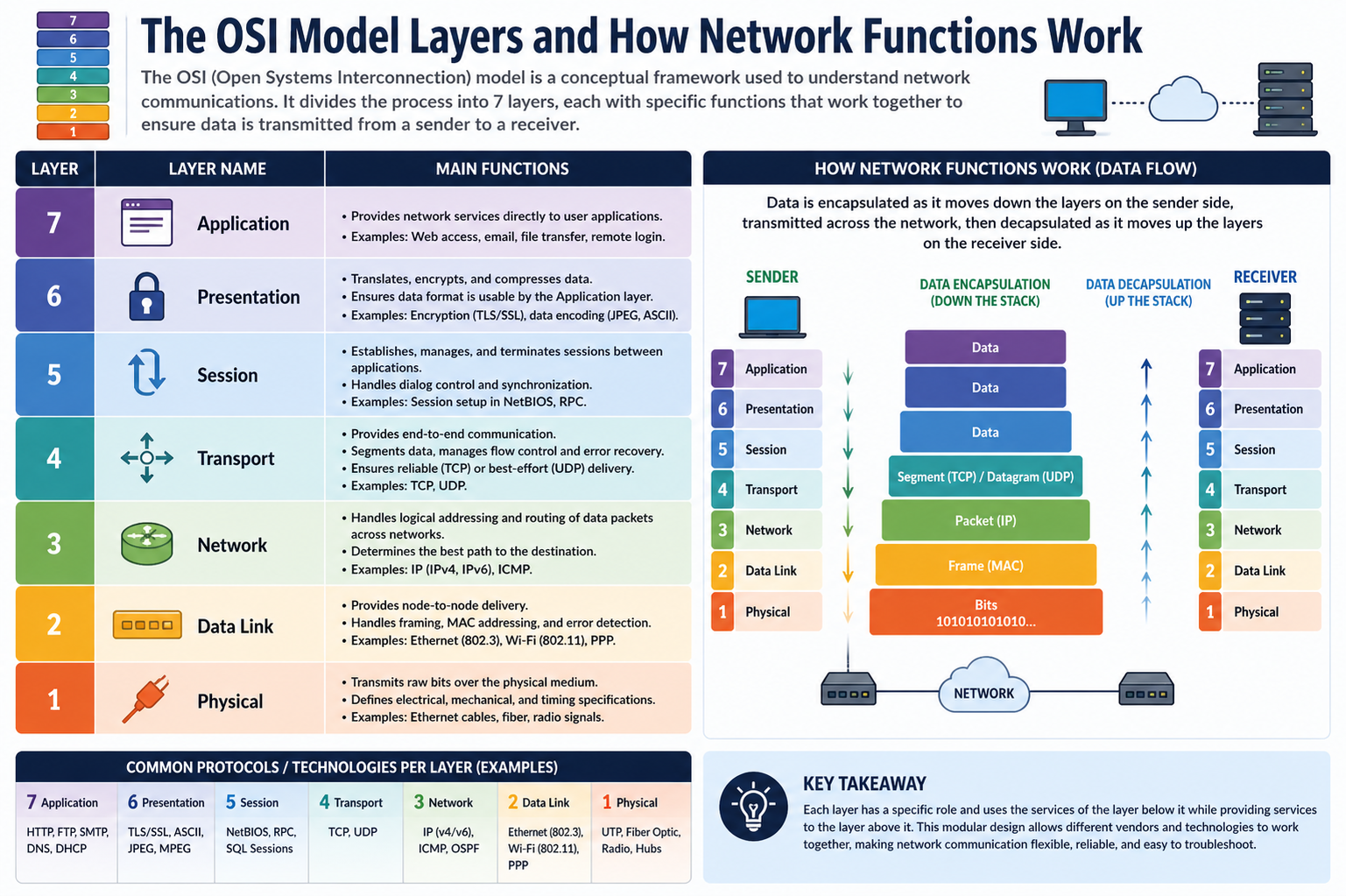
The OSI (Open Systems Interconnection) model is a foundational concept in computer networking that explains how data travels from one device to another across a network. It is not a physical system but a conceptual framework that helps engineers, developers, and network administrators understand and design communication systems in a structured way. The model divides the entire process of communication into multiple layers, where each layer has a specific role and interacts only with the layers directly above and below it. This layered structure simplifies complex networking tasks by breaking them into manageable functions.
Overview of How the OSI Model Works
When data is sent from one device to another, it does not move as a single block. Instead, it passes through all the OSI layers on the sending device, where each layer adds its own information to the data. This process is known as encapsulation. Once the data reaches the receiving device, it moves through the layers in reverse order, and each layer removes its corresponding information. This process is called decapsulation. This structured flow ensures that communication remains organized, accurate, and compatible across different systems and technologies.
The OSI model is divided into seven layers, each serving a unique function in the communication process. These layers work together to ensure that data is transmitted efficiently and correctly, even across complex and large-scale networks.
Physical Layer and Its Role in Communication
The Physical Layer is the lowest layer in the OSI model and is responsible for the actual transmission of raw data bits over a physical medium. This layer deals with electrical signals, light pulses, or radio waves depending on the type of network being used. It defines the physical characteristics of the network, such as cable types, connector designs, signal timing, and voltage levels.
At this stage, data is converted into binary form, represented as 0s and 1s, and transmitted through physical hardware. The Physical Layer does not interpret or modify the data; it simply ensures that bits are sent and received accurately. Devices such as network cables, hubs, and wireless transmitters operate at this layer. The main goal here is to maintain a stable physical connection so that higher layers can function properly.
Data Link Layer and Local Communication Control
The Data Link Layer is responsible for node-to-node communication within the same network. It ensures that data transferred over the Physical Layer is error-free and properly organized. At this layer, raw bits are grouped into frames, which include additional information such as source and destination hardware addresses.
This layer is also responsible for error detection and sometimes correction. If errors are detected during transmission, the Data Link Layer may request retransmission of corrupted frames. It also controls how devices share the same communication channel, preventing data collisions in network environments where multiple devices communicate simultaneously.
Another important function of this layer is addressing using physical identifiers, commonly known as MAC addresses. These addresses help identify devices within a local network and ensure that data reaches the correct destination device.
Network Layer and Data Routing Across Networks
The Network Layer is responsible for determining how data travels across multiple networks to reach its final destination. Unlike the Data Link Layer, which focuses on local communication, the Network Layer handles broader communication across different interconnected networks.
This layer assigns logical addresses to devices, often referred to as IP addresses. These addresses help identify devices globally across networks. The Network Layer also determines the best possible path for data transmission based on network conditions, congestion, and routing protocols.
Routing is a key function at this layer. Routers operate here by analyzing destination addresses and forwarding data packets toward their destination. Each packet may travel through multiple intermediate devices before reaching its final target. This layer ensures that even if one path is unavailable, alternative routes can be used to deliver the data efficiently.
Transport Layer and Reliable Data Delivery
The Transport Layer ensures reliable communication between two devices. It is responsible for breaking large chunks of data into smaller segments before transmission and then reassembling them at the destination.
One of its key roles is error control and flow management. It ensures that data is delivered completely and in the correct order. If any segment is lost during transmission, this layer can request retransmission. It also manages the speed of data transfer so that the receiving device is not overwhelmed.
There are two primary modes of communication at this layer: connection-oriented and connectionless. In connection-oriented communication, a stable connection is established before data transfer begins, ensuring reliability. In connectionless communication, data is sent without establishing a dedicated connection, which is faster but less reliable.
Session Layer and Managing Communication Sessions
The Session Layer is responsible for establishing, maintaining, and terminating communication sessions between applications on different devices. A session refers to a continuous exchange of data between two systems.
This layer ensures that communication remains active and synchronized during data transfer. If a session is interrupted due to network failure, the Session Layer can help restore it without restarting the entire process. It also manages dialog control, determining which device can send or receive data at a given time.
In real-world applications, this layer plays an important role in services that require continuous interaction, such as video calls, online gaming, and remote access systems.
Presentation Layer and Data Translation
The Presentation Layer acts as a translator between the application layer and the network. Its primary role is to ensure that data sent from one system is understandable by another system, even if both systems use different formats or encoding methods.
This layer handles data formatting, encryption, and compression. Formatting ensures that data structures are consistent. Encryption provides security by converting data into a secure format during transmission. Compression reduces the size of data, making transmission faster and more efficient.
When data reaches the destination, the Presentation Layer reverses these processes by decrypting, decompressing, and converting the data into a usable format for the application layer.
Application Layer and User Interaction with Networks
The Application Layer is the topmost layer of the OSI model and is closest to the end user. It provides network services directly to applications such as web browsers, email clients, and file transfer systems.
This layer does not refer to the applications themselves but rather the protocols and services that allow applications to communicate over a network. It enables users to access network resources in a simple and understandable way without needing to know how the underlying network functions operate.
Services provided at this layer include email communication, file sharing, remote login, and web browsing. It acts as an interface between user applications and the network system.
How Data Moves Through the OSI Layers
When a user sends data, such as an email or a file, the information starts at the Application Layer. As it moves downward through the OSI layers, each layer adds its own header information. This process continues until the data reaches the Physical Layer, where it is transmitted as electrical or optical signals.
At the receiving end, the process is reversed. The Physical Layer receives the signals and passes them upward. Each layer removes its corresponding header and processes the data according to its function. By the time the data reaches the Application Layer, it is restored to its original form and ready for the user.
This structured flow ensures that communication remains organized and error-free across complex networks.
Importance of the OSI Model in Networking
The OSI model is essential because it standardizes communication between different systems and devices. It allows different technologies and manufacturers to work together seamlessly. By dividing communication into layers, it becomes easier to troubleshoot network problems, design new systems, and improve performance.
Each layer can be developed and updated independently without affecting the others. This modular approach simplifies network design and enhances flexibility. It also helps in understanding where problems occur in the communication process, making troubleshooting more efficient.
Relationship Between OSI Model and Real-World Networking Systems
Although the OSI model is a theoretical framework, its concepts are deeply embedded in real-world networking systems. Modern networks do not always strictly follow all seven layers in a separated form, but the functions defined by each layer still exist in practice. Network protocols and hardware are designed in a way that they collectively fulfill the responsibilities of these layers, even if multiple functions are combined into fewer layers in practical implementations.
For example, in real networking environments, protocols such as TCP/IP integrate multiple OSI layers into fewer functional layers. Despite this, the OSI model remains extremely important for understanding how each part of the communication process works independently. It provides a universal language for discussing networking concepts, making it easier for engineers and technicians to diagnose and solve problems.
Encapsulation and Decapsulation in Detail
One of the most important processes in the OSI model is encapsulation, which occurs when data is being sent from a source device. At each layer, additional information is attached to the data in the form of headers, and in some cases trailers. This information is essential for routing, error checking, and proper delivery.
At the Application Layer, data is created by the user. As it moves down to the Presentation Layer, it may be formatted, encrypted, or compressed. The Session Layer then adds session control information to manage the communication. The Transport Layer divides the data into segments and adds sequencing and reliability information.
As data reaches the Network Layer, logical addressing is added so that it can travel across multiple networks. The Data Link Layer then frames the data and adds physical addressing information. Finally, the Physical Layer converts everything into binary signals for transmission.
When the data reaches the receiving device, decapsulation occurs. Each layer removes the information added by its counterpart layer on the sending side. This ensures that the original data is reconstructed accurately and delivered to the user without corruption or loss.
Error Detection and Correction Mechanisms
Error handling is a critical aspect of network communication, and multiple OSI layers contribute to it. The Data Link Layer is primarily responsible for detecting errors in transmitted frames using techniques such as checksums and cyclic redundancy checks. If an error is detected, the frame may be retransmitted.
The Transport Layer also plays a major role in ensuring reliability. It uses acknowledgments and timeouts to confirm that data has been received correctly. If an acknowledgment is not received within a specific time, the data segment is retransmitted.
These mechanisms ensure that even in unreliable network conditions, data integrity is maintained and communication remains consistent. Without these processes, network communication would be highly unstable and prone to data loss.
Flow Control and Network Efficiency
Flow control is another important concept managed mainly by the Transport Layer. It ensures that the sender does not transmit data faster than the receiver can process it. If data is sent too quickly, the receiving device may become overwhelmed, leading to congestion and data loss.
To prevent this, flow control techniques adjust the rate of data transmission based on the receiver’s capacity. This creates a balance between sending and receiving devices, improving overall network efficiency.
In addition to flow control, congestion control is also used in modern networks. This helps manage traffic across the entire network, ensuring that no single path becomes overloaded. These mechanisms work together to maintain smooth and stable communication.
Addressing and Identification in Networks
Addressing is a fundamental concept in networking that ensures data reaches the correct destination. Different layers use different types of addressing.
At the Data Link Layer, physical addresses are used to identify devices within a local network. These addresses are permanently assigned to network hardware.
At the Network Layer, logical addresses are used. These addresses are flexible and can change depending on the network configuration. They allow devices to communicate across multiple networks.
This dual addressing system ensures both local and global communication is possible. Without proper addressing, data would not be able to find its destination accurately in complex network environments.
Routing and Path Selection in Data Transmission
Routing is the process of selecting the best path for data to travel from source to destination. This function is handled by devices operating at the Network Layer. Routers analyze destination addresses and determine the most efficient route based on network conditions.
Multiple factors influence routing decisions, including network congestion, distance, and available bandwidth. If one route becomes unavailable, routers can automatically switch to alternative paths, ensuring continuous data delivery.
Routing protocols constantly exchange information between network devices to maintain updated knowledge of network topology. This dynamic system allows large-scale networks like the internet to function efficiently.
Segmentation and Reassembly of Data
The Transport Layer is responsible for breaking large data into smaller segments before transmission. This process is called segmentation. Each segment is assigned a sequence number so that the receiving device can reassemble them in the correct order.
Once the data reaches the destination, these segments are reassembled into the original message. This process ensures that even if segments arrive out of order, the final data remains accurate and complete.
Segmentation also improves efficiency by allowing multiple segments to be transmitted simultaneously over different network paths.
Synchronization and Communication Management
The Session Layer ensures that communication between devices remains synchronized. It manages checkpoints during data transfer so that if a connection is interrupted, communication can resume from the last checkpoint instead of starting over.
This is especially important for long data transfers or continuous communication sessions. It reduces the risk of data loss and improves efficiency in unstable network conditions.
Session management also controls dialog modes, determining whether communication is one-way or two-way at any given time. This ensures structured and organized data exchange between applications.
Data Transformation and Security Handling
The Presentation Layer plays a key role in ensuring that data is secure and properly formatted. Encryption is used to protect sensitive information during transmission. This ensures that even if data is intercepted, it cannot be understood without proper decryption.
Compression is another important function at this layer. It reduces the size of data, allowing faster transmission and efficient use of network bandwidth. Different encoding formats are also handled here so that systems using different standards can still communicate effectively.
These processes ensure that data remains secure, compatible, and efficient throughout its journey across the network.
Application Layer and Network Services in Depth
The Application Layer provides essential services that allow users to interact with networks. It supports protocols that enable communication between software applications and network services.
This layer is responsible for ensuring that user requests are properly interpreted and forwarded to lower layers for processing. It also ensures that responses received from the network are presented in a readable and usable format.
Common services supported at this layer include communication systems, file transfer mechanisms, and remote access tools. It acts as the bridge between human interaction and network operations.
Practical Importance of Layered Networking
The layered structure of the OSI model provides several advantages in real-world networking. It simplifies network design by dividing complex processes into smaller manageable functions. It also makes troubleshooting easier because issues can be isolated to specific layers.
For example, if a network connection fails, technicians can determine whether the issue is related to physical hardware, routing, or application-level problems. This structured approach saves time and improves efficiency in network management.
The modular nature of the OSI model also allows technologies to evolve independently. Improvements in one layer do not necessarily require changes in other layers, making system upgrades more flexible.
Final Understanding of OSI Model Functionality
The OSI model represents a complete system for understanding how network communication works from start to finish. Each layer plays a unique and essential role in ensuring that data moves efficiently, accurately, and securely between devices.
From the physical transmission of signals to user-level application services, every step is carefully organized through a layered approach. This structure allows complex global networks to function smoothly and reliably.
By understanding each layer and its responsibilities, it becomes easier to grasp how modern communication systems operate and how different technologies work together to enable seamless data exchange across the world.
Advanced Understanding of OSI Model Interaction in Modern Networks
The OSI model becomes even more meaningful when viewed in the context of how modern networks operate at scale. While the model itself is conceptual, its principles guide how data centers, enterprise systems, and global communication networks are designed. Each layer contributes not only to basic data transfer but also to performance optimization, security enforcement, and intelligent traffic handling across complex infrastructures.
In large-scale systems, multiple processes occur simultaneously at different layers. A single user action, such as sending a message or opening a web service, triggers a chain of events that moves through all OSI layers within milliseconds. This layered interaction ensures that even massive volumes of data can be handled efficiently without breaking communication integrity.
Role of Hardware and Software Across Layers
The OSI model helps separate responsibilities between hardware and software components in a network. Hardware devices such as cables, switches, routers, and wireless access points primarily operate at the lower layers, especially the Physical and Data Link Layers. These devices focus on signal transmission, frame handling, and local delivery of data.
Software systems, on the other hand, operate mainly at the higher layers such as the Session, Presentation, and Application Layers. These layers manage user interaction, data formatting, encryption, and application-based communication. This separation allows both hardware and software to evolve independently while still maintaining compatibility within the overall network structure.
This distinction is essential because it enables flexibility in system design. For example, improvements in encryption algorithms at the Presentation Layer do not require changes in physical network hardware, and upgrades in routing hardware do not affect application-level functionality.
Multiplexing and Efficient Resource Utilization
One of the important concepts connected to OSI layer functionality is multiplexing, which allows multiple data streams to share a single communication channel. This is especially important in modern networks where bandwidth must be used efficiently.
At the Transport Layer, multiplexing ensures that multiple applications running on the same device can send and receive data simultaneously. Each data stream is assigned identifiers so that it can be correctly delivered to the appropriate application at the receiving end.
At lower layers, this concept continues through channel sharing and signal management. By allowing multiple data flows over a single medium, multiplexing significantly improves network efficiency and reduces infrastructure costs.
Network Security Across OSI Layers
Security is not limited to a single layer in the OSI model; instead, it is distributed across multiple layers. Each layer contributes in its own way to protecting data and ensuring safe communication.
At the Physical Layer, security involves protecting physical infrastructure from unauthorized access or damage. At the Data Link Layer, techniques such as MAC filtering can restrict device access within a local network.
The Network Layer introduces logical security measures such as routing control and filtering of unauthorized traffic. At the Transport Layer, secure transmission protocols ensure that data is delivered safely and correctly.
The Presentation Layer plays a critical role in encryption and decryption, ensuring that sensitive data remains protected during transmission. Finally, the Application Layer enforces authentication and user-level security, ensuring that only authorized users can access specific services.
This layered security approach ensures that even if one layer is compromised, other layers continue to provide protection, making overall systems more resilient.
Latency and Performance Considerations
Network performance is heavily influenced by how efficiently each OSI layer performs its function. Latency refers to the time it takes for data to travel from source to destination. Each layer introduces a small amount of processing delay, which collectively contributes to total network latency.
The Physical Layer affects latency through signal transmission speed and medium quality. The Network Layer influences it through routing efficiency, while the Transport Layer contributes through error checking and flow control mechanisms.
Optimizing performance requires balancing reliability and speed. For example, more rigorous error checking improves data accuracy but may increase delay. Similarly, encryption enhances security but adds processing overhead. Network engineers must carefully manage these trade-offs to achieve optimal performance.
Protocol Interaction Within the OSI Framework
Protocols are sets of rules that define how data is transmitted and received across networks. Each OSI layer uses one or more protocols to perform its functions.
At the Application Layer, protocols define how applications communicate with network services. At the Transport Layer, protocols determine how data is segmented, transmitted, and reassembled. The Network Layer relies on routing protocols to determine data paths, while the Data Link Layer uses protocols for frame handling and error detection.
These protocols work together across layers to ensure smooth communication. Even though each protocol operates independently within its layer, they collectively form a unified communication system when combined through the OSI structure.
Scalability and Network Expansion
One of the major strengths of the OSI model is its ability to support scalable network design. As networks grow in size and complexity, the layered structure allows new technologies to be integrated without disrupting existing systems.
For example, new routing technologies can be introduced at the Network Layer without affecting application-level services. Similarly, improvements in wireless communication can be implemented at the Physical Layer without requiring changes in higher layers.
This scalability is essential for modern global networks, where millions of devices must communicate seamlessly across different technologies and infrastructures.
Fault Isolation and Network Troubleshooting
The OSI model is widely used as a troubleshooting tool because it allows network issues to be isolated to specific layers. When a network problem occurs, engineers can systematically check each layer to identify the source of the issue.
If physical connectivity is lost, the problem lies at the Physical Layer. If devices cannot communicate within a local network, the issue may be at the Data Link Layer. If data is not reaching the correct destination, the Network Layer is likely involved.
This structured approach significantly reduces the time required to diagnose and resolve network problems. It also prevents unnecessary changes to unrelated parts of the system.
Data Integrity and Transmission Reliability
Ensuring data integrity is one of the most important goals of the OSI model. Multiple layers contribute to maintaining accuracy during transmission. Error detection at the Data Link Layer, acknowledgment systems at the Transport Layer, and encryption validation at the Presentation Layer all work together to ensure that data remains unchanged during transit.
If any corruption or loss is detected, mechanisms are in place to request retransmission or correction. This ensures that the final data received by the user is identical to the original data sent from the source.
Evolution of Networking Beyond OSI Concepts
While the OSI model remains a foundational framework, modern networking has evolved to combine and simplify some of its functions. Many systems now operate using integrated protocols that handle multiple layer responsibilities simultaneously.
Despite this evolution, the OSI model continues to serve as a critical educational and analytical tool. It provides a clear mental model for understanding complex networking behavior and remains relevant for designing, analyzing, and troubleshooting communication systems.
Final Perspective on OSI Model Functionality
The OSI model represents a complete blueprint of how data moves through a network in a structured and reliable way. Each layer contributes a specific function, and together they ensure that communication between devices is efficient, secure, and scalable.
From the transmission of electrical signals to the delivery of user-level application data, every step is carefully managed through layered processing. This structure not only simplifies complex networking systems but also enables the continuous growth and evolution of global communication technologies.
Understanding these layers provides a strong foundation for grasping how modern networks function, how data is protected, and how seamless communication is achieved across different systems and platforms worldwide.
Deep Dive into Data Flow Across the OSI Model
Understanding how data actually travels through the OSI model requires looking at it as a continuous pipeline where information is progressively transformed. Every stage adds structure, meaning, or control information, ensuring that raw data becomes a fully deliverable message and then is reconstructed back into its original form at the destination.
When a device initiates communication, the process begins at the Application Layer, where user-generated data is created. As this data moves downward, it is gradually prepared for transmission across physical networks. This downward movement is not just a simple pass-through; each layer actively modifies the data to ensure compatibility, reliability, and traceability.
At the sending side, each layer adds specific control information. At the receiving side, the exact reverse process happens, ensuring that the message is fully restored without losing its structure or meaning. This two-way transformation is one of the core strengths of layered networking.
Encapsulation as a Structured Packaging System
Encapsulation can be understood as a systematic packaging process where each OSI layer wraps the data with its own set of instructions. The Application Layer produces the raw message, and as it moves down, each layer adds its own “label” to guide transmission.
The Transport Layer adds segmentation details and reliability information. The Network Layer adds logical addressing so the data knows where it is going globally. The Data Link Layer adds local delivery information, ensuring correct device-to-device transfer. Finally, the Physical Layer converts everything into signals suitable for transmission.
This layered packaging ensures that even if data travels across many different systems and technologies, it still reaches the correct destination in a usable form.
Decapsulation and Data Reconstruction Process
At the receiving device, the reverse process begins immediately after signals are captured by the Physical Layer. This stage converts raw signals back into structured data units.
As the data moves upward through the layers, each layer removes its corresponding encapsulation information. The Data Link Layer removes frame-level details, the Network Layer removes routing information, and the Transport Layer reassembles segments into complete data streams.
By the time the data reaches the Application Layer, all technical metadata has been stripped away, leaving only the original user data. This clean restoration is essential for ensuring that applications can interpret and use the information correctly.
Synchronization of Layers During Communication
One of the most important aspects of the OSI model is the synchronization between layers during communication. Each layer must operate in coordination with others to maintain data consistency.
For example, if the Transport Layer segments data but the Network Layer fails to route packets correctly, communication breaks down. Similarly, if the Data Link Layer cannot properly frame data, higher layers become ineffective.
This interdependence ensures that all layers must function correctly for successful communication. However, because each layer is independent in design, failures can be isolated without affecting the entire system.
Role of Protocol Stacks in Layer Interaction
In real systems, OSI layers are implemented using protocol stacks. A protocol stack is a group of protocols working together to handle communication across different layers.
Each protocol in the stack corresponds to a specific layer and performs tasks defined by that layer. These protocols interact vertically within a system and horizontally with corresponding protocols on other devices.
This structured interaction ensures that devices from different manufacturers and operating systems can still communicate effectively as long as they follow standard protocol rules.
Timing and Sequencing in Data Transmission
Timing is a critical factor in network communication. Data must not only reach the correct destination but also arrive in the correct order and within acceptable time limits.
The Transport Layer plays a major role in managing sequencing. Each segment is assigned a sequence number so that even if packets arrive out of order, they can be correctly rearranged.
Timing control also ensures that retransmissions do not overload the network. If acknowledgments are delayed, the system can determine whether to resend data or wait for delivery confirmation.
Error Recovery and Reliability Mechanisms
Error recovery is one of the most essential functions across multiple OSI layers. Networks are inherently unreliable due to interference, congestion, or hardware issues, so mechanisms must exist to detect and correct errors.
At lower layers, simple error detection ensures that corrupted frames are identified. At higher layers, more advanced recovery techniques ensure that lost or damaged data is retransmitted.
This multi-layered approach to error handling ensures that no single failure leads to complete communication breakdown. Instead, systems can recover gracefully and continue transmitting data.
Load Distribution Across Network Layers
Modern networks handle large volumes of data simultaneously, which requires efficient load distribution. Each OSI layer contributes to balancing this load.
The Network Layer distributes traffic across multiple routes, preventing congestion in any single path. The Transport Layer manages how much data is sent at a time, preventing overload at the receiving end.
Lower layers ensure that physical transmission channels are not saturated. This combined load distribution allows networks to operate smoothly even under heavy traffic conditions.
Interoperability Between Different Systems
One of the key achievements of the OSI model is enabling interoperability between different systems. Devices from different manufacturers, using different technologies, can still communicate effectively because they follow standardized layer functions.
This is especially important in global networks where millions of devices must work together seamlessly. Without such standardization, communication would be limited to compatible systems only.
Interoperability ensures that innovation can continue independently in different areas without breaking overall network compatibility.
Data Formatting and Structural Consistency
Data must be properly structured to be understood by different systems. The Presentation Layer ensures that formatting differences between systems are resolved.
This includes converting character encoding, adjusting data structures, and ensuring compatibility between different software environments. Without this layer, systems using different formats would be unable to interpret each other’s data.
Structural consistency is essential for global communication, where systems may operate under different standards but still need to exchange information accurately.
Real-Time Communication and OSI Behavior
In real-time communication systems such as voice calls or video streaming, OSI layers operate under strict timing constraints. Any delay or inconsistency can affect user experience.
The Transport Layer ensures continuous data flow, while the Session Layer maintains active communication sessions without interruption. The Network Layer ensures that routing remains stable even under dynamic conditions.
These real-time optimizations allow networks to support interactive services that require immediate response and minimal delay.
Final Integration of OSI Layer Functions
When all OSI layers work together, they form a complete communication system that handles data from creation to delivery. Each layer performs a specialized role, but their combined operation ensures seamless data exchange across complex networks.
The strength of this model lies in its modularity, reliability, and clarity. It allows engineers to design, analyze, and improve networks systematically while maintaining compatibility across diverse systems.
This layered approach remains one of the most important concepts in networking, forming the backbone of how modern communication systems are structured and understood.
Conclusion
The OSI model provides a complete and structured way to understand how data moves across networks from one device to another. It breaks down the complex process of communication into seven distinct layers, where each layer performs a specific function that contributes to the overall transmission of information. This layered design ensures that networking remains organized, scalable, and easier to manage.
From the initial creation of data at the Application Layer to its physical transmission as signals and its reconstruction at the destination, every step is carefully coordinated. Each layer adds or removes its own control information, making sure that data is properly formatted, routed, delivered, and verified. This systematic flow ensures that communication remains accurate and reliable even in large and complex networks.
The model also highlights the importance of modular design in networking systems. Because each layer operates independently, improvements or changes in one layer do not disrupt the others. This allows technology to evolve continuously while maintaining compatibility across different systems and devices. It also makes troubleshooting more efficient, as problems can be isolated to specific layers instead of the entire network.
Another key strength of the OSI model is its role in ensuring interoperability. Devices from different manufacturers and platforms can communicate effectively because they follow standardized layer functions. This universal structure is one of the main reasons global communication systems like the internet function smoothly.
Although modern networking systems may not strictly follow the OSI model in a direct implementation, its principles remain deeply embedded in real-world technologies. It continues to serve as a fundamental reference for understanding how networking works, how data is transmitted, and how different systems interact with each other.