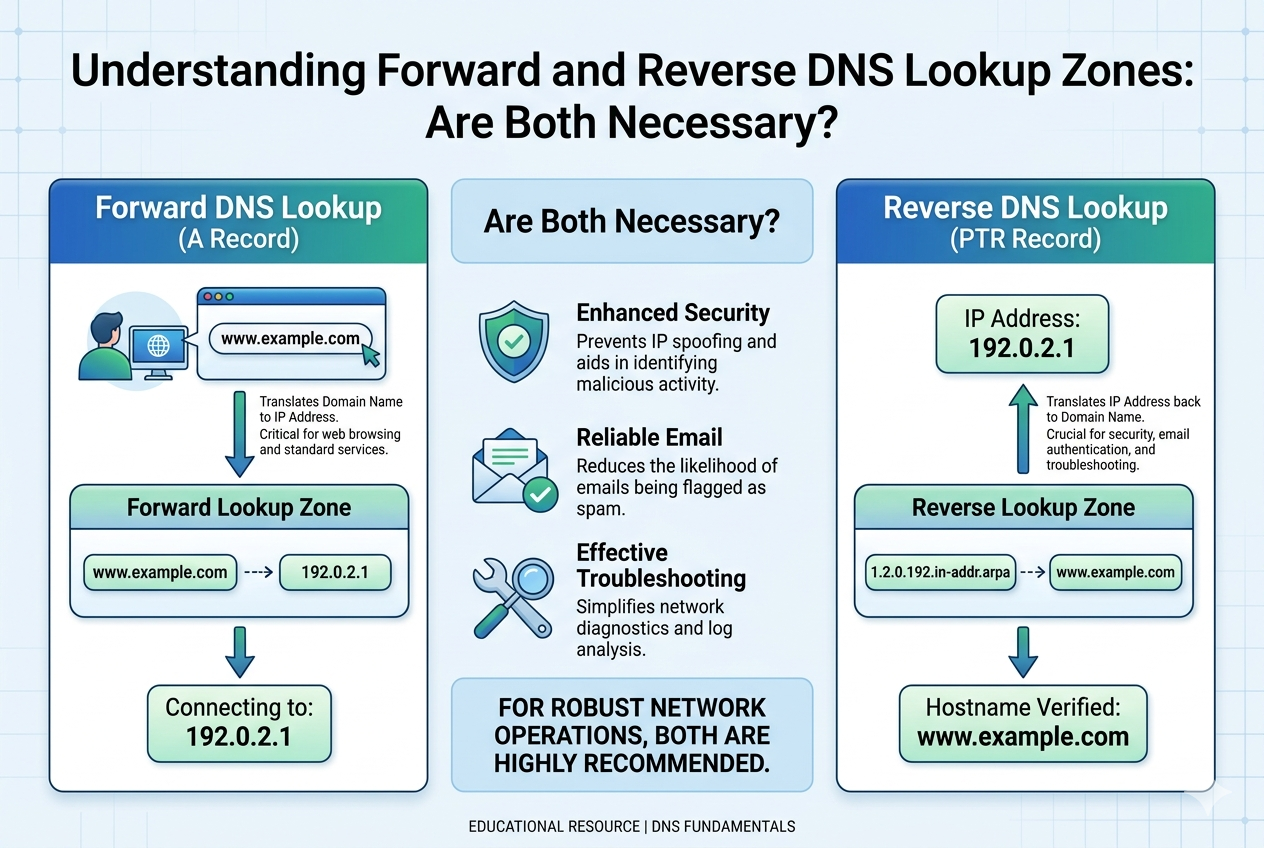
Domain Name System (DNS) is one of the most fundamental components of modern networking, responsible for translating human-friendly names into machine-readable IP addresses. Within this system, forward and reverse lookup zones play distinct roles that together ensure smooth communication across networks. Understanding both is essential for anyone working with networks, system administration, or cybersecurity.
Role of Forward Lookup Zones in Network Communication
Forward lookup zones are the most commonly used part of DNS. Their primary purpose is to convert domain names into IP addresses. When a user enters a website name or accesses a service, the system queries the forward lookup zone to find the corresponding IP address. This process happens almost instantly, making it possible for users to interact with complex networks using simple, memorable names instead of numerical identifiers.
The importance of forward lookup zones lies in their ability to simplify communication. Without them, users would need to remember long strings of numbers for every website or service they access. By maintaining structured records that map names to IP addresses, forward lookup zones make digital interaction practical and scalable. They are continuously queried billions of times every day across global networks, forming the backbone of internet usability.
How Forward Lookup Zones Are Structured
A forward lookup zone consists of various resource records that define mappings between names and IP addresses. These records are stored in a hierarchical structure that allows efficient searching and updating. Each entry links a specific hostname to an IPv4 or IPv6 address, ensuring that devices can be accurately located on a network.
The structure is designed for speed and reliability. When a query is made, the system quickly checks cached entries or authoritative records to return the correct IP address. This minimizes delay and ensures seamless connectivity. Forward lookup zones are also dynamic in many environments, allowing automatic updates when devices join or leave a network.
Importance of Reverse Lookup Zones
Reverse lookup zones perform the opposite function by mapping IP addresses back to domain names. While this may seem less frequently used, it plays a critical role in network diagnostics, security, and logging. When an IP address is identified, reverse lookup helps determine the associated hostname, providing context about the source of network activity.
This capability is especially useful in troubleshooting network issues. Administrators can trace unexpected traffic back to its origin, helping identify misconfigurations or unauthorized access attempts. Reverse lookup zones also support authentication systems and email verification processes, where confirming the identity behind an IP address is important.
How Reverse Lookup Zones Function
Instead of storing name-to-IP mappings, reverse lookup zones store IP-to-name mappings. The process involves querying special pointer records that associate numeric addresses with hostnames. When a request is made, the system searches these records to return the corresponding domain name.
This reverse mapping adds an additional layer of transparency in network operations. It allows administrators to verify whether an IP address truly belongs to a known device or service. Although not always required for basic browsing, it becomes essential in enterprise environments where monitoring and accountability are critical.
Security Benefits of Reverse Lookup Zones
Reverse lookup zones contribute significantly to network security. They help in identifying suspicious activity by revealing the domain associated with an IP address. This is particularly useful in detecting spoofed or malicious traffic, where attackers attempt to disguise their origin.
Security systems often rely on reverse DNS checks as part of their verification process. If an IP address does not resolve to a valid or expected hostname, it may be flagged for further inspection. This helps reduce spam, prevent unauthorized access, and improve overall trust in network communications.
Forward and Reverse DNS Working Together
Although forward and reverse lookup zones serve different purposes, they are most effective when used together. Forward lookup ensures that users can reach the correct destination using domain names, while reverse lookup provides validation and traceability of those destinations.
In many systems, both zones are configured simultaneously to maintain consistency. This dual setup ensures that every forward mapping has a corresponding reverse mapping, reducing errors and improving reliability. When both are properly maintained, network administrators gain a complete view of name resolution in both directions.
Necessity of Forward Lookup Zones
Forward lookup zones are absolutely essential for any functional network. Without them, users would not be able to access services using domain names, making the internet far less practical. Every modern network depends on forward lookup to translate requests into usable IP addresses.
They are not optional in real-world applications because nearly all network communication begins with a forward lookup query. Whether accessing websites, sending emails, or connecting to cloud services, forward lookup zones are always involved in the process.
Necessity of Reverse Lookup Zones
Reverse lookup zones, on the other hand, are not strictly required for basic network functionality. Systems can operate without them, and many small networks do not implement reverse DNS at all. However, their absence can limit visibility and reduce diagnostic capabilities.
In larger or more complex environments, reverse lookup becomes increasingly valuable. It supports monitoring, auditing, and troubleshooting processes that are essential for maintaining secure and efficient operations. While not mandatory, they are highly recommended for professional network setups.
Practical Applications in Real-World Networks
In real-world scenarios, forward lookup zones are used constantly and without interruption. Every time a user accesses a service, a forward lookup is performed. This makes it one of the most heavily utilized components of DNS infrastructure.
Reverse lookup zones are used more selectively but are equally important in specific contexts. System administrators use them when analyzing logs, identifying traffic sources, or verifying server identities. Security teams also rely on reverse lookups when investigating suspicious activity or potential threats.
Performance and Efficiency Considerations
From a performance perspective, forward lookup zones are optimized for speed and scalability. They are designed to handle massive volumes of queries efficiently, often using caching mechanisms to reduce lookup time.
Reverse lookup zones are generally less frequently accessed, so they do not require the same level of optimization. However, they must still be maintained accurately to ensure reliable results when needed. Poorly configured reverse zones can lead to confusion in diagnostics and reduce trust in network data.
Challenges in DNS Configuration
Managing both forward and reverse lookup zones requires careful configuration. Inconsistent records between the two can lead to mismatches, where a hostname resolves to an IP address but the reverse lookup does not confirm the relationship.
Such inconsistencies can cause issues in authentication systems, email delivery, and security verification processes. Maintaining synchronization between both zones is therefore important for ensuring data integrity and network reliability.
Importance in Cybersecurity and Monitoring
In cybersecurity, both forward and reverse lookup zones contribute to threat detection and analysis. Forward lookup ensures that malicious domains can be traced to their IP addresses, while reverse lookup helps identify the source of suspicious traffic.
Security tools often combine both methods to build a complete picture of network activity. This dual perspective improves accuracy in detecting anomalies and responding to threats.
Necessity and Balance
Forward and reverse DNS lookup zones are not interchangeable but complementary. Forward lookup is essential for everyday connectivity and cannot be replaced. Reverse lookup, while not always mandatory, enhances visibility, security, and diagnostic capabilities.
Together, they form a balanced system that supports both usability and control. Networks that implement both effectively benefit from improved reliability, better security insights, and more efficient troubleshooting.
Why Forward Lookup Zones Form the Core of DNS Operations
Forward lookup zones are considered the foundation of DNS functionality because almost every network interaction depends on them. When a user types a domain name into a browser or an application attempts to reach a service, the system must first determine the correct IP address. This translation process is handled by forward lookup zones, making them essential for connectivity.
Without forward lookup, users would be forced to interact directly with IP addresses, which are difficult to remember and manage. The abstraction provided by DNS relies heavily on this mapping system, allowing human-readable names to represent complex numerical identifiers. This simplicity is what enables the internet to scale globally while remaining user-friendly.
Forward lookup zones also play a key role in load balancing and redundancy. In many environments, a single hostname may resolve to multiple IP addresses. This allows traffic to be distributed across different servers, improving performance and reliability. The system can dynamically adjust responses based on availability, ensuring users are always directed to an active resource.
Internal Mechanics Behind Forward Lookup Resolution
When a forward lookup request is initiated, the DNS resolver first checks its local cache. If the requested name has been recently resolved, the system can return the stored result immediately. This reduces latency and improves efficiency. If no cached entry exists, the query is forwarded to a recursive resolver, which continues the search through hierarchical DNS servers until it reaches the authoritative source.
At the authoritative level, the forward lookup zone contains the definitive records for a domain. These records are carefully maintained to ensure accuracy and consistency. Once the correct IP address is identified, it is returned to the requesting system and often cached for future use. This layered approach ensures both speed and reliability in name resolution.
Role of Reverse Lookup in Network Transparency
Reverse lookup zones provide transparency by allowing systems to identify the hostname associated with a given IP address. This is particularly useful in environments where tracking the origin of network traffic is important. Instead of seeing only numerical data, administrators can view meaningful domain names that provide context.
This function becomes especially valuable in logging systems. When servers record incoming requests, reverse DNS lookups help convert raw IP addresses into identifiable names. This makes logs easier to interpret and analyze, especially when investigating unusual activity or performance issues.
Reverse lookup also supports accountability. In shared or distributed environments, multiple services may originate from different systems. Being able to trace an IP address back to its hostname helps ensure that actions can be attributed correctly, which is important for auditing and compliance.
Operational Differences Between Forward and Reverse Zones
Although both zones are part of DNS, their operational behavior differs significantly. Forward lookup zones are heavily optimized for frequent queries, while reverse lookup zones are used less often and typically on demand. This difference reflects their roles within the system.
Forward lookups are proactive and continuous. Every time a connection is made using a domain name, a forward lookup is required. In contrast, reverse lookups are reactive. They are triggered when there is a need to identify an IP address rather than initiate communication.
This distinction means that forward lookup zones require higher performance optimization and caching strategies. Reverse lookup zones prioritize accuracy and completeness over speed, as they are not queried as frequently.
Importance of Consistency Between Both Zones
Maintaining consistency between forward and reverse lookup zones is critical for reliable DNS operation. Ideally, every forward record should have a corresponding reverse record. When this alignment exists, systems can confidently translate names in both directions without discrepancies.
Inconsistent records can lead to confusion in network diagnostics. For example, a hostname might resolve to an IP address, but the reverse lookup of that IP might point to a different or outdated hostname. This mismatch can complicate troubleshooting and reduce trust in system data.
To avoid such issues, administrators often implement synchronization practices that ensure both zones are updated together. This is especially important in dynamic environments where devices frequently change IP addresses.
Security Implications of Reverse DNS Validation
Reverse DNS is widely used in security systems as a validation mechanism. Many security protocols check whether an IP address resolves to a legitimate hostname before allowing communication. This helps filter out suspicious or misconfigured sources.
Email systems also rely on reverse DNS checks to reduce spam. Messages originating from IP addresses without valid reverse mappings are often flagged or rejected. This adds an additional layer of verification that helps maintain trust in communication systems.
While reverse DNS alone is not a complete security solution, it contributes significantly to identifying anomalies and enforcing baseline trust rules across networks.
Scalability Considerations in DNS Design
As networks grow, DNS systems must scale efficiently to handle increasing query volumes. Forward lookup zones are designed with scalability in mind, using distributed architecture and caching mechanisms to manage high traffic loads.
Reverse lookup zones scale differently because they are not queried as frequently. However, they still require careful structuring to ensure they remain responsive in large environments. In enterprise systems, reverse zones may span large IP ranges, requiring efficient organization to maintain performance.
The balance between scalability and accuracy is a key consideration in DNS design. Forward lookup prioritizes speed and distribution, while reverse lookup prioritizes structured mapping and clarity.
Troubleshooting Network Issues Using Both Zones
Network troubleshooting often involves using both forward and reverse lookup zones together. When a connectivity issue arises, administrators may start by resolving a hostname to confirm it points to the correct IP address. If issues persist, reverse lookup is used to verify whether the IP address corresponds to the expected system.
This dual-check approach helps identify misconfigurations, routing problems, or unauthorized changes. It also assists in diagnosing intermittent issues where traffic may be routed incorrectly or inconsistently.
By comparing results from both directions, administrators gain a clearer understanding of how data is flowing through the network.
Role in Logging and Forensic Analysis
In forensic investigations, DNS data is extremely valuable. Forward lookup information helps identify which IP addresses were associated with specific domains at a given time. Reverse lookup provides the ability to trace those IP addresses back to their hostnames.
This combination allows investigators to reconstruct network activity with greater accuracy. Logs enriched with reverse DNS data are easier to analyze and interpret, especially when dealing with large datasets or complex incidents.
Even though reverse lookup is not always enabled by default, it is often activated in environments where auditing and monitoring are priorities.
Operational Efficiency in Modern Networks
Modern networks benefit from having both forward and reverse lookup zones properly configured. Forward lookup ensures users can access resources quickly and reliably, while reverse lookup enhances operational insight and control.
Together, they reduce ambiguity in network communication. Instead of dealing with isolated IP addresses, administrators and systems can work with meaningful identifiers that provide context and structure.
This improves efficiency not only in day-to-day operations but also in long-term network management.
Necessity and Implementation
Forward lookup zones are absolutely indispensable for network functionality, as they enable basic communication between systems. Reverse lookup zones, while not strictly required, provide significant advantages in security, diagnostics, and management.
In small or simple networks, reverse lookup may be optional. However, in professional, enterprise, or security-focused environments, both zones are typically implemented together to ensure full visibility and control.
The most effective DNS setups are those that treat forward and reverse lookup zones as complementary components of a unified system rather than separate or optional features.
Common Misconceptions About Forward and Reverse DNS Zones
One of the most common misunderstandings about DNS is that reverse lookup zones are as essential as forward lookup zones for basic internet functionality. In reality, forward lookup is the critical component that enables almost all user-facing communication, while reverse lookup serves more specialized roles. This confusion often leads beginners to assume both are mandatory in every environment, when in fact many small or private networks operate without reverse DNS entirely.
Another misconception is that reverse lookup zones directly improve browsing speed or connectivity. This is not accurate because reverse DNS is not involved in the initial process of reaching a website or service. Instead, it is typically used after a connection is established, mainly for identification, logging, or verification purposes. Its absence does not prevent users from accessing services.
There is also a belief that DNS systems automatically maintain perfect synchronization between forward and reverse records. In practice, this depends entirely on how the network is configured and maintained. Without proper administrative control, mismatches between the two can easily occur, leading to inconsistent results during lookups.
Administrative Importance of DNS Zone Management
Managing forward and reverse lookup zones requires ongoing attention from network administrators. Forward zones tend to be more dynamic because they must reflect active services, changing IP addresses, and scaling infrastructure. Reverse zones, while more static, must still be updated whenever IP allocations change.
Proper management ensures that both zones remain accurate and aligned. This is especially important in environments where systems are frequently added, removed, or reconfigured. Automated tools often assist in maintaining consistency, but manual oversight is still necessary in many cases to prevent errors.
Administrators also need to consider delegation and organization when structuring DNS zones. Large networks may divide forward and reverse zones into smaller segments to improve manageability. This helps reduce complexity and makes troubleshooting more efficient when issues arise.
Performance Impact of DNS Lookups
Forward lookup zones have a direct impact on user experience because they are involved in every domain resolution request. Their performance is critical, and even small delays can affect perceived speed of websites or applications. To address this, caching mechanisms are widely used to store frequently accessed records temporarily.
Reverse lookup zones, on the other hand, have minimal impact on day-to-day performance because they are not triggered during normal browsing or service access. They are only used in specific scenarios such as log analysis or security checks. As a result, their performance demands are generally lower.
However, in large-scale environments where logging systems continuously perform reverse lookups, performance optimization becomes more important. Poorly optimized reverse DNS configurations can slow down log processing and monitoring tools.
DNS in Modern Cloud and Distributed Systems
In modern cloud-based environments, DNS plays an even more critical role due to the distributed nature of services. Forward lookup zones are heavily used to route traffic to dynamic and scalable resources that may change frequently. This flexibility allows cloud systems to balance load and maintain high availability.
Reverse lookup zones are also present in cloud environments but are often abstracted or managed by service providers. They still serve important roles in logging, auditing, and security verification, especially in large multi-tenant systems where tracking traffic sources is essential.
As systems become more distributed, DNS must handle higher complexity while maintaining accuracy and speed. Forward lookup remains central to this process, while reverse lookup continues to provide supporting diagnostic and verification functions.
Dependency of Applications on Forward DNS
Almost all internet-based applications depend on forward DNS resolution to function correctly. Web browsers, mobile applications, APIs, and cloud services all rely on converting domain names into IP addresses before establishing connections. Without forward lookup, these systems would not be able to locate their required endpoints.
This dependency extends beyond simple browsing. Many background services and automated systems also rely on DNS to communicate with external resources. This makes forward lookup one of the most deeply integrated components in modern computing infrastructure.
Because of this dependency, forward lookup zones must be highly available and resilient. Redundancy and failover mechanisms are commonly implemented to ensure uninterrupted resolution even during outages or high traffic conditions.
Role of Reverse DNS in Trust and Verification Systems
Reverse DNS contributes to trust-building mechanisms in various network services. It helps verify whether an IP address is associated with a legitimate domain name, which is useful in preventing impersonation or spoofing attempts.
In communication systems such as email servers, reverse DNS checks are often part of the validation process before accepting messages. If an IP address does not resolve properly or appears suspicious, the message may be rejected or flagged for further inspection.
This verification process helps reduce malicious activity and improves the overall reliability of network communications. While it is not the sole security measure, it plays an important supporting role in multi-layered defense systems.
Scenarios Where Reverse DNS Becomes Critical
There are several scenarios where reverse DNS is particularly important. In server logging and monitoring systems, reverse lookup helps convert raw IP addresses into readable hostnames, making logs easier to interpret. This is especially useful when analyzing traffic patterns or investigating incidents.
In cybersecurity operations, reverse DNS assists in identifying the origin of suspicious activity. It provides additional context that can help determine whether traffic is legitimate or potentially harmful.
In enterprise environments, reverse DNS is often used in internal auditing processes. It helps ensure that systems are properly identified and that network activity can be traced accurately across different layers of infrastructure.
Limitations of Reverse DNS
Despite its usefulness, reverse DNS has certain limitations. It is not always guaranteed to provide accurate or up-to-date information, especially in environments where IP addresses change frequently. If reverse records are not maintained properly, they can quickly become outdated.
Another limitation is that reverse DNS does not always reflect ownership or control accurately. An IP address may resolve to a hostname that does not clearly indicate its current usage or purpose. This can sometimes lead to confusion during analysis.
Additionally, reverse DNS is not universally enforced, meaning some systems may not have valid reverse records at all. This reduces its reliability as a standalone verification method.
Best Practices for DNS Zone Implementation
Effective DNS management involves maintaining both forward and reverse lookup zones in a structured and consistent manner. Records should be regularly updated to reflect changes in network configuration. Automation tools can help reduce errors, but manual verification remains important.
It is also recommended to design DNS zones with scalability in mind. As networks grow, zone structures should be able to accommodate additional records without becoming overly complex or difficult to manage.
Consistency between forward and reverse records should be prioritized to avoid mismatches. This ensures that both lookup directions produce predictable and reliable results.
Evolving Role of DNS in Modern Infrastructure
As internet infrastructure continues to evolve, DNS remains a foundational technology. Forward lookup continues to support the growing demand for scalable and user-friendly access to digital services. Reverse lookup continues to enhance visibility, security, and diagnostic capabilities.
New technologies such as containerization, microservices, and cloud orchestration have increased the complexity of DNS usage. However, the core principles of forward and reverse lookup zones remain unchanged. They continue to work together to ensure that systems can locate, identify, and communicate with each other efficiently.
Final Understanding of Necessity
Forward lookup zones are absolutely essential and form the core of all DNS-based communication. Without them, modern networking as it is known today would not function. Reverse lookup zones, while not strictly required for basic operation, provide valuable support in security, diagnostics, and administrative control.
Both together create a more complete and transparent networking environment. Forward lookup enables connectivity, while reverse lookup enables understanding. Their combined use leads to more reliable, secure, and manageable systems, especially in complex or enterprise-scale infrastructures.
DNS in Large Enterprise Environments
In large enterprise networks, DNS becomes far more than a simple name-to-IP translation system. It turns into a critical infrastructure layer that supports thousands of devices, services, and applications simultaneously. Forward lookup zones in such environments are heavily optimized and often distributed across multiple servers to ensure reliability and performance under high demand.
Reverse lookup zones in enterprises are equally important but are typically structured more carefully due to the scale of IP address management. Large organizations often divide reverse zones into segments that match their internal IP allocation schemes. This makes it easier to track and manage devices across departments, branches, or data centers.
In these environments, DNS is not just about connectivity but also about governance. Properly configured forward and reverse zones help maintain order, ensure accountability, and support operational transparency across complex systems.
Automation and Dynamic DNS Updates
Modern networks increasingly rely on automation to manage DNS records. In environments where devices frequently join or leave the network, manually updating forward and reverse lookup zones becomes impractical. Dynamic DNS systems help automate this process by updating records in real time as changes occur.
Forward lookup zones benefit significantly from this automation because they must constantly reflect active services and hosts. Reverse lookup zones also benefit, especially in environments where IP addresses are assigned dynamically, such as virtualized or cloud-based systems.
However, automation introduces its own challenges. If not properly configured, it can lead to incorrect or stale records being published. This can create inconsistencies between forward and reverse zones, which may affect troubleshooting and security validation processes.
Impact on Email and Communication Systems
DNS plays a crucial role in email delivery systems, where both forward and reverse lookups are used for validation. Forward lookup ensures that mail servers can be reached using domain names, while reverse lookup helps verify the legitimacy of sending servers.
Many email filtering systems check whether the sending IP address has a valid reverse DNS record. If no reverse mapping exists, or if it does not match expected values, the message may be marked as suspicious or rejected entirely. This helps reduce spam and prevent abuse of email systems.
Forward DNS is equally important because it ensures that mail routing is correctly directed to the appropriate server. Without accurate forward records, email delivery would fail or be misrouted.
Role in Load Balancing and Traffic Distribution
Forward lookup zones are often used in load balancing strategies. A single domain name can be mapped to multiple IP addresses, allowing traffic to be distributed across several servers. This improves performance, increases redundancy, and enhances fault tolerance.
When a user requests a service, the DNS system can respond with different IP addresses based on load, location, or availability. This makes forward DNS a key component in scalable system design.
Reverse lookup zones do not directly contribute to load balancing but can assist in monitoring and verifying the behavior of distributed systems. They help identify which servers are handling specific requests, which is useful for performance analysis.
DNS in Virtualized and Cloud Networks
Virtualization and cloud computing have significantly changed how DNS is used. In these environments, resources are highly dynamic, often created and destroyed within minutes. Forward lookup zones must adapt quickly to these changes, making dynamic updates and automation essential.
Reverse lookup zones in cloud environments are often managed differently depending on the provider. In many cases, they are abstracted away from the user, but they still exist behind the scenes to support logging, monitoring, and security functions.
Because cloud systems operate at scale, DNS must handle large volumes of rapid changes while maintaining accuracy. Forward lookup ensures services remain accessible, while reverse lookup helps maintain traceability across distributed infrastructure.
Troubleshooting Complex Network Issues
DNS is often the first tool used when diagnosing network problems. Forward lookup checks help confirm whether a domain resolves correctly to an IP address. If resolution fails, it usually indicates a configuration or connectivity issue.
Reverse lookup becomes useful when analyzing logs or identifying unexpected traffic sources. It helps administrators understand where requests are coming from and whether they match expected patterns.
Using both forward and reverse DNS together provides a more complete picture of network behavior. This dual approach helps isolate problems more quickly and reduces downtime in critical systems.
DNS Caching and Efficiency Optimization
Caching plays a major role in improving DNS performance. Forward lookup results are frequently cached by operating systems, browsers, and intermediate resolvers. This reduces the need for repeated queries and speeds up access to frequently visited services.
Reverse lookup results can also be cached, but they are typically used less frequently, so caching has a smaller overall impact. However, in logging systems where reverse lookups are performed repeatedly, caching can significantly improve efficiency.
Proper cache management is important because outdated cached records can lead to incorrect routing or mismatched information between forward and reverse zones.
Security Monitoring and Threat Detection
DNS is widely used in security monitoring systems to detect unusual behavior. Forward lookup data helps identify which domains are being accessed, while reverse lookup provides insight into the origin of traffic.
Security systems often analyze patterns in DNS queries to detect anomalies. For example, unusual reverse DNS results may indicate spoofed IP addresses or unauthorized access attempts.
Forward and reverse DNS together help build a more complete security profile of network activity. This combined view is essential for identifying threats and responding to incidents effectively.
Data Integrity and Record Validation
Maintaining accurate DNS records is essential for ensuring data integrity across networks. Forward lookup zones must accurately reflect active services, while reverse lookup zones must correctly map IP addresses back to their corresponding hostnames.
Validation processes are often implemented to ensure consistency between both zones. If mismatches are detected, they may indicate configuration errors or outdated records that need correction.
In critical systems, even small inconsistencies can lead to communication failures or security vulnerabilities. This makes DNS integrity a key aspect of overall network health.
Scalability Challenges in Growing Networks
As networks expand, managing DNS becomes more complex. Forward lookup zones must handle increasing numbers of records while maintaining fast response times. Reverse lookup zones must scale to cover larger IP ranges without becoming difficult to manage.
Large-scale systems often use hierarchical structures to manage this complexity. Forward and reverse zones are divided into smaller segments, making them easier to update and maintain.
Scalability also requires careful planning to avoid bottlenecks and ensure that DNS queries continue to be resolved efficiently under heavy load.
Importance of Redundancy and Failover Systems
Redundancy is critical in DNS infrastructure. Forward lookup zones are often replicated across multiple servers to ensure availability even if one system fails. This prevents service interruptions and maintains connectivity.
Reverse lookup zones may also be replicated, especially in environments where logging and monitoring are critical. Failover systems ensure that DNS queries can still be resolved even during outages or maintenance events.
This redundancy is a key factor in maintaining high availability in modern networks.
Final Integration of Forward and Reverse DNS Roles
Forward and reverse lookup zones are deeply interconnected parts of the DNS ecosystem. Forward lookup provides the essential function of enabling communication between users and services. Reverse lookup enhances this system by adding context, verification, and diagnostic capability.
Together, they form a complete framework for name resolution that supports everything from basic browsing to advanced network security and enterprise infrastructure management. While forward lookup is indispensable, reverse lookup significantly strengthens the overall reliability and transparency of the system.
In well-designed networks, both are implemented not as optional features but as complementary components of a unified DNS strategy that ensures efficiency, scalability, and control.
Conclusion
Forward and reverse DNS lookup zones serve two different but closely connected purposes within the Domain Name System. Forward lookup zones are essential for everyday network operation because they translate domain names into IP addresses, enabling users and applications to access websites, services, and resources efficiently. Without forward lookup, modern internet communication would not function in any practical sense, as systems rely on this mapping to establish connections.
Reverse lookup zones, while not strictly required for basic connectivity, add important value in terms of network visibility, verification, and troubleshooting. They allow IP addresses to be mapped back to hostnames, helping administrators understand where traffic originates and how systems are interacting within a network. This makes them especially useful in security monitoring, logging, and forensic analysis.
Although forward lookup zones are mandatory for core functionality, reverse lookup zones enhance the overall strength and manageability of DNS infrastructure. In small or simple networks, reverse DNS may be optional, but in enterprise, cloud, and security-focused environments, it becomes highly beneficial for maintaining control and accountability.
Ultimately, both zones work best when used together. Forward lookup ensures access and connectivity, while reverse lookup ensures clarity and verification. Their combined use creates a more complete, reliable, and secure DNS environment that supports both operational efficiency and administrative oversight.