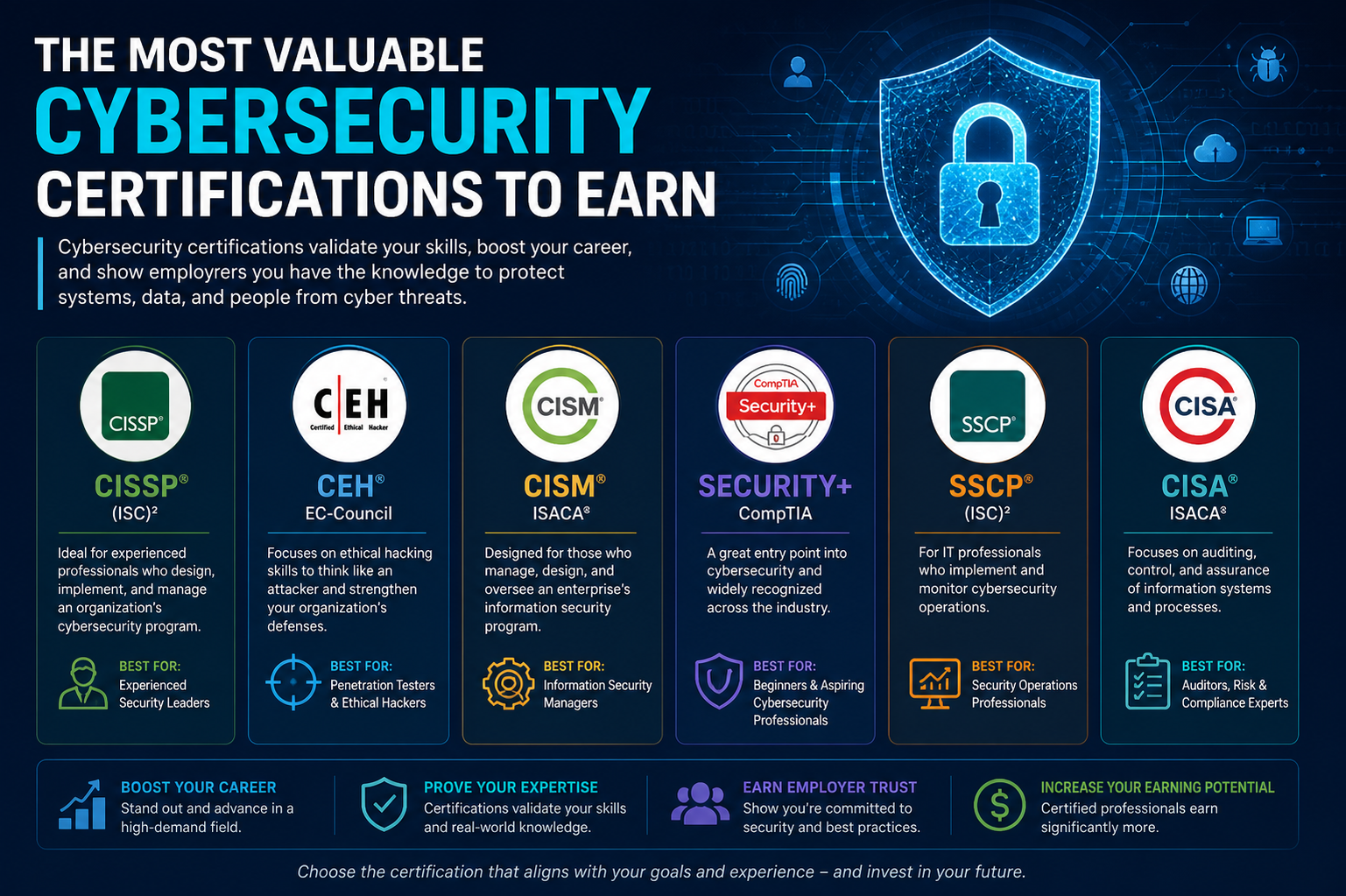
Cybersecurity certifications have become one of the most reliable ways to enter and progress in the information security field. As digital systems expand across every industry, organizations face increasing risks from data breaches, ransomware attacks, identity theft, and network intrusions. Because of this, companies actively look for professionals who can demonstrate verified knowledge through structured certification programs rather than experience alone.
These certifications are not just academic achievements; they reflect practical skills in identifying vulnerabilities, securing systems, managing risk, and responding to cyber incidents. They also help standardize knowledge in a field that evolves rapidly. Unlike traditional education paths, certifications are frequently updated to reflect modern threats and technologies, making them highly relevant for today’s security landscape.
For individuals entering cybersecurity or advancing within it, certifications serve as a roadmap. They help define what to learn, how to apply it, and which roles become accessible after each stage of progress.
Why Cybersecurity Certifications Matter in Today’s Digital Economy
The demand for cybersecurity professionals continues to rise as organizations become more dependent on digital infrastructure. Every system connected to the internet becomes a potential target, and companies must ensure their data, applications, and networks remain secure.
Certifications matter because they provide employers with a measurable standard of competence. Instead of relying solely on resumes or experience claims, hiring managers can trust that certified professionals have passed structured exams covering essential topics. This reduces hiring risk and increases confidence in a candidate’s technical ability.
In addition, certifications help professionals stay relevant. Cybersecurity is constantly evolving, with new attack methods emerging regularly. Certified individuals are expected to maintain up-to-date knowledge, which ensures they can respond effectively to modern threats.
Foundational Certifications for Building Core Knowledge
At the beginning of a cybersecurity journey, foundational certifications are extremely important. They introduce essential concepts such as networking, operating systems, security principles, encryption basics, and threat identification. These certifications are designed for beginners who may not yet have technical experience in IT security.
One of the key benefits of foundational certifications is that they simplify complex topics. Instead of overwhelming learners with advanced security architecture or penetration testing techniques, they focus on building a strong base. Understanding how networks communicate, how data is protected, and how attacks occur is essential before moving into more advanced roles.
These certifications also help individuals qualify for entry-level positions such as security support technician, IT support associate with security responsibilities, or junior security analyst roles. They act as a bridge between general IT knowledge and specialized cybersecurity expertise.
Another important aspect is confidence building. Many learners feel intimidated by cybersecurity due to its technical nature. Foundational certifications provide structured learning paths that make the field more accessible and achievable.
Developing Practical Skills Through Intermediate Certifications
After gaining basic knowledge, professionals typically move toward intermediate-level certifications that focus more on hands-on skills. These certifications introduce real-world security tasks such as vulnerability assessment, penetration testing, system monitoring, and incident response.
At this stage, learners begin working with tools and techniques used by cybersecurity professionals in actual work environments. They may learn how to analyze system logs, detect suspicious activity, and simulate cyberattacks to understand how systems can be exploited.
Intermediate certifications are highly valued because they demonstrate applied knowledge. Employers want professionals who can not only understand security concepts but also implement them in practical situations. These certifications often open doors to roles such as security analyst, network security administrator, and ethical hacker.
Another important feature of this level is specialization begins to emerge. Individuals may start focusing on areas like offensive security, defensive security, or security operations. This helps shape their long-term career direction.
Advanced Certifications for Leadership and Expertise
Advanced cybersecurity certifications are designed for experienced professionals who want to move into senior technical or leadership roles. These certifications cover complex topics such as enterprise security architecture, advanced threat modeling, risk governance, and compliance management.
At this level, the focus shifts from technical execution to strategic decision-making. Professionals are expected to understand how security integrates with business operations and how to design systems that protect large-scale organizations.
These certifications are often required for positions such as security architect, cybersecurity manager, or chief information security officer roles. They demonstrate not only technical expertise but also the ability to lead teams, manage risk at an organizational level, and design long-term security strategies.
Advanced certifications also emphasize regulatory compliance, which is critical in industries such as finance, healthcare, and government. Professionals learn how to align security practices with legal requirements and industry standards.
Specialized Certifications for Focused Career Paths
As cybersecurity becomes more diverse, specialized certifications allow professionals to focus on specific domains. Instead of general security knowledge, these certifications go deep into one area, such as cloud security, ethical hacking, digital forensics, or governance and compliance.
Cloud security certifications are increasingly important due to widespread adoption of cloud platforms. These certifications teach professionals how to secure cloud environments, manage access controls, and protect cloud-based data.
Ethical hacking certifications focus on offensive security techniques, teaching how attackers think and how systems can be tested for weaknesses. These skills are essential for penetration testers and security consultants.
Digital forensics certifications prepare professionals to investigate cybercrime, recover data, and analyze digital evidence. This specialization is often used in law enforcement and corporate investigation roles.
Governance and compliance certifications focus on policy creation, regulatory frameworks, and risk management strategies. These are particularly valuable in large organizations that must comply with strict security regulations.
How Certifications Align With Career Progression
Cybersecurity certifications are often structured in a way that mirrors career development. Beginners start with foundational knowledge, move into practical application, and eventually progress into leadership or specialized roles.
This progression is important because cybersecurity is not a static field. Professionals must continuously learn and adapt as threats evolve. Certifications provide a structured way to keep skills current while advancing professionally.
Entry-level certifications lead to junior roles, intermediate certifications lead to analyst and technical roles, and advanced certifications lead to managerial or architectural positions. Specialized certifications can be layered at any stage to enhance expertise in a particular area.
Industry Demand and Employer Expectations
Employers across industries increasingly prioritize certified candidates. This is because cybersecurity is a high-risk field where mistakes can lead to significant financial and reputational damage. Certifications reduce uncertainty by proving that a candidate has met established standards.
Many job postings now list certifications as preferred or required qualifications. In competitive job markets, certified professionals often have an advantage over non-certified candidates, even if experience levels are similar.
Industries such as banking, healthcare, government, and technology place especially high value on certifications due to strict compliance requirements and sensitive data handling responsibilities.
Skills Developed Through Certification Programs
Cybersecurity certifications develop a wide range of technical and analytical skills. These include network security configuration, threat detection, vulnerability assessment, encryption methods, and incident response strategies.
Beyond technical skills, certifications also build critical thinking and problem-solving abilities. Professionals learn how to analyze complex systems, identify weaknesses, and develop solutions under pressure.
Communication skills are also improved, especially in advanced certifications where professionals must explain security risks to non-technical stakeholders and contribute to organizational decision-making.
Choosing the Right Certification Path
Selecting the right certification path depends on individual goals and current experience level. Beginners should focus on foundational certifications to build core understanding. Those with experience in IT or networking may move directly into intermediate certifications.
Professionals interested in technical roles such as penetration testing should pursue offensive security certifications. Those interested in management or enterprise security should focus on governance and advanced architecture certifications.
It is also important to consider industry demand. Some certifications are more widely recognized across global industries, while others are highly specialized but valuable in niche sectors.
A well-planned certification path ensures continuous growth and avoids unnecessary overlap in learning.
Long-Term Value of Cybersecurity Certifications
Cybersecurity certifications offer long-term career value because they remain relevant throughout a professional’s journey. Unlike short-term technical trends, core security principles remain consistent, even as tools and technologies evolve.
Certified professionals often experience better job stability, higher salary potential, and more career mobility. Certifications also open opportunities for global employment, as many credentials are internationally recognized.
Over time, professionals who continue to upgrade their certifications build a strong reputation in the industry, positioning themselves as experts in their chosen fields.
Specialized Cybersecurity Certifications and Their Career Impact
As cybersecurity continues to expand across industries, specialization has become a defining factor in professional growth. While foundational and intermediate certifications build general competence, specialized certifications allow professionals to focus deeply on specific security domains. These certifications are particularly valuable because modern organizations rarely need generalists alone; they need experts who can solve highly specific and complex problems.
Specialized certifications are often aligned with real-world job functions. For example, a cloud security specialist focuses entirely on securing cloud environments, while a penetration testing specialist concentrates on identifying system vulnerabilities through simulated attacks. This targeted expertise makes certified professionals highly valuable in competitive job markets.
The increasing reliance on cloud computing, remote work infrastructure, and digital transformation has made specialization even more important. Companies now require professionals who understand not only traditional security principles but also how those principles apply to modern distributed systems.
Cloud Security Certifications and Their Growing Demand
Cloud computing has transformed how organizations store, manage, and process data. With this shift, securing cloud environments has become one of the most critical areas in cybersecurity. Cloud security certifications focus on protecting data, applications, and services hosted on platforms such as public, private, and hybrid cloud systems.
These certifications typically cover identity and access management, data encryption, secure architecture design, compliance in cloud environments, and threat detection in distributed systems. Professionals also learn how to configure security controls across multi-cloud environments, which is now a common requirement in large enterprises.
The demand for cloud security professionals continues to rise because misconfigurations and weak access controls are among the leading causes of data breaches. Organizations need certified experts who can design secure cloud infrastructures from the ground up while ensuring scalability and performance.
Cloud security roles often offer higher-than-average salaries due to the specialized skill set required. Professionals with these certifications are frequently employed as cloud security engineers, cloud architects, or DevSecOps specialists.
Ethical Hacking and Penetration Testing Certifications
Ethical hacking certifications are among the most well-known and respected in the cybersecurity field. These certifications focus on offensive security techniques, teaching professionals how attackers think and operate. By understanding attack methods, security experts can better defend systems against real threats.
Penetration testing involves simulating cyberattacks on networks, applications, and systems to identify vulnerabilities before malicious actors can exploit them. Certified ethical hackers learn techniques such as network scanning, vulnerability exploitation, password cracking, and web application testing.
These certifications are highly practical and require strong hands-on skills. Professionals are often placed in real-world lab environments where they must demonstrate their ability to break into systems ethically and report findings accurately.
The career impact of ethical hacking certifications is significant. Certified professionals often work as penetration testers, security consultants, or red team specialists. These roles are essential for organizations that want to proactively strengthen their defenses.
Digital Forensics and Incident Response Certifications
Cyber incidents such as data breaches, ransomware attacks, and insider threats require specialized investigation skills. Digital forensics and incident response certifications focus on identifying how attacks occurred, recovering compromised data, and preserving digital evidence.
Professionals in this field learn how to analyze system logs, recover deleted files, trace attacker activity, and document findings in a legally acceptable format. This requires both technical expertise and attention to detail, as forensic evidence may be used in legal proceedings.
Incident response is equally important, as organizations must react quickly to minimize damage during cyberattacks. Certified professionals are trained to contain threats, eliminate malicious activity, and restore system integrity.
These certifications are highly valued in law enforcement agencies, government organizations, financial institutions, and large corporations. Job roles often include digital forensics analyst, incident response specialist, and cybersecurity investigator.
Governance, Risk, and Compliance Certifications
Not all cybersecurity roles are purely technical. Governance, risk, and compliance certifications focus on the strategic and regulatory side of security. These certifications are designed for professionals who manage security policies, ensure compliance with laws, and assess organizational risk.
Governance involves establishing security policies and frameworks that guide how an organization protects its data and systems. Risk management focuses on identifying potential threats and evaluating their impact. Compliance ensures that organizations meet legal and industry standards such as data protection regulations.
Professionals in this area often work closely with executives and legal teams to ensure that security strategies align with business objectives. They also play a key role in audits and regulatory inspections.
These certifications are essential for roles such as risk analyst, compliance officer, security auditor, and information security manager. They are especially important in industries with strict regulatory requirements.
Network Security Certifications and Infrastructure Protection
Network security remains a foundational element of cybersecurity. Certifications in this area focus on protecting network systems from unauthorized access, attacks, and disruptions.
Professionals learn how to configure firewalls, manage intrusion detection systems, secure routers and switches, and monitor network traffic for suspicious activity. Understanding network architecture is essential for preventing breaches and ensuring system reliability.
As organizations continue to rely on interconnected systems, network security professionals play a crucial role in maintaining operational stability. Without proper network protection, even the most advanced security systems can be compromised.
Certified network security professionals often work as network security engineers, system administrators, or infrastructure security specialists. Their role is critical in both preventing and responding to cyber threats.
Application Security Certifications and Software Protection
Application security focuses on protecting software from vulnerabilities during development and deployment. These certifications teach professionals how to identify and fix security flaws in applications before they are released.
Topics include secure coding practices, vulnerability assessment, authentication mechanisms, and protection against common attacks such as SQL injection and cross-site scripting. Professionals also learn how to integrate security into the software development lifecycle.
As software becomes more complex and widely used, application security has become a top priority for organizations. A single vulnerability in an application can expose sensitive data and lead to large-scale breaches.
Certified application security professionals often work as security engineers, software security analysts, or DevSecOps engineers. Their expertise ensures that applications remain secure from development to production.
How Specialized Certifications Shape Career Identity
Specialized certifications not only build technical expertise but also define a professional’s career identity. Unlike general certifications, which provide broad knowledge, specialized certifications position individuals as experts in a specific domain.
This specialization helps professionals stand out in competitive job markets. Employers often prefer candidates who demonstrate deep knowledge in a targeted area rather than surface-level understanding of multiple domains.
Specialization also leads to higher earning potential. As professionals develop niche expertise, they become more valuable to organizations that require advanced security solutions in specific areas.
In many cases, specialization determines long-term career direction. A professional who begins in network security may transition into cloud security, while another may move into penetration testing or governance roles.
Industry Recognition and Global Value of Certifications
One of the most important advantages of cybersecurity certifications is global recognition. Many certifications are accepted across industries and countries, making them highly valuable for international career opportunities.
Employers around the world recognize certified professionals as credible and skilled, which reduces barriers to entry in foreign job markets. This is especially important in cybersecurity, where talent shortages exist globally.
Certifications also provide consistency in skill evaluation. Regardless of where a professional is located, certification standards ensure that their knowledge meets a global benchmark.
Continuous Learning and Certification Renewal
Cybersecurity is not a field where learning ever stops. Threats evolve continuously, and new technologies introduce new risks. As a result, many certifications require ongoing education or renewal to remain valid.
This encourages professionals to stay updated with the latest trends, tools, and attack methods. Continuous learning ensures that certified individuals remain effective in their roles even as the security landscape changes.
Professionals often pursue additional certifications throughout their careers to expand their expertise or transition into new roles. This lifelong learning approach is one of the defining characteristics of the cybersecurity profession.
Advanced Cybersecurity Certifications for Senior-Level Roles
Advanced cybersecurity certifications represent the highest level of professional development in the information security field. These certifications are designed for experienced professionals who already have strong technical foundations and practical exposure to security environments. At this stage, the focus shifts from performing tasks to designing strategies, managing risk at scale, and leading security initiatives across entire organizations.
Professionals pursuing advanced certifications are often preparing for senior positions such as security architect, cybersecurity manager, director of information security, or chief information security officer. These roles require not only technical expertise but also leadership skills, business understanding, and the ability to align security strategies with organizational goals.
Unlike entry-level or intermediate certifications, advanced programs demand a deep understanding of enterprise systems, regulatory frameworks, risk management methodologies, and complex threat landscapes. They are designed to validate the ability to think strategically and make decisions that affect entire infrastructures.
Enterprise Security Architecture and Strategic Design
One of the key areas covered in advanced certifications is enterprise security architecture. This involves designing secure systems that support large organizations with multiple departments, technologies, and operational requirements.
Security architects are responsible for building frameworks that integrate security into every layer of an organization’s IT environment. This includes network design, application security, cloud integration, identity management, and data protection strategies.
Advanced certifications in this area focus on teaching professionals how to evaluate business requirements and translate them into secure technical solutions. This requires balancing security with usability, performance, and cost efficiency.
Professionals also learn how to anticipate future risks and design systems that can adapt to evolving threats. This forward-looking approach is essential in modern cybersecurity, where new attack vectors emerge constantly.
Risk Management and Organizational Security Governance
Risk management is a central component of advanced cybersecurity certifications. At senior levels, professionals are expected to evaluate risks not just technically, but also in terms of business impact.
This includes identifying potential threats, assessing vulnerabilities, and calculating the financial and operational consequences of security incidents. Risk management frameworks help organizations prioritize security investments and allocate resources effectively.
Governance is closely linked to risk management. It involves creating policies, standards, and procedures that guide how security is implemented across the organization. Certified professionals ensure that these policies align with both internal objectives and external regulations.
In many organizations, governance and risk professionals act as advisors to executive leadership, helping them make informed decisions about cybersecurity investments and strategies.
Compliance and Regulatory Leadership in Cybersecurity
As organizations operate across multiple countries and industries, compliance with legal and regulatory standards becomes essential. Advanced certifications often include extensive coverage of compliance frameworks and international regulations.
Professionals in this area ensure that organizations adhere to data protection laws, industry standards, and contractual obligations. This includes managing audits, preparing compliance reports, and implementing controls that satisfy regulatory requirements.
Compliance is not just about avoiding penalties; it is about building trust with customers, partners, and stakeholders. Organizations that demonstrate strong compliance practices are more likely to maintain credibility in competitive markets.
Certified professionals often work closely with legal teams, auditors, and executive leadership to ensure that compliance is maintained across all levels of operation.
Security Leadership and Management Roles
Advanced certifications also prepare professionals for leadership roles within cybersecurity teams. These roles require a combination of technical expertise and management skills.
Security leaders are responsible for overseeing teams of analysts, engineers, and specialists. They coordinate security operations, manage incident response efforts, and ensure that security policies are effectively implemented.
Leadership in cybersecurity also involves communication with non-technical stakeholders. Professionals must explain risks, present security strategies, and justify investments in a way that executives can understand.
Strong leadership certifications emphasize decision-making under pressure, crisis management, and long-term strategic planning. These skills are critical during large-scale cyber incidents where quick and effective action is required.
Incident Response at the Organizational Level
At advanced levels, incident response becomes a coordinated organizational function rather than an individual task. Certified professionals are responsible for designing and managing incident response frameworks that guide how organizations react to cyberattacks.
This includes establishing response teams, defining escalation procedures, and ensuring that communication channels are clear during security incidents.
Advanced incident response training focuses on large-scale attack scenarios such as ransomware outbreaks, data breaches, and advanced persistent threats. Professionals learn how to minimize damage, restore systems, and prevent future incidents.
They also play a key role in post-incident analysis, identifying root causes and implementing improvements to strengthen future defenses.
Cybersecurity Risk in Business Decision-Making
One of the defining aspects of advanced certifications is the integration of cybersecurity into business strategy. At senior levels, security is no longer viewed as a purely technical function but as a critical business enabler.
Certified professionals are trained to evaluate how security decisions impact business operations, revenue, and reputation. They help organizations understand the cost of security versus the cost of potential breaches.
This strategic perspective allows cybersecurity leaders to influence business decisions at the highest level. They contribute to mergers, acquisitions, digital transformation initiatives, and long-term technology planning.
By aligning security with business objectives, organizations can achieve both protection and growth without compromising operational efficiency.
Threat Intelligence and Strategic Defense Planning
Advanced cybersecurity certifications often include threat intelligence as a core subject. Threat intelligence involves analyzing data about current and emerging cyber threats to predict and prevent attacks.
Professionals learn how to collect, analyze, and interpret threat data from multiple sources. This information is used to identify attack patterns, understand adversary behavior, and strengthen defensive strategies.
Threat intelligence helps organizations move from reactive security to proactive defense. Instead of responding to attacks after they occur, certified professionals help prevent them by anticipating attacker behavior.
This strategic approach is essential for large organizations that face constant and sophisticated cyber threats.
Integration of Cybersecurity with Emerging Technologies
As technology evolves, advanced certifications also cover the integration of cybersecurity with emerging fields such as artificial intelligence, machine learning, Internet of Things systems, and blockchain technologies.
These technologies introduce new security challenges that require specialized knowledge. For example, AI systems may be vulnerable to data poisoning attacks, while IoT devices often have weak security controls.
Certified professionals learn how to secure these technologies while leveraging their benefits. This ensures that organizations can innovate safely without exposing themselves to unnecessary risks.
Understanding emerging technologies is increasingly important as digital transformation accelerates across industries.
Career Growth and Global Opportunities at Advanced Levels
Advanced cybersecurity certifications open doors to high-level career opportunities across the globe. Professionals with these credentials are often sought after by multinational corporations, government agencies, and large enterprises.
These roles typically come with significant responsibility, influence, and compensation. However, they also require continuous learning and adaptability due to the rapidly changing threat landscape.
Certified senior professionals often move into executive positions where they shape organizational security strategies and influence industry standards.
The global recognition of advanced certifications also allows professionals to work in international markets, expanding their career mobility significantly.
Continuous Evolution of Advanced Cybersecurity Skills
Even at advanced levels, cybersecurity professionals must continue to evolve. New threats, technologies, and regulations emerge constantly, requiring ongoing education and adaptation.
Many advanced certifications require periodic renewal or continuing professional development to ensure that skills remain current. This reflects the reality that cybersecurity is a constantly changing field.
Professionals often combine multiple advanced certifications to maintain broad and deep expertise. This layered knowledge helps them stay effective in complex and high-pressure environments.
The Role of Cybersecurity Certifications in Career Progression
Cybersecurity certifications play a structured and continuous role in shaping a professional’s career path. Unlike many other fields where experience alone may be sufficient, cybersecurity relies heavily on validated knowledge and proven competencies. Certifications act as checkpoints that guide professionals from entry-level understanding to advanced expertise and leadership capability.
Each stage of certification builds upon the previous one, ensuring that professionals do not skip essential knowledge areas. This structured progression helps reduce skill gaps that could otherwise lead to security vulnerabilities in real-world environments. As a result, organizations prefer hiring certified professionals because they follow a standardized learning path that aligns with industry expectations.
Career progression in cybersecurity is often non-linear, meaning professionals may shift between technical, managerial, and specialized roles throughout their careers. Certifications provide the flexibility to support these transitions while maintaining credibility and relevance in the field.
Entry into Cybersecurity Careers Through Certifications
For individuals entering the cybersecurity field for the first time, certifications serve as a gateway into the industry. Many employers consider certifications as proof of baseline knowledge, especially when candidates lack direct job experience in security roles.
Entry-level certifications help individuals understand fundamental concepts such as system security, network architecture, access control, encryption basics, and threat identification. These concepts form the foundation upon which all advanced cybersecurity skills are built.
At this stage, certifications also help candidates overcome the common challenge of “experience requirements” in job postings. By demonstrating structured learning and exam success, individuals can qualify for junior roles such as security support technician, IT support with security focus, or junior analyst positions.
This entry point is critical because it helps bridge the gap between academic learning and real-world cybersecurity environments.
Transition from IT Roles to Cybersecurity Specialization
Many cybersecurity professionals begin their careers in general IT roles before transitioning into security-focused positions. Certifications play a key role in this transition by providing targeted knowledge that is not typically covered in general IT training.
Professionals working in networking, system administration, or software development often use certifications to shift their focus toward security. These credentials help them understand how their existing skills apply to cybersecurity challenges.
For example, a network administrator may pursue security certifications to learn how to protect infrastructure rather than just maintain it. Similarly, a software developer may move into application security by learning secure coding practices and vulnerability analysis.
This transition is one of the most common pathways into cybersecurity and is strongly supported by certification programs.
Skill Validation and Employer Confidence
One of the most important functions of cybersecurity certifications is skill validation. Employers face significant risks when hiring security professionals, as mistakes in this field can lead to data breaches, financial losses, and reputational damage.
Certifications provide a standardized measure of competence, reducing uncertainty during the hiring process. They confirm that a candidate has passed structured assessments and demonstrated understanding of critical security concepts.
This validation is particularly important in senior and specialized roles where responsibilities are high and errors can have severe consequences. Certified professionals are often trusted more quickly in new roles because their skills have already been verified through industry-recognized standards.
As a result, certifications significantly improve employability and career stability.
Salary Growth and Financial Benefits of Certifications
Cybersecurity certifications are strongly linked to salary growth and financial advancement. As professionals progress through different certification levels, their earning potential typically increases.
Entry-level certifications may lead to modest starting salaries in IT security roles, while intermediate certifications can significantly increase income by qualifying individuals for analyst and engineering positions. Advanced and specialized certifications often lead to high-paying leadership or expert roles.
The financial value of certifications is driven by market demand. Cybersecurity skills are in short supply globally, and organizations are willing to pay a premium for certified professionals who can reduce risk and protect critical assets.
In many cases, certifications also lead to faster promotions and increased job stability, further enhancing long-term financial benefits.
Global Recognition and International Career Mobility
One of the most powerful advantages of cybersecurity certifications is their global recognition. Many certifications are accepted across multiple countries and industries, making them highly valuable for professionals seeking international opportunities.
This global recognition allows certified professionals to work in different regions without needing to repeat their qualifications. Employers worldwide understand and trust standardized certification frameworks, which reduces barriers to entry in foreign job markets.
International mobility is particularly important in cybersecurity because threats are global in nature. Organizations often prefer professionals who understand international standards and can operate across different regulatory environments.
This makes certifications a powerful tool for building a global cybersecurity career.
Continuous Learning as a Core Requirement
Cybersecurity is one of the few fields where continuous learning is not optional but essential. The threat landscape evolves rapidly, with attackers constantly developing new methods and tools.
To remain effective, professionals must continuously update their knowledge and skills. Many certifications require periodic renewal, ensuring that certified individuals stay current with industry developments.
Continuous learning may involve re-certification exams, professional development courses, or additional specialization certifications. This ongoing process ensures that cybersecurity professionals remain effective throughout their careers.
It also encourages adaptability, which is a key trait in a field where outdated knowledge can quickly become a liability.
The Role of Certifications in Organizational Security Strategy
Beyond individual career growth, cybersecurity certifications also contribute to organizational security strategy. Certified professionals help organizations design, implement, and maintain effective security frameworks.
They play a key role in identifying risks, developing mitigation strategies, and ensuring compliance with industry standards. Their expertise supports decision-making at both technical and executive levels.
Organizations with certified staff are often better prepared to handle cyber incidents and maintain regulatory compliance. This makes certifications not only valuable for individuals but also essential for organizational resilience.
Bridging the Skills Gap in Cybersecurity Industry
The cybersecurity industry continues to face a significant global skills shortage. There are more job openings than qualified professionals available, creating a persistent gap in the workforce.
Certifications help bridge this gap by standardizing training and making cybersecurity education more accessible. They provide structured learning paths that allow individuals from diverse backgrounds to enter the field.
This is especially important as cybersecurity expands beyond traditional IT roles into areas such as finance, healthcare, manufacturing, and government. Certifications enable professionals from different industries to transition into security roles more effectively.
By providing a clear pathway into the field, certifications help address one of the biggest challenges in modern cybersecurity.
Adaptability in a Rapidly Changing Threat Landscape
Cybersecurity is constantly evolving due to technological advancements and increasingly sophisticated cyber threats. Attackers continuously develop new methods, including advanced phishing techniques, ransomware variants, and AI-driven attacks.
Certifications help professionals stay adaptable by updating their knowledge regularly. They ensure that individuals are aware of the latest threats, tools, and defensive strategies.
This adaptability is critical for maintaining strong security defenses. Professionals who rely on outdated knowledge are more likely to miss emerging threats or fail to implement effective protections.
Certifications therefore act as a mechanism for continuous adaptation in a dynamic environment.
Long-Term Professional Identity and Expertise Development
Over time, cybersecurity certifications contribute to building a professional identity. Individuals are often recognized in the industry based on their certifications and areas of specialization.
This identity helps professionals establish credibility and authority within their chosen domains. Whether in cloud security, ethical hacking, governance, or incident response, certifications define areas of expertise.
As professionals accumulate multiple certifications, they build a comprehensive skill set that supports long-term career growth. This layered expertise allows them to take on more complex challenges and leadership responsibilities.
In many cases, certifications become a defining feature of a cybersecurity professional’s career journey.
Conclusion
Cybersecurity certifications play a central role in shaping careers, validating skills, and ensuring long-term professional growth. They guide individuals from entry-level knowledge to advanced expertise and leadership positions while supporting continuous learning and adaptation.
Beyond individual benefits, certifications strengthen organizations by improving security practices, reducing risk, and enhancing compliance. They also help bridge the global skills gap and enable professionals to pursue international career opportunities.
In an industry defined by constant change and increasing complexity, cybersecurity certifications remain one of the most effective tools for building strong, adaptable, and future-ready professionals.