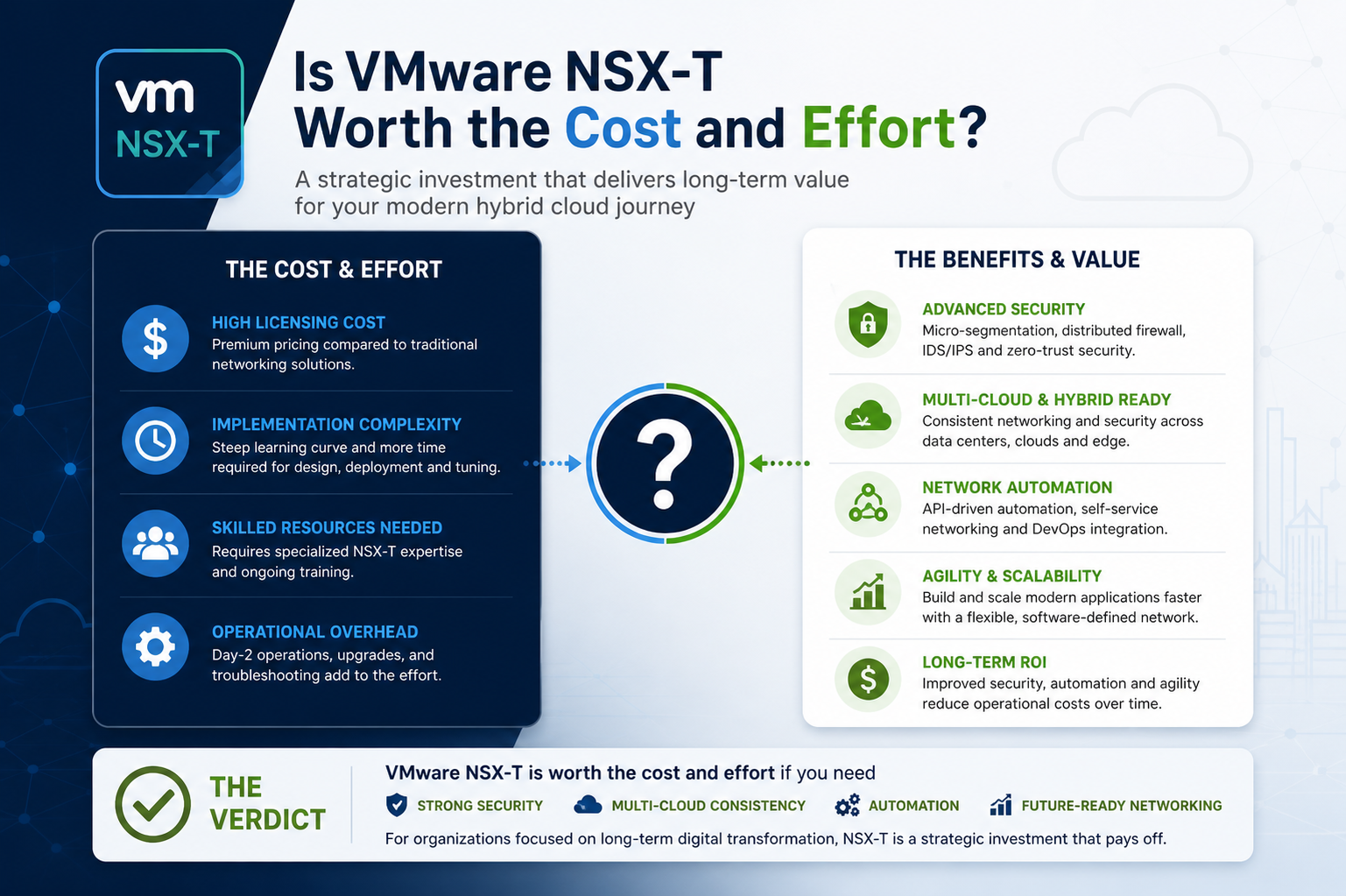
Modern IT environments are no longer limited to a single physical data center or a simple network layout. Most organizations now operate across hybrid infrastructures that combine on-premises systems, private clouds, and public cloud platforms. This shift has created a demand for more flexible, programmable, and secure networking solutions. VMware NSX-T emerged as a response to this need, offering a software-defined approach to networking and security that removes much of the dependency on traditional hardware-based configurations.
At its core, NSX-T is designed to abstract networking from the physical layer, allowing administrators to create, modify, and manage networks entirely in software. This brings significant agility, but it also introduces complexity and cost considerations. Whether it is worth the investment depends heavily on the scale of operations, technical maturity of the organization, and long-term infrastructure strategy.
Understanding VMware NSX-T in Practical Terms
VMware NSX-T can be understood as a network virtualization platform that replicates traditional networking components such as switches, routers, and firewalls in a software environment. Instead of relying on physical devices, these functions are implemented virtually and managed through centralized control.
This approach allows networks to be created and modified at the speed of software deployment rather than hardware provisioning. It also enables consistent policy enforcement across different environments, whether workloads are running in a data center or in a cloud platform.
The key value lies in decoupling networking from physical infrastructure, which enables greater flexibility and automation. However, this shift also requires a different mindset compared to traditional networking, where physical topology played a central role.
Architectural Flexibility and Design Complexity
One of the strongest features of NSX-T is its ability to support diverse environments. It is designed to work across multiple hypervisors, container platforms, and cloud systems. This makes it suitable for modern application architectures that rely heavily on microservices and distributed workloads.
However, this flexibility introduces design complexity. Implementing NSX-T is not simply a matter of installation; it requires careful architectural planning. Network segments, transport zones, overlay configurations, and security policies must all be designed in alignment with application requirements.
For organizations transitioning from traditional networking, this can be a significant shift. The abstraction layer introduced by NSX-T means that network administrators must think in terms of logical constructs rather than physical connections. This can take time to fully understand and implement correctly.
Cost Implications and Investment Factors
The cost of VMware NSX-T is one of the most critical factors in evaluating its worth. Costs can be divided into several categories, including licensing, infrastructure upgrades, and operational expenses.
Licensing itself is typically positioned for enterprise environments, which can make it expensive for smaller organizations. Beyond licensing, there is often a need for compatible hardware, particularly in environments that require high performance or large-scale deployments.
Another hidden cost is training and skill development. NSX-T is not a tool that can be fully utilized without proper expertise. Organizations often need to invest in certified professionals or extensive training programs to ensure correct deployment and management.
In addition to initial setup costs, ongoing operational costs must also be considered. While NSX-T can reduce manual networking effort in the long term, the initial phases of deployment and optimization can be resource-intensive.
Implementation Effort and Learning Curve
Deploying NSX-T is a complex process that requires careful planning and coordination between network, security, and virtualization teams. Unlike traditional networking, where changes are often made at the hardware level, NSX-T requires configuration at multiple software layers.
The implementation process typically involves designing logical networks, configuring transport nodes, setting up overlays, and defining security policies. Each of these steps requires precision, as misconfigurations can lead to connectivity or performance issues.
The learning curve is another important factor. Teams familiar with traditional networking may initially struggle with the abstraction layer introduced by NSX-T. Instead of managing physical switches and routers directly, they must work with logical constructs and centralized policies.
Despite this complexity, once the system is properly configured, day-to-day management becomes significantly more streamlined.
Security Advantages and Micro-Segmentation
One of the most compelling benefits of NSX-T is its advanced security model. Traditional network security often relies on perimeter-based defenses, which assume that threats originate from outside the network. However, modern threats frequently move laterally within internal systems.
NSX-T addresses this issue through micro-segmentation, which allows security policies to be applied at the individual workload level. This means that each application or virtual machine can have its own security rules, limiting lateral movement in case of a breach.
This granular control significantly enhances security posture, especially in environments handling sensitive data or regulated workloads. It also reduces dependency on physical firewalls, shifting security enforcement closer to the workload itself.
Automation and Operational Efficiency
Automation is another key strength of NSX-T. By integrating with orchestration tools and APIs, it allows networks to be provisioned and modified programmatically. This is particularly valuable in DevOps-driven environments where infrastructure needs to scale dynamically.
Instead of manually configuring network components, administrators can define policies that automatically apply across environments. This reduces human error and accelerates deployment cycles.
Over time, this level of automation can significantly reduce operational overhead, allowing IT teams to focus more on strategic initiatives rather than repetitive configuration tasks.
Performance Considerations and Scalability
Performance in NSX-T environments depends heavily on proper design and resource allocation. Since networking functions are virtualized, they rely on underlying compute and storage resources.
When properly optimized, NSX-T can scale efficiently across large environments, supporting thousands of workloads. However, poor configuration or insufficient hardware resources can lead to performance bottlenecks.
Latency, throughput, and overlay network efficiency must all be carefully monitored. In high-performance environments such as large enterprise data centers, proper tuning is essential to ensure consistent performance.
Real-World Use Cases and Suitability
NSX-T is particularly well-suited for large enterprises, cloud providers, and organizations with complex multi-site architectures. It is commonly used in environments where workload mobility, hybrid cloud integration, and strong security segmentation are critical requirements.
Industries such as finance, telecommunications, healthcare, and large-scale technology companies often benefit the most due to their stringent security and scalability needs.
On the other hand, smaller organizations or those with relatively simple network structures may find NSX-T excessive for their needs. In such cases, the cost and complexity may outweigh the operational benefits.
Limitations and Challenges
Despite its advantages, NSX-T is not without limitations. The most significant challenge is complexity. It introduces a layered abstraction model that requires specialized knowledge to manage effectively.
Another limitation is vendor dependency. Organizations adopting NSX-T often become closely tied to its ecosystem, which can reduce flexibility in certain scenarios.
Additionally, troubleshooting can be more difficult compared to traditional networking, as issues may exist across multiple virtual layers rather than a single physical device.
Decision-Making Considerations
Determining whether NSX-T is worth the investment requires a clear understanding of organizational needs. If the primary goals include improved security, automation, scalability, and multi-cloud integration, then NSX-T can provide significant long-term value.
However, if the network environment is relatively simple or static, the benefits may not justify the cost and complexity. A careful assessment of current infrastructure limitations and future growth plans is essential before making a decision.
It is also important to consider internal skill readiness. Without a capable technical team, the platform may not be fully utilized, reducing its overall return on investment.
VMware NSX-T represents a powerful evolution in network virtualization, offering advanced capabilities in security, automation, and scalability. It is designed for modern IT environments that require flexibility and control across distributed infrastructures.
However, this power comes with a price in terms of cost, complexity, and operational learning curve. For large and dynamic enterprises, the investment can be justified by the long-term gains in efficiency and security. For smaller or less complex environments, simpler alternatives may be more practical.
Ultimately, its value is not universal but contextual. NSX-T is worth it when its advanced capabilities align closely with organizational needs and when the infrastructure scale demands a software-defined approach to networking.
Operational Management After Deployment
Once VMware NSX-T is fully deployed, the nature of network management changes significantly compared to traditional infrastructures. Instead of dealing with physical devices and manual configurations, administrators work within a centralized software layer where networking, security, and automation are controlled through logical constructs. This shift simplifies many day-to-day operations, but it also introduces a new operational discipline that must be maintained consistently.
In mature NSX-T environments, changes to network configurations are typically handled through defined policies rather than direct device-level modifications. This reduces configuration drift and improves consistency across environments. However, it also means that teams must be highly disciplined in maintaining policy structures and documentation, since errors at the policy level can propagate widely.
Monitoring and visibility are also different in NSX-T environments. Traditional tools that focus on hardware interfaces are no longer sufficient on their own. Instead, administrators must rely on software-defined monitoring systems that provide insights into logical networks, overlays, and distributed firewall activity. This requires teams to adapt their operational mindset and adopt new troubleshooting methodologies.
Security Architecture in Real Deployment Scenarios
One of the most powerful aspects of NSX-T in real-world usage is its distributed security model. Unlike traditional security architectures that rely heavily on centralized firewalls, NSX-T enforces security policies directly at the virtual network level. This means that every workload can be protected individually, regardless of its physical location.
This distributed approach significantly reduces the attack surface within internal networks. If a threat enters one segment of the infrastructure, micro-segmentation helps prevent it from spreading laterally. This is especially important in modern environments where workloads are highly dynamic and frequently moved across hosts or clouds.
In practical deployment scenarios, organizations often use NSX-T to define security zones based on application tiers, business functions, or compliance requirements. For example, database systems may be isolated from application servers even if they reside on the same physical infrastructure. This level of granular control is difficult to achieve with traditional networking models.
However, designing an effective security model requires careful planning. Poorly structured policies can lead to overly complex rule sets that become difficult to manage over time. As environments scale, maintaining clarity in security rules becomes just as important as the initial configuration.
Scalability in Large Enterprise Environments
NSX-T is designed with scalability in mind, making it suitable for large enterprise environments that handle thousands of virtual machines or containerized workloads. Its architecture allows networks to expand horizontally without requiring major physical infrastructure changes.
In large-scale deployments, NSX-T supports multiple clusters, transport nodes, and edge services that can be distributed across different geographic locations. This makes it possible to build highly resilient and geographically dispersed network architectures.
One of the key strengths in scalability is workload mobility. Virtual machines or containers can be moved between hosts or even across data centers without requiring major network reconfiguration. This is particularly valuable for disaster recovery scenarios, load balancing, and cloud migration strategies.
Despite this scalability, proper design remains critical. Poor architectural decisions in early stages can lead to bottlenecks or inefficient routing paths as the environment grows. Scalability is not automatic; it must be supported by strong foundational design principles.
Integration With Cloud and Modern Application Platforms
Modern IT environments rarely exist in isolation, and NSX-T is often deployed as part of a broader hybrid or multi-cloud strategy. It integrates with cloud platforms and container orchestration systems, allowing consistent networking and security policies across different environments.
This integration is particularly valuable for organizations adopting microservices-based application architectures. In such environments, applications are broken into smaller components that communicate frequently across network boundaries. NSX-T helps manage this complexity by providing consistent networking constructs regardless of where workloads are deployed.
In containerized environments, NSX-T can extend networking and security policies to Kubernetes clusters, ensuring that container workloads are governed by the same rules as virtual machines. This unified approach reduces fragmentation and simplifies policy management across different platforms.
However, integration also increases complexity. Each additional platform introduces new dependencies, and ensuring consistent behavior across environments requires careful synchronization of policies and configurations.
Performance Optimization in Real Environments
Performance is a critical consideration in NSX-T deployments, especially in high-throughput environments such as data centers or cloud infrastructure platforms. Since networking functions are virtualized, they depend heavily on underlying compute resources.
To achieve optimal performance, NSX-T environments must be carefully tuned. This includes proper allocation of CPU and memory resources to network functions, efficient design of overlay networks, and optimization of routing paths.
In many cases, performance issues are not caused by NSX-T itself but by misconfiguration or insufficient infrastructure planning. For example, improper distribution of workloads across hosts can lead to uneven resource utilization and network congestion.
When properly optimized, NSX-T can deliver performance comparable to traditional networking while providing significantly greater flexibility. However, achieving this level of performance requires expertise and ongoing monitoring.
Operational Risks and Common Challenges
While NSX-T offers many advantages, it also introduces certain operational risks. One of the most common challenges is configuration complexity. Because the system operates across multiple abstraction layers, small configuration errors can have wide-reaching effects.
Another challenge is troubleshooting. In traditional networks, issues are often isolated to specific hardware components. In NSX-T environments, however, problems can span multiple virtual layers, making root cause analysis more complex.
There is also the risk of over-engineering. Because NSX-T provides so many capabilities, organizations may implement overly complex architectures that are difficult to maintain. Without proper governance, this can lead to operational inefficiencies over time.
Additionally, dependency on skilled personnel is a significant factor. NSX-T environments require administrators who are comfortable working with both networking concepts and virtualization technologies. A lack of expertise can reduce the effectiveness of the platform.
Long-Term Value and Return on Investment
The long-term value of NSX-T is closely tied to how effectively it is implemented and utilized. In organizations that fully adopt its capabilities, the platform can deliver strong returns in terms of operational efficiency, security posture, and infrastructure agility.
Automation reduces manual workload, allowing IT teams to focus on higher-level tasks rather than repetitive configuration management. Micro-segmentation improves security outcomes, potentially reducing the risk and impact of breaches. Scalability enables organizations to grow without major network redesigns.
However, these benefits are only fully realized when NSX-T is integrated deeply into the organization’s operational model. Partial or superficial adoption may not justify the investment, as the complexity remains without delivering full value.
Return on investment is therefore not immediate. It typically becomes more apparent over time as operational efficiencies accumulate and infrastructure demands increase.
Strategic Fit Within Modern IT Infrastructure
NSX-T is best viewed not just as a tool, but as part of a broader strategic shift toward software-defined infrastructure. It aligns closely with trends such as cloud-native computing, infrastructure as code, and DevOps-driven operations.
Organizations that are actively modernizing their IT environments are more likely to benefit from NSX-T because it supports automation, flexibility, and hybrid cloud integration. It fits naturally into environments where agility and scalability are prioritized over static infrastructure models.
However, for organizations that maintain traditional, static infrastructure with limited change requirements, NSX-T may not align well with their operational model. In such cases, the platform may introduce unnecessary complexity.
Final Evaluation of Worth
When evaluating whether VMware NSX-T is worth the cost and effort, the answer is highly dependent on context. It is a powerful platform that can transform how networking and security are managed, but it requires significant investment in both resources and expertise.
For large, complex, and rapidly evolving IT environments, NSX-T can provide substantial long-term value through automation, security, and scalability. For simpler environments, the same complexity that makes it powerful can also make it unnecessarily difficult to manage.
Ultimately, its worth is determined by alignment. When organizational needs match its capabilities, NSX-T becomes a strategic advantage. When they do not, it can become an expensive and complex solution that delivers limited practical benefit.
Migration From Traditional Networking
Moving from traditional networking to VMware NSX-T is not a simple upgrade; it is a fundamental shift in how network infrastructure is designed and managed. Traditional networks rely heavily on physical devices such as switches, routers, and firewalls, where configuration changes are often manual and tightly coupled with hardware. NSX-T replaces much of this with a software-defined model, which means migration requires rethinking existing architectures rather than simply replicating them in a new system.
During migration, one of the biggest challenges is mapping existing network topologies into logical constructs. VLANs, subnets, routing rules, and firewall policies must all be translated into NSX-T equivalents. This process is not always straightforward, especially in environments where legacy configurations are complex or poorly documented.
Many organizations adopt a phased migration strategy to reduce risk. Instead of migrating everything at once, workloads are gradually moved into NSX-T segments while maintaining interoperability with existing infrastructure. This hybrid approach helps minimize downtime but increases the complexity of management during the transition phase.
Another important factor in migration is dependency analysis. Applications often have hidden network dependencies that are not immediately visible in documentation. Identifying and replicating these dependencies accurately in NSX-T is essential to avoid service disruption.
Training, Skills, and Organizational Readiness
One of the most overlooked aspects of NSX-T adoption is the human factor. The platform requires a different skill set compared to traditional networking. Network engineers must become familiar not only with routing and switching concepts but also with virtualization, automation, and policy-based management.
Training plays a critical role in successful adoption. Teams often need structured learning paths that include both theoretical understanding and hands-on lab environments. Without sufficient training, even well-designed NSX-T deployments can suffer from misconfigurations and inefficiencies.
Organizational readiness is equally important. NSX-T is most effective when multiple teams—networking, security, virtualization, and cloud operations—collaborate closely. Silos between these teams can slow down implementation and reduce the effectiveness of the platform.
In many cases, organizations also need to redefine operational responsibilities. For example, security policies that were previously managed by a separate firewall team may now be distributed across multiple layers within NSX-T. This requires clear governance and role definition.
Cost vs Value Over Time
While initial costs for NSX-T can be high, its value is often realized gradually over time. The upfront investment includes licensing, infrastructure readiness, and training, but the long-term benefits are tied to operational efficiency and automation.
As environments scale, NSX-T can reduce the need for manual network configuration. This leads to fewer human errors, faster provisioning, and more consistent policy enforcement. Over time, these improvements can translate into cost savings, especially in large organizations with frequent infrastructure changes.
However, the return on investment is not guaranteed. If NSX-T is underutilized or implemented without clear strategy, organizations may not fully realize its benefits. In such cases, the cost can outweigh the operational gains.
It is also important to consider opportunity cost. Resources spent on deploying and managing NSX-T could otherwise be allocated to different infrastructure strategies. This makes careful planning essential before committing to adoption.
Security Transformation Impact
NSX-T significantly changes how security is implemented and managed within an organization. Instead of relying primarily on perimeter-based defenses, security becomes embedded within the network itself. This shift aligns with modern cybersecurity principles that assume threats may already exist inside the network.
Micro-segmentation is a key component of this transformation. It allows administrators to define highly specific security policies for individual workloads or application components. This reduces the blast radius of potential breaches and improves overall resilience.
In practical terms, this means that even if an attacker gains access to one part of the network, movement to other systems is restricted by default. This is a major improvement over traditional flat network architectures where internal movement is often easier.
However, implementing micro-segmentation effectively requires deep understanding of application behavior. Without proper planning, security rules can become overly complex or too restrictive, potentially impacting application performance or connectivity.
Operational Efficiency Gains
One of the strongest arguments in favor of NSX-T is its potential to improve operational efficiency. By centralizing network management and introducing automation, many repetitive tasks can be eliminated.
Provisioning new network segments, applying security policies, and adjusting routing configurations can all be automated through APIs and orchestration tools. This reduces the time required to deploy new services and allows IT teams to respond more quickly to business needs.
In addition, NSX-T reduces reliance on physical hardware changes. In traditional environments, scaling often requires purchasing and configuring new devices. With NSX-T, scaling can often be achieved through software configuration, which is faster and more flexible.
Over time, these efficiencies can lead to significant operational savings. However, they are most effective in environments where change is frequent and infrastructure is dynamic.
Complexity Management and Governance
Despite its benefits, NSX-T introduces a new layer of complexity that must be actively managed. Without proper governance, environments can become difficult to maintain and troubleshoot.
Governance involves defining clear standards for network design, security policies, and operational procedures. It also includes maintaining documentation and ensuring consistency across deployments.
As environments grow, maintaining visibility becomes increasingly important. Logical networks can become complex, and without proper structure, administrators may struggle to understand how different components interact.
To manage this complexity, many organizations adopt structured design frameworks and naming conventions. This helps ensure that NSX-T environments remain understandable and maintainable over time.
Troubleshooting and Support Challenges
Troubleshooting in NSX-T environments can be more challenging than in traditional networks due to the abstraction layers involved. Issues may arise in compute, network virtualization, or overlay configurations, making root cause analysis more complex.
Effective troubleshooting requires familiarity with multiple components of the system. Administrators must understand not only NSX-T itself but also the underlying hypervisor and physical network infrastructure.
Logs and diagnostic tools are essential for identifying issues, but interpreting them correctly requires experience. In many cases, problems that appear to be network-related may actually originate from compute or configuration issues elsewhere in the stack.
Support structures are therefore critical. Organizations often rely on vendor support or specialized expertise to resolve complex issues, especially in early stages of deployment.
When NSX-T Is Most Worth It
NSX-T delivers the most value in environments where flexibility, security, and scalability are critical requirements. Large enterprises with distributed infrastructure, multi-cloud strategies, or strict compliance needs are the primary beneficiaries.
It is particularly valuable in organizations that frequently deploy new applications or need to support dynamic workloads. In such environments, the ability to automate networking and security becomes a major advantage.
Industries with high security demands also benefit significantly. The ability to enforce micro-segmentation and granular control over traffic flows helps meet regulatory and internal security requirements.
In these scenarios, the cost and complexity of NSX-T are often justified by the operational and security improvements it provides.
When It May Not Be Worth It
There are situations where NSX-T may not be the best fit. Small or medium-sized organizations with simple network structures may find the platform overly complex for their needs.
If infrastructure changes are infrequent and workloads are relatively static, the benefits of automation and virtualization may not be fully realized. In such cases, traditional networking approaches may be more cost-effective.
Organizations lacking skilled personnel may also struggle to fully utilize NSX-T. Without proper expertise, the platform’s capabilities may remain underused, reducing its overall value.
In these scenarios, the cost of licensing, training, and maintenance may outweigh the practical benefits.
Lifecycle Management and Ongoing Maintenance
After VMware NSX-T is deployed and stabilized, the focus naturally shifts toward lifecycle management. Unlike traditional networking environments where hardware refresh cycles dominate long-term planning, NSX-T introduces a software-driven lifecycle that requires continuous updates, version management, and policy refinement.
Software-defined environments evolve more frequently than hardware-centric systems. This means administrators must stay aligned with updates, patches, and compatibility requirements across the entire stack, including hypervisors, compute resources, and network virtualization components. While this allows access to new features and security improvements more rapidly, it also increases the need for disciplined change management.
Maintenance in NSX-T environments is less about physical replacement and more about configuration integrity and system coherence. Over time, environments can accumulate redundant policies, outdated segments, or unused configurations. Without regular cleanup and optimization, this can lead to unnecessary complexity and reduced performance visibility.
Lifecycle management also includes capacity planning. As workloads grow, NSX-T components such as edge nodes and controllers must scale accordingly. Proper planning ensures that performance remains stable and that network services continue to function efficiently under increased demand.
Reliability and High Availability Considerations
One of the strengths of NSX-T is its ability to support highly available architectures. It is designed with redundancy in mind, allowing network functions to be distributed across multiple nodes and failure domains.
In practical terms, this means that if a component fails, traffic can be rerouted without significant disruption. This is particularly important in enterprise environments where downtime can have serious operational or financial consequences.
However, achieving true high availability requires careful design. Redundancy must be planned across compute clusters, edge nodes, and transport zones. Simply enabling NSX-T does not guarantee resilience; it must be architected correctly from the beginning.
In addition, dependency mapping is essential. Applications that rely on NSX-T services must be designed with failover scenarios in mind. Without proper planning, even a highly available infrastructure can experience service interruptions due to misaligned dependencies.
Business Agility and Speed of Delivery
One of the key strategic advantages of NSX-T is its impact on business agility. In traditional environments, provisioning new network resources can take days or even weeks due to hardware dependencies and manual configuration processes.
NSX-T significantly reduces this timeline by enabling software-based provisioning. Network segments, security policies, and routing configurations can be deployed in a matter of minutes when properly automated. This allows IT teams to respond more quickly to business requirements.
This speed is especially valuable in environments where applications are frequently deployed or updated. Development teams benefit from faster infrastructure provisioning, which supports continuous integration and continuous delivery practices.
However, increased speed also requires strong governance. Without proper controls, rapid provisioning can lead to inconsistencies or overly complex environments that are difficult to manage over time.
Vendor Ecosystem and Dependency Factors
Adopting NSX-T often means integrating deeply into a specific vendor ecosystem. While this provides strong integration benefits and unified support structures, it also introduces a level of dependency.
Organizations that adopt NSX-T may find that their networking strategy becomes closely tied to the broader virtualization and cloud ecosystem it belongs to. This can simplify operations but may reduce flexibility when considering alternative technologies in the future.
On the positive side, tight integration between components can improve stability and reduce compatibility issues. However, it also means that architectural decisions must be made carefully, as changing direction later can require significant effort.
Vendor dependency is not necessarily a drawback, but it is a strategic consideration that must be factored into long-term planning.
Skill Development and Organizational Maturity Over Time
As organizations gain experience with NSX-T, their level of operational maturity typically increases. Teams become more comfortable with automation, policy-based management, and software-defined networking concepts.
This maturity often leads to improved infrastructure design practices. Over time, organizations tend to adopt more standardized configurations, better documentation practices, and more efficient troubleshooting methods.
Skill development is an ongoing process. Early stages of NSX-T adoption are often the most challenging, but as teams gain experience, operational efficiency improves significantly. This learning curve should be expected and planned for during adoption.
Organizations that invest in continuous training and knowledge sharing tend to achieve better long-term outcomes with NSX-T compared to those that treat it as a one-time deployment project.
Cost Efficiency at Scale
While initial costs of NSX-T can be high, cost efficiency tends to improve as scale increases. Larger environments benefit more from automation, centralized management, and reduced manual intervention.
In small deployments, the overhead of NSX-T may outweigh its benefits. However, in large-scale environments with frequent changes, the ability to automate network and security operations can lead to significant cost savings over time.
These savings are often indirect. Instead of reducing direct infrastructure costs, NSX-T reduces operational effort, minimizes downtime risk, and improves deployment speed. These factors collectively contribute to overall efficiency.
The true economic value becomes more visible when organizations measure time saved in provisioning, reduced error rates, and improved system reliability.
Strategic Risks and Dependency on Design Quality
One of the most important factors in NSX-T success is design quality. Poor initial architecture decisions can have long-lasting consequences that are difficult to correct later.
Because NSX-T is highly flexible, it can be configured in many different ways. This flexibility is powerful but also risky if not guided by strong design principles. Overly complex or inconsistent architectures can reduce maintainability and increase operational burden.
Strategic risks also include over-reliance on abstraction. While abstraction simplifies management, it can also obscure underlying system behavior, making troubleshooting more difficult when issues arise.
To mitigate these risks, organizations must invest in strong architectural planning and enforce consistent design standards from the beginning.
Long-Term Infrastructure Evolution
NSX-T is often part of a broader transition toward fully software-defined infrastructure. As organizations continue to modernize, traditional boundaries between networking, compute, and storage become less distinct.
In this context, NSX-T acts as a foundational layer that supports more advanced automation, cloud integration, and application-centric infrastructure design. It enables organizations to move toward infrastructure as code models where systems are defined programmatically rather than manually configured.
Over time, this shift can fundamentally change how IT operations function. Infrastructure becomes more dynamic, more automated, and more closely aligned with application development cycles.
However, this transformation is gradual and requires sustained investment in both technology and people.
Perspective on Value and Justification
When evaluating whether VMware NSX-T is worth the cost and effort, it is essential to consider both immediate and long-term perspectives. In the short term, costs and complexity are significant and may appear challenging to justify.
In the long term, however, organizations that fully adopt and integrate NSX-T often experience substantial improvements in agility, security, and operational efficiency. These benefits become more pronounced as infrastructure scales and becomes more dynamic.
The platform is not universally suitable for all environments. Its value depends heavily on organizational size, technical maturity, and strategic direction. Where it aligns well with business needs, it can deliver transformative results. Where it does not, it may introduce unnecessary complexity.
Ultimately, NSX-T is best understood as a strategic infrastructure investment rather than a simple networking tool. Its worth is realized not at the point of deployment, but through sustained use, optimization, and alignment with long-term digital transformation goals.
Conclusion
VMware NSX-T is a powerful software-defined networking platform that can significantly transform how modern infrastructures are designed, secured, and operated. Its strengths lie in automation, micro-segmentation, scalability, and the ability to support hybrid and multi-cloud environments with consistent policy enforcement. For organizations dealing with complex, fast-changing workloads, it offers a level of flexibility and control that traditional networking approaches struggle to match.
However, this capability comes with clear trade-offs. NSX-T demands a high level of investment in licensing, infrastructure readiness, and skilled personnel. It also introduces architectural and operational complexity that requires careful planning, strong governance, and continuous management. Without these foundations, the platform can become difficult to maintain and may not deliver its full potential value.
In practical terms, NSX-T is most worthwhile for large enterprises or organizations undergoing serious digital transformation, where automation, security segmentation, and rapid scalability are essential. In such environments, the long-term benefits often outweigh the initial cost and effort.
For smaller or less complex infrastructures, the return on investment may be limited, and simpler networking solutions may be more appropriate. Ultimately, the decision is not about whether NSX-T is good or bad, but whether its advanced capabilities align with real business needs, operational maturity, and long-term IT strategy.