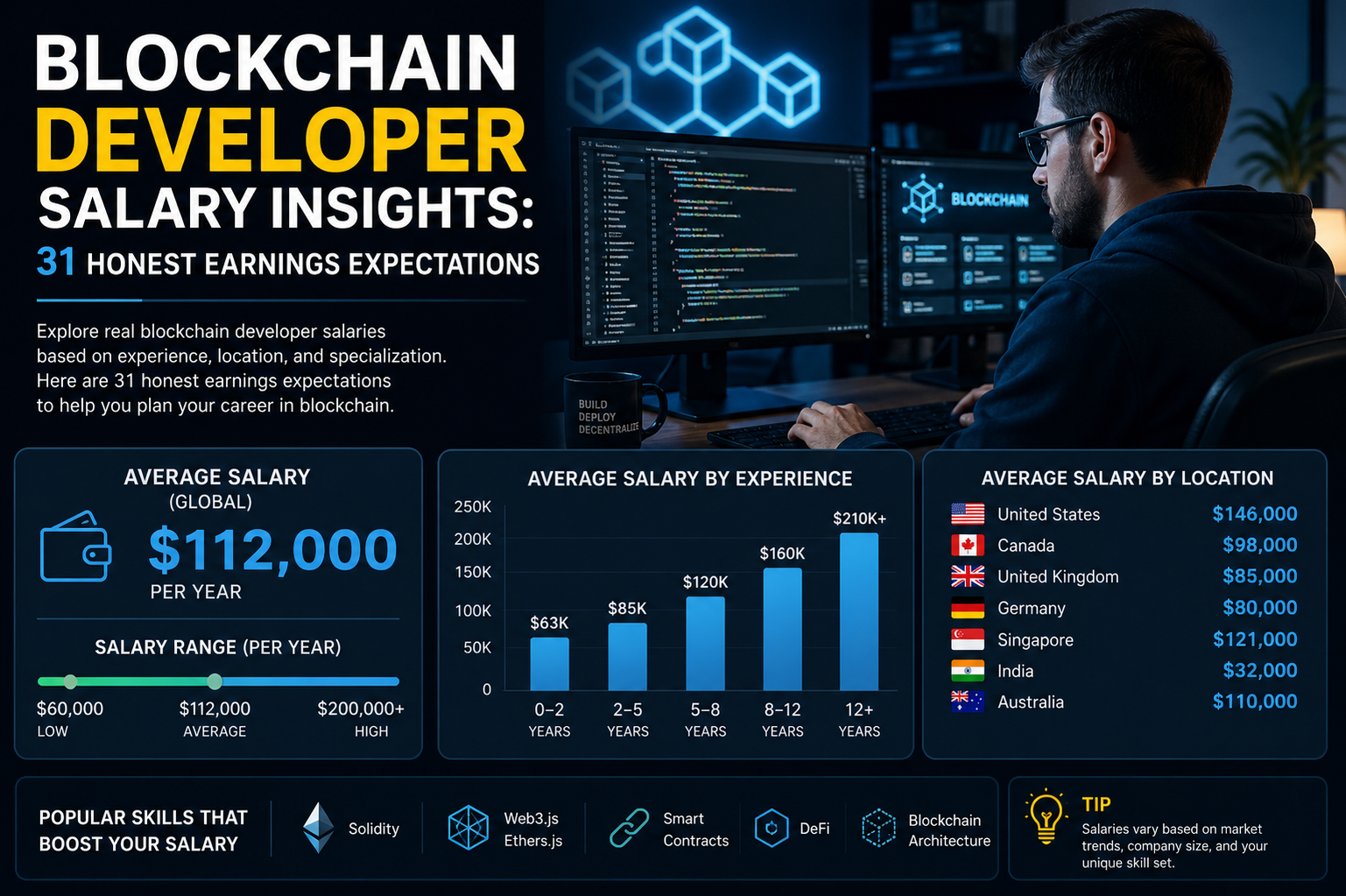
In blockchain development, specialization is often the most decisive factor in determining earning potential. Developers who focus deeply on a single domain tend to progress faster in compensation compared to those who remain generalists. This happens because blockchain systems are layered, and each layer requires a different kind of expertise. Some developers concentrate on application development, building decentralized applications that users interact with directly. Others move closer to the core infrastructure, working on consensus mechanisms, network efficiency, or cryptographic systems.
The deeper a developer moves into the foundational layers, the more valuable their expertise becomes. This is not simply due to complexity, but because errors at lower layers can impact entire ecosystems. Companies therefore prioritize experienced engineers who can demonstrate mastery in these areas. Over time, this creates a salary gap between surface-level development roles and core protocol engineering roles, with the latter consistently receiving stronger compensation offers.
How Market Demand Shapes Compensation Trends
Blockchain salaries are strongly influenced by shifting market demand. Unlike traditional software fields that grow steadily, blockchain development demand often rises in waves. When new technologies, ecosystems, or financial applications gain attention, companies rush to hire developers with relevant experience. During these periods, compensation packages tend to increase rapidly as organizations compete for a limited pool of skilled engineers.
When interest in the market slows, hiring becomes more selective. Instead of broad recruitment, companies focus on highly experienced developers who can immediately contribute to critical systems. This creates a dynamic environment where compensation is closely tied to timing and relevance. Developers who continuously update their skills in emerging technologies tend to benefit the most from these cycles.
The Importance of Ecosystem Familiarity
Blockchain ecosystems are not interchangeable. Each network has its own architecture, programming language preferences, development tools, and community standards. Developers who gain deep familiarity with a specific ecosystem often become highly sought after within that environment. This is because understanding an ecosystem goes beyond coding; it involves knowing its limitations, optimization techniques, security patterns, and common development practices.
As ecosystems expand, companies prefer developers who can contribute immediately without long onboarding periods. This preference leads to higher compensation for those already experienced within a given ecosystem. Over time, developers may even become recognized specialists within that environment, further increasing their earning potential.
Security Auditing as a High Value Career Path
Security auditing has emerged as one of the most critical and well-compensated areas in blockchain development. The irreversible nature of blockchain transactions means that vulnerabilities can lead to significant financial losses. As a result, organizations place immense value on engineers who can identify and eliminate potential risks before deployment.
Security auditors must think like attackers. They analyze code from a malicious perspective, searching for weaknesses that could be exploited. This requires not only technical expertise but also creativity and deep understanding of system behavior under stress. Because of the high stakes involved, security-focused professionals often earn significantly higher compensation than standard application developers.
The Role of Decentralized Finance in Salary Expansion
Decentralized finance has become one of the most financially active areas within blockchain development. It involves creating systems that replicate traditional financial services without centralized control. These systems include lending platforms, trading protocols, and liquidity mechanisms.
Developers in this space must understand both programming and financial logic. This combination of skills is rare, which increases their value significantly. Because decentralized finance systems handle real financial assets, reliability and accuracy are extremely important. This responsibility translates directly into higher compensation for developers who can build and maintain these systems effectively.
Non-Fungible Asset Platforms and Developer Demand
Digital ownership platforms have created another area of demand for blockchain developers. These platforms require systems for minting, verifying, and trading digital assets. While the initial hype around these systems fluctuates, the underlying technology continues to be used in gaming, digital identity, and content ownership.
Developers working in this space often experience periods of rapid demand followed by stabilization. Those who remain in the field long term tend to benefit from ongoing platform integration and enterprise adoption, which leads to steady income opportunities even outside peak cycles.
The Value of Infrastructure-Level Engineering
Infrastructure-level blockchain engineering involves building the systems that support entire networks. This includes node communication, transaction validation, and scalability solutions. These roles require deep technical understanding and often involve working with performance-critical systems.
Because infrastructure engineers influence the stability of entire networks, their compensation is typically higher than that of application-focused developers. Companies rely heavily on these engineers to ensure reliability and efficiency, especially as networks scale to handle larger user bases.
Remote Work and Global Salary Competition
Remote blockchain development has created a global talent marketplace. Developers are no longer limited to local job opportunities, and companies can hire from anywhere in the world. This has led to both opportunities and competition. Developers in lower-cost regions can access higher-paying international roles, while companies benefit from a broader talent pool.
However, this global competition also means that salary expectations are influenced by worldwide standards rather than local benchmarks. Developers must therefore continuously improve their skills to remain competitive in an increasingly globalized environment.
Equity and Long-Term Financial Upside
Many blockchain companies offer equity or token-based compensation in addition to salary. While base pay provides stability, long-term financial upside often comes from the success of these assets. If a project grows significantly, early contributors may see substantial returns.
This structure introduces both opportunity and uncertainty. Developers who join early-stage projects accept higher risk in exchange for potential long-term reward. Those who prefer stability may choose established companies with more predictable compensation structures.
Reputation as a Career Multiplier
In blockchain development, reputation plays a crucial role in career advancement. Unlike traditional industries where credentials may carry more weight, blockchain communities often evaluate developers based on public contributions, code quality, and participation in open development projects.
A strong reputation can lead to direct job offers, consulting opportunities, and invitations to high-value projects. Over time, reputation becomes a form of currency that significantly influences earning potential.
The Rise of Multi-Chain Development Skills
As blockchain ecosystems expand, interoperability between different networks has become increasingly important. Developers who can build systems that operate across multiple chains are becoming more valuable. This skill requires understanding different architectures and ensuring seamless communication between them.
Because multi-chain development is relatively new, experienced professionals in this area are in limited supply. This scarcity contributes to higher compensation and faster career growth for those who develop expertise in it.
Engineering Leadership and Compensation Growth
As developers progress in their careers, many transition into leadership roles. These positions involve overseeing technical teams, designing system architecture, and making strategic engineering decisions. Leadership roles require both technical depth and communication ability.
Compensation in these roles tends to increase significantly because responsibilities expand beyond coding into decision making and system oversight. Leaders influence the direction of projects, which directly impacts company outcomes, making their role highly valuable.
Consulting Opportunities in Blockchain
Experienced blockchain developers often move into consulting roles where they advise companies on architecture, security, or system design. Consulting work typically offers higher short-term compensation due to its project-based nature and specialized expertise requirements.
Consultants may work across multiple projects simultaneously, increasing their earning potential. However, this path also requires strong reputation and proven experience, as clients rely heavily on trust and past performance.
Learning Curve and Long-Term Income Growth
Blockchain development has a steep learning curve, especially in the early stages of a career. Developers must understand cryptography, distributed systems, consensus models, and secure coding practices. This complexity slows initial progress but creates strong long-term earning potential.
As developers move beyond foundational knowledge and begin working on real-world systems, their value increases rapidly. Continuous learning is essential, as the industry evolves quickly and new technologies emerge regularly.
Final Perspective on Blockchain Earnings Reality
Earnings in blockchain development are highly variable and depend on a combination of skill, specialization, timing, and market conditions. While some developers achieve exceptional compensation levels, this is typically the result of deep expertise and consistent adaptation to industry changes.
The field rewards those who commit to continuous growth and are willing to engage with complex technical challenges. At the same time, it remains unpredictable due to market cycles and technological shifts. For those who navigate it effectively, blockchain development can offer strong financial outcomes and long-term career opportunities.
Evolution of Developer Value Over Time
In blockchain development, value is not fixed at the moment of hiring; it evolves continuously with experience and demonstrated capability. Developers who begin with foundational tasks often transition into roles that require architectural thinking, system optimization, and decision-making responsibility. As this transition happens, their perceived value in the market increases naturally because they are no longer just executing tasks but shaping how systems behave at scale. This progression is one of the strongest drivers of long-term earning growth in the industry.
How Complexity of Projects Influences Compensation
Not all blockchain projects require the same level of technical depth. Simple token deployments or basic decentralized applications are relatively straightforward compared to systems handling financial logic, cross-chain communication, or high-throughput networks. Developers who work on complex systems are typically rewarded more because the risk of failure is higher and the technical challenges are more demanding. Companies place a premium on engineers who can handle complexity without compromising security or performance.
The Hidden Impact of Production Responsibility
One of the least discussed factors influencing blockchain earnings is production responsibility. Developers who deploy and maintain systems in live environments carry significant accountability. Once a blockchain application is live, errors cannot easily be reversed, and any vulnerability can have permanent consequences. This responsibility increases the value of experienced engineers who can ensure stability under real-world conditions. Over time, production experience becomes one of the strongest indicators of senior-level compensation.
Why Debugging Skills Are Highly Rewarded
Debugging in blockchain environments is more challenging than in traditional systems due to immutability and distributed architecture. Developers must often trace issues across multiple layers, including smart contracts, node behavior, and network interactions. Those who develop strong debugging intuition become highly valuable because they can resolve issues quickly and prevent costly failures. This skill is often underestimated but plays a major role in salary advancement.
Impact of Early Adoption of New Technologies
Developers who adopt emerging blockchain technologies early often gain a significant advantage in career progression. When new frameworks, consensus models, or scaling solutions are introduced, there is typically a shortage of experienced developers. Those who invest time early in learning these systems position themselves for higher compensation as adoption grows. This early positioning effect is one of the key reasons why some developers experience rapid salary acceleration.
Role of Financial Literacy in Blockchain Development
Unlike traditional software engineering, blockchain development often intersects with financial systems. Developers working in decentralized finance or token-based ecosystems benefit greatly from understanding financial concepts such as liquidity, risk exposure, and incentive mechanisms. This financial literacy enhances their ability to design effective systems and increases their value to employers. Engineers who combine technical and financial understanding are often placed in higher compensation brackets.
Team Size and Its Influence on Salary Levels
The size and structure of development teams can also influence compensation. In smaller teams, developers often take on broader responsibilities, covering multiple aspects of system design and implementation. This multi-role expectation can lead to higher individual value because each developer contributes more directly to project success. In larger organizations, roles may be more specialized, but senior positions still carry high compensation due to coordination and leadership responsibilities.
Importance of Reliability in Blockchain Systems
Reliability is one of the most critical expectations in blockchain environments. Systems must operate continuously without downtime or failure, especially when handling financial transactions. Developers who consistently deliver stable and predictable systems build strong reputations, which directly impacts earning potential. Reliability is often valued as highly as innovation because stability is essential for trust in decentralized systems.
Consulting vs Full-Time Employment Tradeoffs
Many experienced blockchain developers eventually choose between full-time employment and consulting. Full-time roles provide stability, structured growth, and consistent income, while consulting offers flexibility and the potential for higher earnings per engagement. However, consulting requires strong reputation, consistent client acquisition, and the ability to manage multiple responsibilities independently. Each path has distinct financial implications depending on career stage and risk tolerance.
The Influence of Industry Regulation on Compensation
As blockchain technology becomes more integrated into mainstream industries, regulatory frameworks are evolving. Developers who understand compliance requirements and can design systems that align with regulatory expectations become more valuable. This is especially relevant in financial applications where legal and operational risks must be carefully managed. Regulatory awareness is increasingly becoming a factor in senior-level compensation decisions.
Soft Skills as a Hidden Salary Driver
While technical ability is central to blockchain development, soft skills such as communication, collaboration, and problem-solving significantly influence career progression. Developers who can clearly explain technical concepts to non-technical stakeholders often move into higher-responsibility roles faster. These roles naturally come with increased compensation because they bridge the gap between engineering and business strategy.
How Ecosystem Fragmentation Creates Opportunity
The blockchain industry is fragmented into many ecosystems, each with its own tools and standards. This fragmentation creates opportunities for developers who are willing to learn multiple environments. Those who can navigate across ecosystems are often more adaptable and therefore more valuable. This adaptability becomes a key factor in long-term salary growth as companies increasingly look for versatile engineers.
Impact of Network Effects on Developer Demand
As certain blockchain ecosystems grow, network effects increase demand for developers within those systems. More users attract more applications, which in turn require more developers. This cycle creates strong demand pressure that can influence compensation trends. Developers aligned with rapidly growing ecosystems often benefit the most from this effect.
Long-Term Career Stability in a Volatile Industry
Although blockchain markets are known for volatility, long-term career stability for skilled developers remains strong. The underlying technology continues to expand into areas such as supply chain, identity verification, gaming, and financial infrastructure. Developers who focus on foundational skills rather than short-term trends tend to maintain stable career trajectories even during market downturns.
Transition from Developer to Architect Roles
As developers gain experience, many transition into system architecture roles. These positions involve designing entire blockchain systems rather than implementing individual components. Architects must consider scalability, security, efficiency, and integration across multiple layers. This shift represents a major milestone in career progression and is typically associated with significant increases in responsibility and compensation.
Community Reputation and Its Economic Value
Blockchain development is closely tied to open communities. Developers who actively participate in discussions, contribute to open-source projects, and share knowledge often gain recognition that translates into career opportunities. Unlike traditional industries, community reputation can directly influence hiring decisions and compensation offers.
Risk Premium in Emerging Blockchain Projects
Working in early-stage blockchain projects carries higher risk but also offers greater potential rewards. Developers who join these projects accept uncertainty in exchange for equity or token-based incentives. If a project succeeds, early contributors can benefit significantly. However, this path requires careful evaluation of project credibility and long-term viability.
Continuous Learning as a Salary Requirement
Unlike many traditional careers where skills remain relevant for long periods, blockchain development requires continuous learning. New protocols, frameworks, and security practices emerge regularly. Developers who fail to update their knowledge risk stagnation in both skills and compensation. Continuous learning is therefore not optional but essential for long-term financial growth.
Final Understanding of Blockchain Developer Earnings Path
Blockchain developer earnings are shaped by a combination of specialization, adaptability, experience depth, and market timing. There is no single fixed path, but rather multiple trajectories depending on individual choices. Those who invest in deep technical expertise, maintain strong reputations, and adapt to evolving ecosystems tend to experience the strongest long-term financial outcomes, while those who remain static may see slower progression even in a growing industry.
How Reputation in Developer Communities Translates Into Income Growth
In blockchain development, reputation within technical communities often carries real financial weight. Unlike traditional industries where credentials and job titles dominate evaluation, blockchain ecosystems rely heavily on visible contribution history. Developers who consistently contribute to open-source projects, participate in protocol discussions, or help improve widely used tools often gain recognition that directly influences hiring decisions.
This reputation effect works as a multiplier. Even when two developers have similar technical ability, the one with stronger community presence is more likely to receive better opportunities. Employers and project founders often prioritize individuals who are already trusted within the ecosystem because trust is critical in decentralized environments where code and responsibility are distributed across many contributors.
Why Real-World Production Experience Outweighs Theoretical Knowledge
Blockchain development places far greater value on real-world system experience than theoretical understanding. Writing smart contracts in a controlled environment is very different from maintaining systems that handle live transactions. Production environments introduce unpredictability, including network congestion, security threats, and edge-case failures.
Developers who have successfully managed production systems demonstrate a level of competence that cannot be easily replicated through learning alone. This experience becomes a strong signal of reliability, which is one of the most important traits employers look for when offering higher compensation.
The Growing Importance of Interdisciplinary Knowledge
Modern blockchain development is no longer purely a software engineering discipline. It increasingly overlaps with economics, game theory, cryptography, and even behavioral design. Developers who understand how incentives shape user behavior or how financial mechanisms influence system stability are often more effective in designing robust applications.
This interdisciplinary knowledge makes developers more valuable because they can contribute beyond coding. They can help shape system design, token models, and user engagement strategies. As a result, their role becomes more strategic, which often leads to higher-level positions and improved compensation.
How Protocol Upgrades Create Short-Term Salary Surges
When major blockchain networks undergo upgrades or introduce new features, there is often a temporary surge in demand for developers familiar with those changes. Companies rush to adapt their systems, migrate applications, or optimize performance based on new protocol rules.
During these periods, developers who understand the upgrade deeply become highly sought after. This demand spike can temporarily increase compensation opportunities, especially for contractors and consultants who can provide immediate expertise without lengthy onboarding.
The Effect of Ecosystem Maturity on Developer Earnings
Ecosystems go through different stages of maturity, and developer earnings often reflect this progression. In early stages, opportunities may be experimental but volatile. As ecosystems mature, demand becomes more structured, with established companies building long-term infrastructure.
In mature ecosystems, salaries tend to stabilize and become more predictable. However, early-stage ecosystems often offer higher upside potential due to uncertainty and rapid growth. Developers must decide whether they prefer stability or growth-driven environments when choosing where to specialize.
Why Code Quality Directly Impacts Career Growth
In blockchain systems, code quality is not just a technical preference but a financial necessity. Poorly written code can lead to vulnerabilities that may result in irreversible losses. Because of this, developers who consistently produce clean, secure, and well-structured code gain a strong professional advantage.
Over time, high code quality builds trust, and trust leads to more critical responsibilities. These responsibilities often come with higher compensation because they involve greater system ownership and accountability.
The Expanding Role of Automation in Blockchain Development
Automation tools are increasingly being used to streamline blockchain development processes such as testing, deployment, and monitoring. While automation improves efficiency, it also shifts developer responsibilities toward higher-level thinking.
Developers who understand how to design systems that integrate automation effectively tend to become more valuable. Instead of performing repetitive tasks, they focus on architecture, optimization, and system design, which are areas associated with stronger earning potential.
Impact of Hack Culture on Skill Development
The blockchain ecosystem has a strong hack culture, where experimentation and rapid prototyping are common. Developers who actively participate in hackathons or experimental projects often develop a broader skill set faster than those working only in structured environments.
This exposure allows them to understand multiple frameworks and approaches, making them more adaptable in the job market. Adaptability is a key factor in compensation growth because it allows developers to transition between different roles and ecosystems more easily.
How Financial Risk Awareness Affects Compensation Levels
Blockchain systems often deal with real financial assets, which introduces significant risk considerations. Developers who understand financial risk management principles are able to design safer systems, reducing potential losses for organizations.
This awareness is especially important in decentralized finance applications where large volumes of assets are managed by code. Developers who can balance innovation with risk control are typically rewarded with higher compensation due to the critical nature of their work.
The Shift From Coding to System Thinking
As blockchain developers gain experience, many transition from pure coding roles into system thinking roles. Instead of focusing on individual features, they begin to consider how entire systems interact, scale, and evolve over time.
This shift represents a major increase in responsibility because it involves long-term decision-making rather than short-term implementation. Developers who reach this level often move into senior engineering or architectural positions, which are associated with higher compensation structures.
The Influence of Market Confidence on Hiring Trends
Hiring trends in blockchain development are closely linked to market confidence. When confidence in the industry is high, companies expand rapidly and increase hiring. When confidence declines, hiring becomes more selective and focused on essential roles.
This cyclical behavior means that developer opportunities and compensation can fluctuate depending on external market conditions. However, highly skilled developers tend to remain in demand even during slower periods because their expertise is considered essential.
Why Specialized Tooling Knowledge Adds Financial Value
Each blockchain ecosystem has its own set of tools, frameworks, and development environments. Developers who master these tools become more efficient and are able to contribute faster to projects.
This efficiency translates into financial value because companies prefer developers who require less onboarding and can deliver results quickly. Tooling expertise also makes developers more versatile within a specific ecosystem, increasing their job opportunities.
The Role of Mentorship in Career Advancement
Mentorship plays an important but often overlooked role in blockchain career growth. Developers who learn from experienced engineers tend to progress faster because they gain insights that are not easily available through documentation alone.
Mentorship can accelerate understanding of complex systems, reduce learning curves, and provide exposure to real-world problem-solving approaches. Over time, this can significantly influence career trajectory and compensation potential.
The Expansion of Blockchain Into Traditional Industries
As blockchain technology integrates into traditional industries such as finance, logistics, healthcare, and identity systems, the demand for developers continues to diversify. This expansion creates new career paths that are less dependent on cryptocurrency market cycles.
Developers who can bridge blockchain technology with traditional systems are especially valuable because they enable real-world adoption. This bridging capability often leads to more stable and higher-paying roles.
The Importance of Adaptability in Long-Term Earnings
Adaptability is one of the most important traits for long-term success in blockchain development. Technologies evolve quickly, and frameworks that are popular today may become less relevant in the future.
Developers who continuously learn, experiment, and adjust to new technologies are more likely to maintain strong earning potential over time. Adaptability ensures that skills remain relevant even as the industry changes direction.
Perspective on Sustainable Career Growth in Blockchain
Sustainable success in blockchain development is not defined by short-term gains but by long-term skill accumulation and adaptability. Developers who focus on deep technical mastery, continuous learning, and ecosystem awareness tend to build stable and rewarding careers.
While the industry remains dynamic and sometimes unpredictable, it consistently rewards individuals who can combine technical expertise with strategic thinking and real-world problem-solving ability.
How Global Competition Shapes Blockchain Developer Earnings
Blockchain development operates in a truly global talent market, where companies can hire from almost anywhere and developers can work for organizations across different continents. This global reach increases both opportunity and competition at the same time. Skilled developers are no longer limited to local job markets, which expands earning potential, but it also means they are competing with a much larger pool of talent.
Because of this, compensation is increasingly tied to skill level and proven ability rather than geography alone. Developers who consistently demonstrate strong technical capability, especially in production environments, are more likely to secure better opportunities regardless of where they are based. At the same time, those who rely on basic or outdated skills may find it harder to stand out in a crowded global market.
The Rise of High-Responsibility Blockchain Roles
As blockchain systems mature, new roles are emerging that go beyond traditional development. These include system reliability engineering, protocol governance participation, and infrastructure optimization. These positions carry higher responsibility because they directly influence system stability, performance, and long-term sustainability.
Developers in these roles are expected to think beyond code and consider how entire ecosystems function under stress. This shift toward responsibility-driven roles naturally influences compensation, as organizations place higher value on individuals who can ensure long-term system health.
Why Decision-Making Ability Is Becoming a Key Differentiator
In earlier stages of a developer’s career, technical execution is the primary focus. However, as experience grows, decision-making becomes increasingly important. Developers are often required to choose between different architectural approaches, scalability strategies, and security trade-offs.
Those who consistently make sound technical decisions reduce risk and improve system performance, which makes them more valuable to organizations. Over time, strong decision-making ability becomes a key factor in reaching senior-level positions and higher compensation brackets.
The Expanding Influence of Institutional Blockchain Adoption
Blockchain technology is no longer limited to experimental or niche applications. Institutions such as financial organizations, supply chain networks, and enterprise platforms are increasingly integrating blockchain-based systems into their operations.
This institutional adoption has created more structured and stable opportunities for developers. Unlike early-stage experimental projects, institutional systems often require long-term maintenance, compliance awareness, and high reliability. Developers who can operate in these environments tend to benefit from more stable career paths and consistent earning potential.
How Engineering Culture Affects Developer Value
The engineering culture within blockchain organizations can significantly influence developer growth. Teams that emphasize code quality, peer review, security practices, and continuous improvement tend to produce stronger engineers over time.
Developers working in such environments often improve faster because they are exposed to higher standards and better practices. This accelerated growth can translate into improved career opportunities and higher long-term compensation compared to environments with less technical rigor.
The Importance of Long-Term Thinking in Blockchain Careers
Blockchain development rewards long-term thinking more than short-term optimization. Developers who focus only on immediate opportunities may experience inconsistent growth, while those who build deep expertise over time tend to achieve more stable and sustainable career progress.
Long-term thinking involves continuously improving core skills, understanding multiple ecosystems, and staying engaged with technological evolution. This approach ensures that developers remain relevant even as specific tools or trends change over time.
How Innovation Cycles Impact Career Opportunities
Blockchain technology evolves in cycles, with periods of rapid innovation followed by consolidation. During innovation phases, new frameworks, protocols, and applications emerge quickly, creating high demand for developers who can adapt. During consolidation phases, focus shifts toward optimization, security, and scalability.
Developers who understand these cycles can position themselves strategically, either by specializing in emerging technologies or by strengthening expertise in stable, widely adopted systems. This awareness directly influences earning potential over time.
The Role of Portfolio Strength in Professional Advancement
A strong development portfolio is one of the most effective tools for career advancement in blockchain. Unlike traditional resumes, portfolios demonstrate actual ability through deployed projects, open-source contributions, and real-world implementations.
Employers in blockchain ecosystems often prioritize proven work over theoretical knowledge. Developers with visible, high-quality portfolios are more likely to receive better opportunities because their skills are already validated in practical environments.
Why Versatility Enhances Long-Term Earnings Stability
While specialization is important, versatility also plays a key role in long-term success. Developers who can work across different layers of the blockchain stack, from smart contracts to infrastructure, are often more resilient in changing job markets.
Versatile developers can transition between roles more easily, reducing dependency on a single ecosystem or technology. This adaptability helps maintain consistent earning potential even when specific areas of demand shift.
The Psychological Demands of Blockchain Development
Blockchain development can be mentally demanding due to its complexity, fast-paced evolution, and high-stakes environments. Developers must constantly learn new concepts while managing systems that often involve financial risk or security sensitivity.
Those who are able to handle this pressure while maintaining high performance tend to advance more quickly in their careers. Psychological resilience becomes an indirect but important factor in long-term earning potential.
Blockchain Developer Earnings Reality
Blockchain developer earnings are shaped by a combination of technical depth, specialization, adaptability, and market timing. While the field is often associated with high earning potential, actual outcomes vary widely depending on individual skill development and career decisions.
Developers who focus on foundational knowledge, security awareness, and real-world system experience tend to progress steadily into higher-value roles. Those who continuously adapt to new ecosystems and maintain strong professional reputations often achieve more stable and rewarding career trajectories.
At the same time, the industry remains dynamic and influenced by external market cycles, meaning compensation can fluctuate over time. Long-term success in blockchain development is therefore less about short-term gains and more about consistent growth, strategic skill-building, and the ability to evolve alongside rapidly changing technology.
Final Conclusion
Blockchain developer earnings are best understood as a reflection of skill depth, adaptability, and real-world impact rather than a fixed or predictable outcome. The field rewards those who continuously build stronger technical foundations, expand into complex systems, and stay aligned with evolving technologies.
Income potential is influenced heavily by specialization, with security, protocol engineering, and advanced infrastructure work typically carrying greater long-term value due to their complexity and responsibility. At the same time, application-level development can still provide strong opportunities, especially when paired with deep ecosystem knowledge and consistent production experience.
Market cycles also play an important role. Periods of rapid growth can accelerate hiring and compensation, while slower phases tend to emphasize efficiency, stability, and proven expertise. Developers who understand these cycles and adapt accordingly tend to maintain more consistent career progress.
Beyond technical ability, reputation, communication, and reliability increasingly shape career outcomes. Developers who are trusted within communities, contribute meaningfully to projects, and demonstrate consistent delivery often gain access to higher-quality opportunities over time.
Ultimately, blockchain development is not defined by guaranteed earnings, but by a progression of skills and decisions. Those who commit to continuous learning, build strong real-world experience, and remain flexible in a rapidly evolving environment are the ones most likely to achieve long-term financial and professional growth in this space.