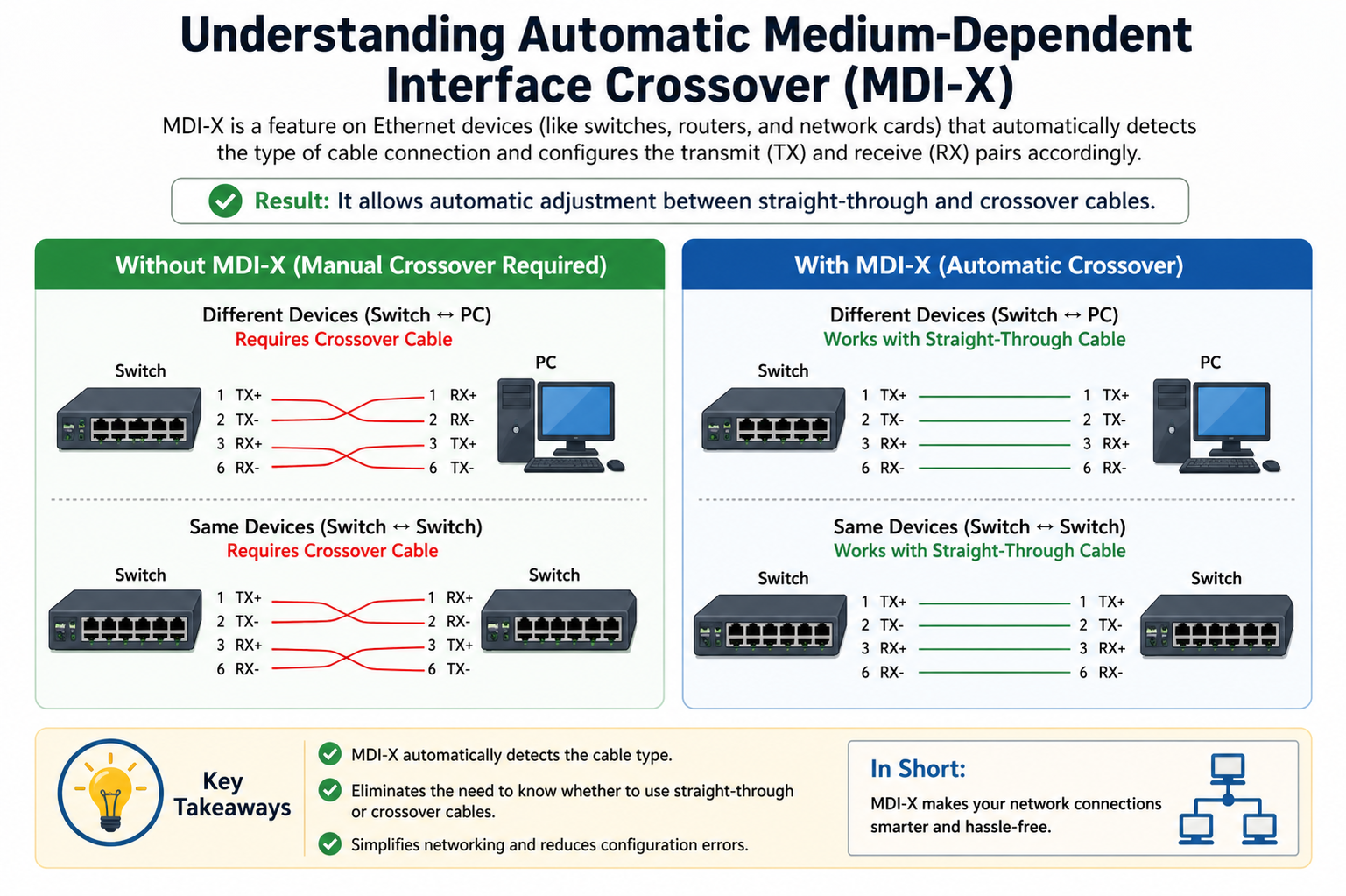
Automatic Medium-Dependent Interface Crossover (Auto MDI-X) is a networking feature designed to simplify Ethernet connections by automatically adjusting how data transmit and receive pairs are configured between devices. In traditional Ethernet systems, connecting two similar devices required careful selection of cable types because the transmit and receive pins needed to be crossed. Auto MDI-X eliminates this manual requirement by intelligently detecting the connection type and reconfiguring the interface electronically so that communication can be established regardless of the cable used.
Fundamental Concept of Ethernet Pairing
To understand Auto MDI-X properly, it is important to first understand how Ethernet communication works at the physical layer. Ethernet cables typically contain multiple twisted pairs of wires, with specific pairs assigned for transmitting and receiving data. In older implementations, devices were categorized based on how they used these pairs. End devices like computers typically transmitted on one pair and received on another, while network devices like switches or hubs used opposite configurations. This mismatch required either a straight-through cable or a crossover cable depending on the connection type.
Problem with Traditional Cabling Methods
Before the introduction of Auto MDI-X, network installers had to carefully determine the correct cable type for every connection. If two similar devices were connected using the wrong cable type, communication would fail. This often led to confusion, especially in large networks where multiple devices were installed or replaced frequently. Even experienced technicians occasionally made mistakes, resulting in troubleshooting delays and unnecessary downtime. The need for a simpler and more flexible solution led to the development of automatic crossover technology.
Introduction of Automatic Detection Mechanism
Auto MDI-X was introduced as an enhancement to modern Ethernet physical layer devices. It works by analyzing the electrical signals on the connected cable and determining whether transmit and receive pairs are correctly aligned. If the system detects that the pairs are reversed or mismatched, it automatically swaps them internally without requiring any physical change to the cable. This process happens quickly and transparently, allowing devices to communicate seamlessly.
Role of the Physical Layer in Auto MDI-X
The physical layer, often referred to as the PHY layer, plays a crucial role in Ethernet communication. It is responsible for transmitting raw bits over the physical medium, such as copper cables. Auto MDI-X is implemented within this PHY layer circuitry. When a connection is established, the PHY continuously monitors signal patterns and performs a negotiation process to determine the correct wiring configuration. This ensures that data transmission occurs correctly regardless of cable orientation.
Relationship with Auto-Negotiation
Auto MDI-X is often associated with another feature called auto-negotiation. While auto-negotiation determines the speed and duplex mode of a connection, Auto MDI-X determines the correct wiring configuration. Together, these features allow Ethernet devices to establish optimal communication settings automatically. In many modern systems, both processes occur simultaneously during link establishment, resulting in a fully automated connection setup.
Evolution of Ethernet Standards and Auto MDI-X
In early Ethernet standards such as 10BASE-T and 100BASE-TX, the need for crossover cables was a strict requirement. However, as technology advanced, newer standards like 1000BASE-T (Gigabit Ethernet) introduced more sophisticated signal processing techniques. Gigabit Ethernet uses all four wire pairs simultaneously for both transmission and reception, which significantly reduces the dependency on fixed transmit and receive roles. This advancement made Auto MDI-X not only possible but essential for modern networking.
How Signal Detection Works Internally
Inside a network interface, Auto MDI-X relies on detecting electrical signal characteristics such as polarity, timing, and amplitude. When a cable is connected, the PHY layer sends test signals and listens for responses. Based on the reflection and response patterns, it determines whether the transmit and receive pairs are correctly aligned. If they are not, internal switching circuits adjust the configuration so that communication can proceed without interruption.
Advantages in Real-World Networking Environments
One of the most significant advantages of Auto MDI-X is the reduction of human error. Network administrators no longer need to worry about selecting between crossover and straight-through cables. This simplifies installation processes and reduces training requirements for technical staff. It also improves efficiency in dynamic environments such as data centers, where devices are frequently added, removed, or reconfigured.
Impact on Network Maintenance and Troubleshooting
Auto MDI-X has also transformed network troubleshooting. In older systems, connectivity issues often required checking cable types and verifying correct wiring configurations. With Auto MDI-X, this category of problem is largely eliminated. If a connection fails, technicians can focus on higher-level issues such as configuration errors, hardware faults, or network congestion instead of physical wiring mismatches.
Compatibility Across Different Ethernet Speeds
Modern Auto MDI-X implementations are designed to support multiple Ethernet speeds including 10 Mbps, 100 Mbps, and 1 Gbps. This backward compatibility ensures that devices operating at different generations of Ethernet standards can still communicate effectively. In mixed network environments, this flexibility is particularly valuable because it allows legacy devices to coexist with newer hardware without requiring special cabling arrangements.
Hardware Design Considerations
From a hardware perspective, implementing Auto MDI-X requires additional circuitry within the Ethernet PHY. This circuitry is responsible for dynamically switching transmit and receive pairs. It must operate at very high speeds and with precise timing to avoid introducing latency or signal distortion. Engineers design these systems to be highly efficient so that the automatic switching process does not impact overall network performance.
Role in Plug-and-Play Networking
Auto MDI-X plays a key role in enabling plug-and-play networking, where devices can be connected without manual configuration. When a device is plugged into a network switch or router, it automatically detects the correct wiring configuration and establishes a link. This makes network expansion much easier, especially for non-technical users or in environments where rapid deployment is required.
Limitations and Edge Cases
Although Auto MDI-X is highly reliable, it is not without limitations. In some very old networking equipment that does not support this feature, manual crossover cables may still be required. Additionally, in rare cases involving faulty cables or damaged ports, automatic detection may not function correctly. However, such scenarios are increasingly uncommon as modern devices almost universally support Auto MDI-X.
Interaction with Full-Duplex and Half-Duplex Modes
Ethernet communication can operate in full-duplex or half-duplex mode. Auto MDI-X works in both scenarios but is most effective in full-duplex environments, where transmission and reception occur simultaneously on separate pairs. In half-duplex systems, collision detection mechanisms are used, but Auto MDI-X still ensures that wiring mismatches do not interfere with communication setup.
Importance in Modern Data Centers
In large-scale data centers, thousands of devices are interconnected using complex switching architectures. Auto MDI-X significantly reduces the complexity of physical network design in such environments. Technicians can connect servers, switches, and storage systems without worrying about cable types, which improves operational efficiency and reduces deployment time.
Energy Efficiency and Signal Optimization
Modern implementations of Auto MDI-X are also designed with energy efficiency in mind. By optimizing signal detection and reducing unnecessary retransmissions caused by wiring errors, the system helps conserve power. This is particularly important in large networks where even small efficiency gains can lead to significant energy savings.
Future of Ethernet Connectivity
As Ethernet technology continues to evolve, the role of Auto MDI-X is expected to remain fundamental. With increasing speeds such as 10 Gbps, 25 Gbps, and beyond, the complexity of signal handling continues to grow. However, the principle of automatic configuration remains essential for maintaining ease of use and reducing manual intervention in network setups.
Advanced Operation of Auto MDI-X in Modern Ethernet Systems
Auto MDI-X is not just a simple switching mechanism; in modern Ethernet systems, it operates as a highly refined process integrated into the physical layer of networking hardware. Once a cable is connected, the system begins a rapid sequence of detection, signaling, and adjustment steps. This entire process occurs within milliseconds, ensuring that the user experiences what appears to be an instant and stable connection. The intelligence behind this mechanism lies in how the device interprets incoming electrical patterns and adapts its transmission behavior accordingly.
Detection of Link Partner Characteristics
When two Ethernet devices are connected, each device attempts to identify the characteristics of its link partner. This includes determining whether the connected device is using a straight-through or crossover configuration. Auto MDI-X does not rely on predefined assumptions; instead, it actively probes the connection by sending specific signal patterns. These patterns are analyzed by the receiving PHY, which evaluates timing differences, polarity alignment, and signal integrity to determine how the pairs are connected.
Internal Pair Swapping Mechanism
At the core of Auto MDI-X functionality is the internal pair swapping circuit. This circuit is responsible for dynamically rerouting transmit and receive signals without requiring physical changes to the cable. Essentially, it acts as an intelligent switch inside the network interface. If the system determines that transmit pins are incorrectly aligned with transmit pins on the other device, it automatically reroutes them to the correct receive channels. This ensures proper communication regardless of external wiring conditions.
Role of Signal Polarity Detection
Signal polarity detection is an important part of the Auto MDI-X process. Ethernet signals are transmitted as differential pairs, meaning that each signal is carried over two wires with opposite electrical polarity. If these polarities are reversed due to incorrect cabling, communication errors may occur. Auto MDI-X continuously monitors these polarity conditions and corrects them internally, ensuring that data integrity is maintained even in imperfect physical connections.
Interaction with Link Pulses and Negotiation Signals
During connection establishment, Ethernet devices exchange special signals known as link pulses. These pulses are used not only to determine link availability but also to assist in negotiation processes. Auto MDI-X utilizes these pulses to analyze the behavior of the connected device. By interpreting the timing and response of these signals, the system can infer whether a crossover adjustment is needed. This passive detection method allows for seamless adaptation without requiring explicit configuration commands.
Integration with Gigabit Ethernet Architecture
In Gigabit Ethernet systems, Auto MDI-X becomes even more efficient due to the use of all four wire pairs for simultaneous transmission and reception. Unlike older Ethernet standards, where specific pairs were dedicated solely to transmit or receive, Gigabit Ethernet distributes data across all pairs using advanced encoding techniques. This reduces dependency on strict pair assignments and enhances the effectiveness of automatic crossover functionality. As a result, modern gigabit systems rarely encounter compatibility issues related to cable types.
Timing and Synchronization Challenges
One of the technical challenges in implementing Auto MDI-X is maintaining precise timing synchronization during the switching process. Since Ethernet communication relies on highly accurate signal timing, any delay introduced during pair switching must be minimized. Engineers design PHY controllers with extremely fast response times to ensure that switching occurs without disrupting the link establishment process. This requires careful balancing of hardware speed, signal integrity, and processing efficiency.
Backward Compatibility with Legacy Devices
Auto MDI-X is designed to work seamlessly with older networking equipment that does not support automatic crossover detection. In such cases, the modern device takes responsibility for adapting to the fixed behavior of the legacy device. This ensures that even in mixed environments containing both old and new hardware, communication can still be established without manual intervention. This backward compatibility has been a major factor in the widespread adoption of Auto MDI-X.
Error Prevention in Physical Layer Communication
One of the most significant benefits of Auto MDI-X is its ability to prevent physical layer errors caused by incorrect cabling. Without this feature, mismatched transmit and receive pairs would result in complete communication failure. With Auto MDI-X, these errors are automatically corrected before they can impact higher-level network operations. This reduces downtime and improves overall network reliability.
Impact on Network Scalability
Auto MDI-X plays a crucial role in supporting scalable network architectures. As organizations expand their infrastructure, they often need to add or relocate devices quickly. The automatic adjustment capability allows new devices to be integrated into the network without requiring detailed cabling analysis. This flexibility is especially valuable in large enterprise environments where network changes occur frequently and must be implemented efficiently.
Simplification of Network Installation Processes
In traditional networking setups, installation required careful planning of cable types and port configurations. Technicians needed to ensure that each connection used the correct cable type based on device roles. Auto MDI-X eliminates this complexity by making all Ethernet ports effectively universal in terms of cabling requirements. This simplification reduces installation time and allows less specialized personnel to perform basic network setup tasks.
Role in Modern Switching Devices
Most modern Ethernet switches are fully equipped with Auto MDI-X capability on all ports. This means that any device can be connected to any port using any standard Ethernet cable. The switch automatically adjusts each port independently based on the connected device. This flexibility is one of the reasons why Ethernet networking remains one of the most widely used communication standards in the world.
Energy Efficiency Considerations in PHY Design
Modern PHY chips that support Auto MDI-X are also designed with energy efficiency in mind. By optimizing signal detection and reducing unnecessary retransmissions, these systems help lower power consumption. In large-scale deployments such as data centers, even small improvements in efficiency can lead to significant reductions in operational costs and energy usage.
Signal Integrity and Noise Handling
Ethernet cables are often subject to external electromagnetic interference, which can distort signals. Auto MDI-X systems are designed to account for such noise by using robust detection algorithms that differentiate between true signal patterns and interference. This ensures that crossover detection remains accurate even in electrically noisy environments.
Importance in Industrial Networking Environments
In industrial environments where networking equipment is exposed to harsh conditions, Auto MDI-X provides additional reliability. Devices may be installed in locations where cable routing is not ideal or where physical constraints limit proper cable selection. The ability to automatically adjust to any connection type ensures that communication remains stable even under less-than-ideal installation conditions.
Influence on Network Design Philosophy
The introduction of Auto MDI-X has influenced how networks are designed at a fundamental level. Instead of focusing heavily on physical cabling rules, designers can now prioritize logical architecture and performance optimization. This shift has allowed networks to become more flexible, modular, and easier to maintain over time.
Reduction of Human Configuration Errors
Human error is one of the most common causes of network failures. Incorrect cable selection, mislabeling, or improper installation can all lead to connectivity issues. Auto MDI-X significantly reduces these risks by removing the dependency on manual cable selection. This leads to more consistent network behavior and fewer support issues.
Relationship with Modern Network Automation
Auto MDI-X can be seen as an early step toward broader network automation. By eliminating manual physical configuration tasks, it laid the foundation for more advanced automation technologies in networking. Today, networks increasingly rely on intelligent systems that can self-configure, self-heal, and adapt dynamically to changing conditions.
Real-World Performance Behavior of Auto MDI-X
In practical networking environments, Auto MDI-X operates as a silent background function that directly influences how quickly and reliably devices establish communication. Although the process is technically complex, its real-world behavior is intentionally designed to appear effortless. When a cable is plugged into a device, link establishment typically occurs within a very short time, often indistinguishable from a standard Ethernet handshake. During this period, the system is actively analyzing the electrical relationship between the connected endpoints and making instant adjustments to ensure compatibility.
Link Establishment Sequence in Detail
The moment a physical connection is made, the Ethernet PHY begins a structured sequence of events. First, it sends out low-level signaling pulses to detect whether another device is present. These pulses are exchanged between both ends of the connection. If a valid response is detected, the system moves into a negotiation phase. At this stage, Auto MDI-X evaluates whether the transmit and receive pairs are correctly aligned or require internal swapping. This evaluation happens before full data transmission begins, ensuring that errors are prevented rather than corrected later.
Adaptive Behavior in Mixed Cable Environments
One of the most practical strengths of Auto MDI-X is its ability to handle mixed cabling environments without disruption. In real-world setups, it is common for networks to contain a combination of straight-through and crossover cables, especially in environments where equipment has been added over time. Auto MDI-X removes the dependency on identifying cable types, allowing devices to function normally regardless of how the physical wiring has been implemented. This adaptability greatly reduces maintenance complexity in long-term network deployments.
Latency Considerations During Auto Configuration
Although Auto MDI-X operates quickly, it still introduces a brief micro-level delay during initial link setup. This delay is primarily due to the time required for signal detection and pair alignment confirmation. However, in modern hardware, this delay is extremely small and does not impact user experience. Once the link is established, there is no ongoing performance penalty, as the system maintains a stable configuration until the connection is reset.
Consistency Across Network Devices
Auto MDI-X ensures consistent behavior across different types of Ethernet devices, including switches, routers, computers, and embedded systems. This consistency is important because it allows network administrators to design systems without needing to account for device-specific cabling constraints. Regardless of manufacturer or hardware design variations, devices that support Auto MDI-X can interoperate seamlessly at the physical layer.
Behavior in High-Density Network Switches
In high-density switching environments, such as enterprise racks or data centers, hundreds of connections may be established simultaneously. Auto MDI-X plays a crucial role in ensuring that each port independently negotiates its own configuration without interference from neighboring ports. Each port operates as an autonomous detection unit, allowing large-scale networks to function reliably even under heavy connection loads.
Error Recovery and Re-Negotiation Mechanisms
Auto MDI-X is not limited to initial connection setup; it also plays a role in maintaining link stability over time. If a cable is disconnected and reconnected, or if there is a change in electrical conditions, the system can re-initiate the detection process. This re-negotiation capability ensures that temporary disruptions do not lead to permanent communication failure. Once stability is restored, the system locks in the appropriate configuration again.
Interference Handling in Real Environments
Ethernet cables are often exposed to electromagnetic interference from nearby electrical equipment, power lines, or industrial machinery. Auto MDI-X systems are designed with robust signal filtering techniques to distinguish genuine link signals from noise. This ensures that incorrect crossover detection does not occur due to environmental distortion. The ability to maintain accuracy in noisy conditions is essential for reliable communication in industrial and outdoor deployments.
Scalability in Expanding Networks
As networks grow, Auto MDI-X becomes increasingly valuable because it reduces the complexity of expansion. New devices can be added to an existing network without requiring careful planning of cable orientation or port configuration. This plug-and-play behavior allows organizations to scale their infrastructure more rapidly while minimizing downtime and installation overhead.
Impact on Network Administration Practices
The presence of Auto MDI-X has changed how network administrators approach physical layer management. Instead of focusing on cable categorization and port pairing, administrators can concentrate on logical network design, security policies, and performance optimization. This shift has improved overall efficiency in network management and reduced the technical burden associated with physical connectivity issues.
Reliability Improvements Over Traditional Systems
Compared to older Ethernet systems that required strict cable rules, Auto MDI-X significantly improves reliability. Traditional systems were prone to simple human errors such as incorrect cable selection, which could lead to complete link failure. With automatic crossover detection, these issues are effectively eliminated at the hardware level, resulting in more stable and predictable network behavior.
Integration with Modern Ethernet Standards
Modern Ethernet standards are designed with Auto MDI-X as a built-in expectation rather than an optional feature. This integration ensures that nearly all contemporary networking equipment supports automatic pair configuration. As Ethernet speeds continue to increase, this feature remains essential for maintaining ease of use and compatibility across evolving technologies.
Effect on Network Troubleshooting Methodology
In troubleshooting scenarios, the presence of Auto MDI-X allows technicians to eliminate cable type as a potential source of failure in most cases. This significantly narrows down diagnostic steps and speeds up problem resolution. Instead of checking physical wiring configurations, attention can be directed toward configuration settings, hardware faults, or network congestion issues.
Hardware Optimization for Fast Switching
Network interface controllers are designed with highly optimized switching logic to support rapid Auto MDI-X operation. This includes specialized circuitry capable of detecting signal orientation changes almost instantly. The goal is to ensure that switching occurs so quickly that it does not introduce noticeable delay in link formation or data transmission readiness.
Behavior in Redundant Network Paths
In networks that use redundancy for fault tolerance, multiple physical paths may exist between devices. Auto MDI-X ensures that each individual link can independently establish correct communication regardless of how redundant paths are configured. This allows redundancy systems to function smoothly without requiring additional cabling adjustments.
Contribution to Seamless User Experience
From a user perspective, Auto MDI-X contributes to a seamless networking experience. Users are typically unaware of the underlying process taking place when they connect devices. The ability to simply plug in a cable and immediately gain network access enhances usability and reduces the need for technical expertise in everyday operations.
Long-Term Stability of Configured Links
Once a connection is successfully established using Auto MDI-X, the configuration remains stable for the duration of the link session. The system does not continuously re-evaluate pair assignments unless the connection is interrupted. This stability ensures consistent performance during data transmission, even in long-running network sessions.
Practical Behavior Analysis
The real-world performance of Auto MDI-X demonstrates its importance as a foundational networking feature. By enabling automatic detection, correction, and stabilization of Ethernet connections, it eliminates many of the traditional challenges associated with physical layer configuration. Its seamless operation, reliability in diverse environments, and contribution to simplified network management make it an essential component of modern Ethernet communication systems.
Auto MDI-X in Modern Network Ecosystems
In today’s networking environments, Auto MDI-X has become an invisible but essential part of Ethernet communication. It is no longer considered an advanced feature but rather a standard expectation in almost all modern networking hardware. From small office setups to large enterprise infrastructures, its presence ensures that physical connectivity remains simple and consistent. The technology blends into the background of network operations, allowing users and administrators to focus on performance, security, and scalability rather than cable configurations.
Role in Enterprise and Cloud Infrastructure
In enterprise and cloud-based infrastructures, where thousands of connections operate simultaneously, Auto MDI-X plays a subtle yet important role in maintaining operational efficiency. Large data centers rely heavily on rapid deployment and reconfiguration of network equipment. Devices are frequently added, replaced, or relocated, and Auto MDI-X ensures that these physical changes do not require additional manual adjustments at the cabling level. This flexibility contributes to faster provisioning and reduced downtime in mission-critical environments.
Support in Virtualized Networking Environments
Even in virtualized environments, where much of the networking is abstracted from physical hardware, Auto MDI-X remains relevant at the underlying physical layer. Virtual machines and software-defined networks still depend on physical Ethernet connections to function. The automatic crossover capability ensures that physical host connections remain stable and do not introduce unnecessary complexity into virtual network architectures. This allows virtualization systems to operate smoothly without concerns about physical wiring mismatches.
Impact on Network Standardization
Auto MDI-X has contributed significantly to the standardization of Ethernet networking practices. By removing the need for separate cable types in most scenarios, it has simplified documentation, training, and deployment procedures. Network standards have evolved to assume the presence of automatic crossover functionality, which has led to more unified design principles across manufacturers and technologies. This standardization improves interoperability between different vendors’ equipment.
Security Implications at the Physical Layer
Although Auto MDI-X is primarily a convenience feature, it indirectly contributes to network security at the physical layer. By reducing the need for manual cable manipulation, it minimizes opportunities for misconfiguration that could lead to unintended network exposure. However, it is important to note that Auto MDI-X does not provide security in itself; it simply ensures correct connectivity. Security must still be enforced through higher-level network protocols and configurations.
Long-Term Technological Evolution
As Ethernet technology continues to evolve toward higher speeds and more complex signaling methods, the principles behind Auto MDI-X are expected to remain relevant. Future networking systems will likely incorporate even more advanced forms of automatic physical layer adaptation. These may include enhanced signal learning algorithms, smarter PHY designs, and deeper integration with network intelligence systems. The core idea of removing manual physical configuration will continue to guide Ethernet development.
Engineering Significance of Auto MDI-X
From an engineering perspective, Auto MDI-X represents a successful example of hardware-level automation solving a long-standing practical problem. Instead of relying on user discipline or strict installation rules, the system itself adapts dynamically to real-world conditions. This shift from manual configuration to automatic adaptation reflects a broader trend in technology design, where complexity is handled internally by systems rather than exposed to users.
Reliability in Mission-Critical Systems
In mission-critical systems such as financial networks, healthcare infrastructure, and industrial control systems, reliability is extremely important. Auto MDI-X contributes to this reliability by eliminating a common point of failure in physical network setup. Even in environments where downtime is costly, the assurance that any Ethernet cable can establish a connection helps maintain continuous operation and reduces risk associated with physical layer errors.
Simplification of Educational and Training Requirements
Networking education and training have also benefited from Auto MDI-X. In earlier networking curricula, significant time was spent teaching students about cable types, pin configurations, and crossover requirements. With the widespread adoption of automatic crossover technology, this complexity has been greatly reduced. Learners can now focus more on conceptual networking principles rather than physical wiring details.
Environmental and Operational Efficiency
By reducing the need for specialized cabling and minimizing installation errors, Auto MDI-X contributes indirectly to environmental and operational efficiency. Fewer incorrect installations mean fewer wasted cables and reduced need for rework. In large-scale deployments, this can lead to more efficient use of materials and lower operational overhead, supporting more sustainable network practices.
Limitations in Extremely Legacy Systems
Despite its widespread adoption, Auto MDI-X still has limitations when interacting with extremely old networking systems. Devices that predate modern Ethernet standards may not support automatic crossover detection. In such cases, manual cable selection may still be required. However, these scenarios are increasingly rare as legacy systems are gradually replaced by modern hardware.
Integration with Future Networking Trends
Future networking trends such as intelligent edge computing, autonomous network management, and AI-driven infrastructure optimization will likely build upon the foundation established by technologies like Auto MDI-X. The principle of self-configuring hardware interfaces aligns closely with the broader goal of creating self-managing networks that require minimal human intervention.
Advanced Integration and Real-World Importance of Auto MDI-X
Auto MDI-X continues to play a critical role in ensuring seamless Ethernet communication across diverse networking environments. Its importance becomes even more evident when networks grow in complexity, involving multiple layers of switches, routers, and interconnected devices. In such environments, manual control over cable types would introduce unnecessary complications, while Auto MDI-X removes this burden entirely by automatically adapting to any physical connection scenario.
In modern networking hardware, Auto MDI-X is deeply integrated into the physical layer chip, working alongside other intelligent features such as auto-negotiation for speed and duplex settings. This combination allows devices to not only detect whether a connection exists but also optimize how data is transmitted over that connection. As a result, network performance becomes more stable and predictable, even when devices from different generations or manufacturers are connected together.
Role in Modern Networking Hardware
In modern devices, Auto MDI-X is built directly into the physical layer circuitry of Ethernet ports. It operates alongside other essential functions such as auto-negotiation, which determines speed and duplex settings. Together, these systems ensure that once a cable is connected, the device can immediately establish a stable and optimized communication link. This integration reduces manual configuration and allows hardware from different manufacturers and generations to work together smoothly.
Operational Flexibility in Dynamic Networks
One of the biggest advantages of Auto MDI-X is the flexibility it provides in rapidly changing network environments. In offices, data centers, and enterprise systems, devices are frequently moved, replaced, or added. Without Auto MDI-X, each change would require careful attention to cable types and port configurations. With it, administrators can use any standard Ethernet cable, making network expansion and modification significantly faster and less error-prone.
Reduction of Network Downtime
Network downtime caused by incorrect cabling was a common issue in traditional Ethernet setups. A simple mismatch between cable types could prevent communication entirely. Auto MDI-X eliminates this problem by automatically correcting such mismatches at the hardware level. As a result, networks experience fewer interruptions, higher reliability, and improved overall uptime, which is especially important for business-critical systems.
Compatibility Between Old and New Systems
Another important benefit of Auto MDI-X is its ability to support mixed environments containing both legacy and modern devices. Older equipment may not have supported automatic crossover detection, but modern devices can adapt to these limitations. This ensures smooth communication without requiring specialized cabling or additional conversion hardware. It allows organizations to upgrade their infrastructure gradually without compatibility issues.
Use in Industrial and Harsh Environments
In industrial environments where equipment is often installed in difficult or inaccessible locations, Auto MDI-X reduces the need for physical intervention. Once installed, devices can maintain reliable communication even if cabling is not perfectly optimized. This reduces maintenance requirements and improves operational efficiency, especially in environments where downtime or physical access is costly or limited.
Final Conclusion
Auto MDI-X is a fundamental advancement in Ethernet networking that has transformed how physical connections are established and maintained. By automatically detecting and adjusting transmit and receive pair configurations, it removes the need for manual cable selection and eliminates a common source of network errors. Its integration into modern Ethernet devices has simplified installation, improved reliability, and supported the growth of large-scale and dynamic network environments.
Beyond convenience, Auto MDI-X represents a shift toward intelligent, self-adapting hardware systems that reduce complexity at the user level while increasing efficiency at the system level. Its influence can be seen across enterprise networks, data centers, industrial systems, and even everyday home networking equipment. As networking technology continues to advance, the principles behind Auto MDI-X will remain essential in shaping more automated, reliable, and user-friendly communication systems.