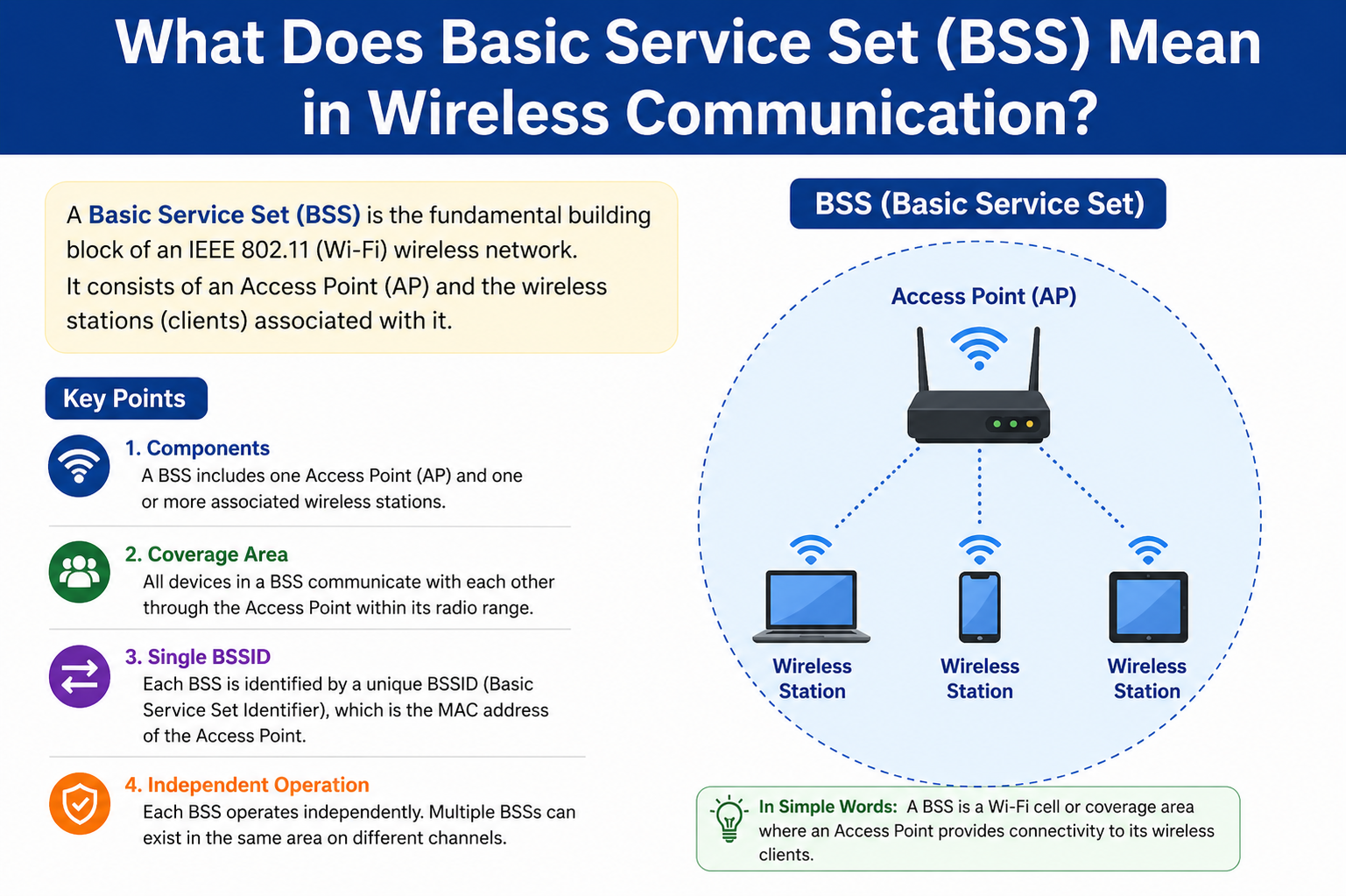
A Basic Service Set (BSS) is one of the core concepts used to describe how wireless local area networks are organized and how devices communicate within a Wi-Fi environment. It defines a logical grouping of wireless devices that share a common communication channel and operate under a single coordination structure. The idea of a BSS helps explain how multiple wireless devices are able to connect, exchange data, and maintain communication within a defined coverage area without interference or confusion.
In practical terms, a BSS represents the smallest unit of a wireless network. It forms the foundation upon which larger and more complex wireless systems are built. Every Wi-Fi connection that a user experiences in homes, offices, or public spaces is part of a BSS in some form. The structure ensures that communication between devices is organized, efficient, and controlled through defined rules of wireless networking.
Fundamental Structure of a Basic Service Set
The structure of a Basic Service Set revolves around wireless stations and their method of communication. A station refers to any device capable of connecting to a wireless network, such as a smartphone, laptop, or tablet. These stations communicate through wireless signals using a shared frequency channel.
At the center of a typical BSS in modern networks is a wireless access point. This access point acts as a central coordination device that manages traffic between connected stations. It ensures that data sent by one device reaches its intended destination without collision or loss. The access point also handles authentication, connection management, and signal distribution, making it a critical component of the network structure.
In simple terms, the BSS defines a controlled environment where wireless devices operate together under a unified system. Without this structure, wireless communication would become chaotic, with devices interfering with each other’s signals.
Infrastructure Mode in Basic Service Set
One of the most widely used forms of BSS is the infrastructure mode. In this configuration, all wireless devices communicate through a central access point. The access point serves as the bridge between devices and also connects the wireless network to a wired network if available.
In infrastructure mode, devices do not communicate directly with each other. Instead, every data packet is first sent to the access point, which then forwards it to the intended recipient. This method improves network efficiency and reduces the chances of data collisions.
The infrastructure mode BSS is commonly used in homes, businesses, schools, and public Wi-Fi systems because it offers better control, security, and scalability. Network administrators can manage connected devices, monitor traffic, and implement security policies through the access point.
Another important feature of infrastructure mode is centralized coordination. The access point regulates when and how devices transmit data, ensuring that all stations get fair access to the network. This controlled environment allows for stable and reliable wireless communication, even when many devices are connected at the same time.
Independent Basic Service Set (Ad Hoc Mode)
The Independent Basic Service Set is a different type of BSS that does not rely on a central access point. Instead, devices communicate directly with each other in a peer-to-peer manner. This configuration is also known as ad hoc mode.
In an Independent BSS, each device acts both as a transmitter and receiver. There is no central controller managing communication, which makes the setup more flexible but less structured compared to infrastructure mode. Devices within range can connect and exchange data directly without requiring external network equipment.
This type of BSS is often used in temporary situations where a quick and simple network is needed. For example, it may be used in meetings, small file-sharing scenarios, or emergency communication setups where no access point is available.
However, Independent BSS networks have limitations. They are not ideal for large-scale communication because they lack centralized management. Security is also more difficult to maintain since there is no central authority controlling access or monitoring traffic.
Communication Process Within a BSS
The communication process in a Basic Service Set involves several steps that ensure data is transmitted correctly between devices. When a wireless station wants to send data, it first checks whether the communication channel is available. If the channel is free, the station transmits its data either directly to another device (in ad hoc mode) or to the access point (in infrastructure mode).
The access point then examines the destination address of the data packet and forwards it accordingly. This process happens very quickly, often in milliseconds, allowing users to experience seamless connectivity.
Wireless communication within a BSS relies heavily on coordination mechanisms to avoid data collisions. Since multiple devices share the same frequency channel, rules are needed to determine when each device can transmit data. These rules are managed by the wireless protocol, which ensures smooth operation even in busy network environments.
Role of Access Point in BSS
The access point plays a central role in most Basic Service Sets. It acts as the controlling entity that manages all wireless communication within its range. One of its primary functions is to coordinate data transmission between devices, ensuring that each station gets a fair opportunity to use the network.
In addition to managing traffic, the access point also handles authentication. It verifies whether a device is allowed to join the network before granting access. This helps maintain security and prevents unauthorized users from connecting.
The access point also broadcasts signals that allow devices to discover and connect to the network. These signals contain important information such as network name, capabilities, and availability. Without this broadcast function, devices would not be able to easily identify and join the wireless network.
Another important responsibility of the access point is maintaining network stability. It ensures that connected devices remain synchronized and that communication continues smoothly even when multiple devices are active at the same time.
Beacons and Network Discovery in BSS
Within a Basic Service Set, access points regularly send out special signals known as beacon frames. These signals are essential for network discovery and synchronization. Beacon frames contain information about the network, including its identity and availability.
Wireless devices scan for these beacon signals to identify nearby networks they can connect to. Once a device detects a beacon, it evaluates whether to join that network based on compatibility and signal strength.
Beacons also help maintain timing synchronization between devices. This ensures that all connected stations remain coordinated, which is important for efficient communication and power management.
Association and Connection Management
When a device joins a Basic Service Set, it goes through a process called association. During this process, the device requests permission to connect to the access point. The access point evaluates the request and either accepts or rejects it based on network policies.
Once the device is associated, it becomes part of the BSS and can begin communication. The access point keeps track of all connected devices and manages their access to the network resources.
Disassociation occurs when a device leaves the network or is disconnected. This can happen voluntarily or due to network conditions such as weak signal strength or security restrictions.
Importance of Basic Service Set in Wireless Networks
The Basic Service Set is fundamental to wireless networking because it defines how devices are grouped and managed within a network. It provides structure, organization, and control, allowing multiple devices to communicate efficiently without interference.
Without the concept of BSS, wireless communication would lack coordination, leading to frequent data collisions and unreliable connections. By organizing devices into structured groups, BSS ensures stable and scalable network performance.
It also forms the foundation for larger wireless systems. Multiple BSS units can be connected together to form extended networks, allowing wider coverage and seamless roaming between different areas.
Overall, the Basic Service Set is essential for enabling modern wireless communication systems. It ensures that devices can connect, communicate, and share data in a controlled and efficient manner, forming the backbone of Wi-Fi technology used worldwide.
Extended Service Set (ESS) and Its Relationship with BSS
A Basic Service Set forms the smallest functional unit of a wireless network, but in real-world environments, a single BSS is often not enough to provide coverage for large areas. This is where the concept of an Extended Service Set (ESS) becomes important. An ESS is created when multiple Basic Service Sets are interconnected through a common distribution system, allowing users to move across different coverage areas while maintaining continuous network access.
Each individual BSS within an ESS has its own access point and coverage region, but they are all linked together to function as a single unified network. This structure is commonly used in large buildings, campuses, airports, and shopping centers where wide-area wireless coverage is required. The ESS ensures that users can roam between different BSS regions without losing their connection, which is essential for modern mobility needs.
Within an ESS, each BSS is identified by its unique Basic Service Set Identifier (BSSID), which is typically the MAC address of the access point. Although multiple BSS units operate independently at the physical level, they appear as a single network to the user due to seamless coordination at the logical level.
Service Set Identifier and Network Identification
Every Basic Service Set is identified by a Service Set Identifier (SSID), which is the network name that users see when searching for available Wi-Fi connections. The SSID helps users distinguish between different wireless networks in the same area.
In a single BSS environment, the SSID is broadcast by the access point and is shared by all connected devices. In an ESS environment, multiple BSS units may share the same SSID to allow seamless roaming. This means that even though there are multiple access points, the network appears as one continuous system to the user.
The SSID plays an important role in network selection, as devices use it to determine which wireless network they should connect to. It also helps in organizing and managing multiple networks in densely populated areas where many Wi-Fi signals overlap.
Mobility and Roaming in BSS Networks
One of the key advantages of modern wireless networks built on the BSS structure is mobility. Users are not restricted to a fixed location and can move freely within the coverage area of the network while maintaining connectivity.
In a single BSS, mobility is limited to the range of the access point. Once a device moves out of range, the connection is lost. However, in an ESS, roaming allows devices to switch between different BSS units without interrupting ongoing communication.
This seamless transition is made possible through coordination between access points. When a device moves closer to a new access point with a stronger signal, it automatically disconnects from the old one and connects to the new BSS. This process happens quickly and often without user intervention.
Roaming is essential for applications such as voice calls over Wi-Fi, video streaming, and real-time communication, where interruptions in connectivity can significantly affect performance.
Data Transmission and Coordination Mechanisms
Data transmission within a Basic Service Set follows strict coordination rules to ensure smooth communication between multiple devices. Since wireless communication uses a shared medium, only one device can transmit at a time within a given channel to avoid interference.
To manage this, wireless networks use coordination protocols that control access to the communication channel. These protocols determine when a device is allowed to transmit data and help prevent collisions that could result in data loss.
In infrastructure-based BSS, the access point plays a central role in managing this process. It coordinates communication by organizing transmission opportunities and ensuring fair usage of the network. This centralized control improves efficiency and reduces the likelihood of communication errors.
In independent BSS setups, coordination is handled directly between devices, which requires more complex timing and agreement mechanisms to avoid conflicts.
Security in Basic Service Set Networks
Security is a critical aspect of any wireless network, including those based on Basic Service Sets. Since wireless signals travel through the air, they are more vulnerable to unauthorized access compared to wired networks.
To protect data and maintain privacy, BSS networks use encryption and authentication methods. Devices must typically authenticate themselves before joining the network, ensuring that only authorized users gain access.
Encryption methods protect the data being transmitted between devices and the access point. This ensures that even if the data is intercepted, it cannot be easily read or modified by unauthorized users.
In infrastructure-based BSS, security is managed centrally through the access point, which enforces network policies and controls access permissions. This centralized approach allows for stronger and more consistent security measures.
In independent BSS networks, security is more challenging to implement because there is no central authority. As a result, these networks are generally considered less secure and are used only in temporary or controlled environments.
Performance Factors in BSS Networks
The performance of a Basic Service Set depends on several factors, including signal strength, number of connected devices, and environmental interference. As more devices connect to a single BSS, the amount of shared bandwidth decreases, which can lead to slower communication speeds.
Physical obstacles such as walls, furniture, and electronic devices can also affect signal quality. These obstacles may weaken the wireless signal, reducing the effective coverage area of the BSS.
Interference from other wireless networks operating on the same or nearby channels can further degrade performance. This is especially common in urban environments where multiple Wi-Fi networks coexist.
To maintain optimal performance, network administrators often adjust channel settings, access point placement, and transmission power levels. These adjustments help reduce interference and improve overall network efficiency.
Advantages of Basic Service Set Architecture
The Basic Service Set structure offers several important advantages in wireless communication. It provides a simple yet effective way to organize wireless devices into manageable groups, ensuring efficient data exchange.
One of its key strengths is scalability. A single BSS can serve a small number of devices, while multiple BSS units can be combined to form larger networks. This flexibility allows wireless systems to be used in a wide range of environments, from small homes to large enterprise networks.
Another advantage is ease of management. In infrastructure-based BSS, centralized control through access points makes it easier to monitor network activity, enforce security policies, and manage connected devices.
BSS also supports mobility, allowing users to move freely within the network coverage area without losing connectivity, especially when multiple BSS units are combined into an ESS.
Limitations of Basic Service Set
Despite its advantages, the Basic Service Set also has certain limitations. In a single BSS, network performance can degrade as the number of connected devices increases. Since all devices share the same communication channel, heavy traffic can lead to congestion and reduced speeds.
Signal range is another limitation. A single access point can only cover a limited physical area, which restricts the size of the network unless multiple BSS units are used.
Independent BSS configurations lack centralized control, making them less secure and less efficient for long-term or large-scale use.
These limitations are typically addressed by using multiple BSS units in combination, forming larger and more robust network structures.
BSS Concept
The Basic Service Set is a foundational concept in wireless networking that defines how devices communicate within a shared wireless environment. It provides the basic structure for organizing wireless stations, managing communication, and ensuring efficient data transmission.
Through its two main forms—infrared-based infrastructure mode and independent ad hoc mode—it supports both structured and flexible communication needs. When expanded into larger systems such as Extended Service Sets, it enables seamless connectivity across wide areas, supporting modern wireless communication demands.
Overall, the BSS plays a crucial role in enabling reliable, scalable, and organized wireless networks that form the backbone of today’s Wi-Fi technology.
Types of Devices Operating in a Basic Service Set
A Basic Service Set consists of different types of wireless devices that work together to enable communication within the network. These devices are generally categorized as stations and access points, depending on their role in the network structure.
Stations refer to client devices such as smartphones, laptops, tablets, printers, and IoT devices. These are the end-user devices that use the wireless network to send and receive data. Each station is equipped with a wireless network interface that allows it to connect to the BSS and communicate over radio signals.
The access point, on the other hand, acts as the central coordinator in an infrastructure-based BSS. It manages communication between stations and also provides a bridge between the wireless network and any connected wired network. Without the access point, stations would not be able to communicate efficiently in a structured manner.
In independent BSS environments, all devices function as stations with equal roles. There is no dedicated access point, and each device is responsible for both sending and receiving data directly from other devices in the network.
Channel Access Methods in BSS
Wireless communication in a Basic Service Set requires a structured method for accessing the shared communication channel. Since multiple devices use the same frequency band, there must be a system that prevents data collisions and ensures orderly transmission.
One common method used is contention-based access, where devices compete for the opportunity to transmit data. Before sending data, a device checks whether the channel is free. If it is available, the device transmits; if not, it waits for a random period before trying again. This reduces the chances of multiple devices transmitting at the same time.
Another important mechanism is carrier sensing, where devices listen to the channel before transmitting. If the channel is busy, they defer transmission until it becomes free. This process helps maintain smooth communication within the BSS.
In infrastructure-based networks, the access point may also help coordinate channel access, reducing congestion and improving efficiency. This centralized coordination allows for more predictable network behavior.
Synchronization in Basic Service Set Networks
Synchronization is an essential part of wireless communication within a BSS. Since all devices share the same communication medium, they must operate in coordination to avoid conflicts and ensure efficient data exchange.
Access points periodically send synchronization signals that help all connected devices align their internal clocks. These signals ensure that devices operate on the same timing schedule, which is important for managing data transmission and power-saving modes.
Proper synchronization also improves network stability by reducing transmission errors and ensuring that devices remain aware of network status. Without synchronization, devices could attempt to transmit at conflicting times, leading to data loss and network inefficiency.
Power Management in BSS
Power management is an important feature in wireless networks, especially for mobile devices that rely on battery power. Basic Service Set networks support power-saving mechanisms that help reduce energy consumption while maintaining connectivity.
In infrastructure-based BSS, the access point can buffer data intended for sleeping devices. When a device enters a low-power mode, it temporarily stops receiving data. The access point stores incoming data and delivers it when the device wakes up.
Devices periodically wake up to check for buffered data from the access point. If data is available, they retrieve it and continue communication; otherwise, they return to sleep mode. This process helps extend battery life without interrupting network connectivity.
Power management is less structured in independent BSS networks, where devices must coordinate directly with each other, making energy efficiency more difficult to manage.
Signal Range and Coverage in BSS
The effectiveness of a Basic Service Set depends heavily on signal range and coverage area. The range of a BSS is determined by the strength of the wireless signal emitted by the access point and the sensitivity of the receiving devices.
In open environments, wireless signals can travel farther, providing wider coverage. However, in indoor environments, physical obstacles such as walls, floors, and furniture can significantly reduce signal strength and coverage area.
As the distance from the access point increases, signal quality decreases, leading to slower data transmission speeds and potential connection instability. To overcome this limitation, multiple access points are often deployed in larger environments to extend coverage.
These multiple BSS units work together to ensure continuous connectivity across a wide area, especially when configured as part of an Extended Service Set.
Interference in Basic Service Set Networks
Interference is a common challenge in wireless communication systems, including Basic Service Sets. Since wireless devices operate using radio frequency signals, they are susceptible to interference from other electronic devices and nearby wireless networks.
Interference can occur when multiple networks operate on overlapping channels. This can result in reduced performance, slower speeds, and unstable connections. Other sources of interference include microwave ovens, Bluetooth devices, and physical obstructions.
To minimize interference, wireless networks often use channel selection techniques that allow access points to operate on less congested frequency channels. Proper placement of access points also helps reduce signal overlap and improve overall network performance.
Collision Avoidance in BSS Communication
Because multiple devices share the same wireless medium, there is always a risk of data collisions, where two or more devices attempt to transmit data simultaneously. Collision avoidance mechanisms are used to prevent this issue.
Before transmitting, a device listens to the channel to check if it is free. If the channel is busy, the device waits for a random backoff period before attempting transmission again. This reduces the probability of repeated collisions.
In addition, acknowledgment systems are used to confirm successful data delivery. If a device does not receive an acknowledgment, it assumes that a collision occurred and retransmits the data after a delay.
These mechanisms ensure reliable communication even in environments with heavy network traffic.
Scalability of Basic Service Set Networks
One of the strengths of the Basic Service Set structure is its ability to scale according to network requirements. A single BSS can support a small group of devices, making it ideal for home or small office use.
For larger environments, multiple BSS units can be combined to form an Extended Service Set. This allows the network to expand without losing efficiency or control.
Scalability is achieved through careful network planning, including the placement of access points, allocation of channels, and management of network traffic. This ensures that even as the network grows, performance remains stable.
Limitations Related to Scalability
Although BSS networks are scalable, they do have limitations. As more devices connect to a single access point, network congestion can increase, leading to reduced performance.
Additionally, the shared nature of wireless communication means that bandwidth must be divided among all connected devices. This can result in slower speeds when the network is heavily loaded.
To address these issues, network designers often distribute devices across multiple BSS units, balancing the load and improving overall performance.
Practical Applications of Basic Service Set
Basic Service Sets are widely used in everyday wireless communication systems. In homes, a single Wi-Fi router creates a BSS that connects all personal devices to the internet.
In office environments, multiple BSS units are deployed to support employees, printers, and other networked devices. These systems are often interconnected to form larger enterprise networks.
Public places such as airports, hotels, and shopping centers also rely on BSS-based networks to provide internet access to large numbers of users simultaneously.
The flexibility and simplicity of the BSS structure make it suitable for almost all wireless networking scenarios, from small-scale personal use to large-scale commercial deployments.
Advanced BSS Concepts
The Basic Service Set is more than just a simple grouping of wireless devices; it is a carefully organized system that enables efficient communication, coordination, and scalability in wireless networks.
Through mechanisms such as channel access control, synchronization, power management, and interference handling, BSS ensures that wireless communication remains stable and reliable.
When expanded into larger systems, it forms the foundation of modern Wi-Fi infrastructure, supporting seamless connectivity across different environments and usage scenarios.
Advanced Role of Access Points in Modern BSS
In a Basic Service Set, especially in infrastructure-based networks, the access point has evolved into a highly intelligent control unit rather than just a simple bridge. It not only forwards data between wireless stations but also actively manages traffic flow, balances network load, and ensures efficient utilization of available bandwidth.
Modern access points can handle multiple frequency bands and dynamically switch devices between channels to reduce congestion. This improves overall performance when many users are connected at the same time. They also support advanced scheduling techniques that prioritize time-sensitive data such as voice and video traffic, ensuring smoother real-time communication.
Another important role of the access point is network monitoring. It continuously tracks the status of connected devices, signal strength, and data usage patterns. Based on this information, it can make adjustments to improve network efficiency and reduce latency.
Handover Process Between BSS Units
In larger wireless systems, devices often move between different Basic Service Sets. This transition process is known as handover or roaming. It is a critical function that ensures continuous connectivity when a device moves from the coverage area of one access point to another.
During handover, the device scans for nearby access points with the same network identity. Once it detects a stronger signal from a new access point, it initiates a connection switch. The previous connection is terminated, and the new BSS takes over communication without interrupting ongoing applications.
This process is designed to be fast and seamless, allowing users to move freely within large environments such as campuses, airports, and hospitals without experiencing disconnection.
Load Distribution in BSS Networks
Load distribution is an important concept in multi-BSS environments where many devices are connected across several access points. Without proper load management, some access points may become overloaded while others remain underutilized.
To address this, modern wireless systems implement load balancing techniques. These techniques distribute devices evenly across multiple access points based on signal strength, device density, and network traffic conditions.
Load distribution improves network performance by preventing congestion and ensuring that no single access point becomes a bottleneck. It also enhances user experience by maintaining stable speeds and reducing delays.
Quality of Service (QoS) in BSS
Quality of Service is a mechanism used in Basic Service Set networks to prioritize different types of data traffic. Not all network traffic has the same level of importance. For example, video calls and online gaming require low latency, while file downloads can tolerate slight delays.
QoS systems categorize data into different priority levels and ensure that high-priority traffic is transmitted first. This is particularly important in busy networks where multiple applications are competing for bandwidth.
By implementing QoS, BSS networks can deliver smoother performance for critical applications, even under heavy load conditions. This improves user satisfaction and ensures that important communications are not disrupted.
Security Enhancements in Modern BSS
Security in Basic Service Set networks has significantly evolved over time. Early wireless networks had limited protection, but modern systems use advanced encryption and authentication protocols to secure data transmission.
Encryption ensures that all data transmitted between devices and access points is protected from unauthorized access. Even if data is intercepted, it cannot be easily decoded without the correct encryption key.
Authentication mechanisms ensure that only authorized devices can join the network. This prevents unauthorized users from accessing sensitive data or consuming network resources.
Modern BSS networks may also include firewall protection, intrusion detection systems, and secure key exchange protocols to further enhance security.
MAC Address Filtering and Access Control
One method used to control access in a Basic Service Set is MAC address filtering. Every wireless device has a unique hardware identifier known as a MAC address. Network administrators can create a list of allowed MAC addresses to control which devices can connect to the network.
If a device’s MAC address is not on the approved list, it is denied access to the network. This adds an extra layer of security and helps prevent unauthorized connections.
However, MAC filtering alone is not sufficient for full security, as MAC addresses can sometimes be spoofed. Therefore, it is typically used in combination with stronger authentication methods.
Impact of Environmental Factors on BSS Performance
The performance of a Basic Service Set is highly influenced by environmental conditions. Wireless signals can be affected by physical obstacles, weather conditions, and electromagnetic interference from other devices.
Walls made of concrete or metal can significantly weaken wireless signals, reducing coverage area and connection quality. Similarly, large objects and dense materials can block or reflect signals, causing signal degradation.
Even human movement within a space can impact signal propagation in high-density environments. This is why careful planning of access point placement is essential for maintaining strong and consistent network coverage.
Frequency Bands Used in BSS
Wireless networks operating under the Basic Service Set concept typically use two main frequency bands: 2.4 GHz and 5 GHz. Each band has its own advantages and limitations.
The 2.4 GHz band offers wider coverage and better penetration through walls, but it is more prone to interference because many devices use the same frequency range.
The 5 GHz band provides faster data speeds and less interference but has a shorter range compared to 2.4 GHz. It is often used in environments where high-speed communication is required over shorter distances.
Modern access points often support both bands simultaneously, allowing devices to choose the most suitable frequency based on their location and requirements.
Network Topologies Based on BSS
The Basic Service Set serves as the foundation for different wireless network topologies. In its simplest form, a single BSS represents a star-like topology where all devices communicate through a central access point.
When multiple BSS units are interconnected, they form a more complex structure known as an Extended Service Set. This creates a distributed network where multiple star-like topologies are connected through a backbone system.
This flexible structure allows wireless networks to be designed according to different needs, ranging from small home networks to large enterprise systems.
Energy Efficiency and Modern Improvements
Energy efficiency has become an important focus in modern BSS design, especially with the rise of mobile and IoT devices. New wireless standards include power-saving features that reduce energy consumption without affecting connectivity.
Devices can enter sleep modes when not actively transmitting data, waking up periodically to check for network activity. Access points also support energy-efficient scheduling that reduces unnecessary signal transmission.
These improvements help extend battery life for mobile devices and reduce overall energy usage in large wireless networks.
Challenges in Basic Service Set Implementation
Despite its advantages, implementing a Basic Service Set comes with several challenges. One major issue is signal interference in crowded environments where multiple wireless networks overlap.
Another challenge is maintaining consistent performance as the number of connected devices increases. High device density can lead to congestion, reduced speeds, and increased latency.
Security management is also a continuous challenge, as wireless networks are more vulnerable to unauthorized access compared to wired systems.
Network administrators must carefully design, configure, and monitor BSS networks to overcome these challenges and maintain optimal performance.
Conclusion
The Basic Service Set is a fundamental structure that supports all modern wireless communication systems. It provides the framework for organizing devices, managing communication, and ensuring efficient data transmission.
Through advanced mechanisms such as load balancing, quality of service, roaming, and security enhancements, BSS networks have evolved to support complex and high-performance wireless environments.
Despite certain limitations, the flexibility and scalability of the BSS make it an essential component of Wi-Fi technology, forming the backbone of wireless connectivity in homes, businesses, and public infrastructure worldwide.