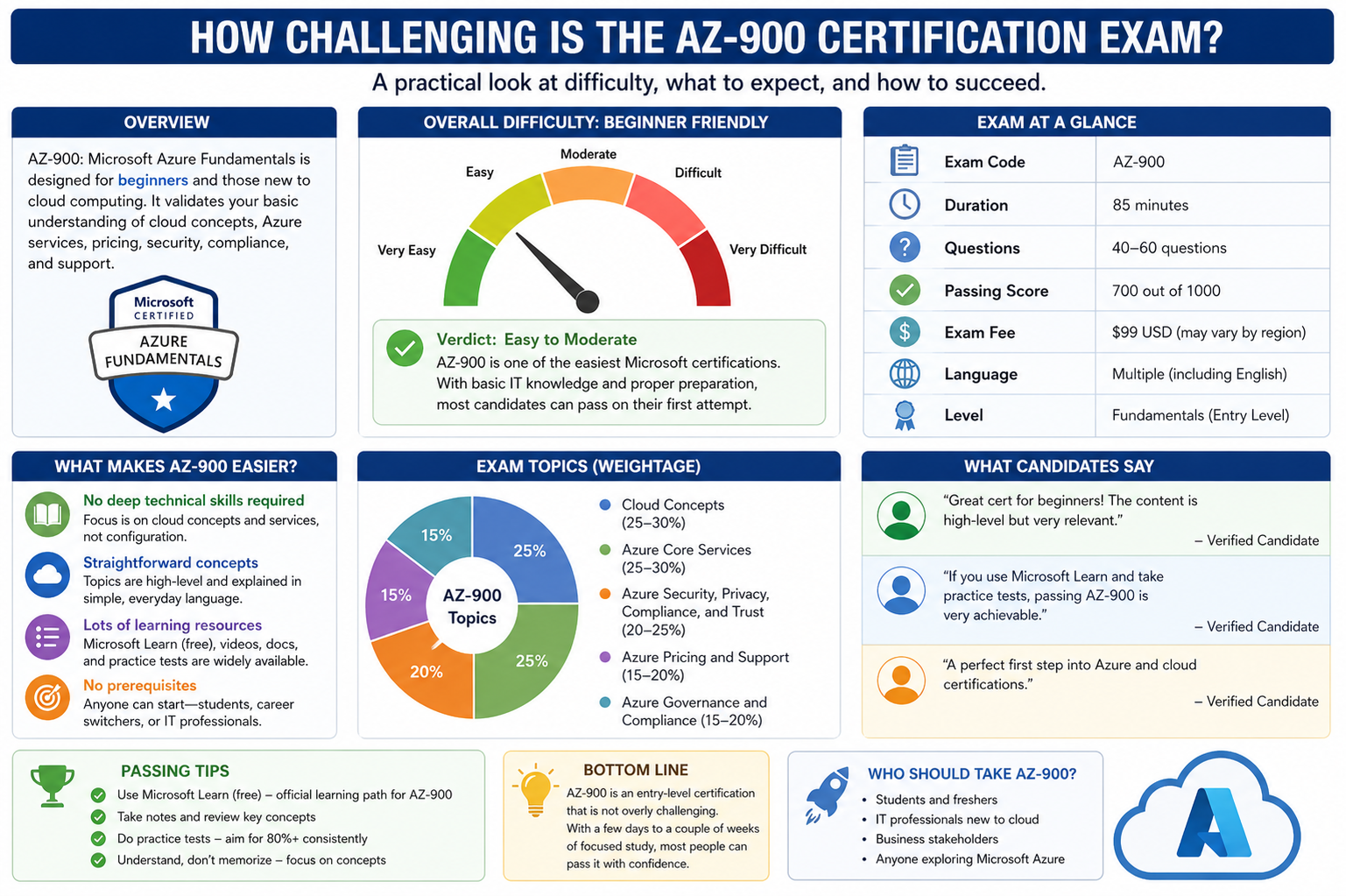
The AZ-900 Microsoft Azure Fundamentals certification is widely recognized as an introductory-level exam in the cloud computing domain. It is designed specifically for individuals who are either completely new to cloud technology or have very limited exposure to it. Because of its foundational nature, the exam does not focus on deep technical implementation or advanced configuration tasks. Instead, it emphasizes understanding core concepts of cloud computing and how Microsoft Azure provides solutions in that space. This positioning makes it one of the most accessible certifications within the Microsoft certification pathway.
While it is considered easy compared to associate or expert-level certifications, the perception of difficulty can vary depending on a person’s background. Someone already familiar with IT concepts, networking basics, or general cloud terminology may find it quite straightforward. On the other hand, a complete beginner without any technical background may need additional time to understand the terminology and structure of cloud services before feeling comfortable with the content.
Purpose and Target Audience of the Exam
The primary purpose of AZ-900 is to validate foundational knowledge of cloud concepts and Microsoft Azure services. It is not intended for engineers, developers, or administrators working at a deep technical level. Instead, it is aimed at students, business professionals, career changers, and anyone who wants to understand cloud computing from a high-level perspective.
Because of this broad audience, the exam avoids overly complex technical scenarios. It focuses more on awareness and conceptual clarity rather than hands-on implementation. For example, candidates are expected to understand what cloud computing is, why organizations use it, and how Azure services fit into modern IT environments. However, they are not required to deploy virtual machines, configure networks, or write scripts.
This makes the exam highly suitable as a first step into the cloud ecosystem. Many candidates use it as a stepping stone before moving on to more advanced certifications like associate-level Azure roles.
Nature of Exam Content and Question Style
The AZ-900 exam is structured around conceptual understanding. The questions are usually scenario-based but remain simple in nature. Instead of asking candidates to perform technical tasks, the exam presents situations and asks which Azure service or cloud concept is most appropriate.
For example, a question might describe a company looking to reduce IT costs and improve scalability, and the candidate must identify which cloud model best fits that need. Another question might involve selecting the correct Azure service for storage, computing, or networking needs at a basic level.
The exam avoids deep troubleshooting or configuration scenarios. This significantly reduces its technical difficulty but increases the importance of conceptual clarity. Candidates who understand definitions but cannot apply them in context may still struggle, as the questions often require interpretation rather than memorization.
Core Knowledge Areas Covered
The exam is generally divided into a few major knowledge areas. These areas are designed to cover the broad fundamentals of Azure and cloud computing.
One key area is cloud concepts. This includes understanding different types of cloud models such as public, private, and hybrid cloud. It also includes benefits of cloud computing such as scalability, reliability, and cost efficiency. These concepts are usually straightforward but require clear understanding rather than surface-level familiarity.
Another important area is core Azure services. This includes basic awareness of compute services, storage options, networking fundamentals, and databases. Candidates are not expected to configure these services but should understand their purpose and use cases.
Security, privacy, compliance, and trust are also covered. This section introduces basic security principles in Azure, including identity management and access control concepts. While not deeply technical, it requires attention to detail because some terms can be similar and easily confused.
Finally, pricing, support, and lifecycle topics are included. This part of the exam focuses on how Azure pricing works at a conceptual level, including cost management tools and support plans. It also covers service level agreements and general governance concepts.
Why the Exam Is Considered Easy by Many Candidates
One of the main reasons AZ-900 is considered easy is its lack of technical depth. Unlike more advanced certifications, it does not require hands-on experience with Azure environments. There are no lab-based questions or coding requirements, which significantly lowers the barrier to entry.
Additionally, the exam is designed for beginners, so the questions are written in a simplified and accessible manner. The language used is generally straightforward, and most questions focus on recognition rather than problem-solving under complex conditions.
Another reason for its perceived ease is the availability of learning resources. Because it is an entry-level certification, there is a large amount of structured study material available in various formats. This makes preparation more manageable even for self-learners.
Challenges Faced by Candidates
Despite being entry-level, the AZ-900 exam is not without challenges. One of the most common difficulties is the volume of information that must be covered. Even though the concepts are basic, there are many of them, and candidates often underestimate how much content is included.
Another challenge is terminology. Cloud computing has its own set of terms, and many of them may be unfamiliar to beginners. Words like scalability, elasticity, availability zones, and resource groups can initially seem confusing. Understanding these terms in context is essential for answering questions correctly.
Some candidates also struggle with distinguishing between similar Azure services. For example, multiple storage options exist, each designed for slightly different use cases. Without clear understanding, it can be easy to mix them up during the exam.
Time management is generally not a major issue, but nervousness can still affect performance. Since the questions are conceptual, candidates who overthink simple questions may spend more time than necessary on each one.
Preparation Effort and Study Approach
Preparing for AZ-900 typically does not require long-term study commitments. Many candidates are able to prepare within a few weeks if they study consistently. However, the actual time needed depends on prior knowledge and familiarity with IT concepts.
A structured approach usually works best. Starting with cloud fundamentals helps build a foundation before moving into Azure-specific topics. Once the basic understanding is in place, candidates can focus on learning services and their use cases.
Practice questions are also helpful in understanding how exam scenarios are framed. Since the exam focuses on conceptual application, exposure to question patterns is more valuable than memorizing definitions alone.
Consistency is more important than intensity. Short, regular study sessions tend to be more effective than long, irregular ones. Repeated exposure to key concepts helps reinforce understanding and improves recall during the exam.
Comparison with Other Azure Certifications
When compared to other Microsoft Azure certifications, AZ-900 is significantly easier. Associate-level exams require hands-on experience and deeper technical knowledge, including configuration, troubleshooting, and implementation skills. Expert-level certifications go even further, requiring advanced architectural understanding.
AZ-900 does not require any of these skills. It serves more as a conceptual introduction rather than a professional qualification for technical roles. This makes it an ideal starting point but not sufficient for advanced career roles on its own.
Because of this, many professionals use AZ-900 as a stepping stone. It helps build confidence and familiarity with Azure before moving on to more demanding certifications.
Common Misconceptions About Difficulty
A common misconception is that AZ-900 is too easy and therefore not valuable. While it is easier than other certifications, it still provides meaningful knowledge about cloud computing and Azure services. It establishes a foundation that is necessary for more advanced learning.
Another misconception is that it can be passed without preparation. While some individuals with prior experience may find it easy, most candidates still need to study to understand terminology and concepts properly.
Some also assume that the exam focuses on memorization. In reality, it emphasizes understanding. Simply memorizing definitions is not enough to answer scenario-based questions correctly.
Overall Difficulty Assessment
The AZ-900 certification exam sits at the beginner level in terms of difficulty. It is designed to be accessible but still meaningful in assessing foundational cloud knowledge. It does not require technical expertise, but it does require clear understanding of basic concepts.
For individuals new to cloud computing, it may feel slightly overwhelming at first due to unfamiliar terminology. However, with structured preparation, it becomes manageable and straightforward.
For those already familiar with IT or cloud concepts, the exam is generally considered easy and can often be completed with minimal preparation.
Final Perspective on Learning Value
Beyond its difficulty level, the AZ-900 exam is valuable as an educational experience. It introduces essential cloud concepts that are widely applicable across modern IT environments. Even if a candidate does not pursue further Azure certifications, the knowledge gained remains useful.
The exam acts as a bridge between general IT awareness and specialized cloud expertise. Its difficulty is intentionally balanced to encourage learning without overwhelming beginners.
Overall, while it is not a technically challenging exam, its importance lies in building a strong conceptual foundation that supports future growth in cloud computing careers.
Key Areas That Require Extra Attention
Even though the AZ-900 certification is considered entry-level, certain areas consistently require more attention from candidates because they are either more detailed or conceptually tricky. One of these areas is cloud service models. Understanding the difference between Infrastructure as a Service, Platform as a Service, and Software as a Service is essential, but many candidates confuse their responsibilities and boundaries. The exam often tests not just definitions but also real-world application of these models in different scenarios.
Another area that demands focus is Azure pricing and cost management. While it is not mathematically complex, it involves understanding how pricing works across different services, what factors influence cost, and how organizations can optimize spending. Concepts like pay-as-you-go, reserved instances, and cost calculators may seem simple individually, but distinguishing when to apply each concept in a scenario can be challenging for beginners.
Security and compliance concepts also require careful study. Azure introduces several identity and access management tools, and although the exam does not go deep into configuration, it expects clarity on what each service is used for. Misunderstanding basic security concepts like authentication versus authorization can lead to incorrect answers.
Role of Cloud Computing Concepts in the Exam
A significant portion of the AZ-900 exam is built around general cloud computing principles. This means candidates must understand why cloud computing exists and what problems it solves in modern IT environments. These concepts include scalability, elasticity, reliability, and high availability.
Scalability refers to the ability of a system to handle increasing or decreasing workloads efficiently. Elasticity takes this concept further by focusing on automatic adjustment of resources based on demand. High availability ensures that systems remain operational even when certain components fail. Reliability focuses on the overall stability and consistency of services.
Although these ideas sound theoretical, they are frequently tested through practical examples. Candidates are often given business scenarios and asked to identify which cloud benefit is most relevant. This requires not just memorization but also interpretation of real-world situations.
Understanding Azure Architecture at a High Level
The exam introduces candidates to the basic structure of Microsoft Azure without going into deep technical architecture. This includes understanding regions, availability zones, and resource groups. These components form the foundation of how Azure organizes and delivers services globally.
Regions refer to geographical areas where Azure data centers are located. Availability zones are physically separate locations within a region that help ensure redundancy and fault tolerance. Resource groups are logical containers used to organize and manage related Azure resources.
While these concepts are not difficult individually, candidates often struggle when asked to differentiate their purposes in scenario-based questions. The exam may present a situation involving disaster recovery or system redundancy and require identification of the correct architectural component.
Common Mistakes Made by Candidates
One of the most frequent mistakes in the AZ-900 exam is rushing through questions without fully understanding the scenario. Since the questions are usually short, candidates sometimes assume they are simpler than they actually are. This can lead to misinterpretation of key details.
Another common mistake is relying solely on memorization. While memorizing definitions may help with basic questions, it is not enough for scenario-based questions that require applied understanding. Candidates who do not practice real-world application often find these questions confusing.
Confusing similar Azure services is another issue. For example, storage solutions, compute options, and networking services may have overlapping features, but each is designed for specific use cases. Without clear conceptual separation, it becomes easy to select the wrong answer.
Some candidates also underestimate the exam entirely. Because it is labeled as “fundamentals,” they assume no preparation is needed. This often results in gaps in understanding that become noticeable during the exam.
Importance of Practice and Repetition
Practice plays a major role in improving performance for the AZ-900 exam. Since the exam focuses on conceptual understanding, repeated exposure to different question formats helps reinforce learning. Practice questions also help candidates become familiar with how scenarios are structured.
Repetition is particularly useful for cloud terminology. Many terms may initially seem confusing, but revisiting them multiple times helps build familiarity. Over time, candidates begin to recognize patterns in how questions are framed and how correct answers are derived.
It is also helpful to review incorrect answers carefully. Understanding why an answer is wrong is often more valuable than simply knowing the correct one. This helps build deeper conceptual clarity and reduces the likelihood of repeating similar mistakes.
Time Management During Preparation and Exam
Although the AZ-900 exam is not time-intensive compared to advanced certifications, time management still plays a role in both preparation and the actual exam. During preparation, it is important to allocate time evenly across all topics rather than focusing too heavily on one area.
In the exam itself, time pressure is usually minimal, but candidates should avoid spending too long on individual questions. Since most questions are conceptual, they should be answered based on understanding rather than overanalysis.
A steady pace is generally the most effective approach. Reading each question carefully and eliminating obviously incorrect options helps improve accuracy without wasting time.
Value of AZ-900 in Career Development
Although the AZ-900 certification is not technically advanced, it holds value in career development, especially for individuals entering the cloud industry. It demonstrates foundational knowledge, which can be useful when applying for entry-level IT or cloud-related roles.
It also serves as a prerequisite mindset builder for more advanced certifications. Understanding cloud fundamentals makes it easier to transition into technical roles such as cloud administrator, developer, or solutions architect.
For non-technical professionals, the certification provides a clear understanding of how cloud services impact business operations. This knowledge can be useful in roles involving project management, sales, or business analysis within technology environments.
Learning Curve for Beginners
For complete beginners, the learning curve for AZ-900 is moderate. The initial challenge lies in unfamiliar terminology and abstract concepts. However, once the basic ideas are understood, progress becomes much smoother.
Most beginners find that cloud computing concepts become clearer after a few days of study. The key is consistency and gradual progression rather than trying to absorb everything at once.
Visual learning and scenario-based thinking also help reduce the difficulty level. When concepts are connected to real-world examples, they become easier to remember and apply during the exam.
How Exam Difficulty Changes with Preparation Level
The perceived difficulty of AZ-900 changes significantly depending on preparation. For someone with no study, the exam may feel confusing due to unfamiliar terms. However, after structured preparation, the same exam becomes much more predictable.
Candidates who spend time understanding core concepts and practicing questions usually find the exam straightforward. The difference is not in the exam itself but in the level of readiness.
This is why preparation quality has a direct impact on perceived difficulty. A well-prepared candidate often completes the exam with confidence, while an underprepared candidate may find it challenging despite its beginner-level design.
Final Understanding of AZ-900 Difficulty
Overall, the AZ-900 certification exam is designed to be accessible, but it still requires meaningful preparation. It is not a test of advanced technical ability but rather a measure of foundational understanding of cloud computing and Microsoft Azure.
The difficulty level can be described as low to moderate, depending on the candidate’s background. For those with prior IT exposure, it feels simple. For complete beginners, it requires focused learning but remains achievable.
Its true value lies not in its difficulty but in its role as an entry point into the cloud ecosystem. It builds the conceptual foundation necessary for further growth in Azure-related careers and helps learners transition into more advanced technical certifications with confidence.
Exam Strategy for Better Performance
Success in the AZ-900 exam is not only about understanding concepts but also about applying a simple and effective strategy during the test. Since most questions are scenario-based, the key is to carefully read each situation and identify what the question is really asking. Many candidates lose marks not because they lack knowledge, but because they misinterpret the context of the question.
A useful approach is to first eliminate clearly incorrect options. This reduces confusion and narrows down the possible answers, making it easier to choose the correct one. Even when unsure, logical elimination often leads to the right choice because many distractor options are intentionally similar.
It is also important to focus on keywords in the question. Terms such as “most cost-effective,” “high availability,” or “scalable solution” usually point toward specific Azure concepts. Recognizing these cues can significantly improve accuracy and reduce hesitation during the exam.
Importance of Conceptual Clarity Over Memorization
One of the defining aspects of the AZ-900 exam is its emphasis on understanding rather than memorization. Candidates who rely only on memorizing definitions often struggle when faced with applied scenarios. This is because the exam tests how well you can connect concepts to real-world use cases.
For example, knowing the definition of cloud computing is helpful, but it is more important to understand why businesses migrate to the cloud and what benefits they expect. Similarly, knowing the name of an Azure service is not enough unless you understand its purpose and where it fits in a solution.
Conceptual clarity allows candidates to approach unfamiliar questions with confidence. Even if a question is phrased differently from what was studied, a strong understanding of fundamentals helps in logically deducing the correct answer.
Difficulty Variation Based on Background Knowledge
The difficulty of AZ-900 is not fixed and can vary significantly depending on the candidate’s background. Individuals with prior exposure to IT infrastructure, networking, or software development often find the exam easier because they already understand many underlying principles.
On the other hand, candidates from non-technical backgrounds may need more time to grasp basic concepts such as virtualization, cloud deployment models, and service categories. However, this does not make the exam impossible; it only means that the learning curve is slightly steeper initially.
Once foundational concepts are understood, both technical and non-technical candidates usually reach a similar level of readiness. The exam is designed in a way that does not favor deep technical expertise, which helps maintain balance across different backgrounds.
Role of Azure Services in Exam Understanding
A significant portion of the AZ-900 exam revolves around basic Azure services. These include compute, storage, networking, and database services. However, the exam does not require configuration knowledge. Instead, it focuses on recognizing what each service is used for.
For example, candidates should understand when to use virtual machines versus container services at a conceptual level. Similarly, they should be able to distinguish between different storage types based on use cases such as file storage, blob storage, or disk storage.
The challenge lies not in complexity but in differentiation. Many services may appear similar at first glance, so careful study is required to understand their unique purposes.
Common Misunderstandings About the Exam Level
A frequent misunderstanding is that AZ-900 is too basic to require preparation. This assumption often leads to poor performance because the exam still requires structured knowledge of cloud fundamentals. While it is not technically difficult, it is still a professional certification that expects clarity and accuracy.
Another misconception is that passing the exam guarantees technical readiness for cloud roles. In reality, AZ-900 is only an introduction. It provides awareness but does not develop hands-on skills needed for engineering or administration roles.
Some candidates also believe that the exam is purely theoretical and does not require application thinking. However, scenario-based questions clearly show that understanding how concepts apply in real situations is essential.
Effective Study Methods for AZ-900
An effective study approach for AZ-900 involves breaking down topics into manageable sections. Instead of trying to learn everything at once, focusing on one domain at a time helps improve retention. Starting with cloud concepts and gradually moving toward Azure services and pricing models is often a practical approach.
Using real-world examples while studying also helps strengthen understanding. When abstract concepts are linked to practical situations, they become easier to remember and apply during the exam.
Regular revision is equally important. Revisiting previously studied topics ensures that information stays fresh and reduces the chances of confusion during the exam.
Mental Preparation and Confidence Building
Mental readiness plays an important role in performing well in the AZ-900 exam. Since the questions are straightforward but sometimes tricky in wording, staying calm and focused is essential.
Candidates who approach the exam with confidence tend to perform better because they are less likely to overthink simple questions. Overthinking is one of the main reasons for incorrect answers in an otherwise easy exam.
Building confidence comes from preparation and practice. The more familiar a candidate is with question patterns, the more comfortable they feel during the actual test.
Time Efficiency in the Exam Environment
Time is usually not a major constraint in AZ-900, but efficient use of time still matters. Since questions are generally short, candidates should aim to maintain a steady pace without rushing or spending too long on individual questions.
If a question seems confusing, it is often better to mark it and return later rather than spending excessive time on it. This ensures that easier questions are not missed due to time pressure.
Maintaining a balanced approach helps complete the exam comfortably within the allocated time while leaving room for review if needed.
Real-World Value of Knowledge Gained
Even though AZ-900 is an entry-level certification, the knowledge gained has real-world value. Understanding cloud concepts helps individuals make better decisions in technology-related discussions, even outside technical roles.
For business professionals, it provides insight into how cloud computing impacts cost, scalability, and operational efficiency. For students and beginners, it builds a foundation for further learning in cloud technologies.
This foundational understanding is often the first step toward more specialized roles in cloud computing, making the certification meaningful beyond just passing an exam.
Long-Term Learning Path After AZ-900
After completing AZ-900, many learners choose to continue their journey into more advanced certifications. These include role-based certifications focused on administration, development, or architecture.
The knowledge gained from AZ-900 makes these next steps easier because candidates already understand the basic structure of Azure and cloud computing principles. Without this foundation, advanced topics can feel overwhelming.
This progression highlights the importance of AZ-900 not as an endpoint but as the beginning of a structured learning path in cloud technology.
Final Perspective on Exam Difficulty and Value
In conclusion, the AZ-900 certification exam is best described as beginner-friendly with moderate conceptual depth. It is not technically difficult, but it requires genuine understanding of cloud fundamentals rather than surface-level awareness.
The exam is designed to be accessible while still maintaining professional value. Its difficulty lies more in understanding and application of concepts rather than technical execution.
For most candidates, with proper preparation and consistent study, the exam is very achievable. Its true importance lies in building confidence and providing a strong foundation for future growth in cloud computing careers.
Advanced Understanding of Question Patterns
As candidates move deeper into preparation for the AZ-900 exam, one of the most useful skills to develop is recognizing question patterns. Although the exam is entry-level, its questions are carefully structured to test applied understanding rather than simple recall. Many questions follow a predictable logic where a business scenario is presented first, followed by a requirement such as cost reduction, improved scalability, or enhanced security.
Understanding how to interpret these requirements is essential. For example, if a question focuses on minimizing costs while maintaining flexibility, it often points toward cloud pricing models or pay-as-you-go services. If the emphasis is on reliability or uptime, concepts like high availability or redundancy become relevant. Recognizing these patterns helps reduce confusion and improves decision-making speed during the exam.
Over time, repeated exposure to practice questions helps train the mind to quickly identify what category a question belongs to. This reduces hesitation and increases accuracy, which is particularly useful given the multiple-choice format of the exam.
Depth of Understanding Required for Azure Concepts
While AZ-900 is not a deep technical exam, it still requires a meaningful level of conceptual depth. Simply knowing definitions is not enough to consistently answer questions correctly. Candidates are expected to understand relationships between different Azure services and how they support business needs.
For instance, understanding storage solutions involves more than knowing their names. It requires knowing when each type is appropriate, how they differ in performance and cost, and what kind of data they are designed to handle. Similarly, compute services must be understood in terms of flexibility, scalability, and deployment scenarios.
This depth is what differentiates a well-prepared candidate from someone relying on surface-level learning. Even though the exam is beginner-friendly, it rewards those who take time to build a structured understanding rather than rushing through content.
Balancing Breadth and Simplicity of Topics
One unique aspect of the AZ-900 exam is its balance between broad coverage and simple depth. The exam touches on many different areas of Azure, but each topic is covered only at a foundational level. This means candidates must be familiar with a wide range of concepts without needing to master any one of them in detail.
This structure can sometimes feel overwhelming because there is a lot of information to absorb. However, the simplicity of each topic prevents the exam from becoming too complex. The challenge lies in organizing knowledge effectively so that different concepts do not become confused with each other.
Creating mental categories for topics such as cloud models, core services, security, and pricing helps in maintaining clarity. Once these categories are well understood, it becomes easier to retrieve information during the exam.
Importance of Logical Thinking in the Exam
Logical thinking plays a significant role in AZ-900 success. Since many questions are scenario-based, the correct answer is often derived through reasoning rather than memorization. Candidates must evaluate what the scenario is asking and match it with the most appropriate Azure concept.
This means that even if a candidate does not immediately recognize an answer, they can still arrive at the correct choice by eliminating incorrect options and applying basic logic. For example, if a scenario involves reducing operational overhead, solutions involving automation or managed services are often relevant.
This logical approach is especially useful when dealing with unfamiliar questions. Instead of relying on memory alone, candidates can use reasoning to narrow down possibilities and make informed decisions.
Psychological Aspect of Exam Difficulty
The perceived difficulty of AZ-900 is often influenced by psychological factors rather than actual content complexity. Many candidates feel nervous because it is their first certification exam, which can make even simple questions seem more challenging.
Exam anxiety can lead to overthinking, where candidates doubt their initial instincts and change correct answers to incorrect ones. This is a common issue in multiple-choice exams, especially when the questions are intentionally designed with closely related options.
Building confidence through preparation and practice helps reduce this psychological pressure. Familiarity with question styles creates a sense of comfort, allowing candidates to focus on logic rather than stress during the exam.
Role of Real-World Scenarios in Learning
One of the most effective ways to prepare for AZ-900 is by connecting concepts to real-world scenarios. Cloud computing is not an abstract idea; it is widely used by businesses for everyday operations such as data storage, application hosting, and global service delivery.
When candidates relate concepts to practical use cases, they develop stronger understanding and better retention. For example, thinking about how a company scales its website during high traffic events helps clarify the concept of elasticity. Similarly, understanding how businesses reduce infrastructure costs by moving to the cloud reinforces pricing and deployment concepts.
This real-world connection makes it easier to interpret exam scenarios, which are often based on similar business situations.
Consistency in Preparation and Knowledge Retention
Consistency is one of the most important factors in successfully preparing for AZ-900. Because the exam covers a wide range of topics, irregular study patterns can lead to gaps in understanding. Regular revision ensures that previously learned concepts remain fresh and accessible.
Spaced repetition is particularly effective for retaining cloud terminology and service names. Revisiting topics multiple times over a period of days or weeks helps strengthen memory and reduces forgetting.
Consistent practice also improves familiarity with question formats. The more exposure candidates have to different types of questions, the more comfortable they become with interpreting and answering them.
Comparing Understanding Levels Among Candidates
Candidates preparing for AZ-900 often fall into different levels of understanding depending on their background and study approach. Some may have strong theoretical knowledge but struggle with application-based questions. Others may understand general concepts but lack familiarity with Azure-specific terminology.
The most successful candidates are those who combine both understanding and application. They not only know what a concept means but also how it is used in a practical context. This balanced approach is what the exam is designed to evaluate.
It is also common for candidates to improve significantly as they progress through preparation. Early confusion often gives way to clarity as concepts begin to connect with each other.
Final Insight
The overall experience of the AZ-900 exam is generally smooth for well-prepared candidates. While the content covers a wide range of foundational topics, the simplicity of each topic ensures that the exam remains accessible.
The main challenge lies not in technical difficulty but in understanding and applying basic concepts correctly. Candidates who invest time in structured learning, practice, and revision usually find the exam straightforward and predictable.
Ultimately, AZ-900 serves as a confidence-building certification that introduces individuals to cloud computing in a structured and practical way. Its difficulty is intentionally balanced to ensure it is achievable while still maintaining professional value, making it an ideal starting point for anyone beginning their journey in cloud technology.