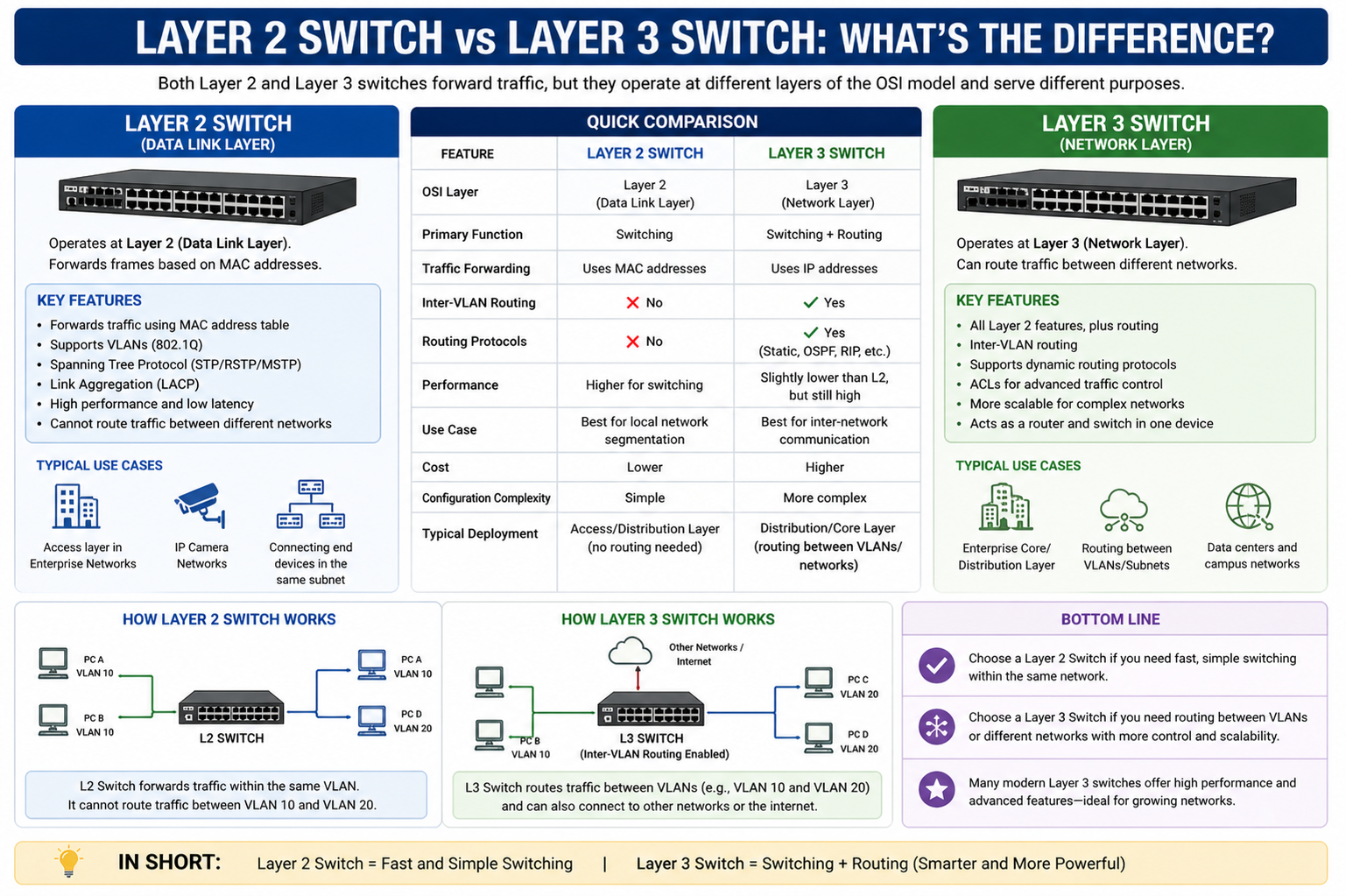
To clearly understand the difference between a Layer 2 switch and a Layer 3 switch, it is important to first understand where they operate in the networking model. Modern computer networks are built on a layered architecture known as the OSI (Open Systems Interconnection) model. This model divides communication functions into different layers, each responsible for a specific role in data transmission.
A Layer 2 switch operates at the Data Link Layer, which is responsible for node-to-node communication within the same local network. This means its job is to ensure that data is delivered accurately between devices that are directly connected or belong to the same network segment. It does not concern itself with broader network routing or addressing beyond its local environment.
On the other hand, a Layer 3 switch operates at the Network Layer in addition to the Data Link Layer. This gives it the ability to perform both switching and routing functions. In simple terms, it not only forwards data within a local network but also decides how data should move between different networks using logical IP addressing.
Role of MAC Addresses in Layer 2 Switching
A Layer 2 switch relies heavily on MAC (Media Access Control) addresses. Every device connected to a network interface has a unique MAC address embedded in its hardware. When a device sends data, it is packaged into a frame containing the destination MAC address.
The Layer 2 switch reads this MAC address and consults its internal MAC address table, also known as a CAM (Content Addressable Memory) table. This table maps MAC addresses to specific switch ports. Once the correct port is identified, the switch forwards the frame only to that port instead of broadcasting it to all connected devices.
This behavior significantly improves network efficiency by reducing unnecessary traffic. It also creates what is known as a single broadcast domain, meaning that broadcast traffic is shared across all devices connected to that switch unless segmentation techniques like VLANs are used.
However, Layer 2 switches cannot interpret IP addresses. This limitation means they cannot decide how to send data between different networks or subnets.
Broadcast Domains and Network Efficiency in Layer 2
In a Layer 2 environment, all devices typically belong to the same broadcast domain unless Virtual LANs (VLANs) are configured. A broadcast domain is a section of the network where a broadcast packet sent by one device is received by all other devices.
While this can be efficient in small networks, it becomes a challenge in large-scale environments. Excessive broadcast traffic can slow down network performance and create congestion. To manage this, network engineers often segment networks using VLANs, even on Layer 2 switches, to isolate traffic logically.
Despite this limitation, Layer 2 switches are still highly efficient for local communication because they operate at hardware speed using ASICs (Application-Specific Integrated Circuits), allowing extremely fast packet forwarding.
How Layer 3 Switching Extends Functionality
A Layer 3 switch introduces routing capabilities into the switching environment. This means it can understand both MAC addresses and IP addresses. When a packet arrives, the switch first checks whether the destination is within the same subnet. If it is, the switch behaves like a Layer 2 device and forwards the frame based on MAC addresses.
If the destination is in a different subnet, the Layer 3 switch uses its routing table to determine the best path. This process is similar to what a traditional router does, but it is performed at much higher speed due to hardware-based processing.
This dual capability makes Layer 3 switches extremely useful in modern enterprise networks where different departments, services, or systems are segmented into multiple VLANs and subnets.
Inter-VLAN Routing and Layer 3 Advantage
One of the most important features of a Layer 3 switch is its ability to perform inter-VLAN routing. VLANs are used to divide a physical network into multiple logical networks. Devices in different VLANs cannot communicate directly without routing.
In traditional setups, a separate router would be required to allow communication between VLANs. This creates additional latency and complexity. A Layer 3 switch eliminates this need by routing traffic internally at wire speed.
For example, if a finance department and an HR department are placed in different VLANs, a Layer 3 switch can enable secure and controlled communication between them without sending traffic outside the switch.
IP Routing and Forwarding Logic
Layer 3 switches maintain both a MAC address table and an IP routing table. The routing table contains information about network destinations and the best paths to reach them.
When a packet enters the switch, the device checks the destination IP address. If the destination network is directly connected, the switch forwards it accordingly. If not, it uses routing protocols or static routes to determine the next hop.
This capability allows Layer 3 switches to handle complex network topologies, making them suitable for large-scale infrastructures such as corporate campuses or data centers.
Performance Differences Between Layer 2 and Layer 3 Switches
Layer 2 switches are generally faster when handling local traffic because they only perform MAC address lookup, which is a simpler operation. This makes them ideal for environments where speed and simplicity are the primary requirements.
Layer 3 switches, while slightly more complex, still operate at very high speed due to hardware-based routing engines. In modern implementations, the performance difference between Layer 2 and Layer 3 switching is minimal for most practical applications.
However, Layer 3 switches may introduce slightly more processing overhead when handling inter-network traffic due to IP routing decisions.
Scalability in Network Design
Layer 2 switches are suitable for small to medium-sized networks but can become limited as the network grows. Large Layer 2 networks can suffer from broadcast storms, spanning tree complexity, and limited segmentation control.
Layer 3 switches provide better scalability because they allow hierarchical network design. Networks can be divided into multiple subnets and VLANs, reducing broadcast domains and improving overall performance.
This makes Layer 3 switching essential in enterprise environments where scalability, redundancy, and segmentation are critical.
Security Considerations
Layer 2 networks rely on MAC addresses, which are relatively easy to spoof. This can create security risks such as MAC flooding or unauthorized device access if proper security measures are not implemented.
Layer 3 switches offer enhanced security capabilities by allowing control based on IP addresses, subnets, and routing policies. They can enforce access control lists (ACLs), restricting communication between different parts of the network.
This makes Layer 3 switches more suitable for environments where security and access control are important concerns.
Use Cases in Real-World Networks
Layer 2 switches are commonly used in home networks, small office setups, and basic LAN environments where devices communicate within the same network segment. They are also widely used at the edge of enterprise networks to connect end-user devices such as computers, printers, and IP phones.
Layer 3 switches are used in larger environments such as enterprise campuses, data centers, and service provider networks. They are ideal for environments where multiple VLANs, subnets, and routing paths are required.
For example, in a university network, different departments such as engineering, administration, and library services may each have separate VLANs. A Layer 3 switch allows controlled communication between them while maintaining segmentation.
Hardware Architecture Differences
Layer 2 switches primarily rely on MAC address tables stored in high-speed memory. Their architecture is optimized for fast frame forwarding with minimal decision-making.
Layer 3 switches include additional hardware components for routing, such as routing engines and IP lookup tables. Many modern Layer 3 switches use specialized ASICs to perform routing functions at hardware speed, reducing dependency on CPU processing.
This architectural difference is what enables Layer 3 switches to combine both switching and routing efficiently.
Common Misconceptions
A common misconception is that Layer 3 switches are simply “better” than Layer 2 switches. In reality, they serve different purposes. Layer 2 switches are essential for basic connectivity and local network performance, while Layer 3 switches add advanced routing capabilities.
Another misconception is that Layer 3 switches are always required in large networks. In some cases, a combination of Layer 2 switches with centralized routing may still be used depending on network design and cost considerations.
Cost and Complexity Factors
Layer 2 switches are generally less expensive and simpler to configure. They require minimal network design knowledge and are easier to deploy.
Layer 3 switches are more expensive due to their advanced hardware and software capabilities. They also require more technical knowledge to configure routing, VLANs, and security policies.
However, the added cost is justified in environments where performance, scalability, and inter-network communication are critical.
Network Design Perspective
From a design perspective, modern networks often use a combination of both Layer 2 and Layer 3 switching. Layer 2 switches are deployed at the access layer to connect end devices, while Layer 3 switches are used at the distribution or core layer to handle routing and inter-VLAN communication.
This hierarchical approach ensures optimal performance, scalability, and manageability.
Final Technical Perspective
The key difference between Layer 2 and Layer 3 switches lies in their intelligence and functionality. Layer 2 switches operate purely on MAC address-based forwarding within a local network, while Layer 3 switches add the ability to understand IP addressing and perform routing between different networks.
This makes Layer 3 switches a more advanced solution for modern networking environments, while Layer 2 switches remain fundamental for basic local connectivity.
VLANs and Their Role in Layer 2 and Layer 3 Switching
Virtual LANs (VLANs) are one of the most important technologies that bridge the gap between Layer 2 and Layer 3 switching. In a Layer 2 switch environment, VLANs are used to logically divide a single physical switch into multiple isolated networks. Each VLAN behaves like a separate broadcast domain, meaning devices in one VLAN cannot directly communicate with devices in another VLAN.
This segmentation improves performance and security, but it also introduces a limitation: communication between VLANs requires routing. This is where Layer 3 switches become essential. A Layer 3 switch can route traffic between VLANs internally without sending data to an external router.
This capability allows organizations to maintain segmentation while still enabling controlled communication between departments or services.
Inter-VLAN Routing in Detail
Inter-VLAN routing is the process of enabling communication between different VLANs. In traditional Layer 2 environments, this is done using an external router connected to multiple VLAN interfaces. Each packet must leave the switch, be processed by the router, and then return to the switch for delivery.
Layer 3 switches eliminate this inefficiency by performing routing internally. When a device in VLAN 10 needs to communicate with a device in VLAN 20, the Layer 3 switch checks its routing table, determines the destination subnet, and forwards the packet directly.
This internal routing reduces latency significantly and improves overall network performance, especially in environments with heavy inter-department communication.
Routing Protocol Support in Layer 3 Switches
Layer 3 switches often support dynamic routing protocols such as RIP, OSPF, or EIGRP depending on the model and vendor. These protocols allow the switch to automatically learn and update routing paths based on network changes.
In contrast, Layer 2 switches do not support routing protocols because they do not handle IP-level forwarding. They rely entirely on MAC address learning and flooding techniques within their broadcast domain.
The inclusion of routing protocols in Layer 3 switches makes them more adaptable in dynamic network environments where routes frequently change.
Traffic Handling and Forwarding Mechanisms
In Layer 2 switching, traffic handling is straightforward. When a frame arrives, the switch reads the destination MAC address and forwards it to the correct port. If the MAC address is unknown, the switch floods the frame to all ports except the source.
In Layer 3 switching, the process is more complex. The switch first determines whether the destination IP address belongs to the same subnet. If it does, Layer 2 forwarding is used. If not, the packet is sent to the appropriate next-hop router or interface based on the routing table.
This dual-layer decision-making process allows Layer 3 switches to handle both local switching and inter-network routing efficiently.
Broadcast Traffic Control and Network Optimization
One of the biggest challenges in large networks is broadcast traffic. In a Layer 2 environment, broadcasts are sent to all devices within the same broadcast domain. If the network is large, this can lead to congestion and performance issues.
Layer 3 switches significantly reduce this problem by segmenting networks into smaller subnets. Since routing boundaries stop broadcast traffic, Layer 3 switches naturally limit the spread of broadcasts.
This improves network stability and reduces unnecessary load on devices.
Redundancy and High Availability Features
Layer 3 switches are often used in enterprise environments where redundancy and high availability are critical. They support features such as link aggregation, dynamic routing failover, and multiple gateway configurations.
Layer 2 switches also support redundancy mechanisms like Spanning Tree Protocol (STP), which prevents loops in the network. However, STP can introduce delays in failover situations.
Layer 3 switching reduces dependency on spanning tree by enabling more intelligent routing-based redundancy, which improves failover speed and network resilience.
Network Latency and Processing Efficiency
Latency is a critical factor in network performance. Layer 2 switches generally provide lower latency for local communication because they perform simple MAC lookups.
Layer 3 switches introduce additional processing steps due to IP routing decisions. However, modern hardware-based Layer 3 switches minimize this delay by using ASICs to perform routing at line speed.
As a result, the difference in latency between Layer 2 and Layer 3 switches in modern networks is often negligible for most applications.
Security Policies and Access Control
Layer 3 switches offer more advanced security capabilities compared to Layer 2 switches. They can implement Access Control Lists (ACLs) based on IP addresses, protocols, and ports. This allows administrators to define granular security rules for inter-network communication.
For example, traffic from one VLAN can be allowed to access specific services in another VLAN while blocking all other communication.
Layer 2 switches primarily rely on MAC-based filtering, which is less flexible and easier to bypass. This makes Layer 3 switches more suitable for environments where strict security enforcement is required.
Scalability in Enterprise Networks
As networks grow, scalability becomes a major concern. Layer 2 networks are limited by broadcast domain size and spanning tree complexity. Expanding a large Layer 2 network can lead to instability and management difficulties.
Layer 3 switching provides a scalable solution by breaking the network into smaller routed segments. Each subnet operates independently, reducing broadcast overhead and improving manageability.
This hierarchical design is commonly used in enterprise architectures where access, distribution, and core layers are clearly defined.
Role in Data Centers
In modern data centers, Layer 3 switches play a critical role in handling east-west traffic, which refers to communication between servers within the same facility. High-speed routing is essential for applications such as cloud computing, virtualization, and distributed storage systems.
Layer 2 switches are still used in data centers, particularly at the access layer where servers connect. However, Layer 3 switching is increasingly dominant in spine-leaf architectures where efficient routing is required between multiple racks and clusters.
Configuration Complexity and Management
Layer 2 switches are generally easier to configure. Basic setup involves assigning ports, creating VLANs, and enabling simple security features.
Layer 3 switches require more advanced configuration, including IP addressing, routing tables, VLAN interfaces, and sometimes dynamic routing protocols. This increases complexity but also provides greater control over the network.
Network engineers must have a deeper understanding of IP networking concepts when working with Layer 3 switches.
Cost vs Performance Trade-Off
Cost is an important factor when choosing between Layer 2 and Layer 3 switches. Layer 2 switches are more affordable and sufficient for basic connectivity needs.
Layer 3 switches are more expensive due to their additional hardware and software capabilities. However, they reduce the need for external routers and can simplify network architecture, which may offset the higher initial cost in large deployments.
Organizations often choose a hybrid approach to balance cost and performance.
Hybrid Network Architectures
Most modern networks do not rely exclusively on either Layer 2 or Layer 3 switching. Instead, they use a hybrid architecture where both are combined.
Layer 2 switches are used at the edge to connect end devices, while Layer 3 switches handle routing at higher layers of the network. This design provides flexibility, scalability, and efficient traffic management.
It also allows organizations to optimize cost while maintaining high performance.
Future Trends in Switching Technology
Network switching technology continues to evolve with advancements in software-defined networking (SDN) and virtualization. Modern Layer 3 switches are increasingly integrated with software control systems that allow centralized management of routing and switching policies.
Automation and intelligent traffic management are becoming more common, reducing manual configuration requirements. In this context, the distinction between Layer 2 and Layer 3 is becoming more fluid, but the fundamental principles remain the same.
Final Comparative Insight
Layer 2 switches focus on fast, efficient local communication using MAC addresses, making them ideal for simple and cost-effective network setups. Layer 3 switches extend this functionality by adding IP-based routing, enabling communication between different networks and supporting advanced enterprise requirements.
Both types of switches are essential in modern networking, and their roles complement each other in building scalable, efficient, and secure network infrastructures.
Understanding Where Each Switch Fits in Real Networks
In practical networking environments, Layer 2 and Layer 3 switches are not chosen in isolation but are deployed based on the structure and needs of the network. The decision is less about which one is better and more about where each one fits best in a layered network design.
Layer 2 switches are typically positioned closer to end devices such as computers, printers, IP phones, and access points. Their main responsibility is to provide fast and efficient connectivity within a local segment. Because they operate using MAC addresses, they are highly efficient at handling internal communication without adding routing complexity.
Layer 3 switches, in contrast, are placed at higher levels of the network hierarchy. They act as aggregation points where multiple Layer 2 segments or VLANs connect. Their job is not just to forward traffic but also to intelligently route it between different logical networks.
Access Layer vs Distribution Layer Role
In structured network design, the access layer is where Layer 2 switching dominates. This is the point where end-user devices connect to the network. The focus here is simplicity, speed, and cost efficiency. VLANs are often implemented at this level to separate traffic logically without physically separating devices.
Above this is the distribution layer, where Layer 3 switching becomes more important. This layer aggregates multiple access switches and handles routing between VLANs and subnets. It also applies policies, security rules, and traffic control mechanisms.
By separating responsibilities in this way, networks become easier to manage, scale, and troubleshoot.
Core Layer and High-Speed Routing
In larger enterprise networks, there is also a core layer, which is responsible for high-speed backbone connectivity. Layer 3 switches are commonly used here due to their ability to handle large volumes of routed traffic efficiently.
At this level, speed and reliability are critical. The core layer is designed to move data quickly between different parts of the network without performing complex filtering or policy enforcement. Layer 3 switches excel here because they can route traffic at hardware speed using optimized forwarding engines.
Traffic Flow Example in a Layered Network
To understand how Layer 2 and Layer 3 switches work together, consider a simple example. A user in a finance department sends a request to a server in the IT department.
The user’s device connects to a Layer 2 switch at the access layer. The traffic is forwarded within the VLAN until it reaches a Layer 3 switch at the distribution layer. The Layer 3 switch checks the destination IP address and determines that it belongs to a different VLAN or subnet. It then routes the traffic internally to the correct destination network.
The response follows the same path in reverse. This combination of switching and routing ensures efficient communication without unnecessary delays or external routing devices.
Performance Optimization in Mixed Environments
Modern networks often combine both switch types to achieve optimal performance. Layer 2 switching handles local traffic at high speed, while Layer 3 switching ensures efficient communication between different network segments.
This division of labor prevents bottlenecks and reduces unnecessary load on routing devices. It also allows network engineers to fine-tune performance based on traffic patterns.
For example, high-volume internal traffic within a department can remain within a Layer 2 domain, while inter-department communication is handled by Layer 3 switching.
Impact on Network Design Philosophy
The introduction of Layer 3 switching has significantly changed how networks are designed. In older architectures, routers were the primary devices responsible for inter-network communication. This created bottlenecks because all traffic between networks had to pass through centralized routers.
Layer 3 switches distribute this workload by embedding routing capabilities directly into switching hardware. This leads to flatter, faster, and more scalable network designs.
As a result, modern enterprise networks are less dependent on centralized routing and more focused on distributed intelligence.
Fault Isolation and Troubleshooting Differences
Troubleshooting in Layer 2 networks often involves identifying issues such as MAC address conflicts, VLAN misconfigurations, or spanning tree loops. Because Layer 2 operates within a single broadcast domain, problems can sometimes spread quickly if not controlled.
Layer 3 networks offer better fault isolation because each subnet is separated by routing boundaries. If an issue occurs in one VLAN or subnet, it is less likely to impact the entire network.
This separation makes it easier for network administrators to identify and resolve problems without affecting unrelated systems.
Loop Prevention Mechanisms
Layer 2 networks are vulnerable to switching loops, which can cause broadcast storms and network instability. To prevent this, protocols like Spanning Tree Protocol (STP) are used. STP disables redundant paths to ensure only one active path exists between switches.
While effective, STP can introduce delays during failover situations. Layer 3 switching reduces reliance on STP because routing naturally avoids loops through IP-based path selection. This results in faster convergence and more stable network behavior.
Address Resolution and Lookup Differences
Layer 2 switches rely on the Address Resolution Process at the MAC level. When a device needs to communicate, it uses ARP (Address Resolution Protocol) to find the MAC address associated with an IP address. The switch then forwards frames based on MAC table entries.
Layer 3 switches perform both MAC and IP lookups. They first determine the IP route and then resolve the MAC address for the next hop. This dual-layer lookup allows more intelligent forwarding decisions but requires more processing logic.
Despite this, hardware optimization ensures that these lookups happen extremely quickly in modern devices.
Bandwidth Utilization and Traffic Efficiency
Layer 2 switching is highly efficient for localized traffic because it avoids unnecessary processing. However, when networks grow large, broadcast traffic can consume significant bandwidth.
Layer 3 switching improves bandwidth utilization by limiting broadcast domains and routing traffic only where needed. This reduces congestion and ensures that bandwidth is used more efficiently across the entire network.
This is especially important in environments with high data transfer requirements such as cloud services and enterprise applications.
Virtualization and Cloud Networking Impact
With the rise of virtualization and cloud computing, network demands have changed significantly. Virtual machines often need to communicate across different physical hosts and networks. Layer 3 switching plays a key role in enabling this communication efficiently.
In virtualized environments, Layer 2 networks can become stretched across physical boundaries, but Layer 3 routing helps maintain performance and isolation. This is why modern data centers heavily rely on Layer 3 switching architectures.
Security Segmentation in Modern Networks
Security has become a major factor in network design. Layer 3 switches allow fine-grained segmentation using subnets, VLANs, and access control rules. This makes it possible to isolate sensitive systems such as financial databases or administrative servers from general user traffic.
Layer 2 switches, while useful for segmentation through VLANs, offer limited enforcement capabilities compared to Layer 3 devices. As a result, Layer 3 switching is often preferred in environments where strict security policies are required.
Energy Efficiency and Hardware Utilization
Modern Layer 3 switches are designed to be energy efficient despite their advanced capabilities. They use specialized ASICs to perform routing and switching tasks with minimal CPU involvement. This reduces power consumption while maintaining high performance.
Layer 2 switches are generally simpler and consume less power overall, but they also offer fewer advanced features. In large deployments, the efficiency of Layer 3 hardware often outweighs its higher complexity.
Operational Management and Monitoring
Network monitoring is another area where differences become apparent. Layer 2 switches typically provide basic monitoring information such as port status, MAC address tables, and VLAN assignments.
Layer 3 switches offer more advanced monitoring capabilities, including routing tables, interface statistics, and traffic flow analysis. This makes them more suitable for enterprise-grade network management systems.
Better visibility into network behavior allows administrators to optimize performance and quickly detect anomalies.
Scalability in Cloud-Ready Architectures
As organizations move toward cloud-first strategies, scalability becomes a critical requirement. Layer 3 switching supports this by enabling flexible routing across distributed environments.
Cloud networks often span multiple physical locations and require dynamic routing between them. Layer 3 switches provide the foundation for this connectivity, while Layer 2 switches remain important for local connectivity within individual segments.
This combination ensures both local efficiency and global reachability.
In real-world deployment, Layer 2 and Layer 3 switches are not competitors but complementary components of a unified network architecture. Layer 2 switching ensures fast, simple, and cost-effective local communication, while Layer 3 switching provides intelligent routing, scalability, and advanced control.
Understanding how and where each type is used is essential for designing efficient, secure, and high-performance networks.
Evolution from Traditional Routing to Layer 3 Switching
In early network architectures, routers were the primary devices responsible for connecting different networks. All inter-network communication had to pass through these routers, which made them critical but also a potential bottleneck. As networks expanded, this centralized routing model struggled to keep up with increasing traffic demands.
Layer 3 switches emerged as a solution to this limitation by integrating routing functionality directly into switching hardware. Instead of sending packets to a separate router, the switch itself could make routing decisions at hardware speed. This evolution fundamentally changed network design by decentralizing routing tasks and distributing them across the network infrastructure.
This shift allowed organizations to build faster, more scalable, and more resilient networks without relying heavily on standalone routing devices.
Hardware Acceleration and ASIC-Based Processing
One of the key technological advancements behind Layer 3 switches is the use of ASICs (Application-Specific Integrated Circuits). These specialized chips are designed to perform switching and routing operations at extremely high speeds.
In Layer 2 switching, ASICs handle MAC address lookups and frame forwarding. In Layer 3 switching, additional ASIC logic enables IP address lookups, routing table processing, and packet forwarding decisions.
This hardware-based processing ensures that even complex routing tasks can be executed with minimal delay. Unlike software-based routers, which rely heavily on CPU processing, Layer 3 switches offload most tasks to dedicated hardware, resulting in near wire-speed performance.
Packet Flow Behavior in Depth
Understanding packet flow helps clarify the internal differences between Layer 2 and Layer 3 switching.
In a Layer 2 environment, a frame enters the switch, and the MAC address table is checked. If the destination MAC is known, the frame is forwarded directly. If unknown, the frame is flooded to all ports within the VLAN except the source port.
In a Layer 3 environment, the process is more layered. A packet first arrives with both MAC and IP headers. The switch checks the destination IP address and determines whether it belongs to a local subnet. If not, it performs a routing lookup to identify the next hop. Once the correct path is determined, the switch rewrites the MAC addresses for the next segment and forwards the packet accordingly.
This combination of switching and routing in a single device enables efficient end-to-end communication across complex networks.
Role of Default Gateways in Layer 3 Switching
In any IP-based network, devices rely on a default gateway to communicate outside their local subnet. In traditional networks, this gateway is a router. In Layer 3 switch environments, the switch itself often serves as the default gateway.
This means end devices send traffic destined for other networks directly to the Layer 3 switch. The switch then determines where the traffic should go based on its routing table.
This reduces network hops and improves communication speed between VLANs and subnets, especially in environments with heavy internal traffic.
Multilayer Switching and Its Importance
Layer 3 switches are often referred to as multilayer switches because they operate across multiple layers of the OSI model. While their primary distinction is routing capability, they still perform all Layer 2 functions such as MAC-based switching.
This dual functionality allows them to adapt dynamically based on traffic type. If traffic remains within the same VLAN, it is handled at Layer 2 speed. If traffic needs to cross networks, Layer 3 logic is applied.
This flexibility is one of the reasons multilayer switches are widely used in enterprise and data center environments.
Impact on Network Convergence Time
Convergence time refers to how quickly a network adapts to changes such as link failures or topology updates. In Layer 2 networks, convergence is often dependent on Spanning Tree Protocol, which can take several seconds to stabilize after a change.
Layer 3 switching significantly improves convergence time because routing protocols can quickly recalculate paths and update routing tables. This allows traffic to be redirected almost immediately in case of failures.
Faster convergence is critical in environments where downtime must be minimized, such as financial systems, cloud platforms, and large-scale enterprise applications.
Load Balancing Capabilities in Layer 3 Networks
Layer 3 switches support advanced load balancing techniques by distributing traffic across multiple equal-cost paths. This is known as Equal-Cost Multi-Path (ECMP) routing.
With ECMP, multiple routes to the same destination can be used simultaneously, improving bandwidth utilization and reducing congestion. Layer 2 switches do not support this type of routing-based load balancing because they operate only within a single broadcast domain.
This makes Layer 3 switching more efficient for handling large volumes of distributed traffic.
Network Segmentation and Micro-Segmentation Trends
Modern network security strategies increasingly rely on segmentation and micro-segmentation. Layer 3 switches play a key role in this approach by enforcing strict boundaries between different network segments.
Each subnet can be isolated while still allowing controlled communication through routing policies. This reduces the attack surface and limits the spread of potential security threats.
Layer 2 switches contribute to segmentation through VLANs, but enforcement is stronger and more flexible at Layer 3 due to IP-based control mechanisms.
Role in Software-Defined Networking (SDN)
Software-Defined Networking has transformed how networks are managed by separating control logic from physical infrastructure. In SDN environments, Layer 3 switches often act as forwarding devices controlled by centralized software controllers.
This allows network administrators to define policies, routing behavior, and traffic rules from a central interface rather than configuring each device individually.
Layer 2 switches are also used in SDN environments, but Layer 3 switches provide greater flexibility due to their routing capabilities and support for dynamic traffic engineering.
QoS (Quality of Service) in Layer 3 Switching
Quality of Service is an important feature in modern networks, especially for applications like VoIP, video conferencing, and real-time data processing. Layer 3 switches can prioritize traffic based on IP addresses, protocols, or port numbers.
This ensures that critical applications receive higher priority over less important traffic. Layer 2 switches can also implement basic QoS at the MAC or VLAN level, but Layer 3 provides more granular and powerful control mechanisms.
This makes Layer 3 switching essential in environments where performance consistency is required.
IPv4 and IPv6 Handling Differences
Layer 3 switches support both IPv4 and IPv6 protocols, allowing them to operate in modern dual-stack environments. They maintain separate routing tables for each protocol and can forward traffic accordingly.
Layer 2 switches are protocol-agnostic at the IP level since they only deal with MAC addresses. This means they do not interpret IP versions, making them simpler but less flexible in evolving network environments.
As IPv6 adoption increases globally, Layer 3 switching becomes even more important for future-proof network design.
Multicast Traffic Handling
Multicast traffic is used for efficient one-to-many communication, such as streaming or real-time data distribution. Layer 3 switches can intelligently handle multicast routing using protocols like IGMP (Internet Group Management Protocol).
This ensures that multicast traffic is only delivered to devices that have requested it, reducing unnecessary bandwidth usage.
Layer 2 switches handle multicast differently, often treating it similarly to broadcast traffic unless specific filtering is applied.
Energy Efficiency in Large-Scale Deployments
In large-scale networks, energy consumption becomes a significant concern. Layer 3 switches are designed with energy-efficient ASICs that optimize processing while maintaining high throughput.
Although they perform more complex tasks than Layer 2 switches, their hardware-based design ensures efficient power usage relative to their performance output.
This balance between performance and energy efficiency is important in data centers and enterprise environments where thousands of devices operate simultaneously.
Operational Visibility and Analytics
Layer 3 switches provide deeper visibility into network traffic compared to Layer 2 switches. They can track IP flows, routing decisions, and traffic patterns across multiple segments.
This data is valuable for network optimization, security monitoring, and performance tuning. Administrators can identify congestion points, detect anomalies, and adjust configurations based on real-time insights.
Layer 2 switches provide more limited visibility, focusing mainly on MAC address activity and port-level statistics.
Future Integration with AI-Driven Networking
Modern networking is increasingly moving toward AI-driven management systems that automatically optimize performance and detect issues. Layer 3 switches are better suited for this evolution because they provide richer data about traffic flows and routing behavior.
As networks become more intelligent, Layer 3 switching will likely play an even greater role in automated decision-making, traffic optimization, and predictive maintenance.
Layer 2 switches will continue to serve as essential access devices, but higher-level intelligence will primarily be implemented at Layer 3 and above.
Final Insight
From an engineering perspective, the distinction between Layer 2 and Layer 3 switches represents the transition from simple frame forwarding to intelligent packet routing. Layer 2 switching focuses on speed and simplicity within a local domain, while Layer 3 switching introduces scalability, routing intelligence, and advanced network control.
Together, they form the backbone of modern network architecture, enabling everything from small office connectivity to global enterprise infrastructure.