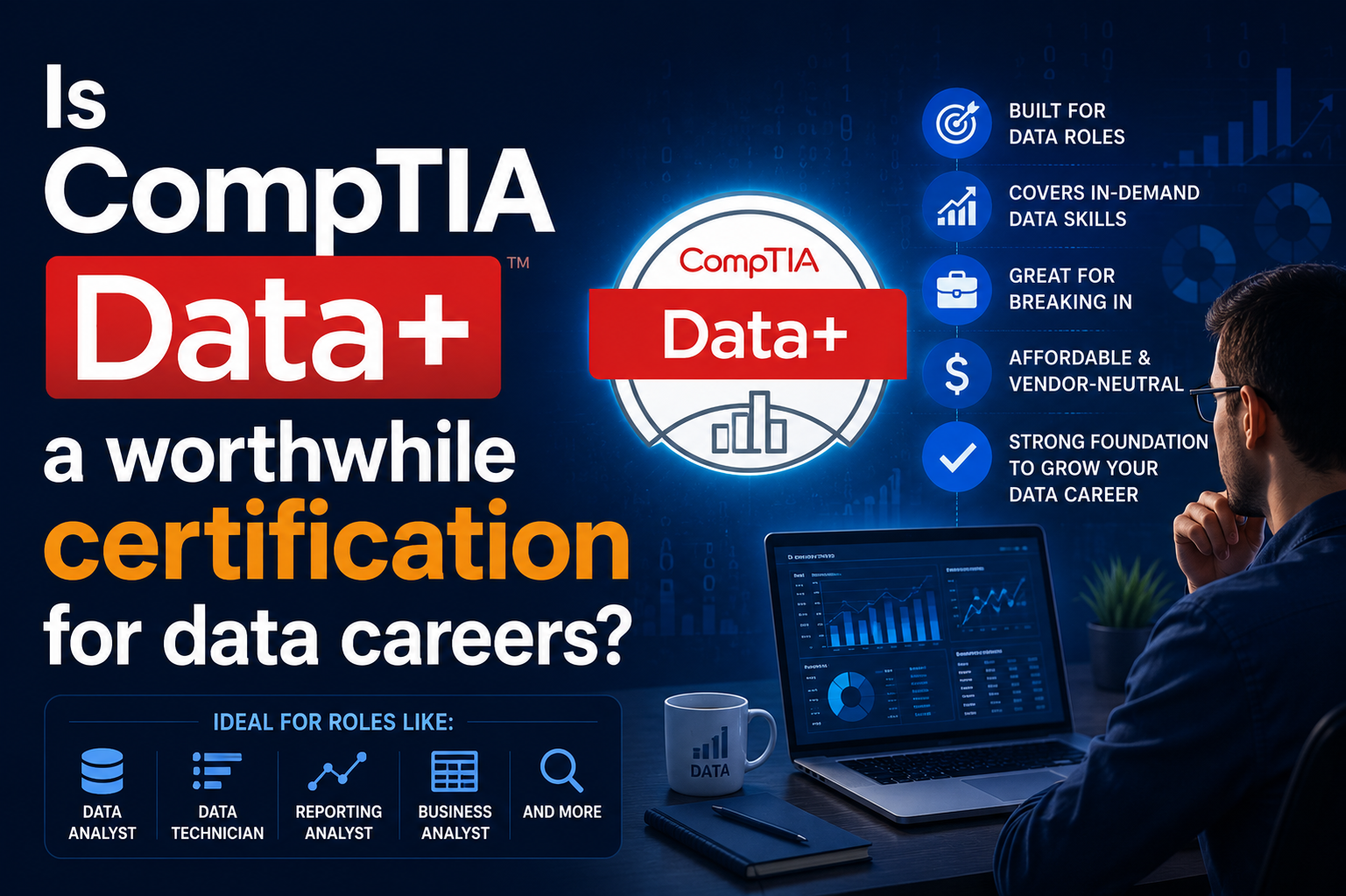
The CompTIA Data+ certification has gained attention in recent years as organizations increasingly rely on data to drive decision-making. With the growth of analytics roles across industries, many beginners and early-career professionals wonder whether this certification is worth the time, effort, and financial investment. Unlike highly advanced certifications that require deep technical expertise, CompTIA Data+ is positioned as an entry-level credential focused on data fundamentals, making it appealing to those transitioning into data-related careers. However, its real value depends on career goals, current skill level, and how it is used within a broader learning path.
To understand whether CompTIA Data+ is worthwhile, it is important to look beyond marketing claims and examine what the certification actually offers in terms of knowledge, industry recognition, career impact, and long-term growth potential in data-focused roles.
Understanding What CompTIA Data+ Represents
CompTIA Data+ is designed to validate foundational skills in data analytics. It focuses on understanding data concepts, data mining, visualization, data governance, and basic statistical methods. Unlike more advanced certifications in data science or cloud-based analytics platforms, it does not require programming expertise or deep knowledge of machine learning. Instead, it emphasizes the ability to interpret data, create meaningful reports, and support business decision-making processes.
This makes it particularly relevant for roles such as junior data analyst, business analyst, reporting analyst, or any position where data interpretation is important but not deeply technical. It is often seen as a stepping stone certification for individuals who are new to the data field and want to build structured knowledge before moving into more specialized areas.
Skills You Gain From CompTIA Data+
One of the main benefits of pursuing this certification is the structured exposure to essential data concepts. Many learners come from non-technical backgrounds and may not know where to start. CompTIA Data+ helps organize foundational knowledge into a clear framework.
You gain an understanding of how data is collected, cleaned, and prepared for analysis. You also learn how to interpret different types of datasets and identify patterns or trends that can support decision-making. Another key area is data visualization, where candidates learn how to present data in a way that is understandable to stakeholders who may not have technical expertise.
In addition, the certification introduces basic statistical concepts such as mean, median, correlation, and data distribution. While not deeply mathematical, this exposure helps learners develop analytical thinking, which is essential in any data-driven role.
Data governance and data quality are also covered, which are increasingly important in modern organizations that rely heavily on accurate and secure data handling practices. Understanding data privacy, compliance, and ethical considerations adds value beyond technical analysis skills.
Industry Recognition and Employer Perception
The value of CompTIA Data+ depends heavily on how employers perceive it. In general, CompTIA certifications are well-known in the IT industry, especially for foundational knowledge areas like A+, Network+, and Security+. Data+ is newer compared to these, which means its recognition is still growing.
For entry-level roles, it can help candidates stand out when competing with others who have no formal data-related certification. It signals that the individual has taken structured steps to learn data fundamentals rather than relying solely on self-study. This can be useful when applying for internships, junior analyst positions, or career transitions from unrelated fields.
However, it is important to understand that CompTIA Data+ alone is not usually enough to secure advanced data analyst or data science roles. Employers in more competitive environments often prioritize practical experience, advanced tools knowledge, and programming skills in languages like SQL, Python, or R.
Therefore, while the certification is respected as a foundational credential, it is not considered a strong differentiator for senior-level or highly technical positions.
Comparison With Other Data Certifications
When evaluating whether CompTIA Data+ is worthwhile, it is useful to compare it with other certifications in the data space. Many alternative certifications focus more heavily on tools and platforms such as Microsoft Power BI, Google Data Analytics, or specialized SQL certifications.
Compared to these, CompTIA Data+ is broader and more conceptual. It does not focus deeply on any single tool or platform. Instead, it provides a general understanding of data processes. This can be both an advantage and a limitation. It is an advantage because it builds a strong foundation that can apply across multiple tools. It is a limitation because employers often expect hands-on proficiency with specific software.
For example, a candidate with Power BI or Tableau certification may be able to demonstrate direct dashboard-building skills, which are often required in job descriptions. CompTIA Data+ does not provide that level of tool-specific expertise.
However, for learners who want to build a strong conceptual base before choosing a specialization, Data+ can serve as a useful starting point.
Career Path Opportunities After Certification
After earning CompTIA Data+, individuals typically pursue entry-level data-related roles. These may include positions such as data analyst trainee, reporting assistant, or business support analyst. In some cases, it can also help professionals in marketing, finance, or operations roles improve their data interpretation skills and advance within their current organization.
The certification is particularly useful for career changers who do not have a technical background. It provides structured learning that can make the transition into data roles smoother. However, to progress beyond entry-level positions, additional skills are necessary.
Most employers expect data professionals to have experience with SQL for querying databases, Excel for data manipulation, and visualization tools for reporting. As careers advance, programming languages, statistical modeling, and machine learning concepts become increasingly important.
CompTIA Data+ should therefore be seen as a starting point rather than a complete career solution. It opens the door, but continued learning is required to move forward.
Practical Value in Real-World Work Environments
One of the key questions is whether the certification translates into practical workplace value. In real-world environments, data professionals are expected to work with messy datasets, interpret business requirements, and deliver insights that support decision-making.
CompTIA Data+ helps build awareness of these responsibilities, but it does not fully simulate real-world complexity. It provides theoretical and foundational understanding rather than hands-on project experience.
However, the concepts learned in the certification can still be applied in practical settings. Understanding data quality, for example, helps professionals identify errors in reports. Knowledge of visualization principles can improve the clarity of presentations. Awareness of data governance can help ensure compliance with organizational policies.
While it does not replace hands-on experience, it complements it by strengthening conceptual understanding.
Cost, Time, and Effort Considerations
Another important factor in determining value is the investment required. CompTIA Data+ requires preparation time, study materials, and exam fees. For beginners, preparation may take several weeks to a few months depending on prior knowledge.
The effort required is moderate compared to more advanced certifications, but it still demands consistent study and understanding of multiple topics. The financial cost may also be a consideration for learners on a tight budget.
Because of this, the return on investment depends on how the certification is used. If it is part of a broader learning strategy that includes practical projects and additional technical skills, it can be worthwhile. If it is pursued alone without further development, its impact may be limited.
Who Should Consider CompTIA Data+
This certification is most suitable for individuals who are completely new to data analysis and want a structured entry point. It is also useful for professionals who already work with data in non-technical roles and want to formalize their understanding.
Students, career changers, and early-career professionals can benefit the most from it. It is less suitable for experienced data analysts or data scientists who already possess technical skills and industry experience, as it may not add significant new value.
Limitations of CompTIA Data+
Despite its benefits, the certification has limitations. It does not cover advanced analytics techniques, machine learning, or programming skills. It is also not strongly tied to any specific industry tool, which can reduce its direct job applicability.
In highly competitive job markets, employers may prioritize candidates with hands-on project portfolios over those with foundational certifications alone. This means the certification should be paired with practical experience to maximize effectiveness.
Conclusion
CompTIA Data+ can be a worthwhile certification for individuals who are beginning their journey into data careers or transitioning from non-technical fields. It provides a structured introduction to essential data concepts, including analytics, visualization, governance, and basic statistics. For beginners, it helps build confidence and creates a foundation for further learning.
However, its value is limited when viewed in isolation. It is not a replacement for hands-on experience, technical tools knowledge, or advanced data skills. In modern data careers, employers expect practical ability in tools like SQL, Excel, and visualization platforms, along with real-world project experience.
Ultimately, CompTIA Data+ is best viewed as a stepping stone rather than a destination. It is worthwhile for those who use it as part of a broader learning path that includes continuous skill development and practical application. When combined with additional training and experience, it can contribute meaningfully to building a successful career in the data field.