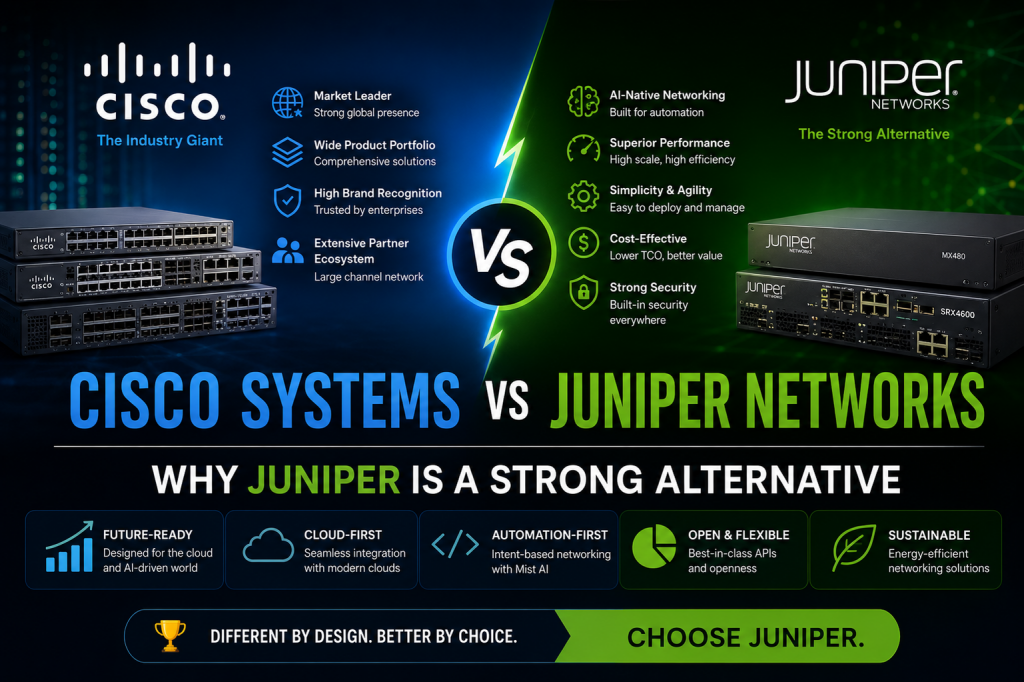
Choosing between Cisco networking and Juniper networking is a design and operations decision, not a contest with a universal winner. There is also an important ownership change to account for: Hewlett Packard Enterprise completed its acquisition of Juniper Networks on July 2, 2025. Juniper product lines remain useful names when comparing equipment and software, but Juniper should no longer be described as an independent corporate alternative to HPE. Cisco and HPE’s Juniper networking portfolio can still be compared for a specific technical requirement, provided the products, deployment model, and support commitments are named precisely.
An evaluation should begin with the network’s required outcomes: acceptable outage duration, routing scale, segmentation, automation, security controls, and what the operations team can actually maintain. A features checklist cannot replace a representative proof of concept.
Start with comparable products and use cases
Cisco sells campus, branch, data-center, security, and service-provider networking products. Juniper’s product families historically include EX and QFX switching, MX routing, SRX security, and the Junos operating system. These are broad families, not like-for-like products. A campus access switch must be compared with a campus access switch; a data-center fabric should be evaluated against a data-center fabric. Even devices from the same vendor can have materially different forwarding, licensing, and management capabilities.
List the endpoints, applications, sites, route count, resiliency targets, interfaces, and deployment constraints first. Only then choose the exact Cisco and HPE Juniper models or platform tiers that meet those requirements. Verify every claimed feature and supported release against the corresponding product documentation.
Compare the operating systems and management model
Teams frequently encounter Cisco IOS XE on enterprise routing and switching platforms, NX-OS in data-center environments, and Junos in several Juniper families. Their configuration hierarchies, operational commands, upgrade mechanisms, and automation interfaces differ. Familiarity with one Cisco command set does not automatically transfer across all Cisco platforms; Junos should not be reduced to a single ‘simpler’ interface either.
Test how a configuration change is reviewed, applied, verified, and reversed. Useful trial tasks include adding an isolated VLAN, changing a route policy, performing a maintenance upgrade, and collecting fault evidence. Record the time and number of manual steps involved, including change approvals and troubleshooting hand-offs.
Evaluate routing, segmentation, and resilience as an end-to-end system
Support for BGP, OSPF, EVPN, or virtual routing is a starting point, not proof of equivalent implementations. Check the particular software release, scale limits, route-policy behavior, high-availability convergence, interoperability with existing devices, and operational diagnostics. Where overlays are involved, validate the underlay as well as the overlay and test a planned failure rather than assuming a brochure’s resiliency claim.
A campus network may prioritize access authentication, wireless roaming, policy-based segmentation, and endpoint experience. A service-provider design may place more weight on routing policy, traffic engineering, and fault recovery. A data-center fabric needs a different set of tests. Document the failure and maintenance scenarios that matter to the organization.
Automation is more than an API checkbox
Both ecosystems offer management and automation options, but their available protocols and tooling vary by model and release. Evaluate how inventory is discovered, desired configuration is modeled, secrets are stored, credentials are scoped, and changes are logged. A credible automation trial should include both a successful deployment and a deliberately failed change with a safe rollback.
Do not assume existing scripts or configuration templates will work unchanged when moving platforms. Configuration models, interface naming, policy syntax, and telemetry schemas may need adaptation. Include that integration effort in the migration estimate.
Security, lifecycle, and support are part of the decision
Ask how the proposed design implements identity-based access, management-plane protection, software image validation, vulnerability response, administrative role separation, and support escalation. Determine how long each selected hardware model and software release will be supported. Evaluate whether the relevant service contract covers replacement hardware and expert assistance in the locations where it will be deployed.
HPE’s ownership of Juniper affects procurement and portfolio strategy, but does not by itself prove that different HPE networking platforms share a configuration model or management console. HPE publicly described cross-portfolio integrations during 2026; customers should validate the actual interoperability available for the specific purchase, version, and deployment. See HPE’s acquisition announcement and its 2026 networking portfolio update.
Build a realistic total-cost comparison
Compare a consistent bill of materials over the expected service life: hardware, optics, licenses, cloud or controller subscriptions, support, power, rack capacity, training, migration, and the operational cost of incidents and changes. Prices differ by contract, region, and purchase date. An unsupported claim that either vendor is universally cheaper is not a useful buying criterion.
Include switching and routing compatibility checks, especially if the design will reuse transceivers or adjacent hardware. The cost of a partial migration can exceed the purchase price when the staff must operate two management systems and maintain divergent configuration templates.
Run a decision-focused proof of concept
- Define acceptance tests: latency, packet loss, failover, provisioning time, security policy, upgrade recovery, and observability.
- Choose equivalent configurations: use comparable platforms, feature licenses, link speeds, and routing designs.
- Exercise daily operations: onboard a device, apply a change, investigate an alert, and collect an audit trail.
- Simulate failure: disconnect a link or lose a control-plane component under an agreed test plan.
- Validate vendor support: confirm software lifecycle dates and contract coverage directly.
- Record trade-offs: distinguish requirements that pass, pass with workarounds, or fail.
How to choose
Cisco may be the practical choice when the organization already has compatible infrastructure, operational expertise, and support workflows that satisfy its requirements. HPE Juniper products may be appropriate where their routing, fabric, management, or automation model fits the deployment and the team has verified support and interoperability. Neither conclusion should be inferred from market reputation alone. Select the design that demonstrably meets the requirements at a sustainable operational cost.