Quality of Service (QoS) is a fundamental concept in modern networking that ensures efficient, predictable, and reliable delivery of data across shared communication systems. As networks continue to carry increasingly diverse traffic types such as voice calls, video streaming, cloud applications, online gaming, and large data transfers, managing congestion and performance becomes essential. Without QoS, all traffic is treated equally, which can lead to delays, packet loss, jitter, and poor user experience for time-sensitive applications.
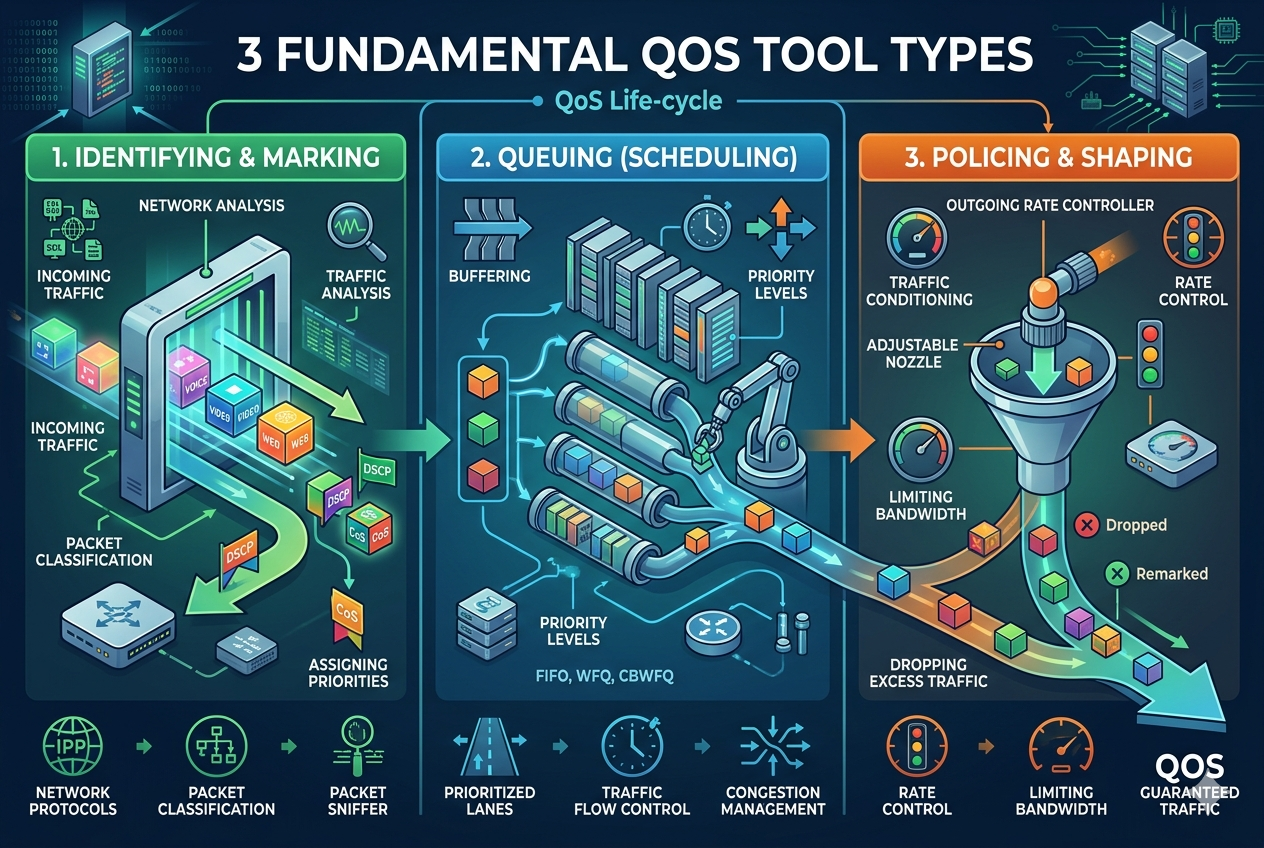
To address these challenges, QoS introduces structured mechanisms that allow network devices to prioritize, control, and regulate traffic flow. Among the most important tools used in QoS are queuing, identifying, and policing. These mechanisms work together to classify traffic, manage congestion, and enforce bandwidth limits. Each tool serves a specific purpose, but they are most effective when implemented as part of a unified QoS strategy.
This discussion explores these three QoS tools in detail, explaining how they function individually and how they contribute collectively to improving network performance and reliability.
Queuing in QoS
Queuing is one of the most widely used QoS mechanisms and plays a central role in managing congestion within network devices. When data packets arrive at a router or switch faster than they can be transmitted, they are temporarily stored in memory buffers known as queues. The way these packets are organized and transmitted determines how efficiently the network handles congestion and how well it supports different types of applications.
In a basic network without QoS, packets are processed in the order they arrive. While this approach is simple, it does not consider the importance or sensitivity of the traffic. For example, a large file download could delay voice packets, resulting in poor call quality. QoS-enabled queuing systems solve this issue by organizing traffic into multiple queues based on priority and type.
Once traffic is classified, it is placed into appropriate queues. High-priority traffic, such as voice and video, is placed in queues that are serviced more frequently, ensuring minimal delay. Lower-priority traffic, such as email or file transfers, is placed in separate queues that may experience longer wait times. This separation ensures that critical applications receive the bandwidth and responsiveness they require even during periods of heavy network usage.
Queuing mechanisms can vary in complexity. Some systems use strict priority handling, where high-priority queues are always serviced first. While this guarantees low latency for critical traffic, it must be carefully controlled to prevent starvation of lower-priority traffic. Other systems use weighted approaches, where each queue is assigned a weight that determines how much bandwidth it receives relative to others. This allows for a more balanced distribution of network resources.
Another important aspect of queuing is congestion management. When buffers become full due to excessive traffic, packet loss can occur. Effective queuing strategies help reduce congestion by efficiently managing buffer space and controlling the rate at which packets are transmitted. This helps maintain smooth data flow even during peak traffic periods.
However, queuing is not without challenges. Improper configuration can lead to increased latency, especially for low-priority traffic. Additionally, overly large buffers can introduce delay, while small buffers may result in packet drops. Therefore, careful design and tuning are required to ensure optimal performance.
Overall, queuing is essential for prioritizing traffic, managing congestion, and ensuring that critical applications maintain consistent performance in a shared network environment.
Identifying in QoS
Identifying, also known as classification and marking, is the process of examining network traffic and assigning it a specific category or label based on its characteristics. This is the foundation of any QoS system because traffic must first be recognized before it can be managed effectively.
When a packet enters a network, QoS systems analyze various attributes such as source and destination addresses, protocol types, port numbers, and application signatures. Based on this analysis, the packet is classified into a traffic category. For example, voice traffic may be identified as delay-sensitive, while file transfers may be identified as bandwidth-intensive but delay-tolerant.
Once identified, packets are marked with a value that indicates their priority level. These markings are stored in packet headers and are used by routers and switches throughout the network to apply consistent QoS policies. This ensures that traffic is treated appropriately at every point in its journey.
The identifying process is typically performed at the edge of the network. This approach reduces the processing burden on core devices, as they do not need to inspect every packet in detail. Instead, they rely on the markings already applied, which improves efficiency and scalability.
Identifying traffic also enables policy consistency. When all devices in a network follow the same classification rules, traffic behavior becomes predictable. This is especially important in large enterprise or service provider networks where multiple types of applications and services coexist.
Another advantage of identifying is its flexibility. Network administrators can create custom classification rules based on business needs. For example, traffic from critical business applications can be prioritized over guest or recreational traffic. This allows organizations to align network performance with business priorities.
However, identifying traffic requires accurate classification rules. Incorrect identification can lead to misclassification, where important traffic is treated as low priority or vice versa. Therefore, careful configuration and regular updates are necessary to maintain accuracy.
In summary, identifying is a crucial QoS tool that enables intelligent traffic recognition and labeling, forming the basis for all subsequent QoS actions.
Policing in QoS
Policing is a QoS mechanism used to enforce traffic limits and ensure that network usage stays within predefined boundaries. Unlike queuing, which manages traffic during congestion, policing actively controls traffic flow by monitoring and restricting data rates in real time.
When traffic exceeds a configured threshold, policing mechanisms take corrective action. This may involve dropping excess packets, marking them as lower priority, or reclassifying them for different handling. The goal is to ensure that no single application or user consumes more bandwidth than allowed, thereby maintaining fairness and stability across the network.
Policing is typically applied at network entry points to control incoming traffic. For example, an internet service provider may use policing to enforce bandwidth limits on customer connections. Similarly, enterprises may use policing to ensure that non-critical applications do not consume excessive resources.
One of the key advantages of policing is that it helps prevent network congestion before it occurs. By limiting traffic at the source, it reduces the likelihood of buffer overflow and packet loss deeper in the network. This proactive approach improves overall network efficiency and stability.
Policing also plays an important role in enforcing service level agreements (SLAs). Organizations that provide network services often guarantee specific bandwidth levels to customers. Policing ensures that these limits are not exceeded, maintaining fairness and contractual compliance.
There are different actions that policing mechanisms can take when traffic exceeds limits. One common action is packet dropping, where excess packets are discarded. Another is remarking, where packets are assigned a lower priority so they are less likely to be forwarded during congestion. Some systems use a combination of both approaches depending on network policies.
However, policing must be carefully configured to avoid negatively impacting legitimate traffic. If thresholds are set too low, users may experience unnecessary packet loss or reduced performance. On the other hand, if thresholds are too high, the effectiveness of traffic control may be reduced.
Policing differs from shaping, another QoS technique, in that it enforces strict limits without buffering excess traffic. While shaping delays packets to smooth traffic flow, policing immediately enforces restrictions. This makes policing more suitable for environments where strict control is required.
Overall, policing is a critical QoS tool that ensures fair usage, enforces bandwidth limits, and prevents network congestion by controlling traffic at its source.
Interaction Between Queuing, Identifying, and Policing
While each QoS tool serves a distinct function, their combined use creates a powerful traffic management system. Identifying provides the foundation by classifying and marking traffic. Queuing uses these classifications to prioritize and manage traffic during congestion. Policing ensures that traffic levels remain within acceptable limits before they can negatively impact the network.
Together, these tools create a structured flow of traffic management. First, traffic is identified and labeled. Then, it is either allowed or restricted based on policing rules. Finally, it is placed into appropriate queues for transmission based on priority.
This layered approach ensures that networks can handle complex and diverse traffic types efficiently. It also allows administrators to implement granular control over how different applications and users consume network resources.
Conclusion
QoS is essential in modern networking environments where multiple applications compete for limited bandwidth. Without proper management, network performance can become unpredictable, leading to poor user experiences and inefficient resource utilization. The three primary QoS tools—queuing, identifying, and policing—work together to solve these challenges.
Queuing ensures that traffic is prioritized and transmitted efficiently during congestion, protecting critical applications from delays. Identifying provides the intelligence needed to classify and mark traffic so that appropriate policies can be applied consistently across the network. Policing enforces strict bandwidth controls, preventing excessive usage and maintaining fairness.
When combined, these tools create a comprehensive QoS framework that enhances performance, improves reliability, and ensures optimal use of network resources. Proper implementation of these mechanisms allows networks to support modern high-demand applications while maintaining stability and efficiency.