Distributed Denial of Service (DDoS) attacks have become one of the most disruptive cybersecurity threats in the digital era. These attacks aim to make online services unavailable by overwhelming them with massive volumes of fake traffic. Unlike traditional security breaches that attempt to steal data, DDoS attacks focus on exhausting system resources such as bandwidth, CPU, memory, or connection capacity. As organizations increasingly migrate to cloud environments, the scale and frequency of these attacks have also increased.
Modern attackers often use botnets, which are networks of compromised devices spread across the internet, to generate large-scale traffic floods. These botnets can include thousands or even millions of devices, making it extremely difficult to block malicious traffic using traditional security methods. The impact of a successful DDoS attack can range from temporary service disruptions to complete outages, financial losses, reputational damage, and loss of customer trust. In industries such as e-commerce, finance, healthcare, and media streaming, even a few minutes of downtime can have significant consequences.
Cloud environments offer scalability and flexibility, but they also attract attackers because of their public exposure and distributed architecture. This is why built-in DDoS protection mechanisms are essential for any cloud-based workload.
Introduction to AWS Shield and Its Purpose
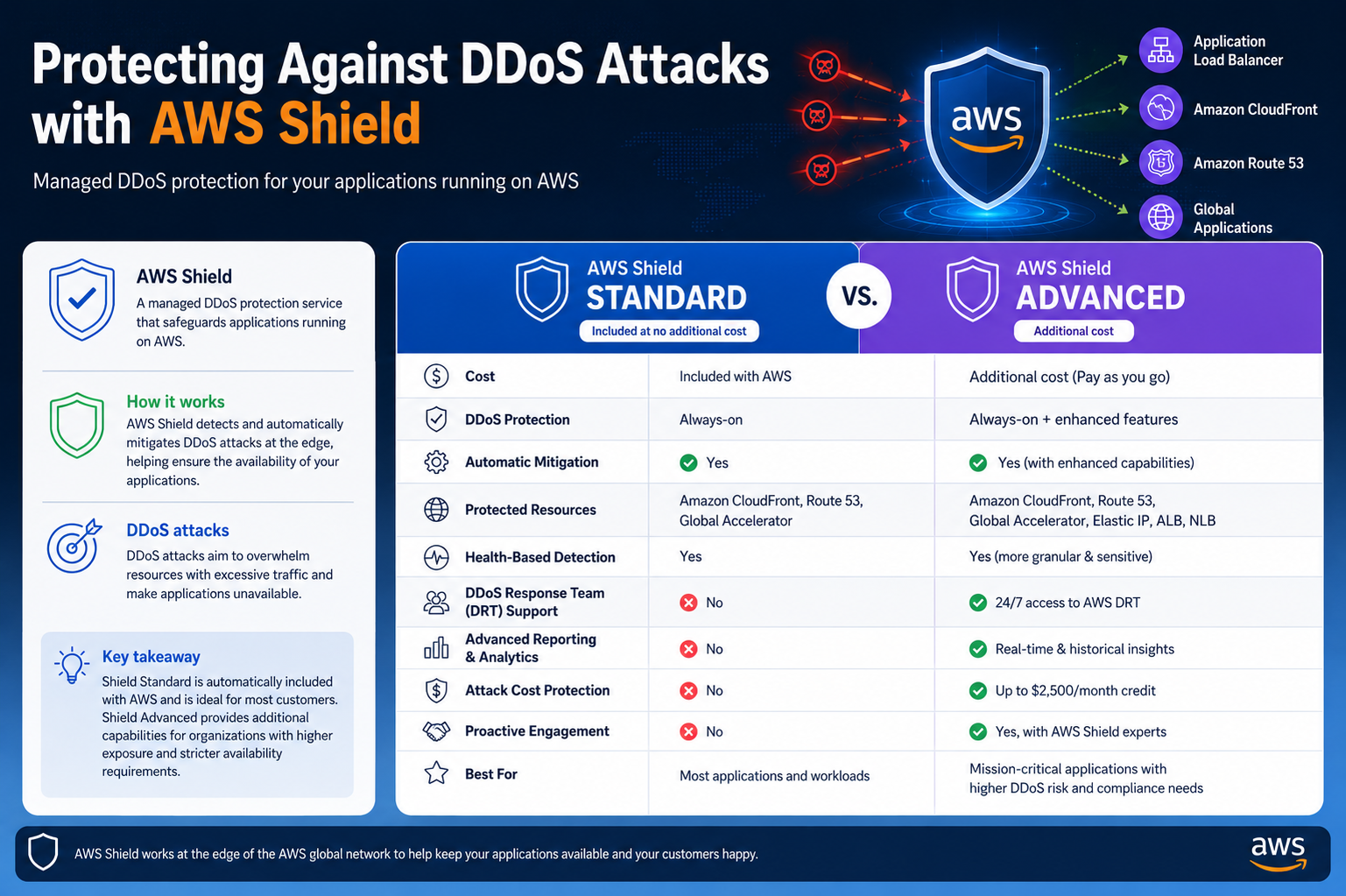
To address these challenges, AWS Shield was developed as a managed DDoS protection service within Amazon Web Services. AWS Shield is designed to protect applications running on AWS infrastructure from both common and sophisticated DDoS attacks. It operates at multiple layers of the network stack and integrates deeply with other AWS security services to provide a layered defense approach.
The service is divided into two tiers: Shield Standard and Shield Advanced. While both tiers provide protection, they differ in scope, visibility, response capabilities, and cost structure. Understanding these differences is essential for choosing the right protection strategy for different types of workloads.
AWS Shield Standard: Built-in Baseline Protection
AWS Shield Standard is automatically enabled for all AWS customers without any additional cost or configuration. This makes it the first layer of defense for any application hosted on AWS. It provides protection against the most common types of DDoS attacks, especially those targeting network and transport layers.
Shield Standard is particularly effective against volumetric attacks such as SYN floods, UDP floods, and reflection attacks. These attacks aim to consume network bandwidth or exhaust connection resources by sending large amounts of illegitimate traffic. AWS Shield Standard uses globally distributed edge locations to detect and mitigate these attacks before they reach the application infrastructure.
One of the most important advantages of Shield Standard is its seamless integration. Users do not need to configure rules or activate the service manually. It automatically protects AWS services such as Elastic Load Balancing, Amazon CloudFront, and Route 53. This ensures that even users with minimal security expertise benefit from baseline protection.
However, Shield Standard has limitations. It does not provide detailed visibility into attack patterns or advanced reporting capabilities. Users cannot access real-time attack diagnostics or forensic information. Additionally, it does not include application-layer protection or advanced customization options. This means that while it is effective against common attacks, it may not be sufficient for high-value or mission-critical applications.
AWS Shield Advanced: Enterprise-Level Protection
For organizations that require stronger security guarantees, AWS offers Shield Advanced as a premium solution. Shield Advanced provides enhanced detection, deeper mitigation capabilities, and additional support services designed for high-risk environments.
One of the key strengths of Shield Advanced is its ability to protect against more sophisticated and multi-vector attacks. These attacks may target not only network layers but also application layers, attempting to exploit vulnerabilities in web applications. Shield Advanced uses advanced traffic analysis and anomaly detection techniques to identify unusual behavior patterns in real time.
Another major benefit is access to the AWS DDoS Response Team. This team of security experts provides 24/7 assistance during active DDoS events. They help analyze attack traffic, recommend mitigation strategies, and coordinate response actions. This level of support is especially valuable for enterprises that cannot afford prolonged downtime.
Shield Advanced also offers real-time visibility into ongoing attacks. Users can access detailed dashboards that show attack vectors, traffic patterns, and mitigation actions. This transparency allows security teams to understand the nature of attacks and adjust defenses accordingly.
In addition, Shield Advanced includes cost protection features. During a DDoS attack, resource usage may spike due to increased traffic or auto-scaling. Shield Advanced helps protect customers from unexpected charges caused by malicious traffic. This financial safeguard is particularly important for large-scale applications with variable traffic loads.
Integration with AWS Web Application Firewall (WAF) is another key feature. This allows organizations to define custom security rules that filter malicious requests at the application layer. By combining Shield Advanced with WAF, organizations can build a multi-layered defense strategy that addresses both network and application threats.
Comparing Shield Standard and Shield Advanced in Practical Use
The difference between Shield Standard and Shield Advanced becomes clearer when viewed in practical scenarios. Shield Standard is suitable for general workloads, small businesses, and applications that do not handle highly sensitive data. It provides automatic protection without requiring configuration, making it ideal for users who want basic security without complexity.
On the other hand, Shield Advanced is designed for critical applications such as financial systems, healthcare platforms, gaming services, and large-scale e-commerce websites. These environments require not only protection but also visibility, control, and rapid response capabilities.
While Shield Standard focuses on passive protection, Shield Advanced provides active defense mechanisms. This includes real-time monitoring, custom mitigation strategies, and direct expert involvement. The difference is similar to having a basic security system versus a full-scale security operations center.
Another key difference lies in incident response. Shield Standard does not provide dedicated support during attacks, whereas Shield Advanced includes immediate access to specialized security professionals. This can significantly reduce recovery time during large-scale incidents.
Importance of Layered Security in DDoS Protection
Relying on a single protection mechanism is not sufficient in modern cybersecurity environments. DDoS attacks are constantly evolving, and attackers frequently change tactics to bypass defenses. This is why layered security is essential.
AWS Shield forms one layer of defense, but it is often used alongside other AWS security tools. For example, combining Shield Advanced with AWS WAF allows organizations to filter malicious HTTP requests while also protecting against network-level floods. Similarly, integrating with CloudFront helps distribute traffic globally, reducing the impact of localized attacks.
Layered security ensures that even if one defense mechanism is bypassed, others remain active to protect the system. This approach significantly reduces the risk of complete service disruption.
Operational Impact of Choosing the Right Shield Tier
Choosing between Shield Standard and Shield Advanced has operational implications. With Shield Standard, organizations rely on automated protection without visibility or control. This reduces operational overhead but also limits response capabilities during complex attacks.
With Shield Advanced, organizations gain more control but also take on additional responsibilities. Security teams must monitor dashboards, configure WAF rules, and respond to alerts. However, this increased responsibility comes with significantly stronger protection and resilience.
For startups and small businesses, Shield Standard is often sufficient in the early stages. As applications grow and attract more traffic, upgrading to Shield Advanced becomes necessary to handle increased risk exposure.
Building a Resilient Defense Against DDoS Attacks
DDoS attacks remain one of the most persistent threats in cloud computing, and their impact can be severe if not properly managed. AWS provides a structured defense mechanism through AWS Shield, offering both Standard and Advanced tiers to meet different security needs.
Shield Standard delivers automatic, always-on protection that is ideal for general workloads and provides a strong baseline defense against common attacks. It ensures that all AWS users benefit from foundational security without additional cost or configuration.
Shield Advanced, on the other hand, offers enterprise-grade protection with advanced detection, real-time visibility, financial safeguards, and expert support. It is designed for mission-critical applications where downtime is not acceptable and where security requirements are significantly higher.
The choice between the two depends on the criticality of the workload, risk exposure, and organizational maturity in security operations. In many cases, organizations begin with Shield Standard and transition to Shield Advanced as their applications scale and their threat landscape becomes more complex.
Ultimately, effective DDoS protection is not about choosing a single tool but about building a layered and adaptive security strategy. AWS Shield plays a central role in this strategy by providing scalable, intelligent, and integrated protection against one of the most challenging threats in modern cybersecurity.
Conclusion:
Protecting against DDoS attacks is a critical requirement for any organization operating in today’s cloud-driven digital environment. As attack methods continue to evolve in scale and complexity, relying on traditional or single-layer defenses is no longer sufficient. A resilient security strategy must combine automation, intelligence, visibility, and rapid response capabilities to ensure continuous service availability.
Within this context, AWS Shield provides a structured and effective approach to DDoS protection. Shield Standard delivers essential, always-on defense that automatically protects all AWS customers against the most common network and transport layer attacks. It acts as a foundational security layer that requires no configuration and ensures baseline resilience for all workloads hosted on AWS.
Shield Advanced extends this protection significantly by offering deeper detection capabilities, enhanced mitigation strategies, and direct access to security experts during active incidents. It is designed for mission-critical applications where downtime, latency, or service disruption can lead to serious financial and operational consequences. Features such as real-time attack visibility, cost protection, and integration with advanced filtering tools make it suitable for high-risk environments.
Ultimately, the decision between Shield Standard and Shield Advanced depends on the importance of the workload and the level of risk an organization is prepared to manage. While Shield Standard is sufficient for general protection, Shield Advanced becomes essential when applications demand higher assurance, greater control, and professional incident response support.
In modern cloud security architecture, AWS Shield is not just a protective service but a core component of a broader defense strategy. When used effectively alongside other security tools, it helps organizations maintain availability, protect user trust, and ensure operational continuity even in the face of increasingly sophisticated DDoS threats.