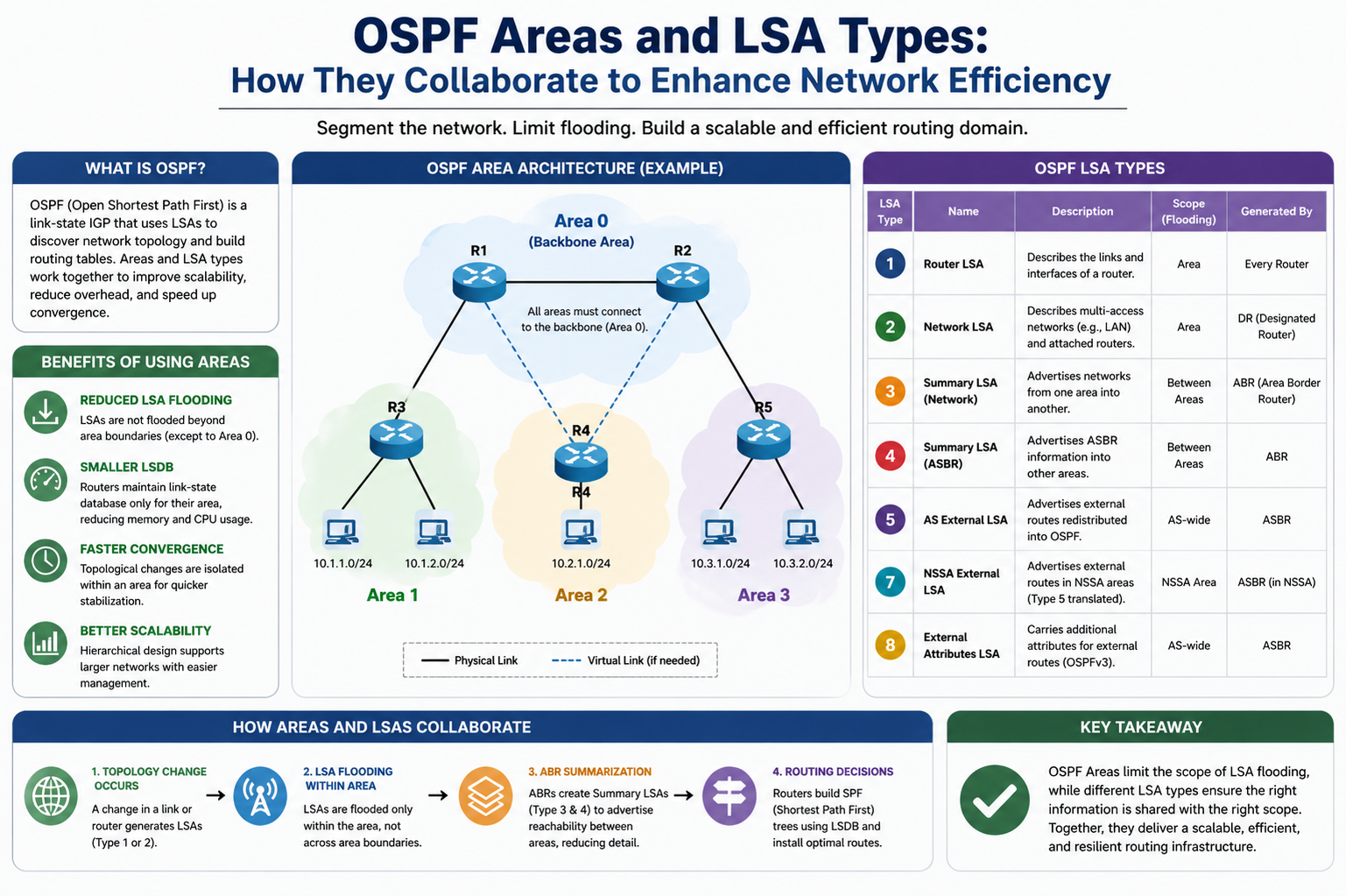
Open Shortest Path First (OSPF) is a link-state routing protocol designed to provide fast convergence and efficient routing in both small and large-scale networks. Its architecture is built on a hierarchical model that introduces structure and control over how routing information is shared. This hierarchy is primarily achieved through the concept of areas, which divide a large network into smaller, more manageable segments. Within this framework, LSAs play a crucial role in exchanging routing information in a controlled and optimized manner.
The combination of areas and LSAs ensures that OSPF does not flood the entire network with unnecessary updates. Instead, it intelligently limits the spread of information, ensuring routers only process data relevant to their position in the topology. This design is one of the main reasons OSPF is considered highly scalable and efficient.
Understanding the Concept of OSPF Areas
OSPF areas are logical groupings of routers and networks that share the same link-state information. Each area maintains its own database of topology information, known as the Link-State Database (LSDB). By dividing a network into areas, OSPF reduces the size of the LSDB on each router, which directly improves performance and reduces CPU and memory usage.
Within an area, all routers have an identical view of that area’s topology, but they do not need full knowledge of other areas. This isolation of information prevents unnecessary routing complexity. When data needs to move between areas, specialized routers handle the summarization and forwarding process.
The backbone area, known as Area 0, is the central part of the OSPF hierarchy. All other areas must connect to it either directly or through virtual links. This ensures that inter-area routing remains consistent and avoids routing loops or inconsistencies.
Role of Router Types in OSPF Areas
OSPF defines several types of routers based on their position in the area structure. Internal routers exist entirely within a single area and maintain only that area’s LSDB. Area Border Routers (ABRs) connect multiple areas and maintain separate LSDBs for each area they belong to. These ABRs are responsible for summarizing routing information and passing it between areas in an efficient way.
Autonomous System Boundary Routers (ASBRs) connect OSPF networks to external routing domains. These routers introduce external routes into OSPF, making them essential for communication between different routing protocols or external networks. Backbone routers, on the other hand, operate within Area 0 and help maintain the core connectivity of the OSPF structure.
Each router type plays a specific role in ensuring that routing information flows efficiently without overwhelming the network.
Introduction to Link-State Advertisements (LSAs)
Link-State Advertisements (LSAs) are the building blocks of OSPF’s routing intelligence. They are small packets of information used by routers to describe the state of their links, neighbors, and network relationships. LSAs are flooded throughout the network or within specific areas depending on their type.
Each LSA type serves a unique purpose, ensuring that only relevant routing information is shared with appropriate routers. This selective distribution of information reduces unnecessary overhead and keeps the network efficient.
LSAs are stored in the Link-State Database, and the OSPF algorithm uses this database to calculate the shortest path to every destination using the Dijkstra Shortest Path First (SPF) algorithm.
LSA Type 1: Router LSAs and Local Topology Awareness
Router LSAs are generated by every router within an OSPF area. They describe the router’s directly connected links, including interface states, link costs, and neighbor relationships. These LSAs remain within the same area and are not forwarded outside of it.
This type of LSA ensures that all routers inside an area have a complete and synchronized view of the local topology. Because they are restricted to a single area, Router LSAs help maintain scalability by limiting the scope of detailed information exchange.
LSA Type 2: Network LSAs and Designated Router Role
Network LSAs are generated by the Designated Router (DR) on multi-access networks such as Ethernet. Their purpose is to describe all routers connected to a shared network segment. This prevents unnecessary duplication of LSAs from multiple routers on the same segment.
The DR acts as a central point for distributing this information, reducing overhead and simplifying the topology representation. These LSAs also remain within the local area and contribute to efficient database synchronization among routers.
LSA Type 3: Summary LSAs for Inter-Area Communication
Summary LSAs are created by Area Border Routers and are used to advertise networks from one area to another. Instead of sharing detailed topology information, ABRs summarize routes and pass only essential information across areas.
This mechanism reduces the size of routing tables in non-local areas and ensures that routers only receive high-level information about external areas. It is one of the most important features for maintaining scalability in large OSPF deployments.
LSA Type 4: ASBR Summary LSAs and External Reachability
ASBR Summary LSAs are used to inform routers about the location of Autonomous System Boundary Routers. When external routes are introduced into OSPF, routers need to know how to reach the ASBR that advertised them.
These LSAs do not describe external networks directly but instead provide a path to the router responsible for external route injection. This ensures proper routing decisions when external destinations are involved.
LSA Type 5: External LSAs and Redistribution of Routes
External LSAs are used by ASBRs to advertise routes from outside the OSPF domain. These could include routes from other routing protocols or external networks. Unlike most internal LSAs, Type 5 LSAs are flooded throughout the entire OSPF domain, except for stub areas.
They carry important information such as external network prefixes and associated metrics. This allows OSPF routers to integrate external routes into their routing decisions while still maintaining internal efficiency.
LSA Type 6: Multicast OSPF Extensions
Although not widely used in modern implementations, Type 6 LSAs were designed for Multicast OSPF (MOSPF). They support multicast routing by describing group memberships and multicast distribution trees. This type is rarely encountered in standard OSPF deployments today.
LSA Type 7: NSSA External LSAs
Type 7 LSAs are used in Not-So-Stubby Areas (NSSAs). These areas allow limited external route injection while still maintaining the restrictions of stub-like behavior. ASBRs within NSSAs generate Type 7 LSAs, which are later translated into Type 5 LSAs by ABRs when they are propagated into other areas.
This mechanism allows flexibility in route redistribution while preserving the efficiency benefits of stub areas.
Interaction Between LSAs and SPF Algorithm
Once LSAs are flooded and stored in the Link-State Database, each router independently runs the SPF algorithm to calculate the shortest path to every destination. This ensures that all routers within an area have a consistent and loop-free view of the network.
The SPF algorithm uses the information provided by LSAs to construct a tree-like representation of the network topology. From this structure, routers determine the best next-hop path for each destination.
Efficiency Achieved Through Controlled Flooding
One of the most powerful aspects of OSPF is its controlled flooding mechanism. LSAs are only propagated where necessary, and their scope is strictly defined based on type and area boundaries. This prevents unnecessary network traffic and reduces processing overhead on routers.
By limiting the spread of detailed topology information and using summarization where possible, OSPF ensures that even large networks remain stable and responsive.
Role of Area Border Routers in Information Control
Area Border Routers (ABRs) play a critical role in maintaining OSPF efficiency by acting as intermediaries between different areas. Each ABR connects one or more areas to the backbone area and is responsible for summarizing routing information before passing it across boundaries. This summarization reduces the amount of detailed topology data that needs to be shared, ensuring that only essential routing information is propagated between areas.
Instead of forwarding full Link-State Databases from one area to another, ABRs create condensed representations of routes using summary LSAs. This process significantly reduces routing overhead and prevents unnecessary complexity in other areas. By controlling how information flows between areas, ABRs ensure that OSPF remains scalable even in large enterprise networks.
Importance of Route Summarization in OSPF
Route summarization is one of the key mechanisms that improves OSPF efficiency. It allows multiple specific routes to be represented as a single aggregated route. This reduces the size of routing tables and minimizes the number of LSAs that need to be processed by routers in other areas.
Summarization typically occurs at ABRs and ASBRs, where detailed route information is converted into broader network prefixes. This not only improves performance but also enhances stability by isolating changes within a specific area. When a change occurs inside an area, it does not necessarily affect other areas if summarization is properly configured.
This isolation of changes reduces the frequency of SPF recalculations across the entire network, which is especially beneficial in large-scale environments where frequent updates could otherwise cause instability.
How LSAs Reduce Network Overhead
LSAs are designed to minimize unnecessary network traffic while still maintaining accurate routing information. Instead of sending full routing tables, OSPF routers exchange only incremental updates using LSAs. These updates are triggered only when a change in the network topology occurs, such as a link failure or a new connection.
Because LSAs are small and event-driven, they significantly reduce bandwidth consumption compared to distance-vector protocols that periodically broadcast full routing tables. Additionally, LSAs are stored locally in the Link-State Database, allowing routers to independently compute routes without continuous external updates.
This design ensures that OSPF remains both reactive and efficient, adapting quickly to changes without overwhelming the network.
Flooding Mechanism and Its Optimization
OSPF uses a controlled flooding mechanism to distribute LSAs throughout the network. When a router generates or receives an LSA, it forwards it to all neighboring routers except the one from which it was received. Each router then repeats this process until all routers within the defined scope have received the update.
To prevent unnecessary duplication and looping, OSPF uses sequence numbers and aging timers. Sequence numbers ensure that routers always recognize the most recent version of an LSA, while aging timers remove outdated information from the network.
This controlled flooding mechanism ensures that LSAs reach all necessary routers efficiently while avoiding redundancy and excessive traffic.
Stability Through Link-State Database Synchronization
One of the key advantages of OSPF is that all routers within an area maintain an identical Link-State Database. This synchronization ensures that every router has the same view of the network topology, eliminating inconsistencies that could lead to routing loops or incorrect path selection.
When a new router joins an area, it exchanges LSAs with its neighbors until its database is fully synchronized. This process, known as adjacency formation, ensures consistency across the network.
Once synchronization is complete, routers can independently calculate optimal routes using the SPF algorithm, resulting in fast and reliable convergence.
Impact of LSA Types on Scalability
Each LSA type plays a specific role in maintaining scalability within OSPF. Internal LSAs (such as Type 1 and Type 2) ensure detailed topology awareness within an area, while summary and external LSAs (Type 3, 4, 5, and 7) control how information is shared between areas and external networks.
This layered approach allows OSPF to scale efficiently from small networks to very large enterprise or service provider environments. Without this classification of LSAs, routing information would quickly become unmanageable in complex networks.
By limiting the scope of detailed information and using abstraction where possible, OSPF ensures that routers only process what is necessary for their function.
Role of Stub and NSSA Areas in Reducing Complexity
Stub areas are designed to simplify routing by limiting the types of LSAs that are allowed inside the area. In stub areas, external LSAs are blocked, and a default route is used instead to reach external destinations. This reduces the size of routing tables and decreases processing overhead.
Not-So-Stubby Areas (NSSAs) provide a balance between flexibility and efficiency. They allow limited external route injection using Type 7 LSAs, which are later translated into Type 5 LSAs when propagated to other areas. This enables controlled redistribution of external routes while maintaining the benefits of stub-like behavior.
Both stub and NSSA designs are widely used to optimize OSPF performance in large hierarchical networks.
SPF Calculation and Its Dependency on LSAs
The Shortest Path First (SPF) algorithm is the core computational engine of OSPF. It relies entirely on LSAs stored in the Link-State Database to construct a complete map of the network topology. Using this map, the algorithm calculates the shortest and most efficient path to each destination.
Whenever a change occurs in the network, affected routers must recompute their SPF tree. However, because LSAs limit the scope of updates, SPF recalculations are often localized rather than global, which improves overall performance.
Efficient LSA design directly reduces the frequency and scope of SPF recalculations, contributing to faster convergence.
Efficiency Gains Through Hierarchical Design
The combination of areas and LSAs creates a hierarchical system that naturally reduces complexity. At the lowest level, routers focus on detailed topology information within their area. At higher levels, ABRs and ASBRs handle summarization and redistribution.
This separation of responsibilities ensures that no single router is overwhelmed with excessive information. It also allows networks to grow without significantly impacting performance.
Hierarchical design is one of the primary reasons OSPF is preferred in large enterprise environments where scalability is essential.
The interaction between OSPF areas and LSA types forms a highly efficient and scalable routing framework. Areas provide structural organization, while LSAs control the flow of routing information. Together, they reduce overhead, improve convergence speed, and ensure stable network operation even in complex environments.
When a link or router fails in an OSPF network, the affected router immediately generates a new LSA reflecting the change in topology. This updated LSA is then flooded throughout the appropriate area, ensuring that all routers quickly become aware of the failure.
Because LSAs are processed rapidly and SPF recalculations are triggered immediately, OSPF can respond to failures within seconds. This fast reaction time is critical for maintaining network reliability in environments where uptime is essential.
Additionally, because the impact of LSAs is often limited to a single area, failure recovery is localized and does not disrupt the entire network.
Hierarchical Efficiency and Real-World Scalability
The combination of areas and LSAs creates a hierarchical structure that mirrors real-world network requirements. Small changes remain localized, while large-scale information is abstracted and summarized.
This hierarchical design allows OSPF to scale from small enterprise networks to large service provider infrastructures without significant redesign. Each layer of the hierarchy handles a specific level of detail, ensuring that routers only process information relevant to their role.
This separation of concerns is what makes OSPF one of the most efficient interior gateway protocols in modern networking.
LSA Optimization Through Network Design Choices
Efficient OSPF operation is not only determined by protocol behavior but also by how the network is designed. Proper area planning and LSA control significantly reduce unnecessary routing overhead. When areas are logically structured, LSAs remain confined to relevant segments of the network, preventing unnecessary flooding and reducing the frequency of SPF recalculations.
A well-designed OSPF topology ensures that frequent changes are isolated within smaller areas, while stable parts of the network remain unaffected. This design principle enhances both performance and reliability, especially in large-scale deployments where thousands of routes may exist.
Careful planning of ABR placement also improves LSA efficiency. When ABRs are strategically located, they can summarize routes more effectively, reducing the number of LSAs that need to be propagated across the network.
Understanding LSA Dependency and SPF Trigger Behavior
Not every LSA update triggers a full SPF recalculation. OSPF routers are intelligent enough to evaluate whether a received LSA change affects the shortest path tree. If the change is minor and does not alter routing decisions, a full recalculation may be avoided or limited in scope.
However, when a significant topology change occurs, such as a link failure or cost modification, the router immediately recalculates its SPF tree. This selective recalculation mechanism ensures that CPU resources are used efficiently, avoiding unnecessary processing.
The dependency of SPF calculations on LSAs highlights the importance of stable LSA generation. Poorly designed networks that generate frequent LSAs can cause excessive SPF recalculations, leading to performance degradation.
Role of LSA Throttling in Stability Improvement
Modern OSPF implementations include mechanisms such as LSA throttling to improve stability in unstable networks. When multiple topology changes occur in rapid succession, throttling delays SPF recalculations to prevent continuous processing.
Instead of recalculating routes for every single LSA update, the router groups changes and processes them after a short delay. This approach reduces CPU load and prevents routing instability caused by constant recalculation cycles.
LSA throttling is especially useful in environments where links may flap or where intermittent connectivity issues exist. It ensures that temporary instability does not overload the routing system.
Database Synchronization and Reliable Neighbor Formation
Before routers can exchange LSAs, they must establish a fully synchronized adjacency. This process involves exchanging database descriptions, identifying missing LSAs, and ensuring both routers have identical Link-State Databases.
This synchronization process ensures consistency before routing begins. If databases are not synchronized properly, routers may calculate different SPF trees, leading to routing inconsistencies or loops.
Once synchronization is complete, LSAs are exchanged only when necessary, and both routers maintain a consistent view of the network at all times.
Impact of LSA Types on Network Security and Stability
LSA types also indirectly contribute to network security and stability by controlling the flow of routing information. Since LSAs are scoped and structured, they prevent uncontrolled route injection across the network.
For example, external LSAs are tightly controlled through ASBRs, reducing the risk of unauthorized route propagation. Similarly, stub and NSSA area restrictions limit exposure to external routing information, reducing the attack surface and improving predictability.
This controlled environment ensures that only trusted and properly structured routing information influences the network topology.
Scalability Challenges Without LSA Hierarchy
Without the structured LSA hierarchy, OSPF would struggle to scale beyond small networks. If every router had to share full routing information with every other router, the number of LSAs would grow exponentially, overwhelming both bandwidth and CPU resources.
The classification of LSAs into internal, summary, and external types prevents this issue by ensuring that only necessary information is shared at each level of the hierarchy. This controlled dissemination is what enables OSPF to function efficiently in large enterprise and service provider environments.
Practical Impact of Area Design on LSA Efficiency
In real-world deployments, area design has a direct impact on LSA efficiency. Poorly designed areas can lead to excessive LSA flooding, frequent SPF recalculations, and increased router load.
On the other hand, well-structured areas ensure that most LSAs remain local, with only summarized information crossing boundaries. This reduces the strain on ABRs and ensures that backbone area traffic remains minimal and stable.
Networks that follow best practices in area segmentation typically experience faster convergence and fewer routing inconsistencies.
LSA Interaction with Route Preference and Metrics
OSPF uses metrics, often based on interface cost, to determine the best path to a destination. LSAs carry this metric information, allowing routers to make informed decisions during SPF calculation.
When multiple paths exist, the router compares metrics from LSAs to select the lowest-cost route. This ensures optimal path selection and efficient traffic distribution across the network.
External routes may also include different types of metrics, which are compared against internal OSPF metrics based on predefined rules. This ensures consistent and predictable routing behavior.
Long-Term Network Efficiency Through LSA Stability
The long-term efficiency of an OSPF network depends heavily on the stability of its LSAs. Frequent changes in LSA content can lead to constant SPF recalculations, which degrade performance over time.
Stable networks minimize unnecessary LSA generation by avoiding unstable links, optimizing interface configurations, and ensuring consistent routing policies. This stability directly contributes to reduced CPU usage and improved convergence behavior.
Networks that maintain stable LSAs experience fewer routing disruptions and more predictable performance.
Advanced Role of Backbone Area in LSA Coordination
The backbone area, known as Area 0, is the central point of coordination in an OSPF network. All inter-area traffic is required to pass through this area, making it the structural core of the entire routing hierarchy. Its primary role is to ensure that LSAs exchanged between different areas are properly summarized, controlled, and distributed.
Within this structure, Area Border Routers connect non-backbone areas to Area 0, ensuring that routing information flows in an organized manner. Without a properly functioning backbone, LSA propagation between areas would become inconsistent, leading to routing inefficiencies and potential loops.
The backbone area also ensures that inter-area LSAs remain consistent across the network. This consistency is essential for maintaining a unified routing view, especially in large enterprise environments where multiple areas coexist.
LSA Processing Efficiency and Router Resource Management
OSPF routers are designed to process LSAs efficiently to minimize CPU and memory usage. When LSAs are received, routers do not immediately recalculate the entire routing table unless necessary. Instead, they first update their Link-State Database and evaluate whether the change affects the shortest path tree.
This staged processing ensures that router resources are used efficiently. Minor changes may not trigger full SPF recalculations, while major topology updates are processed more thoroughly. This intelligent handling of LSAs is a key reason OSPF performs well under heavy network load.
Additionally, routers maintain separate databases for each area they belong to, which further reduces processing complexity. By isolating LSDBs, OSPF ensures that changes in one area do not unnecessarily affect others.
LSA Propagation Delay and Network Stability
OSPF includes built-in mechanisms to control the speed of LSA propagation. This is important because immediate flooding of every change could destabilize the network in environments with frequent topology changes.
To address this, OSPF introduces controlled timers that regulate LSA generation and propagation. These timers help prevent excessive updates during unstable conditions, such as link flapping or temporary outages.
By introducing slight delays before propagating LSAs, OSPF ensures that only stable changes are communicated across the network. This reduces unnecessary churn in routing tables and improves overall stability.
Impact of LSA Types on Multi-Area Route Selection
When a packet needs to travel between different OSPF areas, LSAs play a crucial role in determining the best path. Summary LSAs generated by ABRs provide simplified route information, allowing routers in one area to understand how to reach destinations in another area without needing full topology details.
This abstraction ensures that routers make routing decisions based on summarized information rather than detailed external topology. As a result, routing tables remain compact, and decision-making remains efficient.
External LSAs further extend this capability by introducing routes from outside the OSPF domain. These routes are carefully integrated to ensure they do not disrupt internal routing decisions.
LSA Interaction with Cost-Based Path Selection
OSPF uses cost as its primary metric for determining the best path. LSAs carry cost information associated with each link, allowing routers to calculate the most efficient route using the SPF algorithm.
When multiple paths exist to a destination, routers compare cumulative costs derived from LSAs. The path with the lowest total cost is selected as the preferred route.
This cost-based decision-making ensures optimal traffic flow across the network. It also allows administrators to influence routing behavior by adjusting interface costs, indirectly affecting LSA-based calculations.
LSA Suppression Techniques for Large Networks
In large-scale networks, excessive LSA generation can become a performance concern. To address this, OSPF implementations often include LSA suppression techniques that reduce unnecessary updates.
One such technique involves delaying LSA generation during rapid topology changes. Instead of sending multiple updates in quick succession, the router consolidates changes and sends a single updated LSA.
Another technique involves limiting LSA flooding in stable parts of the network. If no significant changes occur, LSAs are not repeatedly refreshed, reducing unnecessary overhead.
These suppression techniques help maintain network efficiency without compromising routing accuracy.
Role of Virtual Links in LSA Propagation
In some network designs, it is not always possible to maintain a direct physical connection to the backbone area. In such cases, virtual links are used to logically connect areas through intermediate transit areas.
Virtual links allow LSAs to be propagated across non-contiguous backbone segments, ensuring that the OSPF hierarchy remains intact. However, they must be carefully configured, as they can introduce complexity and potential instability if misused.
Despite their complexity, virtual links ensure that LSAs continue to flow correctly in non-ideal network topologies.
LSA Aging Behavior and Network Recovery
When a network failure occurs, LSAs play a critical role in ensuring rapid recovery. The aging mechanism ensures that outdated routing information is quickly removed from the network.
If a router becomes unreachable, its associated LSAs eventually expire, triggering recalculation of routing paths. This ensures that stale routes are not used, preventing packet loss or misrouting.
At the same time, new LSAs are generated to reflect updated topology information, allowing the network to quickly converge to a stable state.
Optimization of LSA Flow in Redundant Topologies
Redundant network designs often include multiple paths between routers to improve reliability. While this increases availability, it can also increase LSA complexity.
OSPF handles this by ensuring that only the most efficient LSAs are used for routing decisions. Redundant paths are included in the database but are only used if the primary path fails.
This ensures that redundancy does not negatively impact performance while still providing backup routes when needed.
Long-Term Scalability Through LSA Hierarchy
The hierarchical structure of LSAs is what allows OSPF to scale effectively across large and complex networks. By dividing LSAs into internal, summary, and external categories, OSPF ensures that routing information is distributed in a controlled and efficient manner.
This hierarchy prevents unnecessary flooding, reduces routing table size, and ensures that each router processes only relevant information.
As networks grow, this structured approach becomes increasingly important for maintaining performance and stability.
Fine-Grained Control of Routing Information Flow
One of the most powerful aspects of OSPF is its ability to precisely control how routing information flows through a network. This control is achieved through the combined use of areas and LSA types, which act as filters and distributors of topology information. Instead of allowing unrestricted propagation of routing data, OSPF carefully defines what information is shared, where it is shared, and how it is interpreted.
This fine-grained control ensures that routers only process relevant information. Internal routers remain focused on their local area, while ABRs and ASBRs handle more complex inter-area and external routing responsibilities. This separation of roles prevents unnecessary load on individual devices and ensures predictable performance across the network.
By limiting unnecessary information exchange, OSPF avoids the common scalability problems seen in simpler routing protocols.
LSA Role in Preventing Routing Loops
Routing loops are a critical issue in large networks, but OSPF’s LSA design helps prevent them effectively. Because every router builds its own complete map of the network using LSAs and the SPF algorithm, routing decisions are always based on a consistent and synchronized view of topology.
Sequence numbers and aging mechanisms ensure that outdated or duplicate LSAs do not interfere with routing calculations. This prevents older topology information from being mistakenly used after a network change.
Additionally, the hierarchical structure of LSAs ensures that routing information is always processed in a controlled order, further reducing the risk of inconsistent routing paths.
Efficient Handling of Network Topology Changes
When a change occurs in the network, such as a link failure or cost adjustment, OSPF responds by generating updated LSAs. These LSAs are then flooded only within their defined scope, ensuring that the impact of the change is contained.
This localized response prevents unnecessary recalculation in unaffected areas of the network. For example, a failure inside one area does not require full SPF recalculation in another area unless inter-area routes are impacted.
This selective reaction to changes is one of the key reasons OSPF is highly efficient in dynamic environments.
LSA Aggregation and Reduction of Routing Complexity
LSA aggregation plays a major role in reducing routing complexity in large OSPF networks. Instead of advertising multiple specific routes, ABRs combine them into a single summarized LSA. This reduces the number of entries in routing tables and simplifies decision-making for routers in other areas.
Aggregation also reduces memory usage and CPU load, as fewer routes need to be processed during SPF calculations. This becomes increasingly important as network size grows.
However, proper aggregation requires careful planning. Poor summarization can lead to suboptimal routing or loss of specific path visibility.
Importance of Hierarchical SPF Calculation
SPF calculations are performed independently within each area, based on the LSAs contained in that area’s database. This hierarchical approach ensures that routing decisions are localized, reducing the computational burden on routers.
Instead of recalculating the entire network topology for every change, routers only process changes relevant to their area. ABRs then handle inter-area SPF considerations separately.
This layered computation model significantly improves scalability and ensures that even large networks can maintain fast convergence times.
LSA Types and Their Contribution to Network Segmentation
Each LSA type contributes to network segmentation in a specific way. Internal LSAs describe detailed topology within an area, while summary LSAs abstract information between areas. External LSAs introduce routes from outside the OSPF domain, and specialized LSAs handle roles such as ASBR identification and NSSA translation.
This structured classification ensures that routing information is always appropriately segmented based on its relevance. It prevents unnecessary exposure of detailed topology across the entire network.
By segmenting information in this way, OSPF achieves both efficiency and scalability without sacrificing accuracy.
Impact of Network Density on LSA Behavior
In highly dense networks with many routers and connections, LSA generation and processing can become more complex. OSPF addresses this challenge through mechanisms such as Designated Routers, summarization, and area segmentation.
These mechanisms reduce the number of LSAs that must be exchanged and processed, ensuring that even dense networks remain manageable. Without these optimizations, the volume of LSAs would grow rapidly, leading to performance degradation.
Proper network design is essential in such environments to ensure that LSA behavior remains predictable and efficient.
LSA Synchronization in Multi-Area Environments
In multi-area OSPF environments, synchronization of LSAs between areas is critical for maintaining consistency. ABRs ensure that each area receives only the necessary summarized information, while still maintaining global routing coherence.
This synchronization process ensures that all areas have a consistent understanding of reachable destinations, even if they do not share the same detailed topology view.
By maintaining this balance between local detail and global abstraction, OSPF ensures both accuracy and efficiency.
Long-Term Network Evolution and LSA Scalability
As networks evolve over time, the number of routes and devices increases. OSPF’s LSA architecture is designed to accommodate this growth without requiring major redesigns.
Areas can be added, subdivided, or reorganized without disrupting the overall routing structure. Similarly, LSAs automatically adapt to changes in topology, ensuring that routing information remains up to date.
This adaptability makes OSPF suitable for long-term deployment in enterprise and service provider environments.
Conclusion
OSPF achieves its efficiency and scalability through a carefully designed combination of areas and Link-State Advertisements. Areas provide structural organization, while LSAs control the flow of routing information within that structure. Together, they create a hierarchical system that minimizes overhead, improves convergence speed, and ensures stable routing behavior.
Across all five parts, it becomes clear that OSPF is not just a routing protocol but a highly optimized system designed for intelligent information distribution. From LSA generation and flooding to area-based summarization and SPF calculation, every component works together to maintain network efficiency.
This layered approach ensures that even in large and dynamic networks, OSPF can deliver fast, reliable, and scalable routing performance while maintaining minimal resource consumption and maximum stability.