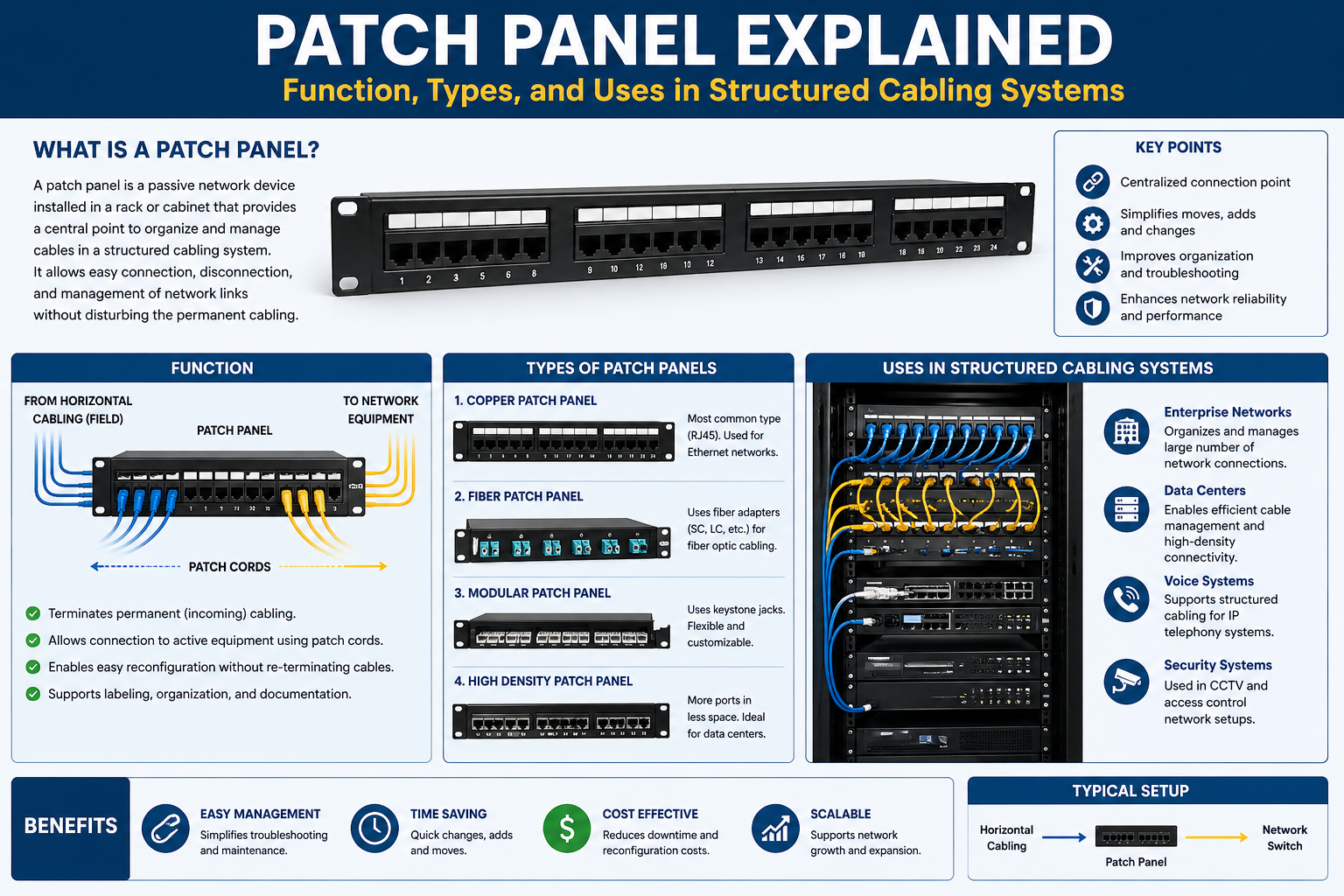
A patch panel is one of the most important passive components used in modern structured cabling environments. It is designed to simplify how network cables are organized, managed, and maintained in both small-scale and large enterprise infrastructures. Instead of allowing cables to run directly between devices, a patch panel provides a centralized termination point where all permanent cabling is neatly arranged and then connected to active networking equipment using short patch cords. This approach creates a more flexible, organized, and scalable network environment that is easier to troubleshoot and expand over time.
The importance of a patch panel becomes even more evident in environments where hundreds or even thousands of cable connections exist. Without proper organization, network systems can quickly become chaotic, leading to confusion, downtime, and inefficiency. A patch panel eliminates this problem by acting as a structured interface that brings order to complex cabling systems.
Role of Patch Panels in Structured Cabling
In structured cabling systems, the patch panel serves as the backbone of cable management. Structured cabling refers to a standardized approach to designing and installing network infrastructure so that all cables follow a clear and organized layout. Within this framework, patch panels act as the termination and distribution point for horizontal and backbone cabling.
When cables are installed in walls, ceilings, or under floors, they are typically run as permanent links that are not frequently moved or altered. These cables terminate at the patch panel, which is mounted inside a network rack or cabinet. From there, short patch cords are used to connect the ports on the patch panel to switches, routers, or other networking equipment. This separation between permanent cabling and active equipment ensures that changes in network configuration can be made easily without disturbing the installed infrastructure.
Basic Working Principle of a Patch Panel
The working principle of a patch panel is relatively simple but highly effective. Each cable coming from different parts of a building or network area is terminated into a designated port on the patch panel. These ports are clearly labeled to represent specific locations or devices. Once terminated, these connections remain fixed, forming the permanent side of the network.
To activate communication between devices, technicians use patch cords to link the patch panel ports to network switches. This creates a dynamic connection system where the logical network can be changed without physically altering the permanent cabling. If a device needs to be moved or reconfigured, only the patch cord connections need to be adjusted, leaving the core infrastructure untouched.
This method significantly reduces downtime and minimizes the risk of damaging permanent cables during maintenance or upgrades.
Importance of Cable Organization
One of the most valuable benefits of using a patch panel is improved cable organization. In a typical network setup without structured management, cables can become tangled and difficult to trace. This not only creates visual clutter but also increases the time required to identify and fix issues.
A patch panel solves this problem by grouping cables into a structured layout. Each port corresponds to a specific cable run, making it easy to identify where each connection originates and where it leads. This organized system is especially important in data centers, office buildings, and industrial environments where multiple network connections operate simultaneously.
Proper organization also reduces the risk of accidental disconnections and ensures that network maintenance can be carried out efficiently.
Types of Patch Panels Based on Cable Media
Patch panels are designed to support different types of network cabling, and their structure varies depending on the media they are intended for.
Copper Ethernet patch panels are the most commonly used type in local area networks. These panels support twisted-pair cables such as Cat5e, Cat6, and Cat6a. They are widely used in office environments due to their affordability and compatibility with standard networking equipment.
Fiber optic patch panels are used in high-speed network environments where data transmission requires greater bandwidth and longer distances. These panels are designed to handle delicate fiber strands and protect them from bending or damage. They are commonly used in data centers, telecom networks, and enterprise backbone systems.
Coaxial patch panels are less common in modern data networking but are still used in specific applications such as television distribution and legacy communication systems.
Each type of patch panel is engineered to support the physical and electrical characteristics of its corresponding cable type, ensuring optimal performance and reliability.
Loaded and Unloaded Patch Panel Designs
Patch panels are also categorized based on whether they come pre-configured or customizable.
Loaded patch panels come with pre-installed ports such as RJ45 jacks or fiber connectors. These panels are ready to use immediately and are ideal for standard installations where the network requirements are already defined. They offer convenience and consistency, especially in large-scale deployments.
Unloaded patch panels, on the other hand, are modular and allow users to install keystone jacks or connectors based on specific needs. This flexibility makes them suitable for environments where network configurations may change frequently or where different types of connections are required within the same panel.
The choice between loaded and unloaded panels depends on the complexity and adaptability required in the network design.
Rack-Mounted Patch Panel Systems
Patch panels are typically installed in network racks or cabinets to maintain a structured and secure setup. Rack-mounted designs ensure that all networking equipment, including switches, routers, and patch panels, are centralized in one location.
This centralized approach improves airflow, reduces cable strain, and makes maintenance easier. Rack-mounted patch panels are designed in standardized sizes, allowing them to fit seamlessly into 19-inch rack systems commonly used in professional environments.
By organizing network components vertically within a rack, technicians can easily trace cable paths and manage connections without confusion.
Wall-Mounted Patch Panels
In smaller installations or locations where rack systems are not practical, wall-mounted patch panels are often used. These panels are fixed directly to walls and serve the same function as rack-mounted versions but on a smaller scale.
Wall-mounted patch panels are commonly found in small offices, retail spaces, and residential networking setups. They provide a compact solution for managing limited cable connections while still maintaining organization and structure.
Although they are not designed for large-scale expansion, they are highly effective in environments with minimal networking requirements.
Advantages of Using Patch Panels
The use of patch panels provides several significant advantages in network infrastructure management. One of the primary benefits is improved flexibility. Since patch cords are used for active connections, changes in network configuration can be made quickly without altering permanent cabling.
Another advantage is reduced maintenance complexity. Technicians can easily trace connections and identify faults without needing to inspect long cable runs throughout a building. This reduces troubleshooting time and improves network uptime.
Patch panels also enhance physical cable protection by reducing strain on connectors and preventing unnecessary bending or pulling of cables. This increases the lifespan of the cabling system and reduces the likelihood of hardware failure.
Additionally, patch panels support scalability. As networks grow, new cables can be added and integrated into existing systems without disrupting current operations.
Patch Panels in Data Centers
In data center environments, patch panels play a critical role in maintaining high-density network connections. Data centers rely on thousands of interconnected devices, and managing these connections without structured organization would be extremely difficult.
Patch panels allow for efficient cable routing between servers, switches, and storage systems. They also support rapid reconfiguration, which is essential in environments where uptime and performance are critical.
By using patch panels, data centers can maintain a clean and efficient cabling layout that supports both current operations and future expansion.
Patch Panels in Office Networks
In office environments, patch panels help create reliable and organized local area networks. They are typically installed in network closets where all office cabling converges. From there, connections are distributed to workstations, printers, phones, and other devices.
This setup ensures that network administrators can manage office connectivity from a single point. If an employee moves to a different location within the office, their network connection can be easily reassigned at the patch panel without rewiring the entire system.
This flexibility is especially valuable in dynamic office environments where layouts and personnel frequently change.
Patch Panels in Industrial Applications
In industrial environments, patch panels are used to manage communication between control systems, monitoring devices, and automation equipment. These environments often require durable and reliable network infrastructure capable of operating under challenging conditions.
Patch panels help maintain structured cabling even in complex industrial setups, ensuring that critical systems remain connected and operational. They also simplify maintenance in environments where downtime can be costly.
Future Role of Patch Panels in Networking
As network technologies continue to evolve, patch panels remain a foundational component of structured cabling systems. Even with the rise of wireless technologies, physical cabling is still essential for high-performance, low-latency communication.
Future network designs will continue to rely on patch panels to maintain order, scalability, and efficiency. Their role may evolve with new connector types and higher-speed cabling standards, but the core concept of centralized cable management will remain unchanged.
Patch panels will continue to support growing data demands, cloud computing infrastructure, and advanced communication systems by providing a stable and organized physical network foundation.
Patch Panel Installation Process and Best Practices
Installing a patch panel correctly is essential for ensuring long-term network stability and ease of maintenance. The installation process begins with selecting an appropriate location, usually within a network rack or structured cabling cabinet. The chosen location should provide sufficient space for cable routing, proper ventilation, and easy accessibility for future maintenance.
Once the location is prepared, the patch panel is securely mounted using standard rack screws or wall brackets depending on the installation type. It is important that the panel is firmly fixed to avoid movement or vibration, which could loosen cable terminations over time.
After mounting, the next step involves preparing the network cables. Each cable is carefully measured, labeled, and routed toward its corresponding port on the patch panel. Proper labeling is critical because it ensures that each connection can be easily identified during troubleshooting or upgrades.
The cables are then terminated into the patch panel ports using appropriate tools such as punch-down tools for copper cables or fusion techniques for fiber optic cables. Each termination must be secure and properly seated to ensure stable signal transmission. Poor termination can lead to data loss, reduced performance, or intermittent connectivity issues.
Once all cables are connected, patch cords are used to link the patch panel to network switches or other active devices. At this stage, network testing is performed to verify connectivity and ensure that all ports are functioning correctly.
Proper installation practices help ensure that the patch panel performs efficiently and supports long-term network reliability.
Cable Management Techniques in Patch Panel Systems
Effective cable management is one of the most important aspects of using patch panels in structured cabling systems. Poor cable management can lead to tangled wires, airflow restrictions, and difficulty in identifying connections, all of which can negatively impact network performance.
One of the most widely used techniques is color-coded cabling. Different colors are assigned to different types of connections, such as data, voice, or uplinks. This makes it easier for technicians to quickly identify cable purposes without tracing them manually.
Another important practice is using cable organizers such as horizontal and vertical cable managers. These accessories help guide patch cords neatly from the patch panel to switches, preventing unnecessary strain on connectors and maintaining a clean layout inside the rack.
Proper cable length selection is also crucial. Using excessively long cables creates clutter, while cables that are too short may cause tension and damage connectors. The goal is to maintain a balanced and efficient cable routing system.
Cable labeling is another essential technique. Each cable should be clearly labeled at both ends to indicate its source and destination. This simplifies troubleshooting and reduces downtime during maintenance or network changes.
By following structured cable management practices, patch panel systems remain organized, efficient, and easy to maintain even in large-scale environments.
Common Problems in Patch Panel Systems
Although patch panels are designed to improve network organization and reliability, certain issues can arise if they are not installed or maintained properly.
One common problem is poor termination of cables. If cables are not properly punched down or secured, it can lead to intermittent connectivity or signal loss. This issue is often caused by improper installation techniques or low-quality tools.
Another issue is mislabeling or lack of labeling. When cables are not clearly identified, troubleshooting becomes time-consuming and confusing. Technicians may accidentally disconnect the wrong cable, causing network disruptions.
Physical cable damage is also a frequent problem. Excessive bending, pulling, or improper routing can damage cable insulation or internal conductors. This reduces performance and may require cable replacement.
Overcrowding of patch panels is another challenge, especially in high-density environments. When too many cables are packed into a limited space, airflow is restricted and maintenance becomes difficult.
Loose patch cords can also create unstable connections. If patch cords are not properly secured, they may disconnect unintentionally, leading to network interruptions.
Regular inspection and maintenance help prevent these issues and ensure consistent network performance.
Maintenance of Patch Panel Systems
Maintaining a patch panel system is essential for long-term reliability and efficiency. Regular inspections should be conducted to ensure that all cables are securely connected and properly organized.
One of the key maintenance practices is checking for loose or damaged connections. Over time, vibration or physical movement can loosen cable terminations, which may affect network performance. Identifying and fixing these issues early helps prevent larger network failures.
Dust and debris accumulation inside network racks can also impact performance. Cleaning the patch panel and surrounding equipment helps maintain proper airflow and prevents overheating of active devices.
Another important maintenance task is updating cable labels. As network configurations change, labels must be updated to reflect new connections. Outdated labeling can lead to confusion and errors during troubleshooting.
Technicians should also periodically test network connections to ensure that all ports are functioning correctly. This helps identify hidden issues before they affect system performance.
Proper maintenance extends the lifespan of the patch panel system and ensures smooth network operations.
Patch Panel vs Direct Cabling Systems
A direct cabling system connects network devices directly without using a centralized patch panel. While this approach may seem simpler initially, it becomes highly inefficient as the network grows.
In direct cabling setups, every change requires physical rewiring between devices, which increases the risk of errors and downtime. Troubleshooting also becomes difficult because cables are not centrally organized.
In contrast, patch panel systems provide a structured and flexible approach. All permanent cabling is terminated at a central location, and changes are made using patch cords. This allows for quick reconfiguration without disturbing the main infrastructure.
Patch panels also improve scalability, making it easier to expand networks without major rewiring. For this reason, they are widely preferred in professional networking environments.
Importance of Labeling in Patch Panel Systems
Labeling is one of the most critical aspects of patch panel management. Each port and cable must be clearly identified to ensure smooth operation and maintenance.
Proper labeling helps technicians quickly locate specific connections, reducing troubleshooting time significantly. It also minimizes the risk of accidental disconnections or incorrect patching.
Labels should be durable and clearly visible, even in low-light conditions or densely packed racks. Consistent labeling conventions should be used throughout the entire network to avoid confusion.
Without proper labeling, even a well-organized patch panel system can become difficult to manage.
Role of Patch Panels in Network Scalability
Scalability is one of the key advantages of using patch panels in structured cabling systems. As organizations grow, their network requirements increase, requiring additional devices, users, and connections.
Patch panels make it easy to integrate new connections into existing systems without disrupting current operations. New cables can be terminated at available ports and connected to network switches using patch cords.
This modular approach allows networks to expand gradually without requiring complete redesign or rewiring. It also ensures that the infrastructure remains organized and manageable even as complexity increases.
Scalability is especially important in environments such as data centers, corporate offices, and educational institutions where network demands constantly evolve.
Security Considerations in Patch Panel Systems
Although patch panels are primarily designed for organization and efficiency, they also play a role in network security. Since all physical connections pass through a centralized point, access to the patch panel should be restricted to authorized personnel only.
Unauthorized access to patch panels can lead to network tampering, accidental disconnections, or security breaches. For this reason, network racks are often locked and monitored.
Physical security measures, combined with proper access control policies, help ensure that the network remains protected from unauthorized modifications.
Future Developments in Patch Panel Technology
As networking technology continues to advance, patch panel systems are also evolving. Modern developments focus on improving density, speed, and ease of management.
High-density patch panels are being designed to accommodate more connections within smaller spaces, making them ideal for advanced data centers. Improved materials and designs also enhance durability and performance.
Some advanced systems now include intelligent patch panels with monitoring capabilities. These systems can track connection status, detect faults, and provide real-time network information.
With the growth of cloud computing, artificial intelligence, and high-speed data transmission, patch panels will continue to evolve to meet increasing demands while maintaining their core function of structured cable management.
Patch Panel Systems in Networking
Patch panels remain an essential component in structured cabling systems due to their ability to organize, simplify, and optimize network infrastructure. From small office environments to large-scale data centers, they provide a reliable foundation for managing complex cable systems.
Their role in improving organization, supporting scalability, reducing downtime, and enhancing maintenance efficiency makes them indispensable in modern networking. As technology advances, patch panels will continue to adapt while maintaining their importance in building efficient and structured communication networks.
Advanced Patch Panel Configurations in Modern Networks
As networking environments become more complex, patch panel configurations have evolved to support higher densities, faster speeds, and more flexible deployment models. Modern installations often require hybrid configurations where copper, fiber, and even specialized cabling systems coexist within the same infrastructure. This has led to more advanced patch panel designs that integrate multiple media types while maintaining structured organization.
In high-performance environments such as data centers, patch panels are often arranged in multi-tier systems. These systems separate different layers of connectivity, such as server-to-switch links, switch-to-core connections, and backbone cabling. This layered structure improves clarity and ensures that large-scale networks remain manageable even when thousands of connections are involved.
High-density patch panels are also increasingly common. These are designed to accommodate a large number of ports in a compact space, making them ideal for environments where rack space is limited. Despite their compact size, they maintain full functionality and support high-speed data transmission standards.
Modular patch panel systems are another advancement that allows network administrators to customize configurations based on evolving requirements. These systems enable the addition or replacement of individual modules without replacing the entire panel, significantly improving flexibility and cost efficiency.
Fiber Optic Patch Panel Systems and Their Importance
Fiber optic patch panels play a critical role in modern high-speed communication networks. Unlike copper-based systems, fiber optic networks transmit data using light signals, allowing for significantly higher bandwidth and longer transmission distances without signal degradation.
Fiber patch panels are specifically designed to protect delicate fiber strands from physical damage while maintaining precise alignment for optimal signal transmission. These panels often include splice trays, adapters, and cable management features that ensure fibers remain organized and secure.
One of the key advantages of fiber optic patch panels is their ability to support extremely high data rates, making them essential in telecommunications, cloud computing, and large-scale enterprise networks. They are commonly used in backbone infrastructure where speed and reliability are critical.
Proper handling and installation of fiber patch panels require specialized tools and expertise. Even minor misalignment or contamination can affect performance, which is why careful installation and maintenance practices are essential.
Copper Patch Panel Systems and Their Applications
Copper-based patch panels remain widely used in many networking environments due to their cost-effectiveness and compatibility with standard Ethernet technologies. These systems typically support twisted-pair cabling categories that range from basic office networking to high-speed Gigabit and 10-Gigabit Ethernet applications.
Copper patch panels are commonly found in office buildings, educational institutions, and small to medium-sized enterprises. They provide reliable performance for everyday networking tasks such as internet access, file sharing, and VoIP communication.
One of the strengths of copper patch panel systems is their simplicity. They are relatively easy to install, maintain, and reconfigure, making them suitable for environments where network requirements change frequently.
However, copper systems are limited in terms of distance and bandwidth compared to fiber optics. This is why they are often used in combination with fiber backbones in larger infrastructures.
Role of Patch Panels in Data Center Architecture
In data center architecture, patch panels are an essential component of structured cabling design. They serve as the intermediary layer between servers, storage systems, and networking switches, allowing for efficient management of high-volume data traffic.
Data centers rely on a hierarchical cabling structure where patch panels help separate and organize different network layers. This separation makes it easier to manage redundancy, load balancing, and failover systems.
Patch panels also play a crucial role in reducing cable congestion within server racks. Without them, direct connections between devices would result in a tangled and unmanageable environment, increasing the risk of errors and downtime.
Another important function of patch panels in data centers is supporting rapid reconfiguration. As workloads change or servers are relocated, patch cords can be easily adjusted without disrupting the underlying cabling infrastructure.
Patch Panels in Telecommunications Infrastructure
Telecommunications networks depend heavily on patch panels to manage large-scale signal distribution across cities, regions, and even countries. These systems require extremely high levels of organization and reliability due to the volume of traffic they handle.
Patch panels in telecom environments are often used in central offices where thousands of connections converge. They help distribute voice, data, and internet services efficiently across different network segments.
In these environments, fiber optic patch panels are especially important due to the need for high-speed long-distance communication. They ensure that signals remain stable and loss-free over extended distances.
Telecommunication patch panel systems are also designed for high durability and continuous operation, as downtime in these networks can affect millions of users.
Structured Cabling Standards and Patch Panel Integration
Structured cabling systems follow internationally recognized standards that define how network infrastructure should be designed and implemented. Patch panels are a key part of these standards, ensuring consistency and compatibility across different installations.
These standards define aspects such as cable types, connector specifications, labeling conventions, and installation practices. By following these guidelines, network designers can ensure that patch panel systems remain interoperable and scalable.
Proper integration of patch panels within structured cabling frameworks ensures that networks are easier to manage, upgrade, and troubleshoot. It also helps maintain consistent performance across different parts of the infrastructure.
Standardization is particularly important in large organizations where multiple network teams may be responsible for different segments of the infrastructure.
Troubleshooting Techniques Using Patch Panels
Patch panels greatly simplify the process of troubleshooting network issues. When a problem occurs, technicians can quickly isolate specific connections by examining patch panel ports rather than tracing cables throughout the entire building.
One common troubleshooting technique involves swapping patch cords between ports to determine whether the issue lies in the cabling, the switch, or the connected device. This method allows for quick identification of faulty components.
Another technique is continuity testing, which verifies whether a cable is properly connected from end to end. This is especially useful in identifying broken or poorly terminated cables.
Patch panels also allow for network segmentation during troubleshooting. By disconnecting specific sections, technicians can isolate problems without affecting the entire system.
These methods significantly reduce downtime and improve network reliability.
Impact of Patch Panels on Network Performance
While patch panels are passive devices and do not actively process data, they have a direct impact on overall network performance. Properly installed and maintained patch panels ensure that signals are transmitted efficiently without unnecessary interference or loss.
Poor-quality or improperly terminated patch panels can introduce issues such as signal degradation, crosstalk, and latency. This is why high-quality components and proper installation practices are essential.
Organized cabling through patch panels also improves airflow within network racks. Better airflow helps prevent overheating of active networking equipment, which in turn enhances system stability and performance.
In high-speed networks, even small inefficiencies in cabling infrastructure can affect performance, making patch panels a critical part of overall network optimization.
Training and Skills Required for Patch Panel Management
Managing patch panel systems effectively requires a combination of technical knowledge and practical skills. Network technicians must understand cabling standards, termination techniques, and troubleshooting procedures.
Familiarity with different cable types, such as copper and fiber optics, is essential for proper installation and maintenance. Technicians must also be skilled in using specialized tools such as punch-down tools, fiber cleavers, and testing equipment.
Attention to detail is extremely important, especially when it comes to labeling and cable organization. Small mistakes can lead to significant network disruptions if not properly managed.
Continuous training is often required to keep up with evolving networking technologies and standards.
Cost Considerations in Patch Panel Deployment
The cost of deploying patch panel systems varies depending on the size and complexity of the network. Copper-based systems are generally more affordable, while fiber optic systems require higher investment due to specialized components and installation requirements.
Additional costs may include network racks, cable management accessories, labeling systems, and installation labor. Despite these costs, patch panels are considered a cost-effective solution in the long run due to their ability to reduce maintenance time and prevent network downtime.
Investing in a well-designed patch panel system ultimately leads to lower operational costs and improved network efficiency over time.
Evolving Role of Patch Panels in Future Networks
As networks continue to evolve toward higher speeds and greater complexity, patch panels will remain a critical component of physical infrastructure. Emerging technologies such as 5G, cloud computing, and edge computing will increase the demand for efficient and scalable cabling systems.
Future patch panel designs are expected to incorporate more intelligent features, including real-time monitoring, automated diagnostics, and integration with network management systems. These advancements will further enhance their role in maintaining reliable and efficient network operations.
Despite technological advancements, the core purpose of patch panels will remain the same: to provide a structured, organized, and flexible method of managing physical network connections.
Patch Panel in Enterprise Network Design
In enterprise environments, patch panels are not just optional components but essential building blocks of the entire network architecture. Large organizations depend on highly structured and scalable cabling systems to support thousands of users, devices, and services running simultaneously. In such environments, patch panels provide the foundation for predictable, manageable, and highly organized connectivity.
Enterprise networks are typically divided into multiple zones such as core, distribution, and access layers. Patch panels are deployed at each layer to ensure clean separation of physical connections. This separation allows network engineers to manage traffic flow efficiently and implement changes without disrupting the entire system.
Another key benefit in enterprise environments is fault isolation. When a network issue occurs, patch panels allow technicians to quickly identify and isolate affected segments without physically tracing long cable routes. This significantly reduces downtime and improves operational efficiency.
Large enterprises also rely heavily on redundancy and failover systems. Patch panels make it easier to implement redundant links between critical systems, ensuring continuous connectivity even in the event of hardware failure.
Patch Panel in Small and Medium Networks
While patch panels are often associated with large-scale infrastructure, they are equally valuable in small and medium-sized networks. In smaller setups such as offices, schools, or retail environments, patch panels bring structure and simplicity to network organization.
Even with a limited number of devices, direct cabling can quickly become messy and difficult to manage. A patch panel solves this by centralizing all connections in one location, making it easier to understand and control the network layout.
In small networks, patch panels also support future expansion. As new devices are added, additional connections can be integrated without redesigning the entire cabling system. This makes the network more future-ready and adaptable to growth.
Maintenance in smaller environments also becomes significantly easier. Instead of searching through tangled cables, administrators can quickly access the patch panel to identify and resolve issues.
Environmental and Physical Protection Benefits
Patch panels also provide indirect environmental and physical protection to network cabling systems. By centralizing cable terminations inside enclosed racks or cabinets, they reduce exposure to dust, moisture, and accidental physical damage.
Proper enclosure of patch panels helps maintain stable operating conditions for network equipment. This is especially important in environments where temperature control and cleanliness are critical, such as data centers and industrial facilities.
Additionally, by reducing cable movement and strain, patch panels extend the physical lifespan of cabling infrastructure. Cables that are frequently bent, pulled, or moved are more likely to degrade over time. Patch panels minimize this risk by keeping permanent connections fixed and secure.
Patch Panel Aesthetics and Workspace Organization
Beyond technical advantages, patch panels contribute significantly to workspace organization and aesthetics. A well-organized network rack with neatly arranged patch panels creates a professional and structured appearance.
This level of organization is not only visually appealing but also functionally important. Clean layouts make it easier for technicians to work efficiently without confusion or errors. It also reflects positively on the overall quality of network management within an organization.
In contrast, poorly organized cabling can create a cluttered environment that increases the likelihood of mistakes and slows down maintenance tasks. Patch panels help eliminate this issue by enforcing a structured approach to cable management.
Integration with Modern Networking Technologies
Modern networking environments increasingly rely on advanced technologies such as virtualization, cloud computing, and software-defined networking. While these technologies operate at a logical level, they still depend on a reliable physical infrastructure underneath.
Patch panels continue to play a crucial role in this physical layer by ensuring that connectivity remains stable and organized. Even in highly virtualized environments, servers, switches, and storage systems must still be physically connected through structured cabling.
As network speeds continue to increase, especially with the adoption of 10G, 40G, and even 100G Ethernet standards, the importance of high-quality patch panels becomes even more critical. They must support higher bandwidths while maintaining signal integrity and minimizing interference.
Common Misconceptions About Patch Panels
There are several misconceptions about patch panels that often lead to misunderstandings about their role in networking. One common misconception is that patch panels actively improve network speed or performance. In reality, they are passive devices that do not amplify or process data.
Another misconception is that patch panels are only necessary in large data centers. While they are essential in such environments, they are equally useful in small and medium networks where organization and flexibility are needed.
Some also believe that patch panels make networks more complex. In fact, they simplify network management by providing a centralized point of control for all physical connections.
Understanding these misconceptions helps in making informed decisions about network design and infrastructure planning.
Best Practices for Long-Term Patch Panel Usage
To ensure long-term efficiency, certain best practices should always be followed when using patch panels. One of the most important practices is maintaining consistent labeling across all connections. This ensures that every cable can be easily identified even after years of operation.
Another best practice is regular inspection and cleaning of patch panel systems. Dust accumulation and loose connections can gradually affect performance if not addressed in time.
It is also important to avoid overloading patch panels beyond their designed capacity. Proper planning of port usage helps maintain airflow and accessibility within network racks.
Using high-quality patch cords and connectors also contributes to long-term reliability. Low-quality components can introduce instability and reduce overall system performance.
Following these best practices ensures that patch panel systems remain efficient, reliable, and easy to manage over time.
Conclusion
Patch panels are a fundamental element of structured cabling systems, providing the foundation for organized, scalable, and efficient network infrastructure. Their primary role is to centralize and simplify cable management, allowing for flexible connections between permanent cabling and active network devices.
Across all types of environments—whether enterprise data centers, small offices, industrial facilities, or telecommunications networks—patch panels play a critical role in maintaining order and reliability. They reduce cable clutter, improve troubleshooting efficiency, support network expansion, and enhance overall system stability.
Although they are passive components, their impact on network performance, maintenance, and scalability is significant. Without patch panels, modern network infrastructures would become difficult to manage, prone to errors, and inefficient to maintain.
As networking technology continues to advance, patch panels will remain a vital part of physical network design. Their ability to adapt to new standards, support higher speeds, and integrate with evolving infrastructure ensures their continued relevance in future communication systems.
In essence, patch panels are not just cable organizers—they are the backbone of structured connectivity, enabling networks to function smoothly, grow efficiently, and remain reliable over time.